General Aim
• Thismodule focuses on the competencies that
the frontline supervisor needs to develop in
order to be able to effectively implement and
monitor the organization’s Occupational Health
and Safety (OH&S) policies, procedures and
programmes to meet statutory requirements.
Objectives
- Assist withincorporating OSH policies and
procedures into work team processes
- Support participative arrangements for
managing WHS
- Support the organisation’s procedures for
providing WHS training
- Assist with documenting and maintaining of
OSH Records
6.
Occupational Health andSafety in the
workplace
• According to the International Labour Organization
(ILO), due to ‘poor Occupational Safety and Health
practices, there are more than 2.78 million deaths per
year’ as a result of ‘occupational accidents or work-
related diseases’.
• The report says that there are ‘some 374 million non-
fatal work-related injuries and illnesses each year,
many of these resulting in extended absences from
work.
• www.ilo.org/global/topics/safety-and-health-at-work/l
ang-
-en/index.htm)
7.
Definition
• An OccupationalHealth and Safety system or
programme, is a plan of action put in place by
organizations to prevent/minimise the
occurrence of accidents and other occupational
hazards in the workplace.
8.
Occupational Health andSafety in the
workplace
• Organizations have a moral and legal
responsibility to ensure that there is a safe and
healthy work environment for all employees and
for customers and visitors to the work
environment. This responsibility also extends to
the wider surrounding community.
Organizations must ensure that their operations
do not put individuals at risk of injury, illness or
damage to property.
9.
Actions Employers MustTake
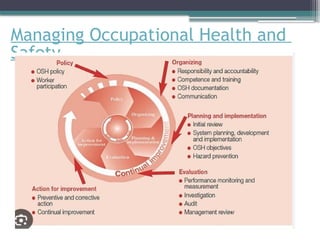
• In addition to putting in place a system, employers must
• ensure compliance with legislative requirements and current
industry standards
• • put strategies in place to maintain the systems
• • get the ‘buy-in’ of all employees on Occupational Health and
Safety(OHS)or Occupational Safety and Health and (OSH)issues
• • ensure the consistent monitoring and reviewing of the effectiveness
of the system
• • incorporate OSH policies and procedures into work processes
• • provide all employees with the essential information, instruction,
training and supervision
• • provide any necessary personal protective equipment/gear/devices
Categories of WorkPlace Hazards
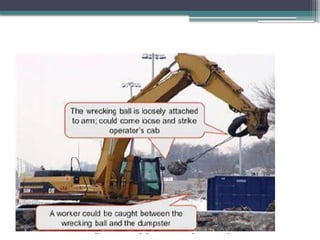
• Improper use of Machinery
• Failure to read and follow manufacturers’ safety and
operational guidelines and instructions, for example
- using machinery without appropriate personal protective
gear/devices
- moving machinery parts that are improperly secured can
get dislodged while certain machines are in operation.
Operators should therefore check to ensure that all
moving parts of machines/equipment are properly
tightened and secured to prevent them from posing a
hazard.
13.
• Chemicals-exposure toany chemical preparation in the
workplace in any form -solid, liquid or gas)
• Industrial gases
• Physical –for example, exposure to radiation: through use
of some machines/equipment, including photocopiers,
microwaves and radio waves, etc.; high exposure to
sunlight/ultraviolet rays; temperature extremes –hot and
cold; constant loud noise, etc.)
• Biological–for example, exposure to blood and other body
fluids, fungi/mould, bacteria and viruses, insect bites)
Categories of Work Place Hazards
14.
Categories of WorkPlace Hazards
• Electrical-including frayed cords and
overloading of electrical circuits
• Ergonomic-include improperly adjusted
workstations and chairs, frequent lifting/use of
• improper lifting techniques, poor posture,
awkward movements, vibrations)
• Spills, trips, fallsfrom ladders, scaffolds, roofs, or
any raised work area
15.
Other Work PlaceHazards
• The following are examples of other hazards that are
associated with the workplace:
• Workload demands
• Workplace violence
• Intensity and/or pace
• Respect (or lack thereof)
• Flexibility(or lack thereof)
• Lack of control over what is said/utterances made
• Social support or relations
• Sexual harassment
16.
Legislative/Regulatory Requirements
• OccupationalHealth and Safety(OHS)
legislations/Guidelines, including Environmental
Protection for sustainable development.
• Employer’s OHS responsibilities, including
providing relevant OHS information, OHS
training, appointing Workplace Safety & Health
Committee to manage implementation of
workplace OHS policies and procedures
• Risk Assessment & Management policies
Research Time – Can you Identify any of these
Actions in your Workplace
17.
Work Time –Look at the Following
Focus Info
• Employees’ OHS rights and responsibilities
• Safety Operating Procedures(SOP)
• Industry standards
• Safety (Warning) signs and symbols
• Monitoring of OHS –roles of managers/supervisors
in ensuring compliance through adoption of safe
work practices and a culture of safety at the
workplace.
18.
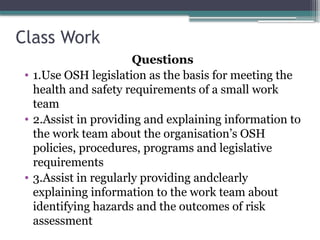
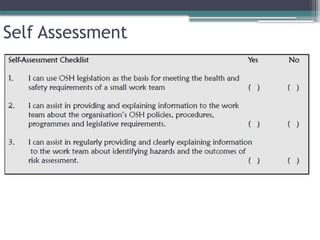
Class Work
Questions
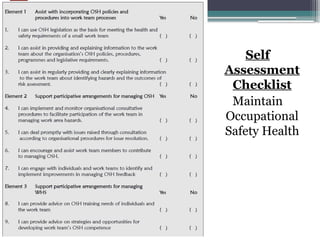
• 1.UseOSH legislation as the basis for meeting the
health and safety requirements of a small work
team
• 2.Assist in providing and explaining information to
the work team about the organisation’s OSH
policies, procedures, programs and legislative
requirements
• 3.Assist in regularly providing andclearly
explaining information to the work team about
identifying hazards and the outcomes of risk
assessment
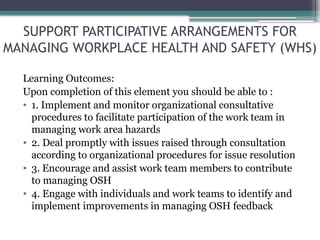
SUPPORT PARTICIPATIVE ARRANGEMENTSFOR
MANAGING WORKPLACE HEALTH AND SAFETY (WHS)
Learning Outcomes:
Upon completion of this element you should be able to :
• 1. Implement and monitor organizational consultative
procedures to facilitate participation of the work team in
managing work area hazards
• 2. Deal promptly with issues raised through consultation
according to organizational procedures for issue resolution
• 3. Encourage and assist work team members to contribute
to managing OSH
• 4. Engage with individuals and work teams to identify and
implement improvements in managing OSH feedback
22.
Implement and monitororganizational consultative procedures to
facilitate participation of the work team in managing work area
hazards
23.
1. Implementation ofOSH practices in
the workplace should be a
collaborative arrangement between
employers and employees.
2. Employers must ensure that
information is free flowing. Employees
should feel free to voice their opinions
without repercussions. This will
encourage a culture geared towards
problem solving and safety.
25.
Consultation
Consultation provides theopportunity for workers
at any level of the organization to:
• • Share information
• • Learn and provide solutions relating to hazards
in their workplace.
Consultation is a legal requirement that is
stipulated in Workplace Health and Safety Acts
and Regulations.
One important reason to ensure collaboration with
employees is that they are often the best persons
to identify workplace risks/hazards, since most
times these hazards are within their work area.
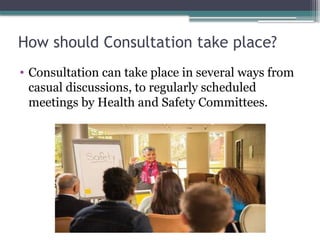
How should Consultationtake place?
• Consultation can take place in several ways from
casual discussions, to regularly scheduled
meetings by Health and Safety Committees.
Class Work
• Copyand label Safety Signs and Symbols that
indicate the following:
1) Directional Sign
2) Exit Signs
3) Admittance/Restrictive Area Sign
4) Slip and Fall
5) Alarm Signs
6) Warning Signs
30.
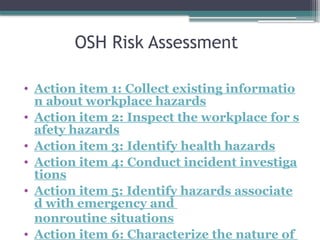
OSH Risk Assessment
•Action item 1: Collect existing informatio
n about workplace hazards
• Action item 2: Inspect the workplace for s
afety hazards
• Action item 3: Identify health hazards
• Action item 4: Conduct incident investiga
tions
• Action item 5: Identify hazards associate
d with emergency and
nonroutine situations
• Action item 6: Characterize the nature of
31.
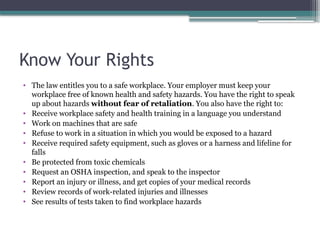
Know Your Rights
•The law entitles you to a safe workplace. Your employer must keep your
workplace free of known health and safety hazards. You have the right to speak
up about hazards without fear of retaliation. You also have the right to:
• Receive workplace safety and health training in a language you understand
• Work on machines that are safe
• Refuse to work in a situation in which you would be exposed to a hazard
• Receive required safety equipment, such as gloves or a harness and lifeline for
falls
• Be protected from toxic chemicals
• Request an OSHA inspection, and speak to the inspector
• Report an injury or illness, and get copies of your medical records
• Review records of work-related injuries and illnesses
• See results of tests taken to find workplace hazards
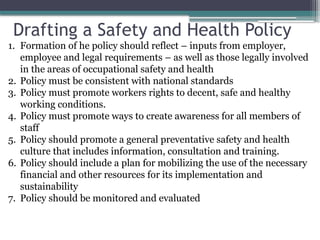
Drafting a Safetyand Health Policy
1. Formation of he policy should reflect – inputs from employer,
employee and legal requirements – as well as those legally involved
in the areas of occupational safety and health
2. Policy must be consistent with national standards
3. Policy must promote workers rights to decent, safe and healthy
working conditions.
4. Policy must promote ways to create awareness for all members of
staff
5. Policy should promote a general preventative safety and health
culture that includes information, consultation and training.
6. Policy should include a plan for mobilizing the use of the necessary
financial and other resources for its implementation and
sustainability
7. Policy should be monitored and evaluated
34.
Remember: Key Principals
•All workers have rights
• Occupational safety and health policies must be
established
• A national system for occupational safety and
health must be established
• Consultation must take place.
• Occupational safety and health programmes and
policies must aim at both prevention and
protection.
35.
Risk Assessment/Hazard Manageme
ntPolicy
Watch the following video and
answer the following:
How can you perform a risk assessment at your
workplace?
Draft an example of a hazard management policy. What
should you include?
36.
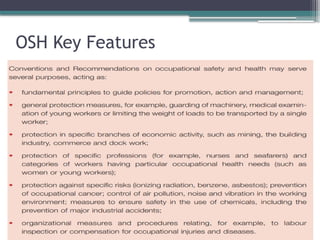
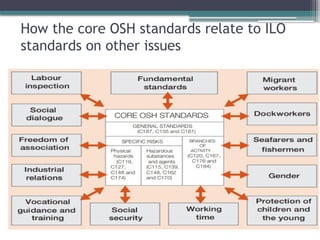
How the coreOSH standards relate to ILO
standards on other issues
37.
Class Work
• Discussbasic requirements of Occupational
Health and Safety (OH&S) legislations, industry
codes and national standards relevant to the
workplace.
• Relate Occupational Health and Safety
management to other organizational systems and
procedures.
• Outline ways to provide information on
organization’s OH&S policies, procedures
and programmes and making it readily
accessible to workgroup.