Lecture # 10
Employee Health & Safety
20CEM29H
Human Resource Management in Construction
2020/2021 Semester 1
Instructor:
Dr. Mohamed Ibrahim
Lecture’s Objectives
2
1. Introduce the importance of employee safety & health
3. Identify the factors influencing workplace health & safety
2. Define the workplace health & safety hazards
4. Define the key steps of designing an effective OHS management system
Introduction
3
 People are an organisation’s most valuable asset and so safeguarding
their health and safety should be central to an organisation’s HRM
strategy.
 In construction, threats to health and safety come from a lot of sources:
1. The physical nature of the tasks.
2. The attitudes of the workers.
3. The culture of the industry.
4. Time & cost pressure.
5. The uncertain production environment.
6. Client and management priorities
Employee Safety
4
 As a result, legislators across the world defined the responsibilities of both
the construction employer and employee towards safety:
1. Employer: employers are required to provide a place of employment free from
recognised hazards that are causing or are likely to cause death or serious harm
to employees, and to comply with occupational safety and health standards
issued under the law. Employers should also put in place systems to detect and
monitor health & safety risks.
2. Employees: Expected to comply with all occupational safety and health
standards, rules, regulations and orders issued under the law that apply to his or
her own actions and conduct on the job.
Workplace Health & Safety Hazards
5
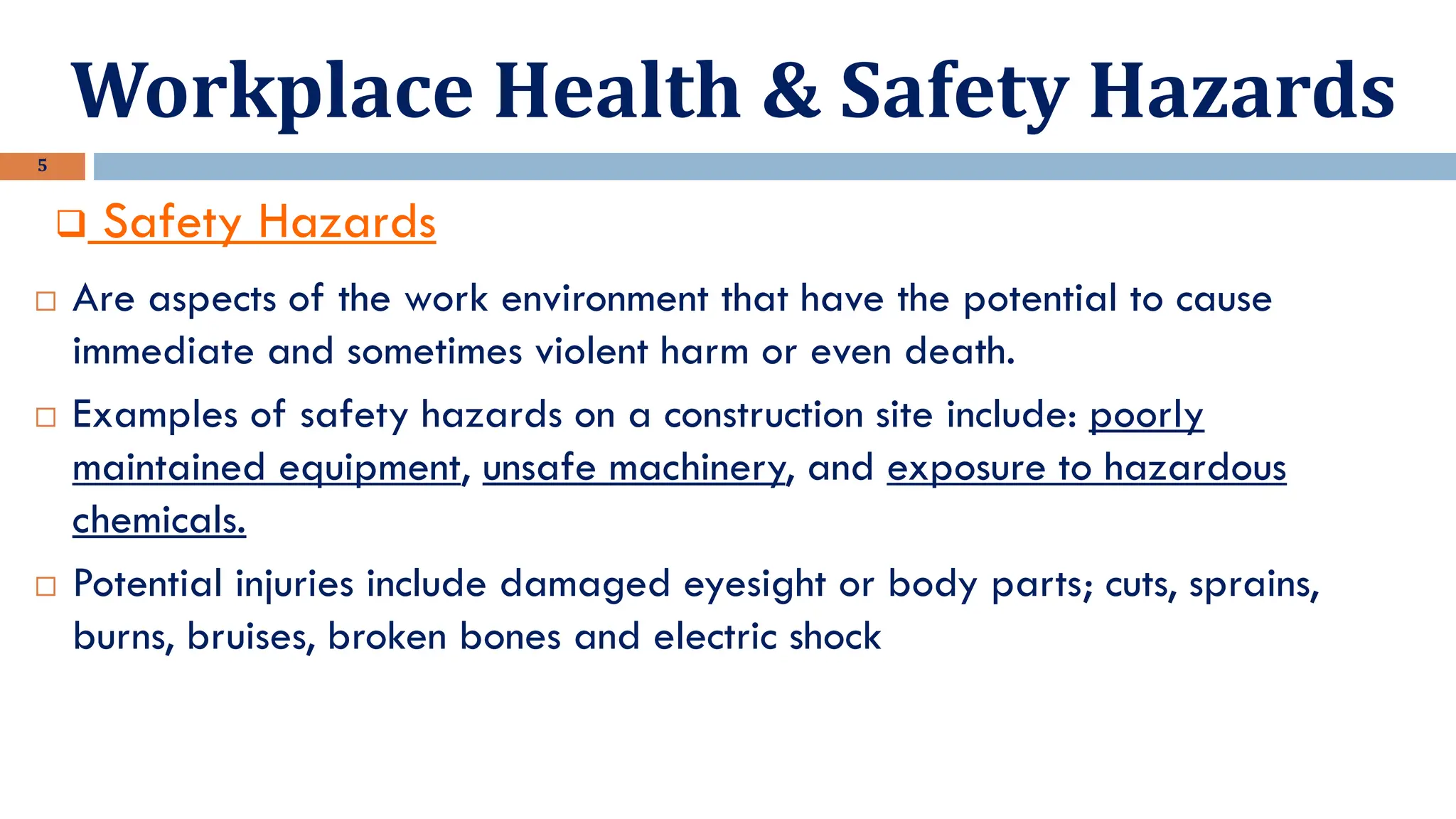
❑ Safety Hazards
 Are aspects of the work environment that have the potential to cause
immediate and sometimes violent harm or even death.
 Examples of safety hazards on a construction site include: poorly
maintained equipment, unsafe machinery, and exposure to hazardous
chemicals.
 Potential injuries include damaged eyesight or body parts; cuts, sprains,
burns, bruises, broken bones and electric shock
Workplace Health & Safety Hazards
6
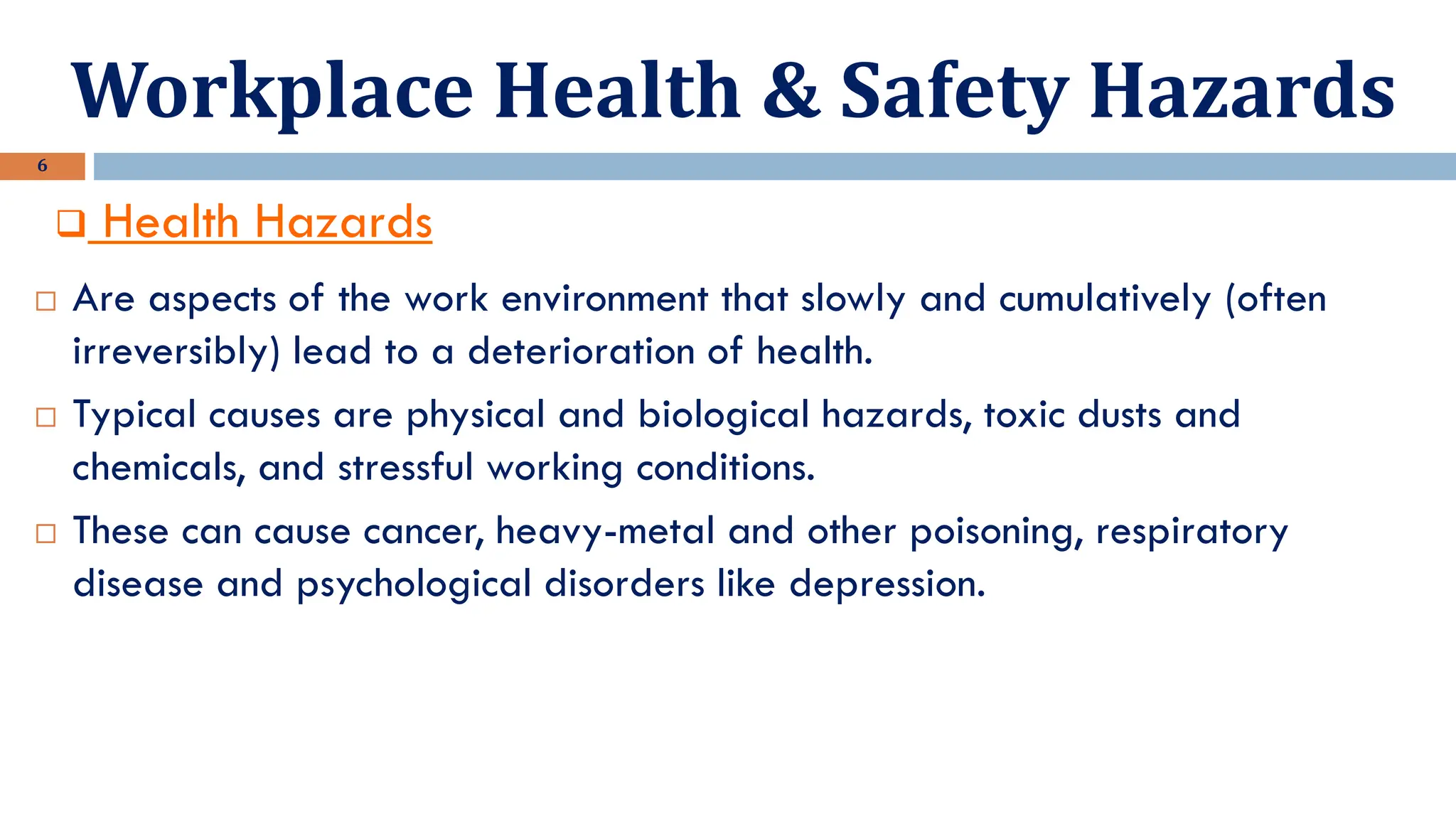
❑ Health Hazards
 Are aspects of the work environment that slowly and cumulatively (often
irreversibly) lead to a deterioration of health.
 Typical causes are physical and biological hazards, toxic dusts and
chemicals, and stressful working conditions.
 These can cause cancer, heavy-metal and other poisoning, respiratory
disease and psychological disorders like depression.
Workplace Health & Safety Hazards
7
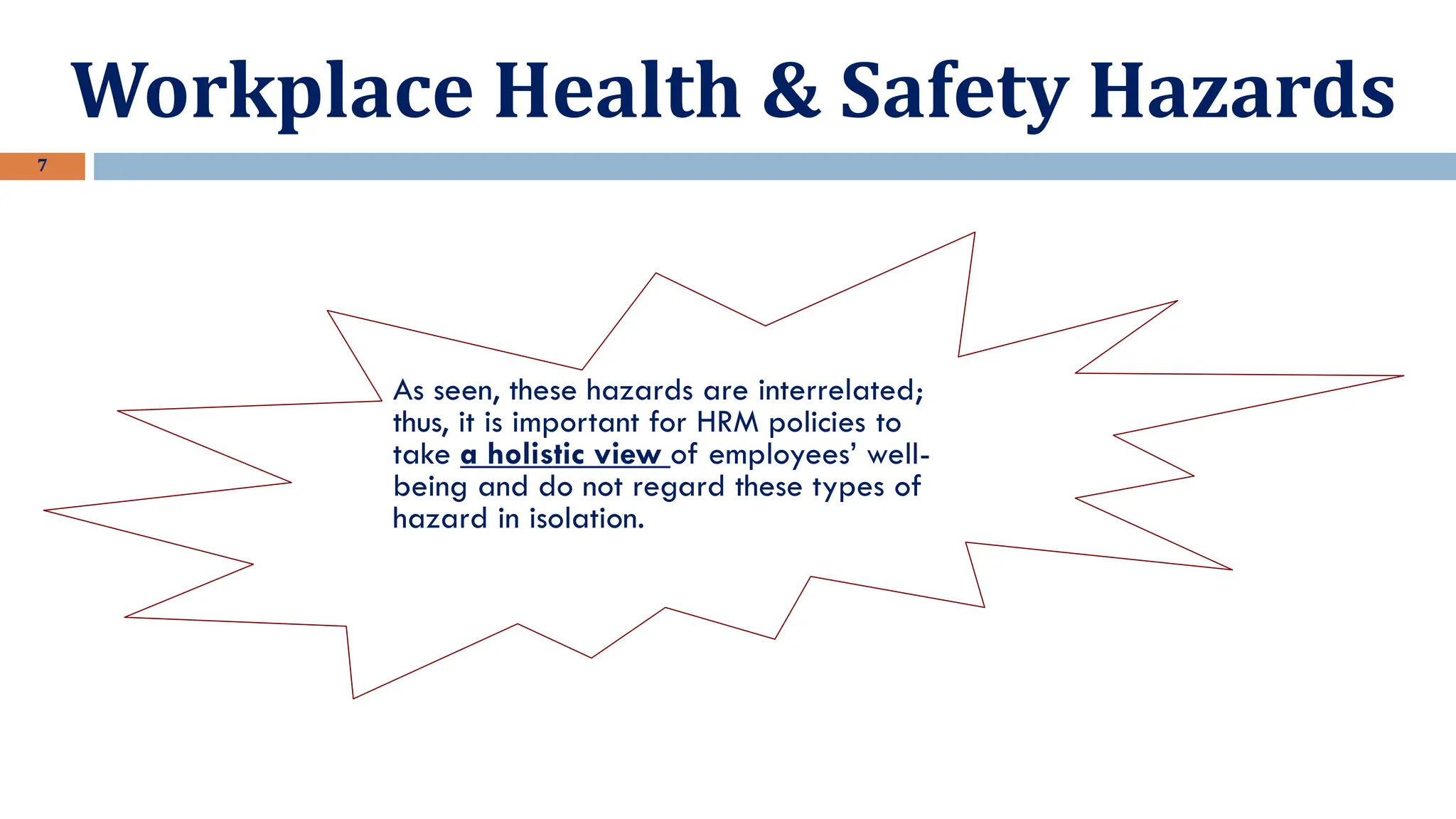
As seen, these hazards are interrelated;
thus, it is important for HRM policies to
take a holistic view of employees’ well-
being and do not regard these types of
hazard in isolation.
Factors Influencing Workplace Health & Safety
8
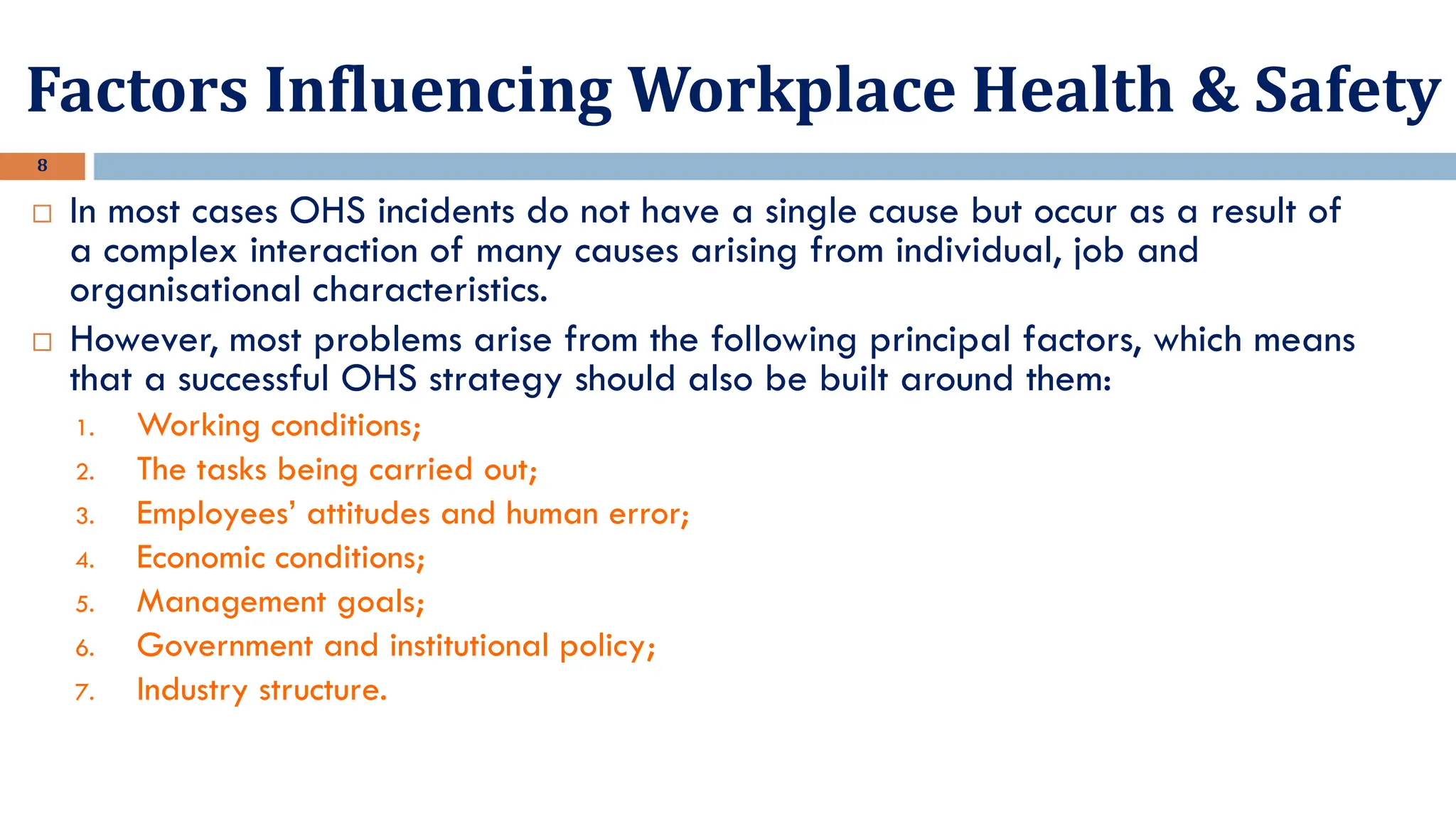
 In most cases OHS incidents do not have a single cause but occur as a result of
a complex interaction of many causes arising from individual, job and
organisational characteristics.
 However, most problems arise from the following principal factors, which means
that a successful OHS strategy should also be built around them:
1. Working conditions;
2. The tasks being carried out;
3. Employees’ attitudes and human error;
4. Economic conditions;
5. Management goals;
6. Government and institutional policy;
7. Industry structure.
9
 Working conditions include a congested, cluttered worksite, poorly designed,
inappropriately used or inadequately maintained machinery, a lack of personal
protective equipment (PPE), the presence of dangerous chemicals or gases and
inadequate welfare facilities.
1- Working Conditions
Factors Influencing Workplace Health & Safety
 The nature of the tasks influence the level of health & safety risks; for
example, tasks that require working at height.
2- The Tasks
10
 Employees’ attitudes toward health and safety can vary from enthusiasm for
safety programmes to apathy. Apathy is a major concern in the construction
industry at all levels because of its ‘macho culture’, poor training in OHS issues,
and priorities which primarily revolve around issues of cost, time and quality.
3- Employee Attitude
Factors Influencing Workplace Health & Safety
 Sometimes, hard economic conditions force a trade-offs between the costs
and the benefits of safety programmes.
4- Economic Conditions
11
 Some socially responsible organisations had active safety programmes long
before the law required them to do so and invest well beyond what is
economically rational.
 On the other hand, other organisations have not been so safety conscious and
have done little more than fulfil minimum legal requirements.
5- Management Goals
Factors Influencing Workplace Health & Safety
 The structure of the construction industry has an impact on OHS
performance.
 For example, the traditional separation of the design and build functions
has prevented the consideration of OHS in design decisionmaking, where
many safety risks are created.
6- Industry Structure
OHS Management Systems
12
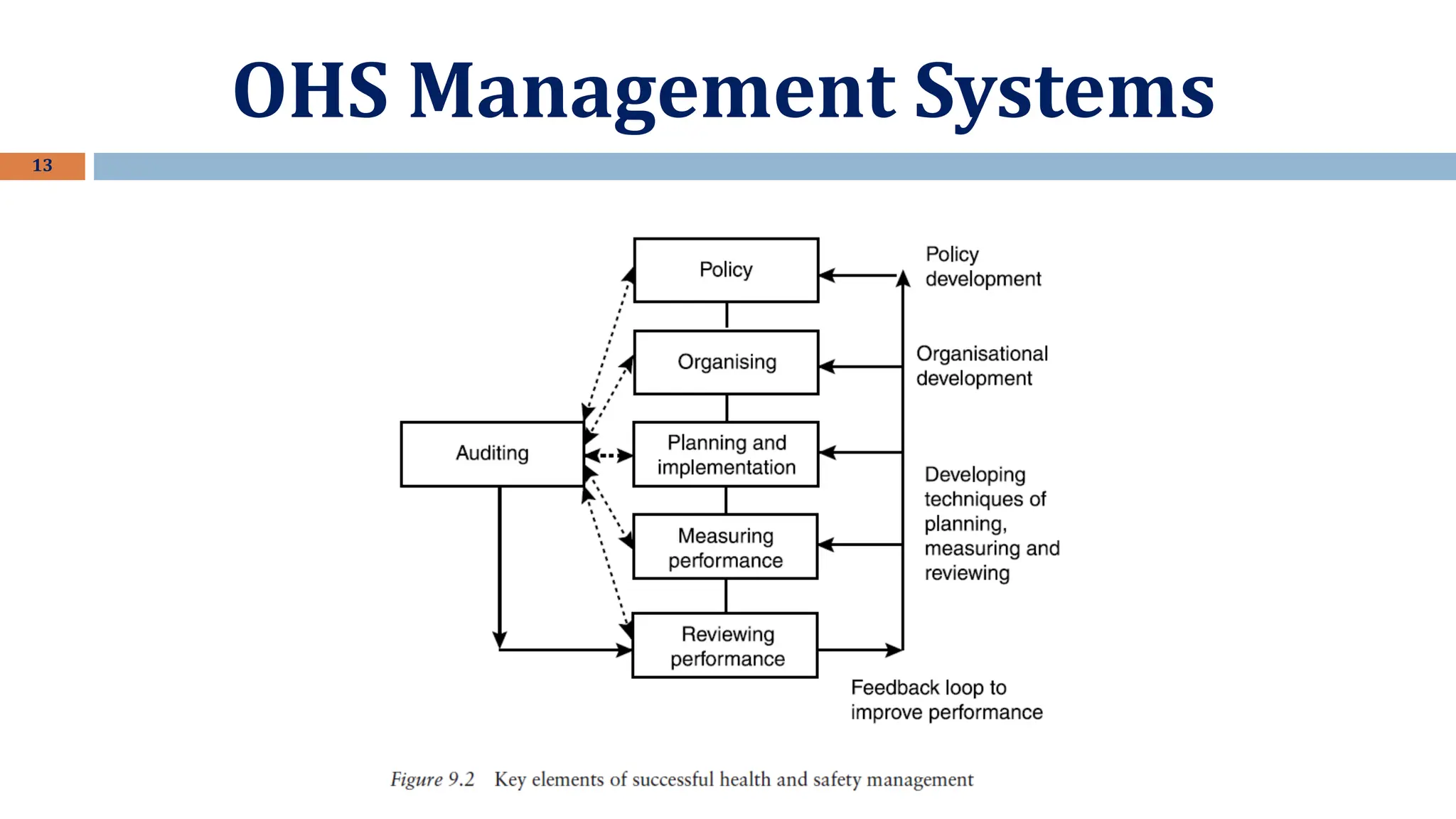
 The key to developing an effective OHS system is to recognize that
employees’ health and safety are an important aspect of corporate
strategy, which is linked to financial loss-control strategies, broader HRM
strategies, marketing strategies, information-management systems and
other operating policies.
OHS Management Systems
13
OHS Management Systems
14
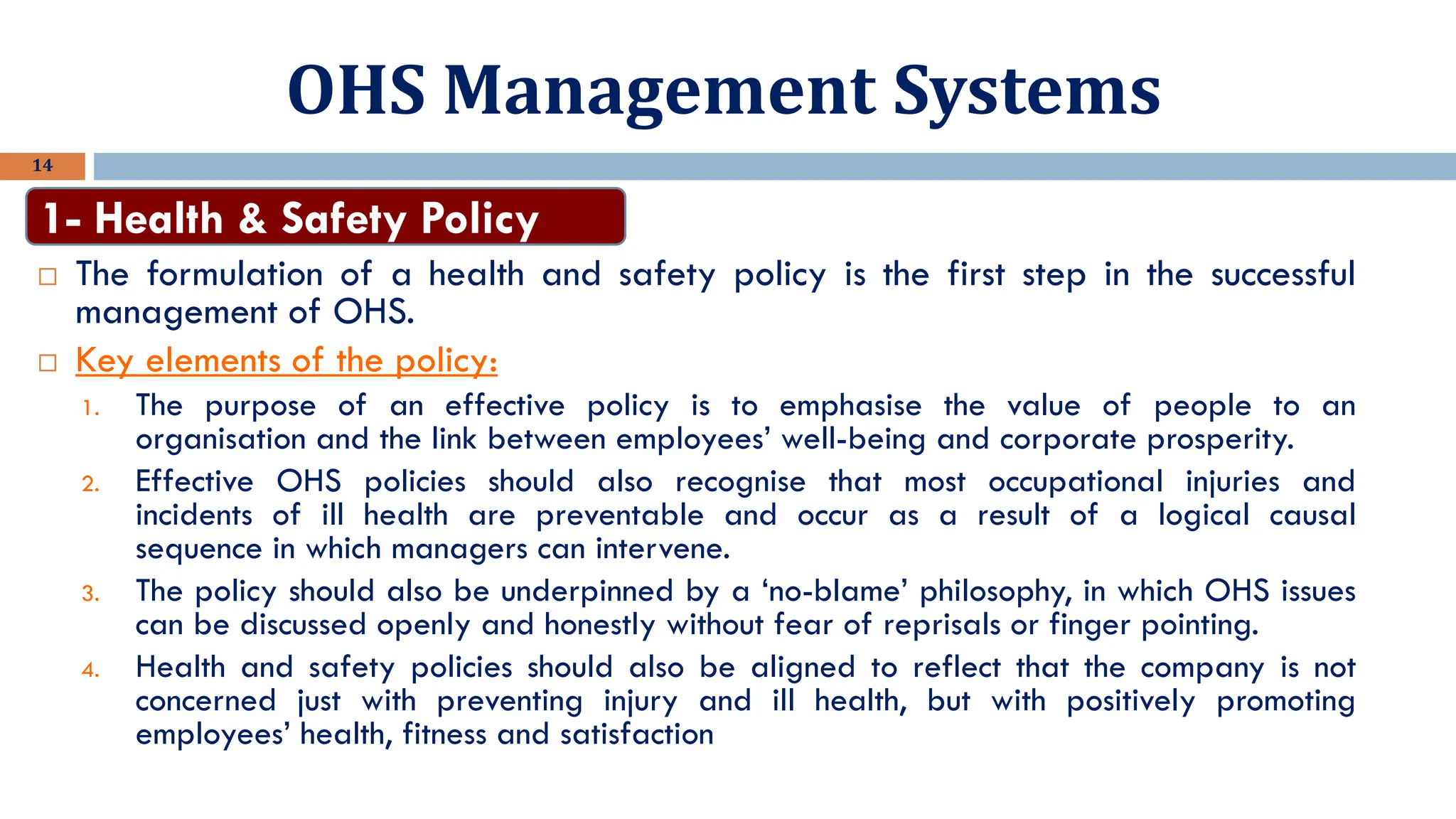
 The formulation of a health and safety policy is the first step in the successful
management of OHS.
 Key elements of the policy:
1. The purpose of an effective policy is to emphasise the value of people to an
organisation and the link between employees’ well-being and corporate prosperity.
2. Effective OHS policies should also recognise that most occupational injuries and
incidents of ill health are preventable and occur as a result of a logical causal
sequence in which managers can intervene.
3. The policy should also be underpinned by a ‘no-blame’ philosophy, in which OHS issues
can be discussed openly and honestly without fear of reprisals or finger pointing.
4. Health and safety policies should also be aligned to reflect that the company is not
concerned just with preventing injury and ill health, but with positively promoting
employees’ health, fitness and satisfaction
1- Health & Safety Policy
OHS Management Systems
15
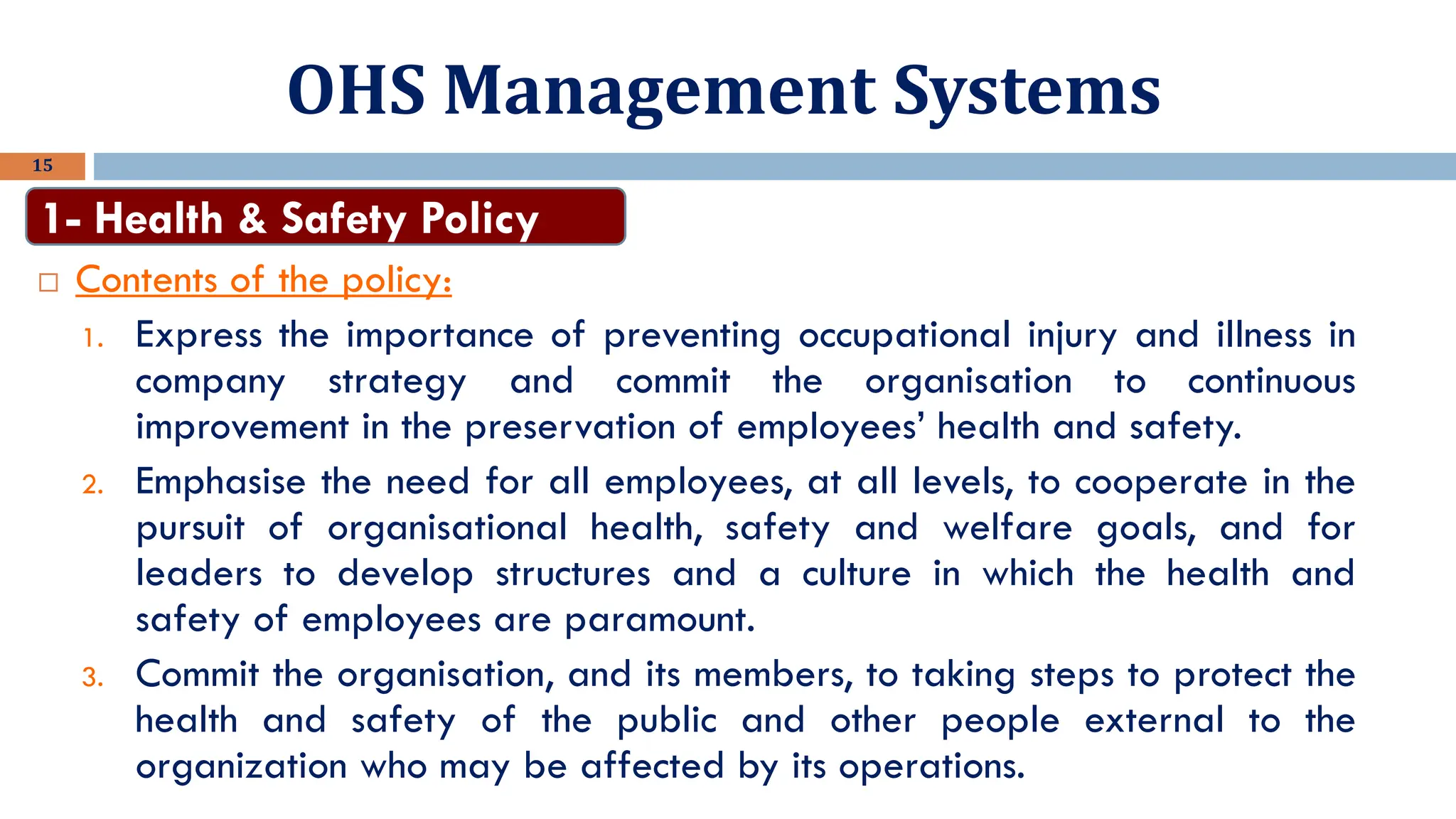
 Contents of the policy:
1. Express the importance of preventing occupational injury and illness in
company strategy and commit the organisation to continuous
improvement in the preservation of employees’ health and safety.
2. Emphasise the need for all employees, at all levels, to cooperate in the
pursuit of organisational health, safety and welfare goals, and for
leaders to develop structures and a culture in which the health and
safety of employees are paramount.
3. Commit the organisation, and its members, to taking steps to protect the
health and safety of the public and other people external to the
organization who may be affected by its operations.
1- Health & Safety Policy
OHS Management Systems
16
1- Health & Safety Policy
OHS Management Systems
17
 The next step is to develop a system to implement the policy
effectively.
 This involves establishing responsibilities and relationships within
the organisation that enable OHS performance to be managed
and controlled.
 Also involves establishing achievable targets and practical
measures to encourage project-based staff to meet the required
standards of performance.
2- Organising & Communicating
OHS Management Systems
18
 Useful mechanisms to communicate the policy effectively:
1. Site induction training: an explanation of the rules, policies and procedures to
be used on the project and a commitment to good practice on site
2. Written communications: Concise and to the point
3. Toolbox talks: focused time set aside for project and senior managers to discuss
health and safety issues with all employees and subcontractors.
4. Health and safety representatives: trade union representatives who make
inspections, report health and safety problems and risks.
5. Safety committees: these allow issues to be discussed by representatives of the
various groups working on the site
6. Training courses: to keep people up to date with OHS regulations and policies
2- Organising & Communicating
OHS Management Systems
19
 The next step is to start the process planning that involves hazard
identification, analysis and control.
 This process of managing OHS risk enables decision makers to
make more informed decisions about safe methods of work and
appropriate OHS control strategies, and to allocate scarce
resources more effectively.
3- Planning & Implementing
OHS Management Systems
20
 Monitoring and reviewing OHS performance is an essential part
of successful OHS management as it is the only way to determine
whether OHS plans are being implemented and policy objectives
achieved.
 This information should be fed back into the OHS management
system and amendments made where necessary
3- Monitoring & Reviewing
OHS Management Systems
21
 Audits are an invaluable tool for identifying problems before
accidents occur and should form a key component of every
company’s active monitoring activities.
 Health and safety auditing is similar to financial auditing in that it
aims to achieve a rigorous, independent evaluation of the validity,
effectiveness and implementation of a company’s OHS
management system.
4- Auditing
OHS Management Systems
22
 Audits can either adopt one of two approaches:
1. Vertical Slice: involves identifying one specific aspect of OHS activity
such as fire safety and evaluating the effectiveness of the company’s
policy, organisation, planning, implementation, monitoring and review
activities in this area.
2. Horizontal Slice: involves one function of the OHS management
system being evaluated, such as the relevance of OHS performance
measurement.
4- Auditing
Lecture 10 - Employee Health & Safety.pdf

Lecture 10 - Employee Health & Safety.pdf

  • 1.
    Lecture # 10 EmployeeHealth & Safety 20CEM29H Human Resource Management in Construction 2020/2021 Semester 1 Instructor: Dr. Mohamed Ibrahim
  • 2.
    Lecture’s Objectives 2 1. Introducethe importance of employee safety & health 3. Identify the factors influencing workplace health & safety 2. Define the workplace health & safety hazards 4. Define the key steps of designing an effective OHS management system
  • 3.
    Introduction 3  People arean organisation’s most valuable asset and so safeguarding their health and safety should be central to an organisation’s HRM strategy.  In construction, threats to health and safety come from a lot of sources: 1. The physical nature of the tasks. 2. The attitudes of the workers. 3. The culture of the industry. 4. Time & cost pressure. 5. The uncertain production environment. 6. Client and management priorities
  • 4.
    Employee Safety 4  Asa result, legislators across the world defined the responsibilities of both the construction employer and employee towards safety: 1. Employer: employers are required to provide a place of employment free from recognised hazards that are causing or are likely to cause death or serious harm to employees, and to comply with occupational safety and health standards issued under the law. Employers should also put in place systems to detect and monitor health & safety risks. 2. Employees: Expected to comply with all occupational safety and health standards, rules, regulations and orders issued under the law that apply to his or her own actions and conduct on the job.
  • 5.
    Workplace Health &Safety Hazards 5 ❑ Safety Hazards  Are aspects of the work environment that have the potential to cause immediate and sometimes violent harm or even death.  Examples of safety hazards on a construction site include: poorly maintained equipment, unsafe machinery, and exposure to hazardous chemicals.  Potential injuries include damaged eyesight or body parts; cuts, sprains, burns, bruises, broken bones and electric shock
  • 6.
    Workplace Health &Safety Hazards 6 ❑ Health Hazards  Are aspects of the work environment that slowly and cumulatively (often irreversibly) lead to a deterioration of health.  Typical causes are physical and biological hazards, toxic dusts and chemicals, and stressful working conditions.  These can cause cancer, heavy-metal and other poisoning, respiratory disease and psychological disorders like depression.
  • 7.
    Workplace Health &Safety Hazards 7 As seen, these hazards are interrelated; thus, it is important for HRM policies to take a holistic view of employees’ well- being and do not regard these types of hazard in isolation.
  • 8.
    Factors Influencing WorkplaceHealth & Safety 8  In most cases OHS incidents do not have a single cause but occur as a result of a complex interaction of many causes arising from individual, job and organisational characteristics.  However, most problems arise from the following principal factors, which means that a successful OHS strategy should also be built around them: 1. Working conditions; 2. The tasks being carried out; 3. Employees’ attitudes and human error; 4. Economic conditions; 5. Management goals; 6. Government and institutional policy; 7. Industry structure.
  • 9.
    9  Working conditionsinclude a congested, cluttered worksite, poorly designed, inappropriately used or inadequately maintained machinery, a lack of personal protective equipment (PPE), the presence of dangerous chemicals or gases and inadequate welfare facilities. 1- Working Conditions Factors Influencing Workplace Health & Safety  The nature of the tasks influence the level of health & safety risks; for example, tasks that require working at height. 2- The Tasks
  • 10.
    10  Employees’ attitudestoward health and safety can vary from enthusiasm for safety programmes to apathy. Apathy is a major concern in the construction industry at all levels because of its ‘macho culture’, poor training in OHS issues, and priorities which primarily revolve around issues of cost, time and quality. 3- Employee Attitude Factors Influencing Workplace Health & Safety  Sometimes, hard economic conditions force a trade-offs between the costs and the benefits of safety programmes. 4- Economic Conditions
  • 11.
    11  Some sociallyresponsible organisations had active safety programmes long before the law required them to do so and invest well beyond what is economically rational.  On the other hand, other organisations have not been so safety conscious and have done little more than fulfil minimum legal requirements. 5- Management Goals Factors Influencing Workplace Health & Safety  The structure of the construction industry has an impact on OHS performance.  For example, the traditional separation of the design and build functions has prevented the consideration of OHS in design decisionmaking, where many safety risks are created. 6- Industry Structure
  • 12.
    OHS Management Systems 12 The key to developing an effective OHS system is to recognize that employees’ health and safety are an important aspect of corporate strategy, which is linked to financial loss-control strategies, broader HRM strategies, marketing strategies, information-management systems and other operating policies.
  • 13.
  • 14.
    OHS Management Systems 14 The formulation of a health and safety policy is the first step in the successful management of OHS.  Key elements of the policy: 1. The purpose of an effective policy is to emphasise the value of people to an organisation and the link between employees’ well-being and corporate prosperity. 2. Effective OHS policies should also recognise that most occupational injuries and incidents of ill health are preventable and occur as a result of a logical causal sequence in which managers can intervene. 3. The policy should also be underpinned by a ‘no-blame’ philosophy, in which OHS issues can be discussed openly and honestly without fear of reprisals or finger pointing. 4. Health and safety policies should also be aligned to reflect that the company is not concerned just with preventing injury and ill health, but with positively promoting employees’ health, fitness and satisfaction 1- Health & Safety Policy
  • 15.
    OHS Management Systems 15 Contents of the policy: 1. Express the importance of preventing occupational injury and illness in company strategy and commit the organisation to continuous improvement in the preservation of employees’ health and safety. 2. Emphasise the need for all employees, at all levels, to cooperate in the pursuit of organisational health, safety and welfare goals, and for leaders to develop structures and a culture in which the health and safety of employees are paramount. 3. Commit the organisation, and its members, to taking steps to protect the health and safety of the public and other people external to the organization who may be affected by its operations. 1- Health & Safety Policy
  • 16.
    OHS Management Systems 16 1-Health & Safety Policy
  • 17.
    OHS Management Systems 17 The next step is to develop a system to implement the policy effectively.  This involves establishing responsibilities and relationships within the organisation that enable OHS performance to be managed and controlled.  Also involves establishing achievable targets and practical measures to encourage project-based staff to meet the required standards of performance. 2- Organising & Communicating
  • 18.
    OHS Management Systems 18 Useful mechanisms to communicate the policy effectively: 1. Site induction training: an explanation of the rules, policies and procedures to be used on the project and a commitment to good practice on site 2. Written communications: Concise and to the point 3. Toolbox talks: focused time set aside for project and senior managers to discuss health and safety issues with all employees and subcontractors. 4. Health and safety representatives: trade union representatives who make inspections, report health and safety problems and risks. 5. Safety committees: these allow issues to be discussed by representatives of the various groups working on the site 6. Training courses: to keep people up to date with OHS regulations and policies 2- Organising & Communicating
  • 19.
    OHS Management Systems 19 The next step is to start the process planning that involves hazard identification, analysis and control.  This process of managing OHS risk enables decision makers to make more informed decisions about safe methods of work and appropriate OHS control strategies, and to allocate scarce resources more effectively. 3- Planning & Implementing
  • 20.
    OHS Management Systems 20 Monitoring and reviewing OHS performance is an essential part of successful OHS management as it is the only way to determine whether OHS plans are being implemented and policy objectives achieved.  This information should be fed back into the OHS management system and amendments made where necessary 3- Monitoring & Reviewing
  • 21.
    OHS Management Systems 21 Audits are an invaluable tool for identifying problems before accidents occur and should form a key component of every company’s active monitoring activities.  Health and safety auditing is similar to financial auditing in that it aims to achieve a rigorous, independent evaluation of the validity, effectiveness and implementation of a company’s OHS management system. 4- Auditing
  • 22.
    OHS Management Systems 22 Audits can either adopt one of two approaches: 1. Vertical Slice: involves identifying one specific aspect of OHS activity such as fire safety and evaluating the effectiveness of the company’s policy, organisation, planning, implementation, monitoring and review activities in this area. 2. Horizontal Slice: involves one function of the OHS management system being evaluated, such as the relevance of OHS performance measurement. 4- Auditing