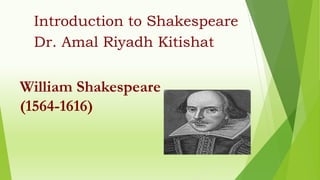
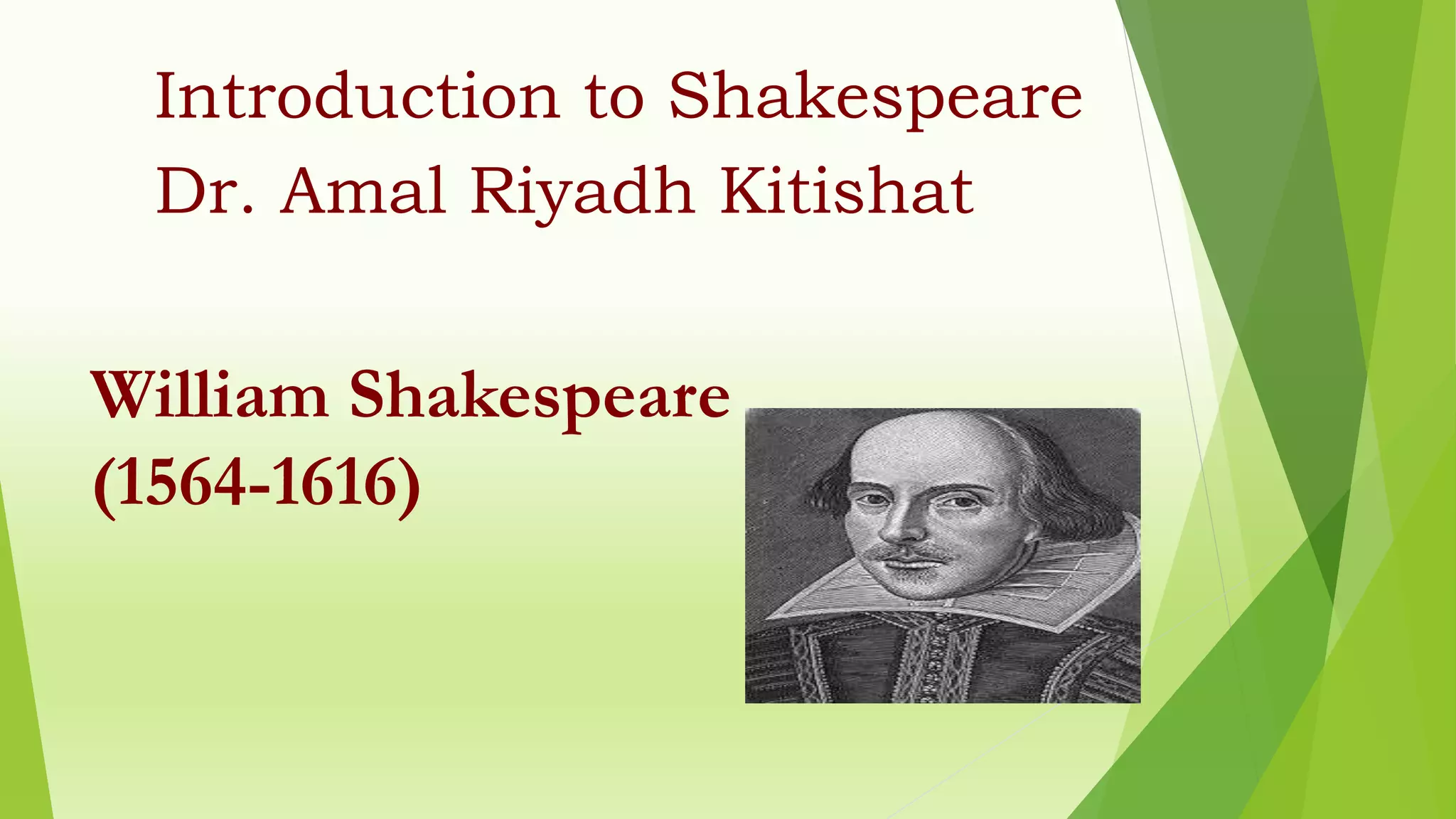
William Shakespeare
(1564-1616)
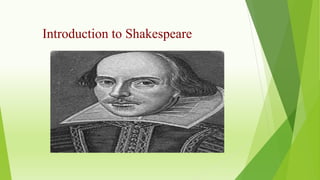
Introduction to Shakespeare
Dr. Amal Riyadh Kitishat
Introduction to Shakespeare
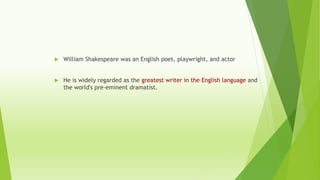
 William Shakespeare was an English poet, playwright, and actor
 He is widely regarded as the greatest writer in the English language and
the world's pre-eminent dramatist.
 Shakespeare was born and brought up in
Stratford-upon-Avon, Warwickshire
 Sometime between 1585 and 1592, he began a
successful career in London as an actor, writer,
and part-owner of a playing company called the
Lord Chamberlain's Men, later known as the
King's Men.
 His works include 38 plays,154 sonnets, and two long
narrative poems
 His early plays were primarily comedies and histories,
and these are regarded as some of the best work ever
produced in these genres.
He then wrote mainly tragedies
until about 1608, including
Hamlet, Othello, King Lear, and
Macbeth, which are considered
some of the finest works in the
English language.
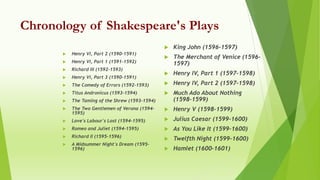
Chronology of Shakespeare's Plays
 Henry VI, Part 2 (1590–1591)
 Henry VI, Part 1 (1591–1592)
 Richard III (1592–1593)
 Henry VI, Part 3 (1590–1591)
 The Comedy of Errors (1592–1593)
 Titus Andronicus (1593–1594)
 The Taming of the Shrew (1593–1594)
 The Two Gentlemen of Verona (1594–
1595)
 Love's Labour's Lost (1594–1595)
 Romeo and Juliet (1594–1595)
 Richard II (1595–1596)
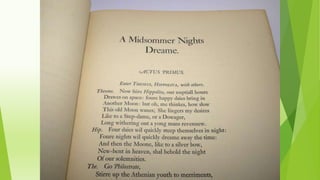
 A Midsummer Night's Dream (1595–
1596)
 King John (1596–1597)
 The Merchant of Venice (1596–
1597)
 Henry IV, Part 1 (1597–1598)
 Henry IV, Part 2 (1597–1598)
 Much Ado About Nothing
(1598–1599)
 Henry V (1598–1599)
 Julius Caesar (1599–1600)
 As You Like It (1599–1600)
 Twelfth Night (1599–1600)
 Hamlet (1600–1601)
Chronology of Shakespeare's Plays
 The Merry Wives of Windsor
(1600–1601)
 Troilus and Cressida (1601–1602)
 All's Well That Ends Well (1602–
1603)
 Measure for Measure (1604–1605)
 Othello (1604–1605)
 King Lear (1605–1606)
 Macbeth (1605–1606)
 Antony and Cleopatra (1606–
1607)
 Coriolanus (1607–1608)
 Timon of Athens (1607–1608)
 Pericles, Prince of Tyre (1608–
1609)
 Cymbeline (1609–1610)
 The Winter's Tale (1610–1611)
 The Tempest (1611–1612)
 Henry VIII (1612–1613)
 The Two Noble Kinsmen
(1612–1613)
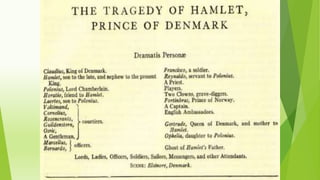
Shakespearean Tragedy
 Characters become isolated or there is social
breakdown
 Ends in death
 There is a sense that events are inevitable or
inescapable
 There is usually a central figure who is noble
but with a character flaw which leads him
towards his eventual downfall
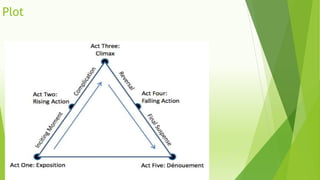
Plot
Levels of characterization
* Physical
* Social
* Psychological
* Moral
Physical
Basic facts as:
* Sex
* Age
* Size
* Coloration
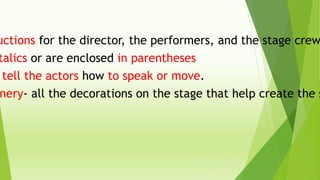
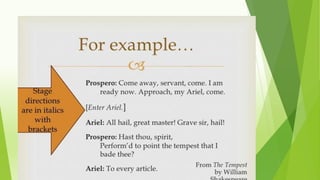
uctions for the director, the performers, and the stage crew.
talics or are enclosed in parentheses
tell the actors how to speak or move.
nery- all the decorations on the stage that help create the s
Forms of a Character’s Speech
 Dialogue: conversations of characters on stage
 Monologue: long speech given by one character to others
 Soliloquy: speech by a character alone onstage to himself or herself or to
the audience
 Asides: remarks made to the audience or to one character; the other
characters onstage do not hear an aside
Types of Shakespeare’s plays
Tragedies
Comedies
Tragicomedies
Histories
Romances
TRAGEDY
 Tragedy is a type of drama that shows the
downfall and destruction of a noble or
outstanding person, traditionally one who
possesses a character weakness called a tragic
flaw (discussed by Aristotle in The POETICS)
 Macbeth (ambition)
 Othello (jealousy)
 Hamlet (indecisiveness)
COMEDY
 Comedy is a type of drama intended to interest
and amuse the audience rather than make them
deeply concerned about events that happen.
 The characters overcome some difficulties, but
they always overcome their ill fortune and find
happiness in the end.
 A Midsummer’s Night Dream
 As You Like It
Shakespearean Comedies
 •A struggle of young lovers to overcome problems,
often the result of the interference of their elders
 •There is some element of separation and reunification
 •Mistaken identities, often involving disguise
 •A clever servant
 •Family tensions that are usually resolved at the end
 •Complex, interwoven plot-lines
 •Frequent use of puns and other styles of comedy
Tragicomedy
 Tragicomedy is a play that does not adhere
strictly to the structure of tragedy.
 This is usually serious play that also has some of
the qualities of comedy. It arouses thought even
with laughter.
 The Merchant of Venice
FARCE
 Farce is a play that brings laughter for the sake
of laughter, usually making use of grossly
embellished events and characters.
 It has very swift movements, has ridiculous
situations, and does not stimulate thought.
Shakespeare's Histories
 Shakespeare's Histories focus on English monarchs.
 They usually play upon Elizabethan propaganda, showing the dangers of
civil war and glorifying the queen's Tudor ancestors.
Pastoral
 The term pastoral refers to the life of the
shepherds or rural folk and their ways of living,
manners and customs.
 The word 'pastoral‘ came to be identified with
an ideal space representing innocence, peace,
philosophic contemplation
 Typically, a pastoral story involves exiles from
urban or court life who flee to the refuge of the
countryside, where they often disguise
themselves as shepherds in order to converse
with other shepherds on a range of established
topics, from the relative merits of life at court
versus life in the country to the relationship
between nature and art.
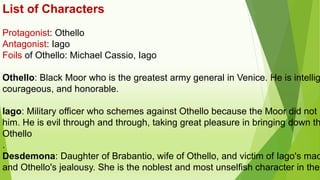
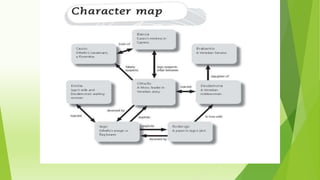
List of Characters
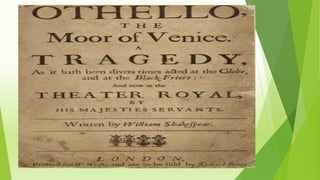
Protagonist: Othello
Antagonist: Iago
Foils of Othello: Michael Cassio, Iago
Othello: Black Moor who is the greatest army general in Venice. He is intellig
courageous, and honorable.
Iago: Military officer who schemes against Othello because the Moor did not p
him. He is evil through and through, taking great pleasure in bringing down th
Othello
.
Desdemona: Daughter of Brabantio, wife of Othello, and victim of Iago's mac
and Othello's jealousy. She is the noblest and most unselfish character in the
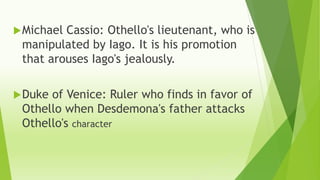
Michael Cassio: Othello's lieutenant, who is
manipulated by Iago. It is his promotion
that arouses Iago's jealously.
Duke of Venice: Ruler who finds in favor of
Othello when Desdemona's father attacks
Othello's character
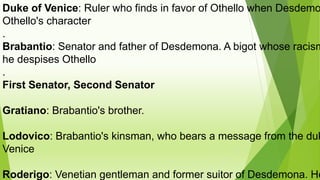
Duke of Venice: Ruler who finds in favor of Othello when Desdemo
Othello's character
.
Brabantio: Senator and father of Desdemona. A bigot whose racism
he despises Othello
.
First Senator, Second Senator
Gratiano: Brabantio's brother.
Lodovico: Brabantio's kinsman, who bears a message from the duk
Venice
Roderigo: Venetian gentleman and former suitor of Desdemona. He
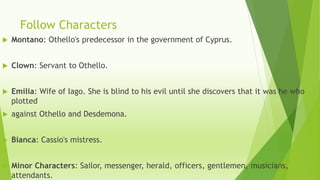
Follow Characters
 Montano: Othello's predecessor in the government of Cyprus.
 Clown: Servant to Othello.
 Emilia: Wife of Iago. She is blind to his evil until she discovers that it was he who
plotted
 against Othello and Desdemona.
 Bianca: Cassio's mistress.
 Minor Characters: Sailor, messenger, herald, officers, gentlemen, musicians,
attendants.
Shakespeare Introduction.ppt

Shakespeare Introduction.ppt

  • 1.
    William Shakespeare (1564-1616) Introduction toShakespeare Dr. Amal Riyadh Kitishat
  • 2.
  • 3.
     William Shakespearewas an English poet, playwright, and actor  He is widely regarded as the greatest writer in the English language and the world's pre-eminent dramatist.
  • 4.
     Shakespeare wasborn and brought up in Stratford-upon-Avon, Warwickshire  Sometime between 1585 and 1592, he began a successful career in London as an actor, writer, and part-owner of a playing company called the Lord Chamberlain's Men, later known as the King's Men.
  • 5.
     His worksinclude 38 plays,154 sonnets, and two long narrative poems  His early plays were primarily comedies and histories, and these are regarded as some of the best work ever produced in these genres.
  • 6.
    He then wrotemainly tragedies until about 1608, including Hamlet, Othello, King Lear, and Macbeth, which are considered some of the finest works in the English language.
  • 7.
    Chronology of Shakespeare'sPlays  Henry VI, Part 2 (1590–1591)  Henry VI, Part 1 (1591–1592)  Richard III (1592–1593)  Henry VI, Part 3 (1590–1591)  The Comedy of Errors (1592–1593)  Titus Andronicus (1593–1594)  The Taming of the Shrew (1593–1594)  The Two Gentlemen of Verona (1594– 1595)  Love's Labour's Lost (1594–1595)  Romeo and Juliet (1594–1595)  Richard II (1595–1596)  A Midsummer Night's Dream (1595– 1596)  King John (1596–1597)  The Merchant of Venice (1596– 1597)  Henry IV, Part 1 (1597–1598)  Henry IV, Part 2 (1597–1598)  Much Ado About Nothing (1598–1599)  Henry V (1598–1599)  Julius Caesar (1599–1600)  As You Like It (1599–1600)  Twelfth Night (1599–1600)  Hamlet (1600–1601)
  • 8.
    Chronology of Shakespeare'sPlays  The Merry Wives of Windsor (1600–1601)  Troilus and Cressida (1601–1602)  All's Well That Ends Well (1602– 1603)  Measure for Measure (1604–1605)  Othello (1604–1605)  King Lear (1605–1606)  Macbeth (1605–1606)  Antony and Cleopatra (1606– 1607)  Coriolanus (1607–1608)  Timon of Athens (1607–1608)  Pericles, Prince of Tyre (1608– 1609)  Cymbeline (1609–1610)  The Winter's Tale (1610–1611)  The Tempest (1611–1612)  Henry VIII (1612–1613)  The Two Noble Kinsmen (1612–1613)
  • 9.
    Shakespearean Tragedy  Charactersbecome isolated or there is social breakdown  Ends in death  There is a sense that events are inevitable or inescapable  There is usually a central figure who is noble but with a character flaw which leads him towards his eventual downfall
  • 10.
  • 13.
    Levels of characterization *Physical * Social * Psychological * Moral
  • 14.
    Physical Basic facts as: *Sex * Age * Size * Coloration
  • 15.
    uctions for thedirector, the performers, and the stage crew. talics or are enclosed in parentheses tell the actors how to speak or move. nery- all the decorations on the stage that help create the s
  • 17.
    Forms of aCharacter’s Speech  Dialogue: conversations of characters on stage  Monologue: long speech given by one character to others  Soliloquy: speech by a character alone onstage to himself or herself or to the audience  Asides: remarks made to the audience or to one character; the other characters onstage do not hear an aside
  • 19.
    Types of Shakespeare’splays Tragedies Comedies Tragicomedies Histories Romances
  • 20.
    TRAGEDY  Tragedy isa type of drama that shows the downfall and destruction of a noble or outstanding person, traditionally one who possesses a character weakness called a tragic flaw (discussed by Aristotle in The POETICS)  Macbeth (ambition)  Othello (jealousy)  Hamlet (indecisiveness)
  • 21.
    COMEDY  Comedy isa type of drama intended to interest and amuse the audience rather than make them deeply concerned about events that happen.  The characters overcome some difficulties, but they always overcome their ill fortune and find happiness in the end.  A Midsummer’s Night Dream  As You Like It
  • 22.
    Shakespearean Comedies  •Astruggle of young lovers to overcome problems, often the result of the interference of their elders  •There is some element of separation and reunification  •Mistaken identities, often involving disguise  •A clever servant  •Family tensions that are usually resolved at the end  •Complex, interwoven plot-lines  •Frequent use of puns and other styles of comedy
  • 23.
    Tragicomedy  Tragicomedy isa play that does not adhere strictly to the structure of tragedy.  This is usually serious play that also has some of the qualities of comedy. It arouses thought even with laughter.  The Merchant of Venice
  • 24.
    FARCE  Farce isa play that brings laughter for the sake of laughter, usually making use of grossly embellished events and characters.  It has very swift movements, has ridiculous situations, and does not stimulate thought.
  • 25.
    Shakespeare's Histories  Shakespeare'sHistories focus on English monarchs.  They usually play upon Elizabethan propaganda, showing the dangers of civil war and glorifying the queen's Tudor ancestors.
  • 26.
    Pastoral  The termpastoral refers to the life of the shepherds or rural folk and their ways of living, manners and customs.  The word 'pastoral‘ came to be identified with an ideal space representing innocence, peace, philosophic contemplation
  • 27.
     Typically, apastoral story involves exiles from urban or court life who flee to the refuge of the countryside, where they often disguise themselves as shepherds in order to converse with other shepherds on a range of established topics, from the relative merits of life at court versus life in the country to the relationship between nature and art.
  • 29.
    List of Characters Protagonist:Othello Antagonist: Iago Foils of Othello: Michael Cassio, Iago Othello: Black Moor who is the greatest army general in Venice. He is intellig courageous, and honorable. Iago: Military officer who schemes against Othello because the Moor did not p him. He is evil through and through, taking great pleasure in bringing down th Othello . Desdemona: Daughter of Brabantio, wife of Othello, and victim of Iago's mac and Othello's jealousy. She is the noblest and most unselfish character in the
  • 30.
    Michael Cassio: Othello'slieutenant, who is manipulated by Iago. It is his promotion that arouses Iago's jealously. Duke of Venice: Ruler who finds in favor of Othello when Desdemona's father attacks Othello's character
  • 31.
    Duke of Venice:Ruler who finds in favor of Othello when Desdemo Othello's character . Brabantio: Senator and father of Desdemona. A bigot whose racism he despises Othello . First Senator, Second Senator Gratiano: Brabantio's brother. Lodovico: Brabantio's kinsman, who bears a message from the duk Venice Roderigo: Venetian gentleman and former suitor of Desdemona. He
  • 32.
    Follow Characters  Montano:Othello's predecessor in the government of Cyprus.  Clown: Servant to Othello.  Emilia: Wife of Iago. She is blind to his evil until she discovers that it was he who plotted  against Othello and Desdemona.  Bianca: Cassio's mistress.  Minor Characters: Sailor, messenger, herald, officers, gentlemen, musicians, attendants.