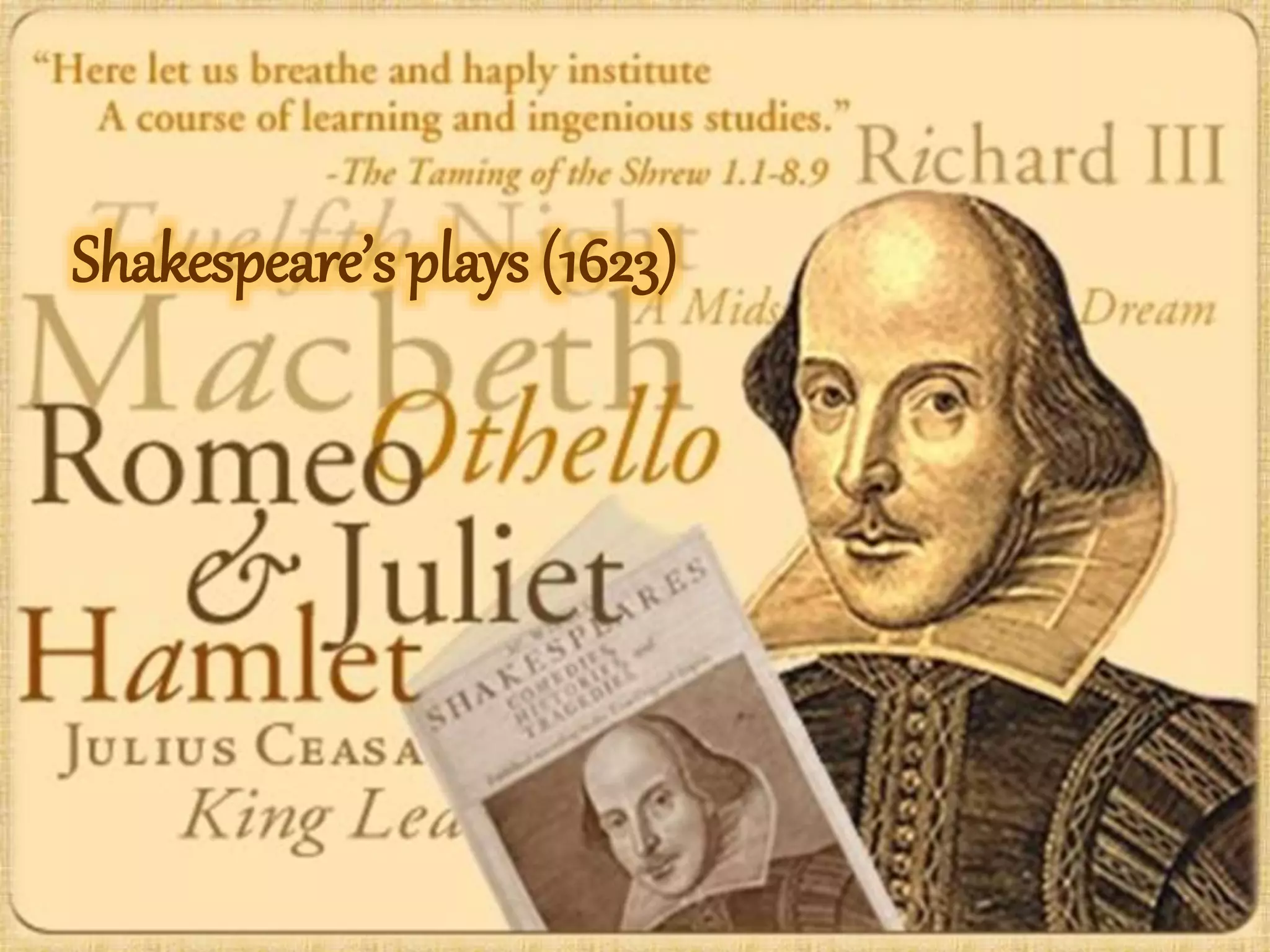
Shakespeare’splays (1623)
THE FIRST FOLIO
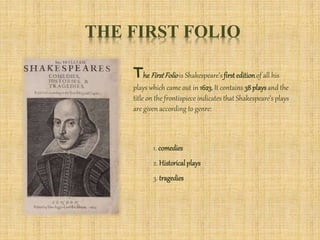
TheFirstFoliois Shakespeare’sfirsteditionof all his
plays which came out in 1623. It contains 38 playsand the
title on the frontispiece indicates that Shakespeare’s plays
are given according to genre:
1. comedies
2. Historicalplays
3. tragedies
THE DRAMA WORKS
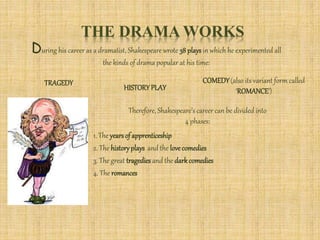
During his career as a dramatist, Shakespeare wrote 38 playsin which he experimented all
the kinds of drama popular at his time:
TRAGEDY
HISTORYPLAY
COMEDY(also its variant form called
‘ROMANCE’)
Therefore, Shakespeare’s career can be divided into
4 phases:
1. The yearsof apprenticeship
2. The historyplays and the lovecomedies
3. The great tragediesand the darkcomedies
4. The romances
THE YEARS OF APPRENTICESHIP
In his first phase of apprenticeship, by the mid 1590s, Shakespeare experimented:
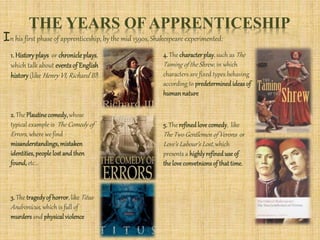
1. History plays or chronicleplays,
which talk about eventsof English
history(like Henry VI, Richard III)
2. The Plautine comedy,whose
typical example is The Comedy of
Errors, where we find
misanderstandings,mistaken
identities,people lost and then
found, etc...
3. The tragedyof horror, like Titus
Andronicus, which is full of
murdersand physical violence
4. The character play, such as The
Taming of the Shrew, in which
characters are fixed types behaving
according to predetermined ideas of
humannature
5. The refined love comedy, like
The Two Gentlemen of Verona or
Love’s Labour’s Lost, which
presents a highlyrefineduse of
the love convetnions of that time.
THE HISTORY PLAYS AND THE LOVE
COMEDIES
During the second phase of his career, Shakespeare became the most important
playwright and wrote:
HISTORY PLAYS LOVE COMEDIES
- joined together a recent and crucialperiod of English
history(like in Richard II, Henry IV and Henry V)
which espress the struggle for power, love and property and
represent the history of a whole nation.
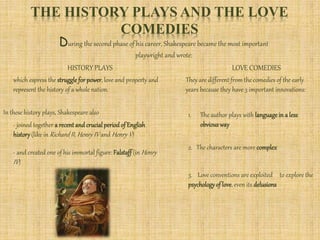
In these history plays, Shakespeare also
- and created one of his immortal figure: Falstaff (in Henry
IV)
They are different from the comedies of the early
years because they have 3 important innovations:
1. The author plays with language in a less
obvious way
2. The characters are more complex
3. Love conventions are exploited to explore the
psychologyof love, even its delusions
THE GREAT TRAGEDIES AND THE DARK
COMEDIES
At the beginning of the XVII century, Shakespeare wrote:
TRAGEDIES COMEDIES
which show Shakespeare’sgrowingdisillusion
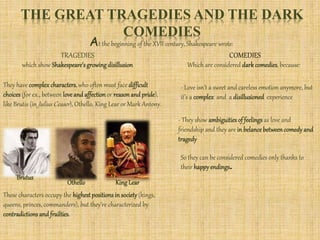
They have complex characters, who often must face difficult
choices(for ex., between love and affection or reason and pride),
like Brutis (in Julius Ceaser), Othello, King Lear or Mark Antony.
These characters occupy the highestpositionsin society (kings,
queens, princes, commanders), but they’re characterized by
contradictions and frailties.
Brutus
Othello KingLear
Which are considered dark comedies, because:
- Love isn’t a sweet and careless emotion anymore, but
it’s a complex and a disillusioned experience
- They show ambiguitiesof feelings as love and
friendship and they are in belance betweencomedyand
tragedy
So they can be considered comedies only thanks to
their happyendings.
THE ROMANCES
In his last phase, Shakespearemainly wrote romanticcomedies, in which he
reconciled with human nature
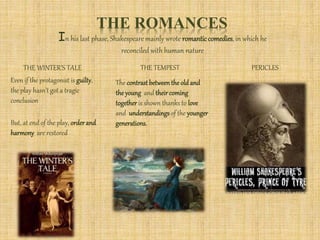
THE WINTER’S TALE THE TEMPEST PERICLES
Even if the protagonist is guilty,
the play hasn’t got a tragic
conclusion
But, at end of the play, orderand
harmony are restored
The contrast betweenthe old and
the young and theircoming
together is shown thanks to love
and understandings of the younger
generations.
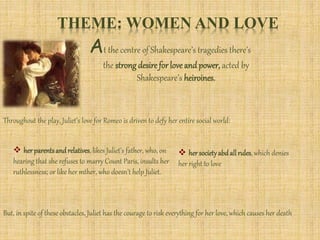
THEME: WOMEN AND LOVE
At the centre of Shakespeare’s tragedies there’s
the strong desire for love and power, acted by
Shakespeare’s heiroines.
Throughout the play, Juliet’s love for Romeo is driven to defy her entire social world:
 herparentsandrelatives, likes Juliet’s father, who, on
hearing that she refuses to marry Count Paris, insults her
ruthlessness; or like her mther, who doesn’t help Juliet.
 hersocietyabdallrules, which denies
her right to love
But, in spite of these obstacles, Juliet has the courage to risk everything for her love, which causes her death
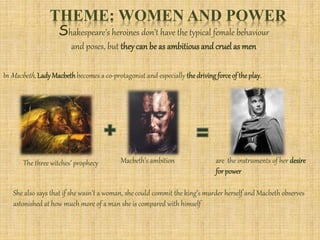
THEME: WOMEN AND POWER
Shakespeare’s heroines don’t have the typical female behaviour
and poses, but theycan be as ambitious and cruelas men
In Macbeth, LadyMacbethbecomes a co-protagonist and especially thedrivingforceof theplay.
The three witches’ prophecy Macbeth’s ambition are the instruments of her desire
forpower
She also says that if she wasn’t a woman, she could commit the king’s murder herself and Macbeth observes
astonished at how much more of a man she is compared with himself
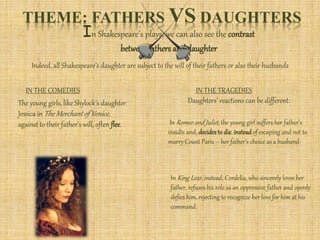
THEME: FATHERS VS DAUGHTERS
In Shakespeare’s plays, we can also see the contrast
between fathers and daughter
Indeed, all Shakespeare’s daughter are subject to the will of their fathers or also their husbands
IN THE COMEDIES IN THE TRAGEDIES
The young girls, like Shylock’s daughter
Jessica in The Merchant of Venice,
against to their father’s will, often flee.
Daughters’ reactions can be different:
In Romeo and Juliet, the young girl suffers her father’s
insults and, decides to die.insteadof escaping and not to
marry Count Paris – her father’s choice as a husband-
In King Lear, instead, Cordelia, who sincerely loves her
father, refuses his role as an oppressive father and openly
defies him, rejecting to recognize her love for him at his
command.
THEME: RHETORIC AND POWER
Shakespeare’s heroes use rhetoric,both
in their actions and speeches, becuase is the
key...
to love,riches,power,happinessand goodness!
In all of Shakespeare’s plays, in fact, we find that rhetoric is:
- helpful in love and politics, like in Richard III, where the protagonist uses
rhetoric to take the throne of England, or in Romeo and Juliet, where Romeo
rhetorically wooes her.
- A great instrumentfor evil , like in Macbeth, where Lady Macbeth pushes her
husband to commit the king’s murder, becuase she wants to become queen, or in
Othello, where Iago says Othello that Desdemona is unfaithful to him
- A way to underlinecharacter’spsychology,weakpointsand obsessions, is
expressedin particular in monologues, like Hamlet’s soliloquy, where he
contemplates his fear of acting.
THEME: THE WORLD AS A STAGE
In his comedies and tragedies , Shakespeare offers brilliant plots and characters and also a profound
reflection on a modern and universal theme:
<<Lifeisaplayandtheworldisitsstage>>
This metaphor was common in Reinaissance culture and it became a part of Shakespeare’s plot and
characters’ psychology.
In The Merchant of Venice, for istance, Antonio
describes the world as << a stagewhereeveryman
mustplaya part>>
In Macbeth’s speech after his wife’s death, the metaphor,
instead, becomes the instrument of Macbeth’s absolute
pessimism: << a poor playerwhois givennomorethanan hour
uponthestageand thenis heardnomore>>.
The metaphor was also reinforced by:
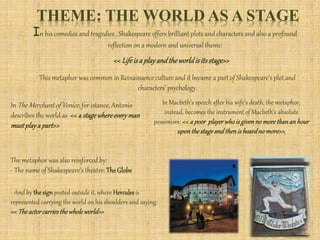
- The name of Shakespeare’s theatre: The Globe
- And by the signposted outside it, where Herculesis
represented carrying the world on his shoulders and saying:
<< Theactorcarriesthewholeworld>>
SHAKESPEARE’S UNIVERSALITY
Shakespeare’s fame consist in his universality. In fact, he united the Renaissance with the classical timesand
the modernworld.
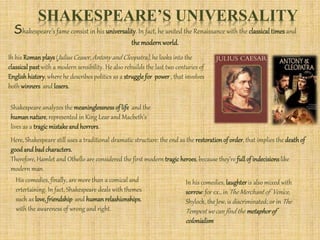
Ih his Roman plays (Julius Ceaser, Antony and Cleopatra), he looks into the
classical pastwith a modern sensibility. He also rebuilds the last two centuries of
English history, where he describes politics as a struggle for power , that involves
both winners and losers.
Shakespeare analyzes the meaninglessness of life and the
humannature, represented in King Lear and Macbeth’s
lives as a tragicmistake and horrors.
Here, Shakespeare still uses a traditional dramatic structure: the end as the restoration of order, that implies the deathof
good and badcharacters.
Therefore, Hamlet and Othello are considered the first modern tragicheroes, because they’re fullof indecisions like
modern man.
His comedies, finally, are more than a comical and
ertertaining. In fact, Shakespeare deals with themes
such as love, friendship and human relashionships,
with the awareness of wrong and right.
In his comedies, laughter is also mixed with
sorrow: for ex., in The Merchant of Venice,
Shylock, the Jew, is discriminated; or in The
Tempest we can find the metaphorof
colonialism

SHAKESPEARE'S PLAYS AND THEMES

  • 1.
  • 2.
    THE FIRST FOLIO TheFirstFolioisShakespeare’sfirsteditionof all his plays which came out in 1623. It contains 38 playsand the title on the frontispiece indicates that Shakespeare’s plays are given according to genre: 1. comedies 2. Historicalplays 3. tragedies
  • 3.
    THE DRAMA WORKS Duringhis career as a dramatist, Shakespeare wrote 38 playsin which he experimented all the kinds of drama popular at his time: TRAGEDY HISTORYPLAY COMEDY(also its variant form called ‘ROMANCE’) Therefore, Shakespeare’s career can be divided into 4 phases: 1. The yearsof apprenticeship 2. The historyplays and the lovecomedies 3. The great tragediesand the darkcomedies 4. The romances
  • 4.
    THE YEARS OFAPPRENTICESHIP In his first phase of apprenticeship, by the mid 1590s, Shakespeare experimented: 1. History plays or chronicleplays, which talk about eventsof English history(like Henry VI, Richard III) 2. The Plautine comedy,whose typical example is The Comedy of Errors, where we find misanderstandings,mistaken identities,people lost and then found, etc... 3. The tragedyof horror, like Titus Andronicus, which is full of murdersand physical violence 4. The character play, such as The Taming of the Shrew, in which characters are fixed types behaving according to predetermined ideas of humannature 5. The refined love comedy, like The Two Gentlemen of Verona or Love’s Labour’s Lost, which presents a highlyrefineduse of the love convetnions of that time.
  • 5.
    THE HISTORY PLAYSAND THE LOVE COMEDIES During the second phase of his career, Shakespeare became the most important playwright and wrote: HISTORY PLAYS LOVE COMEDIES - joined together a recent and crucialperiod of English history(like in Richard II, Henry IV and Henry V) which espress the struggle for power, love and property and represent the history of a whole nation. In these history plays, Shakespeare also - and created one of his immortal figure: Falstaff (in Henry IV) They are different from the comedies of the early years because they have 3 important innovations: 1. The author plays with language in a less obvious way 2. The characters are more complex 3. Love conventions are exploited to explore the psychologyof love, even its delusions
  • 6.
    THE GREAT TRAGEDIESAND THE DARK COMEDIES At the beginning of the XVII century, Shakespeare wrote: TRAGEDIES COMEDIES which show Shakespeare’sgrowingdisillusion They have complex characters, who often must face difficult choices(for ex., between love and affection or reason and pride), like Brutis (in Julius Ceaser), Othello, King Lear or Mark Antony. These characters occupy the highestpositionsin society (kings, queens, princes, commanders), but they’re characterized by contradictions and frailties. Brutus Othello KingLear Which are considered dark comedies, because: - Love isn’t a sweet and careless emotion anymore, but it’s a complex and a disillusioned experience - They show ambiguitiesof feelings as love and friendship and they are in belance betweencomedyand tragedy So they can be considered comedies only thanks to their happyendings.
  • 7.
    THE ROMANCES In hislast phase, Shakespearemainly wrote romanticcomedies, in which he reconciled with human nature THE WINTER’S TALE THE TEMPEST PERICLES Even if the protagonist is guilty, the play hasn’t got a tragic conclusion But, at end of the play, orderand harmony are restored The contrast betweenthe old and the young and theircoming together is shown thanks to love and understandings of the younger generations.
  • 8.
    THEME: WOMEN ANDLOVE At the centre of Shakespeare’s tragedies there’s the strong desire for love and power, acted by Shakespeare’s heiroines. Throughout the play, Juliet’s love for Romeo is driven to defy her entire social world:  herparentsandrelatives, likes Juliet’s father, who, on hearing that she refuses to marry Count Paris, insults her ruthlessness; or like her mther, who doesn’t help Juliet.  hersocietyabdallrules, which denies her right to love But, in spite of these obstacles, Juliet has the courage to risk everything for her love, which causes her death
  • 9.
    THEME: WOMEN ANDPOWER Shakespeare’s heroines don’t have the typical female behaviour and poses, but theycan be as ambitious and cruelas men In Macbeth, LadyMacbethbecomes a co-protagonist and especially thedrivingforceof theplay. The three witches’ prophecy Macbeth’s ambition are the instruments of her desire forpower She also says that if she wasn’t a woman, she could commit the king’s murder herself and Macbeth observes astonished at how much more of a man she is compared with himself
  • 10.
    THEME: FATHERS VSDAUGHTERS In Shakespeare’s plays, we can also see the contrast between fathers and daughter Indeed, all Shakespeare’s daughter are subject to the will of their fathers or also their husbands IN THE COMEDIES IN THE TRAGEDIES The young girls, like Shylock’s daughter Jessica in The Merchant of Venice, against to their father’s will, often flee. Daughters’ reactions can be different: In Romeo and Juliet, the young girl suffers her father’s insults and, decides to die.insteadof escaping and not to marry Count Paris – her father’s choice as a husband- In King Lear, instead, Cordelia, who sincerely loves her father, refuses his role as an oppressive father and openly defies him, rejecting to recognize her love for him at his command.
  • 11.
    THEME: RHETORIC ANDPOWER Shakespeare’s heroes use rhetoric,both in their actions and speeches, becuase is the key... to love,riches,power,happinessand goodness! In all of Shakespeare’s plays, in fact, we find that rhetoric is: - helpful in love and politics, like in Richard III, where the protagonist uses rhetoric to take the throne of England, or in Romeo and Juliet, where Romeo rhetorically wooes her. - A great instrumentfor evil , like in Macbeth, where Lady Macbeth pushes her husband to commit the king’s murder, becuase she wants to become queen, or in Othello, where Iago says Othello that Desdemona is unfaithful to him - A way to underlinecharacter’spsychology,weakpointsand obsessions, is expressedin particular in monologues, like Hamlet’s soliloquy, where he contemplates his fear of acting.
  • 12.
    THEME: THE WORLDAS A STAGE In his comedies and tragedies , Shakespeare offers brilliant plots and characters and also a profound reflection on a modern and universal theme: <<Lifeisaplayandtheworldisitsstage>> This metaphor was common in Reinaissance culture and it became a part of Shakespeare’s plot and characters’ psychology. In The Merchant of Venice, for istance, Antonio describes the world as << a stagewhereeveryman mustplaya part>> In Macbeth’s speech after his wife’s death, the metaphor, instead, becomes the instrument of Macbeth’s absolute pessimism: << a poor playerwhois givennomorethanan hour uponthestageand thenis heardnomore>>. The metaphor was also reinforced by: - The name of Shakespeare’s theatre: The Globe - And by the signposted outside it, where Herculesis represented carrying the world on his shoulders and saying: << Theactorcarriesthewholeworld>>
  • 13.
    SHAKESPEARE’S UNIVERSALITY Shakespeare’s fameconsist in his universality. In fact, he united the Renaissance with the classical timesand the modernworld. Ih his Roman plays (Julius Ceaser, Antony and Cleopatra), he looks into the classical pastwith a modern sensibility. He also rebuilds the last two centuries of English history, where he describes politics as a struggle for power , that involves both winners and losers. Shakespeare analyzes the meaninglessness of life and the humannature, represented in King Lear and Macbeth’s lives as a tragicmistake and horrors. Here, Shakespeare still uses a traditional dramatic structure: the end as the restoration of order, that implies the deathof good and badcharacters. Therefore, Hamlet and Othello are considered the first modern tragicheroes, because they’re fullof indecisions like modern man. His comedies, finally, are more than a comical and ertertaining. In fact, Shakespeare deals with themes such as love, friendship and human relashionships, with the awareness of wrong and right. In his comedies, laughter is also mixed with sorrow: for ex., in The Merchant of Venice, Shylock, the Jew, is discriminated; or in The Tempest we can find the metaphorof colonialism