





Combating Corruption
              in Bangladesh:
            Role of Civil Servants

The lecture note is prepared for the Mid Level Career Civil Servants of Bangladesh
         Bangladesh Public Administration Training Centre, Dhaka.


                                        By
                               Md. Shamsul Arefin
                                 Director General
                       Anti Corruption Commission, Bangladesh.

 Wednesday, September 26, 2012   Md. Shamsul Arefin                              1
Presentation on

           Anti Corruption Commission
                   Bangladesh
01/20/13              Md. Shamsul Arefin   2
Historical Development
• Bureau of Anti- Corruption was formed in 1943 under
  Anti-Corruption Act 1957.
• Since its inception in 1943 until 1983 the organization
  functioned as a branch of the Police
• In 1983 a separate employment charter was provided to
  the Bureau curtailing its dependency on the police for
  manpower.
• The Anti Corruption Commission (ACC) Bangladesh was
  created under section 3 of Anti Corruption Commission
  Act, 2004. The first set of office bearers were appointed
  on 21 November 2004.
01/20/13                Md. Shamsul Arefin                    3
Mission of ACC Bangladesh
• To combat, control and prevent corruption.

• To control corruption by identifying areas
  of vulnerabilities for prosecution action,
  prevention, curative treatment and
  advocacy.


01/20/13         Md. Shamsul Arefin            4
Composition of Commission
• The Commission is consist of three
  commissioners, one of them appointed as
  chairman who is the chief executive of the
  commission;
• Commissioners are appointed by the President on
  the recommendation of the Selection Committee
  for a period of four years and are not eligible for
  re-appointment.
• The commission is independent and work
    impartially.
01/20/13         Md. Shamsul Arefin      5
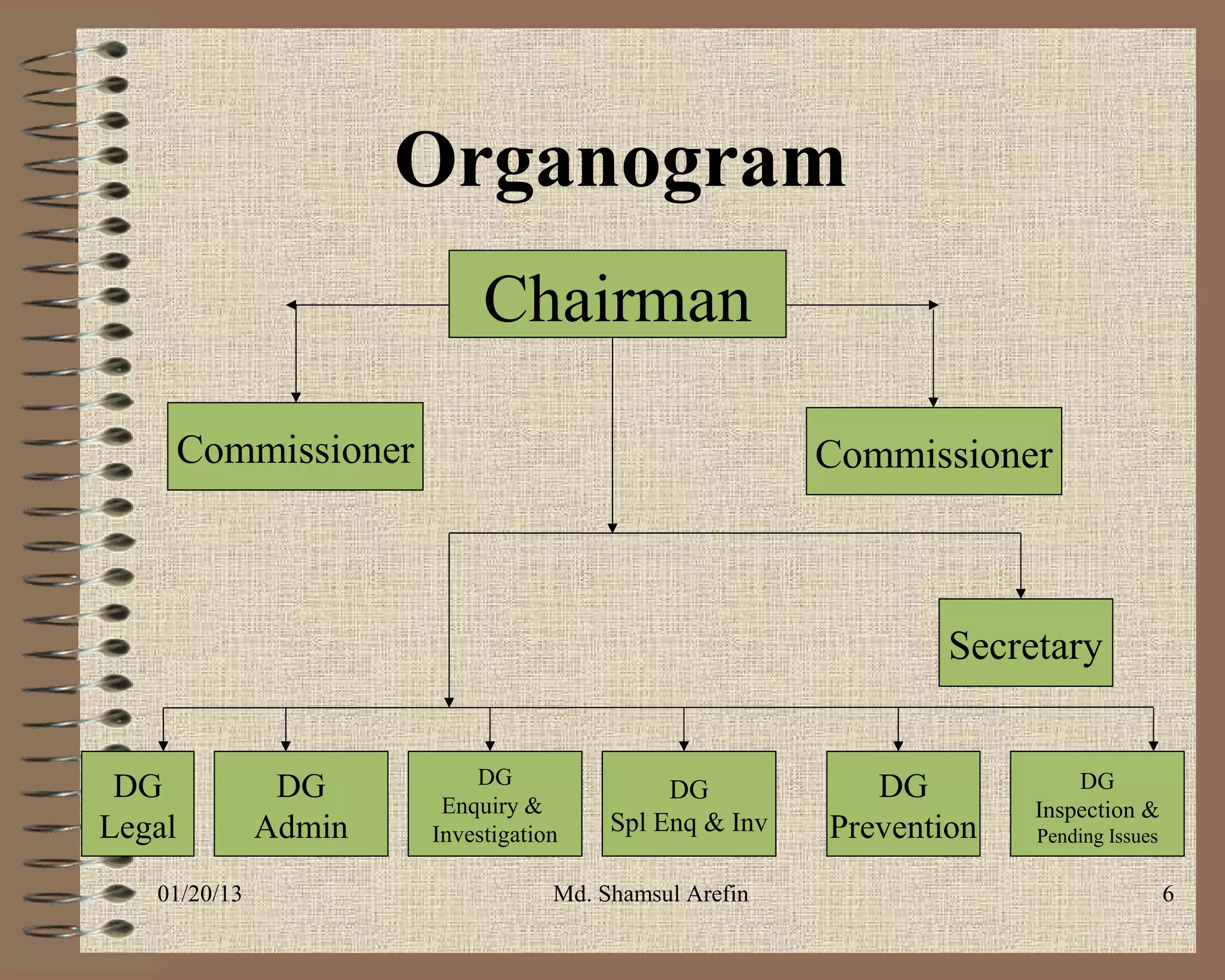
Organogram
                           Chairman

     Commissioner                                      Commissioner


                                                               Secretary


                          DG
 DG            DG      Enquiry &
                                            DG            DG            DG
                                                                    Inspection &
Legal         Admin   Investigation    Spl Enq & Inv   Prevention   Pending Issues

   01/20/13                       Md. Shamsul Arefin                                 6
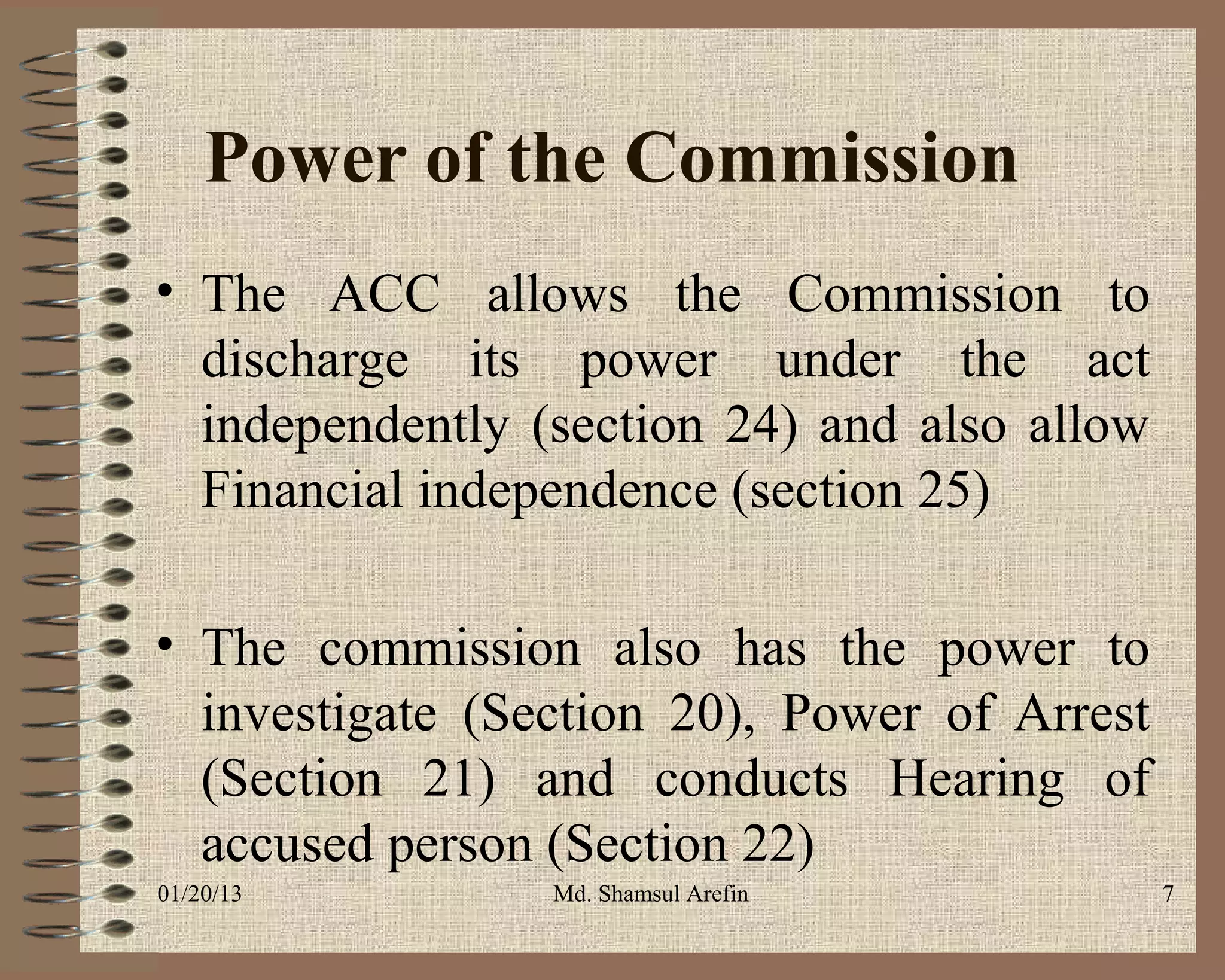
Power of the Commission
• The ACC allows the Commission to
  discharge its power under the act
  independently (section 24) and also allow
  Financial independence (section 25)

• The commission also has the power to
  investigate (Section 20), Power of Arrest
  (Section 21) and conducts Hearing of
  accused person (Section 22)
01/20/13         Md. Shamsul Arefin           7
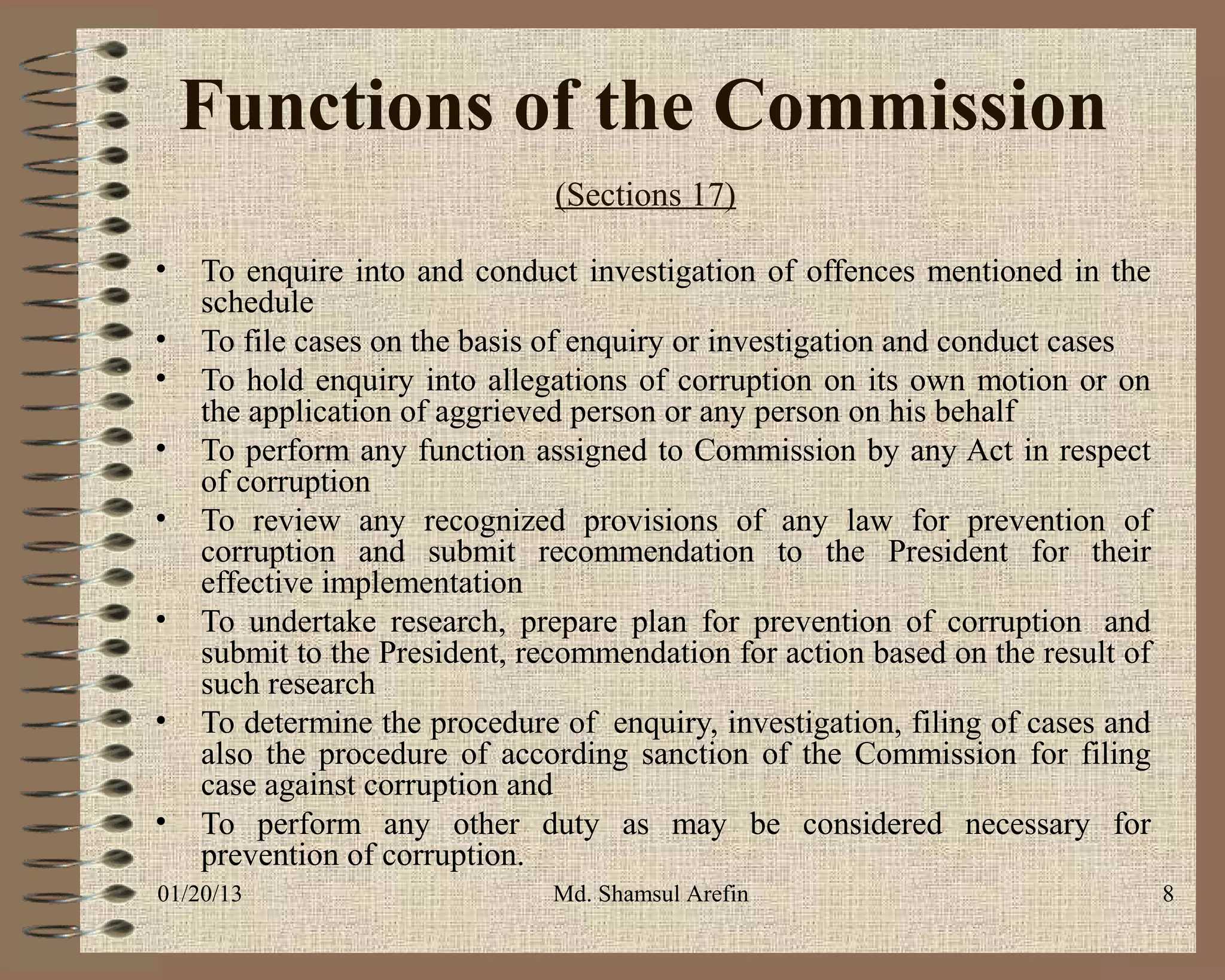
Functions of the Commission
                               (Sections 17)

•   To enquire into and conduct investigation of offences mentioned in the
    schedule
•   To file cases on the basis of enquiry or investigation and conduct cases
•   To hold enquiry into allegations of corruption on its own motion or on
    the application of aggrieved person or any person on his behalf
•   To perform any function assigned to Commission by any Act in respect
    of corruption
•   To review any recognized provisions of any law for prevention of
    corruption and submit recommendation to the President for their
    effective implementation
•   To undertake research, prepare plan for prevention of corruption and
    submit to the President, recommendation for action based on the result of
    such research
•   To determine the procedure of enquiry, investigation, filing of cases and
    also the procedure of according sanction of the Commission for filing
    case against corruption and
•   To perform any other duty as may be considered necessary for
    prevention of corruption.
01/20/13                       Md. Shamsul Arefin                               8
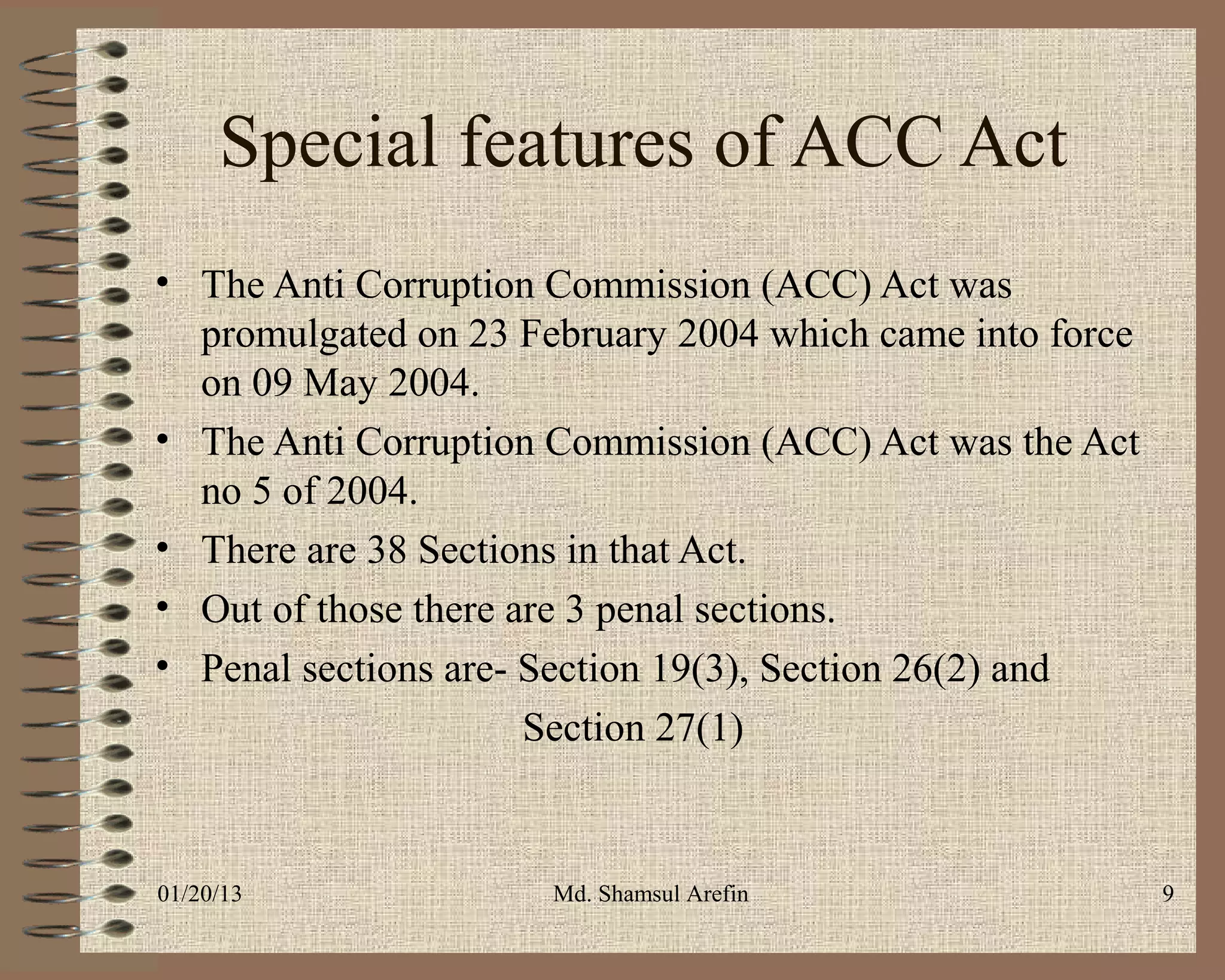
Special features of ACC Act
• The Anti Corruption Commission (ACC) Act was
  promulgated on 23 February 2004 which came into force
  on 09 May 2004.
• The Anti Corruption Commission (ACC) Act was the Act
  no 5 of 2004.
• There are 38 Sections in that Act.
• Out of those there are 3 penal sections.
• Penal sections are- Section 19(3), Section 26(2) and
                      Section 27(1)


01/20/13              Md. Shamsul Arefin                  9
Some Important Aspects of the ACC Act

• In order to make recommendation for the appointment
     of commissioners, a Selection Committee of five
     members shall be constituted (Section 7).
• Section 10(3) - No commissioner shall be removed from
     office except on similar grounds and in accordance with
     the similar procedures as apply to the removal of a
     judge of the Supreme Court.


01/20/13                 Md. Shamsul Arefin                    10
Definition of Corruption
• Corruption is operationally defined as the
  misuse of entrusted power for private gain-
    Transparency International.
• Corruption is the abuse of public office for
  private gain - World Bank
• Misuse of Power for private gain
      Bribery
      Extortion
      Manipulation of Laws

01/20/13                     Md. Shamsul Arefin   11
Legal Definition of Corruption
According to the Section 2(e) of the Anti-
 Corruption Commission Act-2004 :

‘Corruption’ means the offences set out in
  the schedule to this law”.


01/20/13          Md. Shamsul Arefin         12
The schedule of ACC
• Offences under Anti-Corruption Act 2004 (Possession of
property disproportionate to known source of income).
•Offences punishable under the Prevention of Corruption
Act, 1947 (Act 11 of 1947).

•Offences under Money Laundering Prevention Act -2009.

•Offences punishable under sections 161-169, 217, 218, 408,
409 and 477A of the Penal Code, 160 (Act XLV of 1960).

•Offences of abetment, conspiracy and attempts as defined
respectively in section 109, 120B and 511 of the Penal Code,
1860 (Act XLV of 1860) in relation to clauses (a) to The
Anti-Corruption Act, 2004. Shamsul Arefin
 01/20/13                 Md.                                13
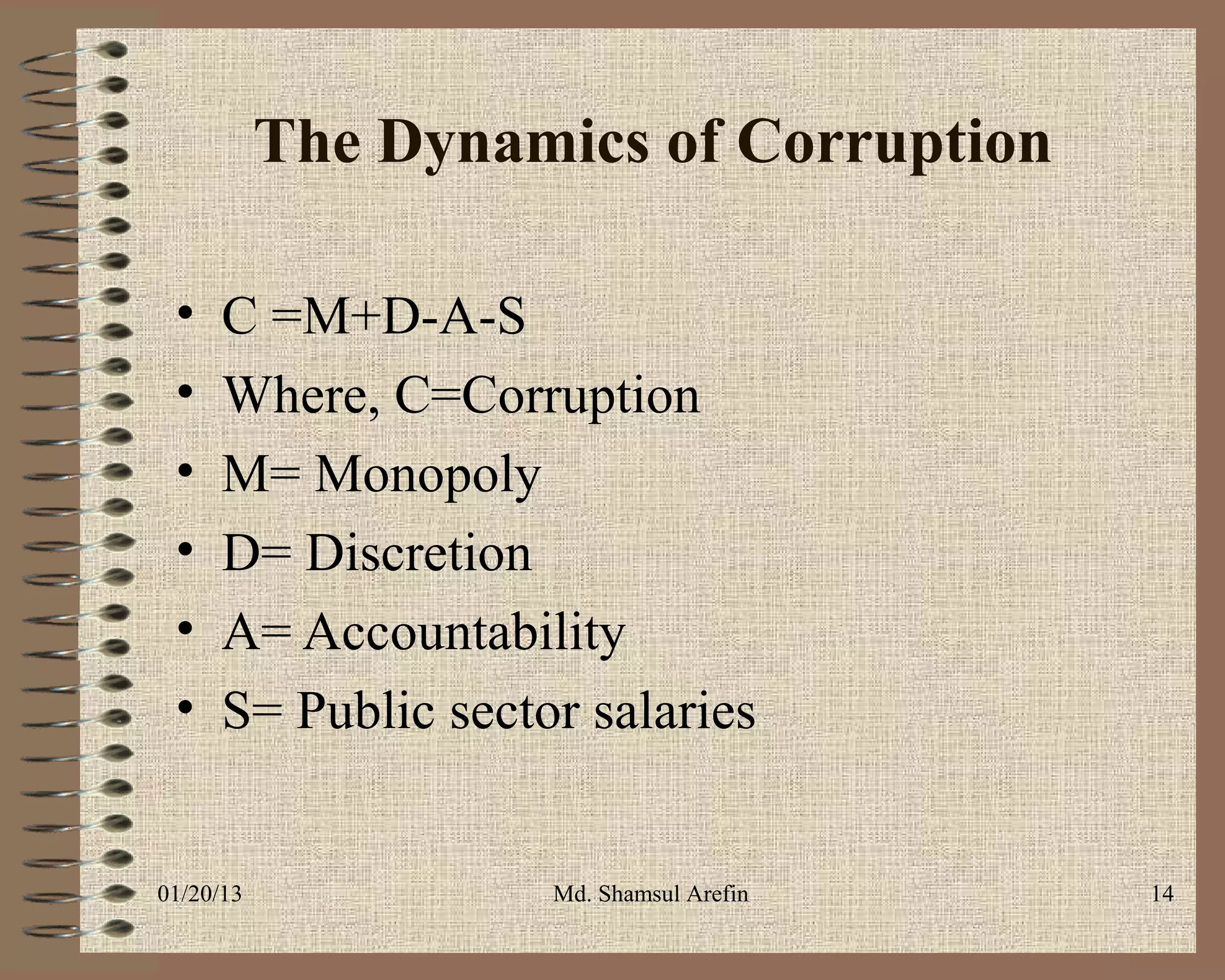
The Dynamics of Corruption

 •    C =M+D-A-S
 •    Where, C=Corruption
 •    M= Monopoly
 •    D= Discretion
 •    A= Accountability
 •    S= Public sector salaries


01/20/13             Md. Shamsul Arefin   14
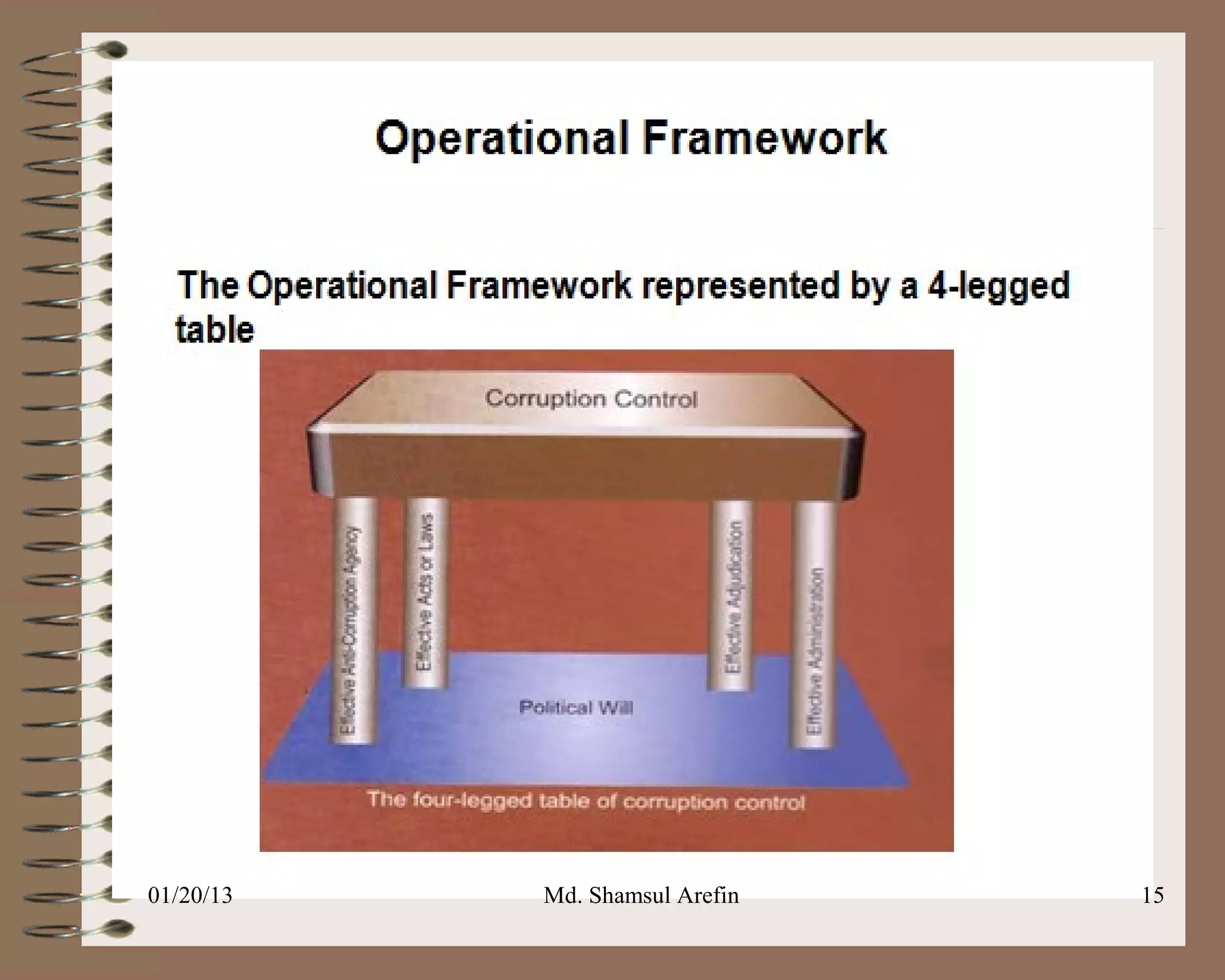
01/20/13   Md. Shamsul Arefin   15
01/20/13   Md. Shamsul Arefin   16
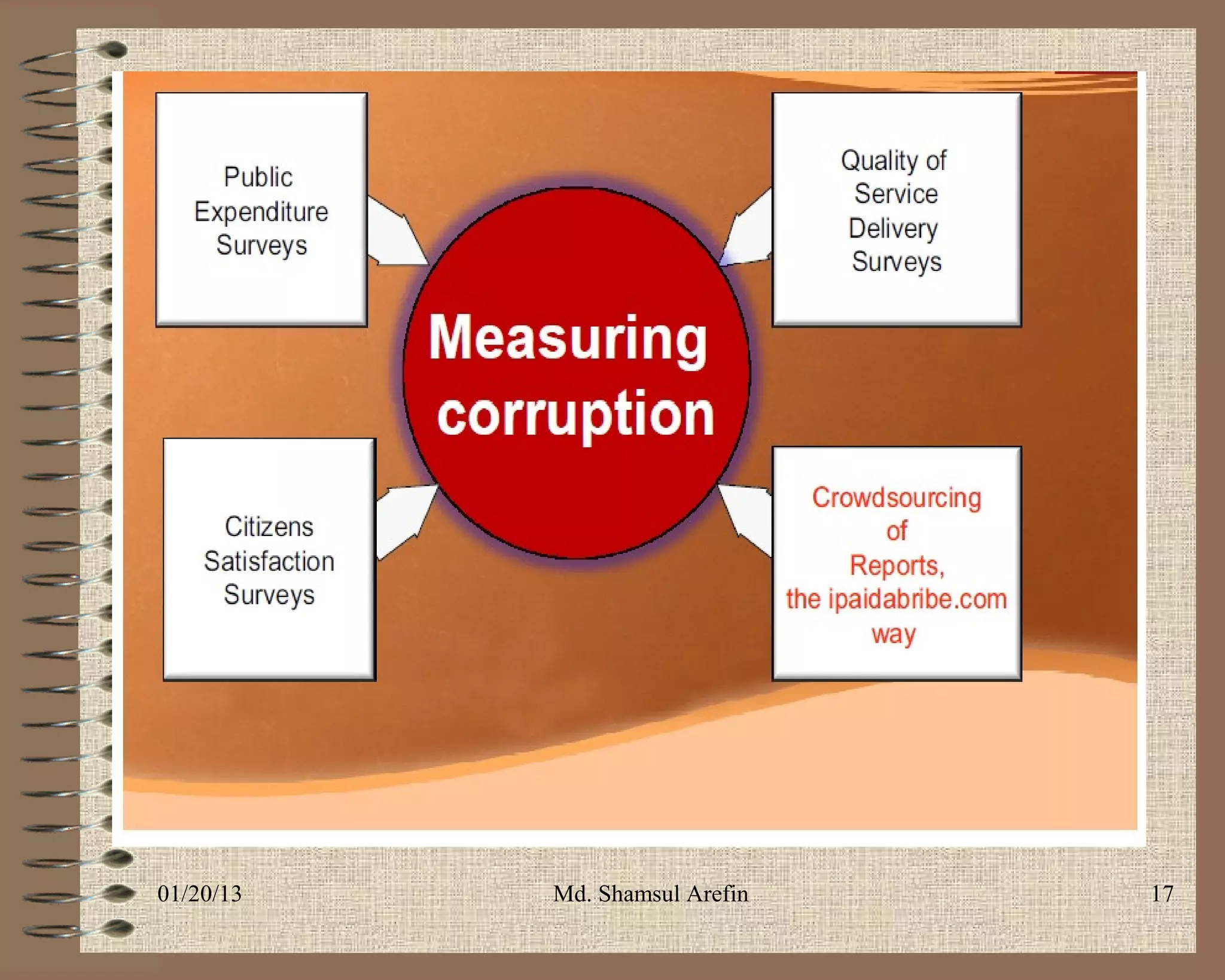
01/20/13   Md. Shamsul Arefin   17
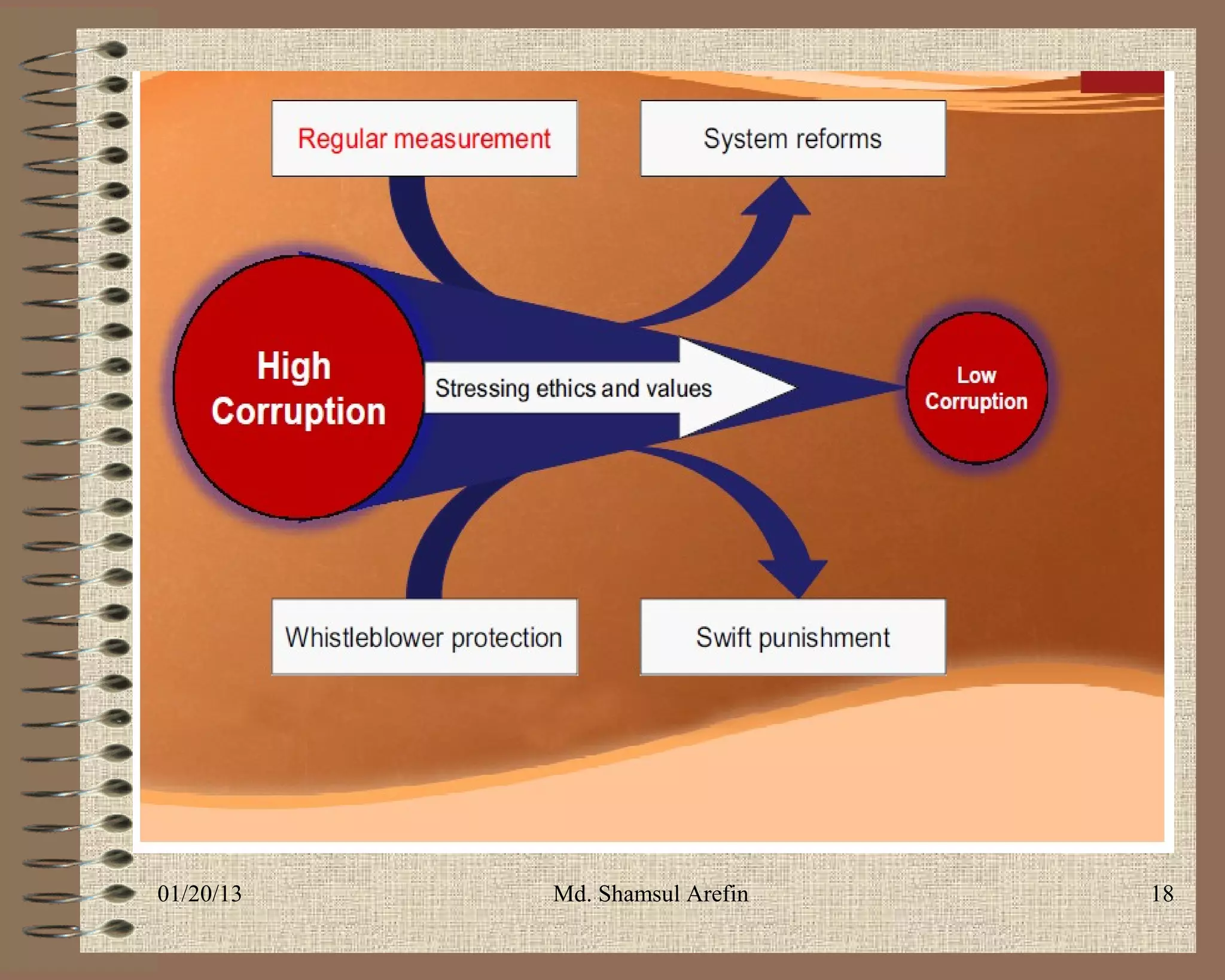
01/20/13   Md. Shamsul Arefin   18
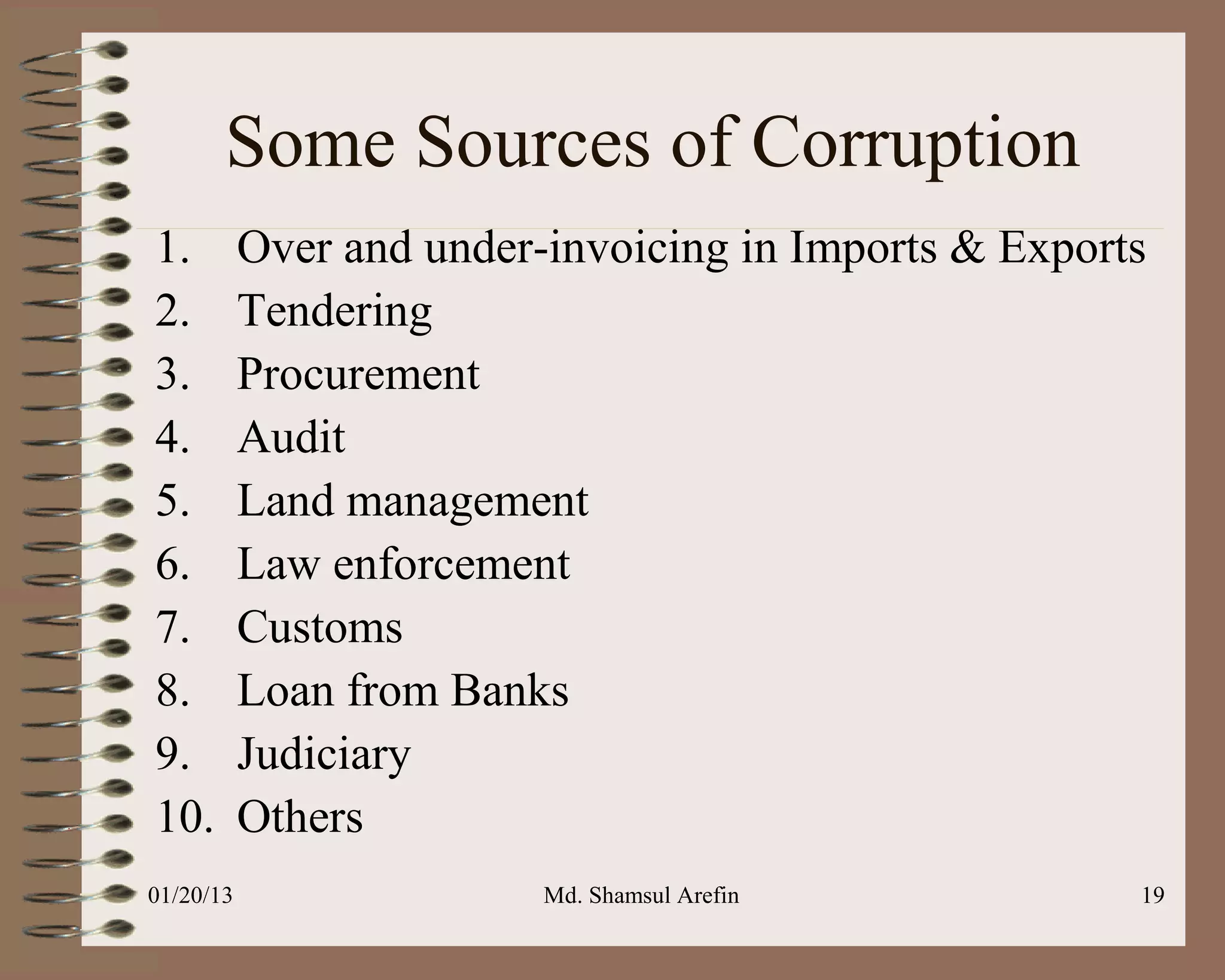
Some Sources of Corruption
1.         Over and under-invoicing in Imports & Exports
2.         Tendering
3.         Procurement
4.         Audit
5.         Land management
6.         Law enforcement
7.         Customs
8.         Loan from Banks
9.         Judiciary
10.        Others
01/20/13                  Md. Shamsul Arefin           19
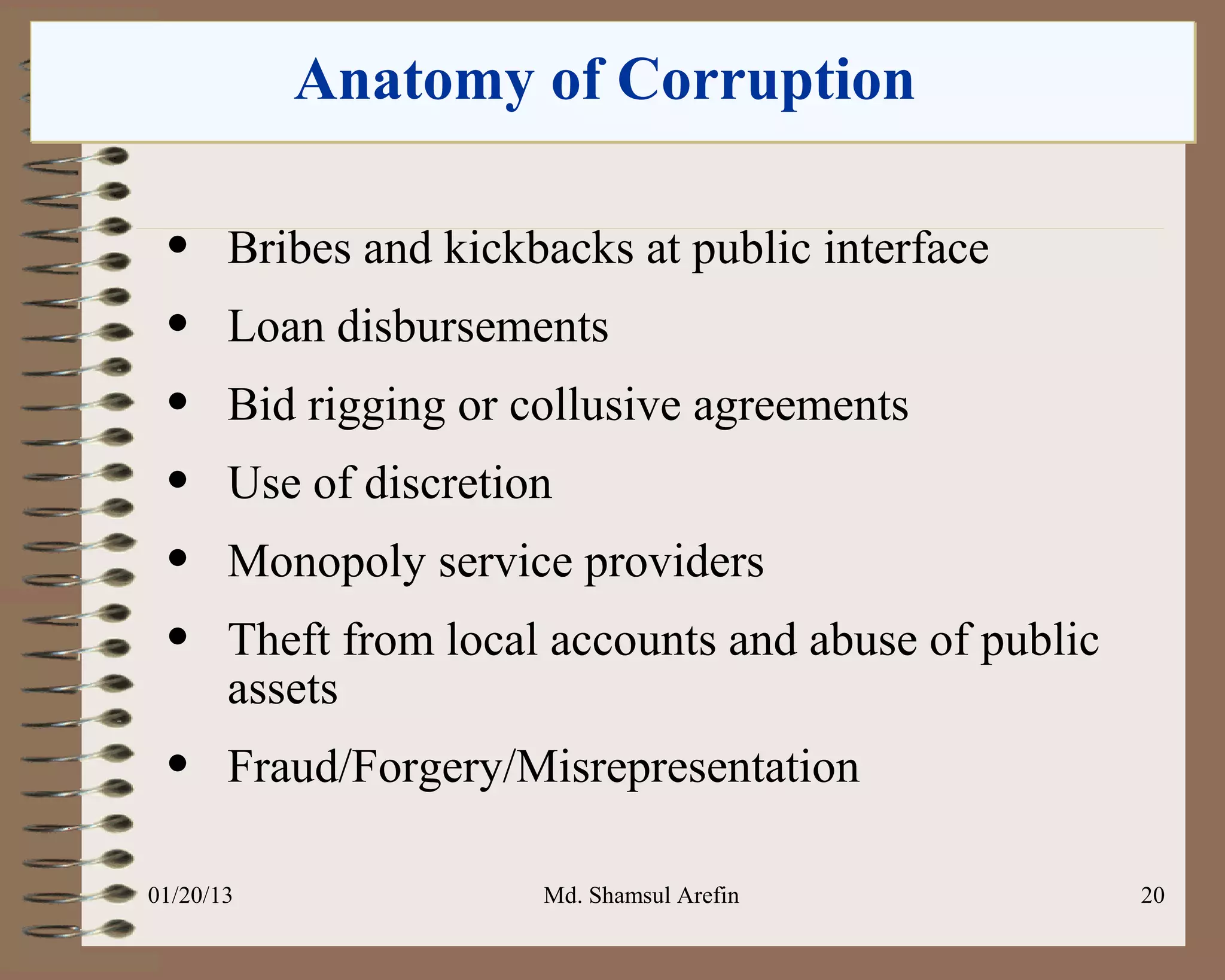
Anatomy of Corruption

 •     Bribes and kickbacks at public interface
 •     Loan disbursements
 •     Bid rigging or collusive agreements
 •     Use of discretion
 •     Monopoly service providers
 •     Theft from local accounts and abuse of public
       assets
 •     Fraud/Forgery/Misrepresentation

01/20/13               Md. Shamsul Arefin              20
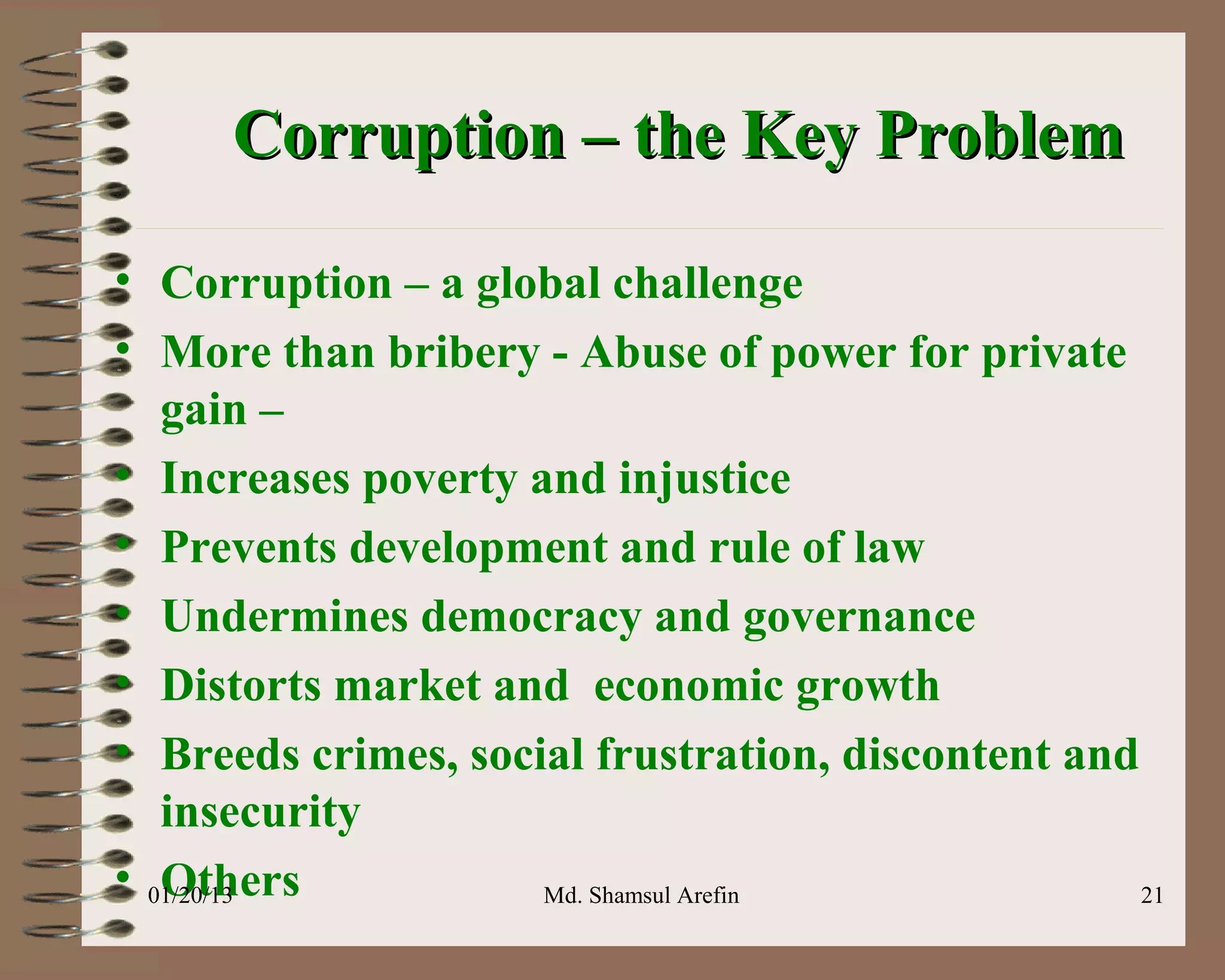
Corruption – the Key Problem

• Corruption – a global challenge
• More than bribery - Abuse of power for private
   gain –
• Increases poverty and injustice
• Prevents development and rule of law
• Undermines democracy and governance
• Distorts market and economic growth
• Breeds crimes, social frustration, discontent and
   insecurity
• 01/20/13
   Others            Md. Shamsul Arefin             21
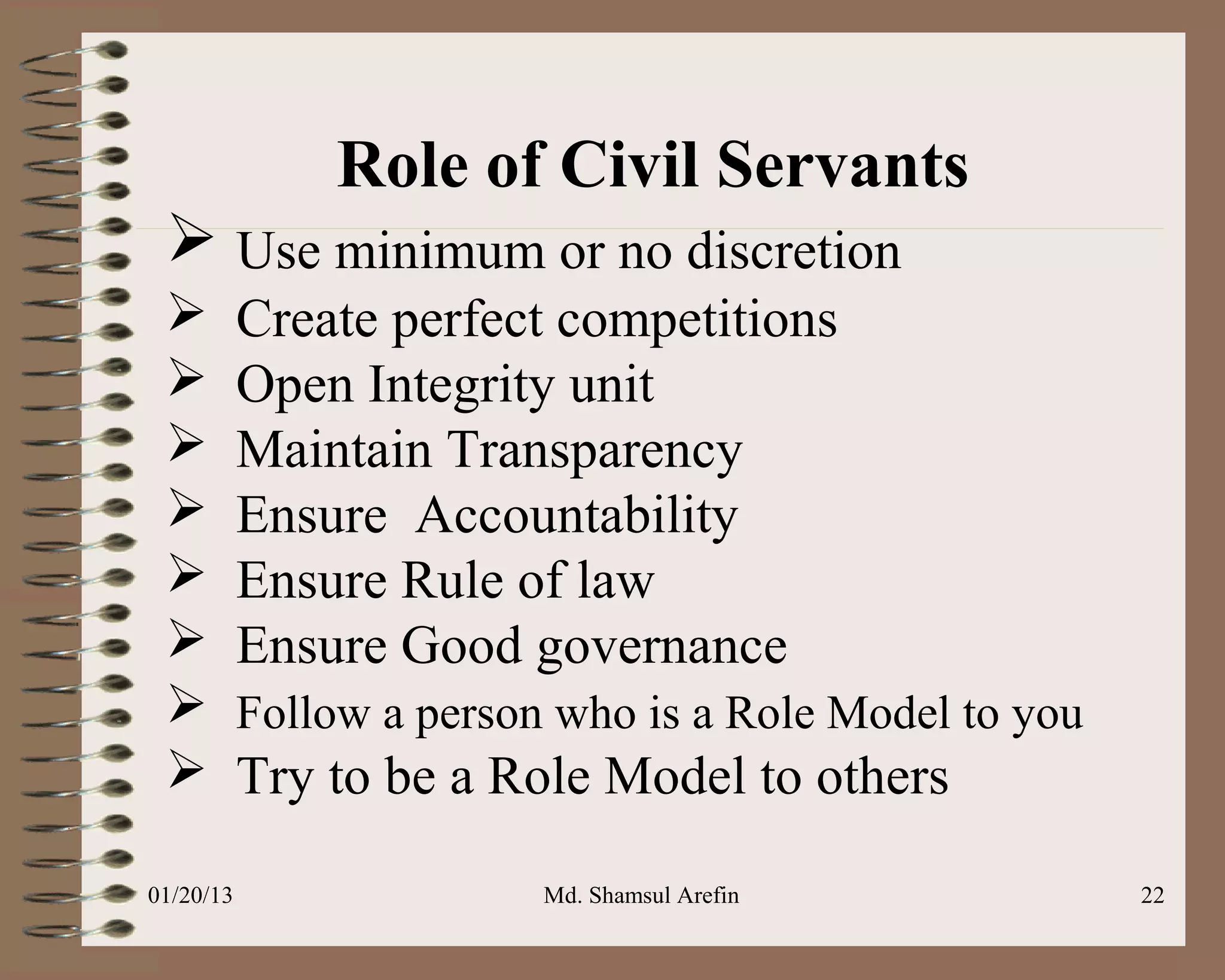
Role of Civil Servants
  Use minimum or no discretion
          Create perfect competitions
          Open Integrity unit
          Maintain Transparency
          Ensure Accountability
          Ensure Rule of law
          Ensure Good governance
          Follow a person who is a Role Model to you
          Try to be a Role Model to others

01/20/13                  Md. Shamsul Arefin            22
Which of the following acts do you consider to
be acts of corruption:
Stealing money from government (embezzlement)
Threatening individuals with harm if they do not give
money (Extortion)
Influencing government contracts in return for financial or
other gains
Bribery
Promotion of unqualified individuals for political reasons or
other gains
Favouring relatives and friends e.g. appointing them to
good positions (nepotism)

01/20/13                Md. Shamsul Arefin                  23
Please indicate how much do you agree with the
following statements

 I would feel comfortable helping my family
member get a job in my govt office, provided
they were qualified.
…even if they were not as qualified as another
candidate.
 I would feel obligated to use my influence as a
civil servant to help my friend / relative with a
problem if I could.
 Corruption by low-level employees is more
acceptable than corruption by high-level officials.
01/20/13            Md. Shamsul Arefin            24
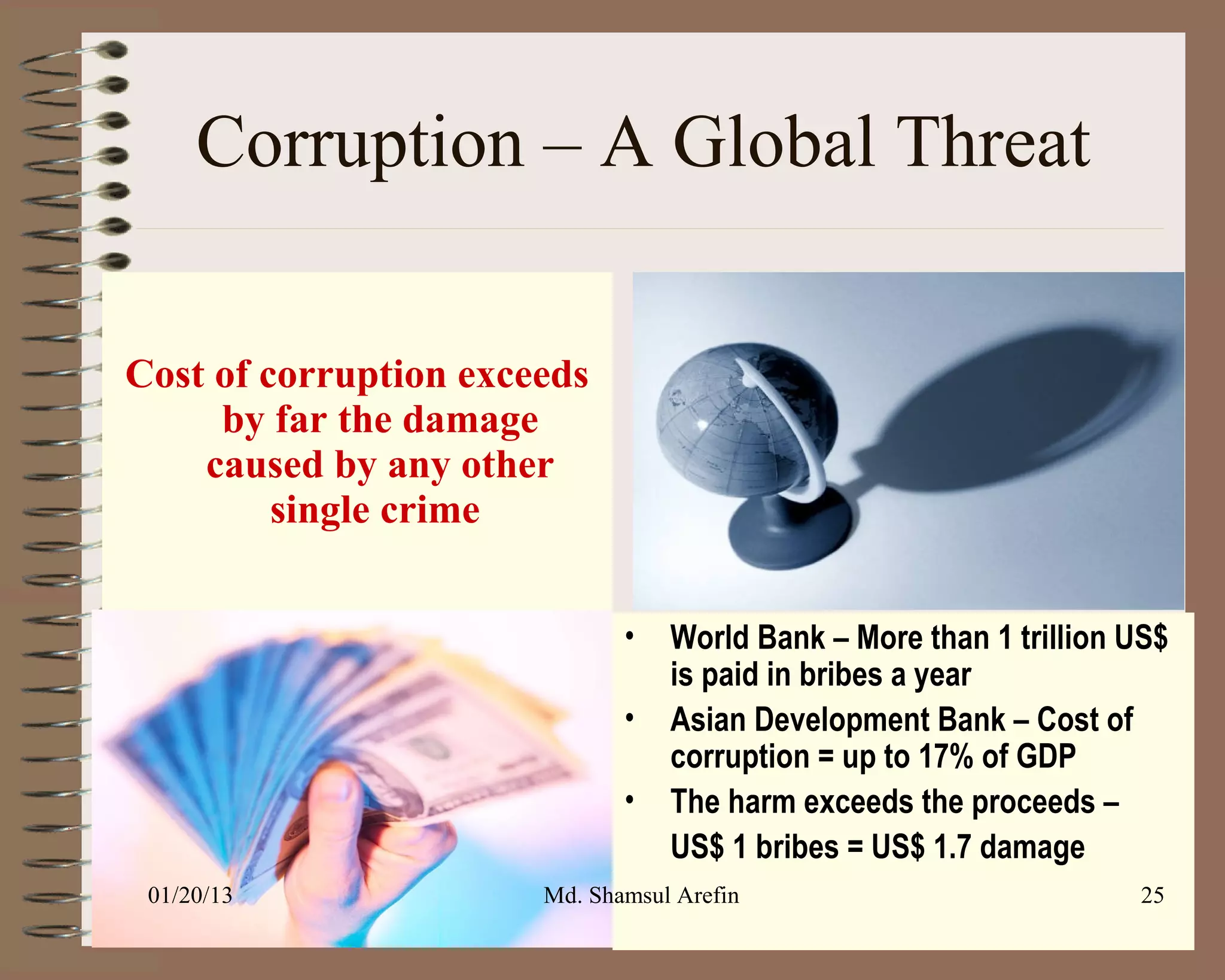
Corruption – A Global Threat

Cost of corruption exceeds
     by far the damage
    caused by any other
         single crime


                              •   World Bank – More than 1 trillion US$
                                  is paid in bribes a year
                              •   Asian Development Bank – Cost of
                                  corruption = up to 17% of GDP
                              •   The harm exceeds the proceeds –
                                  US$ 1 bribes = US$ 1.7 damage
 01/20/13              Md. Shamsul Arefin                           25
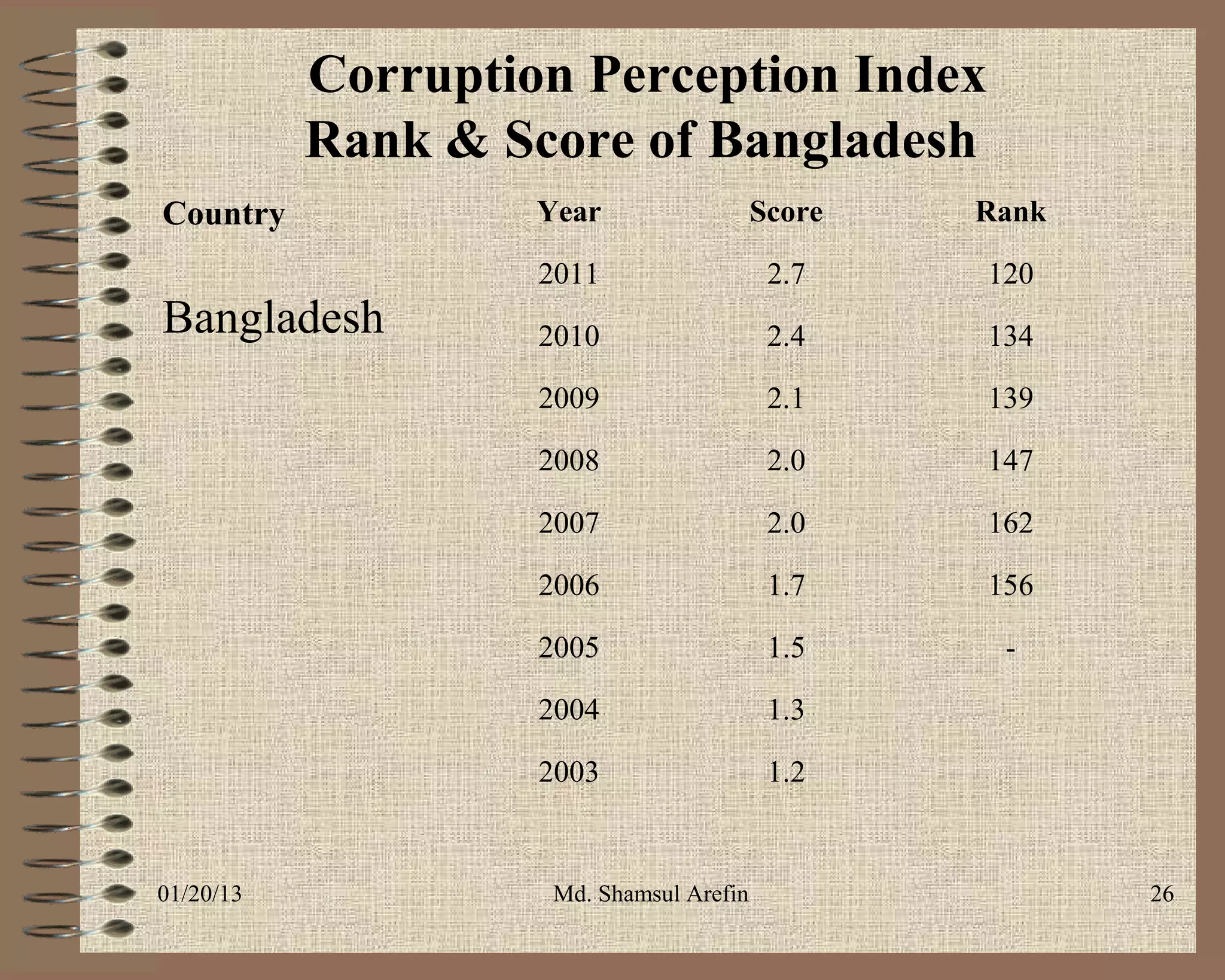
Corruption Perception Index
           Rank & Score of Bangladesh
Country             Year                  Score   Rank

                    2011                   2.7    120
Bangladesh          2010                   2.4    134

                    2009                   2.1    139

                    2008                   2.0    147

                    2007                   2.0    162

                    2006                   1.7    156

                    2005                   1.5     -

                    2004                   1.3

                    2003                   1.2


01/20/13             Md. Shamsul Arefin                  26
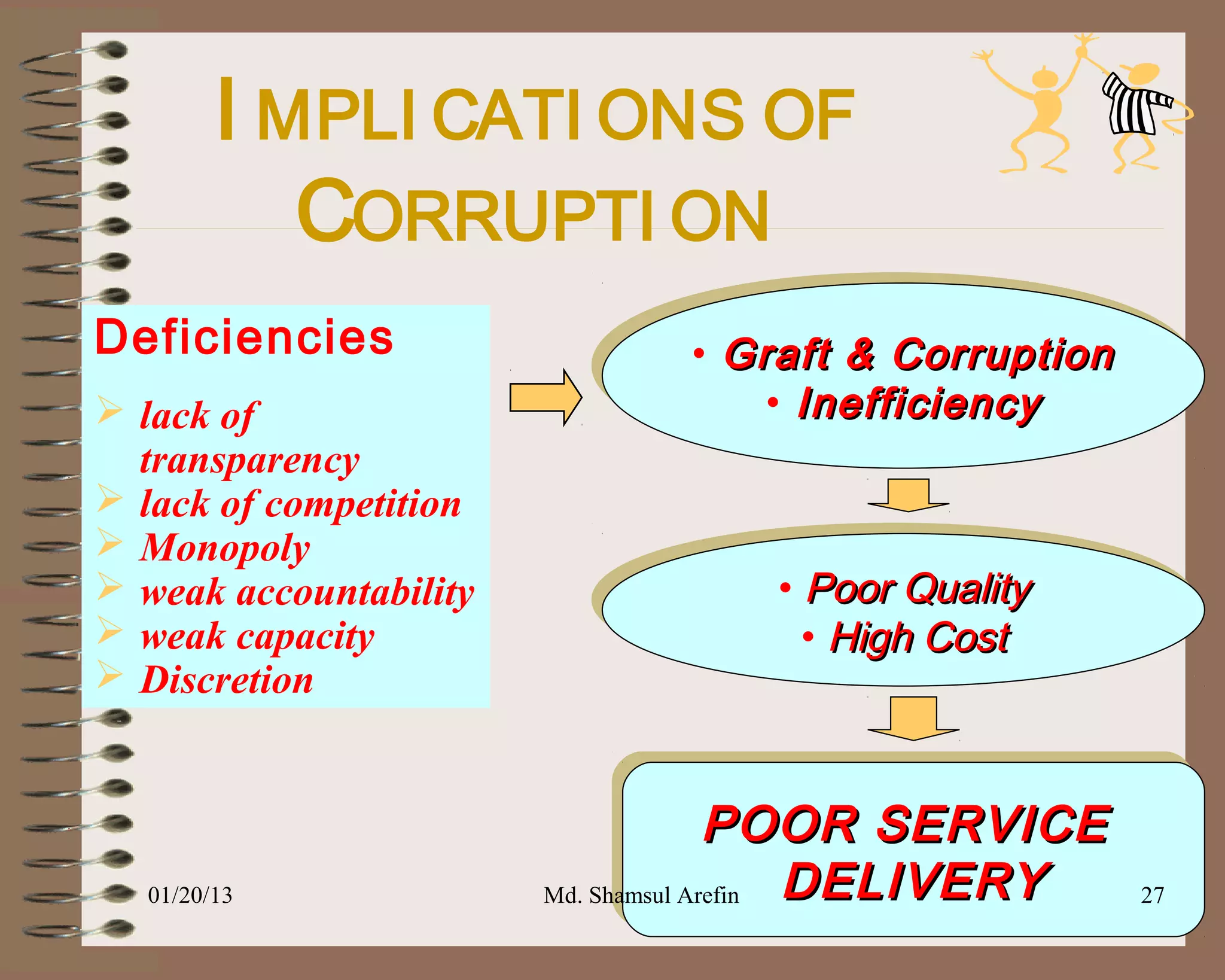
I MPLI CATI ONS OF
           CORRUPTI ON
Deficiencies                  •• Graft & Corruption
                                 Graft & Corruption
 lack of                          •• Inefficiency
                                       Inefficiency
  transparency
 lack of competition
 Monopoly
 weak accountability             ••Poor Quality
                                     Poor Quality
 weak capacity                     ••High Cost
                                      High Cost
 Discretion


                                     POOR SERVICE
                                      POOR SERVICE
  01/20/13              Md. Shamsul Arefin
                                           DELIVERY
                                           DELIVERY   27
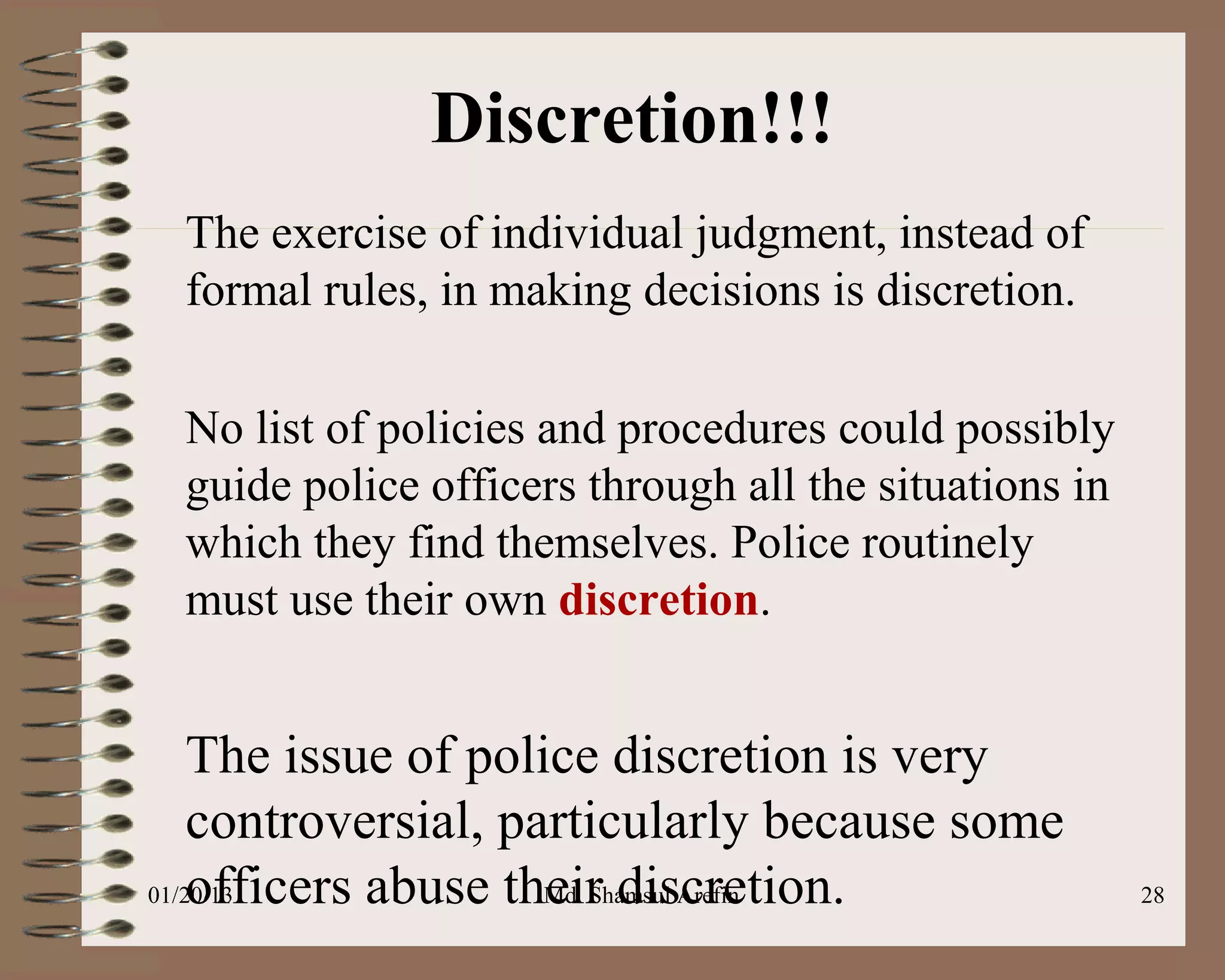
Discretion!!!
 The exercise of individual judgment, instead of
 formal rules, in making decisions is discretion.

 No list of policies and procedures could possibly
 guide police officers through all the situations in
 which they find themselves. Police routinely
 must use their own discretion.


    The issue of police discretion is very
    controversial, particularly because some
    officers abuse their discretion.
01/20/13             Md. Shamsul Arefin                28
Measuring Corruption
•         Transparency International Tools
      – Corruption             Perceptions             Index     –
          international ranking (score) based on
          Survey      of    Surveys         on     perceptions   of
          business,        business        analysts,     investors,
          investment analysts and country specialists
          on political and administrative corruption.


    01/20/13                  Md. Shamsul Arefin                      29
01/20/13   Md. Shamsul Arefin   30
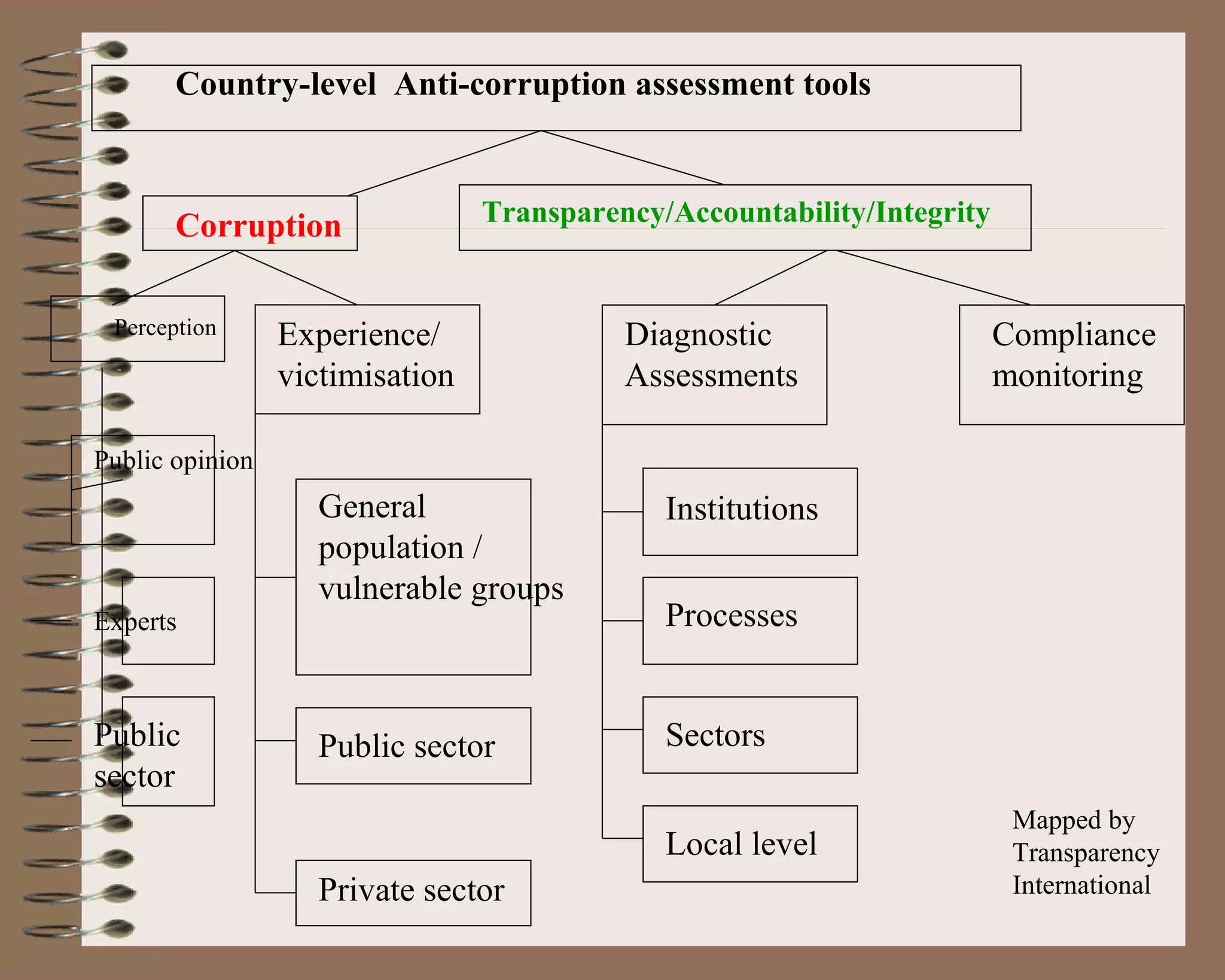
Country-level Anti-corruption assessment tools


       Corruption                Transparency/Accountability/Integrity


 Perception      Experience/               Diagnostic                    Compliance
                 victimisation             Assessments                   monitoring

Public opinion
                    General                   Institutions
                    population /
                    vulnerable groups
Experts                                       Processes


Public              Public sector             Sectors
sector
                                                                          Mapped by
                                              Local level                 Transparency
                    Private sector                                        International
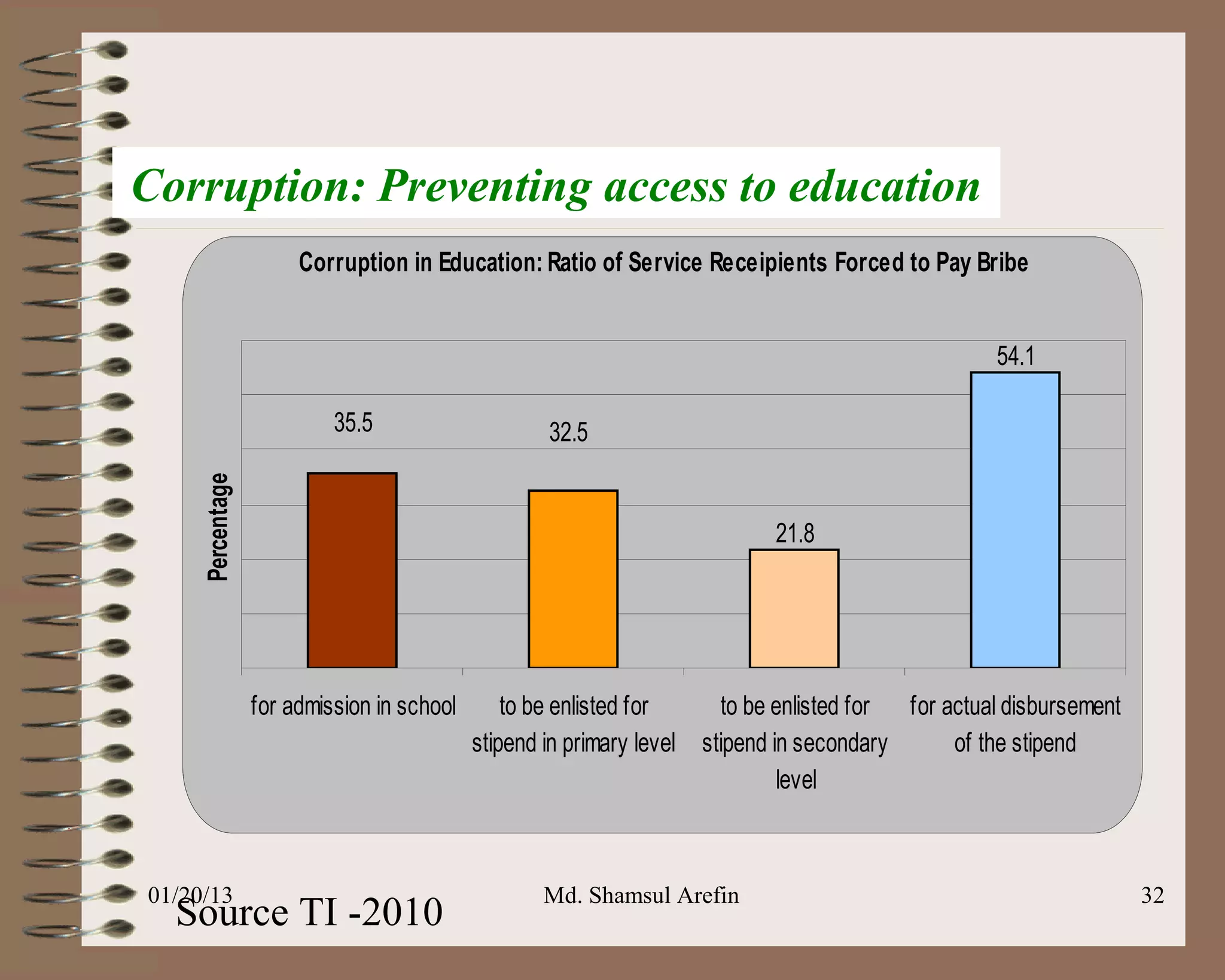
Corruption: Preventing access to education
                       Corruption in Education: Ratio of Service Receipients Forced to Pay Bribe


                                                                                                   54.1

                           35.5                     32.5
     Percentage


                                                                            21.8


                  for admission in school       to be enlisted for     to be enlisted for for actual disbursement
                                            stipend in primary level stipend in secondary      of the stipend
                                                                              level


01/20/13                                           Md. Shamsul Arefin                                               32
  Source TI -2010
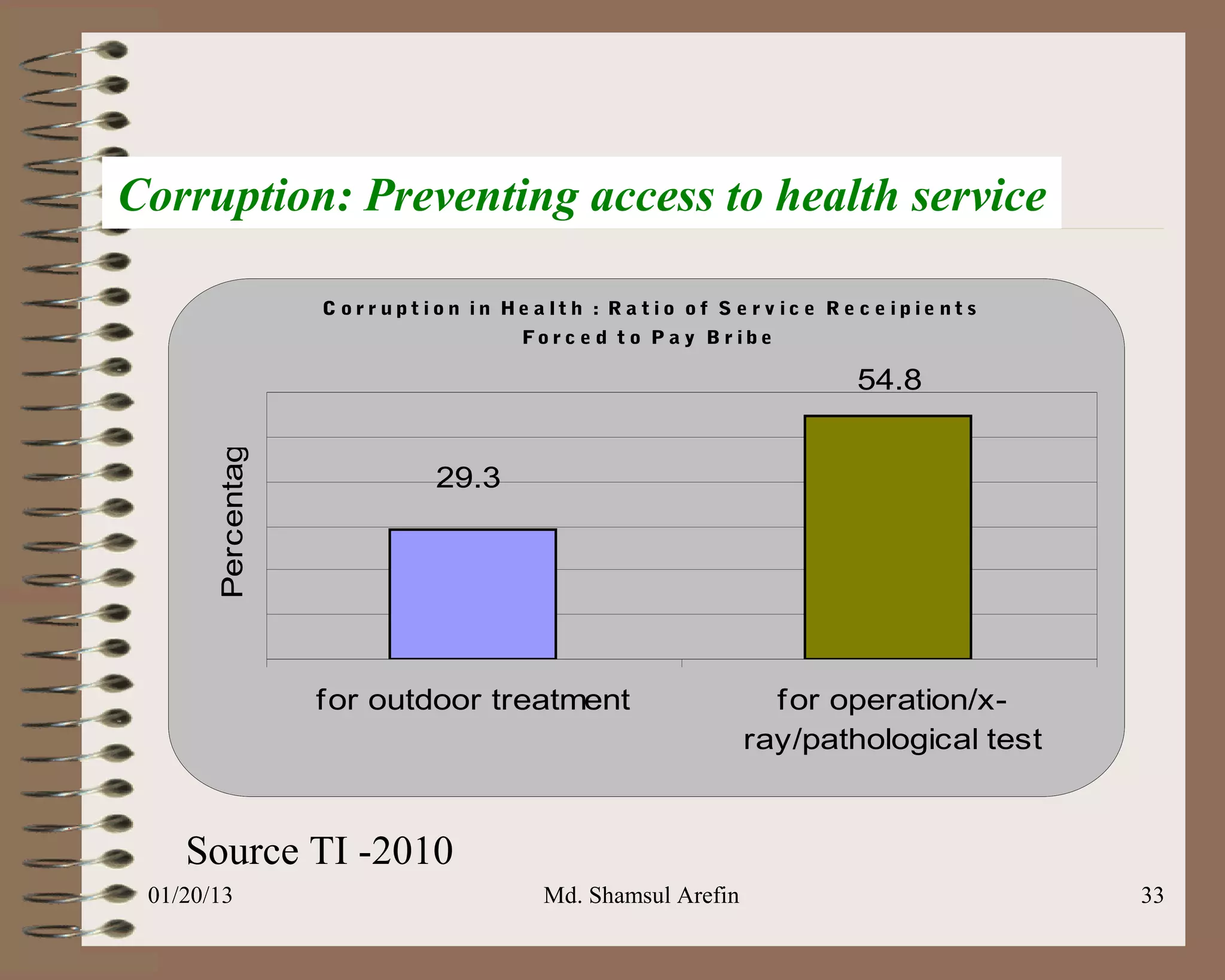
Corruption: Preventing access to health service

                    C orr upt ion in He a lth : R a tio of S e rv ic e R e c e ipie nts
                                        Fo r c e d t o P a y B r i b e

                                                                          54.8
       Percentage


                               29.3


                    for outdoor treatment                           f or operation/x-
                                                                  ray/pathological test


    Source TI -2010
 01/20/13                                 Md. Shamsul Arefin                              33
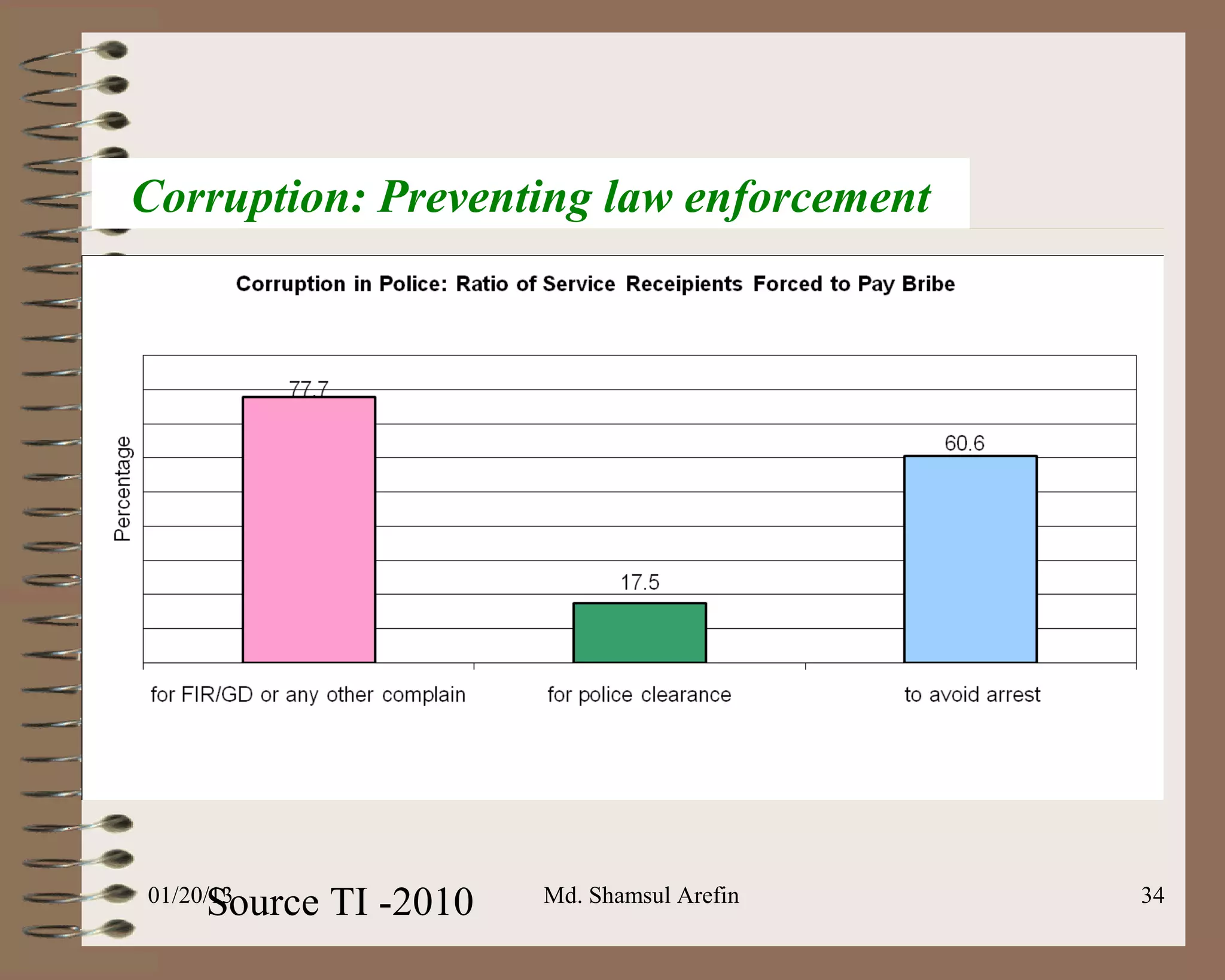
Corruption: Preventing law enforcement


     Source TI -2010
01/20/13               Md. Shamsul Arefin   34
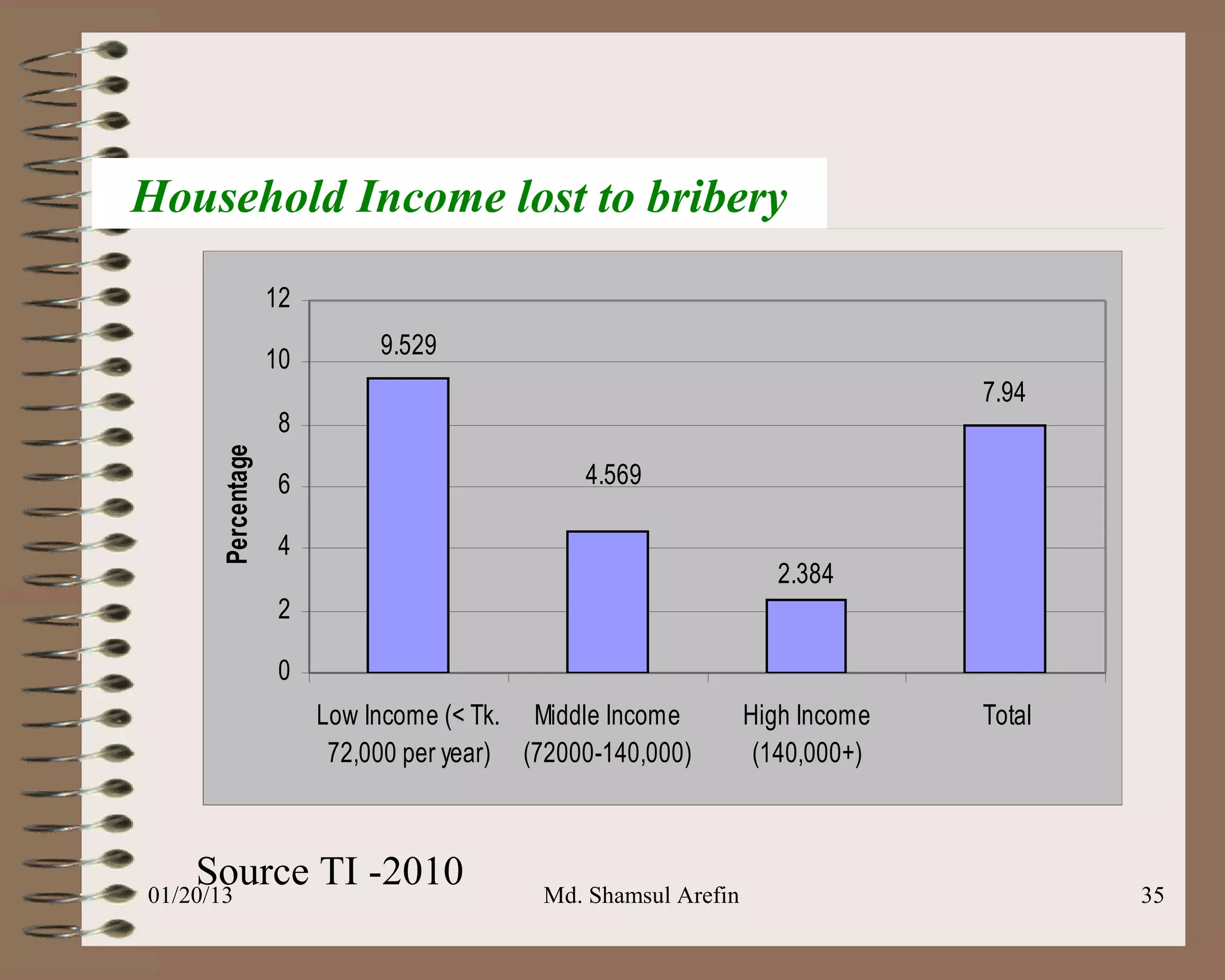
Household Income lost to bribery

                   12
                             9.529
                   10
                                                                              7.94
                    8
      Percentage


                    6                          4.569

                    4
                                                                   2.384
                    2

                    0
                        Low Income (< Tk. Middle Income         High Income   Total
                         72,000 per year) (72000-140,000)        (140,000+)


    Source TI -2010
01/20/13                                   Md. Shamsul Arefin                         35
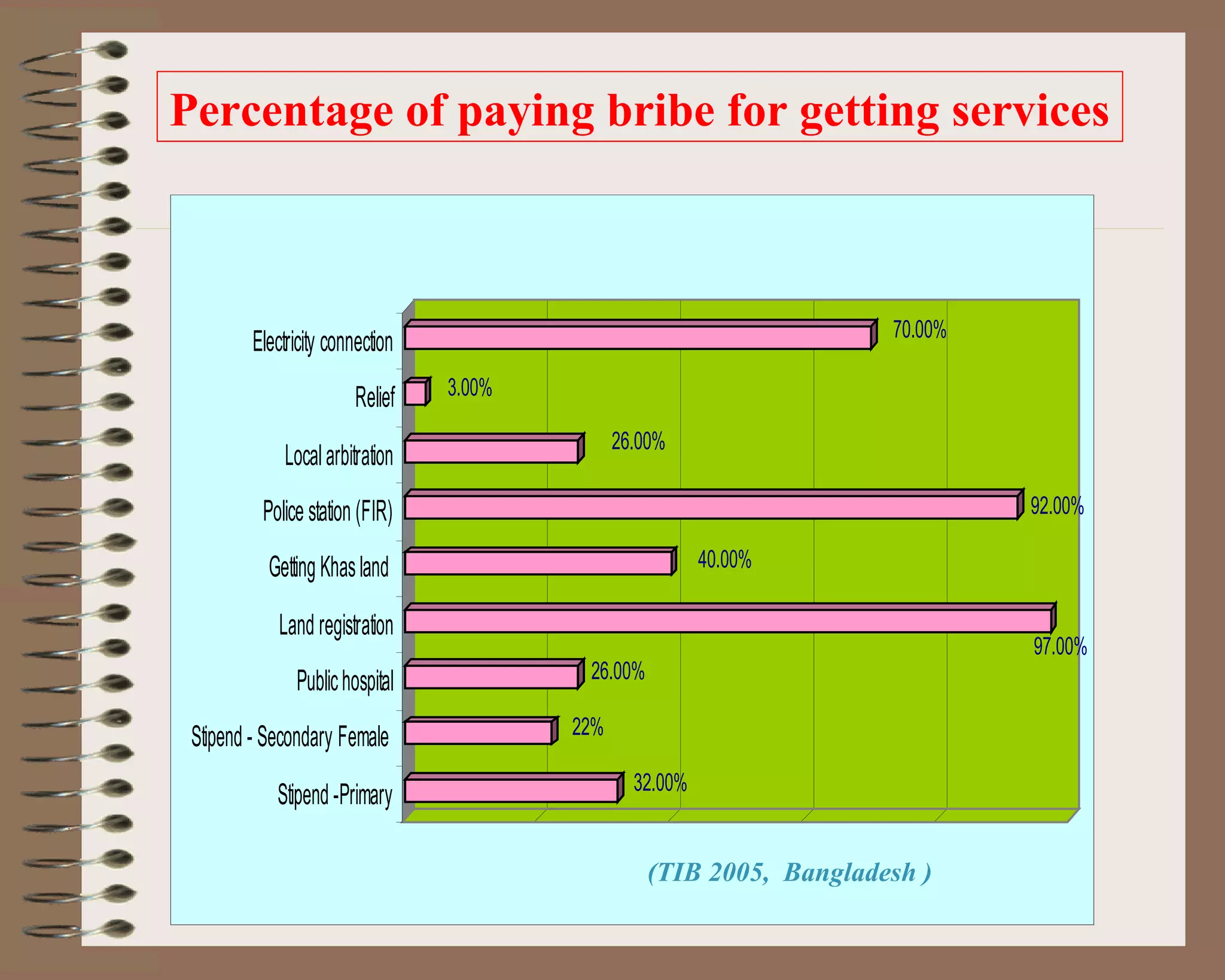
Percentage of paying bribe for getting services


                                                                       70.00%
         Electricity connection
                         Relief   3.00%

                                                26.00%
              Local arbitration
          Police station (FIR)                                                  92.00%

           Getting Khas land                               40.00%

             Land registration
                                                                                97.00%
               Public hospital             26.00%

 Stipend - Secondary Female               22%

                                                  32.00%
            Stipend -Primary

                                                    (TIB 2005, Bangladesh )
Anyone can submit a complaint to the
    Anti-Corruption Commission (district
    office/division office/head office) or to
    the Police Station about the happening
    of a scheduled offences under Rule.4
    and 7 of ACC Rules, 2007.

01/20/13           Md. Shamsul Arefin           37
Steps to be taken by Police Station on
         receiving a complaint
• After submitting to the PS, the complaint
  will be forwarded to ACC for Enquiry (if
  not lodged in the form of FIR).

• After submitting to the PS, the complaint
  will be forwarded to ACC for Investigation
  (if recorded in the form of FIR).


01/20/13         Md. Shamsul Arefin            38
Using the Right to Information as an Anti-
                       Corruption Tool

• Article 39(2) of the constitution of Bangladesh
   states that:
(a)Right to every citizen the freedom of speech and
   expression is guaranteed;
(b)Freedom of the press is guaranteed.
(c)Right to Information Act-2009 (Public
   information disclosure related Act).
(d)The Whistleblower Act


01/20/13                  Md. Shamsul Arefin            39
Which Countries Are Corrupt?
• The Transparency International 2009 Corruption
  Perceptions Index shows that the most honest countries
  are Finland, New Zealand, Iceland, Denmark, and
  Singapore.

• The most corrupt countries are Haiti, Guinea,
  Myanmar, Iraq, Bangladesh, Chad, the Democratic
  Republic of Congo, and Sudan.
• China, Brazil, Ghana, Senegal, Peru, Mexico, Saudi
  Arabia, India, and Egypt all rank in the middle of the 163
  countries ranked.

01/20/13               Md. Shamsul Arefin                      40
The Great Exceptions
• Singapore and Hong Kong are exceptions
  Both have moderately high levels of
  inequality and at best modest levels of
  trust. Botswana is another example of a
  country with moderate corruption and high
  levels of inequality.
• All three countries once had very high
  levels of corruption.

01/20/13         Md. Shamsul Arefin           41
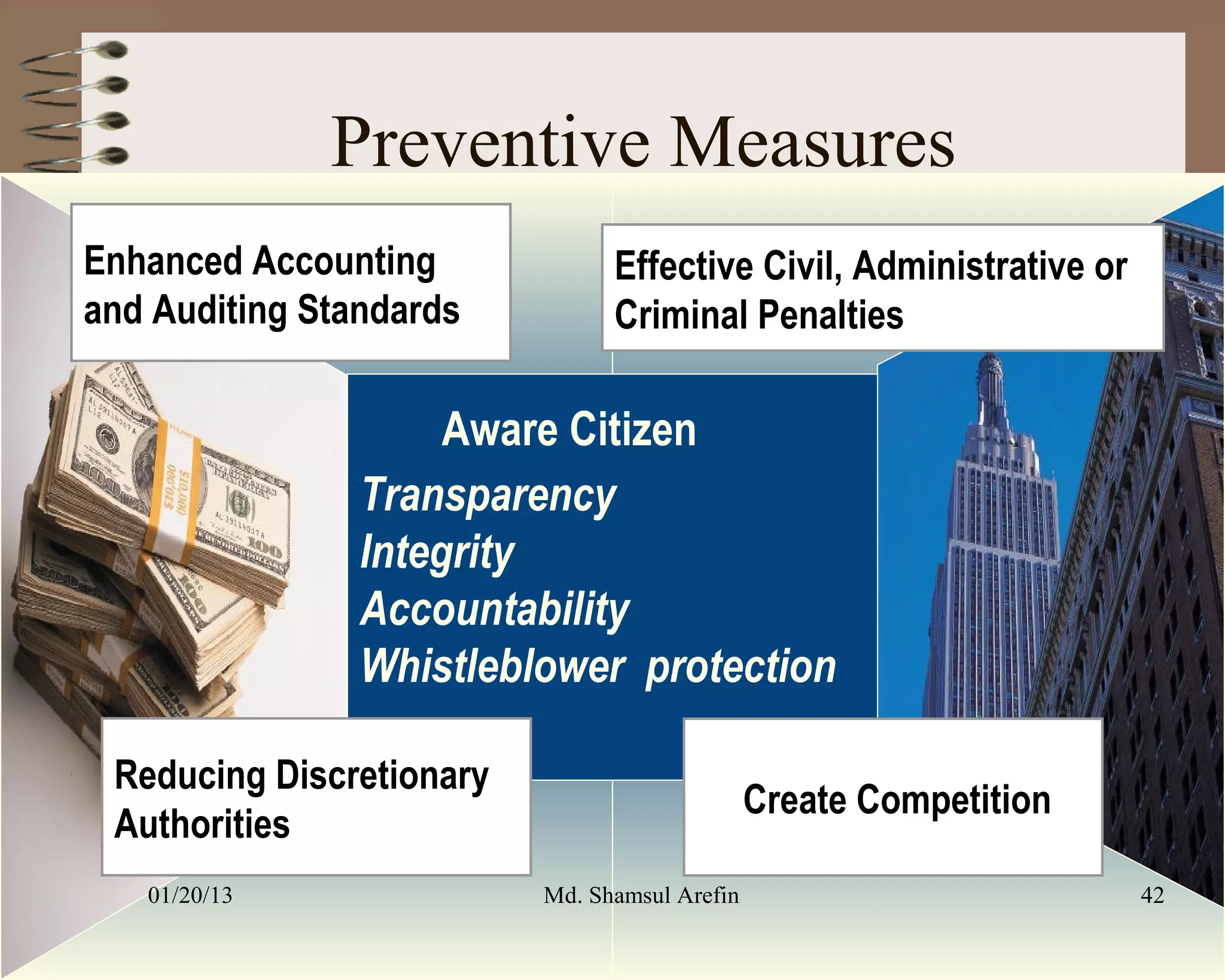
Preventive Measures
Enhanced Accounting             Effective Civil, Administrative or
and Auditing Standards          Criminal Penalties

                     Aware Citizen
                Transparency
                Integrity
                Accountability
                Whistleblower protection

 Reducing Discretionary
                                               Create Competition
 Authorities
   01/20/13               Md. Shamsul Arefin                         42
Whistleblower means-

   An employee who refuses to
   engage in and or reports illegal
   or wrongful activities of his
   employer or fellow employees.
01/20/13       Md. Shamsul Arefin     43
How to tackle corruption in Bangladesh

           1. Developing long-term anti-corruption strategy
           2. Creating citizen’s will
           3. Effective decentralisation of government agency
           4. Create a sense of hate about corruption
           5. More transparency and more simplification of
              procedures
           6. Incentives for good performance
           7. Awareness and Motivational programme

01/20/13                     Md. Shamsul Arefin                 44
Conclusion
 Corruption is widespread in developing and transition economies, not
 because their people are different from people elsewhere but because
 conditions are ripe for it.

 First, the motivation to earn income is extremely strong, aggravated
 by poverty and by low and declining civil service salaries and the
 absence of risk-spreading Mechanisms.

 Second, opportunities to engage in corruption are numerous.
 Monopoly rents can be very large in highly regulated economies.

 The discretion of many public officials is broad in developing and
 transition economies, and this systemic weakness is exacerbated by
 poorly defined, ever changing, and poorly disseminated rules
 and regulations.


01/20/13                   Md. Shamsul Arefin                           45
Conclusion
 Third, accountability is typically weak. Competition are not perfect
 often restricted.

 The watchdog institutions that provide information on which detection
 and enforcement is based—such as investigators, accountants, and the
 press—are also weak.

 The two parties to a bribe often both benefit, bribery can be extremely
 difficult to detect. Even if detection is possible, punishments are apt to
 be mild when corruption is systemic—it is hard to punish one person
 severely when so many others are likely to be equally guilty.


 Finally, certain country-specific factors, such as population size and
 natural resource, also appear to be positively linked with the
 prevalence of bribery.
01/20/13                     Md. Shamsul Arefin                               46
01/20/13   Md. Shamsul Arefin   47
01/20/13   Md. Shamsul Arefin   48
Thank You!
January 20, 2013   Md. Shamsul Arefin   49

Combating corruption 01 10-2012

  • 1.
    Combating Corruption in Bangladesh: Role of Civil Servants The lecture note is prepared for the Mid Level Career Civil Servants of Bangladesh Bangladesh Public Administration Training Centre, Dhaka. By Md. Shamsul Arefin Director General Anti Corruption Commission, Bangladesh. Wednesday, September 26, 2012 Md. Shamsul Arefin 1
  • 2.
    Presentation on Anti Corruption Commission Bangladesh 01/20/13 Md. Shamsul Arefin 2
  • 3.
    Historical Development • Bureauof Anti- Corruption was formed in 1943 under Anti-Corruption Act 1957. • Since its inception in 1943 until 1983 the organization functioned as a branch of the Police • In 1983 a separate employment charter was provided to the Bureau curtailing its dependency on the police for manpower. • The Anti Corruption Commission (ACC) Bangladesh was created under section 3 of Anti Corruption Commission Act, 2004. The first set of office bearers were appointed on 21 November 2004. 01/20/13 Md. Shamsul Arefin 3
  • 4.
    Mission of ACCBangladesh • To combat, control and prevent corruption. • To control corruption by identifying areas of vulnerabilities for prosecution action, prevention, curative treatment and advocacy. 01/20/13 Md. Shamsul Arefin 4
  • 5.
    Composition of Commission •The Commission is consist of three commissioners, one of them appointed as chairman who is the chief executive of the commission; • Commissioners are appointed by the President on the recommendation of the Selection Committee for a period of four years and are not eligible for re-appointment. • The commission is independent and work impartially. 01/20/13 Md. Shamsul Arefin 5
  • 6.
    Organogram Chairman Commissioner Commissioner Secretary DG DG DG Enquiry & DG DG DG Inspection & Legal Admin Investigation Spl Enq & Inv Prevention Pending Issues 01/20/13 Md. Shamsul Arefin 6
  • 7.
    Power of theCommission • The ACC allows the Commission to discharge its power under the act independently (section 24) and also allow Financial independence (section 25) • The commission also has the power to investigate (Section 20), Power of Arrest (Section 21) and conducts Hearing of accused person (Section 22) 01/20/13 Md. Shamsul Arefin 7
  • 8.
    Functions of theCommission (Sections 17) • To enquire into and conduct investigation of offences mentioned in the schedule • To file cases on the basis of enquiry or investigation and conduct cases • To hold enquiry into allegations of corruption on its own motion or on the application of aggrieved person or any person on his behalf • To perform any function assigned to Commission by any Act in respect of corruption • To review any recognized provisions of any law for prevention of corruption and submit recommendation to the President for their effective implementation • To undertake research, prepare plan for prevention of corruption and submit to the President, recommendation for action based on the result of such research • To determine the procedure of enquiry, investigation, filing of cases and also the procedure of according sanction of the Commission for filing case against corruption and • To perform any other duty as may be considered necessary for prevention of corruption. 01/20/13 Md. Shamsul Arefin 8
  • 9.
    Special features ofACC Act • The Anti Corruption Commission (ACC) Act was promulgated on 23 February 2004 which came into force on 09 May 2004. • The Anti Corruption Commission (ACC) Act was the Act no 5 of 2004. • There are 38 Sections in that Act. • Out of those there are 3 penal sections. • Penal sections are- Section 19(3), Section 26(2) and Section 27(1) 01/20/13 Md. Shamsul Arefin 9
  • 10.
    Some Important Aspectsof the ACC Act • In order to make recommendation for the appointment of commissioners, a Selection Committee of five members shall be constituted (Section 7). • Section 10(3) - No commissioner shall be removed from office except on similar grounds and in accordance with the similar procedures as apply to the removal of a judge of the Supreme Court. 01/20/13 Md. Shamsul Arefin 10
  • 11.
    Definition of Corruption •Corruption is operationally defined as the misuse of entrusted power for private gain- Transparency International. • Corruption is the abuse of public office for private gain - World Bank • Misuse of Power for private gain  Bribery  Extortion  Manipulation of Laws 01/20/13 Md. Shamsul Arefin 11
  • 12.
    Legal Definition ofCorruption According to the Section 2(e) of the Anti- Corruption Commission Act-2004 : ‘Corruption’ means the offences set out in the schedule to this law”. 01/20/13 Md. Shamsul Arefin 12
  • 13.
    The schedule ofACC • Offences under Anti-Corruption Act 2004 (Possession of property disproportionate to known source of income). •Offences punishable under the Prevention of Corruption Act, 1947 (Act 11 of 1947). •Offences under Money Laundering Prevention Act -2009. •Offences punishable under sections 161-169, 217, 218, 408, 409 and 477A of the Penal Code, 160 (Act XLV of 1960). •Offences of abetment, conspiracy and attempts as defined respectively in section 109, 120B and 511 of the Penal Code, 1860 (Act XLV of 1860) in relation to clauses (a) to The Anti-Corruption Act, 2004. Shamsul Arefin 01/20/13 Md. 13
  • 14.
    The Dynamics ofCorruption • C =M+D-A-S • Where, C=Corruption • M= Monopoly • D= Discretion • A= Accountability • S= Public sector salaries 01/20/13 Md. Shamsul Arefin 14
  • 15.
    01/20/13 Md. Shamsul Arefin 15
  • 16.
    01/20/13 Md. Shamsul Arefin 16
  • 17.
    01/20/13 Md. Shamsul Arefin 17
  • 18.
    01/20/13 Md. Shamsul Arefin 18
  • 19.
    Some Sources ofCorruption 1. Over and under-invoicing in Imports & Exports 2. Tendering 3. Procurement 4. Audit 5. Land management 6. Law enforcement 7. Customs 8. Loan from Banks 9. Judiciary 10. Others 01/20/13 Md. Shamsul Arefin 19
  • 20.
    Anatomy of Corruption • Bribes and kickbacks at public interface • Loan disbursements • Bid rigging or collusive agreements • Use of discretion • Monopoly service providers • Theft from local accounts and abuse of public assets • Fraud/Forgery/Misrepresentation 01/20/13 Md. Shamsul Arefin 20
  • 21.
    Corruption – theKey Problem • Corruption – a global challenge • More than bribery - Abuse of power for private gain – • Increases poverty and injustice • Prevents development and rule of law • Undermines democracy and governance • Distorts market and economic growth • Breeds crimes, social frustration, discontent and insecurity • 01/20/13 Others Md. Shamsul Arefin 21
  • 22.
    Role of CivilServants  Use minimum or no discretion  Create perfect competitions  Open Integrity unit  Maintain Transparency  Ensure Accountability  Ensure Rule of law  Ensure Good governance  Follow a person who is a Role Model to you  Try to be a Role Model to others 01/20/13 Md. Shamsul Arefin 22
  • 23.
    Which of thefollowing acts do you consider to be acts of corruption: Stealing money from government (embezzlement) Threatening individuals with harm if they do not give money (Extortion) Influencing government contracts in return for financial or other gains Bribery Promotion of unqualified individuals for political reasons or other gains Favouring relatives and friends e.g. appointing them to good positions (nepotism) 01/20/13 Md. Shamsul Arefin 23
  • 24.
    Please indicate howmuch do you agree with the following statements  I would feel comfortable helping my family member get a job in my govt office, provided they were qualified. …even if they were not as qualified as another candidate.  I would feel obligated to use my influence as a civil servant to help my friend / relative with a problem if I could.  Corruption by low-level employees is more acceptable than corruption by high-level officials. 01/20/13 Md. Shamsul Arefin 24
  • 25.
    Corruption – AGlobal Threat Cost of corruption exceeds by far the damage caused by any other single crime • World Bank – More than 1 trillion US$ is paid in bribes a year • Asian Development Bank – Cost of corruption = up to 17% of GDP • The harm exceeds the proceeds – US$ 1 bribes = US$ 1.7 damage 01/20/13 Md. Shamsul Arefin 25
  • 26.
    Corruption Perception Index Rank & Score of Bangladesh Country Year Score Rank 2011 2.7 120 Bangladesh 2010 2.4 134 2009 2.1 139 2008 2.0 147 2007 2.0 162 2006 1.7 156 2005 1.5 - 2004 1.3 2003 1.2 01/20/13 Md. Shamsul Arefin 26
  • 27.
    I MPLI CATIONS OF CORRUPTI ON Deficiencies •• Graft & Corruption Graft & Corruption  lack of •• Inefficiency Inefficiency transparency  lack of competition  Monopoly  weak accountability ••Poor Quality Poor Quality  weak capacity ••High Cost High Cost  Discretion POOR SERVICE POOR SERVICE 01/20/13 Md. Shamsul Arefin DELIVERY DELIVERY 27
  • 28.
    Discretion!!! The exerciseof individual judgment, instead of formal rules, in making decisions is discretion. No list of policies and procedures could possibly guide police officers through all the situations in which they find themselves. Police routinely must use their own discretion. The issue of police discretion is very controversial, particularly because some officers abuse their discretion. 01/20/13 Md. Shamsul Arefin 28
  • 29.
    Measuring Corruption • Transparency International Tools – Corruption Perceptions Index – international ranking (score) based on Survey of Surveys on perceptions of business, business analysts, investors, investment analysts and country specialists on political and administrative corruption. 01/20/13 Md. Shamsul Arefin 29
  • 30.
    01/20/13 Md. Shamsul Arefin 30
  • 31.
    Country-level Anti-corruption assessmenttools Corruption Transparency/Accountability/Integrity Perception Experience/ Diagnostic Compliance victimisation Assessments monitoring Public opinion General Institutions population / vulnerable groups Experts Processes Public Public sector Sectors sector Mapped by Local level Transparency Private sector International
  • 32.
    Corruption: Preventing accessto education Corruption in Education: Ratio of Service Receipients Forced to Pay Bribe 54.1 35.5 32.5 Percentage 21.8 for admission in school to be enlisted for to be enlisted for for actual disbursement stipend in primary level stipend in secondary of the stipend level 01/20/13 Md. Shamsul Arefin 32 Source TI -2010
  • 33.
    Corruption: Preventing accessto health service C orr upt ion in He a lth : R a tio of S e rv ic e R e c e ipie nts Fo r c e d t o P a y B r i b e 54.8 Percentage 29.3 for outdoor treatment f or operation/x- ray/pathological test Source TI -2010 01/20/13 Md. Shamsul Arefin 33
  • 34.
    Corruption: Preventing lawenforcement Source TI -2010 01/20/13 Md. Shamsul Arefin 34
  • 35.
    Household Income lostto bribery 12 9.529 10 7.94 8 Percentage 6 4.569 4 2.384 2 0 Low Income (< Tk. Middle Income High Income Total 72,000 per year) (72000-140,000) (140,000+) Source TI -2010 01/20/13 Md. Shamsul Arefin 35
  • 36.
    Percentage of payingbribe for getting services 70.00% Electricity connection Relief 3.00% 26.00% Local arbitration Police station (FIR) 92.00% Getting Khas land 40.00% Land registration 97.00% Public hospital 26.00% Stipend - Secondary Female 22% 32.00% Stipend -Primary (TIB 2005, Bangladesh )
  • 37.
    Anyone can submita complaint to the Anti-Corruption Commission (district office/division office/head office) or to the Police Station about the happening of a scheduled offences under Rule.4 and 7 of ACC Rules, 2007. 01/20/13 Md. Shamsul Arefin 37
  • 38.
    Steps to betaken by Police Station on receiving a complaint • After submitting to the PS, the complaint will be forwarded to ACC for Enquiry (if not lodged in the form of FIR). • After submitting to the PS, the complaint will be forwarded to ACC for Investigation (if recorded in the form of FIR). 01/20/13 Md. Shamsul Arefin 38
  • 39.
    Using the Rightto Information as an Anti- Corruption Tool • Article 39(2) of the constitution of Bangladesh states that: (a)Right to every citizen the freedom of speech and expression is guaranteed; (b)Freedom of the press is guaranteed. (c)Right to Information Act-2009 (Public information disclosure related Act). (d)The Whistleblower Act 01/20/13 Md. Shamsul Arefin 39
  • 40.
    Which Countries AreCorrupt? • The Transparency International 2009 Corruption Perceptions Index shows that the most honest countries are Finland, New Zealand, Iceland, Denmark, and Singapore. • The most corrupt countries are Haiti, Guinea, Myanmar, Iraq, Bangladesh, Chad, the Democratic Republic of Congo, and Sudan. • China, Brazil, Ghana, Senegal, Peru, Mexico, Saudi Arabia, India, and Egypt all rank in the middle of the 163 countries ranked. 01/20/13 Md. Shamsul Arefin 40
  • 41.
    The Great Exceptions •Singapore and Hong Kong are exceptions Both have moderately high levels of inequality and at best modest levels of trust. Botswana is another example of a country with moderate corruption and high levels of inequality. • All three countries once had very high levels of corruption. 01/20/13 Md. Shamsul Arefin 41
  • 42.
    Preventive Measures Enhanced Accounting Effective Civil, Administrative or and Auditing Standards Criminal Penalties Aware Citizen Transparency Integrity Accountability Whistleblower protection Reducing Discretionary Create Competition Authorities 01/20/13 Md. Shamsul Arefin 42
  • 43.
    Whistleblower means- An employee who refuses to engage in and or reports illegal or wrongful activities of his employer or fellow employees. 01/20/13 Md. Shamsul Arefin 43
  • 44.
    How to tacklecorruption in Bangladesh 1. Developing long-term anti-corruption strategy 2. Creating citizen’s will 3. Effective decentralisation of government agency 4. Create a sense of hate about corruption 5. More transparency and more simplification of procedures 6. Incentives for good performance 7. Awareness and Motivational programme 01/20/13 Md. Shamsul Arefin 44
  • 45.
    Conclusion Corruption iswidespread in developing and transition economies, not because their people are different from people elsewhere but because conditions are ripe for it. First, the motivation to earn income is extremely strong, aggravated by poverty and by low and declining civil service salaries and the absence of risk-spreading Mechanisms. Second, opportunities to engage in corruption are numerous. Monopoly rents can be very large in highly regulated economies. The discretion of many public officials is broad in developing and transition economies, and this systemic weakness is exacerbated by poorly defined, ever changing, and poorly disseminated rules and regulations. 01/20/13 Md. Shamsul Arefin 45
  • 46.
    Conclusion Third, accountabilityis typically weak. Competition are not perfect often restricted. The watchdog institutions that provide information on which detection and enforcement is based—such as investigators, accountants, and the press—are also weak. The two parties to a bribe often both benefit, bribery can be extremely difficult to detect. Even if detection is possible, punishments are apt to be mild when corruption is systemic—it is hard to punish one person severely when so many others are likely to be equally guilty. Finally, certain country-specific factors, such as population size and natural resource, also appear to be positively linked with the prevalence of bribery. 01/20/13 Md. Shamsul Arefin 46
  • 47.
    01/20/13 Md. Shamsul Arefin 47
  • 48.
    01/20/13 Md. Shamsul Arefin 48
  • 49.
    Thank You! January 20,2013 Md. Shamsul Arefin 49

Editor's Notes

  • #2 01 October 2012 Md. Shamsul Arefin
  • #20 01 October 2012 Md. Shamsul Arefin
  • #23 01 October 2012 Md. Shamsul Arefin
  • #28 01 October 2012 Md. Shamsul Arefin
  • #32 Module 1 - Introduction to the Programme Many different tools exist for measuring corruption that can be applied, or that can serve as indicator sources or research models As with indicators, methods can be grouped as More than just measuring – different purposes, different actors Differ in terms of who they ask Type of data method (ask experts vs surveys) Types of questions Many different tools exist for measuring corruption that can be applied, or that can serve as indicator sources or research models Existing assessments can provide data for To carry out broad assessments of the national integrity systems and identify corruption capacities and weaknesses Can be focused on a specific sector, process or institution integrity – involves mapping out corruption risks, followed by defining mechanisms, processes, which can be measured, and which yield actionable indicators Normally, for the purpose of creating an evidence base for policy making.
  • #41 01 October 2012 Md. Shamsul Arefin
  • #42 01 October 2012 Md. Shamsul Arefin
  • #43 01 October 2012 Md. Shamsul Arefin