ANDRES C. MATAWARAN
EDUCATION PROGRAM SUPERVISOR-ENGLISH
SDO BATAAN
Objectives
Define and Understand column
article and its types;
Distinguish the various types of
column article ; and
Identify the parts of column article
1.
2.
3.
DISCUSSION OUTLINE
What is Column?
Objectives of Column
How to write a Column Article?
Types of Column Article
Tips in Writing a Column Article
What is Column Article?
Journalistic output that shows the writer's opinion on
the chosen topic or topics.
Appears regularly on a designated page and/or location
(e.g. above or below the fold, left or right).
Normally has a specific style, tone or "approach" in
writing and analyzing.
Normally has a specific scope based on the columnist's
specialization.
It is often personal, using the first or second person
(I and You)
Objectives of a Column
Column should use the language that is
understood by the target audience
Column should discuss both local and
national concerns (the latter being
analyzed in relation to the local context)
Column should reflect the writer's
advocacy
In the context of campus journalism
Objectives of a Column
Column should explain the writer's stand
on a selected topic or topics (attack,
defend, endorse or compliment)
Column should clarify points of fact or
argument that readers may find confusing
or complicated.
Column should mobilize readers to action
(explicitly or implicitly)
In the context of campus journalism
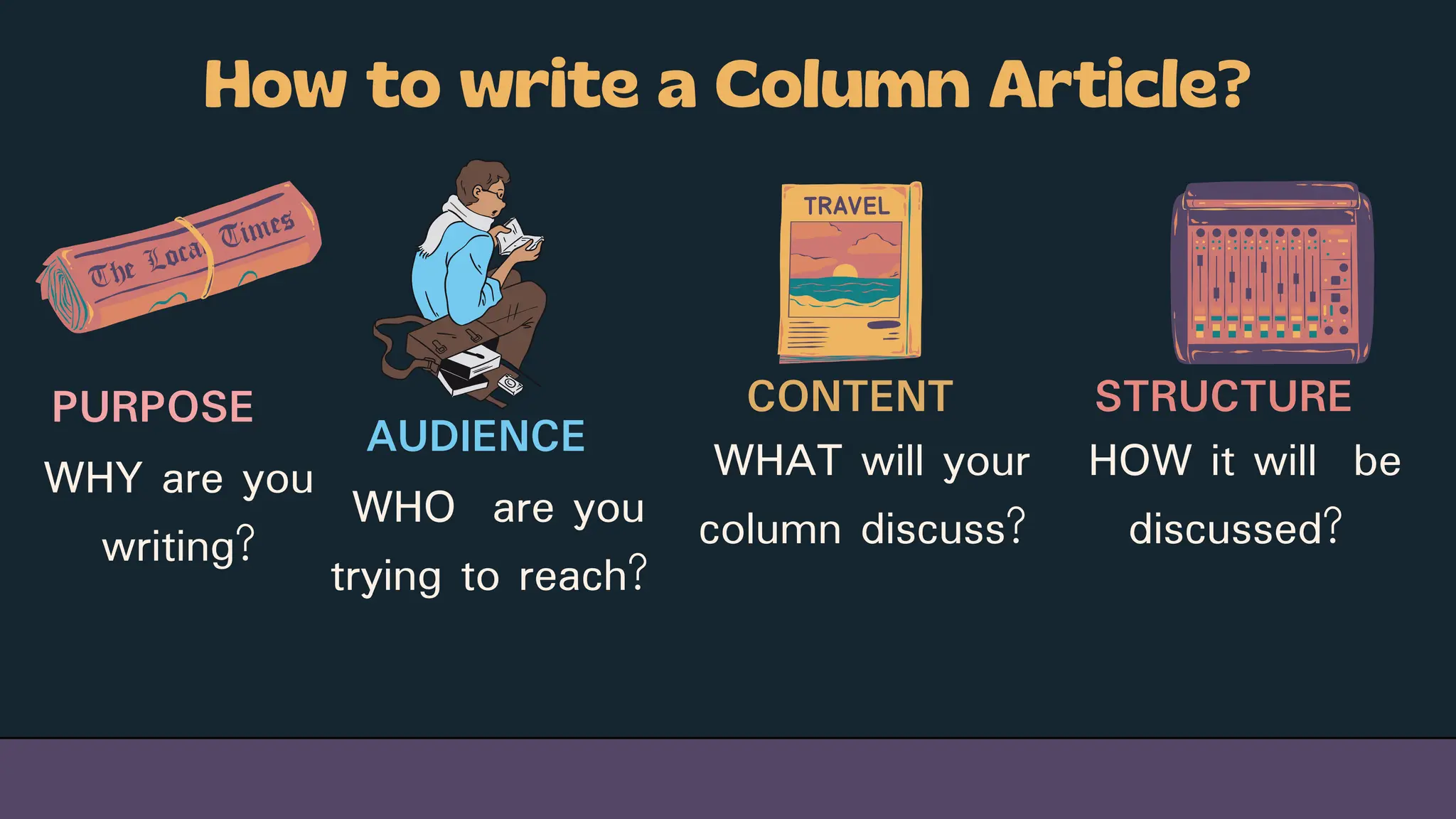
How to write a Column Article?
PURPOSE
WHY are you
writing?
AUDIENCE
WHO are you
trying to reach?
CONTENT
WHAT will your
column discuss?
STRUCTURE
HOW it will be
discussed?
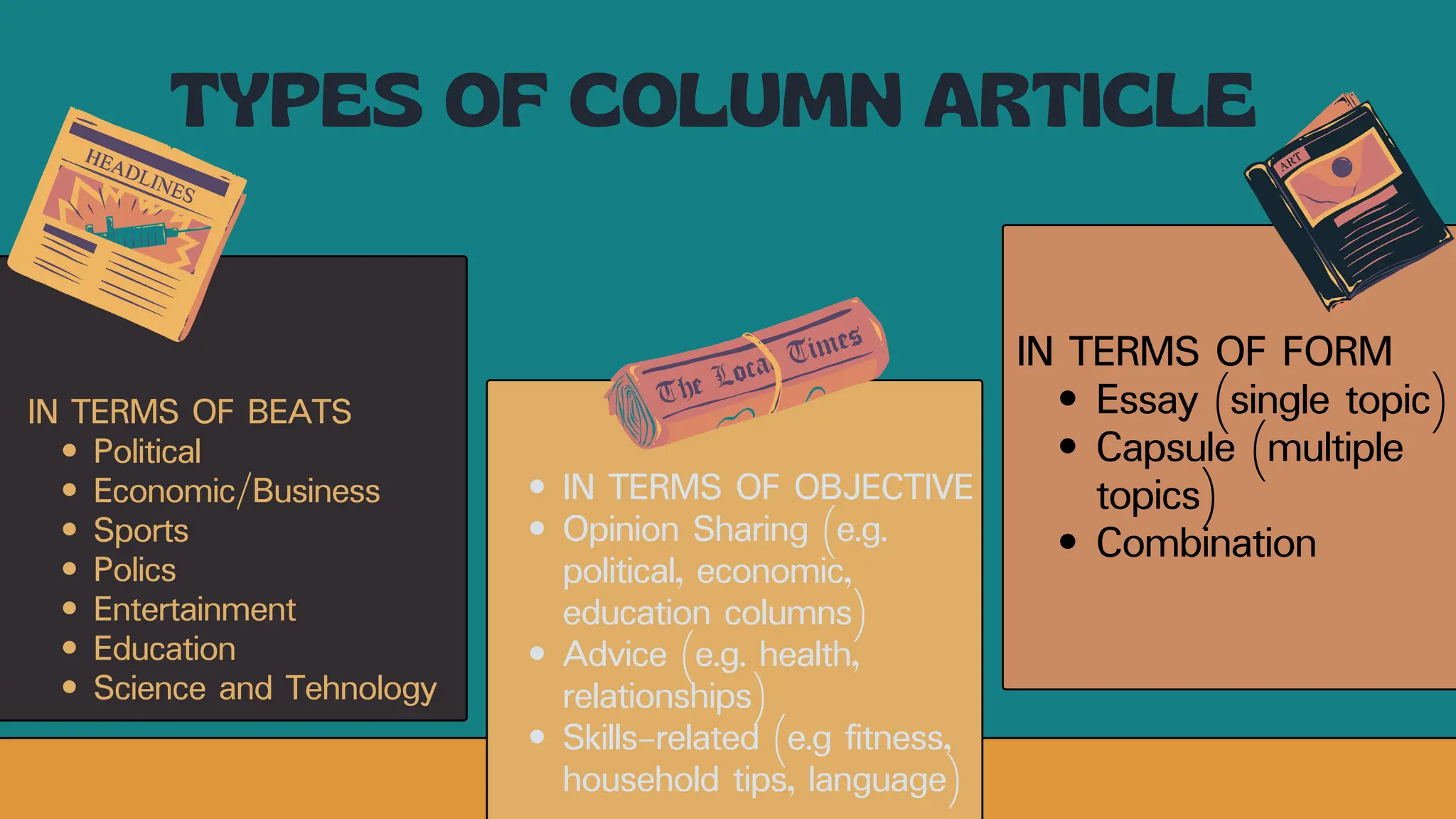
TYPES OF COLUMN ARTICLE
Political
Economic/Business
Sports
Polics
Entertainment
Education
Science and Tehnology
IN TERMS OF BEATS
IN TERMS OF OBJECTIVE
Opinion Sharing (e.g.
political, economic,
education columns)
Advice (e.g. health,
relationships)
Skills-related (e.g fitness,
household tips, language)
Essay (single topic)
Capsule (multiple
topics)
Combination
IN TERMS OF FORM
TIPS IN WRITING COLUMN
FIND YOUR VOICE
1.
A good way to find your voice is to read newspaper articles
that report just the facts, and then freewriting a response. Do
this with 5 or 6 articles, then chart how you reacted. You
might notice that you consistently take a sarcastic tone or an
optimistic one.
Your editor will also be able to help you refine your voice, so
don’t be afraid to reach out.
As a newspaper columnist, you’re charged to have distinct
opinions and a voice. Your voice could be humorous or dark, for
example.
2. HAVE AN OPINION
A good way to test your opinion is to ask yourself, “Will
someone have a strong reaction to my article?” If the answer is
yes, you’ve successfully formed an opinion. If your stance doesn’t
elicit any reaction, then you’ve probably written a very neutral
piece.
Make sure you can back that opinion up with researched
evidence. This will help persuade your readers to buy into your
opinion.
What distinguishes a newspaper column from an article is that a
column inserts an opinion where the article only reports facts in an
objective way. Forming an opinion is a good way to speak your
voice.
3. SHARE YOUR PERSONAL EXPERIENCES
If you’ve had a situation where prescription drug costs
buried you financially, start off your column with an
anecdote about this time in your life before you lay out
your fiery opinion on the high cost of prescription drugs
for seniors.
A good way to develop a voice and opinion is to draw from
your own personal experiences. Including anecdotes from
your own life will not only make you more relatable to your
reader, but also more credible.
4. WRITE IN FIRST PERSON
Since a column is based on your opinion, incorporate your
voice by using “I.” This will remind the reader of your
presence and will help establish which opinions presented
are yours. Instead of saying, “The facilities for race horses
are inadequate,” use first person to make the statement
more compelling. For example: “The facilities that I, as a
trainer, have visited don't meet the horses needs, which
affects their performance and well-being.”
5. LOOK TO CURRENT EVENTS
Your readers will be most interested in topics that are
dominating the news, such as politics or pop culture, and
not some obscure event that’s no longer relevant. Stay on
top of the news cycle and be ready to jump in with your
own opinion. Scan newspaper and magazine headlines to
see what events are most popular. These reoccurring issues
are ones that the general public will be interested in.
Often newspaper columns are about politics, but they can
draw on social issues also, such as prison conditions.
6. FIND AN INTERESTING
ANGLE FOR YOUR TOPIC
Providing your readers with a fresh approach to a story can
make your column appealing. Thinking about new angles for a
topic on current events will be sure to speak to readers. Don’t
be afraid to include yourself in your topic. Look at your own
personal history for a way to contribute something unique to
your column.
Dive into the details and see where they take you. Looking
closely at details may provoke a new idea.
Focusing on local angles is a great way to make your column
relevant to your reader.
7. CHOOSE A TOPIC FOR WHICH
YOU HAVE A SOLUTION
Have the conviction to suggest a solution or two for the
opinion you’ve stated. Readers are looking for answers when
they pick up a newspaper column, and it’s your job as the
columnist to provide them. If, for example, you’re going to
say, “Social media use by students during school hours is
crushing student productivity,” you’d better be prepared to
offer a solution to get students to put aside social media and
concentrate on the tasks at hand.
If you’ve got a strong point of view on a particular topic, but
have no solutions to offer, you should wait to write the
column until you’ve got more concrete solutions.
8. DO YOUR RESEARCH
While column writing does leave a lot of room for your
own personal voice, it should be anchored in facts. Backing
up your opinion with facts will help make your case for
your readers. You can conduct research at the library or
from your computer, but you can also conduct field
research by interviewing people involved in your story.
Always make sure you properly cite your sources.
If you include a quote be sure to name your source and
their expertise. This way the reader is able to assess the
reliability of that person's statement.
EXAMPLES OF
COLUMN ARTICLES
https://mb.com.ph/2022/09/27/improving-quality-of-philippine-education/
https://www.philstar.com/business/2022/07/04/2192779/crisis-education
https://www.philstar.com/business/2022/09/26/2212176/addressing-education-crisis
https://pilipinomirror.com/libreng-edukasyon-malinaw-ba-ito/
https://pahayagangthecatalyst.wordpress.com/2022/01/11/opinyon-panulat-laban-
sa-panunupil/
Sources:
https://projects.iq.harvard.edu/files/hks-communications-
program/files/new_seglin_how_to_write_an_oped_1_25_17_7.pdf
Opinion Writing for Campus Jopurnalist by Danilo A. Arao (UP-Diliman)
Column-Writing.pdf hgssfgefgkffdgbnxjshgfdfg

Column-Writing.pdf hgssfgefgkffdgbnxjshgfdfg

  • 1.
    ANDRES C. MATAWARAN EDUCATIONPROGRAM SUPERVISOR-ENGLISH SDO BATAAN
  • 2.
    Objectives Define and Understandcolumn article and its types; Distinguish the various types of column article ; and Identify the parts of column article 1. 2. 3.
  • 3.
    DISCUSSION OUTLINE What isColumn? Objectives of Column How to write a Column Article? Types of Column Article Tips in Writing a Column Article
  • 4.
    What is ColumnArticle? Journalistic output that shows the writer's opinion on the chosen topic or topics. Appears regularly on a designated page and/or location (e.g. above or below the fold, left or right). Normally has a specific style, tone or "approach" in writing and analyzing. Normally has a specific scope based on the columnist's specialization. It is often personal, using the first or second person (I and You)
  • 5.
    Objectives of aColumn Column should use the language that is understood by the target audience Column should discuss both local and national concerns (the latter being analyzed in relation to the local context) Column should reflect the writer's advocacy In the context of campus journalism
  • 6.
    Objectives of aColumn Column should explain the writer's stand on a selected topic or topics (attack, defend, endorse or compliment) Column should clarify points of fact or argument that readers may find confusing or complicated. Column should mobilize readers to action (explicitly or implicitly) In the context of campus journalism
  • 7.
    How to writea Column Article? PURPOSE WHY are you writing? AUDIENCE WHO are you trying to reach? CONTENT WHAT will your column discuss? STRUCTURE HOW it will be discussed?
  • 8.
    TYPES OF COLUMNARTICLE Political Economic/Business Sports Polics Entertainment Education Science and Tehnology IN TERMS OF BEATS IN TERMS OF OBJECTIVE Opinion Sharing (e.g. political, economic, education columns) Advice (e.g. health, relationships) Skills-related (e.g fitness, household tips, language) Essay (single topic) Capsule (multiple topics) Combination IN TERMS OF FORM
  • 9.
  • 10.
    FIND YOUR VOICE 1. Agood way to find your voice is to read newspaper articles that report just the facts, and then freewriting a response. Do this with 5 or 6 articles, then chart how you reacted. You might notice that you consistently take a sarcastic tone or an optimistic one. Your editor will also be able to help you refine your voice, so don’t be afraid to reach out. As a newspaper columnist, you’re charged to have distinct opinions and a voice. Your voice could be humorous or dark, for example.
  • 11.
    2. HAVE ANOPINION A good way to test your opinion is to ask yourself, “Will someone have a strong reaction to my article?” If the answer is yes, you’ve successfully formed an opinion. If your stance doesn’t elicit any reaction, then you’ve probably written a very neutral piece. Make sure you can back that opinion up with researched evidence. This will help persuade your readers to buy into your opinion. What distinguishes a newspaper column from an article is that a column inserts an opinion where the article only reports facts in an objective way. Forming an opinion is a good way to speak your voice.
  • 12.
    3. SHARE YOURPERSONAL EXPERIENCES If you’ve had a situation where prescription drug costs buried you financially, start off your column with an anecdote about this time in your life before you lay out your fiery opinion on the high cost of prescription drugs for seniors. A good way to develop a voice and opinion is to draw from your own personal experiences. Including anecdotes from your own life will not only make you more relatable to your reader, but also more credible.
  • 13.
    4. WRITE INFIRST PERSON Since a column is based on your opinion, incorporate your voice by using “I.” This will remind the reader of your presence and will help establish which opinions presented are yours. Instead of saying, “The facilities for race horses are inadequate,” use first person to make the statement more compelling. For example: “The facilities that I, as a trainer, have visited don't meet the horses needs, which affects their performance and well-being.”
  • 14.
    5. LOOK TOCURRENT EVENTS Your readers will be most interested in topics that are dominating the news, such as politics or pop culture, and not some obscure event that’s no longer relevant. Stay on top of the news cycle and be ready to jump in with your own opinion. Scan newspaper and magazine headlines to see what events are most popular. These reoccurring issues are ones that the general public will be interested in. Often newspaper columns are about politics, but they can draw on social issues also, such as prison conditions.
  • 15.
    6. FIND ANINTERESTING ANGLE FOR YOUR TOPIC Providing your readers with a fresh approach to a story can make your column appealing. Thinking about new angles for a topic on current events will be sure to speak to readers. Don’t be afraid to include yourself in your topic. Look at your own personal history for a way to contribute something unique to your column. Dive into the details and see where they take you. Looking closely at details may provoke a new idea. Focusing on local angles is a great way to make your column relevant to your reader.
  • 16.
    7. CHOOSE ATOPIC FOR WHICH YOU HAVE A SOLUTION Have the conviction to suggest a solution or two for the opinion you’ve stated. Readers are looking for answers when they pick up a newspaper column, and it’s your job as the columnist to provide them. If, for example, you’re going to say, “Social media use by students during school hours is crushing student productivity,” you’d better be prepared to offer a solution to get students to put aside social media and concentrate on the tasks at hand. If you’ve got a strong point of view on a particular topic, but have no solutions to offer, you should wait to write the column until you’ve got more concrete solutions.
  • 17.
    8. DO YOURRESEARCH While column writing does leave a lot of room for your own personal voice, it should be anchored in facts. Backing up your opinion with facts will help make your case for your readers. You can conduct research at the library or from your computer, but you can also conduct field research by interviewing people involved in your story. Always make sure you properly cite your sources. If you include a quote be sure to name your source and their expertise. This way the reader is able to assess the reliability of that person's statement.
  • 18.
  • 19.