Fely Rose M. Nacario, PhD
Resource Speaker on
COLUMN WRITING
Published Poet and Writer at Amazon
• Author of Soul’s Songs (2020)
• Rhythm of Life (2020)
• On Wings of Love (2021)
• Lotus Amidst Storms and Other
Poems (2021
Date: November 19,-21 2021
National Webinar on Campus Journalism
Facing the Challenges on Digital Journalism and Media Trends
Objectives
General:
• Understanding column writing
and its types
Specific:
• Distinguish the various types of
column
• Remember the principles and
suggestions in column writing
• Engage oneself in column writing
and use effective strategies in
National Webinar on Campus Journalism
Facing the Challenges on Digital Journalism and Media Trends
COLUMN WRITING : Overview
1 What is a Column?
2 How do you write a Column?
2.1 Purpose
2.2 Audience
2.3 Content
2.4 Structure
3 Kinds of Column Writing
3.1 Sports Columns
3.2 Political Columns
3.3 Advice Columns
3.4 Humor Columns
3.5 Local Columns
4 Column Suggestions
5. Sample Columns
WORKSHOP____________________
National Webinar on Campus Journalism
Facing the Challenges on Digital Journalism and Media Trends
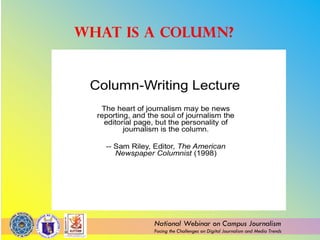
WHAT IS A COLUMN?
National Webinar on Campus Journalism
Facing the Challenges on Digital Journalism and Media Trends
WHAT IS A COLUMN?
1. Does it answer what and who?
2. Does it use “I” and “You”?
3. Does it have parts?
4. Does the writer need facts?
5. Is it a news or a news article?
6. Is it formal or informal?
7. Is it objective or subjective?
8. Is it personal or impersonal?
9. Are the topics restricted or varied?
10. Does it use familiar or unfamiliar words?
National Webinar on Campus Journalism
Facing the Challenges on Digital Journalism and Media Trends
WHAT IS COLUMN?
• A recurring feature by the same author
in a newspaper, magazine or website.
• Expresses the views of the columnists;
• Characterized by voice, personality and
opinions of the writer.
National Webinar on Campus Journalism
Facing the Challenges on Digital Journalism and Media Trends
WHAT IS COLUMN WRITING?
• Columns in journalism are best known
for the columnist (journalist, expert in
the field, like sports, politics, etc)
• Column writing in journalism can be
focused on any topic from politics, to
sports, to religion, to gardening
National Webinar on Campus Journalism
Facing the Challenges on Digital Journalism and Media Trends
WHAT IS COLUMN WRITING?
• A column is not a news article, but it is
news.
• It generally answers why and how.
• It often is personal, using the first and
second person (I and you).
• A column often states an opinion.
• A column also has a standard head, called
a title, and a by-line (name) at the top.
National Webinar on Campus Journalism
Facing the Challenges on Digital Journalism and Media Trends
Sample of a COLUMN
National Webinar on Campus Journalism
Facing the Challenges on Digital Journalism and Media Trends
How do you
write a column?
National Webinar on Campus Journalism
Facing the Challenges on Digital Journalism and Media Trends
PURPOSE
• Why are you writing?
• Is it to inform the community about an
event?
• Does the paper's editor, the community or
co-workers want it?
• Are you entertaining, informing or
educating?
• Do you seek an identity or exposure?
National Webinar on Campus Journalism
Facing the Challenges on Digital Journalism and Media Trends
AUDIENCE
• Whom are you trying to reach?
• Who are you reaching?
• Write in their language, at their level,
about things the audience needs to
know or wants to know
National Webinar on Campus Journalism
Facing the Challenges on Digital Journalism and Media Trends
CONTENT
• What will your column discuss?
• How will you discuss it?
Answer why and how to determine what.
Columns: based on facts and should be
accurate.
• Names are crucial in a personal column.
Personal columns may be informal; yet
accuracy and sourcing material counts.
National Webinar on Campus Journalism
Facing the Challenges on Digital Journalism and Media Trends
STRUCTURE
• How will your message get to your
audience?
"question and answer,"
"new ideas,"
"how-to-do-it" pieces or
"calendars."
National Webinar on Campus Journalism
Facing the Challenges on Digital Journalism and Media Trends
STRUCTURE
• Personal columns often have
departments.
"coming events,"
applications,
notes or other categories
• Decide on the purpose, content,
audience and structure.
National Webinar on Campus Journalism
Facing the Challenges on Digital Journalism and Media Trends
Kinds of
column writing
National Webinar on Campus Journalism
Facing the Challenges on Digital Journalism and Media Trends
SPORTS COLUMNS
• Sports columns offer analysis
and opinion on sports news and
trends.
• While sports reporters cover
events in real time, sports
columnists explore the broader
implications of those events.
National Webinar on Campus Journalism
Facing the Challenges on Digital Journalism and Media Trends
SPORTS COLUMNS
• Provides partisan viewpoints and
arguments, as well as analysis of
political news.
• Political columnists often use wit
and satire to criticize politicians or
certain policies
National Webinar on Campus Journalism
Facing the Challenges on Digital Journalism and Media Trends
ADVICE COLUMNS
• Provides readers with help and guidance
on specific topics.
• Advice columnists - experts in their
respective fields.
• Columnist on auto repair tell readers how
to diagnose engine problems or change
their oil.
• A lawyer with expertise in probate or
estate law might instruct readers how to
make a will.
National Webinar on Campus Journalism
Facing the Challenges on Digital Journalism and Media Trends
HUMOR COLUMNS
• Designed to inform the readership and tickle
their funny bones at the same time.
• Humorists explore current events with wit,
playfulness and levity, providing comic relief
from hard news.
• Humorists- known for their distinct voice and
personality, and for exploring difficult issues in
funny ways.
• Example: Dave Barry of "The Miami Herald"
National Webinar on Campus Journalism
Facing the Challenges on Digital Journalism and Media Trends
LOCAL COLUMNS
• Mix humor, human interest stories,
news and political coverage, even
sports, as long as the content is
relevant to local readers.
• Have long functioned as a way for
publications to connect with their
community, and for writers to explore
local issues with style and personality.
National Webinar on Campus Journalism
Facing the Challenges on Digital Journalism and Media Trends
COLUMN SUGGESTIONS
By Debrah Jefferson
DO in Writing a Column
• Give the reader timely, helpful information.
• Develop a structure and keep it.
• Write on a regular schedule.
• Write simple and short sentences and paragraphs.
• In personal columns, use local names and places.
• Use of quotes and references.
• Learn the difference between a column and a news
story.
National Webinar on Campus Journalism
Facing the Challenges on Digital Journalism and Media Trends
COLUMN SUGGESTIONS
By Debrah Jefferson
DON’T in Writing a Column
• Use technical or complex words.
• Talk in jargon or unfamiliar terms.
• Talk about one topic constantly.
• Include too much detail or material.
• Stimulate interest, not exhaust a subject.
• Refer to yourself as a third person (this
author, your reporter) or quote yourself
(Jimmy Jones said). Instead use mine.
National Webinar on Campus Journalism
Facing the Challenges on Digital Journalism and Media Trends
COLUMN SUGGESTIONS
1. Be specific
2. Use active voice
Ex. “The owl hooted “ is stronger than “An
owl’s hoot was heard.”
3. Use Quotes – writing event, person,
idea, refer to an authority
4. Use characterization -
Ex.Faraz is a short, rumpled little man who
wears a blue beret and his collar turned up.He
has a fat nose and big ears.
National Webinar on Campus Journalism
Facing the Challenges on Digital Journalism and Media Trends
COLUMN SUGGESTIONS
5. Use carry over transitional
devices
6. Show don’t tell
Ex. “The professor acted strange.”
The professor drooled on his tie, staggered
against the blackboard, and slid to the floor,
moaning.”
7. Describe scenes
8. Use vivid, figures of speech
9. Use analogies
National Webinar on Campus Journalism
Facing the Challenges on Digital Journalism and Media Trends
COLUMN SUGGESTIONS
TIPS from Billybuc’s House of Writing Tips
WRITE WITH POWER AND CONVICTION
• Believe in your opinion; write about it
• Strength of your conviction should be
apparent
• Sell your viewpoint with a strong
statements
National Webinar on Campus Journalism
Facing the Challenges on Digital Journalism and Media Trends
COLUMN SUGGESTIONS
TIPS from Billybuc’s House of Writing Tips
KEEP YOUR FOCUS
• Make your article about one thing only
• Stray not from your message.
• Focus on your title; make a strong
impression.
National Webinar on Campus Journalism
Facing the Challenges on Digital Journalism and Media Trends
COLUMN SUGGESTIONS
TIPS from Billybuc’s House of Writing Tips
BE AWARE OF OPPOSITE VIEWPOINTS
• Anticipate what will be said against you so that
you have arguments ready to combat the
negative comments.
• Respond to objections before they are made.
• Be proactive and convincing rather than
reactive and wishy-washy.
National Webinar on Campus Journalism
Facing the Challenges on Digital Journalism and Media Trends
COLUMN SUGGESTIONS
TIPS from Billybuc’s House of Writing Tips
USE SIMPLE ANALOGIES
• Readers associate better with an example from
real life. (complicated or technical subject)
• Use a simple analogy to drive your point
home. Your readers will appreciate it and be
much more willing to sign on to your point of
view
National Webinar on Campus Journalism
Facing the Challenges on Digital Journalism and Media Trends
COLUMN SUGGESTIONS
TIPS from Billybuc’s House of Writing Tips
USE FACTS
• Use facts and statistics.
• Back your opinion up with some facts.
• Don’t be a loudmouth and speak nonsense.
• Use facts in your article so your argument
carries weight with the reader.
National Webinar on Campus Journalism
Facing the Challenges on Digital Journalism and Media Trends
COLUMN SUGGESTIONS
TIPS from Billybuc’s House of Writing Tips
NAME REAL PEOPLE AS EXAMPLES
• Nameless concepts and policies mean very little to
the average reader.
• Naming a celebrity who they recognize carries much
more weight.
• If you are doing a controversial piece, don’t be afraid
to name real people and criticize them.
• Just don’t be too critical or you run the risk of
sounding a bit deranged and obsessive.
National Webinar on Campus Journalism
Facing the Challenges on Digital Journalism and Media Trends
Sample
Column
1
National Webinar on Campus Journalism
Facing the Challenges on Digital Journalism and Media Trends
Sample
Column
2
National Webinar on Campus Journalism
Facing the Challenges on Digital Journalism and Media Trends
Sample
Column
3
National Webinar on Campus Journalism
Facing the Challenges on Digital Journalism and Media Trends
Sample
Column
4
National Webinar on Campus Journalism
Facing the Challenges on Digital Journalism and Media Trends
Sample
Column
5
National Webinar on Campus Journalism
Facing the Challenges on Digital Journalism and Media Trends
Sample
column
6
National Webinar on Campus Journalism
Facing the Challenges on Digital Journalism and Media Trends
Sample
column
6
National Webinar on Campus Journalism
Facing the Challenges on Digital Journalism and Media Trends
TOPICS FOR WORKSHOP
• Why I Should Vote for the Best
Candidate
• Elections and the Future of the Youth
• Vaccination Should Not Be Imposed
on People
National Webinar on Campus Journalism
Facing the Challenges on Digital Journalism and Media Trends
REFERENCES
Debrah Jefferson, Writing Columns, Extension and Agricultural Information
https://extension.missouri.edu/cm360?fbclid=IwAR1jSeBp-
esYTjMtKXrWQ2be7TsfBnG1oyHuIZqMEbOvCOz9kg43msFfvMU#example
https://study.com/academy/answer/what-is-column-
writing-in-journalism.html
https://penandthepad.com/types-columns-journalism-
6048715.html
https://owlcation.com/academia/Ten-Tips-For-Better-
Column-and-Article-Writing
National Webinar on Campus Journalism
Facing the Challenges on Digital Journalism and Media Trends
TOPICS FOR WORKSHOP
• Why I Should Vote for the Best
Candidate
• Elections and the Future of the Youth
• Vaccination Should Not Be Imposed
on People
National Webinar on Campus Journalism
Facing the Challenges on Digital Journalism and Media Trends
Rubrics in Column Writing
National Webinar on Campus Journalism
Facing the Challenges on Digital Journalism and Media Trends

ColumnWriting-DrFMNacario-1.pdf

  • 1.
    Fely Rose M.Nacario, PhD Resource Speaker on COLUMN WRITING Published Poet and Writer at Amazon • Author of Soul’s Songs (2020) • Rhythm of Life (2020) • On Wings of Love (2021) • Lotus Amidst Storms and Other Poems (2021 Date: November 19,-21 2021
  • 2.
    National Webinar onCampus Journalism Facing the Challenges on Digital Journalism and Media Trends Objectives General: • Understanding column writing and its types Specific: • Distinguish the various types of column • Remember the principles and suggestions in column writing • Engage oneself in column writing and use effective strategies in
  • 3.
    National Webinar onCampus Journalism Facing the Challenges on Digital Journalism and Media Trends COLUMN WRITING : Overview 1 What is a Column? 2 How do you write a Column? 2.1 Purpose 2.2 Audience 2.3 Content 2.4 Structure 3 Kinds of Column Writing 3.1 Sports Columns 3.2 Political Columns 3.3 Advice Columns 3.4 Humor Columns 3.5 Local Columns 4 Column Suggestions 5. Sample Columns WORKSHOP____________________
  • 4.
    National Webinar onCampus Journalism Facing the Challenges on Digital Journalism and Media Trends WHAT IS A COLUMN?
  • 5.
    National Webinar onCampus Journalism Facing the Challenges on Digital Journalism and Media Trends WHAT IS A COLUMN? 1. Does it answer what and who? 2. Does it use “I” and “You”? 3. Does it have parts? 4. Does the writer need facts? 5. Is it a news or a news article? 6. Is it formal or informal? 7. Is it objective or subjective? 8. Is it personal or impersonal? 9. Are the topics restricted or varied? 10. Does it use familiar or unfamiliar words?
  • 6.
    National Webinar onCampus Journalism Facing the Challenges on Digital Journalism and Media Trends WHAT IS COLUMN? • A recurring feature by the same author in a newspaper, magazine or website. • Expresses the views of the columnists; • Characterized by voice, personality and opinions of the writer.
  • 7.
    National Webinar onCampus Journalism Facing the Challenges on Digital Journalism and Media Trends WHAT IS COLUMN WRITING? • Columns in journalism are best known for the columnist (journalist, expert in the field, like sports, politics, etc) • Column writing in journalism can be focused on any topic from politics, to sports, to religion, to gardening
  • 8.
    National Webinar onCampus Journalism Facing the Challenges on Digital Journalism and Media Trends WHAT IS COLUMN WRITING? • A column is not a news article, but it is news. • It generally answers why and how. • It often is personal, using the first and second person (I and you). • A column often states an opinion. • A column also has a standard head, called a title, and a by-line (name) at the top.
  • 9.
    National Webinar onCampus Journalism Facing the Challenges on Digital Journalism and Media Trends Sample of a COLUMN
  • 10.
    National Webinar onCampus Journalism Facing the Challenges on Digital Journalism and Media Trends How do you write a column?
  • 11.
    National Webinar onCampus Journalism Facing the Challenges on Digital Journalism and Media Trends PURPOSE • Why are you writing? • Is it to inform the community about an event? • Does the paper's editor, the community or co-workers want it? • Are you entertaining, informing or educating? • Do you seek an identity or exposure?
  • 12.
    National Webinar onCampus Journalism Facing the Challenges on Digital Journalism and Media Trends AUDIENCE • Whom are you trying to reach? • Who are you reaching? • Write in their language, at their level, about things the audience needs to know or wants to know
  • 13.
    National Webinar onCampus Journalism Facing the Challenges on Digital Journalism and Media Trends CONTENT • What will your column discuss? • How will you discuss it? Answer why and how to determine what. Columns: based on facts and should be accurate. • Names are crucial in a personal column. Personal columns may be informal; yet accuracy and sourcing material counts.
  • 14.
    National Webinar onCampus Journalism Facing the Challenges on Digital Journalism and Media Trends STRUCTURE • How will your message get to your audience? "question and answer," "new ideas," "how-to-do-it" pieces or "calendars."
  • 15.
    National Webinar onCampus Journalism Facing the Challenges on Digital Journalism and Media Trends STRUCTURE • Personal columns often have departments. "coming events," applications, notes or other categories • Decide on the purpose, content, audience and structure.
  • 16.
    National Webinar onCampus Journalism Facing the Challenges on Digital Journalism and Media Trends Kinds of column writing
  • 17.
    National Webinar onCampus Journalism Facing the Challenges on Digital Journalism and Media Trends SPORTS COLUMNS • Sports columns offer analysis and opinion on sports news and trends. • While sports reporters cover events in real time, sports columnists explore the broader implications of those events.
  • 18.
    National Webinar onCampus Journalism Facing the Challenges on Digital Journalism and Media Trends SPORTS COLUMNS • Provides partisan viewpoints and arguments, as well as analysis of political news. • Political columnists often use wit and satire to criticize politicians or certain policies
  • 19.
    National Webinar onCampus Journalism Facing the Challenges on Digital Journalism and Media Trends ADVICE COLUMNS • Provides readers with help and guidance on specific topics. • Advice columnists - experts in their respective fields. • Columnist on auto repair tell readers how to diagnose engine problems or change their oil. • A lawyer with expertise in probate or estate law might instruct readers how to make a will.
  • 20.
    National Webinar onCampus Journalism Facing the Challenges on Digital Journalism and Media Trends HUMOR COLUMNS • Designed to inform the readership and tickle their funny bones at the same time. • Humorists explore current events with wit, playfulness and levity, providing comic relief from hard news. • Humorists- known for their distinct voice and personality, and for exploring difficult issues in funny ways. • Example: Dave Barry of "The Miami Herald"
  • 21.
    National Webinar onCampus Journalism Facing the Challenges on Digital Journalism and Media Trends LOCAL COLUMNS • Mix humor, human interest stories, news and political coverage, even sports, as long as the content is relevant to local readers. • Have long functioned as a way for publications to connect with their community, and for writers to explore local issues with style and personality.
  • 22.
    National Webinar onCampus Journalism Facing the Challenges on Digital Journalism and Media Trends COLUMN SUGGESTIONS By Debrah Jefferson DO in Writing a Column • Give the reader timely, helpful information. • Develop a structure and keep it. • Write on a regular schedule. • Write simple and short sentences and paragraphs. • In personal columns, use local names and places. • Use of quotes and references. • Learn the difference between a column and a news story.
  • 23.
    National Webinar onCampus Journalism Facing the Challenges on Digital Journalism and Media Trends COLUMN SUGGESTIONS By Debrah Jefferson DON’T in Writing a Column • Use technical or complex words. • Talk in jargon or unfamiliar terms. • Talk about one topic constantly. • Include too much detail or material. • Stimulate interest, not exhaust a subject. • Refer to yourself as a third person (this author, your reporter) or quote yourself (Jimmy Jones said). Instead use mine.
  • 24.
    National Webinar onCampus Journalism Facing the Challenges on Digital Journalism and Media Trends COLUMN SUGGESTIONS 1. Be specific 2. Use active voice Ex. “The owl hooted “ is stronger than “An owl’s hoot was heard.” 3. Use Quotes – writing event, person, idea, refer to an authority 4. Use characterization - Ex.Faraz is a short, rumpled little man who wears a blue beret and his collar turned up.He has a fat nose and big ears.
  • 25.
    National Webinar onCampus Journalism Facing the Challenges on Digital Journalism and Media Trends COLUMN SUGGESTIONS 5. Use carry over transitional devices 6. Show don’t tell Ex. “The professor acted strange.” The professor drooled on his tie, staggered against the blackboard, and slid to the floor, moaning.” 7. Describe scenes 8. Use vivid, figures of speech 9. Use analogies
  • 26.
    National Webinar onCampus Journalism Facing the Challenges on Digital Journalism and Media Trends COLUMN SUGGESTIONS TIPS from Billybuc’s House of Writing Tips WRITE WITH POWER AND CONVICTION • Believe in your opinion; write about it • Strength of your conviction should be apparent • Sell your viewpoint with a strong statements
  • 27.
    National Webinar onCampus Journalism Facing the Challenges on Digital Journalism and Media Trends COLUMN SUGGESTIONS TIPS from Billybuc’s House of Writing Tips KEEP YOUR FOCUS • Make your article about one thing only • Stray not from your message. • Focus on your title; make a strong impression.
  • 28.
    National Webinar onCampus Journalism Facing the Challenges on Digital Journalism and Media Trends COLUMN SUGGESTIONS TIPS from Billybuc’s House of Writing Tips BE AWARE OF OPPOSITE VIEWPOINTS • Anticipate what will be said against you so that you have arguments ready to combat the negative comments. • Respond to objections before they are made. • Be proactive and convincing rather than reactive and wishy-washy.
  • 29.
    National Webinar onCampus Journalism Facing the Challenges on Digital Journalism and Media Trends COLUMN SUGGESTIONS TIPS from Billybuc’s House of Writing Tips USE SIMPLE ANALOGIES • Readers associate better with an example from real life. (complicated or technical subject) • Use a simple analogy to drive your point home. Your readers will appreciate it and be much more willing to sign on to your point of view
  • 30.
    National Webinar onCampus Journalism Facing the Challenges on Digital Journalism and Media Trends COLUMN SUGGESTIONS TIPS from Billybuc’s House of Writing Tips USE FACTS • Use facts and statistics. • Back your opinion up with some facts. • Don’t be a loudmouth and speak nonsense. • Use facts in your article so your argument carries weight with the reader.
  • 31.
    National Webinar onCampus Journalism Facing the Challenges on Digital Journalism and Media Trends COLUMN SUGGESTIONS TIPS from Billybuc’s House of Writing Tips NAME REAL PEOPLE AS EXAMPLES • Nameless concepts and policies mean very little to the average reader. • Naming a celebrity who they recognize carries much more weight. • If you are doing a controversial piece, don’t be afraid to name real people and criticize them. • Just don’t be too critical or you run the risk of sounding a bit deranged and obsessive.
  • 32.
    National Webinar onCampus Journalism Facing the Challenges on Digital Journalism and Media Trends Sample Column 1
  • 33.
    National Webinar onCampus Journalism Facing the Challenges on Digital Journalism and Media Trends Sample Column 2
  • 34.
    National Webinar onCampus Journalism Facing the Challenges on Digital Journalism and Media Trends Sample Column 3
  • 35.
    National Webinar onCampus Journalism Facing the Challenges on Digital Journalism and Media Trends Sample Column 4
  • 36.
    National Webinar onCampus Journalism Facing the Challenges on Digital Journalism and Media Trends Sample Column 5
  • 37.
    National Webinar onCampus Journalism Facing the Challenges on Digital Journalism and Media Trends Sample column 6
  • 38.
    National Webinar onCampus Journalism Facing the Challenges on Digital Journalism and Media Trends Sample column 6
  • 39.
    National Webinar onCampus Journalism Facing the Challenges on Digital Journalism and Media Trends TOPICS FOR WORKSHOP • Why I Should Vote for the Best Candidate • Elections and the Future of the Youth • Vaccination Should Not Be Imposed on People
  • 40.
    National Webinar onCampus Journalism Facing the Challenges on Digital Journalism and Media Trends REFERENCES Debrah Jefferson, Writing Columns, Extension and Agricultural Information https://extension.missouri.edu/cm360?fbclid=IwAR1jSeBp- esYTjMtKXrWQ2be7TsfBnG1oyHuIZqMEbOvCOz9kg43msFfvMU#example https://study.com/academy/answer/what-is-column- writing-in-journalism.html https://penandthepad.com/types-columns-journalism- 6048715.html https://owlcation.com/academia/Ten-Tips-For-Better- Column-and-Article-Writing
  • 41.
    National Webinar onCampus Journalism Facing the Challenges on Digital Journalism and Media Trends TOPICS FOR WORKSHOP • Why I Should Vote for the Best Candidate • Elections and the Future of the Youth • Vaccination Should Not Be Imposed on People
  • 42.
    National Webinar onCampus Journalism Facing the Challenges on Digital Journalism and Media Trends Rubrics in Column Writing
  • 43.
    National Webinar onCampus Journalism Facing the Challenges on Digital Journalism and Media Trends