COLUMNS USED IN HPLC
MODERN PHARMACEUTICALANALYTICAL
TECHNIQUES
PRESENTED BY:- ADHWITHA RAI K S
NU24PHPY01
1st
MPHARM
CONTENTS:-
➢ INTRODUCTION
➢ COLUMNS USED IN HPLC
➢ SEPARATION/ ANALYTICAL COLUMNS
➢ GUARD COLUMNS AND IN-LINE FILTERS
➢ TYPES OF COLUMNS
➢ COLUMN PACKING
➢ USP LISTING OF COLUMNS
➢ FACTORS AFFECTING COLUMN SELECTION
➢ CONCLUSION
➢ REFERENCES
INTRODUCTION
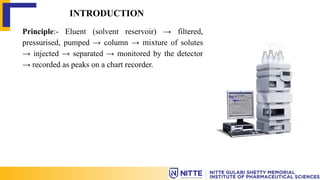
Principle:- Eluent (solvent reservoir) → filtered,
pressurised, pumped → column → mixture of solutes
→ injected → separated → monitored by the detector
→ recorded as peaks on a chart recorder.
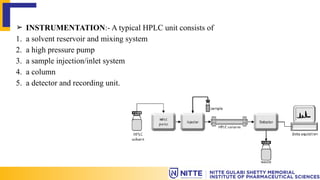
➢ INSTRUMENTATION:- A typical HPLC unit consists of
1. a solvent reservoir and mixing system
2. a high pressure pump
3. a sample injection/inlet system
4. a column
5. a detector and recording unit.
COLUMNS USED IN HPLC
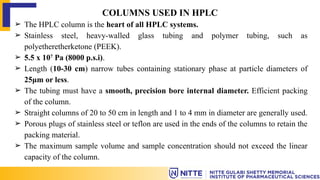
➢ The HPLC column is the heart of all HPLC systems.
➢ Stainless steel, heavy-walled glass tubing and polymer tubing, such as
polyetheretherketone (PEEK).
➢ 5.5 x 10⁷
Pa (8000 p.s.i).
➢ Length (10-30 cm) narrow tubes containing stationary phase at particle diameters of
25μm or less.
➢ The tubing must have a smooth, precision bore internal diameter. Efficient packing
of the column.
➢ Straight columns of 20 to 50 cm in length and 1 to 4 mm in diameter are generally used.
➢ Porous plugs of stainless steel or teflon are used in the ends of the columns to retain the
packing material.
➢ The maximum sample volume and sample concentration should not exceed the linear
capacity of the column.
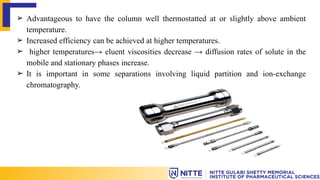
➢ Advantageous to have the column well thermostatted at or slightly above ambient
temperature.
➢ Increased efficiency can be achieved at higher temperatures.
➢ higher temperatures→ eluent viscosities decrease → diffusion rates of solute in the
mobile and stationary phases increase.
➢ It is important in some separations involving liquid partition and ion-exchange
chromatography.
SEPARATION/ ANALYTICAL COLUMNS
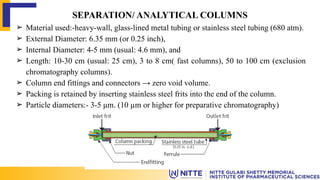
➢ Material used:-heavy-wall, glass-lined metal tubing or stainless steel tubing (680 atm).
➢ External Diameter: 6.35 mm (or 0.25 inch),
➢ Internal Diameter: 4-5 mm (usual: 4.6 mm), and
➢ Length: 10-30 cm (usual: 25 cm), 3 to 8 cm( fast columns), 50 to 100 cm (exclusion
chromatography columns).
➢ Column end fittings and connectors → zero void volume.
➢ Packing is retained by inserting stainless steel frits into the end of the column.
➢ Particle diameters:- 3-5 μm. (10 µm or higher for preparative chromatography)
Radial Compression Columns
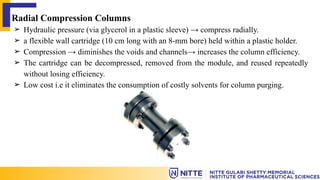
➢ Hydraulic pressure (via glycerol in a plastic sleeve) → compress radially.
➢ a flexible wall cartridge (10 cm long with an 8-mm bore) held within a plastic holder.
➢ Compression → diminishes the voids and channels→ increases the column efficiency.
➢ The cartridge can be decompressed, removed from the module, and reused repeatedly
without losing efficiency.
➢ Low cost i.e it eliminates the consumption of costly solvents for column purging.
Narrow-Bore Columns
➢ Decreasing the internal diameter of the column by a
factor of 2 increases the signal of a sample component
by a factor of 4.
➢ The linear column velocity of the mobile phase and
the analysis time→ same.
➢ unconventional solvents or high-purity solvents
➢ Better homogeneity in packing density over the cross-
sectional area of the bed
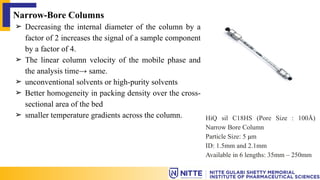
➢ smaller temperature gradients across the column. HiQ sil C18HS (Pore Size : 100Å)
Narrow Bore Column
Particle Size: 5 μm
ID: 1.5mm and 2.1mm
Available in 6 lengths: 35mm – 250mm
Short, Fast Columns
➢ short (3-6 cm), packed with 3-μm particles.
➢ Save solvent costs,
➢ increase sample throughput,
➢ deliver higher sensitivity than conventional-length columns.
➢ Analysis times : 15-120 sec (isocratic elution) and 1-4 min (gradient elution).
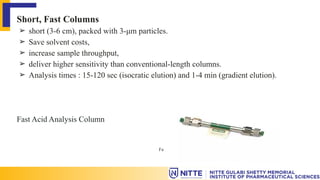
Fast Acid Analysis Column
Fa
GUARD COLUMNS AND IN-LINE FILTERS
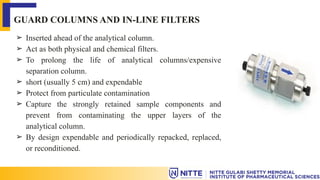
➢ Inserted ahead of the analytical column.
➢ Act as both physical and chemical filters.
➢ To prolong the life of analytical columns/expensive
separation column.
➢ short (usually 5 cm) and expendable
➢ Protect from particulate contamination
➢ Capture the strongly retained sample components and
prevent from contaminating the upper layers of the
analytical column.
➢ By design expendable and periodically repacked, replaced,
or reconditioned.
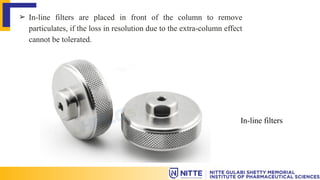
In-line filters
➢ In-line filters are placed in front of the column to remove
particulates, if the loss in resolution due to the extra-column effect
cannot be tolerated.
Temperature Control
➢ A stable system with temperature variations of less than 0.1 °C.
➢ Circulating air baths or electrically heated chambers are used to control the
column temperature.
➢ The solvent is preheated separately before entering the separation column.
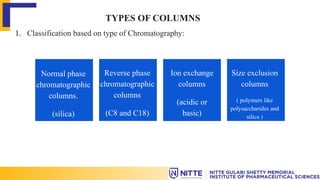
TYPES OF COLUMNS
1. Classification based on type of Chromatography:
Reverse phase
chromatographic
columns
(C8 and C18)
Ion exchange
columns
(acidic or
basic)
Size exclusion
columns
( polymers like
polysaccharides and
silica )
Normal phase
chromatographic
columns.
(silica)
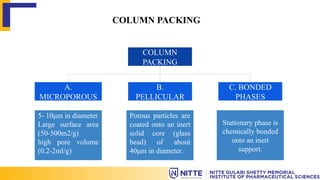
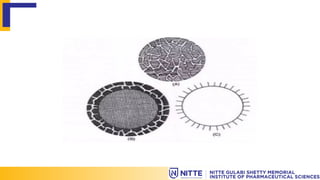
COLUMN PACKING
Lorem Ipsum
COLUMN
PACKING
A.
MICROPOROUS
C. BONDED
PHASES
B.
PELLICULAR
5- 10μm in diameter
Large surface area
(50-500m2/g)
high pore volume
(0.2-2ml/g)
Porous particles are
coated onto an inert
solid core (glass
bead) of about
40μm in diameter.
Stationary phase is
chemically bonded
onto an inert
support.
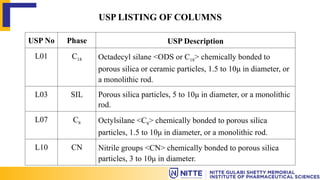
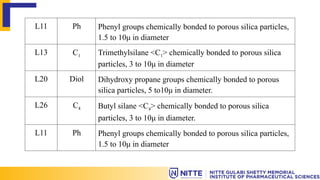
USP LISTING OF COLUMNS
USP No Phase USP Description
L01 C18 Octadecyl silane <ODS or C18> chemically bonded to
porous silica or ceramic particles, 1.5 to 10μ in diameter, or
a monolithic rod.
L03 SIL Porous silica particles, 5 to 10μ in diameter, or a monolithic
rod.
L07 C8 Octylsilane <C8> chemically bonded to porous silica
particles, 1.5 to 10μ in diameter, or a monolithic rod.
L10 CN Nitrile groups <CN> chemically bonded to porous silica
particles, 3 to 10μ in diameter.
L11 Ph Phenyl groups chemically bonded to porous silica particles,
1.5 to 10μ in diameter
L13 C1 Trimethylsilane <C1> chemically bonded to porous silica
particles, 3 to 10μ in diameter
L20 Diol Dihydroxy propane groups chemically bonded to porous
silica particles, 5 to10μ in diameter.
L26 C4 Butyl silane <C4> chemically bonded to porous silica
particles, 3 to 10μ in diameter.
L11 Ph Phenyl groups chemically bonded to porous silica particles,
1.5 to 10μ in diameter
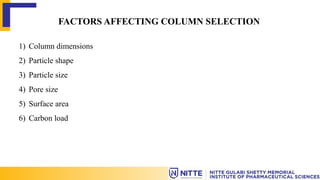
FACTORS AFFECTING COLUMN SELECTION
1) Column dimensions
2) Particle shape
3) Particle size
4) Pore size
5) Surface area
6) Carbon load
CONCLUSION
Columns act as heart of HPLC. The actual separation of constituents of the mixture is
done in columns. The manufacturing of columns is different from one to another and thus it
is necessary to first know what we are separating otherwise the mere hit and trial without
any basis can affect the life of columns. This paper is focused on types of columns, area of
their use, packing material and USP listing of columns.
REFERENCES:-
1. Willard HH, Merritt LL, Dean JA. Instrumental methods of analysis. van
Nostrand; 1965.
2. Sharma BK. Instrumental methods of chemical analysis. Krishna prakashan
media; 1981.
3. Schirmer RE. Modern Methods of Pharmaceutical Analysis, Volume II. 2nd
edition. CRC press; 1990 Dec.: 239-384.
4. Gurdeep R, Chatwal S, Anand K. Instrumental methods of chemical analysis.
Himalaya publishing house. 1998;2:185-234.
5. Kar A. Pharmaceutical drug analysis. New Age International; 2005.
6. Priyambada P, Anju G. HPLC columns and their role in analytical method
development: A review. World Journal of Pharmaceutical Research. 2018 May
12;7(13):386-94.

Columns used in High performance liquid chromatography.pptx

  • 1.
    COLUMNS USED INHPLC MODERN PHARMACEUTICALANALYTICAL TECHNIQUES PRESENTED BY:- ADHWITHA RAI K S NU24PHPY01 1st MPHARM
  • 2.
    CONTENTS:- ➢ INTRODUCTION ➢ COLUMNSUSED IN HPLC ➢ SEPARATION/ ANALYTICAL COLUMNS ➢ GUARD COLUMNS AND IN-LINE FILTERS ➢ TYPES OF COLUMNS ➢ COLUMN PACKING ➢ USP LISTING OF COLUMNS ➢ FACTORS AFFECTING COLUMN SELECTION ➢ CONCLUSION ➢ REFERENCES
  • 3.
    INTRODUCTION Principle:- Eluent (solventreservoir) → filtered, pressurised, pumped → column → mixture of solutes → injected → separated → monitored by the detector → recorded as peaks on a chart recorder.
  • 4.
    ➢ INSTRUMENTATION:- Atypical HPLC unit consists of 1. a solvent reservoir and mixing system 2. a high pressure pump 3. a sample injection/inlet system 4. a column 5. a detector and recording unit.
  • 5.
    COLUMNS USED INHPLC ➢ The HPLC column is the heart of all HPLC systems. ➢ Stainless steel, heavy-walled glass tubing and polymer tubing, such as polyetheretherketone (PEEK). ➢ 5.5 x 10⁷ Pa (8000 p.s.i). ➢ Length (10-30 cm) narrow tubes containing stationary phase at particle diameters of 25μm or less. ➢ The tubing must have a smooth, precision bore internal diameter. Efficient packing of the column. ➢ Straight columns of 20 to 50 cm in length and 1 to 4 mm in diameter are generally used. ➢ Porous plugs of stainless steel or teflon are used in the ends of the columns to retain the packing material. ➢ The maximum sample volume and sample concentration should not exceed the linear capacity of the column.
  • 6.
    ➢ Advantageous tohave the column well thermostatted at or slightly above ambient temperature. ➢ Increased efficiency can be achieved at higher temperatures. ➢ higher temperatures→ eluent viscosities decrease → diffusion rates of solute in the mobile and stationary phases increase. ➢ It is important in some separations involving liquid partition and ion-exchange chromatography.
  • 7.
    SEPARATION/ ANALYTICAL COLUMNS ➢Material used:-heavy-wall, glass-lined metal tubing or stainless steel tubing (680 atm). ➢ External Diameter: 6.35 mm (or 0.25 inch), ➢ Internal Diameter: 4-5 mm (usual: 4.6 mm), and ➢ Length: 10-30 cm (usual: 25 cm), 3 to 8 cm( fast columns), 50 to 100 cm (exclusion chromatography columns). ➢ Column end fittings and connectors → zero void volume. ➢ Packing is retained by inserting stainless steel frits into the end of the column. ➢ Particle diameters:- 3-5 μm. (10 µm or higher for preparative chromatography)
  • 8.
    Radial Compression Columns ➢Hydraulic pressure (via glycerol in a plastic sleeve) → compress radially. ➢ a flexible wall cartridge (10 cm long with an 8-mm bore) held within a plastic holder. ➢ Compression → diminishes the voids and channels→ increases the column efficiency. ➢ The cartridge can be decompressed, removed from the module, and reused repeatedly without losing efficiency. ➢ Low cost i.e it eliminates the consumption of costly solvents for column purging.
  • 9.
    Narrow-Bore Columns ➢ Decreasingthe internal diameter of the column by a factor of 2 increases the signal of a sample component by a factor of 4. ➢ The linear column velocity of the mobile phase and the analysis time→ same. ➢ unconventional solvents or high-purity solvents ➢ Better homogeneity in packing density over the cross- sectional area of the bed ➢ smaller temperature gradients across the column. HiQ sil C18HS (Pore Size : 100Å) Narrow Bore Column Particle Size: 5 μm ID: 1.5mm and 2.1mm Available in 6 lengths: 35mm – 250mm
  • 10.
    Short, Fast Columns ➢short (3-6 cm), packed with 3-μm particles. ➢ Save solvent costs, ➢ increase sample throughput, ➢ deliver higher sensitivity than conventional-length columns. ➢ Analysis times : 15-120 sec (isocratic elution) and 1-4 min (gradient elution). Fast Acid Analysis Column Fa
  • 11.
    GUARD COLUMNS ANDIN-LINE FILTERS ➢ Inserted ahead of the analytical column. ➢ Act as both physical and chemical filters. ➢ To prolong the life of analytical columns/expensive separation column. ➢ short (usually 5 cm) and expendable ➢ Protect from particulate contamination ➢ Capture the strongly retained sample components and prevent from contaminating the upper layers of the analytical column. ➢ By design expendable and periodically repacked, replaced, or reconditioned.
  • 12.
    In-line filters ➢ In-linefilters are placed in front of the column to remove particulates, if the loss in resolution due to the extra-column effect cannot be tolerated.
  • 13.
    Temperature Control ➢ Astable system with temperature variations of less than 0.1 °C. ➢ Circulating air baths or electrically heated chambers are used to control the column temperature. ➢ The solvent is preheated separately before entering the separation column.
  • 14.
    TYPES OF COLUMNS 1.Classification based on type of Chromatography: Reverse phase chromatographic columns (C8 and C18) Ion exchange columns (acidic or basic) Size exclusion columns ( polymers like polysaccharides and silica ) Normal phase chromatographic columns. (silica)
  • 15.
    COLUMN PACKING Lorem Ipsum COLUMN PACKING A. MICROPOROUS C.BONDED PHASES B. PELLICULAR 5- 10μm in diameter Large surface area (50-500m2/g) high pore volume (0.2-2ml/g) Porous particles are coated onto an inert solid core (glass bead) of about 40μm in diameter. Stationary phase is chemically bonded onto an inert support.
  • 17.
    USP LISTING OFCOLUMNS USP No Phase USP Description L01 C18 Octadecyl silane <ODS or C18> chemically bonded to porous silica or ceramic particles, 1.5 to 10μ in diameter, or a monolithic rod. L03 SIL Porous silica particles, 5 to 10μ in diameter, or a monolithic rod. L07 C8 Octylsilane <C8> chemically bonded to porous silica particles, 1.5 to 10μ in diameter, or a monolithic rod. L10 CN Nitrile groups <CN> chemically bonded to porous silica particles, 3 to 10μ in diameter.
  • 18.
    L11 Ph Phenylgroups chemically bonded to porous silica particles, 1.5 to 10μ in diameter L13 C1 Trimethylsilane <C1> chemically bonded to porous silica particles, 3 to 10μ in diameter L20 Diol Dihydroxy propane groups chemically bonded to porous silica particles, 5 to10μ in diameter. L26 C4 Butyl silane <C4> chemically bonded to porous silica particles, 3 to 10μ in diameter. L11 Ph Phenyl groups chemically bonded to porous silica particles, 1.5 to 10μ in diameter
  • 19.
    FACTORS AFFECTING COLUMNSELECTION 1) Column dimensions 2) Particle shape 3) Particle size 4) Pore size 5) Surface area 6) Carbon load
  • 20.
    CONCLUSION Columns act asheart of HPLC. The actual separation of constituents of the mixture is done in columns. The manufacturing of columns is different from one to another and thus it is necessary to first know what we are separating otherwise the mere hit and trial without any basis can affect the life of columns. This paper is focused on types of columns, area of their use, packing material and USP listing of columns.
  • 21.
    REFERENCES:- 1. Willard HH,Merritt LL, Dean JA. Instrumental methods of analysis. van Nostrand; 1965. 2. Sharma BK. Instrumental methods of chemical analysis. Krishna prakashan media; 1981. 3. Schirmer RE. Modern Methods of Pharmaceutical Analysis, Volume II. 2nd edition. CRC press; 1990 Dec.: 239-384. 4. Gurdeep R, Chatwal S, Anand K. Instrumental methods of chemical analysis. Himalaya publishing house. 1998;2:185-234. 5. Kar A. Pharmaceutical drug analysis. New Age International; 2005. 6. Priyambada P, Anju G. HPLC columns and their role in analytical method development: A review. World Journal of Pharmaceutical Research. 2018 May 12;7(13):386-94.

Editor's Notes

  • #3 Chromatography is a physical method of separation, in which the components to be separated are distributed between two phases, one of which is stationary whilst the other moves in a definite direction. Problems with liquid chromatography → loss of resolution by diffusion. The High Performance Liquid Chromatography is a analytical techniques used in separation and identification of constituent in a mixture using two phases i.e. stationary and mobile phase. based on the differences in the rate at which the components of a mixture move through a porous medium (called stationary phase) under the influence of some solvent or gas (called moving phase). In chromatography, the stationary phase may be a solid or a liquid and the mobile phase may be liquid or a gas. early problems with LC was the slow rate at which the analysis took place. great delay, but also the excessive time on the column inevitably led to loss of resolution by diffusion. In this system, pressure is applied to the column, forcing the mobile phase through at a much higher rate. Pressure is applied using a pumping system. It is possible to achieve good resolution under the conditions required for HPLC.
  • #5 from heThe plugs must be homogenous to ensure uniform flow of solvents through the column.avy-walled glass tubing and polymer tubing, such as polyetheretherketone (PEEK). In addition, stainless steel columns lined with glass or PEEK are also available. The linear capacity is the weight of the sample per gm of packing which causes a 10% reduction in the specific retention volume relative to the constant retention volume observed for smaller samples
  • #7 columns with an internal diameter of 4 to 5 mm. Such columns provide a good compromise between efficiency, sample capacity, and the amount of packing and solvent required. Column packings feature particles that are uniformly sized and mechanically stable. Particle diameters lie in the range 3-5 μm, occasionally up to 10 µm or higher for preparative chromatography. Columns of this type contain 40,000 to 60,000 theoretical plates/ metre.
  • #8 there are benefits to using the wider-diameter radial compression columns. A decrease in the overall operating pressure allows the analyst to decrease analysis time by increasing solvent flow. . Separations are performed while the cartridge is under compression. Compression. Low cost permits the dedication of a cartridge to each application, in turn this eliminates the consumption of costly solvents for column purging.
  • #9 because frictional heat is dissipated better. a number of short columns can be joined together to build up a long column without loss of plate count (cannot be done with 4.6-mm bore columns).
  • #10 . These columns are useful where analytical speed is essential, as in quality control work Isocratic ; composition of mobile phase is constant Gradient - changing
  • #11 stationary phase similar to that in the analytical column. (contaminated mobile phase or from degrading sample-injection valves). The approximately 0.08-ml band spreading in the guard column ahead of the 2-mm-bore column results in appreciable broadening of solute peaks and degradation of the separation of caffeine and benzoic acid
  • #12 If the loss in resolution due to the extra-column effect cannot be tolerated, an in-line filter designed to remove particulates should be placed in front of the column.
  • #13 Separation columns should be housed within a stable system with temperature variations of less than 0.1 °C when temperature changes must be avoided. Circulating air baths or electrically heated chambers are used to control the column temperature. The solvent is preheated separately before entering the separation column.
  • #14 Ion exchange; Stationary phase in these columns is acidic or basic having negative or positive charge while the mobile phase is polar liquid as the salt solution in water. The molecules separate on the basis of the attractive ionic force between molecules and the charged stationary phase. Size exclusion columns: In this type the stationary phase is porous which allows the separation of the components according to their size. The columns are made up of polymers like polysaccharides and silica. The sample molecules penetrate into the pores and get separated according to their size. The larger molecules are penetrated partially and get eluted fast while the smaller ones are completely penetrated and thus elutes later. These are least used in the analysis of pharmaceutical products.
  • #15 Microporous packing: The particles are composed of silica, alumina, the synthetic resin polystyrene-divinylbenzene, or an ion-exchange resin. Silica is by far the most common packing in LC. Many of these spherical particulate silicas are made from colloidal silica which are agglomerated under carefully controlled conditions in the presence of a suitable binder. Ureas have often been used as the binder for this type of particle technology. The agglomerated particles are then sintered to give a stable particle. These same particles also serve as the silica backbone for the bonded phase packings. The resulting particles are also often coated with thin organic films, which are chemically or physically bonded to the surface.