Viewpoints: Leveraging ISS to Enable LEO
Commercialization
SAM SCIMEMI, DIRECTOR FOR INTERNATIONAL SPACE STATION, HUMAN EXPLORATION
AND OPERATIONS MISSION DIRECTORATE – NASA HQ (CO-MODERATOR)
JEFF BINGHAM, FORMER SENIOR ADVISER, US SENATE COMMERCE, SCIENCE AND
TRANSPORTATION COMMITTEE (CO-MODERATOR)
JOHN SHANNON, VICE PRESIDENT, SPACE LAUNCH SYSTEM, BOEING
FRANK CULBERTSON, PRESIDENT, SPACE SYSTEMS GROUP,
ORBITAL ATK
JEFF MANBER, MANAGING DIRECTOR, NANORACKS LLC
JANICE L. HESS, PRESIDENT, TELEDYNE BROWN ENGINEERING &
ENGINEERED SYSTEM SEGMENT, TELEDYNE TECHNOLOGIES
INCORPORATED
LEVERAGING ISS TO ENABLE LEO
COMMERCIALIZATION
JEFF BINGHAM
FORMER SENIOR ADVISER, US SENATE COMMERCE,
SCIENCE AND TRANSPORTATION COMMITTEE
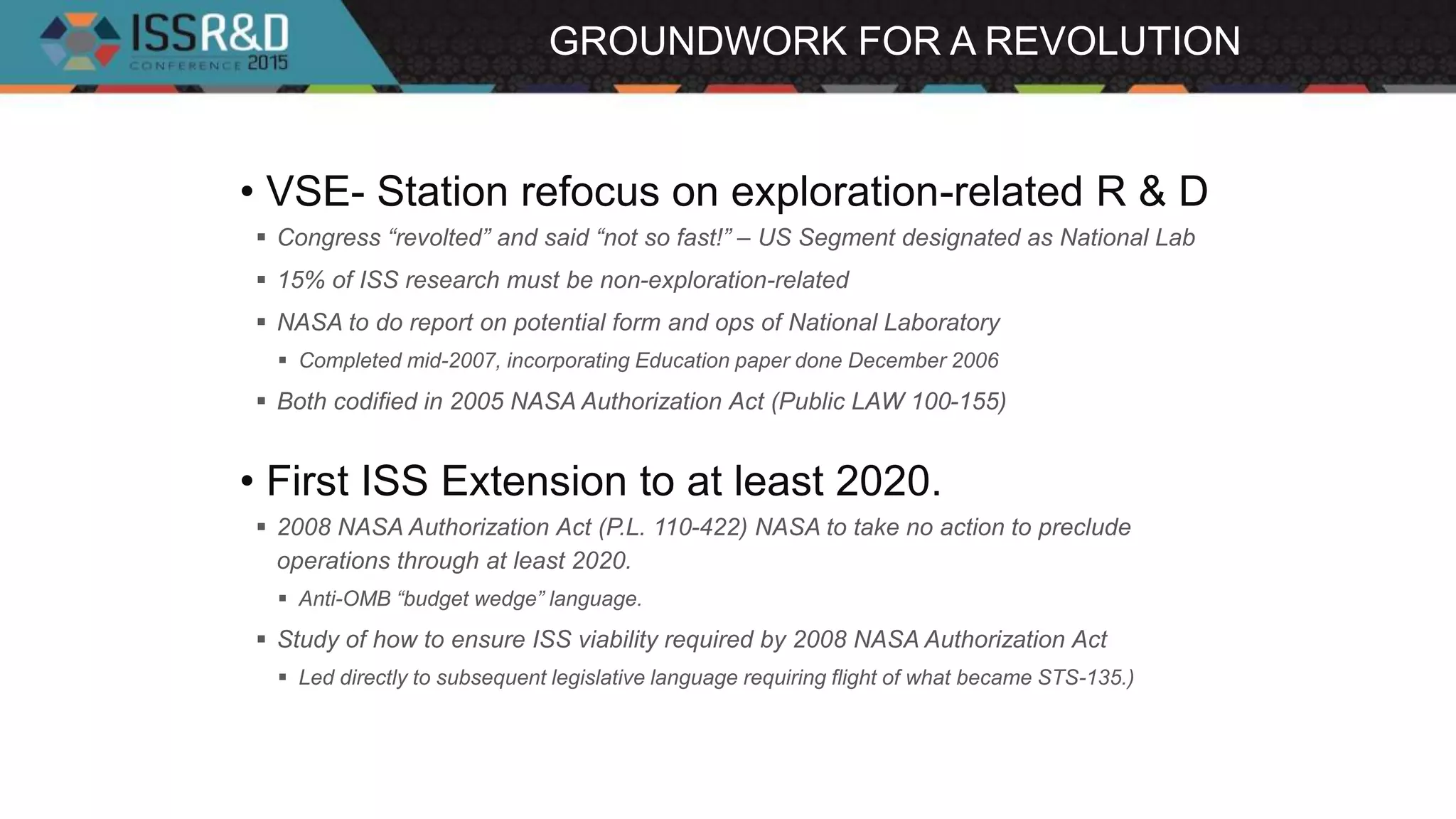
GROUNDWORK FOR A REVOLUTION
• VSE- Station refocus on exploration-related R & D
 Congress “revolted” and said “not so fast!” – US Segment designated as National Lab
 15% of ISS research must be non-exploration-related
 NASA to do report on potential form and ops of National Laboratory
 Completed mid-2007, incorporating Education paper done December 2006
 Both codified in 2005 NASA Authorization Act (Public LAW 100-155)
• First ISS Extension to at least 2020.
 2008 NASA Authorization Act (P.L. 110-422) NASA to take no action to preclude
operations through at least 2020.
 Anti-OMB “budget wedge” language.
 Study of how to ensure ISS viability required by 2008 NASA Authorization Act
 Led directly to subsequent legislative language requiring flight of what became STS-135.)
GROUNDWORK FOR A REVOLUTION
• NASA 2010 Authorization (and Policy) Act
 Requirement to establish cooperative agreement with independent management
entity for ISS National Lab management purposes.
 CASIS is born.
 Mandate for no less than fifty percent of U.S. ISS research capacity to be
allocated to independent entity.
•Congress appears supportive of extension to
at least 2024
What will REALLY decide the future of ISS and any follow-on
LEO “economy” or infrastructure is the success or failure of
what is happening right now and the success or failure of the
catalytic affect and leveraging of that activity for the future.
LEVERAGING ISS TO ENABLE LEO
COMMERCIALIZATION
SAM SCIMEMI
DIRECTOR FOR INTERNATIONAL SPACE STATION, HUMAN
EXPLORATION AND OPERATIONS MISSION DIRECTORATE
– NASA HQ
LEVERAGING ISS TO ENABLE LEO
COMMERCIALIZATION
How can we leverage the remaining time we
have with ISS to enable the demand for LEO
services that could sustain commercial LEO
supply?
What mechanisms can the government enable
that would sustain commercial and non-NASA
government investment in LEO research
beyond ISS?
How can we leverage NASA next human
spaceflight steps beyond LEO to benefit the
development of commercial LEO capabilities?
JOHN SHANNON
VICE PRESIDENT, SPACE LAUNCH SYSTEM, BOEING
LEVERAGING ISS TO ENABLE LEO
COMMERCIALIZATION
FRANK CULBERTSON
PRESIDENT, SPACE SYSTEMS GROUP, ORBITAL ATK
LEVERAGING ISS TO ENABLE LEO
COMMERCIALIZATION
Leveraging ISS to Enable LEO Commercialization
July 8, 2015
Frank Culbertson
President
Space Systems Group
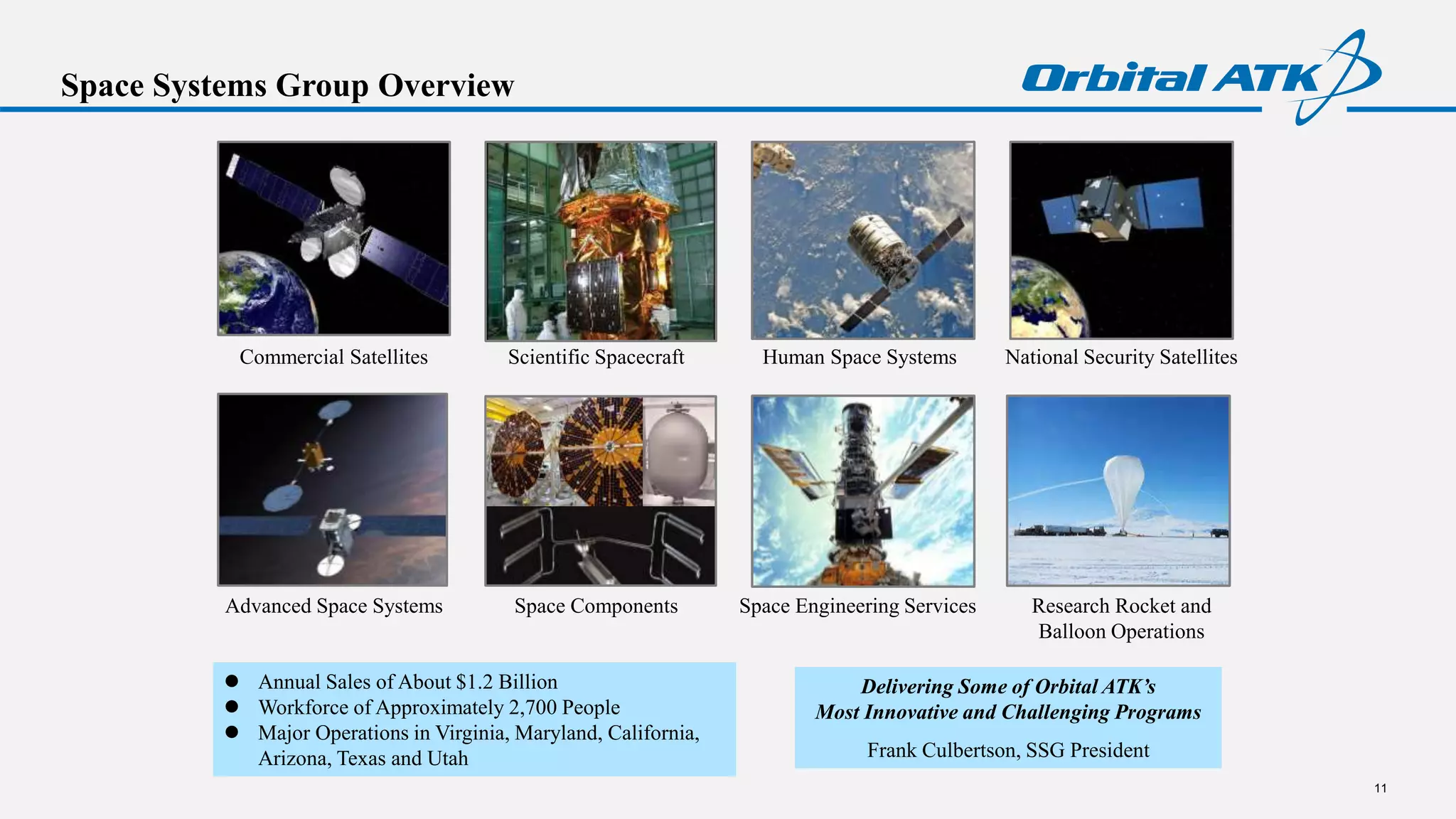
Space Systems Group Overview
Scientific Spacecraft Human Space Systems National Security SatellitesCommercial Satellites
Space Components Space Engineering Services Research Rocket and
Balloon Operations
Advanced Space Systems
 Annual Sales of About $1.2 Billion
 Workforce of Approximately 2,700 People
 Major Operations in Virginia, Maryland, California,
Arizona, Texas and Utah
11
Delivering Some of Orbital ATK’s
Most Innovative and Challenging Programs
Frank Culbertson, SSG President
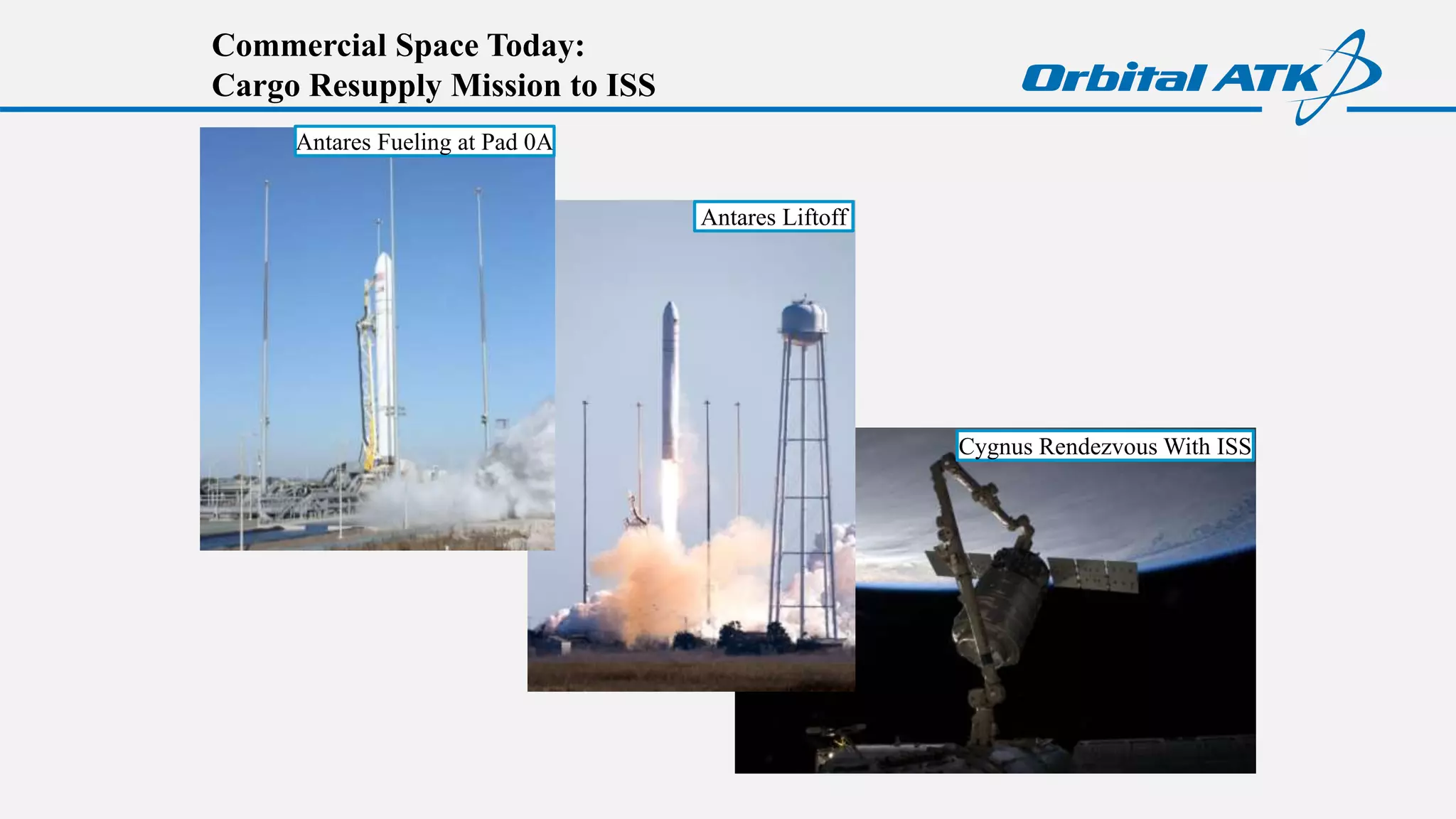
Commercial Space Today:
Cargo Resupply Mission to ISS
Antares Fueling at Pad 0A
Antares Liftoff
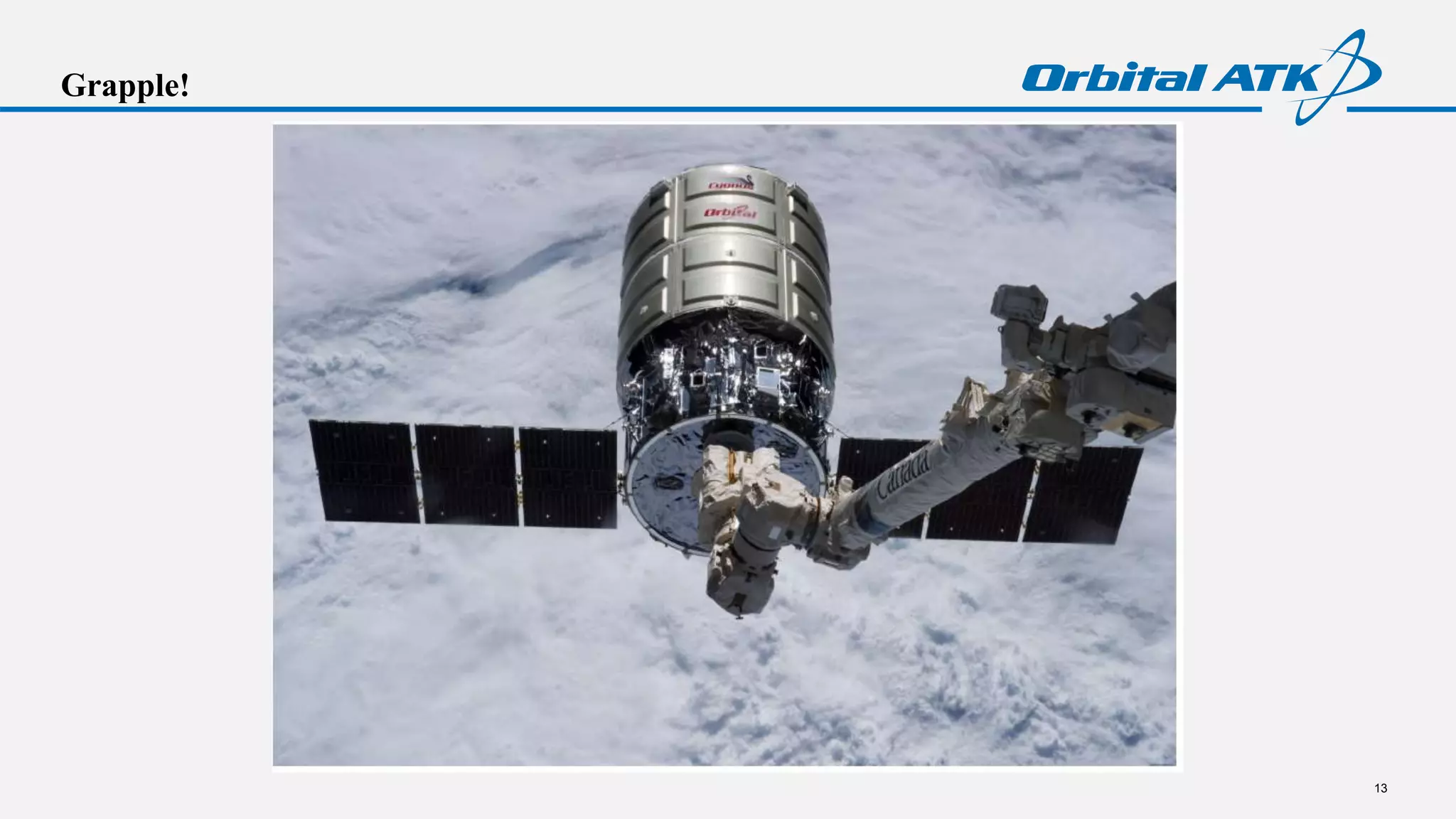
Cygnus Rendezvous With ISS
Grapple!
13
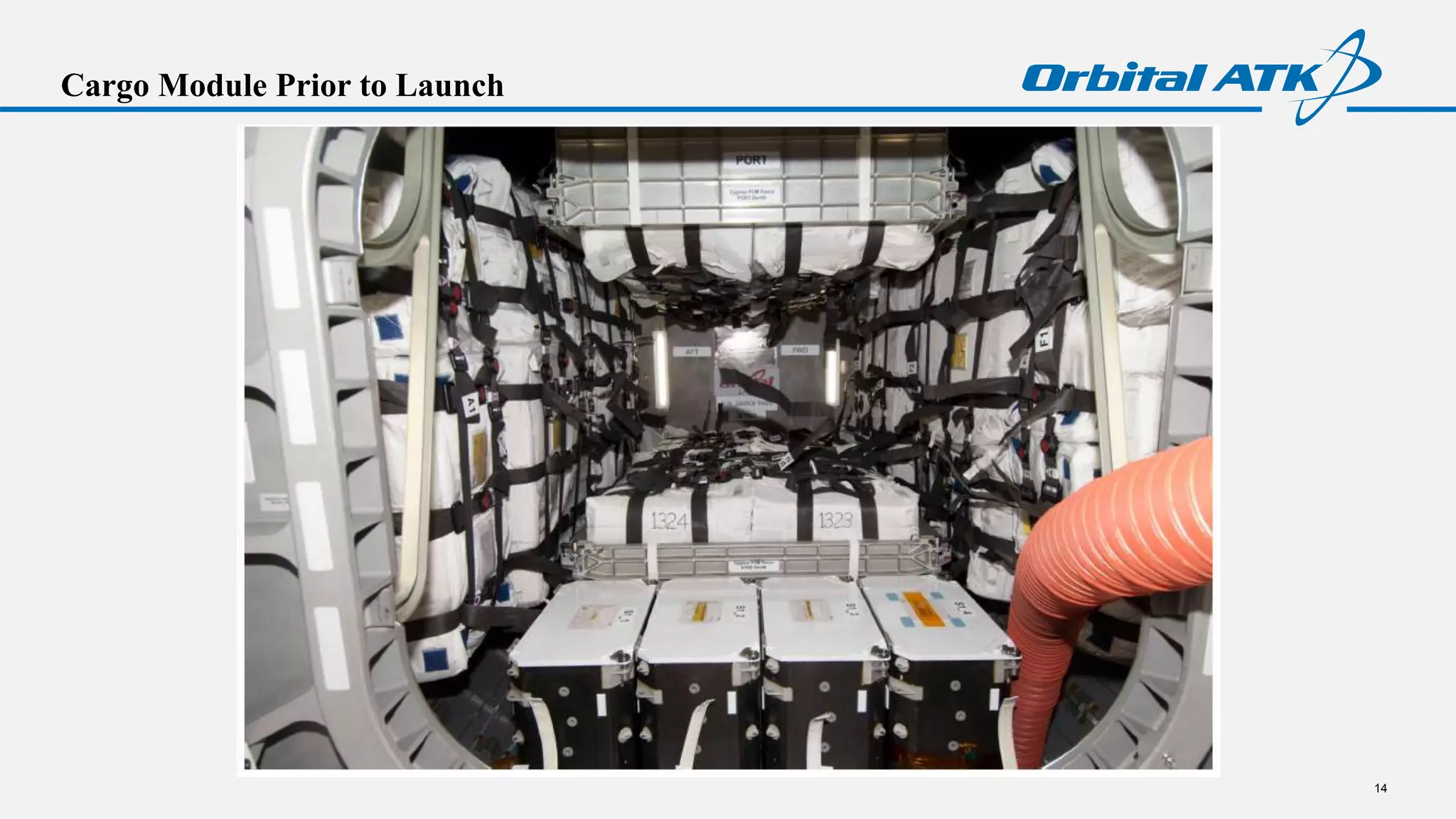
Cargo Module Prior to Launch
14
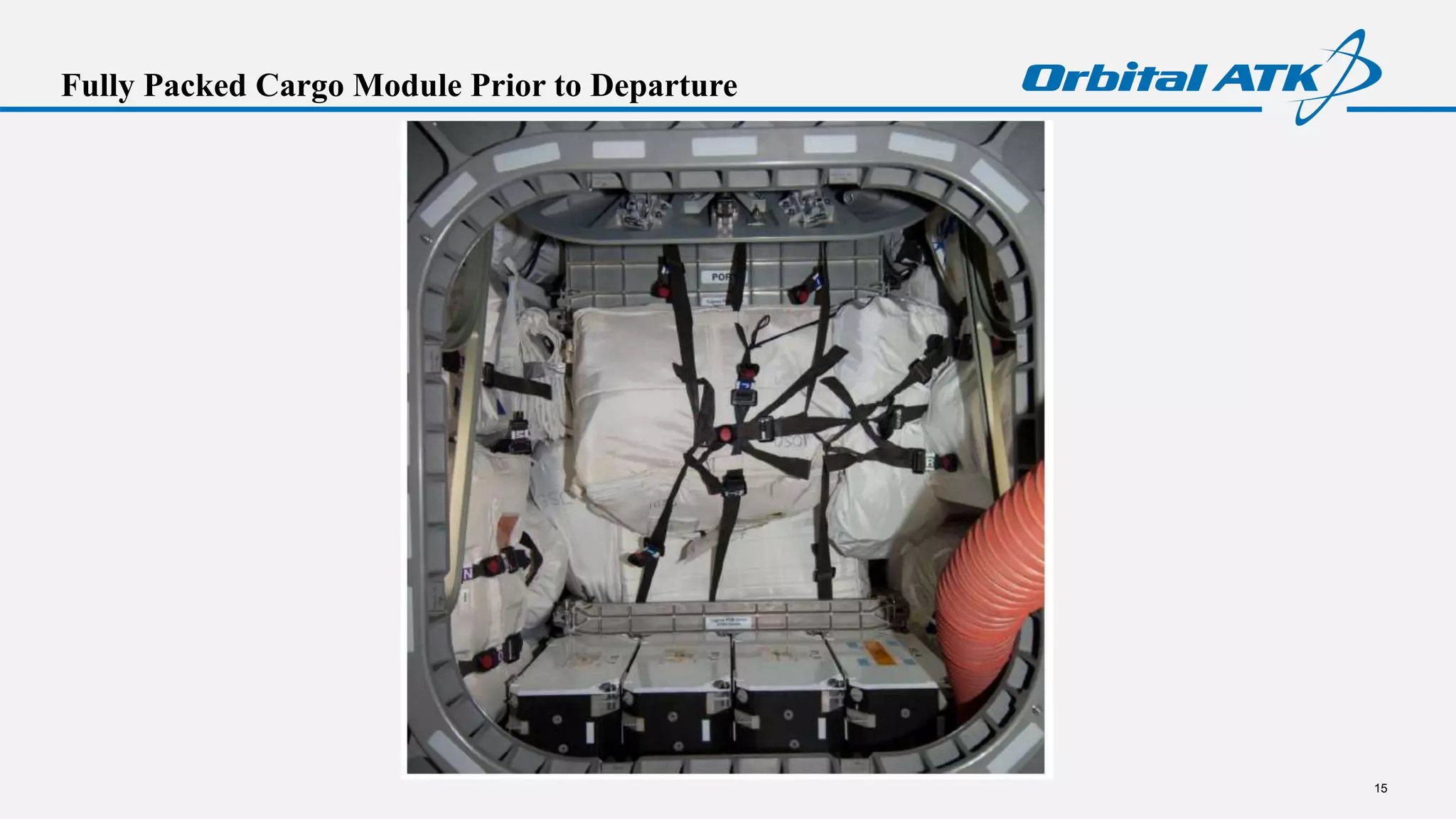
Fully Packed Cargo Module Prior to Departure
15
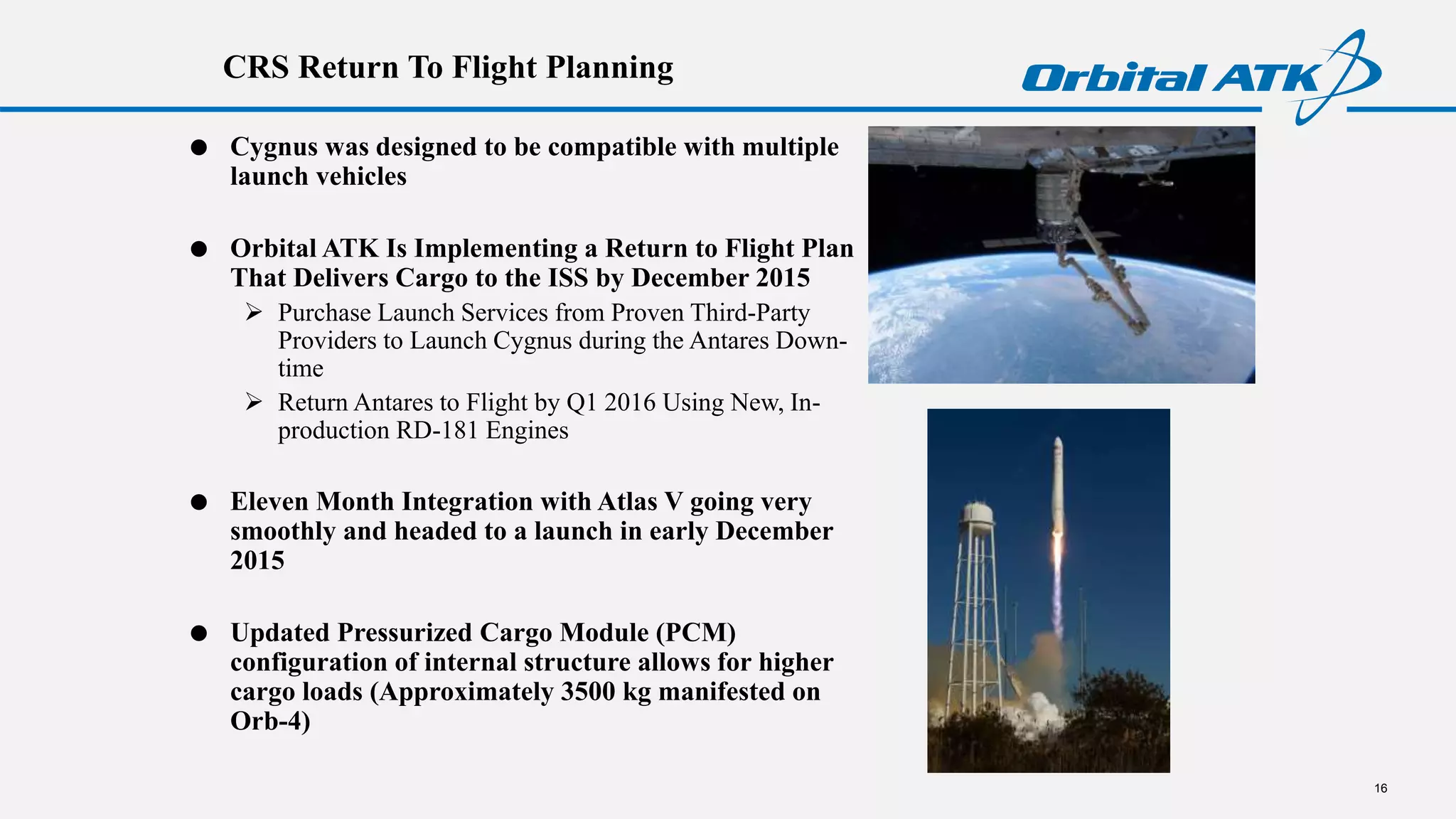
CRS Return To Flight Planning
16
 Cygnus was designed to be compatible with multiple
launch vehicles
 Orbital ATK Is Implementing a Return to Flight Plan
That Delivers Cargo to the ISS by December 2015
 Purchase Launch Services from Proven Third-Party
Providers to Launch Cygnus during the Antares Down-
time
 Return Antares to Flight by Q1 2016 Using New, In-
production RD-181 Engines
 Eleven Month Integration with Atlas V going very
smoothly and headed to a launch in early December
2015
 Updated Pressurized Cargo Module (PCM)
configuration of internal structure allows for higher
cargo loads (Approximately 3500 kg manifested on
Orb-4)
17
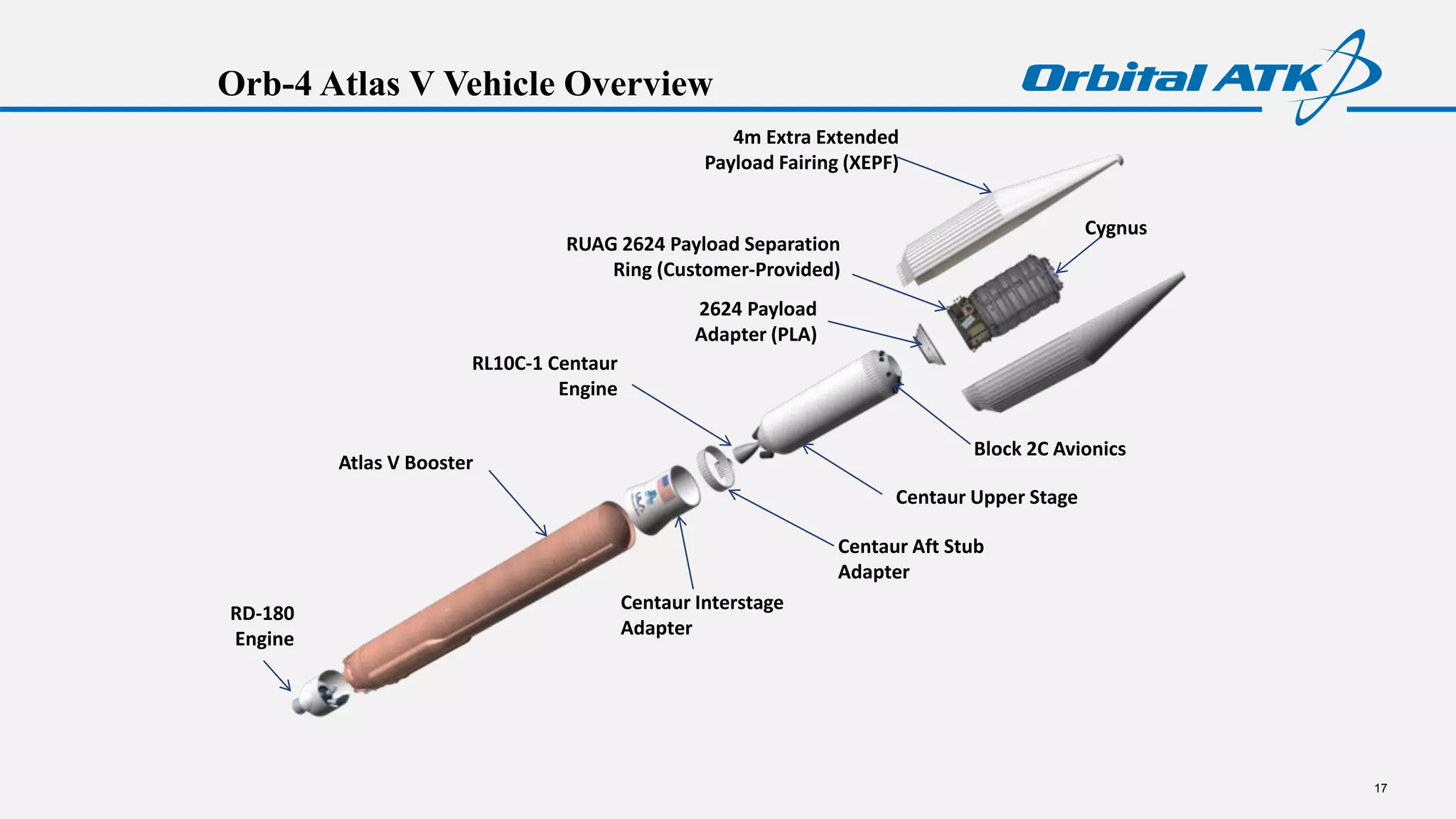
Orb-4 Atlas V Vehicle Overview
RL10C-1 Centaur
Engine
RD-180
Engine
Centaur Interstage
Adapter
Centaur Upper Stage
4m Extra Extended
Payload Fairing (XEPF)
Cygnus
2624 Payload
Adapter (PLA)
Centaur Aft Stub
Adapter
Atlas V Booster
RUAG 2624 Payload Separation
Ring (Customer-Provided)
Block 2C Avionics
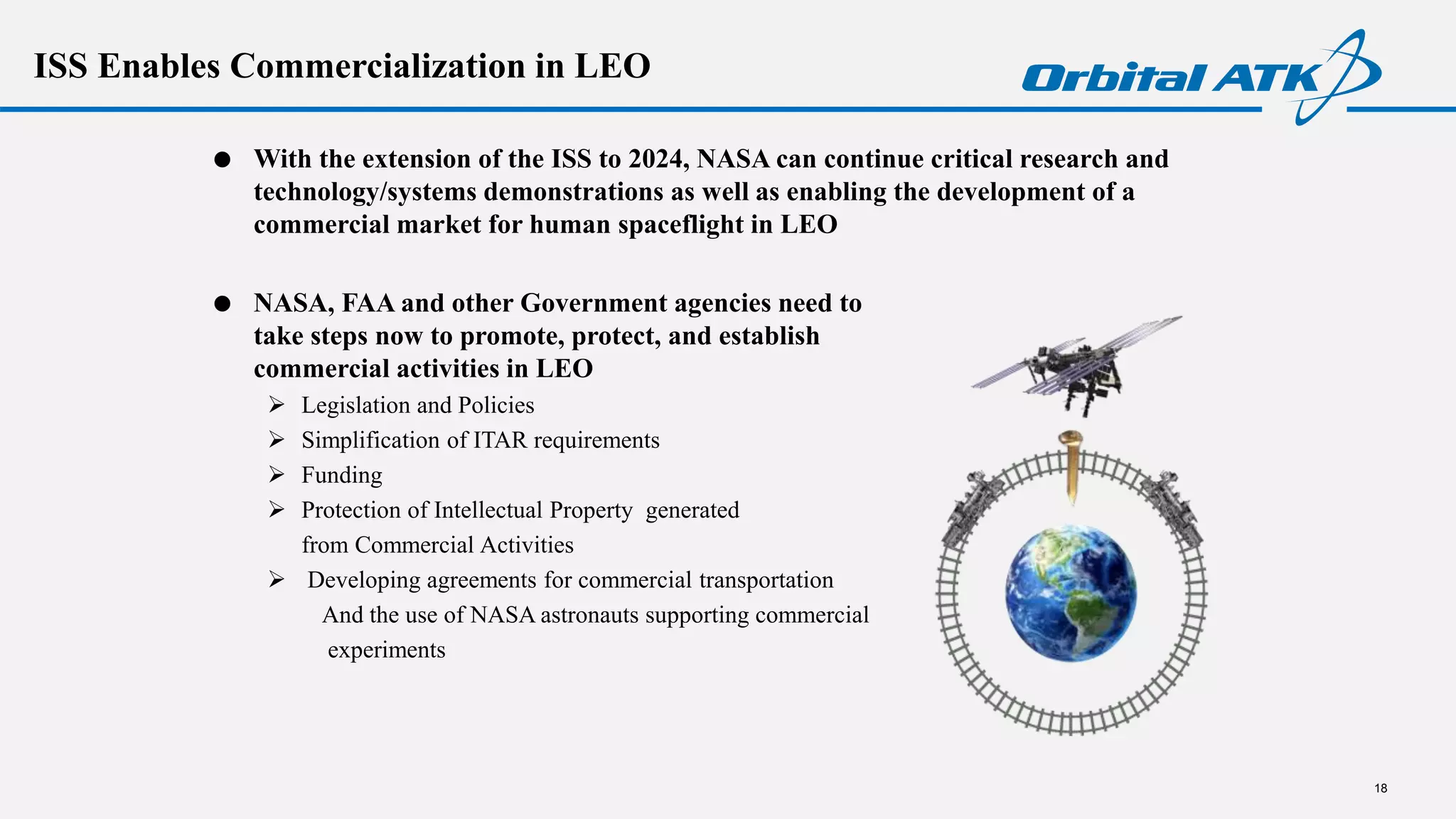
ISS Enables Commercialization in LEO
 With the extension of the ISS to 2024, NASA can continue critical research and
technology/systems demonstrations as well as enabling the development of a
commercial market for human spaceflight in LEO
 NASA, FAA and other Government agencies need to
take steps now to promote, protect, and establish
commercial activities in LEO
 Legislation and Policies
 Simplification of ITAR requirements
 Funding
 Protection of Intellectual Property generated
from Commercial Activities
 Developing agreements for commercial transportation
And the use of NASA astronauts supporting commercial
experiments
18
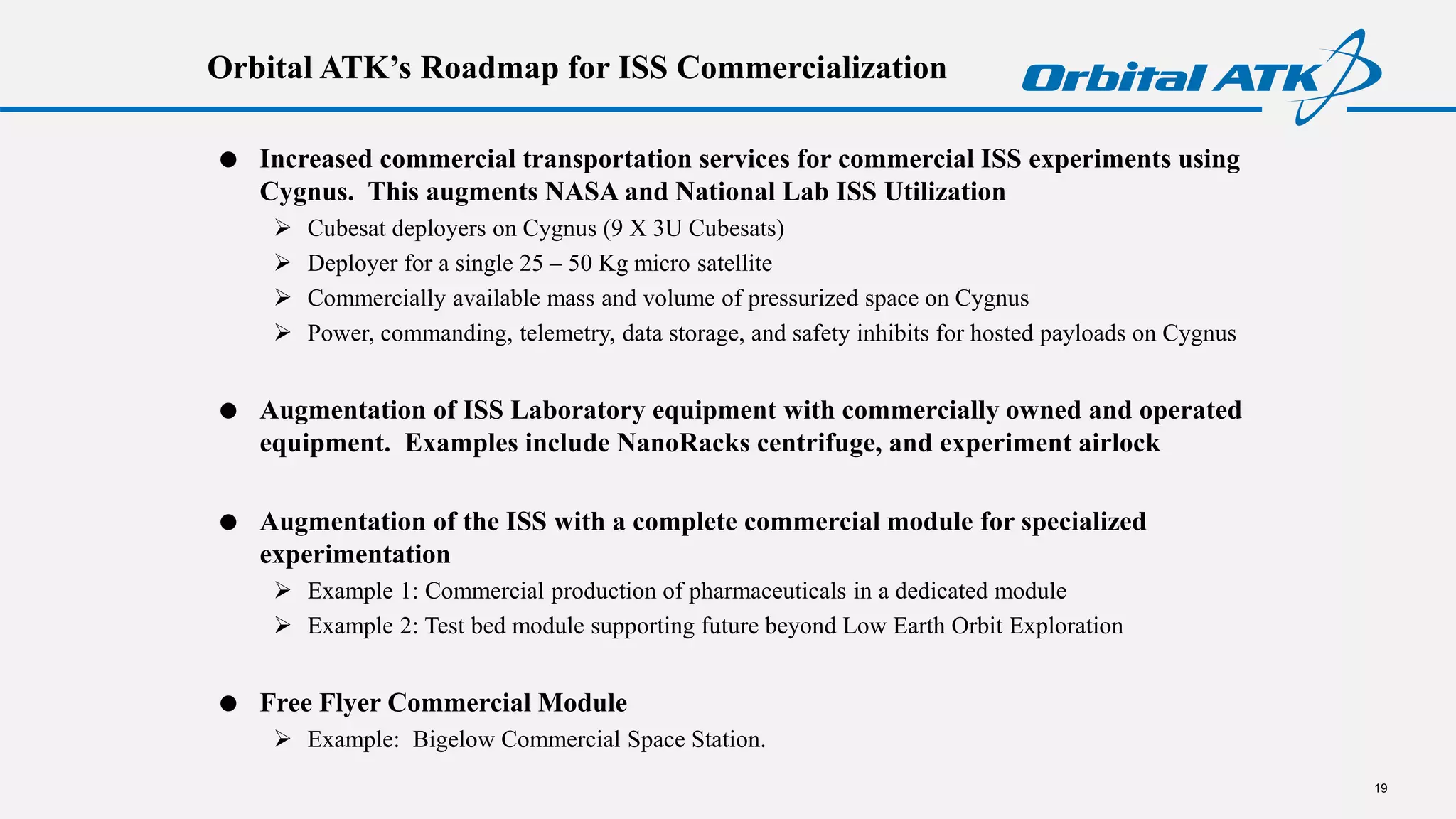
Orbital ATK’s Roadmap for ISS Commercialization
 Increased commercial transportation services for commercial ISS experiments using
Cygnus. This augments NASA and National Lab ISS Utilization
 Cubesat deployers on Cygnus (9 X 3U Cubesats)
 Deployer for a single 25 – 50 Kg micro satellite
 Commercially available mass and volume of pressurized space on Cygnus
 Power, commanding, telemetry, data storage, and safety inhibits for hosted payloads on Cygnus
 Augmentation of ISS Laboratory equipment with commercially owned and operated
equipment. Examples include NanoRacks centrifuge, and experiment airlock
 Augmentation of the ISS with a complete commercial module for specialized
experimentation
 Example 1: Commercial production of pharmaceuticals in a dedicated module
 Example 2: Test bed module supporting future beyond Low Earth Orbit Exploration
 Free Flyer Commercial Module
 Example: Bigelow Commercial Space Station.
19
Summary
 NASA can help invigorate the commercial LEO market:
 Restructuring of requirements to accommodate commercial utilization
 Streamlining of processes
 Funding opportunities to “Prime” the commercialization pump
− Anchor tenant
− COTS model
 Accommodate commercial utilization outside of National Lab
− Opens new markets
 Large Scale Commercial Utilization still waiting on the “killer app”
 Use of commercial practices and contracting approaches is the most cost effective way to implement space
programs
 Cygnus ready to support commercial activities in the near term
20
JEFF MANBER
MANAGING DIRECTOR, NANORACKS LLC
LEVERAGING ISS TO ENABLE LEO
COMMERCIALIZATION
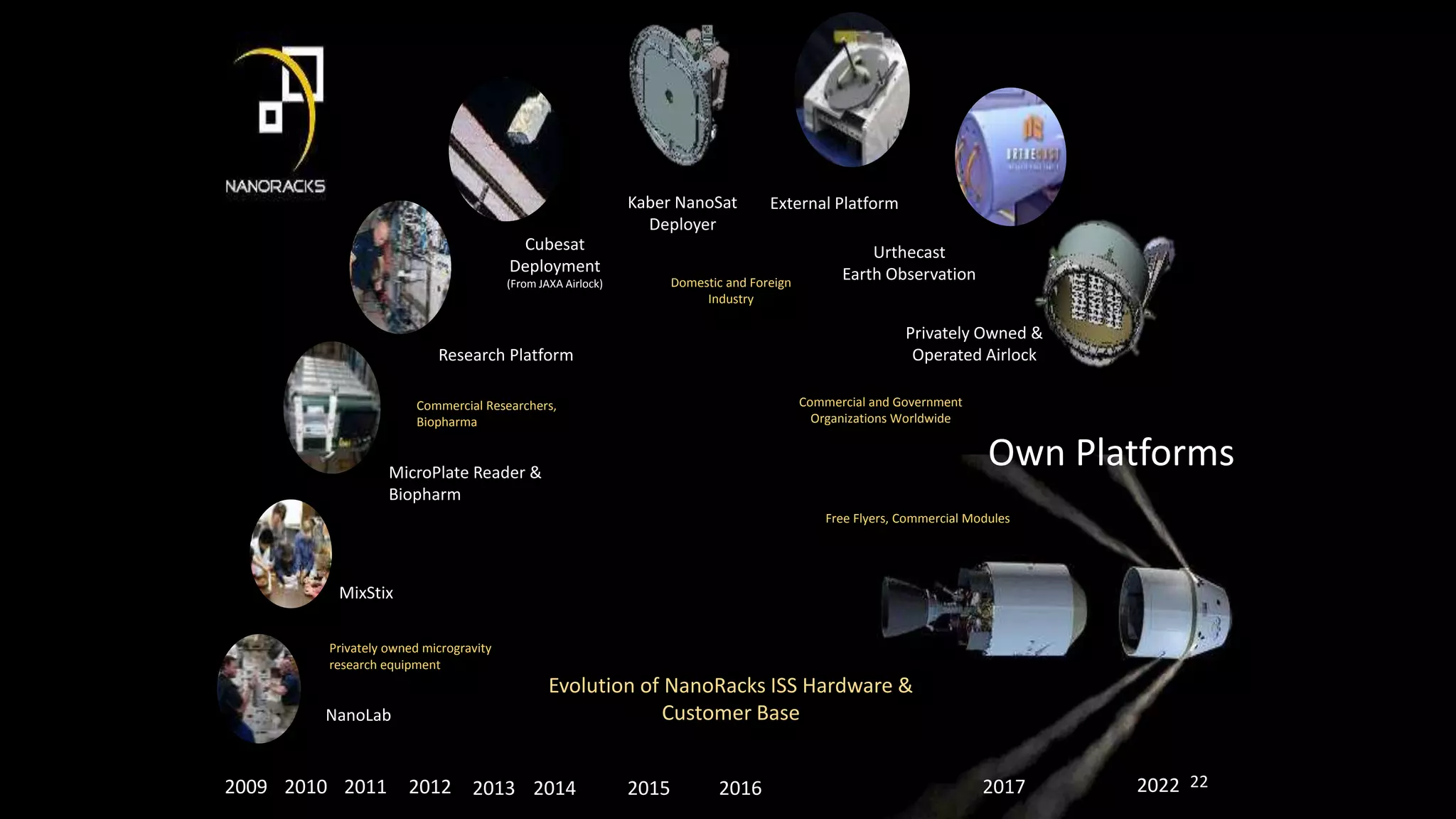
NanoLab
MixStix
MicroPlate Reader &
Biopharm
Research Platform
Cubesat
Deployment
(From JAXA Airlock)
External Platform
Urthecast
Earth Observation
Privately Owned &
Operated Airlock
Own Platforms
2009 2010 2011 2012 2013 2014 2015 2016 2017 2022
Privately owned microgravity
research equipment
Commercial Researchers,
Biopharma
Domestic and Foreign
Industry
Evolution of NanoRacks ISS Hardware &
Customer Base
Commercial and Government
Organizations Worldwide
Kaber NanoSat
Deployer
Free Flyers, Commercial Modules
22
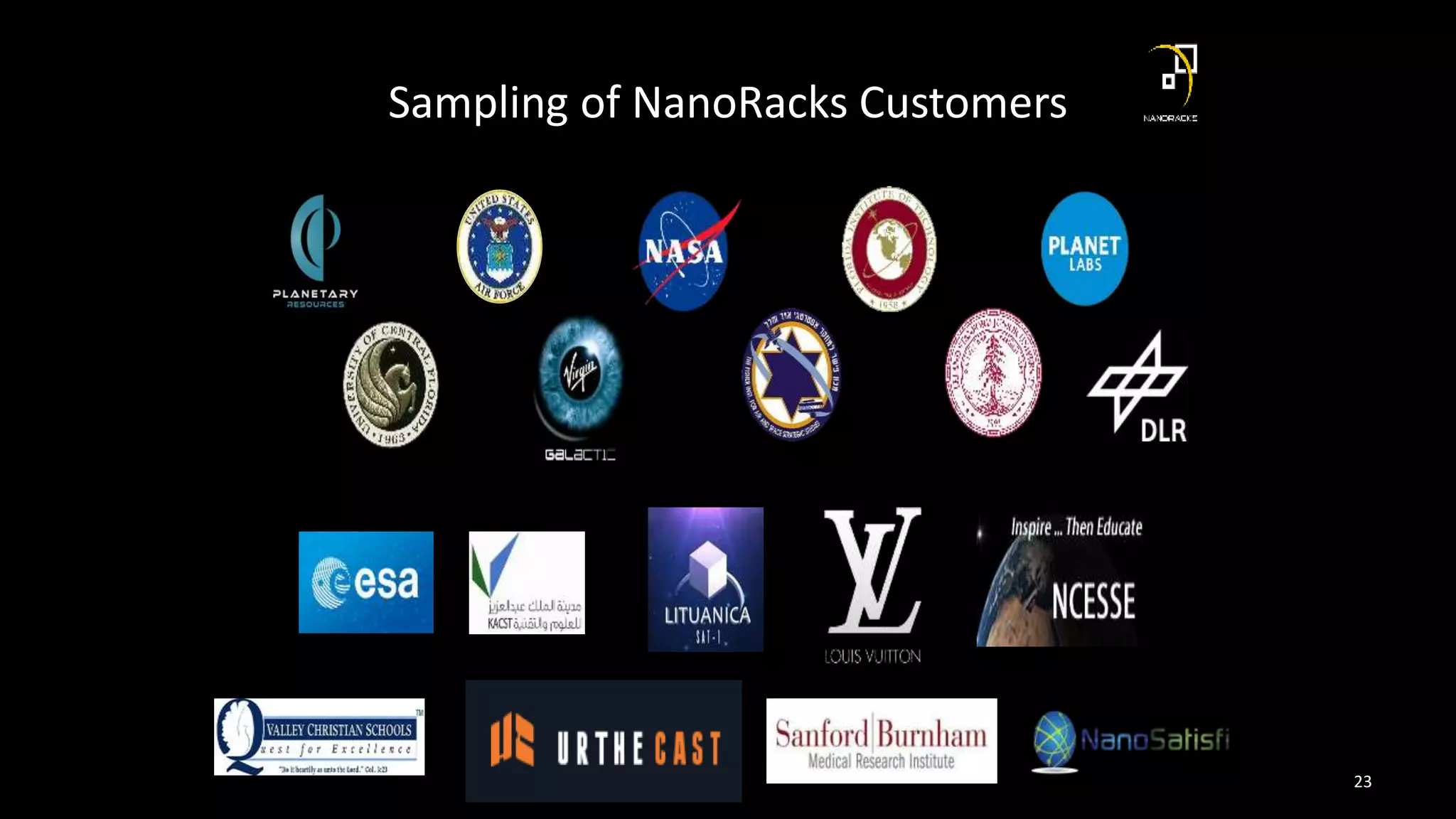
Sampling of NanoRacks Customers
23
JAN HESS
PRESIDENT, TELEDYNE BROWN ENGINEERING & ENGINEERED SYSTEM
SEGMENT, TELEDYNE TECHNOLOGIES INCORPORATED
LEVERAGING ISS TO ENABLE LEO
COMMERCIALIZATION
Leveraging ISS to Enable
LEO Commercialization
Jan Hess
Teledyne Brown Engineering
Huntsville, Alabama
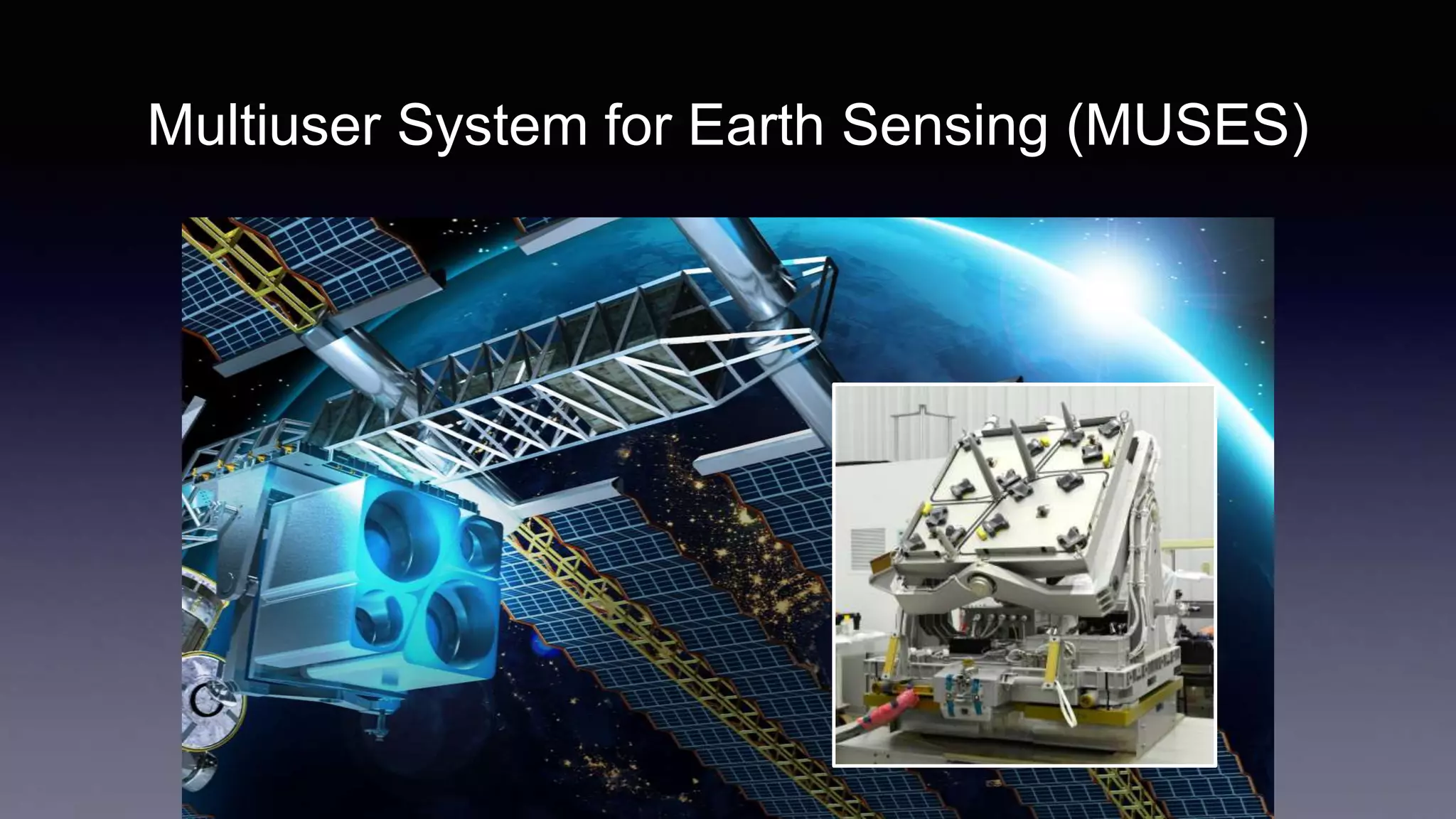
Multiuser System for Earth Sensing (MUSES)
The Big Shift – Government
Contractor to Commercial Business
• ~Ten years ago we recognized the need to balance our portfolio,
adding commercial. Government budgets were shrinking with
increasing entrants into the market.
• ISS commercialization was a natural fit with our involvement with
ISS since its inception – payload integration, mission operations,
and hardware manufacturing.
• Once the National Lab Office was established with emphasis on
commercialization, we knew we had a strong partner that would
support us in our endeavor to realize our commercial space
imaging and instrument hosting vision.
The Big Shift –
Financial and Cultural
• Teledyne Brown Engineering (TBE) is part of a mature, mid-
sized public company.
• Public companies are responsible to many: shareholders,
employees, customers, communities, etc. The prime expectation
is earnings growth.
• However, starting our commercial space business meant that
we, in actuality, had a start up inside a mature, public company.
• TBE had to move its culture quickly from a government
contractor cost-type mentality to fixed-priced commercial.
The Big Shift –
Education and Innovation
• Learned to be flexible, patient, and persistent.
• Determined early on that we needed partners to make the business case viable. ISS
National Lab was key. Also, partnered with the German Space Agency, who is
providing the first instrument on MUSES, a hyperspectral imager.
• We adjusted our strategy as we moved through the project which began in early 2012.
We have moved from a position of solely providing earth imaging to one of also
providing turn-key instrument hosting.
• We streamlined all internal processes and practice continuous process improvement.
We have and continue to educate our workforce and have added resources from the
commercial market place.
• Learned that we had to educate the market place, before we could sell to it. Most earth
observations are done from "free flyers." Turn-key instrument hosting is innovative and
has yielded much interest.
• MUSES is complete, and in late June, successfully passed ISS interface testing at
Kennedy.
• Risks and rewards can be high. MUST have
commitment, discipline, and understanding at all
levels and across all functional organizations
(technical, contracts, finance, manufacturing, etc.) for
highest probability of success.
• One of the most exciting opportunities our company
has ever worked.
Outcomes

Viewpoints: Leveraging ISS to Enable LEO Commercialization

  • 2.
    Viewpoints: Leveraging ISSto Enable LEO Commercialization SAM SCIMEMI, DIRECTOR FOR INTERNATIONAL SPACE STATION, HUMAN EXPLORATION AND OPERATIONS MISSION DIRECTORATE – NASA HQ (CO-MODERATOR) JEFF BINGHAM, FORMER SENIOR ADVISER, US SENATE COMMERCE, SCIENCE AND TRANSPORTATION COMMITTEE (CO-MODERATOR) JOHN SHANNON, VICE PRESIDENT, SPACE LAUNCH SYSTEM, BOEING FRANK CULBERTSON, PRESIDENT, SPACE SYSTEMS GROUP, ORBITAL ATK JEFF MANBER, MANAGING DIRECTOR, NANORACKS LLC JANICE L. HESS, PRESIDENT, TELEDYNE BROWN ENGINEERING & ENGINEERED SYSTEM SEGMENT, TELEDYNE TECHNOLOGIES INCORPORATED
  • 3.
    LEVERAGING ISS TOENABLE LEO COMMERCIALIZATION JEFF BINGHAM FORMER SENIOR ADVISER, US SENATE COMMERCE, SCIENCE AND TRANSPORTATION COMMITTEE
  • 4.
    GROUNDWORK FOR AREVOLUTION • VSE- Station refocus on exploration-related R & D  Congress “revolted” and said “not so fast!” – US Segment designated as National Lab  15% of ISS research must be non-exploration-related  NASA to do report on potential form and ops of National Laboratory  Completed mid-2007, incorporating Education paper done December 2006  Both codified in 2005 NASA Authorization Act (Public LAW 100-155) • First ISS Extension to at least 2020.  2008 NASA Authorization Act (P.L. 110-422) NASA to take no action to preclude operations through at least 2020.  Anti-OMB “budget wedge” language.  Study of how to ensure ISS viability required by 2008 NASA Authorization Act  Led directly to subsequent legislative language requiring flight of what became STS-135.)
  • 5.
    GROUNDWORK FOR AREVOLUTION • NASA 2010 Authorization (and Policy) Act  Requirement to establish cooperative agreement with independent management entity for ISS National Lab management purposes.  CASIS is born.  Mandate for no less than fifty percent of U.S. ISS research capacity to be allocated to independent entity. •Congress appears supportive of extension to at least 2024 What will REALLY decide the future of ISS and any follow-on LEO “economy” or infrastructure is the success or failure of what is happening right now and the success or failure of the catalytic affect and leveraging of that activity for the future.
  • 6.
    LEVERAGING ISS TOENABLE LEO COMMERCIALIZATION SAM SCIMEMI DIRECTOR FOR INTERNATIONAL SPACE STATION, HUMAN EXPLORATION AND OPERATIONS MISSION DIRECTORATE – NASA HQ
  • 7.
    LEVERAGING ISS TOENABLE LEO COMMERCIALIZATION How can we leverage the remaining time we have with ISS to enable the demand for LEO services that could sustain commercial LEO supply? What mechanisms can the government enable that would sustain commercial and non-NASA government investment in LEO research beyond ISS? How can we leverage NASA next human spaceflight steps beyond LEO to benefit the development of commercial LEO capabilities?
  • 8.
    JOHN SHANNON VICE PRESIDENT,SPACE LAUNCH SYSTEM, BOEING LEVERAGING ISS TO ENABLE LEO COMMERCIALIZATION
  • 9.
    FRANK CULBERTSON PRESIDENT, SPACESYSTEMS GROUP, ORBITAL ATK LEVERAGING ISS TO ENABLE LEO COMMERCIALIZATION
  • 10.
    Leveraging ISS toEnable LEO Commercialization July 8, 2015 Frank Culbertson President Space Systems Group
  • 11.
    Space Systems GroupOverview Scientific Spacecraft Human Space Systems National Security SatellitesCommercial Satellites Space Components Space Engineering Services Research Rocket and Balloon Operations Advanced Space Systems  Annual Sales of About $1.2 Billion  Workforce of Approximately 2,700 People  Major Operations in Virginia, Maryland, California, Arizona, Texas and Utah 11 Delivering Some of Orbital ATK’s Most Innovative and Challenging Programs Frank Culbertson, SSG President
  • 12.
    Commercial Space Today: CargoResupply Mission to ISS Antares Fueling at Pad 0A Antares Liftoff Cygnus Rendezvous With ISS
  • 13.
  • 14.
    Cargo Module Priorto Launch 14
  • 15.
    Fully Packed CargoModule Prior to Departure 15
  • 16.
    CRS Return ToFlight Planning 16  Cygnus was designed to be compatible with multiple launch vehicles  Orbital ATK Is Implementing a Return to Flight Plan That Delivers Cargo to the ISS by December 2015  Purchase Launch Services from Proven Third-Party Providers to Launch Cygnus during the Antares Down- time  Return Antares to Flight by Q1 2016 Using New, In- production RD-181 Engines  Eleven Month Integration with Atlas V going very smoothly and headed to a launch in early December 2015  Updated Pressurized Cargo Module (PCM) configuration of internal structure allows for higher cargo loads (Approximately 3500 kg manifested on Orb-4)
  • 17.
    17 Orb-4 Atlas VVehicle Overview RL10C-1 Centaur Engine RD-180 Engine Centaur Interstage Adapter Centaur Upper Stage 4m Extra Extended Payload Fairing (XEPF) Cygnus 2624 Payload Adapter (PLA) Centaur Aft Stub Adapter Atlas V Booster RUAG 2624 Payload Separation Ring (Customer-Provided) Block 2C Avionics
  • 18.
    ISS Enables Commercializationin LEO  With the extension of the ISS to 2024, NASA can continue critical research and technology/systems demonstrations as well as enabling the development of a commercial market for human spaceflight in LEO  NASA, FAA and other Government agencies need to take steps now to promote, protect, and establish commercial activities in LEO  Legislation and Policies  Simplification of ITAR requirements  Funding  Protection of Intellectual Property generated from Commercial Activities  Developing agreements for commercial transportation And the use of NASA astronauts supporting commercial experiments 18
  • 19.
    Orbital ATK’s Roadmapfor ISS Commercialization  Increased commercial transportation services for commercial ISS experiments using Cygnus. This augments NASA and National Lab ISS Utilization  Cubesat deployers on Cygnus (9 X 3U Cubesats)  Deployer for a single 25 – 50 Kg micro satellite  Commercially available mass and volume of pressurized space on Cygnus  Power, commanding, telemetry, data storage, and safety inhibits for hosted payloads on Cygnus  Augmentation of ISS Laboratory equipment with commercially owned and operated equipment. Examples include NanoRacks centrifuge, and experiment airlock  Augmentation of the ISS with a complete commercial module for specialized experimentation  Example 1: Commercial production of pharmaceuticals in a dedicated module  Example 2: Test bed module supporting future beyond Low Earth Orbit Exploration  Free Flyer Commercial Module  Example: Bigelow Commercial Space Station. 19
  • 20.
    Summary  NASA canhelp invigorate the commercial LEO market:  Restructuring of requirements to accommodate commercial utilization  Streamlining of processes  Funding opportunities to “Prime” the commercialization pump − Anchor tenant − COTS model  Accommodate commercial utilization outside of National Lab − Opens new markets  Large Scale Commercial Utilization still waiting on the “killer app”  Use of commercial practices and contracting approaches is the most cost effective way to implement space programs  Cygnus ready to support commercial activities in the near term 20
  • 21.
    JEFF MANBER MANAGING DIRECTOR,NANORACKS LLC LEVERAGING ISS TO ENABLE LEO COMMERCIALIZATION
  • 22.
    NanoLab MixStix MicroPlate Reader & Biopharm ResearchPlatform Cubesat Deployment (From JAXA Airlock) External Platform Urthecast Earth Observation Privately Owned & Operated Airlock Own Platforms 2009 2010 2011 2012 2013 2014 2015 2016 2017 2022 Privately owned microgravity research equipment Commercial Researchers, Biopharma Domestic and Foreign Industry Evolution of NanoRacks ISS Hardware & Customer Base Commercial and Government Organizations Worldwide Kaber NanoSat Deployer Free Flyers, Commercial Modules 22
  • 23.
  • 24.
    JAN HESS PRESIDENT, TELEDYNEBROWN ENGINEERING & ENGINEERED SYSTEM SEGMENT, TELEDYNE TECHNOLOGIES INCORPORATED LEVERAGING ISS TO ENABLE LEO COMMERCIALIZATION
  • 25.
    Leveraging ISS toEnable LEO Commercialization Jan Hess Teledyne Brown Engineering Huntsville, Alabama
  • 26.
    Multiuser System forEarth Sensing (MUSES)
  • 27.
    The Big Shift– Government Contractor to Commercial Business • ~Ten years ago we recognized the need to balance our portfolio, adding commercial. Government budgets were shrinking with increasing entrants into the market. • ISS commercialization was a natural fit with our involvement with ISS since its inception – payload integration, mission operations, and hardware manufacturing. • Once the National Lab Office was established with emphasis on commercialization, we knew we had a strong partner that would support us in our endeavor to realize our commercial space imaging and instrument hosting vision.
  • 28.
    The Big Shift– Financial and Cultural • Teledyne Brown Engineering (TBE) is part of a mature, mid- sized public company. • Public companies are responsible to many: shareholders, employees, customers, communities, etc. The prime expectation is earnings growth. • However, starting our commercial space business meant that we, in actuality, had a start up inside a mature, public company. • TBE had to move its culture quickly from a government contractor cost-type mentality to fixed-priced commercial.
  • 29.
    The Big Shift– Education and Innovation • Learned to be flexible, patient, and persistent. • Determined early on that we needed partners to make the business case viable. ISS National Lab was key. Also, partnered with the German Space Agency, who is providing the first instrument on MUSES, a hyperspectral imager. • We adjusted our strategy as we moved through the project which began in early 2012. We have moved from a position of solely providing earth imaging to one of also providing turn-key instrument hosting. • We streamlined all internal processes and practice continuous process improvement. We have and continue to educate our workforce and have added resources from the commercial market place. • Learned that we had to educate the market place, before we could sell to it. Most earth observations are done from "free flyers." Turn-key instrument hosting is innovative and has yielded much interest. • MUSES is complete, and in late June, successfully passed ISS interface testing at Kennedy.
  • 30.
    • Risks andrewards can be high. MUST have commitment, discipline, and understanding at all levels and across all functional organizations (technical, contracts, finance, manufacturing, etc.) for highest probability of success. • One of the most exciting opportunities our company has ever worked. Outcomes