
In School & On Track


                                              Scaling
                                              City Year’s
                       A National Challenge


                                              Impact
                                              Growth plans to reach 50% of the off-track
                                              students in City Year’s 20 U.S. locations
photos by Jennifer Cogswell, Andy Dean, David Debalko, Claire Duggin, John Gillooly/PEI, Hyun Sun Kwon and Keri Leary
“
     As we think about what City Year can do going forward we need greater scale so that in
     all of your locations, we think about doubling, tripling, quadrupling your presence…I’m
     convinced that City Year is perhaps uniquely positioned to be our partner and to be the
     partner at the local level to transform schools that have historically struggled.
                                                              – U.S. Secretary of Education Arne Duncan ”
Last year at City Year’s National Leadership Summit               and poor course performance in math or English. When a
in Washington DC, with Secretary of Education Arne Duncan’s       student in an urban public school exhibits even one of these
support, City Year announced a major new initiative to            indicators when they are in 6th grade, that student has a 75%
address the nation’s high school dropout crisis – In School       chance of dropping out.
& On Track: A National Challenge. Through this initiative,
City Year seeks to significantly increase the nation’s urban      City Year supports school districts’ efforts to turn around the
graduation pipeline – the number of students who reach the        lowest-achieving schools by providing whole school and
10th grade on track and on time. City Year’s goal is to reach     focused supports at the required scale and intensity to ensure
at least 50% of all the students who are falling off-track in     students stay in school and on track to graduate. To address
City Year’s 20 U.S. locations, which will require expanding the   the early warning indicators, City Year has developed a model
number of corps members from 1,500 to more than 6,000             for supporting students and teachers in high-poverty schools,
nationally.                                                       called Whole School, Whole Child. The Whole School, Whole
                                                                  Child model leverages City Year’s unique assets to provide a
Every 26 seconds another student gives up on school,              holistic portfolio of research-based academic interventions,
resulting in more than one million American high school           extending learning programs, and activities that foster a
students who drop out every year. Over the next decade, this      school-wide climate of achievement. By deploying City
will cost the nation $3 trillion. In urban public schools that    Year teams to the subset of high schools and the middle
serve primarily low income and Latino or African American         and elementary schools that disproportionately generate
youth, between 40% and 60% of entering freshmen do                dropouts, City Year will help ensure that students are on a
not graduate from high school. Nationally, 40% of African         path to succeed in school and graduate prepared for college
American, 33% of Latino and 8% of Caucasian students              and career.
attend a high school with a 40% or higher drop out rate. The
results of this failure rate are devastating, both to the young   Since last year’s Summit, City Year sites have engaged their
adults who give up on school and to their communities.            local school districts, mayors, community leaders, educators,
Dropouts are more likely than high school graduates to            private sector champions and board members in this effort
be unemployed, in poor health, living in poverty, on public       to reverse the trajectory for students at-risk of dropping out of
assistance, and single parents with children who drop out         school and the response has been overwhelmingly positive.
of school. On average, they earn more than $1 million less        We introduced a set of guideposts for sites to achieve
over a lifetime than do college graduates. They are three         National Impact Site status, ensuring sites have the resources,
times more likely to be unemployed, disengaged from civic         capacity and local support to advance scale and impact
life, and are eight times more likely to be in prison or jail     goals. As a National Impact Site, local communities will be
than graduates. For a single young adult such a fate can be       positioned as an innovative national model leveraging national
tragic, but when the majority or near majority of students from   service to address the high school dropout crisis.
entire neighborhoods and communities fail to graduate, the
                                                                  In this Scaling City Year’s Impact book, we are sharing the
social and economic costs are profound and far reaching.
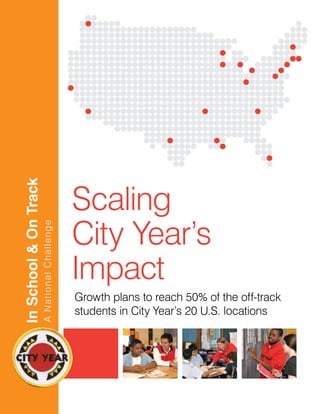
                                                                  City Year site scale plans, that collectively outline City Year’s
Costs to communities mount in public health, crime and
                                                                  In School & On Track challenge. At scale, City Year’s 20
welfare payments, loss of tax revenue, and the creation of an
                                                                  U.S. sites would deploy 6,223 corps members to 519
underclass of citizens.
                                                                  schools, annually reaching over 432,300 students,
Fortunately, recent research has emerged from the Johns           including 125,166 off-track students. We are actively
Hopkins University that sheds valuable light on the high          partnering with local stakeholders in all of our markets to
school dropout crisis. Of the more than one million youth         support local plans to scale City Year to serve in the subset of
that drop out from school each year, we know that 50% of the      schools that generate half of the city’s dropouts, ensuring that
nation’s dropouts come from only 12% of the high schools,         students in all of our communities are on a path to graduate
which are located predominantly in urban, high poverty,           and succeed as productive engaged citizens.
minority communities. Research also tells us that as early
as 6th grade, students begin to demonstrate signs that they
                                                                  For more information, contact Christine Morin, Vice President of Site Growth
are likely to drop out. These signs are called “Early Warning     and New Site Development at cmorin@cityyear.org
Indicators” and consist of: poor attendance, poor behavior,       or visit www.cityyear.org/inschool_ontrack.aspx


Information is current as of May 18, 2010
Scaling City Year’s Impact: National Impact Site Guideposts


   Every 26 seconds a student gives up on school; one million Americans drop out every year and they are three times more
   likely than college graduates to be unemployed, and eight times more likely than high school graduates to be incarcerated.
   Research has shown that as early as 6th grade, students who demonstrate key off-track indicators relating to attendance,
   behavior and course performance in math and English, have a 75% probability of dropping out of high school. By
   implementing a scalable, outcomes-based service model focusing on the high schools and feeder middle and elementary
   schools that disproportionately generate dropouts, City Year will keep students from high-poverty communities on track to
   succeed in school and graduate as productive, engaged citizens.

   City Year’s National Impact Site (NIS) designation affirms local strategies to scale City Year’s impact and reach 50%
   of the students who are off track or falling off track within a district or high-need area. Headquarters will provide increased
   financial and human capital, which includes leveraging senior leadership to secure resources, helping develop a scale plan
   in partnership with stakeholders, expanding staff and corps member recruitment capacities, supporting local evaluation
   and program development and providing national marketing and communications support.

   The following National Impact Site guideposts, approved by the City Year, Inc. Board of Trustees, are designed to ensure
   that City Year’s National Impact Sites are developed in a manner that is operationally sound and sustainable. The Board of
   Trustees will vote to authorize National Impact Site Designation once the following guideposts are met:

 Shared Impact Goal: A goal that is shared by local                Mayoral and City Support: Formal support from the
   stakeholders, including the superintendent, mayor,                 Mayor and City in the form of funding, support letter
   teachers, state service commission, site board and                 and in-kind transportation passes for corps members.
   philanthropic champions to scale City Year’s impact
   through the strategic deployment of Whole School,                AmeriCorps Support: The State Commission
   Whole Child teams. Stakeholders commit to a plan that              administering AmeriCorps funds strongly endorses City
   will reach at least 50% of children who are off track or           Year’s impact plan.
   are in danger of falling off track within a district or high-
   need region.                                                     Multi-year Funding: Pledges totaling at least 90% of
                                                                      the non-federal (AmeriCorps) funding required over
 Champion: A lead champion, fully committed to the                   four years, including school district commitment, city
   scale plan’s success, who has convening power and
                                                                      funding, 100% of teams sponsored for at least three
   access to essential resources.
                                                                      years and local investment in City Year’s Individual
 Scale Plan: City Year Headquarters will provide staff               Giving Circles with at least two Founder Circle
   resources to facilitate the development of a scale plan            members and 10 Champion Circle members.
   in partnership with local stakeholders. This includes
   a timeline and plans for: team deployment, resource/             Board Leadership: Experienced Board Chair
   capacity development, program development, staff and               committed to City Year for three to five years. Board
   corps recruitment and multi-year diversified revenue               self-assessment completed by Chair in order to identify
   strategy.                                                          board development needs to support scale plan.
                                                                      Established standard committee/chair structure and
 Lead Investor: $1 - 5 million multi-year investment,                100% participation in board giving.
   depending on market size, to develop capacities
   required for scale.                                              Operational Readiness: As determined by the Office
                                                                      of Site Leadership, key programmatic and personnel
 Strategic Partnership with School District:                         objectives are met to ensure operational readiness,
   A formally executed strategic partnership with the
                                                                      including experienced site senior leadership, strategic
   local superintendent committing support of $100,000
                                                                      plan aligned with scaled impact strategy, staffing plan
   annually per City Year team, ideally inclusive of a
                                                                      to support growth, track record of success in corps
   minimum commitment by each partnering school. The
                                                                      recruitment and retention, established site training
   partnership will include a commitment to data-driven
                                                                      capacity and proven success implementing the Whole
   instruction, as demonstrated by the full integration of
                                                                      School, Whole Child model in multiple schools.
   the City Year team into school instruction, program,
   practices and systems. District shares goal of strategic
   deployment of City Year teams to feeder schools with a
   high percentage of the district’s off-track students.
In School & On Track
           A N ati o n a l S e r v i c e R e s p o n s e to
           th e H i g h S c h o o l D ro p o u t C r isis                                                                                                                                     BOSTOn

    A Plan to Keep Boston Students In School and On Track
    City Year’s Whole School, Whole Child model places teams of young adults in schools to improve student attendance, behavior and course
    performance, three indicators that a comprehensive Johns Hopkins University study confirms are highly predictive of a student’s likelihood of
    dropping out of high school. City Year Boston seeks to serve in the subset of schools that generate 50% of the district’s dropouts, ensuring that
    the students who are most likely to drop-out reach the 10th grade on track and on time.*
    At scale, City Year Boston would reach half of the city’s off-track students, thereby achieving the designation of a City Year, Inc. National Impact
    Site. Each year, City Year Boston’s 353 corps members would reach over 22,000 students, including 6,200 off-track students.


                       National Impact Site Plan
                                                                                                                                                                      ≈55% of off-track
                                                                                                                                                                     students in Boston
                                                         Corps Members
                                                         Students Served                                                                                                                           25,000


                                                      City Year Boston achieves National Impact Site status                                                                      22,710
                                              500

                                                                                                                                                                                                   20,000


                                                                                                                                                                                                                 Students Served
                                              400                                                                                                   15,830
                              Corps Members


                                                                                                                                                                          353                      15,000


                                              300                                                                       10,540
                                                                                                                                             251                                                   10,000


                                                                                           6,550
                                              200
                                                                                                                 173
                                                               4,000                                                                                                                               5,000

                                                                                   120
                                                        100
                                              100


                                                          Current                      Year 1                       Year 2                      Year 3                     Year 4
    Schools/Students Served

               Total Students Served                       4,000                        6,550                       10,540                      15,830                     22,710

        Off-Track Students Served                             600                       2,040                       2,950                       4,400                       6,240
                        Schools Served                        10                          12                           18                          25                         35
    Resources Required

                                                    Federal AmeriCorps             $1,447,000                  $2,086,000                  $3,026,000                  $4,256,000
                                                    School District/City           $1,200,000                  $1,730,000                  $2,510,000                  $3,530,000
                                Private Sector Support Needed                       $2,037,000                  $2,308,000                  $2,635,000                 $3,070,000
                                                                     Total          $4,684,000                  $6,124,000                  $8,171,000                 $10,856,000


 4-YEAR PRIVATE SECTOR SUPPORT NEEDED                                                          NET SOCIETAL BENEFIT


  $10M                                                                                         $455M**
Corps size estimates for Whole School, Whole Child corps members only.
*Students in high poverty school districts who successfully complete grades 6 to 9, have a 75% or higher graduation rate. Students who exhibit an off-track indicator (poor attendance, disruptive behavior or
course failure in math/English) have a 20% probability of graduating, identified as early as the 6th grade (Johns Hopkins Study).
**Source: Net societal benefit based on increasing the graduation rate from 20% to 75% among off track students each year at scale with the average economic benefit per new graduate assumed to be
$292,000 (see Northeastern University study, October 2009, “The Consequences of Dropping Out of High School”).
In School & On Track
          A N ati o n a l S e r v i c e R e s p o n s e to
          th e H i g h S c h o o l D ro p o u t C r isis                                                                                                                                 CHICAGO

  A Plan to Keep Chicago Students In School and On Track
  City Year’s Whole School, Whole Child model places teams of young adults in schools to improve student attendance, behavior and course
  performance, three indicators that a comprehensive Johns Hopkins University study confirms are highly predictive of a student’s likelihood of
  dropping out of high school. City Year Chicago seeks to serve in the subset of schools that generate 50% of the dropouts within high need zones,
  ensuring that the students who are most likely to drop-out reach the 10th grade on track and on time.*
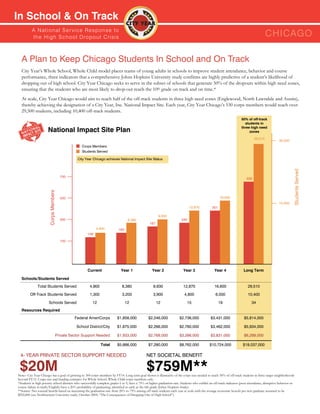
  At scale, City Year Chicago would aim to reach half of the off-track students in three high need zones (Englewood, North Lawndale and Austin),
  thereby achieving the designation of a City Year, Inc. National Impact Site. Each year, City Year Chicago’s 530 corps members would reach over
  29,500 students, including 10,400 off-track students.
                                                                                                                                                                      50% of off-track
                                                                                                                                                                        students in
                                                                                                                                                                      three high need
                      National Impact Site Plan                                                                                                                            zones

                                                                                                                                                                                29,510
                                                                                                                                                                                                  30,000
                                                 Corps Members
                                                 Students Served

                                              City Year Chicago achieves National Impact Site Status


                                                                                                                                                                                                             Students Served
                                       700
                                                                                                                                                                          530
                       Corps Members


                                       500                                                                                                            16,600
                                                                                                                                                                                                  15,000
                                                                                                                               12,870           301

                                                                                                         9,930
                                       300                                       8,380                                   240
                                                                                                  197
                                                          4,900           163
                                                    108
                                       100


                                                    Current                 Year 1                  Year 2                 Year 3                 Year 4                Long Term

  Schools/Students Served
              Total Students Served                  4,900                   8,380                  9,930                  12,870                 16,600                   29,510

         Off-Track Students Served                   1,300                   3,200                  3,900                   4,800                  6,000                   10,400

                      Schools Served                   12                       12                      12                    15                      19                      34
  Resources Required
                                             Federal AmeriCorps          $1,858,000              $2,246,000             $2,736,000             $3,431,000               $5,814,000

                                              School District/City       $1,875,000              $2,266,000             $2,760,000             $3,462,000               $5,934,000

                                   Private Sector Support Needed         $1,933,000              $2,768,000             $3,266,000             $3,831,000               $6,289,000

                                                             Total       $5,666,000              $7,280,000             $8,762,000            $10,724,000              $18,037,000

 4- YEAR PRIVATE SECTOR SUPPORT NEEDED                                                         NET SOCIETAL BENEFIT

 $20M                                                                                          $759M**
Note– City Year Chicago has a goal of growing to 300 corps members by FY14. Long term goal shown is illustrative of the corps size needed to reach 50% of off-track students in three target neighborhoods
beyond FY15. Corps size and funding estimates for Whole School, Whole Child corps members only.
*Students in high poverty school districts who successfully complete grades 6 to 9, have a 75% or higher graduation rate. Students who exhibit an off-track indicator (poor attendance, disruptive behavior or
course failure in math/English) have a 20% probability of graduating, identified as early as the 6th grade (Johns Hopkins Study).
**Source: Net societal benefit based on increasing the graduation rate from 20% to 75% among off track students each year at scale with the average economic benefit per new graduate assumed to be
$292,000 (see Northeastern University study, October 2009, “The Consequences of Dropping Out of High School”).
In School & On Track
         A N ati o n a l S e r v i c e R e s p o n s e to
         th e H i g h S c h o o l D ro p o u t C r isis                                                                                                                      CLEVEL AnD

  A Plan to Keep Cleveland Students In School and On Track
  City Year’s Whole School, Whole Child model places teams of young adults in schools to improve student attendance, behavior and course
  performance, three indicators that a comprehensive Johns Hopkins University study confirms are highly predictive of a student’s likelihood of
  dropping out of high school. City Year Cleveland seeks to serve in the subset of schools that generate 50% of Cleveland’s dropouts, ensuring
  that the students who are most likely to drop-out reach the 10th grade on track and on time.*
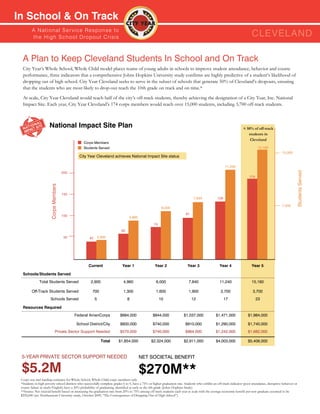
  At scale, City Year Cleveland would reach half of the city’s off-track students, thereby achieving the designation of a City Year, Inc. National
  Impact Site. Each year, City Year Cleveland’s 174 corps members would reach over 15,000 students, including 3,700 off-track students.


                      National Impact Site Plan                                                                                                                       ≈ 50% of off-track
                                                                                                                                                                         students in
                                                                                                                                                                          Cleveland
                                                 Corps Members
                                                 Students Served                                                                                                                  15,160
                                                                                                                                                                                                   15,000
                                               City Year Cleveland achieves National Impact Site status

                                                                                                                                                         11,240


                                                                                                                                                                                                              Students Served
                                       200
                                                                                                                                                                           174
                       Corps Members


                                       150
                                                                                                                                 7,840             129

                                                                                                                                                                                                   7,500
                                                                                                          6,000
                                                                                                                            91
                                       100                                       4,960
                                                                                                    74
                                                                           60
                                       50           45       2,900


                                                    Current                 Year 1                  Year 2                   Year 3                  Year 4                  Year 5

  Schools/Students Served
              Total Students Served                  2,900                   4,960                   6,000                    7,840                  11,240                  15,160

         Off-Track Students Served                    700                    1,300                   1,600                    1,900                   2,700                  3,700
                       Schools Served                    5                      8                        10                      12                      17                      23

  Resources Required
                                             Federal AmeriCorps            $684,000                $844,000               $1,037,000              $1,471,000              $1,984,000

                                             School District/City          $600,000                $740,000                $910,000               $1,290,000              $1,740,000
                               Private Sector Support Needed               $570,000                $740,000                $964,000               $1,242,000              $1,682,000

                                                               Total     $1,854,000               $2,324,000              $2,911,000              $4,003,000              $5,406,000


 5-YEAR PRIVATE SECTOR SUPPORT NEEDED                                                    NET SOCIETAL BENEFIT

 $5.2M                                                                                   $270M**
 Corps size and funding estimates for Whole School, Whole Child corps members only.
 *Students in high poverty school districts who successfully complete grades 6 to 9, have a 75% or higher graduation rate. Students who exhibit an off-track indicator (poor attendance, disruptive behavior or
 course failure in math/English) have a 20% probability of graduating, identified as early as the 6th grade (Johns Hopkins Study).
 **Source: Net societal benefit based on increasing the graduation rate from 20% to 75% among off track students each year at scale with the average economic benefit per new graduate assumed to be
 $292,000 (see Northeastern University study, October 2009, “The Consequences of Dropping Out of High School”).
In School & On Track
        A N ati o n a l S e r v i c e R e s p o n s e to
        th e H i g h S c h o o l D ro p o u t C r isis                                                                                                                            COLUMBIA

   A Plan to Keep Columbia Students In School and On Track
  City Year’s Whole School, Whole Child model places teams of young adults in schools to improve student attendance, behavior and course
  performance, three indicators that a comprehensive Johns Hopkins University study confirms are highly predictive of a student’s likelihood of
  dropping out of high school. City Year Columbia seeks to serve in the subset of schools that generate 50% of the district’s dropouts, ensuring
  that the students who are most likely to drop-out reach the 10th grade on track and on time.*
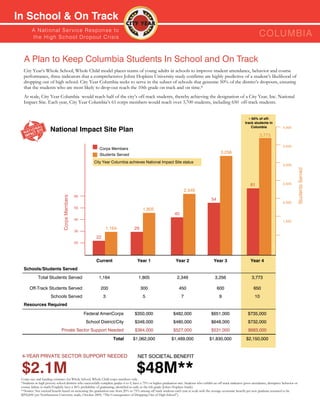
  At scale, City Year Columbia would reach half of the city’s off-track students, thereby achieving the designation of a City Year, Inc. National
  Impact Site. Each year, City Year Columbia’s 61 corps members would reach over 3,700 students, including 650 off-track students.


                                                                                                                                                                           ≈ 50% of off-
                                                                                                                                                                        track students in
                                                                                                                                                                             Columbia
                      National Impact Site Plan                                                                                                                                                     4,000

                                                                                                                                                                                  3,773

                                                                                                                                                                                                    3,500
                                                            Corps Members
                                                            Students Served
                                                                                                                                                     3,256

                                                         City Year Columbia achieves National Impact Site status
                                                                                                                                                                                                    3,000


                                                                                                                                                                                                              Students Served
                                                                                                                                                                            61                      2,500
                                                                                                                            2,349
                                                60
                                Corps Members


                                                                                                                                              54
                                                                                                                                                                                                    2,000
                                                50                                         1,805
                                                                                                                   40
                                                40
                                                                                                                                                                                                    1,500

                                                                   1,164             29
                                                30
                                                          22
                                                20


                                                          Current                      Year 1                       Year 2                      Year 3                      Year 4
  Schools/Students Served
             Total Students Served                         1,164                        1,805                        2,349                       3,256                      3,773

       Off-Track Students Served                            200                           300                         450                          600                        650
                       Schools Served                          3                           5                            7                           9                          10
  Resources Required

                                                     Federal AmeriCorps              $350,000                     $482,000                    $651,000                    $735,000
                                                     School District/City            $348,000                     $480,000                    $648,000                    $732,000
                               Private Sector Support Needed                         $364,000                     $527,000                    $531,000                    $683,000
                                                                      Total         $1,062,000                   $1,489,000                  $1,830,000                 $2,150,000


 4-YEAR PRIVATE SECTOR SUPPORT NEEDED                                                  NET SOCIETAL BENEFIT


 $2.1M
 Corps size and funding estimates for Whole School, Whole Child corps members only.
                                                                                       $48M**
 *Students in high poverty school districts who successfully complete grades 6 to 9, have a 75% or higher graduation rate. Students who exhibit an off-track indicator (poor attendance, disruptive behavior or
 course failure in math/English) have a 20% probability of graduating, identified as early as the 6th grade (Johns Hopkins Study).
 **Source: Net societal benefit based on increasing the graduation rate from 20% to 75% among off track students each year at scale with the average economic benefit per new graduate assumed to be
 $292,000 (see Northeastern University study, October 2009, “The Consequences of Dropping Out of High School”).
In School & On Track
           A N ati o n a l S e r v i c e R e s p o n s e to
           th e H i g h S c h o o l D ro p o u t C r isis                                                                                                                         COLUMBUS

    A Plan to Keep Columbus Students In School and On Track
    City Year’s Whole School, Whole Child model places teams of young adults in schools to improve student attendance, behavior and course
    performance, three indicators that a comprehensive Johns Hopkins University study confirms are highly predictive of a student’s likelihood of
    dropping out of high school. City Year Columbus seeks to serve in the subset of schools that generate 50% of the district’s dropouts, ensuring
    that the students who are most likely to drop-out reach the 10th grade on track and on time.*
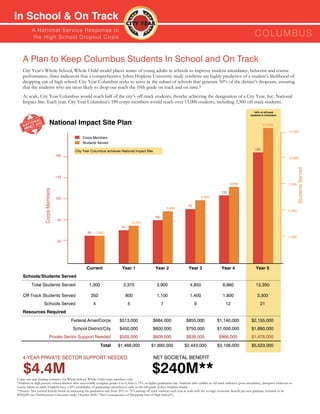
    At scale, City Year Columbus would reach half of the city’s off-track students, thereby achieving the designation of a City Year, Inc. National
    Impact Site. Each year, City Year Columbus’s 189 corps members would reach over 13,000 students, including 3,300 off-track students.
                                                                                                                                                                                  ≈50% of off-track
                                                                                                                                                                               students in Columbus


                             National Impact Site Plan                                                                                                                                  13,350
                                                                                                                                                                                                           13,300
                                                 Corps Members
                                                 Students Served

                                            City Year Columbus achieves National Impact Site                                                                                      189
                                    180
                                                                                                                                                                                                           10,300


                                                                                                                                                                                                                   Students Served
                                    140
                                                                                                                                                               6,860                                       7,300
                    Corps Members


                                                                                                                                                        100
                                    100                                                                                                  4,850

                                                                                                                                75
                                                                                                                3,900
                                                                                                                                                                                                           4,300
                                                                                                       60
                                    60
                                                                                       2,370
                                                                              45
                                                    30    1,300
                                                                                                                                                                                                           1,300
                                    20


                                                    Current                   Year 1                   Year 2                   Year 3                   Year 4                    Year 5
    Schools/Students Served
          Total Students Served                      1,300                     2,370                    3,900                    4,850                    6,860                    13,350

    Off-Track Students Served                          350                       800                    1,100                    1,400                    1,800                     3,300
                    Schools Served                       4                         5                        7                        9                      12                        21
    Resources Required
                                          Federal AmeriCorps                $513,000                 $684,000                 $855,000               $1,140,000                $2,155,000
                                          School District/City              $450,000                 $600,000                 $750,000               $1,000,000                $1,890,000
                             Private Sector Support Needed                  $505,000                 $609,000                 $838,000                 $966,000                $1,478,000
                                                              Total        $1,468,000               $1,893,000               $2,443,000               $3,106,000               $5,523,000

    4-YEAR PRIVATE SECTOR SUPPORT NEEDED                                                              NET SOCIETAL BENEFIT

    $4.4M
Corps size and funding estimates for Whole School, Whole Child corps members only.
                                                                                                     $240M**
*Students in high poverty school districts who successfully complete grades 6 to 9, have a 75% or higher graduation rate. Students who exhibit an off-track indicator (poor attendance, disruptive behavior or
course failure in math/English) have a 20% probability of graduating, identified as early as the 6th grade (Johns Hopkins Study).
**Source: Net societal benefit based on increasing the graduation rate from 20% to 75% among off track students each year at scale with the average economic benefit per new graduate assumed to be
$292,000 (see Northeastern University study, October 2009, “The Consequences of Dropping Out of High School”).
In School & On Track
         A N ati o n a l S e r v i c e R e s p o n s e to
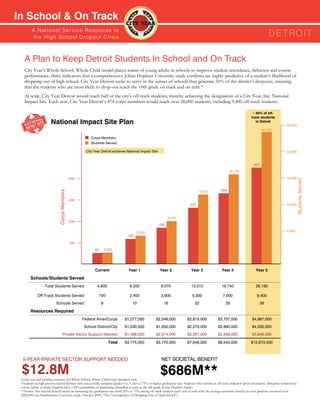
         th e H i g h S c h o o l D ro p o u t C r isis                                                                                                                                  DETROIT

   A Plan to Keep Detroit Students In School and On Track
   City Year’s Whole School, Whole Child model places teams of young adults in schools to improve student attendance, behavior and course
   performance, three indicators that a comprehensive Johns Hopkins University study confirms are highly predictive of a student’s likelihood of
   dropping out of high school. City Year Detroit seeks to serve in the subset of schools that generate 50% of the district’s dropouts, ensuring
   that the students who are most likely to drop-out reach the 10th grade on track and on time.*
   At scale, City Year Detroit would reach half of the city’s off-track students, thereby achieving the designation of a City Year, Inc. National
   Impact Site. Each year, City Year Detroit’s 474 corps members would reach over 26,000 students, including 9,400 off-track students.

                                                                                                                                                                              ≈ 50% of off-
                                                                                                                                                                             track students
                       National Impact Site Plan                                                                                                                                in Detroit
                                                                                                                                                                                                       26,500
                                                                                                                                                                                    26,190

                                                       Corps Members
                                                       Students Served

                                                    City Year Detroit achieves National Impact Site                                                                                                    22,500


                                                                                                                                                                              403
                                                                                                                                                            18,740

                                             400                                                                                                                                                       18,000


                                                                                                                                                                                                                  Students Served
                                                                                                                                                      299
                             Corps Members


                                                                                                                                     13,010

                                             300
                                                                                                                               227                                                                     12,500


                                                                                                              8,070
                                             200
                                                                                                        165

                                                                                         6,200                                                                                                         8,000
                                                                                103

                                             100
                                                          63       4,600


                                                         Current                 Year 1                 Year 2                  Year 3                 Year 4                   Year 5

       Schools/Students Served
                  Total Students Served                    4,600                  6,200                  8.070                  13,010                 18,740                   26,190

             Off-Track Students Served                      700                   2,400                  3,900                  5,300                  7,000                     9,400
                           Schools Served                      8                    10                     16                     22                     29                         39

       Resources Required
                                                   Federal AmeriCorps         $1,277,000             $2,046,000              $2,815,000             $3,707,000               $4,997,000
                                                   School District/City       $1,030,500             $1,650,000              $2,270,000             $2,990,000               $4,030,000
                                   Private Sector Support Needed              $1,468,000             $2,074,000              $2,561,000             $2,848,000               $3,846,000

                                                                     Total    $3,775,000             $5,770,000              $7,646,000             $9,545,000              $12,873,000


  5-YEAR PRIVATE SECTOR SUPPORT NEEDED                                                                   NET SOCIETAL BENEFIT

 $12.8M
 Corps size and funding estimates for Whole School, Whole Child corps members only.
                                                                                                         $686M**
 *Students in high poverty school districts who successfully complete grades 6 to 9, have a 75% or higher graduation rate. Students who exhibit an off-track indicator (poor attendance, disruptive behavior or
 course failure in math/English) have a 20% probability of graduating, identified as early as the 6th grade (Johns Hopkins Study).
 **Source: Net societal benefit based on increasing the graduation rate from 20% to 75% among off track students each year at scale with the average economic benefit per new graduate assumed to be
 $292,000 (see Northeastern University study, October 2009, “The Consequences of Dropping Out of High School”).
In School & On Track
         A N ati o n a l S e r v i c e R e s p o n s e to
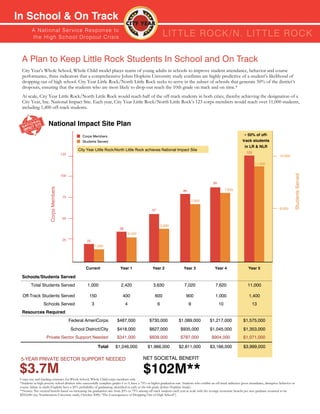
         th e H i g h S c h o o l D ro p o u t C r isis                                                       LIT TLE ROCK /n. LIT TLE ROCK

  A Plan to Keep Little Rock Students In School and On Track
  City Year’s Whole School, Whole Child model places teams of young adults in schools to improve student attendance, behavior and course
  performance, three indicators that a comprehensive Johns Hopkins University study confirms are highly predictive of a student’s likelihood of
  dropping out of high school. City Year Little Rock/North Little Rock seeks to serve in the subset of schools that generate 50% of the district’s
  dropouts, ensuring that the students who are most likely to drop-out reach the 10th grade on track and on time.*
  At scale, City Year Little Rock/North Little Rock would reach half of the off-track students in both cities, thereby achieving the designation of a
  City Year, Inc. National Impact Site. Each year, City Year Little Rock/North Little Rock’s 123 corps members would reach over 11,000 students,
  including 1,400 off-track students.


                      National Impact Site Plan
                                                   Corps Members                                                                                                         ≈ 50% of off-
                                                   Students Served                                                                                                      track students
                                                                                                                                                                         in LR & NLR
                                                 City Year Little Rock/North Little Rock achieves National Impact Site
                                                                                                                                                                          123
                                       125                                                                                                                                                         12,000

                                                                                                                                                                                 11,000


                                                                                                                                                                                                              Students Served
                                       100

                                                                                                                                                 95
                       Corps Members


                                                                                                                           85                              7,620

                                       75
                                                                                                                                 7,020

                                                                                                    57                                                                                             6,000

                                       50

                                                                                                             3,630
                                                                           38
                                                                                    2,420
                                       25             22
                                                               1,000


                                                     Current                Year 1                  Year 2                 Year 3                  Year 4                   Year 5

  Schools/Students Served
         Total Students Served                        1,000                 2,420                   3,630                   7,020                  7,620                   11,000

  Off-Track Students Served                            150                    400                     600                    900                   1,000                    1,400
                  Schools Served                           3                    4                        6                      9                     10                      13
  Resources Required
                                             Federal AmeriCorps          $487,000                 $730,000              $1,089,000             $1,217,000               $1,575,000
                                             School District/City        $418,000                 $627,000               $935,000              $1,045,000               $1,353,000
                    Private Sector Support Needed                        $341,000                 $609,000               $787,000               $904,000                $1,071,000

                                                                Total   $1,246,000              $1,966,000              $2,811,000             $3,166,000               $3,999,000

 5-YEAR PRIVATE SECTOR SUPPORT NEEDED                                                        NET SOCIETAL BENEFIT

 $3.7M                                                                                       $102M**
 Corps size and funding estimates for Whole School, Whole Child corps members only.
 *Students in high poverty school districts who successfully complete grades 6 to 9, have a 75% or higher graduation rate. Students who exhibit an off-track indicator (poor attendance, disruptive behavior or
 course failure in math/English) have a 20% probability of graduating, identified as early as the 6th grade (Johns Hopkins Study).
 **Source: Net societal benefit based on increasing the graduation rate from 20% to 75% among off track students each year at scale with the average economic benefit per new graduate assumed to be
 $292,000 (see Northeastern University study, October 2009, “The Consequences of Dropping Out of High School”).
In School & On Track
        A N ati o n a l S e r v i c e R e s p o n s e to
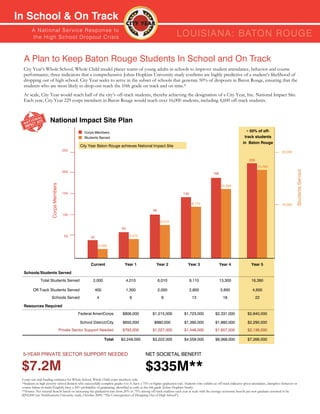
        th e H i g h S c h o o l D ro p o u t C r isis                                                              LOUISIAnA: BATOn ROUGE

  A Plan to Keep Baton Rouge Students In School and On Track
  City Year’s Whole School, Whole Child model places teams of young adults in schools to improve student attendance, behavior and course
  performance, three indicators that a comprehensive Johns Hopkins University study confirms are highly predictive of a student’s likelihood of
  dropping out of high school. City Year seeks to serve in the subset of schools that generate 50% of dropouts in Baton Rouge, ensuring that the
  students who are most likely to drop-out reach the 10th grade on track and on time.*
  At scale, City Year would reach half of the city’s off-track students, thereby achieving the designation of a City Year, Inc. National Impact Site.
  Each year, City Year 229 corps members in Baton Rouge would reach over 16,000 students, including 4,600 off-track students.


                     National Impact Site Plan
                                                    Corps Members                                                                                                       ≈ 50% of off-
                                                    Students Served                                                                                                    track students
                                                                                                                                                                      in Baton Rouge
                                                  City Year Baton Rouge achieves National Impact Site
                                        250                                                                                                                                                        20,000

                                                                                                                                                                           229
                                                                                                                                                                                  16,390


                                                                                                                                                                                                              Students Served
                                        200                                                                                                     188
                       Corps Members


                                                                                                                                                      13,300

                                        150                                                                              139

                                                                                                                                9,110                                                              10,000
                                                                                                   98
                                        100

                                                                                                         6,010
                                                                           65

                                         50             40                       4,010

                                                              2,000


                                                        Current              Year 1                  Year 2                  Year 3                   Year 4                Year 5

  Schools/Students Served
              Total Students Served                      2,000                  4,010                   6,010                  9,110                  13,300                16,390

         Off-Track Students Served                           400                1,300                   2,000                  2,800                  3,800                  4,600
                       Schools Served                        4                   6                       9                      13                     18                        22

  Resources Required
                                                 Federal AmeriCorps         $806,000              $1,215,000              $1,723,000             $2,331,000              $2,840,000

                                                  School District/City      $650,000                $980,000              $1,390,000             $1,880,000              $2,290,000
                                       Private Sector Support Needed        $793,000              $1,027,000              $1,446,000             $1,857,000              $2,136,000

                                                                   Total   $2,249,000             $3,222,000              $4,559,000             $6,068,000              $7,266,000


 5-YEAR PRIVATE SECTOR SUPPORT NEEDED                                                        NET SOCIETAL BENEFIT

 $7.2M                                                                                       $335M**
 Corps size and funding estimates for Whole School, Whole Child corps members only.
 *Students in high poverty school districts who successfully complete grades 6 to 9, have a 75% or higher graduation rate. Students who exhibit an off-track indicator (poor attendance, disruptive behavior or
 course failure in math/English) have a 20% probability of graduating, identified as early as the 6th grade (Johns Hopkins Study).
 **Source: Net societal benefit based on increasing the graduation rate from 20% to 75% among off track students each year at scale with the average economic benefit per new graduate assumed to be
 $292,000 (see Northeastern University study, October 2009, “The Consequences of Dropping Out of High School”).
In School & On Track
        A N ati o n a l S e r v i c e R e s p o n s e to
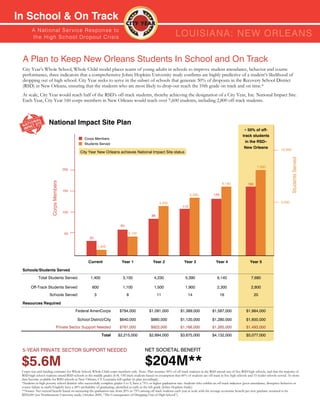
        th e H i g h S c h o o l D ro p o u t C r isis                                                             LOUISIAnA: nEW ORLEAnS

 A Plan to Keep New Orleans Students In School and On Track
 City Year’s Whole School, Whole Child model places teams of young adults in schools to improve student attendance, behavior and course
 performance, three indicators that a comprehensive Johns Hopkins University study confirms are highly predictive of a student’s likelihood of
 dropping out of high school. City Year seeks to serve in the subset of schools that generate 50% of dropouts in the Recovery School District
 (RSD) in New Orleans, ensuring that the students who are most likely to drop-out reach the 10th grade on track and on time.*
 At scale, City Year would reach half of the RSD’s off-track students, thereby achieving the designation of a City Year, Inc. National Impact Site.
 Each Year, City Year 160 corps members in New Orleans would reach over 7,600 students, including 2,800 off-track students.


                    National Impact Site Plan
                                                                                                                                                                     ≈ 50% of off-
                                                                                                                                                                    track students
                                                 Corps Members
                                                                                                                                                                      in the RSD–
                                                 Students Served
                                                                                                                                                                     New Orleans
                                                                                                                                                                                                 10,000
                                               City Year New Orleans achieves National Impact Site status


                                                                                                                                                                                                         Students Served
                                                                                                                                                                               7,680
                                       250
                       Corps Members


                                                                                                                                                      6,140             160
                                       150
                                                                                                                              5,390            128

                                                                                                       4,230                                                                                     5,000
                                                                                                                        112
                                       100
                                                                                                 88

                                                                          64

                                       50                                      3,100
                                                    30

                                                             1,400


                                                   Current                 Year 1                 Year 2                 Year 3                  Year 4                   Year 5

 Schools/Students Served
             Total Students Served                  1,400                  3,100                   4,230                  5,390                  6,140                     7,680

       Off-Track Students Served                     600                   1,100                   1,500                  1,900                  2,300                     2,800
                     Schools Served                      3                     8                      11                    14                       16                       20

 Resources Required
                                             Federal AmeriCorps          $794,000              $1,091,000             $1,389,000              $1,587,000               $1,984,000

                                             School District/City        $640,000               $880,000              $1,120,000              $1,280,000               $1,600,000
                                Private Sector Support Needed            $781,000               $923,000              $1,166,000              $1,265,000               $1,493,000

                                                               Total    $2,215,000             $2,894,000             $3,675,000              $4,132,000               $5,077,000


 5-YEAR PRIVATE SECTOR SUPPORT NEEDED                                                       NET SOCIETAL BENEFIT

 $5.6M                                                                                      $204M**
 Corps size and funding estimates for Whole School, Whole Child corps members only. Note- Plan assumes 50% of off track students in the RSD attend one of five RSD high schools, and that the majority of
 RSD high school students attend RSD schools in the middle grades (6-8). Off track students based on assumption that 60% of students are off track in five high schools and 15 feeder schools served. As more
 data become available for RSD schools in New Orleans, CY Louisiana will update its plan accordingly.
 *Students in high poverty school districts who successfully complete grades 6 to 9, have a 75% or higher graduation rate. Students who exhibit an off-track indicator (poor attendance, disruptive behavior or
 course failure in math/English) have a 20% probability of graduating, identified as early as the 6th grade (Johns Hopkins Study).
 **Source: Net societal benefit based on increasing the graduation rate from 20% to 75% among off track students each year at scale with the average economic benefit per new graduate assumed to be
 $292,000 (see Northeastern University study, October 2009, “The Consequences of Dropping Out of High School”).
In School & On Track
          A N ati o n a l S e r v i c e R e s p o n s e to
          th e H i g h S c h o o l D ro p o u t C r isis                                                                                                              LOS AnGELES

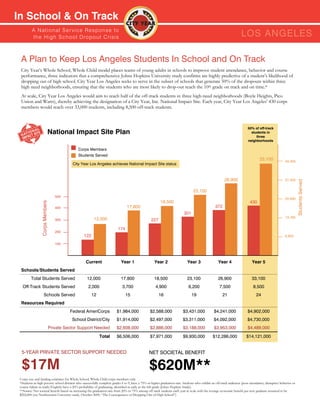
  A Plan to Keep Los Angeles Students In School and On Track
  City Year’s Whole School, Whole Child model places teams of young adults in schools to improve student attendance, behavior and course
  performance, three indicators that a comprehensive Johns Hopkins University study confirms are highly predictive of a student’s likelihood of
  dropping out of high school. City Year Los Angeles seeks to serve in the subset of schools that generate 50% of the dropouts within three
  high need neighborhoods, ensuring that the students who are most likely to drop-out reach the 10th grade on track and on time.*
  At scale, City Year Los Angeles would aim to reach half of the off-track students in three high-need neighborhoods (Boyle Heights, Pico
  Union and Watts), thereby achieving the designation of a City Year, Inc. National Impact Site. Each year, City Year Los Angeles’ 430 corps
  members would reach over 33,000 students, including 8,500 off-track students.


                                                                                                                                                                           50% of off-track
                             National Impact Site Plan                                                                                                                       students in
                                                                                                                                                                                three
                                                                                                                                                                           neighborhoods

                                               Corps Members
                                               Students Served
                                                                                                                                                                                    33,100             34,400
                                            City Year Los Angeles achieves National Impact Site status


                                                                                                                                                          26,900                                       27,520


                                                                                                                                                                                                                  Students Served
                                                                                                                                  23,100
                                    500
                                                                                                                                                                                                       20,640
                                                                                                          18,500                                                             430
                 Corps Members


                                    400                                          17,800                                                            372
                                                                                                                           301
                                                                                                                                                                                                       13,760
                                    300                  12,000                                    227
                                                                          174
                                    200
                                                  122                                                                                                                                                  6,850

                                    100


                                                   Current                  Year 1                   Year 2                   Year 3                 Year 4                   Year 5
  Schools/Students Served
         Total Students Served                      12,000                  17,800                   18,500                   23,100                 26,900                   33,100
   Off-Track Students Served                        2,000                    3,700                    4,900                    6,200                  7,500                    8,500
                     Schools Served                     12                      15                       16                      19                     21                       24
  Resources Required
                                           Federal AmeriCorps            $1,984,000               $2,588,000               $3,431,000             $4,241,000               $4,902,000
                                            School District/City         $1,914,000               $2,497,000               $3,311,000             $4,092,000               $4,730,000
                                 Private Sector Support Needed           $2,608,000               $2,886,000               $3,188,000             $3,953,000               $4,489,000
                                                             Total       $6,506,000               $7,971,000               $9,930,000            $12,286,000              $14,121,000


  5-YEAR PRIVATE SECTOR SUPPORT NEEDED                                                           NET SOCIETAL BENEFIT


  $17M                                                                                           $620M**
 Corps size and funding estimates for Whole School, Whole Child corps members only.
 *Students in high poverty school districts who successfully complete grades 6 to 9, have a 75% or higher graduation rate. Students who exhibit an off-track indicator (poor attendance, disruptive behavior or
 course failure in math/English) have a 20% probability of graduating, identified as early as the 6th grade (Johns Hopkins Study).
 **Source: Net societal benefit based on increasing the graduation rate from 20% to 75% among off track students each year at scale with the average economic benefit per new graduate assumed to be
 $292,000 (see Northeastern University study, October 2009, “The Consequences of Dropping Out of High School”).
In School & On Track
        A N ati o n a l S e r v i c e R e s p o n s e to
        th e H i g h S c h o o l D ro p o u t C r isis                                                                                                                                              MIAMI

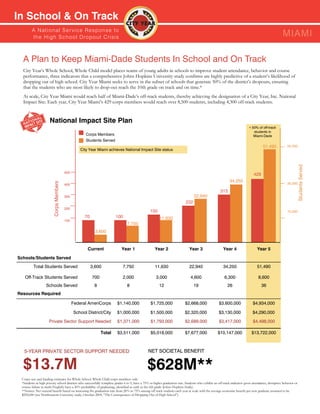
  A Plan to Keep Miami-Dade Students In School and On Track
  City Year’s Whole School, Whole Child model places teams of young adults in schools to improve student attendance, behavior and course
  performance, three indicators that a comprehensive Johns Hopkins University study confirms are highly predictive of a student’s likelihood of
  dropping out of high school. City Year Miami seeks to serve in the subset of schools that generate 50% of the district’s dropouts, ensuring
  that the students who are most likely to drop-out reach the 10th grade on track and on time.*
  At scale, City Year Miami would reach half of Miami-Dade’s off-track students, thereby achieving the designation of a City Year, Inc. National
  Impact Site. Each year, City Year Miami’s 429 corps members would reach over 8,500 students, including 4,300 off-track students.


                     National Impact Site Plan
                                                                                                                                                                          ≈ 50% of off-track
                                                                                                                                                                             students in
                                                     Corps Members                                                                                                           Miami-Dade
                                                     Students Served
                                                                                                                                                                                     51,490            55,000
                                                  City Year Miami achieves National Impact Site status


                                                                                                                                                                                                                  Students Served
                                        500
                                                                                                                                                                              429
                                                                                                                                                            34,250
                        Corps Members


                                        400                                                                                                                                                            35,000

                                                                                                                                                     313
                                        300                                                                                      22,940
                                                                                                                           232
                                        200
                                                                                                150                                                                                                    15,000
                                                    70                 100                             11,630
                                        100
                                                                               7,750
                                                           3,600


                                                      Current              Year 1                   Year 2                    Year 3                   Year 4                   Year 5

Schools/Students Served
         Total Students Served                           3,600              7,750                   11,630                    22,940                   34,250                   51,490

   Off-Track Students Served                             700                2,000                    3,000                     4,600                    6,300                    8,600
                   Schools Served                         8                    8                       12                        19                       26                        36
Resources Required

                                              Federal AmeriCorps        $1,140,000               $1,725,000               $2,668,000                $3,600,000               $4,934,000

                                              School District/City      $1,000,000               $1,500,000               $2,320,000                $3,130,000               $4,290,000
                     Private Sector Support Needed                      $1,371,000               $1,793,000               $2,689,000                $3,417,000               $4,498,000

                                                               Total    $3,511,000               $5,018,000               $7,677,000               $10,147,000              $13,722,000


  5-YEAR PRIVATE SECTOR SUPPORT NEEDED                                                         NET SOCIETAL BENEFIT


  $13.7M                                                                                      $628M**
 Corps size and funding estimates for Whole School, Whole Child corps members only.
 *Students in high poverty school districts who successfully complete grades 6 to 9, have a 75% or higher graduation rate. Students who exhibit an off-track indicator (poor attendance, disruptive behavior or
 course failure in math/English) have a 20% probability of graduating, identified as early as the 6th grade (Johns Hopkins Study).
 **Source: Net societal benefit based on increasing the graduation rate from 20% to 75% among off track students each year at scale with the average economic benefit per new graduate assumed to be
 $292,000 (see Northeastern University study, October 2009, “The Consequences of Dropping Out of High School”).
In School & On Track
          A N ati o n a l S e r v i c e R e s p o n s e to
          th e H i g h S c h o o l D ro p o u t C r isis                                                                                                                      MILWAUKEE

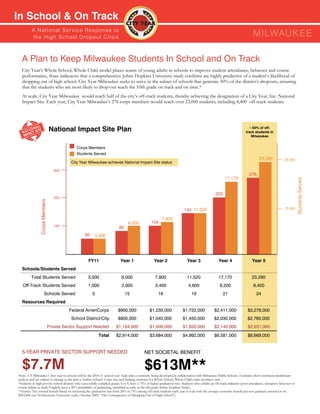
  A Plan to Keep Milwaukee Students In School and On Track
  City Year’s Whole School, Whole Child model places teams of young adults in schools to improve student attendance, behavior and course
  performance, three indicators that a comprehensive Johns Hopkins University study confirms are highly predictive of a student’s likelihood of
  dropping out of high school. City Year Milwaukee seeks to serve in the subset of schools that generate 50% of the district’s dropouts, ensuring
  that the students who are most likely to drop-out reach the 10th grade on track and on time.*
  At scale, City Year Milwaukee would reach half of the city’s off-track students, thereby achieving the designation of a City Year, Inc. National
  Impact Site. Each year, City Year Milwaukee’s 276 corps members would reach over 23,000 students, including 8,400 off-track students.


                                National Impact Site Plan                                                                                                                   ≈ 50% of off-
                                                                                                                                                                         track students in
                                                                                                                                                                             Milwaukee


                                              Corps Members
                                              Students Served
                                                                                                                                                                                   23,290             25,000
                                           City Year Milwaukee achieves National Impact Site status

                                   300
                                                                                                                                                                            276
                                                                                                                                                         17,170


                                                                                                                                                                                                                 Students Served
                                                                                                                                                  203
                                   200
                Corps Members


                                                                                                                           145 11,520                                                                 12,500


                                                                                                          7,800
                                                                                 6,000             104
                                   100                                     80
                                                  50    3,000


                                                    FY11                    Year 1                   Year 2                  Year 3                  Year 4                   Year 5
  Schools/Students Served
         Total Students Served                      3,000                   6,000                    7,800                   11,520                  17,170                   23,290
   Off-Track Students Served                        1,000                   2,600                     3,400                   4,600                   6,200                    8,400
                       Schools Served                  5                        15                      16                       19                     21                       24
  Resources Required
                                          Federal AmeriCorps              $950,000               $1,235,000               $1,722,000              $2,411,000               $3,278,000
                                           School District/City           $800,000               $1,040,000               $1,450,000              $2,030,000              $2,760,000
                                Private Sector Support Needed           $1,164,000               $1,409,000               $1,820,000              $2,140,000               $2,631,000
                                                           Total        $2,914,000               $3,684,000               $4,992,000              $6,581,000               $8,669,000


  5-YEAR PRIVATE SECTOR SUPPORT NEEDED                                                       NET SOCIETAL BENEFIT


  $7.7M                                                                                       $613M**
Note– CY Milwaukee’s first year in schools will be the 2010-11 school year. Scale plan is currently being developed in collaboration with Milwaukee Public Schools. Estimates above represent preliminary
analysis and are subject to change as the plan is further refined. Corps size and funding estimates for Whole School, Whole Child corps members only.
*Students in high poverty school districts who successfully complete grades 6 to 9, have a 75% or higher graduation rate. Students who exhibit an off-track indicator (poor attendance, disruptive behavior or
course failure in math/English) have a 20% probability of graduating, identified as early as the 6th grade (Johns Hopkins Study).
**Source: Net societal benefit based on increasing the graduation rate from 20% to 75% among off track students each year at scale with the average economic benefit per new graduate assumed to be
$292,000 (see Northeastern University study, October 2009, “The Consequences of Dropping Out of High School”).
In School & On Track
          A N ati o n a l S e r v i c e R e s p o n s e to
          th e H i g h S c h o o l D ro p o u t C r isis                                                                                                  nEW HAMPSHIRE

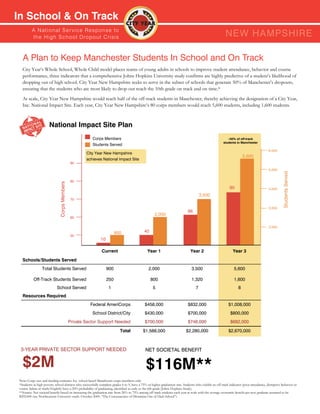
   A Plan to Keep Manchester Students In School and On TrackTrack
                  New Hampshire Students In School and On
   City Year’s Whole School, Whole Child model places teams of young adults in schools to improve student attendance, behavior and course
   performance, three indicators that a comprehensive Johns Hopkins University study confirms are highly predictive of a student’s likelihood of
   dropping out of high school. City Year New Hampshire seeks to serve in the subset of schools that generate 50% of Manchester’s dropouts,
   ensuring that the students who are most likely to drop-out reach the 10th grade on track and on time.*
   At scale, City Year New Hampshire would reach half of the off-track students in Manchester, thereby achieving the designation of a City Year,
   Inc. National Impact Site. Each year, City Year New Hampshire’s 80 corps members would reach 5,600 students, including 1,600 students.


                       National Impact Site Plan
                                                         Corps Members                                                                                     ≈50% of off-track
                                                                                                                                                        students in Manchester
                                                         Students Served
                                                                                                                                                                                          6,000
                                                      City Year New Hampshire
                                                                                                                                                                       5,600
                                                      achieves National Impact Site
                                              90
                                                                                                                                                                                          5,000


                                                                                                                                                                                                    Students Served
                                              80
                              Corps Members


                                                                                                                                                             80                           4,000
                                                                                                                                        3,500
                                              70

                                                                                                                                                                                          3,000
                                                                                                                              66
                                                                                                     2,000
                                              60

                                                                                                                                                                                          2,000
                                                                        900                  40
                                              50
                                                             10

                                                              Current                           Year 1                          Year 2                         Year 3
   Schools/Students Served
                 Total Students Served                            900                            2,000                           3,500                          5,600

           Off-Track Students Served                              250                             800                            1,320                          1,600
                            School Served                          1                                5                               7                              8
   Resources Required
                                                        Federal AmeriCorps                    $458,000                        $832,000                      $1,008,000
                                                         School District/City                 $430,000                        $700,000                       $800,000
                                              Private Sector Support Needed                   $700,000                        $748,000                       $682,000

                                                                           Total            $1,588,000                      $2,280,000                      $2,670,000


  3-YEAR PRIVATE SECTOR SUPPORT NEEDED                                                        NET SOCIETAL BENEFIT


   $2M                                                                                         $116M**
 Note-Corps size and funding estimates for school based Manchester corps members only.
 *Students in high poverty school districts who successfully complete grades 6 to 9, have a 75% or higher graduation rate. Students who exhibit an off-track indicator (poor attendance, disruptive behavior or
 course failure in math/English) have a 20% probability of graduating, identified as early as the 6th grade (Johns Hopkins Study).
 **Source: Net societal benefit based on increasing the graduation rate from 20% to 75% among off track students each year at scale with the average economic benefit per new graduate assumed to be
 $292,000 (see Northeastern University study, October 2009, “The Consequences of Dropping Out of High School”).
In School & On Track
         A N ati o n a l S e r v i c e R e s p o n s e to
         th e H i g h S c h o o l D ro p o u t C r isis                                                                                                                            nEW YORK

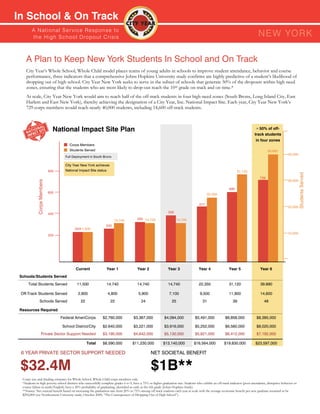
    A Plan to Keep New York Students In School and On Track
    City Year’s Whole School, Whole Child model places teams of young adults in schools to improve student attendance, behavior and course
    performance, three indicators that a comprehensive Johns Hopkins University study confirms are highly predictive of a student’s likelihood of
    dropping out of high school. City Year New York seeks to serve in the subset of schools that generate 50% of the dropouts within high need
    zones, ensuring that the students who are most likely to drop-out reach the 10th grade on track and on time.*
    At scale, City Year New York would aim to reach half of the off-track students in four high-need zones (South Bronx, Long Island City, East
    Harlem and East New York), thereby achieving the designation of a City Year, Inc. National Impact Site. Each year, City Year New York’s
    729 corps members would reach nearly 40,000 students, including 14,600 off-track students.


                               National Impact Site Plan                                                                                                                         ≈ 50% of off-
                                                                                                                                                                                track students
                                                                                                                                                                                 in four zones
                                       Corps Members
                                       Students Served                                                                                                                                    39,890
                                                                                                                                                                                                         40,000
                                     Full Deployment in South Bronx
                                     Full deployment in South

                                     City Year New York achieves
                             800     National Impact Site status                                                                                                   31,120


                                                                                                                                                                                                                   Students Served
                                                                                                                                                                                    729
                                                                                                                                                                                                         30,000
             Corps Members


                                                                                                                                                             596
                             600
                                                                                                                                            22,350

                                                                                                                                      477
                                                                                                                                                                                                         20,000
                             400                                                                               356

                                                                      14,740            293 14,740                   14,740
                                                                240
                                           22011,500
                                                                                                                                                                                                         10,000
                             200


                                           Current               Year 1                 Year 2                 Year 3                 Year 4                 Year 5                 Year 6
 Schools/Students Served
      Total Students Served                 11,500               14,740                 14,740                 14,740                 22,350                 31,120                 39.890

 Off-Track Students Served                   2,800               4,800                   5,900                  7,100                  9,500                 11,900                 14,600
                 Schools Served                22                  22                      24                     25                     31                     39                     48

 Resources Required
                                   Federal AmeriCorps         $2,760,000             $3,367,000             $4,094,000             $5,491,000             $6,858,000             $8,385,000

                                   School District/City       $2,640,000             $3,221,000             $3,916,000             $5,252,000             $6,560,000             $8,020,000
                    Private Sector Support Needed             $3,190,000             $4,642,000             $5,130,000             $5,821,000             $6,412,000             $7,192,000

                                                    Total     $8,590,000            $11,230,000            $13,140,000            $16,564,000            $19,830,000             $23,597,000

 6 YEAR PRIVATE SECTOR SUPPORT NEEDED                                                             NET SOCIETAL BENEFIT


 $32.4M                                                                                           $1B**
  Corps size and funding estimates for Whole School, Whole Child corps members only.
  *Students in high poverty school districts who successfully complete grades 6 to 9, have a 75% or higher graduation rate. Students who exhibit an off-track indicator (poor attendance, disruptive behavior or
  course failure in math/English) have a 20% probability of graduating, identified as early as the 6th grade (Johns Hopkins Study).
  **Source: Net societal benefit based on increasing the graduation rate from 20% to 75% among off track students each year at scale with the average economic benefit per new graduate assumed to be
  $292,000 (see Northeastern University study, October 2009, “The Consequences of Dropping Out of High School”).
In School & On Track
          A N ati o n a l S e r v i c e R e s p o n s e to
          th e H i g h S c h o o l D ro p o u t C r isis                                                                      GRE ATER PHIL ADELPHIA

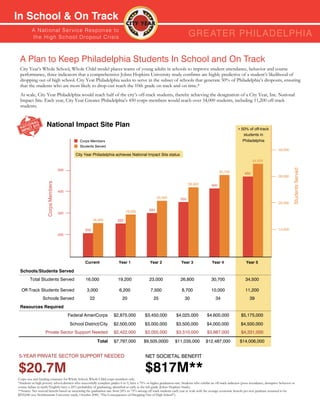
 A Plan to Keep Philadelphia Students In School and On Track
 City Year’s Whole School, Whole Child model places teams of young adults in schools to improve student attendance, behavior and course
 performance, three indicators that a comprehensive Johns Hopkins University study confirms are highly predictive of a student’s likelihood of
 dropping out of high school. City Year Philadelphia seeks to serve in the subset of schools that generate 50% of Philadelphia’s dropouts, ensuring
 that the students who are most likely to drop-out reach the 10th grade on track and on time.*
 At scale, City Year Philadelphia would reach half of the city’s off-track students, thereby achieving the designation of a City Year, Inc. National
 Impact Site. Each year, City Year Greater Philadelphia’s 450 corps members would reach over 34,000 students, including 11,200 off-track
 students.


                     National Impact Site Plan
                                                                                                                                                                   ≈ 50% of off-track
                                                                                                                                                                      students in
                                                Corps Members                                                                                                         Philadelphia
                                                Students Served
                                                                                                                                                                                                  40,000
                                              City Year Philadelphia achieves National Impact Site status
                                                                                                                                                                              34,500


                                                                                                                                                                                                            Students Served
                                     500
                                                                                                                                                      30,700            450
                                                                                                                                                                                                  30,000
                     Corps Members


                                                                                                                              26,800            400
                                     400
                                                                                                       23,000           350
                                                                                                                                                                                                  20,000

                                                                                19,200           300
                                     300
                                                         16,000           250

                                                   200                                                                                                                                            10,000
                                     200


                                                   Current                 Year 1                 Year 2                 Year 3                 Year 4                   Year 5

 Schools/Students Served
        Total Students Served                      16,000                 19,200                 23,000                  26,800                30,700                    34,500

  Off-Track Students Served                         3,000                  6,200                  7,500                  8,700                 10,000                    11,200
                  Schools Served                      22                     20                     25                      30                     34                       39
 Resources Required
                                           Federal AmeriCorps          $2,875,000             $3,450,000             $4,025,000             $4,600,000                $5,175,000
                                           School District/City        $2,500,000             $3,000,000             $3,500,000             $4,000,000               $4,500,000
                    Private Sector Support Needed                      $2,422,000             $3,055,000             $3,510,000             $3,887,000                $4,331,000

                                                           Total       $7,797,000            $9,505,0000            $11,035,000            $12,487,000               $14,006,000


5-YEAR PRIVATE SECTOR SUPPORT NEEDED                                                          NET SOCIETAL BENEFIT

$20.7M                                                                                        $817M**
Corps size and funding estimates for Whole School, Whole Child corps members only.
*Students in high poverty school districts who successfully complete grades 6 to 9, have a 75% or higher graduation rate. Students who exhibit an off-track indicator (poor attendance, disruptive behavior or
course failure in math/English) have a 20% probability of graduating, identified as early as the 6th grade (Johns Hopkins Study).
**Source: Net societal benefit based on increasing the graduation rate from 20% to 75% among off track students each year at scale with the average economic benefit per new graduate assumed to be
$292,000 (see Northeastern University study, October 2009, “The Consequences of Dropping Out of High School”).
In School & On Track
         A N ati o n a l S e r v i c e R e s p o n s e to
         th e H i g h S c h o o l D ro p o u t C r isis                                                                                                          RHODE ISL AnD

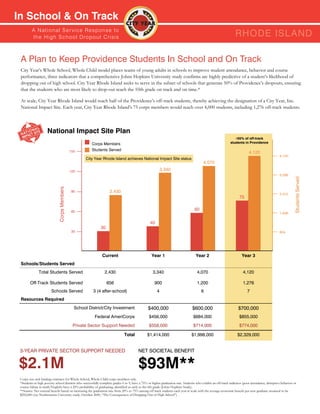
 A Plan to Keep Providence Students In School and On Track
 City Year’s Whole School, Whole Child model places teams of young adults in schools to improve student attendance, behavior and course
 performance, three indicators that a comprehensive Johns Hopkins University study confirms are highly predictive of a student’s likelihood of
 dropping out of high school. City Year Rhode Island seeks to serve in the subset of schools that generate 50% of Providence’s dropouts, ensuring
 that the students who are most likely to drop-out reach the 10th grade on track and on time.*

 At scale, City Year Rhode Island would reach half of the Providence’s off-track students, thereby achieving the designation of a City Year, Inc.
 National Impact Site. Each year, City Year Rhode Island’s 75 corps members would reach over 4,000 students, including 1,276 off-track students.


                     National Impact Site Plan
                                                                                                                                                                ≈55% of off-track
                                                        Corps Members                                                                                        students in Providence

                                             150        Students Served
                                                                                                                                                                           4,120
                                                                                                                                                                                                  4,120
                                                     City Year Rhode Island achieves National Impact Site status
                                                                                                                                         4,070
                                             120                                                           3,340
                                                                                                                                                                                                  3,296


                                                                                                                                                                                                             Students Served
                             Corps Members


                                             90                    2,430
                                                                                                                                                                                                  2,472
                                                                                                                                                                    75


                                             60
                                                                                                                                   60
                                                                                                                                                                                                  1,648

                                                                                                  40
                                                             30
                                             30                                                                                                                                                   824


                                                              Current                              Year 1                           Year 2                            Year 3
 Schools/Students Served
              Total Students Served                             2,430                               3,340                            4,070                             4,120

        Off-Track Students Served                                 656                                900                             1,200                             1,276
                        Schools Served                   3 (4 after-school)                            4                                6                                 7
 Resources Required
                                               School District/City Investment                  $400,000                         $600,000                          $700,000
                                                         Federal AmeriCorps                      $456,000                         $684,000                          $855,000
                                              Private Sector Support Needed                      $558,000                         $714,000                          $774,000

                                                                              Total            $1,414,000                       $1,998,000                         $2,329,000


 3-YEAR PRIVATE SECTOR SUPPORT NEEDED                                                    NET SOCIETAL BENEFIT


$2.1M                                                                                    $93M**
 Corps size and funding estimates for Whole School, Whole Child corps members only.
 *Students in high poverty school districts who successfully complete grades 6 to 9, have a 75% or higher graduation rate. Students who exhibit an off-track indicator (poor attendance, disruptive behavior or
 course failure in math/English) have a 20% probability of graduating, identified as early as the 6th grade (Johns Hopkins Study).
 **Source: Net societal benefit based on increasing the graduation rate from 20% to 75% among off track students each year at scale with the average economic benefit per new graduate assumed to be
 $292,000 (see Northeastern University study, October 2009, “The Consequences of Dropping Out of High School”).
In School & On Track
          A N ati o n a l S e r v i c e R e s p o n s e to
          th e H i g h S c h o o l D ro p o u t C r isis                                                                                                               SAn AnTOnIO

  A Plan to Keep San Antonio Students In School and On Track
  City Year’s Whole School, Whole Child model places teams of young adults in schools to improve student attendance, behavior and course
  performance, three indicators that a comprehensive Johns Hopkins University study confirms are highly predictive of a student’s likelihood of
  dropping out of high school. City Year San Antonio seeks to serve in the subset of schools that generate 50% of San Antonio’s dropouts,
  ensuring that the students who are most likely to drop-out reach the 10th grade on track and on time.*
  At scale, City Year San Antonio would reach half of the off-track students in five high need districts, thereby achieving the designation of a
  City Year, Inc. National Impact Site. Each year, City Year San Antonio’s 563 corps members would reach over 15,000 students, including
  15,300 off-track students.
                                                                                                                                                                             ≈ 50% of off-track
                                                                                                                                                                              students in five
                             National Impact Site Plan                                                                                                                           districts
                                                                                                                                                                                                           45,000
                                     Corps Members                                                                                                                                      43,030
                                     Students Served                                                                                                                              563

                                  City Year San Antonio achieves National Impact Site Status                                                                    22,260
                           520
                                                                                                                                                                                                           20,500

                                                                                                                                          14,820
                           420


                                                                                                                                                                                                                 Students Served
                                                                                                                                                                                                           10,500
           Corps Members


                                                                                                                                                          286
                                                                                                                   8,630
                           320

                                                                                                                                   215
                                                                                                                                                                                                           7,500

                           220                                                                              144


                                                                                            4,130
                                                                                                                                                                                                           4,500
                                                                                      84
                           120                                          2,460
                                                               48
                                              2,000
                                         25

                           20                                                                                                                                                                              1,500


                                         Current                Year 1                 Year 2                 Year 3                  Year 4                 Year 5              Long Term
  Schools/Students Served
   Total Students Served                  2,000                 2,460                   4,130                  8,630                  14,820                 22,260                 43,030

        Off-Track Students                 400                  1,200                   2,200                  3,700                   5,600                 7,400                   15,300
                    Served
           Schools Served                     4                     4                      7                      12                     18                     24                      35

  Resources Required
                                 Federal AmeriCorps           $595,000              $1,042,000             $1,786,000              $2,666,000             $3,546,000              $6,981,000

                                 School District/City         $480,000               $840,000              $1,440,000              $2,150,000             $2,860,000              $5,630,000

                   Private Sector Support Needed              $519,000               $902,000              $1,499,000              $1,704,000             $2,373,000              $3,579,000

                                                  Total      $1,594,000             $2,784,000             $4,725,000              $6,520,000             $8,779,000             $16,190,000

  5-YEAR PRIVATE SECTOR SUPPORT NEEDED                                                         NET SOCIETAL BENEFIT


 $7M
Corps size and funding estimates for Whole School, Whole Child corps members only.
                                                                                               $1.1B**
*Students in high poverty school districts who successfully complete grades 6 to 9, have a 75% or higher graduation rate. Students who exhibit an off-track indicator (poor attendance, disruptive behavior or
course failure in math/English) have a 20% probability of graduating, identified as early as the 6th grade (Johns Hopkins Study).
**Source: Net societal benefit based on increasing the graduation rate from 20% to 75% among off track students each year at scale with the average economic benefit per new graduate assumed to be
$292,000 (see Northeastern University study, October 2009, “The Consequences of Dropping Out of High School”).
In School & On Track
         A N ati o n a l S e r v i c e R e s p o n s e to
         th e H i g h S c h o o l D ro p o u t C r isis                                                             SAn JOSÉ/SILICOn VALLEY

  A Plan to Keep San José Students In School and On Track
  City Year’s Whole School, Whole Child model places teams of young adults in schools to improve student attendance, behavior and course
  performance, three indicators that a comprehensive Johns Hopkins University study confirms are highly predictive of a student’s likelihood of
  dropping out of high school. City Year San José seeks to serve in the subset of schools that generate 50% of San José’s dropouts, ensuring that
  the students who are most likely to drop-out reach the 10th grade on track and on time.*
  At scale, City Year San José would reach half of the city’s off-track students, thereby achieving the designation of a City Year, Inc. National
  Impact Site. Each year, City Year San José’s 394 corps members would reach over 26,000 students, including 4,400 off-track students.


                      National Impact Site Plan
                                                    Corps Members                                                                                                        ≈ 50% of off-
                                                    Students Served                                                                                                     track students
                                                                                                                                                                         in San José
                                                  City Year San José achieves National Impact Site status
                                       450                                                                                                                                                         30,000

                                                                                                                                                                           394 26,190


                                                                                                                                                                                                              Students Served
                                       350

                                                                                                                                                  310
                       Corps Members


                                                                                                                                                        18,740

                                       250

                                                                                                                          228
                                                                                                                                                                                                   15,000
                                                                                                                                   13,010
                                                                                                  162
                                       150

                                                                                                         8,070
                                                                          97


                                       50            40                            4,840


                                                          1,900


                                                     Current               Year 1                   Year 2                 Year 3                  Year 4                   Year 5

  Schools/Students Served
         Total Students Served                        1,900                4,840                    8,070                 13,010                  18,740                    26,190

  Off-Track Students Served                            350                 1,100                    1,800                  2,500                   3,500                     4,400
                  Schools Served                          4                    6                      10                      14                      17                       23
  Resources Required
                                         Federal AmeriCorps            $1,175,000               $1,962,000             $2,761,000              $3,754,000                $4,772,000
                                             School District/City      $1,067,000               $1,782,000             $2,508,000              $3,410,000                $4,334,000
                  Private Sector Support Needed                        $1,331,000               $1,696,000             $2,342,000              $3,062,000                $3,632,000

                                                              Total     $3,573,000               $5,440,000             $7,611,000             $10,226,000               $12,738,000


  5-YEAR PRIVATE SECTOR SUPPORT NEEDED                                                        NET SOCIETAL BENEFIT


 $12M                                                                                         $321M**
 Corps size and funding estimates for Whole School, Whole Child corps members only.
 *Students in high poverty school districts who successfully complete grades 6 to 9, have a 75% or higher graduation rate. Students who exhibit an off-track indicator (poor attendance, disruptive behavior or
 course failure in math/English) have a 20% probability of graduating, identified as early as the 6th grade (Johns Hopkins Study).
 **Source: Net societal benefit based on increasing the graduation rate from 20% to 75% among off track students each year at scale with the average economic benefit per new graduate assumed to be
 $292,000 (see Northeastern University study, October 2009, “The Consequences of Dropping Out of High School”).
In School & On Track
         A N ati o n a l S e r v i c e R e s p o n s e to
         th e H i g h S c h o o l D ro p o u t C r isis                                                                          SE AT TLE/KInG COUnT Y

   A Plan to Keep Seattle Students In School and On Track
   City Year’s Whole School, Whole Child model places teams of young adults in schools to improve student attendance, behavior and course
   performance, three indicators that a comprehensive Johns Hopkins University study confirms are highly predictive of a student’s likelihood of
   dropping out of high school. City Year Seattle seeks to serve in the subset of schools that generate 50% of the district’s dropouts, ensuring
   that the students who are most likely to drop-out reach the 10th grade on track and on time.*

   At scale, City Year Seattle would reach half of the city’s off-track students, thereby achieving the designation of a City Year, Inc. National
   Impact Site. Each year, City Year Seattle’s 240 corps members would reach over 13,000 students, including 2,800 off-track students.

                                                                                                                                                                                 ≈ 50% of
                                                                                                                                                                           off-track students
                                                                                                                                                                                in Seattle
                       National Impact Site Plan                                                                                                                                                        14,000
                                                                                                                                                                                    13,840

                                                                                                                                                                                                        12,000
                                                          Corps Members
                                                          Students Served
                                                                                                                                                           10,490


                                                                                                                                                                                                                  Students Served
                                                     City Year Seattle achieves National Impact Site status                                                                                             10,000


                                                                                                                                                                                                        8,000
                                        300
                                                                                                                                   7,620
                                                                                                                                                                              240
                        Corps Members


                                        250
                                                                                                                                                                                                        6,000

                                        200                                                             5,200                                       182

                                        150                                   3,800                                        135                                                                          4,000
                                                           3,500
                                                                                                 97
                                        100
                                                                       60
                                                     50                                                                                                                                                 2,000
                                        50


                                                      Current             Year 1                   Year 2                    Year 3                   Year 4                    Year 5
   Schools/Students
   Served
          Total Students Served                        3,500                3,800                   5,200                     7,620                   10,490                    13,840

   Off-Track Students Served                              500               700                     1,100                     1,500                    2,100                     2,800
                   Schools Served                          6                  6                       10                        14                       19                        25
   Resources Required

                                          Federal AmeriCorps            $684,000                $1,106,000                $1,539,000               $2,075,000               $2,736,000

                                              School District/City      $600,000                 $970,000                 $1,350,000               $1,820,000               $2,400,000

                   Private Sector Support Needed                       $1,110,000               $1,418,000                $1,687,000               $2,028,000               $2,610,000
                                                               Total   $2,394,000               $3,494,000                $4,576,000               $5,923,000               $7,746,000

  5-YEAR PRIVATE SECTOR SUPPORT NEEDED                                                         NET SOCIETAL BENEFIT

 $8.8M
 Corps size and funding estimates for Whole School, Whole Child corps members only.
                                                                                               $204M**
 *Students in high poverty school districts who successfully complete grades 6 to 9, have a 75% or higher graduation rate. Students who exhibit an off-track indicator (poor attendance, disruptive behavior or
 course failure in math/English) have a 20% probability of graduating, identified as early as the 6th grade (Johns Hopkins Study).
 **Source: Net societal benefit based on increasing the graduation rate from 20% to 75% among off track students each year at scale with the average economic benefit per new graduate assumed to be
 $292,000 (see Northeastern University study, October 2009, “The Consequences of Dropping Out of High School”).
In School & On Track
          A N ati o n a l S e r v i c e R e s p o n s e to
          th e H i g h S c h o o l D ro p o u t C r isis                                                                                                WASHInGTOn, DC

  A Plan to Keep Washington, DC Students In School and On Track
  City Year’s Whole School, Whole Child model places teams of young adults in schools to improve student attendance, behavior and course
  performance, three indicators that a comprehensive Johns Hopkins University study confirms are highly predictive of a student’s likelihood of
  dropping out of high school. City Year Washington DC seeks to serve in the subset of schools that generate 50% of the district’s dropouts,
  ensuring that the students who are most likely to drop-out reach the 10th grade on track and on time.*
  At scale, City Year Washington DC would reach half of the city’s off-track students, thereby achieving the designation of a City Year, Inc.
  National Impact Site. Each year, City Year Washington DC’s 335 corps members would reach over 11,500 students, including 6,000 students.


                     National Impact Site Plan                                                                                                                            50% of off-track
                                                                                                                                                                            students in
                                                                                                                                                                          Washington, DC

                                                           Corps Members
                                                           Students Served                                                                                                          11,500
                                                                                                                                                                                                      11,500
                                                        City Year Washington DC achieves National Impact Site status
                                                  625

                                                                                                                                                        9,200
                                                                                                                                                                                                      9,200


                                                                                                                                                                                                                 Students Served
                                                  500
                                  Corps Members


                                                                                                                                                                                                      6,900
                                                  375
                                                                                                                             6,600
                                                                                                                                                                             335

                                                                                                                                                270
                                                                                                                                                                                                      4,600
                                                  250                                         4,400
                                                                                                                    200
                                                                                      140
                                                                   1,800                                                                                                                              2,300
                                                  125     100


                                                          Current                       Year 1                       Year 2                       Year 3                      Year 4
  Schools/Students Served
              Total Students Served                         1,800                        4,400                       6,600                        9,200                       11,500

        Off-Track Students Served                            800                         2,300                       3,400                        4,700                       6,000
                        Schools Served                         7                           10                           18                           26                          33
  Resources Required
                                        Public (AmeriCorps+DCPS)                    $2,703,000                   $4,233,000                   $5,885,000                  $7,376,000
                                Private Sector Support Needed                       $2,219,000                   $2,830,000                   $3,392,000                  $4,096,000

                                                                      Total          $4,922,000                   $7,063000                   $9,277,000                 $11,472,000


  4-YEAR PRIVATE SECTOR SUPPORT NEEDED                                                          NET SOCIETAL BENEFIT


 $10M                                                                                           $438M**
Corps size and funding estimates for Whole School, Whole Child corps members only.
*Students in high poverty school districts who successfully complete grades 6 to 9, have a 75% or higher graduation rate. Students who exhibit an off-track indicator (poor attendance, disruptive behavior or
course failure in math/English) have a 20% probability of graduating, identified as early as the 6th grade (Johns Hopkins Study).
**Source: Net societal benefit based on increasing the graduation rate from 20% to 75% among off track students each year at scale with the average economic benefit per new graduate assumed to be
$292,000 (see Northeastern University study, October 2009, “The Consequences of Dropping Out of High School”).
CIT Y YEAR, InC. BOARD OF TRUSTEES

Steve Woodsum, Chair of the Board*                Andrew Hauptman                                 Denny Marie Post
Founding Managing Director                        Chairman
Summit Partners                                   Andell Holdings, LLC                            Jennifer Eplett Reilly*
Boston, MA                                        Chair                                           Co-Founder
                                                  City Year Los Angeles                           City Year, Inc.
Kristen Atwood*                                   Los Angeles, CA                                 Chair
Founding Staff Member                                                                             City Year Louisiana
City Year, Inc.                                   Ilene Jacobs*                                   Baton Rouge, LA
Dedham, MA                                        Vice Chair of the Board
                                                  Executive Vice President                        Shirley Sagawa
Joe Banner*                                       Human Resources (Retired)                       Co-Founder
President and COO                                 Fidelity Investments                            Sagawa/Jospin
Philadelphia Eagles                               Boston, MA                                      Chevy Chase, MD
Philadelphia, PA
                                                  Hubie Jones***                                  Jeff Shames
Josh Bekenstein*                                  Social Justice Entrepreneur in Residence        Executive in Residence
Managing Director                                 City Year, Inc.                                 MIT Sloan School of Management
Bain Capital, LLC                                 Boston, MA                                      Retired Chairman
Boston, MA                                                                                        MFS Investment Management
                                                  Rosabeth Moss Kanter                            Boston, MA
Jessica L. Blume                                  Ernest L. Arbuckle Professor of Business
National Managing Director Clients & Industries     Administration                                Secretary Rodney Slater***
Deloitte Consulting LLP                           Harvard Business School                         Former U.S. Secretary of Transportation
Atlanta, GA                                       Harvard University                              Partner
                                                  Boston, MA                                      Patton Boggs, LLP
Michael Brown*                                                                                    Washington, DC
CEO and Co-Founder                                Andrew Kerin
City Year, Inc.                                   Executive Vice President                        Richard Stengel
Boston, MA                                        Group President, Global Food, Hospitality and   Managing Editor
                                                    Facility Services                             TIME
David Cohen*                                      ARAMARK Corporation                             New York, NY
Executive Vice President                          Philadelphia, PA
Comcast                                                                                           Jeffrey Swartz***
Philadelphia, PA                                  Jonathan Lavine*                                President and CEO
                                                  Managing Director                               The Timberland Company
Cheryl Dorsey                                     Bain Capital, LLC                               Stratham, NH
President                                         Chief Investment Officer
Echoing Green                                     Sankaty Advisors, LLC                           Michael J. Ward
New York, NY                                      Boston, MA                                      Chairman, President
                                                                                                  and CEO
Corinne Ferguson                                  Rick Menell                                     CSX Corporation
(Ex-Officio)                                      Chairman                                        Jacksonville, FL
Chair                                             The Carrick Foundation
City Year Boston                                  Johannesburg, South Africa                      Tom Ward
Brookline, MA                                                                                     Clerk pro tem**
                                                  Susan nokes                                     Senior Partner
Dan Fireman                                       Senior Vice President, Customer Solutions       WilmerHale
Managing Partner                                  Asurion                                         Boston, MA
Fireman Capital Partners                          Nashville, TN
New York, NY                                                                                      *Executive Committee Member
                                                  C. Gregg Petersmeyer                            **Ex-officio Executive Committee Member
David Gergen***                                   Vice Chair                                      ***Charter Trustees
Professor of Public Service and Director of the   America’s Promise Alliance
  Center for Public Leadership                    Chair and CEO
Harvard Kennedy School                            Personal Pathways LLC
Harvard University                                Alexandria, VA
Cambridge, MA
CIT Y YEAR BOARD CHAIRS AnD EXECUTIVE DIRECTORS

Board Chairs
City Year Boston                   City Year Detroit                      City Year Milwaukee                   City Year Rhode Island
Corinne Ferguson                   Daniel Little                          Julia Uihlein                         Alan Harlam
                                   Chancellor                             Assistant Adjunct Professor of        Director of Social Entrepreneurship
City Year Chicago                  University of Michigan – Dearborn         Bioethics and Pediatrics           Swearer Center for Public Service
Stephen Quazzo                                                            Center for the Study of Bioethics     Brown University
                                   N. Charles Anderson, Vice Chair
CEO                                                                       Associate Director of the Medical
                                   President/CEO
Transwestern Investment Company                                              Humanities Program                 City Year San Antonio
                                   Detroit Urban League, Inc.
Ms. Beth Swanson, Vice Chair                                              Medical College of Wisconsin          Jeff Galt
Executive Director                                                                                              CEO (Retired)
                                   City Year Little Rock/
The Pritzker Traubert Family                                              City Year new Hampshire               Harcourt San Antonio
                                   north Little Rock
   Foundation                                                             Major General Kenneth Clark
                                   General (Ret.) Wesley K. Clark
                                                                          New Hampshire National Guard          City Year San José/Silicon Valley
City Year Cleveland                Bruce Moore, Co-Vice Chair                                                   Carl Guardino
                                                                          Lesa Scott, Vice Chair
Bruce Akers, Co-Chair              City Manager                                                                 President & CEO
                                                                          President
Mayor                              City of Little Rock                                                          Silicon Valley Leadership Group
                                                                          Heinemann
City of Pepper Pike
                                   Stephanie Streett, Co-Vice Chair
                                                                                                                City Year Seattle/King County
Robert W. Gillespie, Co-Chair      Executive Director                     City Year new York
                                                                                                                George Meng, Co-Chair
Chairman Emeritus                  William J. Clinton Foundation          Stephanie Mudick
                                                                                                                Director of Staff - Marketing
KeyCorp                                                                   EVP, International Strategy
                                                                                                                Microsoft
                                   City Year Los Angeles                  JP Morgan Chase
City Year Columbia                 Andrew Hauptman                                                              Travis Warren, Co-Chair
                                                                          David Caplan, Vice Chair
Sidney Evering, Interim Co-Chair   Chairman                                                                     Director, Marketing
                                                                          Dean
Attorney                           Andell Holdings                                                              T-Mobile USA
                                                                          City Year New York
Parker, Poe, Adams and Bernstein
   LLP                             City Year Louisiana                                                          City Year Washington, DC
                                                                          City Year Greater Philadelphia
                                   Jennifer Eplett-Reilly                                                       Jeff Leonard
                                                                          Joe Banner, Co-Chair
Amy Love, Interim Co-Chair         Co-Founder, City Year, Inc.                                                  President & Chief Executive Officer
                                                                          President & Chief Operating Officer
Deputy Exectutive Director                                                                                         and Founding Partner
                                   Diana Lewis, Co-Chair                  Philadelphia Eagles
New Carolina Foundation                                                                                         Global Environment Fund
                                   New Orleans Community Leader
                                                                          Art Block, Co-Chair
City Year Columbus                 City Year Miami                        Senior Vice President, General
Cris Gossard                       Brad Meltzer                              Counsel & Secretary
Vice President of Commercial       Best Selling Author                    Comcast Corporation
   Banking
JP Morgan Chase & Co.              Cori Flam, Vice Chair
                                   Brad & Cori Meltzer Charitable Trust


Executive Directors
City Year Boston                   City Year Louisiana: Baton Rouge       City Year San Antonio
Sandra Lopez Burke                 Katrina Shaw                           Paul Garro

City Year Chicago                  City Year Louisiana: new Orleans       City Year San José/Silicon Valley
Lisa Morrison Butler               Peggy Mendoza                          Beach Pace

City Year Cleveland                City Year Miami                        City Year Seattle/King County
Gretchen Faro                      Saif Ishoof                            Simon Amiel

City Year Columbus                 City Year Milwaukee                    City Year Washington, DC
Lourdes Barroso de Padilla         Jason Holton                           Jeff Franco

City Year Columbia                 City Year new Hampshire
Elliott Epps                       Alexandra Allen
                                   Pawn Nitichan
City Year Detroit
Penny Bailer                       City Year new York
                                   Itai Dinour
City Year Little Rock/
north Little Rock                  City Year Philadelphia
Shannon Butler                     Wyneshia Foxworth
                                   Loree Jones
City Year Los Angeles
Allison Graff-Weisner              City Year Rhode Island
                                   Jennie Johnson
FROM BEFORE THE FIRST BELL RInGS
UnTIL THE L AST STUDEnT LE AVES

8:00 am Travel with team to school           8:30 am Greet students for a positive and energetic start to the school day


11:00 am Team-building puzzle activities         12:00 pm Lunch with mentor group


3:00 pm After-school homework help and test prep


9:00 am One-on-one math tutoring           10:00 am Small group literacy lesson


1:00 pm Reading comprehension and writing review           2:00 pm Meeting with principal to plan playground renovation


5:30 pm Give parents flyer for upcoming family book fair                             6:00 pm Break for the day
w w w. c i t y y e a r. o r g


US LOCATIONS                      City Year Detroit                 City Year Milwaukee               City Year San José/
                                  1 Ford Place, 1F                  322 Michigan Street               Silicon Valley
City Year Headquarters            Detroit, Ml 48202                 Suite 300                         90 north 1st Street
287 Columbus Avenue               313.874.6825                      Milwaukee, WI 53202               San José, CA 95113
Boston, MA 02116                                                    414.712.6930                      408.907.6500
617.927.2500                      City Year Little Rock/
                                  North Little Rock                 City Year New Hampshire           City Year Seattle/King County
City Year Boston                  610 President Clinton Avenue      200 Domain Drive                  2203 23rd Avenue South
287 Columbus Avenue               Third Floor                       Stratham, nH 03885                Suite 101
Boston, MA 02116                  Little Rock, AR 72201             603.773.1607                      Seattle, WA 98144
617.927.2500                      501.707.1400                                                        206.219.5010
                                                                    City Year New York
City Year Chicago                 City Year Los Angeles             20 West 22nd Street               City Year Washington, DC
36 S. Wabash Avenue               606 S. Olive Street               Third Floor                       1875 Connecticut Avenue, nW
Suite 1500                        Second Floor                      new York, nY 10010                Suite 1130
Chicago, IL 60603                 Los Angeles, CA 90014             212.675.8881                      Washington, DC 20009
312.464.9899                      213.596.5900                                                        202.776.7780
                                                                    City Year Greater Philadelphia
City Year Cleveland               City Year Louisiana               2221 Chestnut Street
526 Superior Ave E.               161 n. Third Street               Second Floor                      INTERNATIONAL AFFILIATES
Suite 408                         Baton Rouge, LA 70801             Philadelphia, PA 19103
Cleveland, OH 44114               225.663.4220                      215.988.2118                      City Year London
216.373.3400                                                                                          Tagwright House
                                  City Year Louisiana               City Year Rhode Island            35-41 Westland Place
City Year Columbia                805 Howard Ave                    77 Eddy Street, 2nd Floor         London n1 7LP
1919 Hampton Street               new Orleans, LA 70113             Providence, RI 02903              44 (0) 7850.311180
Columbia, SC 29201                504.561.1290                      401.553.2500
803.254.3349                                                                                          City Year South Africa
                                  City Year Miami                   City Year San Antonio             56 Main Street, Ground Flr
City Year Columbus                44 W Flagler Street, Suite 500    109-B north San Saba              Johannesburg
107 S. High Street, Suite 200     Miami, FL 33130                   San Antonio, TX 78207             South Africa
Columbus, OH 43215                786.406.7900                      210.247.4500                      2001
614.586.4520


City Year unites young people of all backgrounds for a year of full-time service, giving them the skills and opportunities to change
the world. As tutors, mentors and role models, these diverse young leaders help children stay in school and on track, and transform
schools and communities across the United States, as well as through international affiliates in Johannesburg, South Africa and
London, England.

In School & On Track: Scaling City Year's Impact

  • 1.
    In School &On Track Scaling City Year’s A National Challenge Impact Growth plans to reach 50% of the off-track students in City Year’s 20 U.S. locations
  • 2.
    photos by JenniferCogswell, Andy Dean, David Debalko, Claire Duggin, John Gillooly/PEI, Hyun Sun Kwon and Keri Leary
  • 3.
    As we think about what City Year can do going forward we need greater scale so that in all of your locations, we think about doubling, tripling, quadrupling your presence…I’m convinced that City Year is perhaps uniquely positioned to be our partner and to be the partner at the local level to transform schools that have historically struggled. – U.S. Secretary of Education Arne Duncan ” Last year at City Year’s National Leadership Summit and poor course performance in math or English. When a in Washington DC, with Secretary of Education Arne Duncan’s student in an urban public school exhibits even one of these support, City Year announced a major new initiative to indicators when they are in 6th grade, that student has a 75% address the nation’s high school dropout crisis – In School chance of dropping out. & On Track: A National Challenge. Through this initiative, City Year seeks to significantly increase the nation’s urban City Year supports school districts’ efforts to turn around the graduation pipeline – the number of students who reach the lowest-achieving schools by providing whole school and 10th grade on track and on time. City Year’s goal is to reach focused supports at the required scale and intensity to ensure at least 50% of all the students who are falling off-track in students stay in school and on track to graduate. To address City Year’s 20 U.S. locations, which will require expanding the the early warning indicators, City Year has developed a model number of corps members from 1,500 to more than 6,000 for supporting students and teachers in high-poverty schools, nationally. called Whole School, Whole Child. The Whole School, Whole Child model leverages City Year’s unique assets to provide a Every 26 seconds another student gives up on school, holistic portfolio of research-based academic interventions, resulting in more than one million American high school extending learning programs, and activities that foster a students who drop out every year. Over the next decade, this school-wide climate of achievement. By deploying City will cost the nation $3 trillion. In urban public schools that Year teams to the subset of high schools and the middle serve primarily low income and Latino or African American and elementary schools that disproportionately generate youth, between 40% and 60% of entering freshmen do dropouts, City Year will help ensure that students are on a not graduate from high school. Nationally, 40% of African path to succeed in school and graduate prepared for college American, 33% of Latino and 8% of Caucasian students and career. attend a high school with a 40% or higher drop out rate. The results of this failure rate are devastating, both to the young Since last year’s Summit, City Year sites have engaged their adults who give up on school and to their communities. local school districts, mayors, community leaders, educators, Dropouts are more likely than high school graduates to private sector champions and board members in this effort be unemployed, in poor health, living in poverty, on public to reverse the trajectory for students at-risk of dropping out of assistance, and single parents with children who drop out school and the response has been overwhelmingly positive. of school. On average, they earn more than $1 million less We introduced a set of guideposts for sites to achieve over a lifetime than do college graduates. They are three National Impact Site status, ensuring sites have the resources, times more likely to be unemployed, disengaged from civic capacity and local support to advance scale and impact life, and are eight times more likely to be in prison or jail goals. As a National Impact Site, local communities will be than graduates. For a single young adult such a fate can be positioned as an innovative national model leveraging national tragic, but when the majority or near majority of students from service to address the high school dropout crisis. entire neighborhoods and communities fail to graduate, the In this Scaling City Year’s Impact book, we are sharing the social and economic costs are profound and far reaching. City Year site scale plans, that collectively outline City Year’s Costs to communities mount in public health, crime and In School & On Track challenge. At scale, City Year’s 20 welfare payments, loss of tax revenue, and the creation of an U.S. sites would deploy 6,223 corps members to 519 underclass of citizens. schools, annually reaching over 432,300 students, Fortunately, recent research has emerged from the Johns including 125,166 off-track students. We are actively Hopkins University that sheds valuable light on the high partnering with local stakeholders in all of our markets to school dropout crisis. Of the more than one million youth support local plans to scale City Year to serve in the subset of that drop out from school each year, we know that 50% of the schools that generate half of the city’s dropouts, ensuring that nation’s dropouts come from only 12% of the high schools, students in all of our communities are on a path to graduate which are located predominantly in urban, high poverty, and succeed as productive engaged citizens. minority communities. Research also tells us that as early as 6th grade, students begin to demonstrate signs that they For more information, contact Christine Morin, Vice President of Site Growth are likely to drop out. These signs are called “Early Warning and New Site Development at cmorin@cityyear.org Indicators” and consist of: poor attendance, poor behavior, or visit www.cityyear.org/inschool_ontrack.aspx Information is current as of May 18, 2010
  • 4.
    Scaling City Year’sImpact: National Impact Site Guideposts Every 26 seconds a student gives up on school; one million Americans drop out every year and they are three times more likely than college graduates to be unemployed, and eight times more likely than high school graduates to be incarcerated. Research has shown that as early as 6th grade, students who demonstrate key off-track indicators relating to attendance, behavior and course performance in math and English, have a 75% probability of dropping out of high school. By implementing a scalable, outcomes-based service model focusing on the high schools and feeder middle and elementary schools that disproportionately generate dropouts, City Year will keep students from high-poverty communities on track to succeed in school and graduate as productive, engaged citizens. City Year’s National Impact Site (NIS) designation affirms local strategies to scale City Year’s impact and reach 50% of the students who are off track or falling off track within a district or high-need area. Headquarters will provide increased financial and human capital, which includes leveraging senior leadership to secure resources, helping develop a scale plan in partnership with stakeholders, expanding staff and corps member recruitment capacities, supporting local evaluation and program development and providing national marketing and communications support. The following National Impact Site guideposts, approved by the City Year, Inc. Board of Trustees, are designed to ensure that City Year’s National Impact Sites are developed in a manner that is operationally sound and sustainable. The Board of Trustees will vote to authorize National Impact Site Designation once the following guideposts are met:  Shared Impact Goal: A goal that is shared by local  Mayoral and City Support: Formal support from the stakeholders, including the superintendent, mayor, Mayor and City in the form of funding, support letter teachers, state service commission, site board and and in-kind transportation passes for corps members. philanthropic champions to scale City Year’s impact through the strategic deployment of Whole School,  AmeriCorps Support: The State Commission Whole Child teams. Stakeholders commit to a plan that administering AmeriCorps funds strongly endorses City will reach at least 50% of children who are off track or Year’s impact plan. are in danger of falling off track within a district or high- need region.  Multi-year Funding: Pledges totaling at least 90% of the non-federal (AmeriCorps) funding required over  Champion: A lead champion, fully committed to the four years, including school district commitment, city scale plan’s success, who has convening power and funding, 100% of teams sponsored for at least three access to essential resources. years and local investment in City Year’s Individual  Scale Plan: City Year Headquarters will provide staff Giving Circles with at least two Founder Circle resources to facilitate the development of a scale plan members and 10 Champion Circle members. in partnership with local stakeholders. This includes a timeline and plans for: team deployment, resource/  Board Leadership: Experienced Board Chair capacity development, program development, staff and committed to City Year for three to five years. Board corps recruitment and multi-year diversified revenue self-assessment completed by Chair in order to identify strategy. board development needs to support scale plan. Established standard committee/chair structure and  Lead Investor: $1 - 5 million multi-year investment, 100% participation in board giving. depending on market size, to develop capacities required for scale.  Operational Readiness: As determined by the Office of Site Leadership, key programmatic and personnel  Strategic Partnership with School District: objectives are met to ensure operational readiness, A formally executed strategic partnership with the including experienced site senior leadership, strategic local superintendent committing support of $100,000 plan aligned with scaled impact strategy, staffing plan annually per City Year team, ideally inclusive of a to support growth, track record of success in corps minimum commitment by each partnering school. The recruitment and retention, established site training partnership will include a commitment to data-driven capacity and proven success implementing the Whole instruction, as demonstrated by the full integration of School, Whole Child model in multiple schools. the City Year team into school instruction, program, practices and systems. District shares goal of strategic deployment of City Year teams to feeder schools with a high percentage of the district’s off-track students.
  • 5.
    In School &On Track A N ati o n a l S e r v i c e R e s p o n s e to th e H i g h S c h o o l D ro p o u t C r isis BOSTOn A Plan to Keep Boston Students In School and On Track City Year’s Whole School, Whole Child model places teams of young adults in schools to improve student attendance, behavior and course performance, three indicators that a comprehensive Johns Hopkins University study confirms are highly predictive of a student’s likelihood of dropping out of high school. City Year Boston seeks to serve in the subset of schools that generate 50% of the district’s dropouts, ensuring that the students who are most likely to drop-out reach the 10th grade on track and on time.* At scale, City Year Boston would reach half of the city’s off-track students, thereby achieving the designation of a City Year, Inc. National Impact Site. Each year, City Year Boston’s 353 corps members would reach over 22,000 students, including 6,200 off-track students. National Impact Site Plan ≈55% of off-track students in Boston Corps Members Students Served 25,000 City Year Boston achieves National Impact Site status 22,710 500 20,000 Students Served 400 15,830 Corps Members 353 15,000 300 10,540 251 10,000 6,550 200 173 4,000 5,000 120 100 100 Current Year 1 Year 2 Year 3 Year 4 Schools/Students Served Total Students Served 4,000 6,550 10,540 15,830 22,710 Off-Track Students Served 600 2,040 2,950 4,400 6,240 Schools Served 10 12 18 25 35 Resources Required Federal AmeriCorps $1,447,000 $2,086,000 $3,026,000 $4,256,000 School District/City $1,200,000 $1,730,000 $2,510,000 $3,530,000 Private Sector Support Needed $2,037,000 $2,308,000 $2,635,000 $3,070,000 Total $4,684,000 $6,124,000 $8,171,000 $10,856,000 4-YEAR PRIVATE SECTOR SUPPORT NEEDED NET SOCIETAL BENEFIT $10M $455M** Corps size estimates for Whole School, Whole Child corps members only. *Students in high poverty school districts who successfully complete grades 6 to 9, have a 75% or higher graduation rate. Students who exhibit an off-track indicator (poor attendance, disruptive behavior or course failure in math/English) have a 20% probability of graduating, identified as early as the 6th grade (Johns Hopkins Study). **Source: Net societal benefit based on increasing the graduation rate from 20% to 75% among off track students each year at scale with the average economic benefit per new graduate assumed to be $292,000 (see Northeastern University study, October 2009, “The Consequences of Dropping Out of High School”).
  • 6.
    In School &On Track A N ati o n a l S e r v i c e R e s p o n s e to th e H i g h S c h o o l D ro p o u t C r isis CHICAGO A Plan to Keep Chicago Students In School and On Track City Year’s Whole School, Whole Child model places teams of young adults in schools to improve student attendance, behavior and course performance, three indicators that a comprehensive Johns Hopkins University study confirms are highly predictive of a student’s likelihood of dropping out of high school. City Year Chicago seeks to serve in the subset of schools that generate 50% of the dropouts within high need zones, ensuring that the students who are most likely to drop-out reach the 10th grade on track and on time.* At scale, City Year Chicago would aim to reach half of the off-track students in three high need zones (Englewood, North Lawndale and Austin), thereby achieving the designation of a City Year, Inc. National Impact Site. Each year, City Year Chicago’s 530 corps members would reach over 29,500 students, including 10,400 off-track students. 50% of off-track students in three high need National Impact Site Plan zones 29,510 30,000 Corps Members Students Served City Year Chicago achieves National Impact Site Status Students Served 700 530 Corps Members 500 16,600 15,000 12,870 301 9,930 300 8,380 240 197 4,900 163 108 100 Current Year 1 Year 2 Year 3 Year 4 Long Term Schools/Students Served Total Students Served 4,900 8,380 9,930 12,870 16,600 29,510 Off-Track Students Served 1,300 3,200 3,900 4,800 6,000 10,400 Schools Served 12 12 12 15 19 34 Resources Required Federal AmeriCorps $1,858,000 $2,246,000 $2,736,000 $3,431,000 $5,814,000 School District/City $1,875,000 $2,266,000 $2,760,000 $3,462,000 $5,934,000 Private Sector Support Needed $1,933,000 $2,768,000 $3,266,000 $3,831,000 $6,289,000 Total $5,666,000 $7,280,000 $8,762,000 $10,724,000 $18,037,000 4- YEAR PRIVATE SECTOR SUPPORT NEEDED NET SOCIETAL BENEFIT $20M $759M** Note– City Year Chicago has a goal of growing to 300 corps members by FY14. Long term goal shown is illustrative of the corps size needed to reach 50% of off-track students in three target neighborhoods beyond FY15. Corps size and funding estimates for Whole School, Whole Child corps members only. *Students in high poverty school districts who successfully complete grades 6 to 9, have a 75% or higher graduation rate. Students who exhibit an off-track indicator (poor attendance, disruptive behavior or course failure in math/English) have a 20% probability of graduating, identified as early as the 6th grade (Johns Hopkins Study). **Source: Net societal benefit based on increasing the graduation rate from 20% to 75% among off track students each year at scale with the average economic benefit per new graduate assumed to be $292,000 (see Northeastern University study, October 2009, “The Consequences of Dropping Out of High School”).
  • 7.
    In School &On Track A N ati o n a l S e r v i c e R e s p o n s e to th e H i g h S c h o o l D ro p o u t C r isis CLEVEL AnD A Plan to Keep Cleveland Students In School and On Track City Year’s Whole School, Whole Child model places teams of young adults in schools to improve student attendance, behavior and course performance, three indicators that a comprehensive Johns Hopkins University study confirms are highly predictive of a student’s likelihood of dropping out of high school. City Year Cleveland seeks to serve in the subset of schools that generate 50% of Cleveland’s dropouts, ensuring that the students who are most likely to drop-out reach the 10th grade on track and on time.* At scale, City Year Cleveland would reach half of the city’s off-track students, thereby achieving the designation of a City Year, Inc. National Impact Site. Each year, City Year Cleveland’s 174 corps members would reach over 15,000 students, including 3,700 off-track students. National Impact Site Plan ≈ 50% of off-track students in Cleveland Corps Members Students Served 15,160 15,000 City Year Cleveland achieves National Impact Site status 11,240 Students Served 200 174 Corps Members 150 7,840 129 7,500 6,000 91 100 4,960 74 60 50 45 2,900 Current Year 1 Year 2 Year 3 Year 4 Year 5 Schools/Students Served Total Students Served 2,900 4,960 6,000 7,840 11,240 15,160 Off-Track Students Served 700 1,300 1,600 1,900 2,700 3,700 Schools Served 5 8 10 12 17 23 Resources Required Federal AmeriCorps $684,000 $844,000 $1,037,000 $1,471,000 $1,984,000 School District/City $600,000 $740,000 $910,000 $1,290,000 $1,740,000 Private Sector Support Needed $570,000 $740,000 $964,000 $1,242,000 $1,682,000 Total $1,854,000 $2,324,000 $2,911,000 $4,003,000 $5,406,000 5-YEAR PRIVATE SECTOR SUPPORT NEEDED NET SOCIETAL BENEFIT $5.2M $270M** Corps size and funding estimates for Whole School, Whole Child corps members only. *Students in high poverty school districts who successfully complete grades 6 to 9, have a 75% or higher graduation rate. Students who exhibit an off-track indicator (poor attendance, disruptive behavior or course failure in math/English) have a 20% probability of graduating, identified as early as the 6th grade (Johns Hopkins Study). **Source: Net societal benefit based on increasing the graduation rate from 20% to 75% among off track students each year at scale with the average economic benefit per new graduate assumed to be $292,000 (see Northeastern University study, October 2009, “The Consequences of Dropping Out of High School”).
  • 8.
    In School &On Track A N ati o n a l S e r v i c e R e s p o n s e to th e H i g h S c h o o l D ro p o u t C r isis COLUMBIA A Plan to Keep Columbia Students In School and On Track City Year’s Whole School, Whole Child model places teams of young adults in schools to improve student attendance, behavior and course performance, three indicators that a comprehensive Johns Hopkins University study confirms are highly predictive of a student’s likelihood of dropping out of high school. City Year Columbia seeks to serve in the subset of schools that generate 50% of the district’s dropouts, ensuring that the students who are most likely to drop-out reach the 10th grade on track and on time.* At scale, City Year Columbia would reach half of the city’s off-track students, thereby achieving the designation of a City Year, Inc. National Impact Site. Each year, City Year Columbia’s 61 corps members would reach over 3,700 students, including 650 off-track students. ≈ 50% of off- track students in Columbia National Impact Site Plan 4,000 3,773 3,500 Corps Members Students Served 3,256 City Year Columbia achieves National Impact Site status 3,000 Students Served 61 2,500 2,349 60 Corps Members 54 2,000 50 1,805 40 40 1,500 1,164 29 30 22 20 Current Year 1 Year 2 Year 3 Year 4 Schools/Students Served Total Students Served 1,164 1,805 2,349 3,256 3,773 Off-Track Students Served 200 300 450 600 650 Schools Served 3 5 7 9 10 Resources Required Federal AmeriCorps $350,000 $482,000 $651,000 $735,000 School District/City $348,000 $480,000 $648,000 $732,000 Private Sector Support Needed $364,000 $527,000 $531,000 $683,000 Total $1,062,000 $1,489,000 $1,830,000 $2,150,000 4-YEAR PRIVATE SECTOR SUPPORT NEEDED NET SOCIETAL BENEFIT $2.1M Corps size and funding estimates for Whole School, Whole Child corps members only. $48M** *Students in high poverty school districts who successfully complete grades 6 to 9, have a 75% or higher graduation rate. Students who exhibit an off-track indicator (poor attendance, disruptive behavior or course failure in math/English) have a 20% probability of graduating, identified as early as the 6th grade (Johns Hopkins Study). **Source: Net societal benefit based on increasing the graduation rate from 20% to 75% among off track students each year at scale with the average economic benefit per new graduate assumed to be $292,000 (see Northeastern University study, October 2009, “The Consequences of Dropping Out of High School”).
  • 9.
    In School &On Track A N ati o n a l S e r v i c e R e s p o n s e to th e H i g h S c h o o l D ro p o u t C r isis COLUMBUS A Plan to Keep Columbus Students In School and On Track City Year’s Whole School, Whole Child model places teams of young adults in schools to improve student attendance, behavior and course performance, three indicators that a comprehensive Johns Hopkins University study confirms are highly predictive of a student’s likelihood of dropping out of high school. City Year Columbus seeks to serve in the subset of schools that generate 50% of the district’s dropouts, ensuring that the students who are most likely to drop-out reach the 10th grade on track and on time.* At scale, City Year Columbus would reach half of the city’s off-track students, thereby achieving the designation of a City Year, Inc. National Impact Site. Each year, City Year Columbus’s 189 corps members would reach over 13,000 students, including 3,300 off-track students. ≈50% of off-track students in Columbus National Impact Site Plan 13,350 13,300 Corps Members Students Served City Year Columbus achieves National Impact Site 189 180 10,300 Students Served 140 6,860 7,300 Corps Members 100 100 4,850 75 3,900 4,300 60 60 2,370 45 30 1,300 1,300 20 Current Year 1 Year 2 Year 3 Year 4 Year 5 Schools/Students Served Total Students Served 1,300 2,370 3,900 4,850 6,860 13,350 Off-Track Students Served 350 800 1,100 1,400 1,800 3,300 Schools Served 4 5 7 9 12 21 Resources Required Federal AmeriCorps $513,000 $684,000 $855,000 $1,140,000 $2,155,000 School District/City $450,000 $600,000 $750,000 $1,000,000 $1,890,000 Private Sector Support Needed $505,000 $609,000 $838,000 $966,000 $1,478,000 Total $1,468,000 $1,893,000 $2,443,000 $3,106,000 $5,523,000 4-YEAR PRIVATE SECTOR SUPPORT NEEDED NET SOCIETAL BENEFIT $4.4M Corps size and funding estimates for Whole School, Whole Child corps members only. $240M** *Students in high poverty school districts who successfully complete grades 6 to 9, have a 75% or higher graduation rate. Students who exhibit an off-track indicator (poor attendance, disruptive behavior or course failure in math/English) have a 20% probability of graduating, identified as early as the 6th grade (Johns Hopkins Study). **Source: Net societal benefit based on increasing the graduation rate from 20% to 75% among off track students each year at scale with the average economic benefit per new graduate assumed to be $292,000 (see Northeastern University study, October 2009, “The Consequences of Dropping Out of High School”).
  • 10.
    In School &On Track A N ati o n a l S e r v i c e R e s p o n s e to th e H i g h S c h o o l D ro p o u t C r isis DETROIT A Plan to Keep Detroit Students In School and On Track City Year’s Whole School, Whole Child model places teams of young adults in schools to improve student attendance, behavior and course performance, three indicators that a comprehensive Johns Hopkins University study confirms are highly predictive of a student’s likelihood of dropping out of high school. City Year Detroit seeks to serve in the subset of schools that generate 50% of the district’s dropouts, ensuring that the students who are most likely to drop-out reach the 10th grade on track and on time.* At scale, City Year Detroit would reach half of the city’s off-track students, thereby achieving the designation of a City Year, Inc. National Impact Site. Each year, City Year Detroit’s 474 corps members would reach over 26,000 students, including 9,400 off-track students. ≈ 50% of off- track students National Impact Site Plan in Detroit 26,500 26,190 Corps Members Students Served City Year Detroit achieves National Impact Site 22,500 403 18,740 400 18,000 Students Served 299 Corps Members 13,010 300 227 12,500 8,070 200 165 6,200 8,000 103 100 63 4,600 Current Year 1 Year 2 Year 3 Year 4 Year 5 Schools/Students Served Total Students Served 4,600 6,200 8.070 13,010 18,740 26,190 Off-Track Students Served 700 2,400 3,900 5,300 7,000 9,400 Schools Served 8 10 16 22 29 39 Resources Required Federal AmeriCorps $1,277,000 $2,046,000 $2,815,000 $3,707,000 $4,997,000 School District/City $1,030,500 $1,650,000 $2,270,000 $2,990,000 $4,030,000 Private Sector Support Needed $1,468,000 $2,074,000 $2,561,000 $2,848,000 $3,846,000 Total $3,775,000 $5,770,000 $7,646,000 $9,545,000 $12,873,000 5-YEAR PRIVATE SECTOR SUPPORT NEEDED NET SOCIETAL BENEFIT $12.8M Corps size and funding estimates for Whole School, Whole Child corps members only. $686M** *Students in high poverty school districts who successfully complete grades 6 to 9, have a 75% or higher graduation rate. Students who exhibit an off-track indicator (poor attendance, disruptive behavior or course failure in math/English) have a 20% probability of graduating, identified as early as the 6th grade (Johns Hopkins Study). **Source: Net societal benefit based on increasing the graduation rate from 20% to 75% among off track students each year at scale with the average economic benefit per new graduate assumed to be $292,000 (see Northeastern University study, October 2009, “The Consequences of Dropping Out of High School”).
  • 11.
    In School &On Track A N ati o n a l S e r v i c e R e s p o n s e to th e H i g h S c h o o l D ro p o u t C r isis LIT TLE ROCK /n. LIT TLE ROCK A Plan to Keep Little Rock Students In School and On Track City Year’s Whole School, Whole Child model places teams of young adults in schools to improve student attendance, behavior and course performance, three indicators that a comprehensive Johns Hopkins University study confirms are highly predictive of a student’s likelihood of dropping out of high school. City Year Little Rock/North Little Rock seeks to serve in the subset of schools that generate 50% of the district’s dropouts, ensuring that the students who are most likely to drop-out reach the 10th grade on track and on time.* At scale, City Year Little Rock/North Little Rock would reach half of the off-track students in both cities, thereby achieving the designation of a City Year, Inc. National Impact Site. Each year, City Year Little Rock/North Little Rock’s 123 corps members would reach over 11,000 students, including 1,400 off-track students. National Impact Site Plan Corps Members ≈ 50% of off- Students Served track students in LR & NLR City Year Little Rock/North Little Rock achieves National Impact Site 123 125 12,000 11,000 Students Served 100 95 Corps Members 85 7,620 75 7,020 57 6,000 50 3,630 38 2,420 25 22 1,000 Current Year 1 Year 2 Year 3 Year 4 Year 5 Schools/Students Served Total Students Served 1,000 2,420 3,630 7,020 7,620 11,000 Off-Track Students Served 150 400 600 900 1,000 1,400 Schools Served 3 4 6 9 10 13 Resources Required Federal AmeriCorps $487,000 $730,000 $1,089,000 $1,217,000 $1,575,000 School District/City $418,000 $627,000 $935,000 $1,045,000 $1,353,000 Private Sector Support Needed $341,000 $609,000 $787,000 $904,000 $1,071,000 Total $1,246,000 $1,966,000 $2,811,000 $3,166,000 $3,999,000 5-YEAR PRIVATE SECTOR SUPPORT NEEDED NET SOCIETAL BENEFIT $3.7M $102M** Corps size and funding estimates for Whole School, Whole Child corps members only. *Students in high poverty school districts who successfully complete grades 6 to 9, have a 75% or higher graduation rate. Students who exhibit an off-track indicator (poor attendance, disruptive behavior or course failure in math/English) have a 20% probability of graduating, identified as early as the 6th grade (Johns Hopkins Study). **Source: Net societal benefit based on increasing the graduation rate from 20% to 75% among off track students each year at scale with the average economic benefit per new graduate assumed to be $292,000 (see Northeastern University study, October 2009, “The Consequences of Dropping Out of High School”).
  • 12.
    In School &On Track A N ati o n a l S e r v i c e R e s p o n s e to th e H i g h S c h o o l D ro p o u t C r isis LOUISIAnA: BATOn ROUGE A Plan to Keep Baton Rouge Students In School and On Track City Year’s Whole School, Whole Child model places teams of young adults in schools to improve student attendance, behavior and course performance, three indicators that a comprehensive Johns Hopkins University study confirms are highly predictive of a student’s likelihood of dropping out of high school. City Year seeks to serve in the subset of schools that generate 50% of dropouts in Baton Rouge, ensuring that the students who are most likely to drop-out reach the 10th grade on track and on time.* At scale, City Year would reach half of the city’s off-track students, thereby achieving the designation of a City Year, Inc. National Impact Site. Each year, City Year 229 corps members in Baton Rouge would reach over 16,000 students, including 4,600 off-track students. National Impact Site Plan Corps Members ≈ 50% of off- Students Served track students in Baton Rouge City Year Baton Rouge achieves National Impact Site 250 20,000 229 16,390 Students Served 200 188 Corps Members 13,300 150 139 9,110 10,000 98 100 6,010 65 50 40 4,010 2,000 Current Year 1 Year 2 Year 3 Year 4 Year 5 Schools/Students Served Total Students Served 2,000 4,010 6,010 9,110 13,300 16,390 Off-Track Students Served 400 1,300 2,000 2,800 3,800 4,600 Schools Served 4 6 9 13 18 22 Resources Required Federal AmeriCorps $806,000 $1,215,000 $1,723,000 $2,331,000 $2,840,000 School District/City $650,000 $980,000 $1,390,000 $1,880,000 $2,290,000 Private Sector Support Needed $793,000 $1,027,000 $1,446,000 $1,857,000 $2,136,000 Total $2,249,000 $3,222,000 $4,559,000 $6,068,000 $7,266,000 5-YEAR PRIVATE SECTOR SUPPORT NEEDED NET SOCIETAL BENEFIT $7.2M $335M** Corps size and funding estimates for Whole School, Whole Child corps members only. *Students in high poverty school districts who successfully complete grades 6 to 9, have a 75% or higher graduation rate. Students who exhibit an off-track indicator (poor attendance, disruptive behavior or course failure in math/English) have a 20% probability of graduating, identified as early as the 6th grade (Johns Hopkins Study). **Source: Net societal benefit based on increasing the graduation rate from 20% to 75% among off track students each year at scale with the average economic benefit per new graduate assumed to be $292,000 (see Northeastern University study, October 2009, “The Consequences of Dropping Out of High School”).
  • 13.
    In School &On Track A N ati o n a l S e r v i c e R e s p o n s e to th e H i g h S c h o o l D ro p o u t C r isis LOUISIAnA: nEW ORLEAnS A Plan to Keep New Orleans Students In School and On Track City Year’s Whole School, Whole Child model places teams of young adults in schools to improve student attendance, behavior and course performance, three indicators that a comprehensive Johns Hopkins University study confirms are highly predictive of a student’s likelihood of dropping out of high school. City Year seeks to serve in the subset of schools that generate 50% of dropouts in the Recovery School District (RSD) in New Orleans, ensuring that the students who are most likely to drop-out reach the 10th grade on track and on time.* At scale, City Year would reach half of the RSD’s off-track students, thereby achieving the designation of a City Year, Inc. National Impact Site. Each Year, City Year 160 corps members in New Orleans would reach over 7,600 students, including 2,800 off-track students. National Impact Site Plan ≈ 50% of off- track students Corps Members in the RSD– Students Served New Orleans 10,000 City Year New Orleans achieves National Impact Site status Students Served 7,680 250 Corps Members 6,140 160 150 5,390 128 4,230 5,000 112 100 88 64 50 3,100 30 1,400 Current Year 1 Year 2 Year 3 Year 4 Year 5 Schools/Students Served Total Students Served 1,400 3,100 4,230 5,390 6,140 7,680 Off-Track Students Served 600 1,100 1,500 1,900 2,300 2,800 Schools Served 3 8 11 14 16 20 Resources Required Federal AmeriCorps $794,000 $1,091,000 $1,389,000 $1,587,000 $1,984,000 School District/City $640,000 $880,000 $1,120,000 $1,280,000 $1,600,000 Private Sector Support Needed $781,000 $923,000 $1,166,000 $1,265,000 $1,493,000 Total $2,215,000 $2,894,000 $3,675,000 $4,132,000 $5,077,000 5-YEAR PRIVATE SECTOR SUPPORT NEEDED NET SOCIETAL BENEFIT $5.6M $204M** Corps size and funding estimates for Whole School, Whole Child corps members only. Note- Plan assumes 50% of off track students in the RSD attend one of five RSD high schools, and that the majority of RSD high school students attend RSD schools in the middle grades (6-8). Off track students based on assumption that 60% of students are off track in five high schools and 15 feeder schools served. As more data become available for RSD schools in New Orleans, CY Louisiana will update its plan accordingly. *Students in high poverty school districts who successfully complete grades 6 to 9, have a 75% or higher graduation rate. Students who exhibit an off-track indicator (poor attendance, disruptive behavior or course failure in math/English) have a 20% probability of graduating, identified as early as the 6th grade (Johns Hopkins Study). **Source: Net societal benefit based on increasing the graduation rate from 20% to 75% among off track students each year at scale with the average economic benefit per new graduate assumed to be $292,000 (see Northeastern University study, October 2009, “The Consequences of Dropping Out of High School”).
  • 14.
    In School &On Track A N ati o n a l S e r v i c e R e s p o n s e to th e H i g h S c h o o l D ro p o u t C r isis LOS AnGELES A Plan to Keep Los Angeles Students In School and On Track City Year’s Whole School, Whole Child model places teams of young adults in schools to improve student attendance, behavior and course performance, three indicators that a comprehensive Johns Hopkins University study confirms are highly predictive of a student’s likelihood of dropping out of high school. City Year Los Angeles seeks to serve in the subset of schools that generate 50% of the dropouts within three high need neighborhoods, ensuring that the students who are most likely to drop-out reach the 10th grade on track and on time.* At scale, City Year Los Angeles would aim to reach half of the off-track students in three high-need neighborhoods (Boyle Heights, Pico Union and Watts), thereby achieving the designation of a City Year, Inc. National Impact Site. Each year, City Year Los Angeles’ 430 corps members would reach over 33,000 students, including 8,500 off-track students. 50% of off-track National Impact Site Plan students in three neighborhoods Corps Members Students Served 33,100 34,400 City Year Los Angeles achieves National Impact Site status 26,900 27,520 Students Served 23,100 500 20,640 18,500 430 Corps Members 400 17,800 372 301 13,760 300 12,000 227 174 200 122 6,850 100 Current Year 1 Year 2 Year 3 Year 4 Year 5 Schools/Students Served Total Students Served 12,000 17,800 18,500 23,100 26,900 33,100 Off-Track Students Served 2,000 3,700 4,900 6,200 7,500 8,500 Schools Served 12 15 16 19 21 24 Resources Required Federal AmeriCorps $1,984,000 $2,588,000 $3,431,000 $4,241,000 $4,902,000 School District/City $1,914,000 $2,497,000 $3,311,000 $4,092,000 $4,730,000 Private Sector Support Needed $2,608,000 $2,886,000 $3,188,000 $3,953,000 $4,489,000 Total $6,506,000 $7,971,000 $9,930,000 $12,286,000 $14,121,000 5-YEAR PRIVATE SECTOR SUPPORT NEEDED NET SOCIETAL BENEFIT $17M $620M** Corps size and funding estimates for Whole School, Whole Child corps members only. *Students in high poverty school districts who successfully complete grades 6 to 9, have a 75% or higher graduation rate. Students who exhibit an off-track indicator (poor attendance, disruptive behavior or course failure in math/English) have a 20% probability of graduating, identified as early as the 6th grade (Johns Hopkins Study). **Source: Net societal benefit based on increasing the graduation rate from 20% to 75% among off track students each year at scale with the average economic benefit per new graduate assumed to be $292,000 (see Northeastern University study, October 2009, “The Consequences of Dropping Out of High School”).
  • 15.
    In School &On Track A N ati o n a l S e r v i c e R e s p o n s e to th e H i g h S c h o o l D ro p o u t C r isis MIAMI A Plan to Keep Miami-Dade Students In School and On Track City Year’s Whole School, Whole Child model places teams of young adults in schools to improve student attendance, behavior and course performance, three indicators that a comprehensive Johns Hopkins University study confirms are highly predictive of a student’s likelihood of dropping out of high school. City Year Miami seeks to serve in the subset of schools that generate 50% of the district’s dropouts, ensuring that the students who are most likely to drop-out reach the 10th grade on track and on time.* At scale, City Year Miami would reach half of Miami-Dade’s off-track students, thereby achieving the designation of a City Year, Inc. National Impact Site. Each year, City Year Miami’s 429 corps members would reach over 8,500 students, including 4,300 off-track students. National Impact Site Plan ≈ 50% of off-track students in Corps Members Miami-Dade Students Served 51,490 55,000 City Year Miami achieves National Impact Site status Students Served 500 429 34,250 Corps Members 400 35,000 313 300 22,940 232 200 150 15,000 70 100 11,630 100 7,750 3,600 Current Year 1 Year 2 Year 3 Year 4 Year 5 Schools/Students Served Total Students Served 3,600 7,750 11,630 22,940 34,250 51,490 Off-Track Students Served 700 2,000 3,000 4,600 6,300 8,600 Schools Served 8 8 12 19 26 36 Resources Required Federal AmeriCorps $1,140,000 $1,725,000 $2,668,000 $3,600,000 $4,934,000 School District/City $1,000,000 $1,500,000 $2,320,000 $3,130,000 $4,290,000 Private Sector Support Needed $1,371,000 $1,793,000 $2,689,000 $3,417,000 $4,498,000 Total $3,511,000 $5,018,000 $7,677,000 $10,147,000 $13,722,000 5-YEAR PRIVATE SECTOR SUPPORT NEEDED NET SOCIETAL BENEFIT $13.7M $628M** Corps size and funding estimates for Whole School, Whole Child corps members only. *Students in high poverty school districts who successfully complete grades 6 to 9, have a 75% or higher graduation rate. Students who exhibit an off-track indicator (poor attendance, disruptive behavior or course failure in math/English) have a 20% probability of graduating, identified as early as the 6th grade (Johns Hopkins Study). **Source: Net societal benefit based on increasing the graduation rate from 20% to 75% among off track students each year at scale with the average economic benefit per new graduate assumed to be $292,000 (see Northeastern University study, October 2009, “The Consequences of Dropping Out of High School”).
  • 16.
    In School &On Track A N ati o n a l S e r v i c e R e s p o n s e to th e H i g h S c h o o l D ro p o u t C r isis MILWAUKEE A Plan to Keep Milwaukee Students In School and On Track City Year’s Whole School, Whole Child model places teams of young adults in schools to improve student attendance, behavior and course performance, three indicators that a comprehensive Johns Hopkins University study confirms are highly predictive of a student’s likelihood of dropping out of high school. City Year Milwaukee seeks to serve in the subset of schools that generate 50% of the district’s dropouts, ensuring that the students who are most likely to drop-out reach the 10th grade on track and on time.* At scale, City Year Milwaukee would reach half of the city’s off-track students, thereby achieving the designation of a City Year, Inc. National Impact Site. Each year, City Year Milwaukee’s 276 corps members would reach over 23,000 students, including 8,400 off-track students. National Impact Site Plan ≈ 50% of off- track students in Milwaukee Corps Members Students Served 23,290 25,000 City Year Milwaukee achieves National Impact Site status 300 276 17,170 Students Served 203 200 Corps Members 145 11,520 12,500 7,800 6,000 104 100 80 50 3,000 FY11 Year 1 Year 2 Year 3 Year 4 Year 5 Schools/Students Served Total Students Served 3,000 6,000 7,800 11,520 17,170 23,290 Off-Track Students Served 1,000 2,600 3,400 4,600 6,200 8,400 Schools Served 5 15 16 19 21 24 Resources Required Federal AmeriCorps $950,000 $1,235,000 $1,722,000 $2,411,000 $3,278,000 School District/City $800,000 $1,040,000 $1,450,000 $2,030,000 $2,760,000 Private Sector Support Needed $1,164,000 $1,409,000 $1,820,000 $2,140,000 $2,631,000 Total $2,914,000 $3,684,000 $4,992,000 $6,581,000 $8,669,000 5-YEAR PRIVATE SECTOR SUPPORT NEEDED NET SOCIETAL BENEFIT $7.7M $613M** Note– CY Milwaukee’s first year in schools will be the 2010-11 school year. Scale plan is currently being developed in collaboration with Milwaukee Public Schools. Estimates above represent preliminary analysis and are subject to change as the plan is further refined. Corps size and funding estimates for Whole School, Whole Child corps members only. *Students in high poverty school districts who successfully complete grades 6 to 9, have a 75% or higher graduation rate. Students who exhibit an off-track indicator (poor attendance, disruptive behavior or course failure in math/English) have a 20% probability of graduating, identified as early as the 6th grade (Johns Hopkins Study). **Source: Net societal benefit based on increasing the graduation rate from 20% to 75% among off track students each year at scale with the average economic benefit per new graduate assumed to be $292,000 (see Northeastern University study, October 2009, “The Consequences of Dropping Out of High School”).
  • 17.
    In School &On Track A N ati o n a l S e r v i c e R e s p o n s e to th e H i g h S c h o o l D ro p o u t C r isis nEW HAMPSHIRE A Plan to Keep Manchester Students In School and On TrackTrack New Hampshire Students In School and On City Year’s Whole School, Whole Child model places teams of young adults in schools to improve student attendance, behavior and course performance, three indicators that a comprehensive Johns Hopkins University study confirms are highly predictive of a student’s likelihood of dropping out of high school. City Year New Hampshire seeks to serve in the subset of schools that generate 50% of Manchester’s dropouts, ensuring that the students who are most likely to drop-out reach the 10th grade on track and on time.* At scale, City Year New Hampshire would reach half of the off-track students in Manchester, thereby achieving the designation of a City Year, Inc. National Impact Site. Each year, City Year New Hampshire’s 80 corps members would reach 5,600 students, including 1,600 students. National Impact Site Plan Corps Members ≈50% of off-track students in Manchester Students Served 6,000 City Year New Hampshire 5,600 achieves National Impact Site 90 5,000 Students Served 80 Corps Members 80 4,000 3,500 70 3,000 66 2,000 60 2,000 900 40 50 10 Current Year 1 Year 2 Year 3 Schools/Students Served Total Students Served 900 2,000 3,500 5,600 Off-Track Students Served 250 800 1,320 1,600 School Served 1 5 7 8 Resources Required Federal AmeriCorps $458,000 $832,000 $1,008,000 School District/City $430,000 $700,000 $800,000 Private Sector Support Needed $700,000 $748,000 $682,000 Total $1,588,000 $2,280,000 $2,670,000 3-YEAR PRIVATE SECTOR SUPPORT NEEDED NET SOCIETAL BENEFIT $2M $116M** Note-Corps size and funding estimates for school based Manchester corps members only. *Students in high poverty school districts who successfully complete grades 6 to 9, have a 75% or higher graduation rate. Students who exhibit an off-track indicator (poor attendance, disruptive behavior or course failure in math/English) have a 20% probability of graduating, identified as early as the 6th grade (Johns Hopkins Study). **Source: Net societal benefit based on increasing the graduation rate from 20% to 75% among off track students each year at scale with the average economic benefit per new graduate assumed to be $292,000 (see Northeastern University study, October 2009, “The Consequences of Dropping Out of High School”).
  • 18.
    In School &On Track A N ati o n a l S e r v i c e R e s p o n s e to th e H i g h S c h o o l D ro p o u t C r isis nEW YORK A Plan to Keep New York Students In School and On Track City Year’s Whole School, Whole Child model places teams of young adults in schools to improve student attendance, behavior and course performance, three indicators that a comprehensive Johns Hopkins University study confirms are highly predictive of a student’s likelihood of dropping out of high school. City Year New York seeks to serve in the subset of schools that generate 50% of the dropouts within high need zones, ensuring that the students who are most likely to drop-out reach the 10th grade on track and on time.* At scale, City Year New York would aim to reach half of the off-track students in four high-need zones (South Bronx, Long Island City, East Harlem and East New York), thereby achieving the designation of a City Year, Inc. National Impact Site. Each year, City Year New York’s 729 corps members would reach nearly 40,000 students, including 14,600 off-track students. National Impact Site Plan ≈ 50% of off- track students in four zones Corps Members Students Served 39,890 40,000 Full Deployment in South Bronx Full deployment in South City Year New York achieves 800 National Impact Site status 31,120 Students Served 729 30,000 Corps Members 596 600 22,350 477 20,000 400 356 14,740 293 14,740 14,740 240 22011,500 10,000 200 Current Year 1 Year 2 Year 3 Year 4 Year 5 Year 6 Schools/Students Served Total Students Served 11,500 14,740 14,740 14,740 22,350 31,120 39.890 Off-Track Students Served 2,800 4,800 5,900 7,100 9,500 11,900 14,600 Schools Served 22 22 24 25 31 39 48 Resources Required Federal AmeriCorps $2,760,000 $3,367,000 $4,094,000 $5,491,000 $6,858,000 $8,385,000 School District/City $2,640,000 $3,221,000 $3,916,000 $5,252,000 $6,560,000 $8,020,000 Private Sector Support Needed $3,190,000 $4,642,000 $5,130,000 $5,821,000 $6,412,000 $7,192,000 Total $8,590,000 $11,230,000 $13,140,000 $16,564,000 $19,830,000 $23,597,000 6 YEAR PRIVATE SECTOR SUPPORT NEEDED NET SOCIETAL BENEFIT $32.4M $1B** Corps size and funding estimates for Whole School, Whole Child corps members only. *Students in high poverty school districts who successfully complete grades 6 to 9, have a 75% or higher graduation rate. Students who exhibit an off-track indicator (poor attendance, disruptive behavior or course failure in math/English) have a 20% probability of graduating, identified as early as the 6th grade (Johns Hopkins Study). **Source: Net societal benefit based on increasing the graduation rate from 20% to 75% among off track students each year at scale with the average economic benefit per new graduate assumed to be $292,000 (see Northeastern University study, October 2009, “The Consequences of Dropping Out of High School”).
  • 19.
    In School &On Track A N ati o n a l S e r v i c e R e s p o n s e to th e H i g h S c h o o l D ro p o u t C r isis GRE ATER PHIL ADELPHIA A Plan to Keep Philadelphia Students In School and On Track City Year’s Whole School, Whole Child model places teams of young adults in schools to improve student attendance, behavior and course performance, three indicators that a comprehensive Johns Hopkins University study confirms are highly predictive of a student’s likelihood of dropping out of high school. City Year Philadelphia seeks to serve in the subset of schools that generate 50% of Philadelphia’s dropouts, ensuring that the students who are most likely to drop-out reach the 10th grade on track and on time.* At scale, City Year Philadelphia would reach half of the city’s off-track students, thereby achieving the designation of a City Year, Inc. National Impact Site. Each year, City Year Greater Philadelphia’s 450 corps members would reach over 34,000 students, including 11,200 off-track students. National Impact Site Plan ≈ 50% of off-track students in Corps Members Philadelphia Students Served 40,000 City Year Philadelphia achieves National Impact Site status 34,500 Students Served 500 30,700 450 30,000 Corps Members 26,800 400 400 23,000 350 20,000 19,200 300 300 16,000 250 200 10,000 200 Current Year 1 Year 2 Year 3 Year 4 Year 5 Schools/Students Served Total Students Served 16,000 19,200 23,000 26,800 30,700 34,500 Off-Track Students Served 3,000 6,200 7,500 8,700 10,000 11,200 Schools Served 22 20 25 30 34 39 Resources Required Federal AmeriCorps $2,875,000 $3,450,000 $4,025,000 $4,600,000 $5,175,000 School District/City $2,500,000 $3,000,000 $3,500,000 $4,000,000 $4,500,000 Private Sector Support Needed $2,422,000 $3,055,000 $3,510,000 $3,887,000 $4,331,000 Total $7,797,000 $9,505,0000 $11,035,000 $12,487,000 $14,006,000 5-YEAR PRIVATE SECTOR SUPPORT NEEDED NET SOCIETAL BENEFIT $20.7M $817M** Corps size and funding estimates for Whole School, Whole Child corps members only. *Students in high poverty school districts who successfully complete grades 6 to 9, have a 75% or higher graduation rate. Students who exhibit an off-track indicator (poor attendance, disruptive behavior or course failure in math/English) have a 20% probability of graduating, identified as early as the 6th grade (Johns Hopkins Study). **Source: Net societal benefit based on increasing the graduation rate from 20% to 75% among off track students each year at scale with the average economic benefit per new graduate assumed to be $292,000 (see Northeastern University study, October 2009, “The Consequences of Dropping Out of High School”).
  • 20.
    In School &On Track A N ati o n a l S e r v i c e R e s p o n s e to th e H i g h S c h o o l D ro p o u t C r isis RHODE ISL AnD A Plan to Keep Providence Students In School and On Track City Year’s Whole School, Whole Child model places teams of young adults in schools to improve student attendance, behavior and course performance, three indicators that a comprehensive Johns Hopkins University study confirms are highly predictive of a student’s likelihood of dropping out of high school. City Year Rhode Island seeks to serve in the subset of schools that generate 50% of Providence’s dropouts, ensuring that the students who are most likely to drop-out reach the 10th grade on track and on time.* At scale, City Year Rhode Island would reach half of the Providence’s off-track students, thereby achieving the designation of a City Year, Inc. National Impact Site. Each year, City Year Rhode Island’s 75 corps members would reach over 4,000 students, including 1,276 off-track students. National Impact Site Plan ≈55% of off-track Corps Members students in Providence 150 Students Served 4,120 4,120 City Year Rhode Island achieves National Impact Site status 4,070 120 3,340 3,296 Students Served Corps Members 90 2,430 2,472 75 60 60 1,648 40 30 30 824 Current Year 1 Year 2 Year 3 Schools/Students Served Total Students Served 2,430 3,340 4,070 4,120 Off-Track Students Served 656 900 1,200 1,276 Schools Served 3 (4 after-school) 4 6 7 Resources Required School District/City Investment $400,000 $600,000 $700,000 Federal AmeriCorps $456,000 $684,000 $855,000 Private Sector Support Needed $558,000 $714,000 $774,000 Total $1,414,000 $1,998,000 $2,329,000 3-YEAR PRIVATE SECTOR SUPPORT NEEDED NET SOCIETAL BENEFIT $2.1M $93M** Corps size and funding estimates for Whole School, Whole Child corps members only. *Students in high poverty school districts who successfully complete grades 6 to 9, have a 75% or higher graduation rate. Students who exhibit an off-track indicator (poor attendance, disruptive behavior or course failure in math/English) have a 20% probability of graduating, identified as early as the 6th grade (Johns Hopkins Study). **Source: Net societal benefit based on increasing the graduation rate from 20% to 75% among off track students each year at scale with the average economic benefit per new graduate assumed to be $292,000 (see Northeastern University study, October 2009, “The Consequences of Dropping Out of High School”).
  • 21.
    In School &On Track A N ati o n a l S e r v i c e R e s p o n s e to th e H i g h S c h o o l D ro p o u t C r isis SAn AnTOnIO A Plan to Keep San Antonio Students In School and On Track City Year’s Whole School, Whole Child model places teams of young adults in schools to improve student attendance, behavior and course performance, three indicators that a comprehensive Johns Hopkins University study confirms are highly predictive of a student’s likelihood of dropping out of high school. City Year San Antonio seeks to serve in the subset of schools that generate 50% of San Antonio’s dropouts, ensuring that the students who are most likely to drop-out reach the 10th grade on track and on time.* At scale, City Year San Antonio would reach half of the off-track students in five high need districts, thereby achieving the designation of a City Year, Inc. National Impact Site. Each year, City Year San Antonio’s 563 corps members would reach over 15,000 students, including 15,300 off-track students. ≈ 50% of off-track students in five National Impact Site Plan districts 45,000 Corps Members 43,030 Students Served 563 City Year San Antonio achieves National Impact Site Status 22,260 520 20,500 14,820 420 Students Served 10,500 Corps Members 286 8,630 320 215 7,500 220 144 4,130 4,500 84 120 2,460 48 2,000 25 20 1,500 Current Year 1 Year 2 Year 3 Year 4 Year 5 Long Term Schools/Students Served Total Students Served 2,000 2,460 4,130 8,630 14,820 22,260 43,030 Off-Track Students 400 1,200 2,200 3,700 5,600 7,400 15,300 Served Schools Served 4 4 7 12 18 24 35 Resources Required Federal AmeriCorps $595,000 $1,042,000 $1,786,000 $2,666,000 $3,546,000 $6,981,000 School District/City $480,000 $840,000 $1,440,000 $2,150,000 $2,860,000 $5,630,000 Private Sector Support Needed $519,000 $902,000 $1,499,000 $1,704,000 $2,373,000 $3,579,000 Total $1,594,000 $2,784,000 $4,725,000 $6,520,000 $8,779,000 $16,190,000 5-YEAR PRIVATE SECTOR SUPPORT NEEDED NET SOCIETAL BENEFIT $7M Corps size and funding estimates for Whole School, Whole Child corps members only. $1.1B** *Students in high poverty school districts who successfully complete grades 6 to 9, have a 75% or higher graduation rate. Students who exhibit an off-track indicator (poor attendance, disruptive behavior or course failure in math/English) have a 20% probability of graduating, identified as early as the 6th grade (Johns Hopkins Study). **Source: Net societal benefit based on increasing the graduation rate from 20% to 75% among off track students each year at scale with the average economic benefit per new graduate assumed to be $292,000 (see Northeastern University study, October 2009, “The Consequences of Dropping Out of High School”).
  • 22.
    In School &On Track A N ati o n a l S e r v i c e R e s p o n s e to th e H i g h S c h o o l D ro p o u t C r isis SAn JOSÉ/SILICOn VALLEY A Plan to Keep San José Students In School and On Track City Year’s Whole School, Whole Child model places teams of young adults in schools to improve student attendance, behavior and course performance, three indicators that a comprehensive Johns Hopkins University study confirms are highly predictive of a student’s likelihood of dropping out of high school. City Year San José seeks to serve in the subset of schools that generate 50% of San José’s dropouts, ensuring that the students who are most likely to drop-out reach the 10th grade on track and on time.* At scale, City Year San José would reach half of the city’s off-track students, thereby achieving the designation of a City Year, Inc. National Impact Site. Each year, City Year San José’s 394 corps members would reach over 26,000 students, including 4,400 off-track students. National Impact Site Plan Corps Members ≈ 50% of off- Students Served track students in San José City Year San José achieves National Impact Site status 450 30,000 394 26,190 Students Served 350 310 Corps Members 18,740 250 228 15,000 13,010 162 150 8,070 97 50 40 4,840 1,900 Current Year 1 Year 2 Year 3 Year 4 Year 5 Schools/Students Served Total Students Served 1,900 4,840 8,070 13,010 18,740 26,190 Off-Track Students Served 350 1,100 1,800 2,500 3,500 4,400 Schools Served 4 6 10 14 17 23 Resources Required Federal AmeriCorps $1,175,000 $1,962,000 $2,761,000 $3,754,000 $4,772,000 School District/City $1,067,000 $1,782,000 $2,508,000 $3,410,000 $4,334,000 Private Sector Support Needed $1,331,000 $1,696,000 $2,342,000 $3,062,000 $3,632,000 Total $3,573,000 $5,440,000 $7,611,000 $10,226,000 $12,738,000 5-YEAR PRIVATE SECTOR SUPPORT NEEDED NET SOCIETAL BENEFIT $12M $321M** Corps size and funding estimates for Whole School, Whole Child corps members only. *Students in high poverty school districts who successfully complete grades 6 to 9, have a 75% or higher graduation rate. Students who exhibit an off-track indicator (poor attendance, disruptive behavior or course failure in math/English) have a 20% probability of graduating, identified as early as the 6th grade (Johns Hopkins Study). **Source: Net societal benefit based on increasing the graduation rate from 20% to 75% among off track students each year at scale with the average economic benefit per new graduate assumed to be $292,000 (see Northeastern University study, October 2009, “The Consequences of Dropping Out of High School”).
  • 23.
    In School &On Track A N ati o n a l S e r v i c e R e s p o n s e to th e H i g h S c h o o l D ro p o u t C r isis SE AT TLE/KInG COUnT Y A Plan to Keep Seattle Students In School and On Track City Year’s Whole School, Whole Child model places teams of young adults in schools to improve student attendance, behavior and course performance, three indicators that a comprehensive Johns Hopkins University study confirms are highly predictive of a student’s likelihood of dropping out of high school. City Year Seattle seeks to serve in the subset of schools that generate 50% of the district’s dropouts, ensuring that the students who are most likely to drop-out reach the 10th grade on track and on time.* At scale, City Year Seattle would reach half of the city’s off-track students, thereby achieving the designation of a City Year, Inc. National Impact Site. Each year, City Year Seattle’s 240 corps members would reach over 13,000 students, including 2,800 off-track students. ≈ 50% of off-track students in Seattle National Impact Site Plan 14,000 13,840 12,000 Corps Members Students Served 10,490 Students Served City Year Seattle achieves National Impact Site status 10,000 8,000 300 7,620 240 Corps Members 250 6,000 200 5,200 182 150 3,800 135 4,000 3,500 97 100 60 50 2,000 50 Current Year 1 Year 2 Year 3 Year 4 Year 5 Schools/Students Served Total Students Served 3,500 3,800 5,200 7,620 10,490 13,840 Off-Track Students Served 500 700 1,100 1,500 2,100 2,800 Schools Served 6 6 10 14 19 25 Resources Required Federal AmeriCorps $684,000 $1,106,000 $1,539,000 $2,075,000 $2,736,000 School District/City $600,000 $970,000 $1,350,000 $1,820,000 $2,400,000 Private Sector Support Needed $1,110,000 $1,418,000 $1,687,000 $2,028,000 $2,610,000 Total $2,394,000 $3,494,000 $4,576,000 $5,923,000 $7,746,000 5-YEAR PRIVATE SECTOR SUPPORT NEEDED NET SOCIETAL BENEFIT $8.8M Corps size and funding estimates for Whole School, Whole Child corps members only. $204M** *Students in high poverty school districts who successfully complete grades 6 to 9, have a 75% or higher graduation rate. Students who exhibit an off-track indicator (poor attendance, disruptive behavior or course failure in math/English) have a 20% probability of graduating, identified as early as the 6th grade (Johns Hopkins Study). **Source: Net societal benefit based on increasing the graduation rate from 20% to 75% among off track students each year at scale with the average economic benefit per new graduate assumed to be $292,000 (see Northeastern University study, October 2009, “The Consequences of Dropping Out of High School”).
  • 24.
    In School &On Track A N ati o n a l S e r v i c e R e s p o n s e to th e H i g h S c h o o l D ro p o u t C r isis WASHInGTOn, DC A Plan to Keep Washington, DC Students In School and On Track City Year’s Whole School, Whole Child model places teams of young adults in schools to improve student attendance, behavior and course performance, three indicators that a comprehensive Johns Hopkins University study confirms are highly predictive of a student’s likelihood of dropping out of high school. City Year Washington DC seeks to serve in the subset of schools that generate 50% of the district’s dropouts, ensuring that the students who are most likely to drop-out reach the 10th grade on track and on time.* At scale, City Year Washington DC would reach half of the city’s off-track students, thereby achieving the designation of a City Year, Inc. National Impact Site. Each year, City Year Washington DC’s 335 corps members would reach over 11,500 students, including 6,000 students. National Impact Site Plan 50% of off-track students in Washington, DC Corps Members Students Served 11,500 11,500 City Year Washington DC achieves National Impact Site status 625 9,200 9,200 Students Served 500 Corps Members 6,900 375 6,600 335 270 4,600 250 4,400 200 140 1,800 2,300 125 100 Current Year 1 Year 2 Year 3 Year 4 Schools/Students Served Total Students Served 1,800 4,400 6,600 9,200 11,500 Off-Track Students Served 800 2,300 3,400 4,700 6,000 Schools Served 7 10 18 26 33 Resources Required Public (AmeriCorps+DCPS) $2,703,000 $4,233,000 $5,885,000 $7,376,000 Private Sector Support Needed $2,219,000 $2,830,000 $3,392,000 $4,096,000 Total $4,922,000 $7,063000 $9,277,000 $11,472,000 4-YEAR PRIVATE SECTOR SUPPORT NEEDED NET SOCIETAL BENEFIT $10M $438M** Corps size and funding estimates for Whole School, Whole Child corps members only. *Students in high poverty school districts who successfully complete grades 6 to 9, have a 75% or higher graduation rate. Students who exhibit an off-track indicator (poor attendance, disruptive behavior or course failure in math/English) have a 20% probability of graduating, identified as early as the 6th grade (Johns Hopkins Study). **Source: Net societal benefit based on increasing the graduation rate from 20% to 75% among off track students each year at scale with the average economic benefit per new graduate assumed to be $292,000 (see Northeastern University study, October 2009, “The Consequences of Dropping Out of High School”).
  • 25.
    CIT Y YEAR,InC. BOARD OF TRUSTEES Steve Woodsum, Chair of the Board* Andrew Hauptman Denny Marie Post Founding Managing Director Chairman Summit Partners Andell Holdings, LLC Jennifer Eplett Reilly* Boston, MA Chair Co-Founder City Year Los Angeles City Year, Inc. Kristen Atwood* Los Angeles, CA Chair Founding Staff Member City Year Louisiana City Year, Inc. Ilene Jacobs* Baton Rouge, LA Dedham, MA Vice Chair of the Board Executive Vice President Shirley Sagawa Joe Banner* Human Resources (Retired) Co-Founder President and COO Fidelity Investments Sagawa/Jospin Philadelphia Eagles Boston, MA Chevy Chase, MD Philadelphia, PA Hubie Jones*** Jeff Shames Josh Bekenstein* Social Justice Entrepreneur in Residence Executive in Residence Managing Director City Year, Inc. MIT Sloan School of Management Bain Capital, LLC Boston, MA Retired Chairman Boston, MA MFS Investment Management Rosabeth Moss Kanter Boston, MA Jessica L. Blume Ernest L. Arbuckle Professor of Business National Managing Director Clients & Industries Administration Secretary Rodney Slater*** Deloitte Consulting LLP Harvard Business School Former U.S. Secretary of Transportation Atlanta, GA Harvard University Partner Boston, MA Patton Boggs, LLP Michael Brown* Washington, DC CEO and Co-Founder Andrew Kerin City Year, Inc. Executive Vice President Richard Stengel Boston, MA Group President, Global Food, Hospitality and Managing Editor Facility Services TIME David Cohen* ARAMARK Corporation New York, NY Executive Vice President Philadelphia, PA Comcast Jeffrey Swartz*** Philadelphia, PA Jonathan Lavine* President and CEO Managing Director The Timberland Company Cheryl Dorsey Bain Capital, LLC Stratham, NH President Chief Investment Officer Echoing Green Sankaty Advisors, LLC Michael J. Ward New York, NY Boston, MA Chairman, President and CEO Corinne Ferguson Rick Menell CSX Corporation (Ex-Officio) Chairman Jacksonville, FL Chair The Carrick Foundation City Year Boston Johannesburg, South Africa Tom Ward Brookline, MA Clerk pro tem** Susan nokes Senior Partner Dan Fireman Senior Vice President, Customer Solutions WilmerHale Managing Partner Asurion Boston, MA Fireman Capital Partners Nashville, TN New York, NY *Executive Committee Member C. Gregg Petersmeyer **Ex-officio Executive Committee Member David Gergen*** Vice Chair ***Charter Trustees Professor of Public Service and Director of the America’s Promise Alliance Center for Public Leadership Chair and CEO Harvard Kennedy School Personal Pathways LLC Harvard University Alexandria, VA Cambridge, MA
  • 26.
    CIT Y YEARBOARD CHAIRS AnD EXECUTIVE DIRECTORS Board Chairs City Year Boston City Year Detroit City Year Milwaukee City Year Rhode Island Corinne Ferguson Daniel Little Julia Uihlein Alan Harlam Chancellor Assistant Adjunct Professor of Director of Social Entrepreneurship City Year Chicago University of Michigan – Dearborn Bioethics and Pediatrics Swearer Center for Public Service Stephen Quazzo Center for the Study of Bioethics Brown University N. Charles Anderson, Vice Chair CEO Associate Director of the Medical President/CEO Transwestern Investment Company Humanities Program City Year San Antonio Detroit Urban League, Inc. Ms. Beth Swanson, Vice Chair Medical College of Wisconsin Jeff Galt Executive Director CEO (Retired) City Year Little Rock/ The Pritzker Traubert Family City Year new Hampshire Harcourt San Antonio north Little Rock Foundation Major General Kenneth Clark General (Ret.) Wesley K. Clark New Hampshire National Guard City Year San José/Silicon Valley City Year Cleveland Bruce Moore, Co-Vice Chair Carl Guardino Lesa Scott, Vice Chair Bruce Akers, Co-Chair City Manager President & CEO President Mayor City of Little Rock Silicon Valley Leadership Group Heinemann City of Pepper Pike Stephanie Streett, Co-Vice Chair City Year Seattle/King County Robert W. Gillespie, Co-Chair Executive Director City Year new York George Meng, Co-Chair Chairman Emeritus William J. Clinton Foundation Stephanie Mudick Director of Staff - Marketing KeyCorp EVP, International Strategy Microsoft City Year Los Angeles JP Morgan Chase City Year Columbia Andrew Hauptman Travis Warren, Co-Chair David Caplan, Vice Chair Sidney Evering, Interim Co-Chair Chairman Director, Marketing Dean Attorney Andell Holdings T-Mobile USA City Year New York Parker, Poe, Adams and Bernstein LLP City Year Louisiana City Year Washington, DC City Year Greater Philadelphia Jennifer Eplett-Reilly Jeff Leonard Joe Banner, Co-Chair Amy Love, Interim Co-Chair Co-Founder, City Year, Inc. President & Chief Executive Officer President & Chief Operating Officer Deputy Exectutive Director and Founding Partner Diana Lewis, Co-Chair Philadelphia Eagles New Carolina Foundation Global Environment Fund New Orleans Community Leader Art Block, Co-Chair City Year Columbus City Year Miami Senior Vice President, General Cris Gossard Brad Meltzer Counsel & Secretary Vice President of Commercial Best Selling Author Comcast Corporation Banking JP Morgan Chase & Co. Cori Flam, Vice Chair Brad & Cori Meltzer Charitable Trust Executive Directors City Year Boston City Year Louisiana: Baton Rouge City Year San Antonio Sandra Lopez Burke Katrina Shaw Paul Garro City Year Chicago City Year Louisiana: new Orleans City Year San José/Silicon Valley Lisa Morrison Butler Peggy Mendoza Beach Pace City Year Cleveland City Year Miami City Year Seattle/King County Gretchen Faro Saif Ishoof Simon Amiel City Year Columbus City Year Milwaukee City Year Washington, DC Lourdes Barroso de Padilla Jason Holton Jeff Franco City Year Columbia City Year new Hampshire Elliott Epps Alexandra Allen Pawn Nitichan City Year Detroit Penny Bailer City Year new York Itai Dinour City Year Little Rock/ north Little Rock City Year Philadelphia Shannon Butler Wyneshia Foxworth Loree Jones City Year Los Angeles Allison Graff-Weisner City Year Rhode Island Jennie Johnson
  • 27.
    FROM BEFORE THEFIRST BELL RInGS UnTIL THE L AST STUDEnT LE AVES 8:00 am Travel with team to school 8:30 am Greet students for a positive and energetic start to the school day 11:00 am Team-building puzzle activities 12:00 pm Lunch with mentor group 3:00 pm After-school homework help and test prep 9:00 am One-on-one math tutoring 10:00 am Small group literacy lesson 1:00 pm Reading comprehension and writing review 2:00 pm Meeting with principal to plan playground renovation 5:30 pm Give parents flyer for upcoming family book fair 6:00 pm Break for the day
  • 28.
    w w w.c i t y y e a r. o r g US LOCATIONS City Year Detroit City Year Milwaukee City Year San José/ 1 Ford Place, 1F 322 Michigan Street Silicon Valley City Year Headquarters Detroit, Ml 48202 Suite 300 90 north 1st Street 287 Columbus Avenue 313.874.6825 Milwaukee, WI 53202 San José, CA 95113 Boston, MA 02116 414.712.6930 408.907.6500 617.927.2500 City Year Little Rock/ North Little Rock City Year New Hampshire City Year Seattle/King County City Year Boston 610 President Clinton Avenue 200 Domain Drive 2203 23rd Avenue South 287 Columbus Avenue Third Floor Stratham, nH 03885 Suite 101 Boston, MA 02116 Little Rock, AR 72201 603.773.1607 Seattle, WA 98144 617.927.2500 501.707.1400 206.219.5010 City Year New York City Year Chicago City Year Los Angeles 20 West 22nd Street City Year Washington, DC 36 S. Wabash Avenue 606 S. Olive Street Third Floor 1875 Connecticut Avenue, nW Suite 1500 Second Floor new York, nY 10010 Suite 1130 Chicago, IL 60603 Los Angeles, CA 90014 212.675.8881 Washington, DC 20009 312.464.9899 213.596.5900 202.776.7780 City Year Greater Philadelphia City Year Cleveland City Year Louisiana 2221 Chestnut Street 526 Superior Ave E. 161 n. Third Street Second Floor INTERNATIONAL AFFILIATES Suite 408 Baton Rouge, LA 70801 Philadelphia, PA 19103 Cleveland, OH 44114 225.663.4220 215.988.2118 City Year London 216.373.3400 Tagwright House City Year Louisiana City Year Rhode Island 35-41 Westland Place City Year Columbia 805 Howard Ave 77 Eddy Street, 2nd Floor London n1 7LP 1919 Hampton Street new Orleans, LA 70113 Providence, RI 02903 44 (0) 7850.311180 Columbia, SC 29201 504.561.1290 401.553.2500 803.254.3349 City Year South Africa City Year Miami City Year San Antonio 56 Main Street, Ground Flr City Year Columbus 44 W Flagler Street, Suite 500 109-B north San Saba Johannesburg 107 S. High Street, Suite 200 Miami, FL 33130 San Antonio, TX 78207 South Africa Columbus, OH 43215 786.406.7900 210.247.4500 2001 614.586.4520 City Year unites young people of all backgrounds for a year of full-time service, giving them the skills and opportunities to change the world. As tutors, mentors and role models, these diverse young leaders help children stay in school and on track, and transform schools and communities across the United States, as well as through international affiliates in Johannesburg, South Africa and London, England.