Culture & Poverty
Emtinan Alqurashi
Elif Gokbel
Overview
- Introducing poverty
- Key points on poverty
- Culture and education
- Connections to Social Justice
- Empirical studies
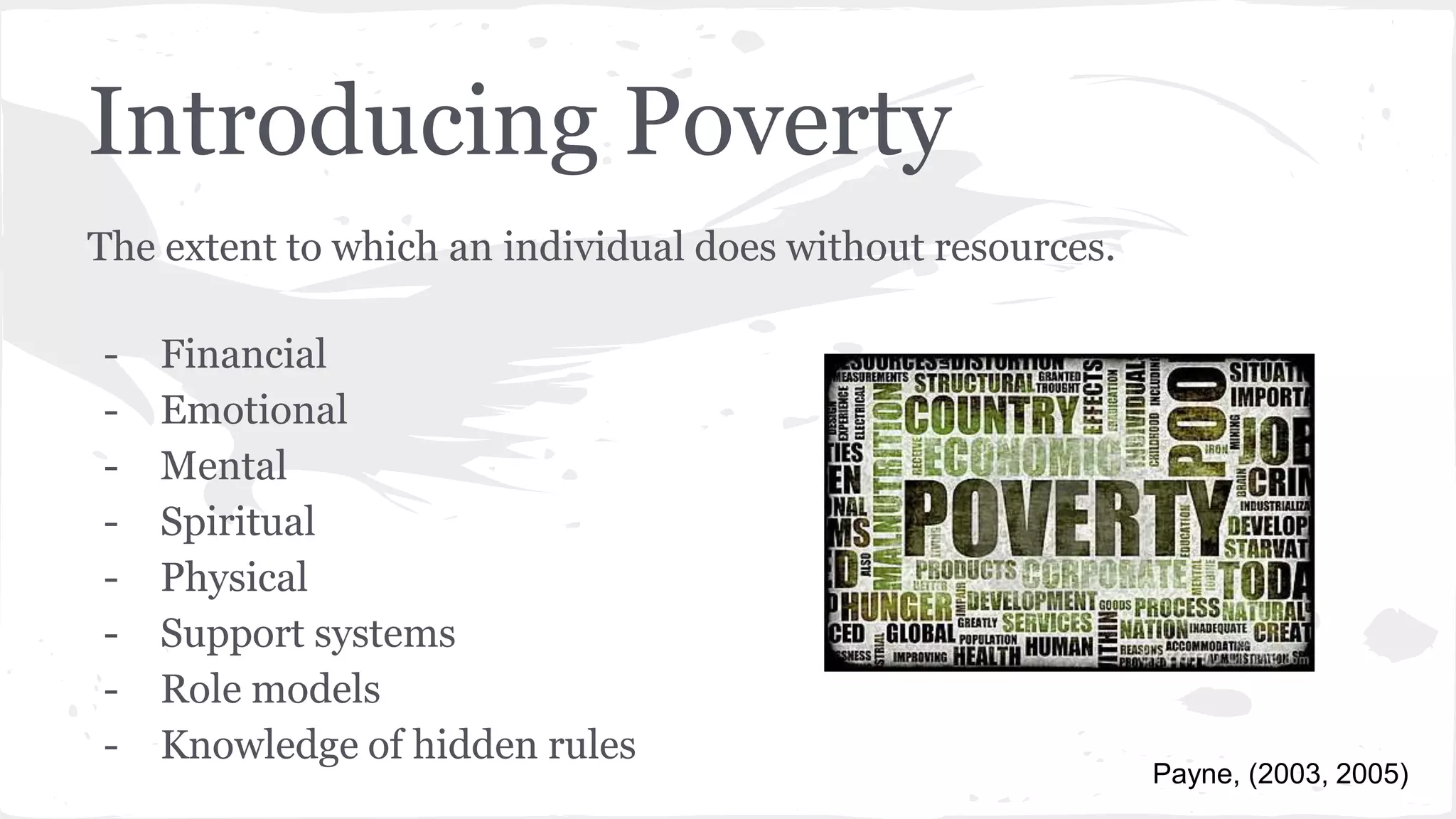
Introducing Poverty
The extent to which an individual does without resources.
- Financial
- Emotional
- Mental
- Spiritual
- Physical
- Support systems
- Role models
- Knowledge of hidden rules
Payne, (2003, 2005)
Key points on poverty
➢ It is relative.
➢ It occur in all races and in all countries.
➢ There are cultural differences in poverty.
➢ Generational poverty and situational poverty are different.
➢ Schools operate from middle-class norms and values.
➢ Individuals bring with them the hidden rules of the class in which
they were raised.
Payne, (2003, 2005)
Key points on poverty
➢ To move from poverty to middle class, one must give up (for a
period of time) relationships for achievement.
➢ Two things that help one move out of poverty are education and
relationships.
➢ Four reasons one leaves poverty are:
➢ It’s painful to stay
➢ A vision or goal
➢ A key relationship
➢ A special talent or skill
Payne, (2003, 2005)
Culture and education
Culture:
- norms, values, attitudes and
patterns of behavior
- spiritual, material, intellectual and
emotional features of society
- lifestyles, ways of living together,
value systems, traditions and
beliefs
- shapes individual’s worldviews
(Lamont & Small, 2008)
Connections to social justice
Facts from UNESCO
-Mother’s schooling / Infant mortality
-Secondary education for girls / Wage
-Schooling for a country’s population / Civil war
-People of voting age with a primary education / support democracy
-Well‐nourished children / be in the correct grade at school
-Low‐income countries with basic reading skills/ cut in global poverty
https://youtu.be/Ft5sDJG054w
How poverty affects classroom
engagement
● One in five U.S. children under the age of 18—or 16 million children—
live in poverty.
● Students from low-income households are more likely to struggle with
engagement—for seven reasons.
o Health and nutrition
o Vocabulary
o Effort
o Hope and the growth of mind-set
o Cognition
o Relationships
o Distress
1)Health and nutrition
Children from low SES conditions are
● less likely to exercise, get proper
diagnoses, receive appropriate
and prompt medical attention
● exposed to food with lower
nutritional value
What you can do:
● give attention to physical
education programs
o the use of games, movement,
and drama, etc.
2)Vocabulary
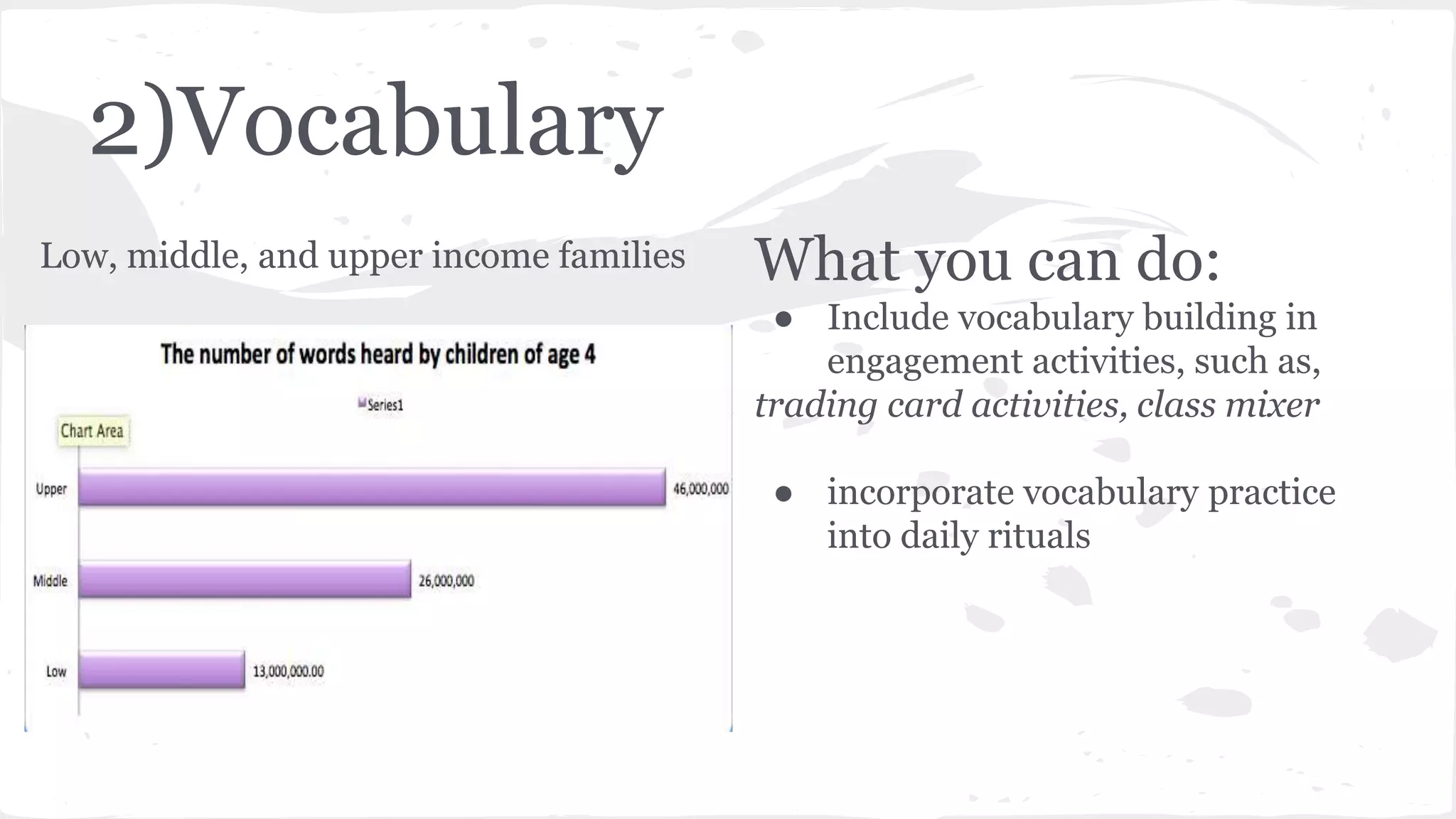
Low, middle, and upper income families What you can do:
● Include vocabulary building in
engagement activities, such as,
trading card activities, class mixer
● incorporate vocabulary practice
into daily rituals
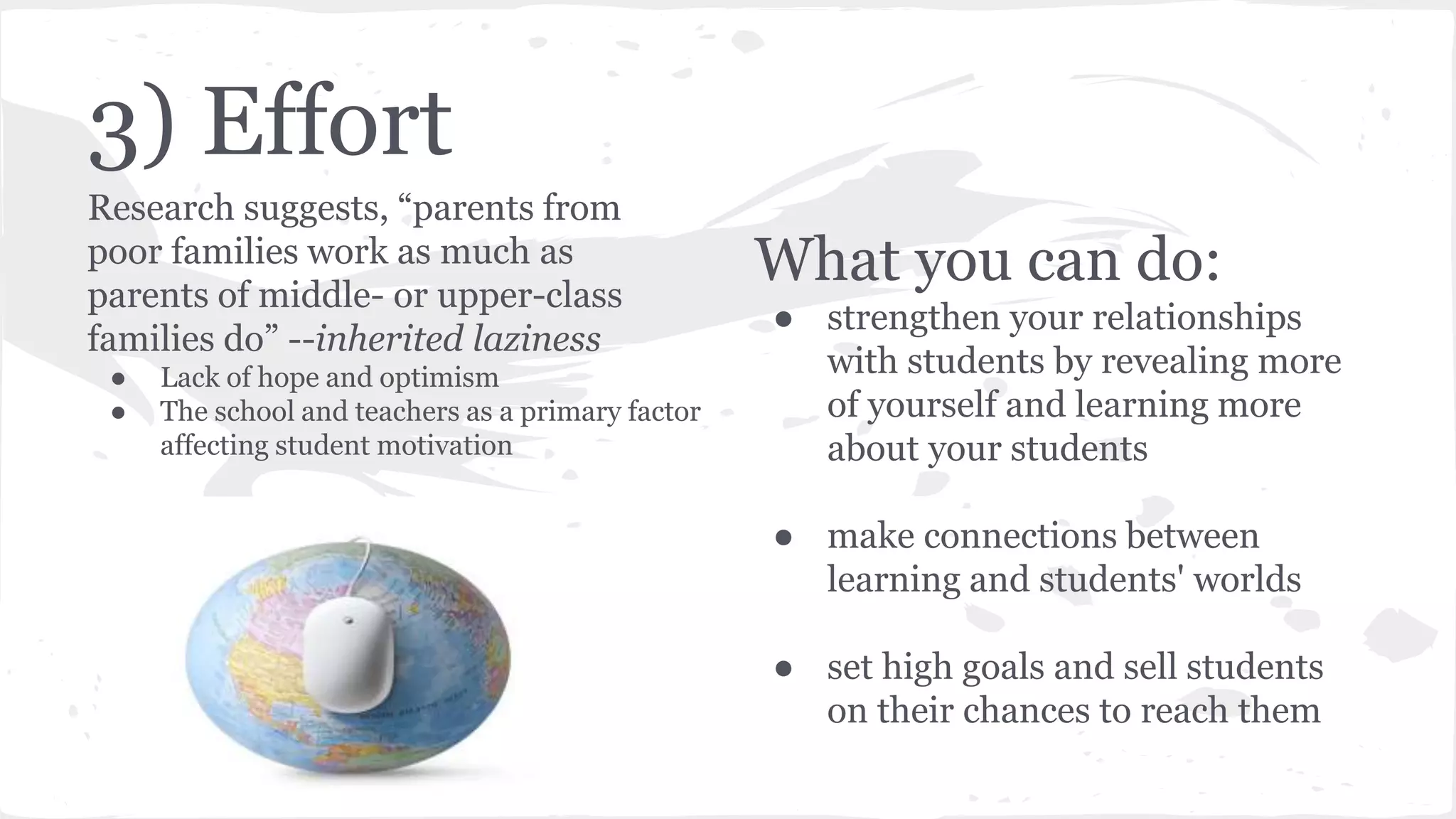
3) Effort
Research suggests, “parents from
poor families work as much as
parents of middle- or upper-class
families do” --inherited laziness
● Lack of hope and optimism
● The school and teachers as a primary factor
affecting student motivation
What you can do:
● strengthen your relationships
with students by revealing more
of yourself and learning more
about your students
● make connections between
learning and students' worlds
● set high goals and sell students
on their chances to reach them
4) Hope and the growth of mind-set
lowered expectations about future
outcomes
What you can do:
Guide students in making smarter
strategy choices and cultivating a
positive attitude
Don't use comforting phrases that
imply that even though a student isn't
good at something, he or she has
"other" strengths
5) Cognition
low-SES children show cognitive
problems (Jensen, 2013), including
-short attention spans,
-high levels of distractibility,
-difficulty monitoring the quality of their work,
and
-difficulty generating new solutions to problems
What you can do:
Focus on the core academic skills that
students need the most
Such as, how to organize, study, take notes,
prioritize, remember key ideas and then
problem-solving, processing, and working-
memory skills.
6) Relationships
● Single parent caregiver, missing
role models
● Disruptive home relationships
What you can do:
Need of strong, positive, caring adults
The more you care, the better the
foundation for interventions
7) Distress
Typical behaviors of distressed
children:
-angry "in your face" assertiveness or
-disconnected "leave me alone"
passivity
What you can do:
● Reduce stress by embedding
more classroom fun in academics
● Teach students ongoing coping
skills so they can better deal with
their stressors
A Study about Educational Experiences
of Children in the U.S. South
The Early Childhood Longitudinal Study Kindergarten Cohort (ECLS-K)
(NCES, 2001)
● 3,501 children, in 1,208 classrooms, in 246 schools
● Purpose: exploring the contexts of educational achievement in the South,
considering issues of race and SES
● Why South: The large ethnic minority population and the high levels of
child poverty in the South
Fram, Miller-Cribbs, &Van Horn (2007)
Findings & Conclusion
Findings:
Smaller gains in reading:
Children who repeated kindergarten, children from single-parent households,
and children of teenage mothers
Greater gains in reading:
-Girls, longer teacher tenure, reading peers
Conclusion:
-Potential barriers to these children's educational achievement; less parental
time and know-how for supporting children's learning
-The significance of school peer group composition
Implications
How social workers might promote greater equality in educational
opportunities and outcomes:
● Advocating for mixed-ability peer groups may empower vulnerable
children toward greater school success.
● Educating teachers and school administrators on building support for
integration among the more privileged families whose children are
overrepresented in high-skill groups.
● strengthening the policies and programs that promote economic equality
and meaningful choices about family formation and parenting.
References
Fram, M. S., Miller-Cribbs, J. E., & Van Horn, L. (2007). Poverty, race, and the contexts of achievement: Examining educational experiences of children in
the US South. Social Work, 52(4), 309-319.
Jensen, E. (2010). http://www.ascd.org/publications/educational-leadership/may13/vol70/num08/How-Poverty-Affects-Classroom-Engagement.aspx
Lamont, M., & Small, M. L. (2008). How culture matters: Enriching our understanding of poverty. In A. Lin & D. Harris (Eds.), The Colors of Poverty: Why
Racial and Ethinic Disparities Persist (pp. 76-102). New York: Russell Sage Foundation.
Payne, R. K. (2003).Understanding and Working with Students and Adults from Poverty: Poverty Series. Highlands, TX: aha! Process, Inc.
Payne, R. K. (2005). A framework for understanding poverty. Highlands, TX: aha! Process, Inc.
UNESCO, 2011. EFA Global Monitoring Report – the hidden crisis: armed conflict and education. 3 Gene Sperling and Barbara Herz, 2004. “What Works in
Girls’ Education: Evidence and Policies from the Developing World,” Council for Foreign Relation, Center for International education. 4 See above, note 2.
5
UNESCO, 2009. EFA Global Monitoring Report – overcoming inequalities: why governance matters. 6 Save the Children, 2013. Food for Thought –
Tackling child malnutrition to unlock potential and boost prosperity. 7 See above, note 2. 8
United Nations, 2012. The Millennium Development Goals Report 2012. 9
UNESCO, 2012. Education for All Global Monitoring Report– Youth and Skills: putting education to work.

Gdit 819 social justice

  • 1.
    Culture & Poverty EmtinanAlqurashi Elif Gokbel
  • 2.
    Overview - Introducing poverty -Key points on poverty - Culture and education - Connections to Social Justice - Empirical studies
  • 3.
    Introducing Poverty The extentto which an individual does without resources. - Financial - Emotional - Mental - Spiritual - Physical - Support systems - Role models - Knowledge of hidden rules Payne, (2003, 2005)
  • 4.
    Key points onpoverty ➢ It is relative. ➢ It occur in all races and in all countries. ➢ There are cultural differences in poverty. ➢ Generational poverty and situational poverty are different. ➢ Schools operate from middle-class norms and values. ➢ Individuals bring with them the hidden rules of the class in which they were raised. Payne, (2003, 2005)
  • 5.
    Key points onpoverty ➢ To move from poverty to middle class, one must give up (for a period of time) relationships for achievement. ➢ Two things that help one move out of poverty are education and relationships. ➢ Four reasons one leaves poverty are: ➢ It’s painful to stay ➢ A vision or goal ➢ A key relationship ➢ A special talent or skill Payne, (2003, 2005)
  • 6.
    Culture and education Culture: -norms, values, attitudes and patterns of behavior - spiritual, material, intellectual and emotional features of society - lifestyles, ways of living together, value systems, traditions and beliefs - shapes individual’s worldviews (Lamont & Small, 2008)
  • 7.
  • 8.
    Facts from UNESCO -Mother’sschooling / Infant mortality -Secondary education for girls / Wage -Schooling for a country’s population / Civil war -People of voting age with a primary education / support democracy -Well‐nourished children / be in the correct grade at school -Low‐income countries with basic reading skills/ cut in global poverty https://youtu.be/Ft5sDJG054w
  • 9.
    How poverty affectsclassroom engagement ● One in five U.S. children under the age of 18—or 16 million children— live in poverty. ● Students from low-income households are more likely to struggle with engagement—for seven reasons. o Health and nutrition o Vocabulary o Effort o Hope and the growth of mind-set o Cognition o Relationships o Distress
  • 10.
    1)Health and nutrition Childrenfrom low SES conditions are ● less likely to exercise, get proper diagnoses, receive appropriate and prompt medical attention ● exposed to food with lower nutritional value What you can do: ● give attention to physical education programs o the use of games, movement, and drama, etc.
  • 11.
    2)Vocabulary Low, middle, andupper income families What you can do: ● Include vocabulary building in engagement activities, such as, trading card activities, class mixer ● incorporate vocabulary practice into daily rituals
  • 12.
    3) Effort Research suggests,“parents from poor families work as much as parents of middle- or upper-class families do” --inherited laziness ● Lack of hope and optimism ● The school and teachers as a primary factor affecting student motivation What you can do: ● strengthen your relationships with students by revealing more of yourself and learning more about your students ● make connections between learning and students' worlds ● set high goals and sell students on their chances to reach them
  • 13.
    4) Hope andthe growth of mind-set lowered expectations about future outcomes What you can do: Guide students in making smarter strategy choices and cultivating a positive attitude Don't use comforting phrases that imply that even though a student isn't good at something, he or she has "other" strengths
  • 14.
    5) Cognition low-SES childrenshow cognitive problems (Jensen, 2013), including -short attention spans, -high levels of distractibility, -difficulty monitoring the quality of their work, and -difficulty generating new solutions to problems What you can do: Focus on the core academic skills that students need the most Such as, how to organize, study, take notes, prioritize, remember key ideas and then problem-solving, processing, and working- memory skills.
  • 15.
    6) Relationships ● Singleparent caregiver, missing role models ● Disruptive home relationships What you can do: Need of strong, positive, caring adults The more you care, the better the foundation for interventions
  • 16.
    7) Distress Typical behaviorsof distressed children: -angry "in your face" assertiveness or -disconnected "leave me alone" passivity What you can do: ● Reduce stress by embedding more classroom fun in academics ● Teach students ongoing coping skills so they can better deal with their stressors
  • 17.
    A Study aboutEducational Experiences of Children in the U.S. South The Early Childhood Longitudinal Study Kindergarten Cohort (ECLS-K) (NCES, 2001) ● 3,501 children, in 1,208 classrooms, in 246 schools ● Purpose: exploring the contexts of educational achievement in the South, considering issues of race and SES ● Why South: The large ethnic minority population and the high levels of child poverty in the South Fram, Miller-Cribbs, &Van Horn (2007)
  • 18.
    Findings & Conclusion Findings: Smallergains in reading: Children who repeated kindergarten, children from single-parent households, and children of teenage mothers Greater gains in reading: -Girls, longer teacher tenure, reading peers Conclusion: -Potential barriers to these children's educational achievement; less parental time and know-how for supporting children's learning -The significance of school peer group composition
  • 19.
    Implications How social workersmight promote greater equality in educational opportunities and outcomes: ● Advocating for mixed-ability peer groups may empower vulnerable children toward greater school success. ● Educating teachers and school administrators on building support for integration among the more privileged families whose children are overrepresented in high-skill groups. ● strengthening the policies and programs that promote economic equality and meaningful choices about family formation and parenting.
  • 20.
    References Fram, M. S.,Miller-Cribbs, J. E., & Van Horn, L. (2007). Poverty, race, and the contexts of achievement: Examining educational experiences of children in the US South. Social Work, 52(4), 309-319. Jensen, E. (2010). http://www.ascd.org/publications/educational-leadership/may13/vol70/num08/How-Poverty-Affects-Classroom-Engagement.aspx Lamont, M., & Small, M. L. (2008). How culture matters: Enriching our understanding of poverty. In A. Lin & D. Harris (Eds.), The Colors of Poverty: Why Racial and Ethinic Disparities Persist (pp. 76-102). New York: Russell Sage Foundation. Payne, R. K. (2003).Understanding and Working with Students and Adults from Poverty: Poverty Series. Highlands, TX: aha! Process, Inc. Payne, R. K. (2005). A framework for understanding poverty. Highlands, TX: aha! Process, Inc. UNESCO, 2011. EFA Global Monitoring Report – the hidden crisis: armed conflict and education. 3 Gene Sperling and Barbara Herz, 2004. “What Works in Girls’ Education: Evidence and Policies from the Developing World,” Council for Foreign Relation, Center for International education. 4 See above, note 2. 5 UNESCO, 2009. EFA Global Monitoring Report – overcoming inequalities: why governance matters. 6 Save the Children, 2013. Food for Thought – Tackling child malnutrition to unlock potential and boost prosperity. 7 See above, note 2. 8 United Nations, 2012. The Millennium Development Goals Report 2012. 9 UNESCO, 2012. Education for All Global Monitoring Report– Youth and Skills: putting education to work.

Editor's Notes

  • #12 Children from low-income families hear, on average, 13 million words by age 4. In middle-class families, children hear about 26 million words during that same time period. In upper-income families, they hear a staggering 46 million words by age 4.