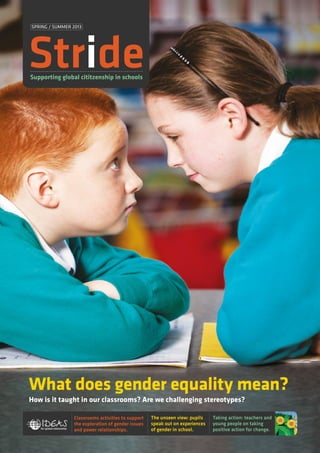
What does gender equality mean?
How is it taught in our classrooms? Are we challenging stereotypes?
SPRING / SUMMER 2013
Taking action: teachers and
young people on taking
positive action for change.
The unseen view: pupils
speak out on experiences
of gender in school.
Classrooms activities to support
the exploration of gender issues
and power relationships.
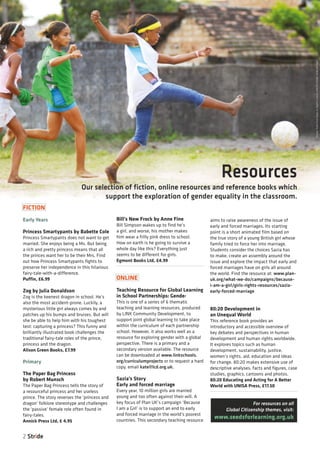
Our selection of fiction, online resources and reference books which
support the exploration of gender equality in the classroom.
FICTION
Early Years
Princess Smartypants by Babette Cole
Princess Smartypants does not want to get
married. She enjoys being a Ms. But being
a rich and pretty princess means that all
the princes want her to be their Mrs. Find
out how Princess Smartypants fights to
preserve her independence in this hilarious
fairy-tale-with-a-difference.
Puffin, £6.99
Zog by Julia Donaldson
Zog is the keenest dragon in school. He’s
also the most accident-prone. Luckily, a
mysterious little girl always comes by and
patches up his bumps and bruises. But will
she be able to help him with his toughest
test: capturing a princess? This funny and
brilliantly illustrated book challenges the
traditional fairy-tale roles of the prince,
princess and the dragon.
Alison Green Books, £7.99
Primary
The Paper Bag Princess
by Robert Munsch
The Paper Bag Princess tells the story of
a resourceful princess and her useless
prince. The story reverses the ‘princess and
dragon’ folklore stereotype and challenges
the ‘passive’ female role often found in
fairy-tales.
Annick Press Ltd, £ 4.95
Bill’s New Frock by Anne Fine
Bill Simpson wakes up to find he’s
a girl, and worse, his mother makes
him wear a frilly pink dress to school.
How on earth is he going to survive a
whole day like this? Everything just
seems to be different for girls.
Egmont Books Ltd, £4.99
ONLINE
Teaching Resource for Global Learning
in School Partnerships: Gender
This is one of a series of 6 thematic
teaching and learning resources, produced
by LINK Community Development, to
support joint global learning to take place
within the curriculum of each partnership
school. However, it also works well as a
resource for exploring gender with a global
perspective. There is a primary and a
secondary version available. The resource
can be downloaded at www.linkschools.
org/curriculumprojects or to request a hard
copy, email kate@lcd.org.uk.
Sazia’s Story
Early and forced marriage
Every year, 10 million girls are married
young and too often against their will. A
key focus of Plan UK’s campaign ‘Because
I am a Girl’ is to support an end to early
and forced marriage in the world’s poorest
countries. This secondary teaching resource
aims to raise awareness of the issue of
early and forced marriages. Its starting
point is a short animated film based on
the true story of a young British girl whose
family tried to force her into marriage.
Students consider the choices Sazia has
to make, create an assembly around the
issue and explore the impact that early and
forced marriages have on girls all around
the world. Find the resource at: www.plan-
uk.org/what-we-do/campaigns/because-
i-am-a-girl/girls-rights-resources/sazia-
early-forced-marriage
80:20 Development in
an Unequal World
This reference book provides an
introductory and accessible overview of
key debates and perspectives in human
development and human rights worldwide.
It explores topics such as human
development, sustainability, justice,
women’s rights, aid, education and ideas
for change. 80:20 makes extensive use of
descriptive analyses, facts and figures, case
studies, graphics, cartoons and photos.
80:20 Educating and Acting for A Better
World with UNISA Press, £17.50
Resources
2 Stride
Picture:fromFirstStepstoRightsUnicef,UNICEF/HQ06-1338/Versiani
For resources on all
Global Citizenship themes, visit:
www.seedsforlearning.org.uk
The startling reality is that there is not
a single country in the entire world
today where women have achieved
equality with men.
While, the expectation both in Scottish,
UK and International Law is that men
and women are equal and are treated
accordingly, gender inequality remains
a feature in every region in the world. In
developing countries this inequality is
exacerbated by extreme poverty.
Despite the fact that very significant
progress has been made in some
areas such as education and health,
women remain hugely
disadvantaged in areas
such as economics and
politics and, in some
countries, they experience
widespread and systematic
abuse and discrimination.
Education has a significant
role to play in changing
this. How we educate our girls and boys
here and what we teach them about
gender issues globally matters hugely in
our drive to achieve equality for women
and for men. Our lead article on page
4 and 5 explores the issue from both a
local and global perspective.
We hear from a male and female
pupil on their experiences of gender in
Scottish schools. Their experiences are
very personal but at their heart expose
the gender stereotyping which our
young people must negotiate. Gender
stereotyping has become so deeply
entrenched in our society we have
almost become desensitised to it. With
Rights and Responsibilities at the heart
of the curriculum, there is the space
within which to address gender issues.
Developing the skills to engage critically
with social and media representations
of gender and to challenge these views
is key to empowering all young people
in our schools. The activities pages
suggest some starting points on how
to do this and we also highlight some
useful resources on the topic.
While education for
Global Citizenship
strives to equip young
people with the skills
and knowledge to
live as responsible
citizens, equally
important is the belief
that they themselves
can make a difference and stand up
for what they believe in. Our guide to
taking action on page 10 and 11 reflects
on what it is that makes some people
take action and others not, while
suggesting ways to support your pupils
in their endeavours.
As ever, we are keen to hear your
views on Stride and welcome your
contributions. Join us in the debate
@ stride_global on Twitter.
© IDEAS, Spring / Summer 2013
Stride magazine is printed using
vegetable inks on 100% recycled uncoated
stock, a product with FSC certification.
Gender equality	 4-5
Gender activity	 6-7
The unseen view 	 8-9
Take action!	 10-11	
Action activity	 12-13
My story	 14
Gender matters: Malawi	 15
Museum to school	 16
Latin American journeys	 17
In the Loop	 18-19
We would love to hear
your ideas, comments and
feedback. Get in touch!
stride@ideas-forum.org.uk Front cover picture: Aly Wight, www.alywight.com
Stride team
EditorialCharlotte Dwyer, Editor
Inside
Stride 3
‘Gender stereotyping
has become so
deeply entrenched
in our society we
have almost become
desensitised to it.’
No country treats its women
the same as its men.
Angela Higgins – IDEAS
Joshephine McLaughlin – IDEAS
Charlotte Dwyer – Scotdec
Della Rea – Scotdec
Diana Ellis – WOSDEC
John Dornan – Conforti Institiute
Lynn Baxendale – WOSDEC
Richard Nicodème – Context
Silvia Sabino-Hunt – British Red Cross
Nick Morgan – Education Scotland Design: www.contextdesigns.co.uk
4 Stride
E
very single child and young person
we teach will have personal
experience of gender inequality. We
live in a society which encourages gender
stereotyping from birth, and our young
people grow up with preconceived notions
of what male and female roles should
be. It is vital that our schools challenge
these roles and empower pupils to think
critically about gender issues. Supporting
them to make the connections between
gender inequality here and around the
world can provide a rich context for
developing Global Citizens.
What do we explore when we’re looking at
gender in our classrooms? Gender refers
not only to women and men but also
to the relationship between both. Any
exploration of gender issues in schools
needs to make explicit connections with
rights and responsibilities. It is important
to investigate where our stereotypes
of men and women come from and
how gender inequality is manifest in
our society. In a global context, women
suffer greater inequalities than men and
the consequences of this discrimination
against females at personal, social,
economic and political levels are felt not
only by women but by us all.
Gender stereotypes
‘When we talk about gender, we are talking
about social roles and not ‘sex’ or biological
characteristics. Gender varies from culture
to culture and over time. People are born
male and female but learn to be boys and
girls who grow into women and men.’1
The starting point of an exploration of
gender stereotypes with learners must be
their understanding of gender as opposed
to sex. Learners could conduct surveys of
attitudes at home, or an audit of how the
media represent women and men, boys
and girls.
It is important that we recognise that
schools are significantly gendered
environments. 77% of teachers in our
schools are female, according to the
2012 teacher census from the Scottish
Government. How do our learners perceive
this imbalance? The recent TESS report
(15/2/13) suggests that gender differences
make little impact on the school
experience for most young people. Would
your pupils agree?
What about the subjects that girls and
boys choose in Secondary school and the
roles and responsibilities they take on
during their school careers? At West Calder
High, the majority of prefects and bully
mentors are girls. Is there a balance of
representation on groups in your school?
Gender inequalities in Scotland
and around the world
As is clearly illustrated within our schools,
professions are rarely gender neutral. It
is interesting to investigate how work,
income and property are divided between
women and men both in Scotland and
throughout the world. There are varying
obstacles faced by both men and
women in achieving their full human
development and potential. For example,
men in Scotland have a life expectancy
consistently several years less than that of
women, suggesting the costs of gender-
related occupational and consumption
patterns. Globally, the overwhelming
recruitment of men as fighters by both
state and revolutionary forces puts them
in great danger.
Gender inequality is an aspect that
affects all areas of society around the
world: health, education, industry and
Gender equality: everyone’s issue
Diana Ellis, education officer at Wosdec, investigates why it is vital that
gender issues, both locally and globally, are explored in our classrooms.
‘We live in a society
which encourages gender
stereotyping from birth,
and our young people
grow up with preconceived
notions of what male and
female roles should be.’
1 Text adapted from ‘URARI - Equality: Exploring gender equality through a global lens. A CSPE/Citizenship Resource’ Trocaire, 2007
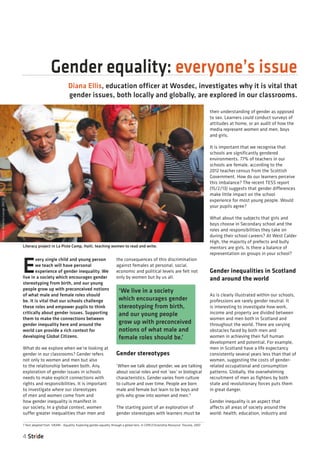
Literacy project in La Piste Camp, Haiti, teaching women to read and write.
Picture:AmandaGeorge(BRCS)
Stride 5
government. However, when speaking
about gender equality in the Global North
compared with the Global South, are we
talking about the same issues?
The third Millennium Development
Goal promotes gender equality and the
empowerment of women, demonstrating
the importance of addressing these issues
in order to alleviate poverty globally. It is
widely accepted that the empowerment
of women starts with equal access to
education. The United Nations Millennium
Development goals report from 2012
indicates that, ‘the world has achieved
parity in primary education between girls
and boys’. However, there are still many
barriers facing girls’ access to education in
the Global South. Some of these barriers
include the need for a young girl to care for
others in the household due to a parent’s
death, the girl’s personal health due to
high rate of HIV and early pregnancies,
or the fact that the community does
not understand the need for a girl to be
educated as her husband will be taking
care of her in the future.
The Forum for African Women
Educationalists2 (FAWE) is involved in
a number of projects to support female
empowerment and gender awareness.
Some of these projects include
establishing ‘Mother Groups’ in primary
schools and some secondary schools, and
strengthening girls clubs in schools and
communities. Our learners in Scotland
can look at these and other positive steps
being taken to address gender issues
elsewhere, and contrast with similar
initiatives here, such as the Scottish
Women’s Institute, and the Women’s
Fund for Scotland.
Why do girls and women
suffer greater inequalities?
Discrimination consistently deprives
girls and women of power and access
to resources. As teachers we need to
encourage our pupils to ask why society is
structured in such a way that undermines
and undervalues the contributions of
women around the world.
A starting place for teachers and pupils is
the UN’s Convention on the Elimination of
Discrimination Against Women (CEDAW),
which was adopted in 1979. It was the
first Convention to address women’s
rights within political, economic, social,
cultural and family life and emerged
after the first conference on Women
in 1975 in Mexico. CEDAW recognises
that a change in the traditional role of
men, as well as women in society and
the family is needed to achieve full
equality between men and women.
Exploring the extent to which men and
women are equal and treated accordingly
is highly sensitive. How do we choose
which case studies to examine? How do
we support our learners to think critically
about the data they are investigating?
As ever, when we are planning for Global
Citizenship we must ensure that the
material we provide enables our learners
to question the issues deeply, examine
multiple perspectives and take action
in a way in which they have chosen
themselves.
.
‘As teachers we need to
encourage our pupils to ask
why society is structured in
such a way that undermines
and undervalues the
contributions of women
around the world.’
2 www.fawe.org
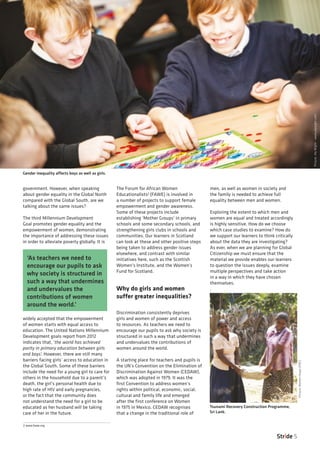
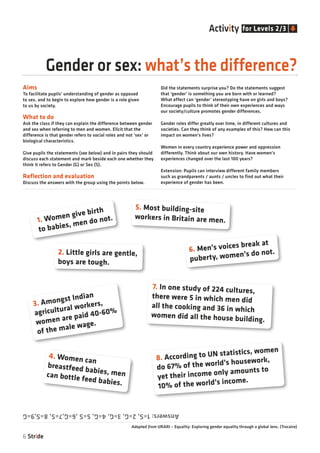
Gender inequality affects boys as well as girls.
Tsunami Recovery Construction Programme,
Sri Lank.
Picture:AlyWight–www.alywight.com
Picture:MortenHvaal(IFRC)
Aims
To facilitate pupils’ understanding of gender as opposed
to sex, and to begin to explore how gender is a role given
to us by society.
What to do
Ask the class if they can explain the difference between gender
and sex when referring to men and women. Elicit that the
difference is that gender refers to social roles and not ‘sex’ or
biological characteristics.
Give pupils the statements (see below) and in pairs they should
discuss each statement and mark beside each one whether they
think it refers to Gender (G) or Sex (S).
Reflection and evaluation
Discuss the answers with the group using the points below.
Did the statements surprise you? Do the statements suggest
that ‘gender’ is something you are born with or learned?
What effect can ‘gender’ stereotyping have on girls and boys?
Encourage pupils to think of their own experiences and ways
our society/culture promotes gender differences.
Gender roles differ greatly over time, in different cultures and
societies. Can they think of any examples of this? How can this
impact on women’s lives?
Women in every country experience power and oppression
differently. Think about our own history. Have women’s
experiences changed over the last 100 years?
Extension: Pupils can interview different family members
such as grandparents / aunts / uncles to find out what their
experience of gender has been.
6 Stride
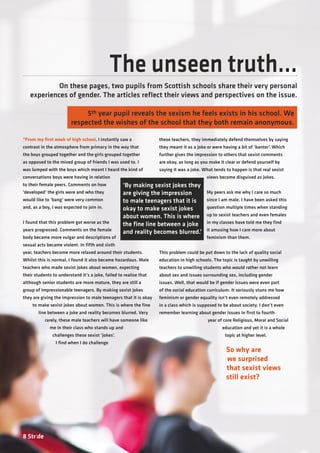
Gender or sex: what’s the difference?
for Levels 2/3Activity
Answers:1=S,2=G,3=G,4=G,5=S,6=G,7=S,8=S,9=G
1. Women give birth
to babies, men do not.
2. Little girls are gentle,
boys are tough.
3. Amongst Indian
agricultural workers,
women are paid 40-60%
of the male wage.
4. Women can
breastfeed babies, mencan bottle feed babies.
5. Most building-site
workers in Britain are men.
6. Men’s voices break at
puberty, women’s do not.
7. In one study of 224 cultures,
there were 5 in which men did
all the cooking and 36 in which
women did all the house building.
8. According to UN statistics, women
do 67% of the world’s housework,
yet their income only amounts to
10% of the world’s income.
Adapted from URARI – Equality: Exploring gender equality through a global lens. (Trocaire)
In the world, 774 million people
are illiterate. This means that they
cannot read and write. Of these 774
million people, what percentage/
proportion are women?
ANSWER: 64% or 6/10
[Source: UN stats 2007 http://unstats.un.org/unsd/demographic/products/
Worldswomen/wwEduc2010.htm]
Of all the land in the world, what
percentage is owned by women?
ANSWER: 1%
[Source: Independent 8th March 2006]
Of all the politicians in the world,
what percentage are women?
ANSWER: 17%
[Source: Proportion of parliamentary seats in lower or single chamber 2009
UN Statistics.
http://unstats.un.org/unsd/demographic/products/Worldswomen/
wwPower&dec2010.htm]
Of the 1.2 billion people living in
poverty in the world, what percentage
are women and children?
ANSWER: 70%
[Source: Independent 8th March 2006]
Aims
To recognize that globally women do not have an equal share
of power or resources and that this is not fair.
What you need
Pebbles or small objects and two hoops or mats if using
Method 2.
What to do
The aim of this lesson is to show the vast inequalities
that exist globally between men and women in terms of
global wealth, power and access to opportunities. The
activity helps pupils to visualize statistics (see below)
around this issue through 3 possible methods. Read
out each question in turn and ask pupils to guess what
percentage of the world’s women is the correct answer.
Method 1 – On the Line
Make an imaginary line in the classroom (or outside if the
classroom is not large enough), with 0% at one end and 100%
at the other end, and ask pupils, or a sample of pupils, to
stand on the line according to what they think is the correct
answer.
For example, if they think the answer is 50%, they would
stand halfway along the line, etc.
Method 2 – Moving pebbles
Collect together 100 pebbles or stones or any other small
object. Put two mats or hoops on the floor to create two
distinct areas, one to represent ‘women’ and one to represent
‘men’. Learners will distribute the pebbles between the two
areas according to what they think the answer is – e.g. 60 men
to 40 women would mean 60 pebbles on the ‘men’ mat and 40
pebbles on the ‘women’ mat.
Method 3 – Finger voting
Ask learners to hold up the correct number of fingers (1-10)
according to what they think is the right answer. Ask some
learners to be monitors or ‘counters’ and collate the answers
given to produce a class medium or mean.
Reflection and evaluation
In pairs, pupils discuss what they found out. What surprised
them? How does it make them feel? Is it fair? What do the
statistics show about the power between men and women?
Are some countries better at treating women more fairly than
others?
Ask pupils if they can think of reasons why these inequalities
exist. Do you think the reasons will be the same in all
countries? Why / why not?
A fair world for women?
Stride 7
(For the finger voting method, 1 finger = 1/10, 2 fingers = 2/10, etc)
From Teaching Resources for Global Learning in School Partnerships, Theme 5: gender. (LINK Community Development)
Statistics
for Levels 2/3Activity
[Source: The Fawcett Society]
Looking at the top 100 companies
in the UK, what percentage of their
executive directors are women?
ANSWER: 4%
8 Stride
The unseen truth...
On these pages, two pupils from Scottish schools share their very personal
experiences of gender. The articles reflect their views and perspectives on the issue.
“From my first week of high school, I instantly saw a
contrast in the atmosphere from primary in the way that
the boys grouped together and the girls grouped together
as opposed to the mixed group of friends I was used to. I
was lumped with the boys which meant I heard the kind of
conversations boys were having in relation
to their female peers. Comments on how
‘developed’ the girls were and who they
would like to ‘bang’ were very common
and, as a boy, I was expected to join in.
I found that this problem got worse as the
years progressed. Comments on the female
body became more vulgar and descriptions of
sexual acts became violent. In fifth and sixth
year, teachers become more relaxed around their students.
Whilst this is normal, I found it also became hazardous. Male
teachers who made sexist jokes about women, expecting
their students to understand it’s a joke, failed to realise that
although senior students are more mature, they are still a
group of impressionable teenagers. By making sexist jokes
they are giving the impression to male teenagers that it is okay
to make sexist jokes about women. This is where the fine
line between a joke and reality becomes blurred. Very
rarely, these male teachers will have someone like
me in their class who stands up and
challenges these sexist ‘jokes’.
I find when I do challenge
these teachers, they immediately defend themselves by saying
they meant it as a joke or were having a bit of ‘banter’. Which
further gives the impression to others that sexist comments
are okay, as long as you make it clear or defend yourself by
saying it was a joke. What tends to happen is that real sexist
views become disguised as jokes.
My peers ask me why I care so much
since I am male. I have been asked this
question multiple times when standing
up to sexist teachers and even females
in my classes have told me they find
it amusing how I care more about
feminism than them.
This problem could be put down to the lack of quality social
education in high schools. The topic is taught by unwilling
teachers to unwilling students who would rather not learn
about sex and issues surrounding sex, including gender
issues. Well, that would be if gender issues were even part
of the social education curriculum. It seriously stuns me how
feminism or gender equality isn’t even remotely addressed
in a class which is supposed to be about society. I don’t even
remember learning about gender issues in first to fourth
year of core Religious, Moral and Social
education and yet it is a whole
topic at higher level.
5th year pupil reveals the sexism he feels exists in his school. We
respected the wishes of the school that they both remain anonymous.
‘By making sexist jokes they
are giving the impression
to male teenagers that it is
okay to make sexist jokes
about women. This is where
the fine line between a joke
and reality becomes blurred.’
So why are
we surprised
that sexist views
still exist?
Stride 9
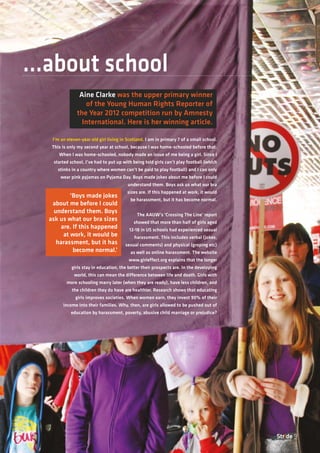
I’m an eleven-year old girl living in Scotland. I am in primary 7 of a small school.
This is only my second year at school, because I was home-schooled before that.
When I was home-schooled, nobody made an issue of me being a girl. Since I
started school, I’ve had to put up with being told girls can’t play football (which
stinks in a country where women can’t be paid to play football) and I can only
wear pink pyjamas on Pyjama Day. Boys made jokes about me before I could
understand them. Boys ask us what our bra
sizes are. If this happened at work, it would
be harassment, but it has become normal.
The AAUW’s ‘Crossing The Line’ report
showed that more than half of girls aged
12-18 in US schools had experienced sexual
harassment. This includes verbal (jokes,
sexual comments) and physical (groping etc)
as well as online harassment. The website
www.girleffect.org explains that the longer
girls stay in education, the better their prospects are. In the developing
world, this can mean the difference between life and death. Girls with
more schooling marry later (when they are ready), have less children, and
the children they do have are healthier. Research shows that educating
girls improves societies. When women earn, they invest 90% of their
income into their families. Why, then, are girls allowed to be pushed out of
education by harassment, poverty, abusive child marriage or prejudice?
...about school
Aine Clarke was the upper primary winner
of the Young Human Rights Reporter of
the Year 2012 competition run by Amnesty
International. Here is her winning article.
‘Boys made jokes
about me before I could
understand them. Boys
ask us what our bra sizes
are. If this happened
at work, it would be
harassment, but it has
become normal.’
Taking action
10 Stride
How do we prepare the global citizen? What is it that makes some people
take action on issues that affect us all but not others? Silvia Sabino-Hunt,
humanitarian educator with the Red Cross investigates.
A guide for educators and young people
W
hen we look at the work of
people who campaign for
citizenship causes they believe
in, it’s difficult to pinpoint where all this
energy, belief and wanting to make a
change comes from. Is it education, family
life or individual experiences that count?
Research shows for example that
campaigns like Make Poverty History
help develop a heightened awareness
of development issues but there is
little evidence of an increased depth
of understanding around the issues.
Campaigning can therefore be a starting
point to motivate ‘global citizens’ but
to make sure the process doesn’t end
at the post-campaigning stage, young
people need to be provided with more
opportunities to explore Global Citizenship
issues further.
Local connections
People need to feel a connection with the
issues on which they take action. Wangari
Maathai, a Kenyan environmentalist and
activist understood this and harnessed the
power of grass roots activism among the
women she worked with in rural Kenya.
Maathai realised that when accessing
nutrition, education, land, power and jobs
women were always second to men in
her society. She was a positive solution
focussed person and
her ‘solution’ was to
plant trees. Planting
trees gave the women
agricultural skills,
providing fuel for
cooking, food in the
case of fruit trees,
shade and would
also help mitigate
deforestation in
Kenya. It wasn’t just about planting some
trees, it was economic and social progress
going hand in hand with environmental
protection. It was a local issue that had a
global outlook.
Maathai reflects in her book, Unbowed,
that those involved in social change
processes have to be affected by, or
connected to the issue they’re helping to
improve. She realised early on that her
visionary project needed local women to
plant local trees, so that
they took ownership of the
trees and cared for them
over time. She also realised
that those trees had to be
appropriate to the local
environmental context.
These key ideas are also
valid in the classroom. Our
young people need the
space and time to engage with local issues
which are important to them, develop
creative and sustainable responses and
be given enough time to learn and explore
these issues in-depth.
‘Active local and global
citizenship is about
taking responsible
actions and making
sure that the impact of
the action is measured.’
Picture:BritishRedCross2009
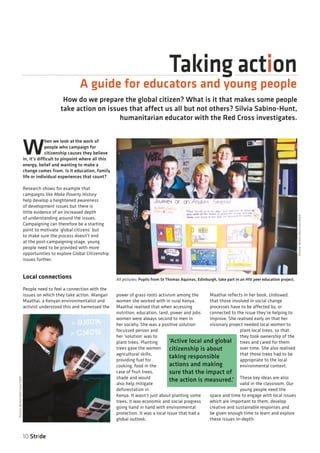
All pictures: Pupils from St Thomas Aquinas, Edinburgh, take part in an HIV peer education project.
Stride 11
So if there’s something that makes the
young people you work with blow their
top, encourage them to take action. That
is the ultimate goal in Global Citizenship
Education, and with Curriculum for
Excellence’s emphasis on an education
that develops responsible citizens and
effective contributors, all the justification
you need is there.
Whether it’s food (or the lack of it for some
925 million people), food price hikes, land
grabs, climate change, racism, refugees,
conflict, child soldiers, the government’s
education policies, their school’s lack of
Fair Trade products, or the cafeteria food
mileage and packaging – if there’s an issue
that really makes your pupils want to get
out there and change things for the better,
assure them that there are lots they can
do. From volunteering, to campaigning,
asking difficult questions, spreading the
word, distributing leaflets, peer educating,
writing to their MSP or MP, participating
in a demonstration, celebrating Global
Citizenship days – there’s a never ending
list of ideas on how to take action around
issues that are important to them. But
do support their creativity and if none of
these ideas really gets them excited, let
them suggest their own ideas.
It is also fundamental to make sure young
people are given the tools to evaluate
the impact of their actions. Active local
and global citizenship is about taking
responsible actions and making sure that
the impact of the action is measured.
The Get Global! resource book (download
at www.getglobal.org.uk) is just one of
the many resources that can help you as
a teacher to facilitate and assess active
global citizenship. This resource contains
a range of innovative and participatory
activities that promote a skills-based
approach rather than a content-based
approach, so Get Global can be used
within different subject areas and at
different levels.
› Tell a story! Simple Acts is a campaign
developed by the Refugee Council that
suggests different possible actions
that people can take to help unpack
the myths surrounding issues related
to asylum, refuge and difference. The
acts range in level of difficulty, time
and effort required and can be done by
both primary and secondary school aged
pupils as well as adults. There is even a
toolkit to support you – www.simpleacts.
org.uk/toolkit. So far there have been
27,864 Simple Acts completed in the UK.
How many could you add to the list?
› Send My Friend to School
Join the world’s biggest education
campaign. Every year the UK Global
Campaign for Education leads a
campaign to encourage children
and young people to speak up for the
right to an education. The 2013 campaign
is ‘Every Child Needs a Teacher’. For more
information and how to get involved:
www.sendmyfriend.org
› Sign up to the IF campaign
The world has enough food for everyone,
but not everyone has enough food.
The IF campaign is a coalition of
organisations calling on the G8 to take
action on global hunger. There are lots of
ways to get involved. Find our more at
www.enoughfoodif.org
Finally don’t forget to tell your parents,
your neighbours and your friends what
you are learning about!
Here are 3 simple ideas to inspire you and your students to take action:
Useful resources
› Get Global! A skills based
approach to active global citizenship
www.getglobal.org.uk
› How do we know it’s working? (RISC)
Go to: www.seedsforlearning.org.uk
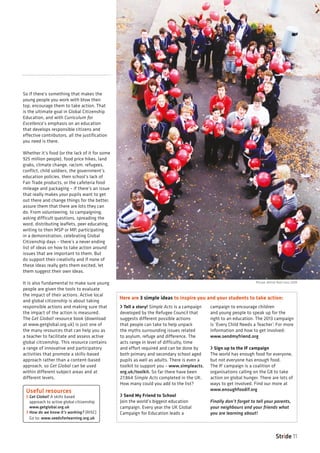
Picture: British Red Cross 2009
12 Stride
Aims
To enable students to brainstorm issues and reach a group
consensus on which one to take action on, and to develop and
extend skills for enquiry.
What to do
On a large sheet of flip chart draw the outline of a person. Ask
the pupils what makes them blow their top? What issues do
they feel strongly about? These can be issues in the school, local
community, country or world. Write the issues around the body.
Read all the issues and group them into similar ones.
In groups, pupils can think about what could be done to improve
the situation around each issue.
The most popular issues can be analysed before choosing one to
take action on.
What to do
Put up a number of photos around the classroom which illustrate
topical local and global issues / events. Ask the pupils to look
at the photos and select one which represents an issue they feel
strongly about.
Groups gather around the issue / picture. These groups will now
use the trigger photo questions (see below), to explore the issue
further. Each group can present their ideas to the class.
The class can now vote for the issue they feel they could all work
on together to make a difference.
Choose an issue
for Levels 2/3Activity
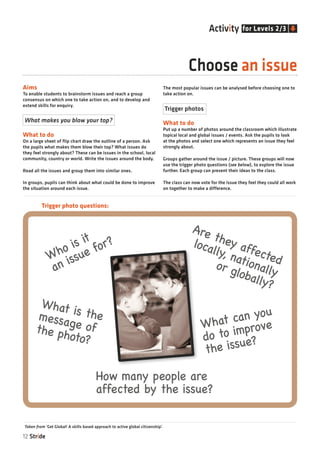
Trigger photo questions:
Who is it
an issue for?
What is themessage ofthe photo?
Are they affected
locally, nationallyor globally?
What can you
do to improve
the issue?
How many people are
affected by the issue?
Taken from ‘Get Global! A skills based approach to active global citizenship’.
What makes you blow your top?
Trigger photos
Stride 13
Aims
To enable pupils to consider the feasibility of possible actions and decide on one; to
develop skills to negotiate, decide and plan for action.
What to do
Prepare a set of cut up cards (see below) for each group.
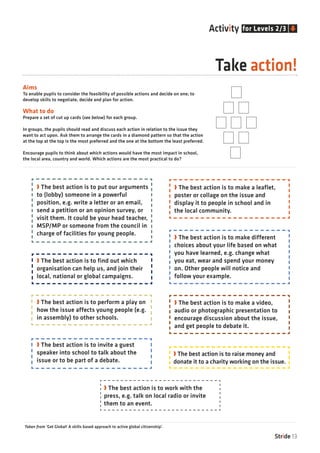
In groups, the pupils should read and discuss each action in relation to the issue they
want to act upon. Ask them to arrange the cards in a diamond pattern so that the action
at the top at the top is the most preferred and the one at the bottom the least preferred.
Encourage pupils to think about which actions would have the most impact in school,
the local area, country and world. Which actions are the most practical to do?
Take action!
for Levels 2/3Activity
❱ The best action is to put our arguments
to (lobby) someone in a powerful
position, e.g. write a letter or an email,
send a petition or an opinion survey, or
visit them. It could be your head teacher,
MSP/MP or someone from the council in
charge of facilities for young people.
❱ The best action is to find out which
organisation can help us, and join their
local, national or global campaigns.
❱ The best action is to invite a guest
speaker into school to talk about the
issue or to be part of a debate.
❱ The best action is to perform a play on
how the issue affects young people (e.g.
in assembly) to other schools.
❱ The best action is to make a leaflet,
poster or collage on the issue and
display it to people in school and in
the local community.
❱ The best action is to make a video,
audio or photographic presentation to
encourage discussion about the issue,
and get people to debate it.
❱ The best action is to make different
choices about your life based on what
you have learned, e.g. change what
you eat, wear and spend your money
on. Other people will notice and
follow your example.
Taken from ‘Get Global! A skills based approach to active global citizenship’.
❱ The best action is to raise money and
donate it to a charity working on the issue.
❱ The best action is to work with the
press, e.g. talk on local radio or invite
them to an event.
I
was well into a ‘traditional’ marriage
with two children in the 1980’s, before
I realised the extent to which society’s
expectations of women had significantly
influenced my own life choices. Gender
issues matter to me for other reasons too:
primarily because of social injustice. It is
simply unfair that women worldwide are
disadvantaged and discriminated against.
I don’t subscribe to the myth that
emancipation and equality has been
largely achieved in the Global North. No
part of the world has achieved gender
equality and while this is the case, I
make no apologies for the fact that my
passion has been about the redressing the
disadvantages faced by girls and women.
A scientist by training, I entered the
teaching profession because it seemed
like a sensible job for married women
intending to have children. I did come to
love teaching and to be in positions where
I could take action on important issues.
In my classroom I tried to redress gender
inequalities by questioning the male
biases and sexist language or attitudes
in teaching materials. In classes we
celebrated the hidden contribution of
women scientists and learned that
‘sex’ had little to do with what could be
achieved.
I had no personal ambitions to go into
Senior Management but after helping
to write and deliver a course aimed
at encouraging women into senior
management positions in schools, it became
hard not to do so myself. So, rather late in
my teaching career, I began to climb the
ladder into management positions.
As a head teacher of a Community High
School, I was committed to redressing
gender imbalances in a number of ways: by
challenging sexist attitudes and behaviour,
working to raise expectations for all
students without gender biases, challenging
stereotypes in curricular or career choices,
promoting an understanding of gender
influences in learning and teaching styles
and by being a female role model as a
secondary school head teacher.
Later on in my career, I became a
volunteer Development Officer in Papua
New Guinea (PNG). Here I came face to
face with the harsh reality of womens
lives in a very different part of the world.
Life is very tough for women in PNG,
particularly in the Highlands. They are
born into a lifelong role that includes
child and family care, farming, cooking
and fetching water. As they grow older,
the payment of a ‘bride price’ by their
husband’s family confirms the view that
they are a ‘possession’ and many women
are treated as such and subjected to
abuse and violence on a daily basis.
The project I worked on supported girls’
education. Research shows that educating
girls has a considerable impact on many
aspects of society such as improving
maternal and infant mortality rates and
family health and diet. It also paves the
way for income generation and as such
can be a major contribution to community
development.
If the argument for gender equality
cannot be won on social or humanitarian
grounds, perhaps economic reasons
can be more persuasive. Every country
depends on its human talent: the skills,
education and productivity of its people.
What a waste it is not to use that
potential to find ways of improving the
life experiences for everyone.
14 Stride
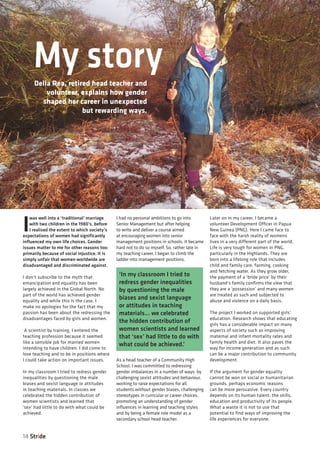
My storyDella Rea, retired head teacher and
volunteer, explains how gender
shaped her career in unexpected
but rewarding ways.
‘In my classroom I tried to
redress gender inequalities
by questioning the male
biases and sexist language
or attitudes in teaching
materials... we celebrated
the hidden contribution of
women scientists and learned
that ‘sex’ had little to do with
what could be achieved.’
A
cross the world gender inequality
limits the freedoms available to
girls and women. Most often,
it is girls and women who miss out on
schooling, healthcare and employment
opportunities in favour of men. Many
more face problems in relationships, or
with pregnancy and birth. So what is the
Scotland Malawi Partnership doing to
raise awareness of gender inequality?
And how can young people in Scotland
get involved?
Malawi is one of the poorest countries in
the world – and has a high proportion of
women living below the poverty line. The
OECD ranks Malawi as 120/146 in the world
for gender inequality which highlights the
vast number of challenges girls and women
face every day in their quest for equality
and opportunity. While Malawi has come
far in achieving gender balance in primary
education, very few women make it into
secondary and tertiary education. Women
also suffer health wise: Malawi has an
incredibly high maternal mortality rate and
women are disproportionately affected by
HIV/Aids.
The promotion of gender equality is of
vital importance to the Scotland Malawi
Partnership – an umbrella organisation
that represents over 600 members, all of
whom have their own Malawi link. The
Partnership believes that the issue of
gender equality matters for all Scotland-
Malawi links. Therefore, in September
2012 the Partnership launched its ‘Gender
Matters’ campaign, encouraging SMP
members to reflect on why ‘gender
matters’ across their partnerships.
The campaign is conducted through a
postcard campaign and various Gender
Equality Forum meetings, celebrating
the many ways in which Scotland-Malawi
links are advancing gender equality to
the benefit of both nations. Through
the forum the opportunity for reciprocal
learning, mutual support and joint
advocacy is available between people in
Scotland and their partners in Malawi.
The first Gender Equality Forum focussed
on ‘Gender Matters in education’ in
Malawi and attracted a whole range of
NGOs and organisations promoting girls’
access to education. The next forum will
focus on ‘Gender Matters in leadership’,
looking particularly at women in political
leadership. The final forum meeting of the
campaign will consider ‘Gender Matters in
economic empowerment.’
There are many different ways in which
teachers and pupils can get involved in
the ‘Gender Matters’ campaign. At all of
our events you will see colourful ‘Gender
Matters’ postcards floating around which
you can fill in to let us know why you think
gender equality is so important.
Stride 15
Gender matters
Charlie Ager, from the Scotland Malawi Partnership, outlines the work of
the Gender Matters campaign and how young people can get involved.
Promoting gender equality in Malawi
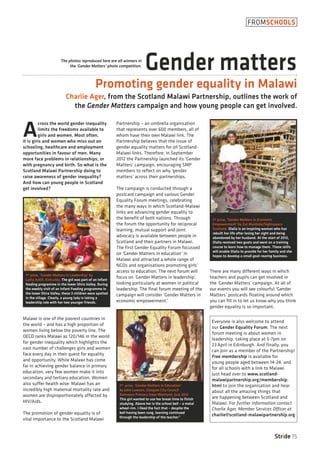
1st prize, ‘Gender Matters in Leadership’ by
Lydia Astill, Kirkcaldy. The girl was part of an Infant
feeding programme in the lower Shira Valley. During
the weekly visit of an Infant Feeding programme in
the lower Shira Valley, these 3 children were spotted
in the village. Clearly, a young lady is taking a
leadership role with her two younger friends.
1st prize, ‘Gender Matters in Economic
Empowerment’ by Zul Mukhida/Sightsavers
Scotland. Olalia is an inspiring woman who has
rebuilt her life after losing her sight and being
abandoned by her husband. At the start of 2012,
Olalia received two goats and went on a training
course to learn how to manage them. These skills
will enable Olalia to provide for her family and she
hopes to develop a small goat-rearing business.
The photos reproduced here are all winners in
the ‘Gender Matters’ photo competition.
1st prize, ‘Gender Matters in Education’
by John Lawson, Glasgow City Council
Namwiyo Primary (near Blantyre), July 2012
This girl wanted to use her break time to finish
studying. Above her is the school bell – a metal
wheel-rim. I liked the fact that – despite the
bell having been rung, learning continued
through the leadership of the teacher.”
FROMSCHOOLS
Everyone is also welcome to attend
our Gender Equality Forum. The next
forum meeting is about women in
leadership, taking place at 5-7pm on
23 April in Edinburgh. And finally, you
can join as a member of the Partnership!
Free membership is available for
young people aged between 14-24, and
for all schools with a link to Malawi.
Just head over to www.scotland-
malawipartnership.org/membership.
html to join the organisation and hear
about all the amazing things that
are happening between Scotland and
Malawi. For further information contact
Charlie Ager, Member Services Officer at
charlie@scotland-malawipartnership.org
I
’ve always been interested in the idea
of Global Citizenship and, through
taking part in a joint project between
WOSDEC and Glasgow Museums, I was
able to work with my P4 pupils to explore
connections both local and global and past
and present on a topic which really fired
their imaginations.
The idea was to plan a topic, addressing
one of the Millennium Development Goals,
using artefacts from the Glasgow Museums
Collection as a stimulus. I decided to focus
on equal chances for girls and women, and
used the wonderful suffragette collections
at the People’s Palace.
To introduce the children to the topic,
we did a brief novel study based on Bill’s
New Frock by Anne Fine. This is a very
funny book, describing what happens to
Bill when he wakes up and discovers that
everyone thinks he’s a girl. Bill feels that
he is treated differently and the children
were quick to agree. From there, we looked
at our toys and noticed some common
differences between the girls’ and the
boys’ toys. The children then undertook
a challenge, whereby boys designed a toy
for a girl and vice versa. Each group then
picked a winning design and built the toy.
Each group ultimately chose a toy that a
girl had designed for a boy, but whether
that was because the boys’ toys looked
more fun or that girls are better designers,
I don’t know!
After this introduction, the children
examined the case study of Jaya, a girl in
Pakistan whose family can no longer afford
to send her to school. Once the children
had overcome their initial confusion,
they were struck by how unfair this was.
It was at this stage in the topic that we
went to the People’s Palace and learned
about the suffragettes and how they had
campaigned for women’s rights. Inspired
by this, the children campaigned to get
more girls in developing countries into
school. They researched, using sites such
as the ‘Send My Friend to School’ website,
and wrote a blog to persuade people to
support their cause. They made banners
and posters and created display boards
to showcase their hard work. They then
invited Johann Lamont MSP to come to
their class so they could speak to her
about the problem.
Overall, I think the topic raised important
issues with the class and made them think
in more detail about children in other parts
of the world. They were united in their
incredulity that people might think that
girls were less worthy of education than
boys, and horrified at the impact of girls
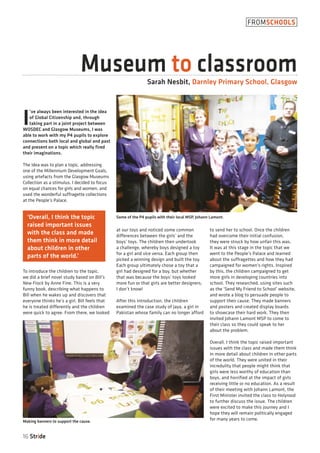
receiving little or no education. As a result
of their meeting with Johann Lamont, the
First Minister invited the class to Holyrood
to further discuss the issue. The children
were excited to make this journey and I
hope they will remain politically engaged
for many years to come.
16 Stride
FROMSCHOOLS
Museum to classroomSarah Nesbit, Darnley Primary School, Glasgow
Some of the P4 pupils with their local MSP, Johann Lamont.
Making banners to support the cause.
‘Overall, I think the topic
raised important issues
with the class and made
them think in more detail
about children in other
parts of the world.’
I
chose the theme of ‘journeys’ by
Latin American Spanish speakers
to the USA, as an inter-disciplinary
approach to Global Citizenship with my
S2 class. The curriculum areas covered
were Spanish, Social Subjects and Health
and Well-being.
To open the project and introduce the key
themes, pupils noted down their knowledge
and thoughts about why they thought
Latin Americans would leave their country
and go to the USA. They then revisited the
UN Rights of the Child (a topic covered in
both S1 and S2 Modern Studies) through a
Spanish-English match-up activity. This was
an excellent way of providing pupils with
unfamiliar Spanish text that they were able
to understand through familiar vocabulary.
Pupils had the opportunity to revise
‘push’ and ‘pull’ factors (a topic they had
just finished in S2 Geography) as well as
critically analyse the ‘pull’ factors through
examination of the reality for Latin
American immigrants in the USA. Having
considered the difficulties for many Latin
American immigrants in the USA, pupils
reflected on similar situations in their own
communities and discussed what they
could do to help immigrants in Glasgow.
They also discussed what role they had
in preventing the need for forced social,
economic, political or environmental
immigration in Latin America. The hope
is that pupils will take action in their day-
to-day lives, as well as have increased
understanding of the role of charity and
fair trade in Latin
American countries.
My initial concern was
how to incorporate
Spanish into a project
that required pupils to
think about, read and
discuss quite complex
topics. Although it
was not possible to
hold discussions in the
target language, during the six classes I was
able to input a considerable amount of new
vocabulary. I utilised and assessed the new
vocabulary the same way I would any other
vocabulary: smart-board games, match-up
activities and show-me boards. Not only
did this satisfy me as a Modern Language
teacher in terms of language development,
but it provided an element of routine and
‘normality’ for my pupils in the relatively
unfamiliar Global Citizenship context.
A variety of teaching methods were used
throughout the project: video clips (e.g.
the deportation scene from Babel, a
Honduran immigrant
talking in Spanish about
his life in California),
images of Latin American
immigrants in the USA
to generate ideas and
discussion, English texts,
Spanish texts, posters and
match-up cards.
The pupils responded
positively to the work
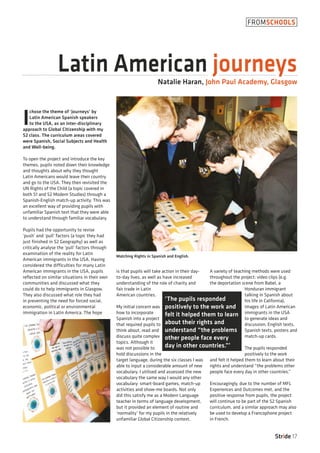
and felt it helped them to learn about their
rights and understand “the problems other
people face every day in other countries.”
Encouragingly, due to the number of MFL
Experiences and Outcomes met, and the
positive response from pupils, the project
will continue to be part of the S2 Spanish
curriculum, and a similar approach may also
be used to develop a Francophone project
in French.
Stride 17
FROMSCHOOLS
Latin American journeysNatalie Haran, John Paul Academy, Glasgow
‘The pupils responded
positively to the work and
felt it helped them to learn
about their rights and
understand “the problems
other people face every
day in other countries.”’
Matching Rights in Spanish and English.
In the loopA round-up of Global Citizenship events,
competitions  CPD from IDEAS members.
18 Stride
Picture:ChrisRossPhotography
British Council
Connecting Classrooms
Connecting Classrooms is the British
Council’s new global education programme
designed to help young people learn about
global issues and become responsible
global citizens. The 3 key strands are:
• School Partnerships funding: our
new offer for UK schools involved in
a partnership with schools in Africa,
Asia, Middle East and South America.
You can apply for £1,500 per school to
fund reciprocal visits. Next deadline:
28 June 2013.
• Professional Development: online
courses and face-to-face workshops for
teachers engaged in international work.
• The International School Award: get
involved with the flexible, accessible and
supportive International School Award
framework. It’s a great way to get formal
accreditation for your international and
global citizenship work.
Find out more at www.britishcouncil.org/
connectingclassrooms
Red Cross
Refugee Week
The Positive Images toolkit is a free
educational resource for teachers, youth
workers and other educators to teach
young people about migration and
development. It includes a wealth of
activities and case studies of actions,
enabling young people through their
community to make a difference to global
issues. It can be used in the build up to
Refugee Week, 17-21 June, or alongside
a British Red Cross in-service training.
For more information contact Lucy
(West Scotland) LucyPhilpott@redcross.
org.uk or Jennifer (East Scotland)
JenniferBooth@redcross.org.uk
IDEAS
Global Learning Project
The Global Learning Project (GLP) is
working to support the embedding of
Education for Global Citizenship within
schools and Initial Teachers Education
establishments across Scotland. The
project is managed by a partnership of
voluntary and statutory organisations
including, Scottish Government, Education
Scotland, Universities (STEC), Local
Authorities, Development Education
Centres and the British Council.
The project is nearing its conclusion and
we are planning various events across
Scotland to consolidate the work so far.
These will include:
• Symposiums to reinvigorate those who
attended previous events and to share
learning experiences.
• Secondary school seminars to extend the
reach to teachers and local authorities
not currently engaged with the project.
These events will be held across the
country in late May, early June – watch out
for dates being publicised on the IDEAS
website – www.ideas-forum.org.uk
Scotland Malawi Partnership
School Links Forum
The Scotland Malawi Partnership’s Primary
and Secondary School Links Forum exists
to strengthen Scotland-Malawi schools
engagement. One of the projects the
Schools Forum will be undertaking this
year will be to update the SMP’s Schools
Partnership Guide. If you would like to feed
into the process, or hear more about the
Forum, please email charlie@scotland-
malawipartnership.org
NIDOS
Event: Scotland 2013 and beyond
Global Citizenship will be profiled at this
event on 17 May 2013, organised by the
Network of International Development
Organisations (NIDOS) and the IF campaign.
It will provide an opportunity for education
professionals, including teachers, to build a
consensus on key principles and values for
Scottish international development. IDEAS
will also be running a workshop around
‘Scotland Learns’ which will focus on Global
Citizenship and how we can build a globally
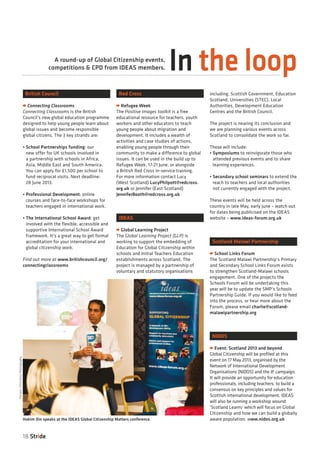
aware population. www.nidos.org.ukHakim Din speaks at the IDEAS Global Citizenship Matters conference.
Stride 19
Enough food for everyone IF...
‘Enough Food for Everyone IF’ is a coalition of organisations
calling on the G8 to take action on global hunger. The
organisations working in Scotland have put together a blueprint
of the steps Scotland should take, one of which is around Global
Citizenship Education for children, young people and adults.
There are lots of resources to explore this issue in the classroom.
These can be found on the main campaign website:
www.oxfam.org.uk/education
For more information on the campaign visit:
www.enoughfoodif.org/scotland
For resources on a wide range of global citizenship themes
and how to contact your local Global Learning Centre:
www.seedsforlearning.org.uk
Divine poetry
competition
Organised by Divine Chocolate
and Christian Aid, this year’s
theme invites you to think about
the part chocolate plays in your
life. It’s your chance to explore
and describe what chocolate
means to you.
Poems can be submitted for
7-11 and 12-16 year olds and the
winner in each category will
receive Divine chocolates and
book tokens. Find out more at
www.divinechocolate.com/
poetry
Send My
Friend
to School
Join the world’s
biggest education
campaign. Every
year the UK Global
Campaign for Education leads a campaign to
encourage children and young people to speak
up for the right to an education. The 2013
campaign is ‘Every Child Needs a Teacher’.
Find out how to get involved:
www.sendmyfriend.org
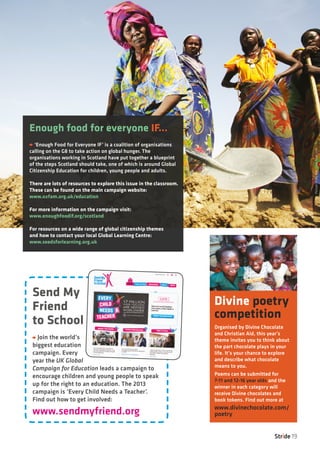
Picture:AndyHall,Chadfoodcrisis
‘If you educate a
man, you educate
an individual.
If you educate
a women, you
educate a nation.’
Dr Kwegyir Aggrey
Amnesty International
0131 313 7010
www.amnesty.org.uk/
scotlandeducation
British Red Cross
0131 338 5700
www.redcross.org.uk/education
Christian Aid
0141 241 6137
www.christianaid.org.uk/learn
British Council
0131 524 5700
www.britishcouncil.org
Hand Up Media
0131 226 2674
www.handupmedia.co.uk
Mercy Corps
0131 662 5160
www.mercycorps.org.uk
Oxfam Scotland
0141 285 8887
www.oxfam.org.uk/education
Save the Children
0131 527 8200
www.savethechildren.org.uk/
scotland
SCIAF
0141 354 5555
www.sciaf.org.uk
Scotland Malawi Partnership
0131 529 3164
www.scotland-malawi
partnership.org
Woodcraft Folk Scotland
0141 304 5552
www.woodcraft.org.uk
World Peace Prayer Society
01387 740642
www.worldpeace-uk.org
WWF Scotland
01350 728200
www.wwfscotland.org.uk
IDEAS  its members
Conforti Institute
01236 607120
www.confortiinstitute.org
Highland One World Group
01381 621265
www.globaldimension.
highlandschools.org.uk
Montgomery Development
Education Centre
01224 620111
www.montgomerydec.org.uk
One World Centre Dundee
01382 454603
www.oneworldcentredundee.
org.uk
Scotdec
0131 226 1499
www.scotdec.org.uk
West of Scotland DEC
0141 243 2800
www.wosdec.org
including Global Learning Centres
IDEAS (the International Development
Education Association of Scotland) is
a network of organisations involved in
Development Education and Education
for Global Citizenship across Scotland.
www.ideas-forum.org.uk
IDEAS’ work in Scotland
is funded by:
The essential
one-stop website
giving you local
and national
access to
Global Citizenship
resources.
www.seedsforlearning.org.uk
In the next issue:
Focus on water
Subscribe to Stride free of charge:
stride@ideas-forum.org.uk
Follow @ Stride_global
on Twitter

Stride gender

  • 1.
    What does genderequality mean? How is it taught in our classrooms? Are we challenging stereotypes? SPRING / SUMMER 2013 Taking action: teachers and young people on taking positive action for change. The unseen view: pupils speak out on experiences of gender in school. Classrooms activities to support the exploration of gender issues and power relationships.
  • 2.
    Our selection offiction, online resources and reference books which support the exploration of gender equality in the classroom. FICTION Early Years Princess Smartypants by Babette Cole Princess Smartypants does not want to get married. She enjoys being a Ms. But being a rich and pretty princess means that all the princes want her to be their Mrs. Find out how Princess Smartypants fights to preserve her independence in this hilarious fairy-tale-with-a-difference. Puffin, £6.99 Zog by Julia Donaldson Zog is the keenest dragon in school. He’s also the most accident-prone. Luckily, a mysterious little girl always comes by and patches up his bumps and bruises. But will she be able to help him with his toughest test: capturing a princess? This funny and brilliantly illustrated book challenges the traditional fairy-tale roles of the prince, princess and the dragon. Alison Green Books, £7.99 Primary The Paper Bag Princess by Robert Munsch The Paper Bag Princess tells the story of a resourceful princess and her useless prince. The story reverses the ‘princess and dragon’ folklore stereotype and challenges the ‘passive’ female role often found in fairy-tales. Annick Press Ltd, £ 4.95 Bill’s New Frock by Anne Fine Bill Simpson wakes up to find he’s a girl, and worse, his mother makes him wear a frilly pink dress to school. How on earth is he going to survive a whole day like this? Everything just seems to be different for girls. Egmont Books Ltd, £4.99 ONLINE Teaching Resource for Global Learning in School Partnerships: Gender This is one of a series of 6 thematic teaching and learning resources, produced by LINK Community Development, to support joint global learning to take place within the curriculum of each partnership school. However, it also works well as a resource for exploring gender with a global perspective. There is a primary and a secondary version available. The resource can be downloaded at www.linkschools. org/curriculumprojects or to request a hard copy, email kate@lcd.org.uk. Sazia’s Story Early and forced marriage Every year, 10 million girls are married young and too often against their will. A key focus of Plan UK’s campaign ‘Because I am a Girl’ is to support an end to early and forced marriage in the world’s poorest countries. This secondary teaching resource aims to raise awareness of the issue of early and forced marriages. Its starting point is a short animated film based on the true story of a young British girl whose family tried to force her into marriage. Students consider the choices Sazia has to make, create an assembly around the issue and explore the impact that early and forced marriages have on girls all around the world. Find the resource at: www.plan- uk.org/what-we-do/campaigns/because- i-am-a-girl/girls-rights-resources/sazia- early-forced-marriage 80:20 Development in an Unequal World This reference book provides an introductory and accessible overview of key debates and perspectives in human development and human rights worldwide. It explores topics such as human development, sustainability, justice, women’s rights, aid, education and ideas for change. 80:20 makes extensive use of descriptive analyses, facts and figures, case studies, graphics, cartoons and photos. 80:20 Educating and Acting for A Better World with UNISA Press, £17.50 Resources 2 Stride Picture:fromFirstStepstoRightsUnicef,UNICEF/HQ06-1338/Versiani For resources on all Global Citizenship themes, visit: www.seedsforlearning.org.uk
  • 3.
    The startling realityis that there is not a single country in the entire world today where women have achieved equality with men. While, the expectation both in Scottish, UK and International Law is that men and women are equal and are treated accordingly, gender inequality remains a feature in every region in the world. In developing countries this inequality is exacerbated by extreme poverty. Despite the fact that very significant progress has been made in some areas such as education and health, women remain hugely disadvantaged in areas such as economics and politics and, in some countries, they experience widespread and systematic abuse and discrimination. Education has a significant role to play in changing this. How we educate our girls and boys here and what we teach them about gender issues globally matters hugely in our drive to achieve equality for women and for men. Our lead article on page 4 and 5 explores the issue from both a local and global perspective. We hear from a male and female pupil on their experiences of gender in Scottish schools. Their experiences are very personal but at their heart expose the gender stereotyping which our young people must negotiate. Gender stereotyping has become so deeply entrenched in our society we have almost become desensitised to it. With Rights and Responsibilities at the heart of the curriculum, there is the space within which to address gender issues. Developing the skills to engage critically with social and media representations of gender and to challenge these views is key to empowering all young people in our schools. The activities pages suggest some starting points on how to do this and we also highlight some useful resources on the topic. While education for Global Citizenship strives to equip young people with the skills and knowledge to live as responsible citizens, equally important is the belief that they themselves can make a difference and stand up for what they believe in. Our guide to taking action on page 10 and 11 reflects on what it is that makes some people take action and others not, while suggesting ways to support your pupils in their endeavours. As ever, we are keen to hear your views on Stride and welcome your contributions. Join us in the debate @ stride_global on Twitter. © IDEAS, Spring / Summer 2013 Stride magazine is printed using vegetable inks on 100% recycled uncoated stock, a product with FSC certification. Gender equality 4-5 Gender activity 6-7 The unseen view 8-9 Take action! 10-11 Action activity 12-13 My story 14 Gender matters: Malawi 15 Museum to school 16 Latin American journeys 17 In the Loop 18-19 We would love to hear your ideas, comments and feedback. Get in touch! stride@ideas-forum.org.uk Front cover picture: Aly Wight, www.alywight.com Stride team EditorialCharlotte Dwyer, Editor Inside Stride 3 ‘Gender stereotyping has become so deeply entrenched in our society we have almost become desensitised to it.’ No country treats its women the same as its men. Angela Higgins – IDEAS Joshephine McLaughlin – IDEAS Charlotte Dwyer – Scotdec Della Rea – Scotdec Diana Ellis – WOSDEC John Dornan – Conforti Institiute Lynn Baxendale – WOSDEC Richard Nicodème – Context Silvia Sabino-Hunt – British Red Cross Nick Morgan – Education Scotland Design: www.contextdesigns.co.uk
  • 4.
    4 Stride E very singlechild and young person we teach will have personal experience of gender inequality. We live in a society which encourages gender stereotyping from birth, and our young people grow up with preconceived notions of what male and female roles should be. It is vital that our schools challenge these roles and empower pupils to think critically about gender issues. Supporting them to make the connections between gender inequality here and around the world can provide a rich context for developing Global Citizens. What do we explore when we’re looking at gender in our classrooms? Gender refers not only to women and men but also to the relationship between both. Any exploration of gender issues in schools needs to make explicit connections with rights and responsibilities. It is important to investigate where our stereotypes of men and women come from and how gender inequality is manifest in our society. In a global context, women suffer greater inequalities than men and the consequences of this discrimination against females at personal, social, economic and political levels are felt not only by women but by us all. Gender stereotypes ‘When we talk about gender, we are talking about social roles and not ‘sex’ or biological characteristics. Gender varies from culture to culture and over time. People are born male and female but learn to be boys and girls who grow into women and men.’1 The starting point of an exploration of gender stereotypes with learners must be their understanding of gender as opposed to sex. Learners could conduct surveys of attitudes at home, or an audit of how the media represent women and men, boys and girls. It is important that we recognise that schools are significantly gendered environments. 77% of teachers in our schools are female, according to the 2012 teacher census from the Scottish Government. How do our learners perceive this imbalance? The recent TESS report (15/2/13) suggests that gender differences make little impact on the school experience for most young people. Would your pupils agree? What about the subjects that girls and boys choose in Secondary school and the roles and responsibilities they take on during their school careers? At West Calder High, the majority of prefects and bully mentors are girls. Is there a balance of representation on groups in your school? Gender inequalities in Scotland and around the world As is clearly illustrated within our schools, professions are rarely gender neutral. It is interesting to investigate how work, income and property are divided between women and men both in Scotland and throughout the world. There are varying obstacles faced by both men and women in achieving their full human development and potential. For example, men in Scotland have a life expectancy consistently several years less than that of women, suggesting the costs of gender- related occupational and consumption patterns. Globally, the overwhelming recruitment of men as fighters by both state and revolutionary forces puts them in great danger. Gender inequality is an aspect that affects all areas of society around the world: health, education, industry and Gender equality: everyone’s issue Diana Ellis, education officer at Wosdec, investigates why it is vital that gender issues, both locally and globally, are explored in our classrooms. ‘We live in a society which encourages gender stereotyping from birth, and our young people grow up with preconceived notions of what male and female roles should be.’ 1 Text adapted from ‘URARI - Equality: Exploring gender equality through a global lens. A CSPE/Citizenship Resource’ Trocaire, 2007 Literacy project in La Piste Camp, Haiti, teaching women to read and write. Picture:AmandaGeorge(BRCS)
  • 5.
    Stride 5 government. However,when speaking about gender equality in the Global North compared with the Global South, are we talking about the same issues? The third Millennium Development Goal promotes gender equality and the empowerment of women, demonstrating the importance of addressing these issues in order to alleviate poverty globally. It is widely accepted that the empowerment of women starts with equal access to education. The United Nations Millennium Development goals report from 2012 indicates that, ‘the world has achieved parity in primary education between girls and boys’. However, there are still many barriers facing girls’ access to education in the Global South. Some of these barriers include the need for a young girl to care for others in the household due to a parent’s death, the girl’s personal health due to high rate of HIV and early pregnancies, or the fact that the community does not understand the need for a girl to be educated as her husband will be taking care of her in the future. The Forum for African Women Educationalists2 (FAWE) is involved in a number of projects to support female empowerment and gender awareness. Some of these projects include establishing ‘Mother Groups’ in primary schools and some secondary schools, and strengthening girls clubs in schools and communities. Our learners in Scotland can look at these and other positive steps being taken to address gender issues elsewhere, and contrast with similar initiatives here, such as the Scottish Women’s Institute, and the Women’s Fund for Scotland. Why do girls and women suffer greater inequalities? Discrimination consistently deprives girls and women of power and access to resources. As teachers we need to encourage our pupils to ask why society is structured in such a way that undermines and undervalues the contributions of women around the world. A starting place for teachers and pupils is the UN’s Convention on the Elimination of Discrimination Against Women (CEDAW), which was adopted in 1979. It was the first Convention to address women’s rights within political, economic, social, cultural and family life and emerged after the first conference on Women in 1975 in Mexico. CEDAW recognises that a change in the traditional role of men, as well as women in society and the family is needed to achieve full equality between men and women. Exploring the extent to which men and women are equal and treated accordingly is highly sensitive. How do we choose which case studies to examine? How do we support our learners to think critically about the data they are investigating? As ever, when we are planning for Global Citizenship we must ensure that the material we provide enables our learners to question the issues deeply, examine multiple perspectives and take action in a way in which they have chosen themselves. . ‘As teachers we need to encourage our pupils to ask why society is structured in such a way that undermines and undervalues the contributions of women around the world.’ 2 www.fawe.org Gender inequality affects boys as well as girls. Tsunami Recovery Construction Programme, Sri Lank. Picture:AlyWight–www.alywight.com Picture:MortenHvaal(IFRC)
  • 6.
    Aims To facilitate pupils’understanding of gender as opposed to sex, and to begin to explore how gender is a role given to us by society. What to do Ask the class if they can explain the difference between gender and sex when referring to men and women. Elicit that the difference is that gender refers to social roles and not ‘sex’ or biological characteristics. Give pupils the statements (see below) and in pairs they should discuss each statement and mark beside each one whether they think it refers to Gender (G) or Sex (S). Reflection and evaluation Discuss the answers with the group using the points below. Did the statements surprise you? Do the statements suggest that ‘gender’ is something you are born with or learned? What effect can ‘gender’ stereotyping have on girls and boys? Encourage pupils to think of their own experiences and ways our society/culture promotes gender differences. Gender roles differ greatly over time, in different cultures and societies. Can they think of any examples of this? How can this impact on women’s lives? Women in every country experience power and oppression differently. Think about our own history. Have women’s experiences changed over the last 100 years? Extension: Pupils can interview different family members such as grandparents / aunts / uncles to find out what their experience of gender has been. 6 Stride Gender or sex: what’s the difference? for Levels 2/3Activity Answers:1=S,2=G,3=G,4=G,5=S,6=G,7=S,8=S,9=G 1. Women give birth to babies, men do not. 2. Little girls are gentle, boys are tough. 3. Amongst Indian agricultural workers, women are paid 40-60% of the male wage. 4. Women can breastfeed babies, mencan bottle feed babies. 5. Most building-site workers in Britain are men. 6. Men’s voices break at puberty, women’s do not. 7. In one study of 224 cultures, there were 5 in which men did all the cooking and 36 in which women did all the house building. 8. According to UN statistics, women do 67% of the world’s housework, yet their income only amounts to 10% of the world’s income. Adapted from URARI – Equality: Exploring gender equality through a global lens. (Trocaire)
  • 7.
    In the world,774 million people are illiterate. This means that they cannot read and write. Of these 774 million people, what percentage/ proportion are women? ANSWER: 64% or 6/10 [Source: UN stats 2007 http://unstats.un.org/unsd/demographic/products/ Worldswomen/wwEduc2010.htm] Of all the land in the world, what percentage is owned by women? ANSWER: 1% [Source: Independent 8th March 2006] Of all the politicians in the world, what percentage are women? ANSWER: 17% [Source: Proportion of parliamentary seats in lower or single chamber 2009 UN Statistics. http://unstats.un.org/unsd/demographic/products/Worldswomen/ wwPower&dec2010.htm] Of the 1.2 billion people living in poverty in the world, what percentage are women and children? ANSWER: 70% [Source: Independent 8th March 2006] Aims To recognize that globally women do not have an equal share of power or resources and that this is not fair. What you need Pebbles or small objects and two hoops or mats if using Method 2. What to do The aim of this lesson is to show the vast inequalities that exist globally between men and women in terms of global wealth, power and access to opportunities. The activity helps pupils to visualize statistics (see below) around this issue through 3 possible methods. Read out each question in turn and ask pupils to guess what percentage of the world’s women is the correct answer. Method 1 – On the Line Make an imaginary line in the classroom (or outside if the classroom is not large enough), with 0% at one end and 100% at the other end, and ask pupils, or a sample of pupils, to stand on the line according to what they think is the correct answer. For example, if they think the answer is 50%, they would stand halfway along the line, etc. Method 2 – Moving pebbles Collect together 100 pebbles or stones or any other small object. Put two mats or hoops on the floor to create two distinct areas, one to represent ‘women’ and one to represent ‘men’. Learners will distribute the pebbles between the two areas according to what they think the answer is – e.g. 60 men to 40 women would mean 60 pebbles on the ‘men’ mat and 40 pebbles on the ‘women’ mat. Method 3 – Finger voting Ask learners to hold up the correct number of fingers (1-10) according to what they think is the right answer. Ask some learners to be monitors or ‘counters’ and collate the answers given to produce a class medium or mean. Reflection and evaluation In pairs, pupils discuss what they found out. What surprised them? How does it make them feel? Is it fair? What do the statistics show about the power between men and women? Are some countries better at treating women more fairly than others? Ask pupils if they can think of reasons why these inequalities exist. Do you think the reasons will be the same in all countries? Why / why not? A fair world for women? Stride 7 (For the finger voting method, 1 finger = 1/10, 2 fingers = 2/10, etc) From Teaching Resources for Global Learning in School Partnerships, Theme 5: gender. (LINK Community Development) Statistics for Levels 2/3Activity [Source: The Fawcett Society] Looking at the top 100 companies in the UK, what percentage of their executive directors are women? ANSWER: 4%
  • 8.
    8 Stride The unseentruth... On these pages, two pupils from Scottish schools share their very personal experiences of gender. The articles reflect their views and perspectives on the issue. “From my first week of high school, I instantly saw a contrast in the atmosphere from primary in the way that the boys grouped together and the girls grouped together as opposed to the mixed group of friends I was used to. I was lumped with the boys which meant I heard the kind of conversations boys were having in relation to their female peers. Comments on how ‘developed’ the girls were and who they would like to ‘bang’ were very common and, as a boy, I was expected to join in. I found that this problem got worse as the years progressed. Comments on the female body became more vulgar and descriptions of sexual acts became violent. In fifth and sixth year, teachers become more relaxed around their students. Whilst this is normal, I found it also became hazardous. Male teachers who made sexist jokes about women, expecting their students to understand it’s a joke, failed to realise that although senior students are more mature, they are still a group of impressionable teenagers. By making sexist jokes they are giving the impression to male teenagers that it is okay to make sexist jokes about women. This is where the fine line between a joke and reality becomes blurred. Very rarely, these male teachers will have someone like me in their class who stands up and challenges these sexist ‘jokes’. I find when I do challenge these teachers, they immediately defend themselves by saying they meant it as a joke or were having a bit of ‘banter’. Which further gives the impression to others that sexist comments are okay, as long as you make it clear or defend yourself by saying it was a joke. What tends to happen is that real sexist views become disguised as jokes. My peers ask me why I care so much since I am male. I have been asked this question multiple times when standing up to sexist teachers and even females in my classes have told me they find it amusing how I care more about feminism than them. This problem could be put down to the lack of quality social education in high schools. The topic is taught by unwilling teachers to unwilling students who would rather not learn about sex and issues surrounding sex, including gender issues. Well, that would be if gender issues were even part of the social education curriculum. It seriously stuns me how feminism or gender equality isn’t even remotely addressed in a class which is supposed to be about society. I don’t even remember learning about gender issues in first to fourth year of core Religious, Moral and Social education and yet it is a whole topic at higher level. 5th year pupil reveals the sexism he feels exists in his school. We respected the wishes of the school that they both remain anonymous. ‘By making sexist jokes they are giving the impression to male teenagers that it is okay to make sexist jokes about women. This is where the fine line between a joke and reality becomes blurred.’ So why are we surprised that sexist views still exist?
  • 9.
    Stride 9 I’m aneleven-year old girl living in Scotland. I am in primary 7 of a small school. This is only my second year at school, because I was home-schooled before that. When I was home-schooled, nobody made an issue of me being a girl. Since I started school, I’ve had to put up with being told girls can’t play football (which stinks in a country where women can’t be paid to play football) and I can only wear pink pyjamas on Pyjama Day. Boys made jokes about me before I could understand them. Boys ask us what our bra sizes are. If this happened at work, it would be harassment, but it has become normal. The AAUW’s ‘Crossing The Line’ report showed that more than half of girls aged 12-18 in US schools had experienced sexual harassment. This includes verbal (jokes, sexual comments) and physical (groping etc) as well as online harassment. The website www.girleffect.org explains that the longer girls stay in education, the better their prospects are. In the developing world, this can mean the difference between life and death. Girls with more schooling marry later (when they are ready), have less children, and the children they do have are healthier. Research shows that educating girls improves societies. When women earn, they invest 90% of their income into their families. Why, then, are girls allowed to be pushed out of education by harassment, poverty, abusive child marriage or prejudice? ...about school Aine Clarke was the upper primary winner of the Young Human Rights Reporter of the Year 2012 competition run by Amnesty International. Here is her winning article. ‘Boys made jokes about me before I could understand them. Boys ask us what our bra sizes are. If this happened at work, it would be harassment, but it has become normal.’
  • 10.
    Taking action 10 Stride Howdo we prepare the global citizen? What is it that makes some people take action on issues that affect us all but not others? Silvia Sabino-Hunt, humanitarian educator with the Red Cross investigates. A guide for educators and young people W hen we look at the work of people who campaign for citizenship causes they believe in, it’s difficult to pinpoint where all this energy, belief and wanting to make a change comes from. Is it education, family life or individual experiences that count? Research shows for example that campaigns like Make Poverty History help develop a heightened awareness of development issues but there is little evidence of an increased depth of understanding around the issues. Campaigning can therefore be a starting point to motivate ‘global citizens’ but to make sure the process doesn’t end at the post-campaigning stage, young people need to be provided with more opportunities to explore Global Citizenship issues further. Local connections People need to feel a connection with the issues on which they take action. Wangari Maathai, a Kenyan environmentalist and activist understood this and harnessed the power of grass roots activism among the women she worked with in rural Kenya. Maathai realised that when accessing nutrition, education, land, power and jobs women were always second to men in her society. She was a positive solution focussed person and her ‘solution’ was to plant trees. Planting trees gave the women agricultural skills, providing fuel for cooking, food in the case of fruit trees, shade and would also help mitigate deforestation in Kenya. It wasn’t just about planting some trees, it was economic and social progress going hand in hand with environmental protection. It was a local issue that had a global outlook. Maathai reflects in her book, Unbowed, that those involved in social change processes have to be affected by, or connected to the issue they’re helping to improve. She realised early on that her visionary project needed local women to plant local trees, so that they took ownership of the trees and cared for them over time. She also realised that those trees had to be appropriate to the local environmental context. These key ideas are also valid in the classroom. Our young people need the space and time to engage with local issues which are important to them, develop creative and sustainable responses and be given enough time to learn and explore these issues in-depth. ‘Active local and global citizenship is about taking responsible actions and making sure that the impact of the action is measured.’ Picture:BritishRedCross2009 Picture:BritishRedCross2009 All pictures: Pupils from St Thomas Aquinas, Edinburgh, take part in an HIV peer education project.
  • 11.
    Stride 11 So ifthere’s something that makes the young people you work with blow their top, encourage them to take action. That is the ultimate goal in Global Citizenship Education, and with Curriculum for Excellence’s emphasis on an education that develops responsible citizens and effective contributors, all the justification you need is there. Whether it’s food (or the lack of it for some 925 million people), food price hikes, land grabs, climate change, racism, refugees, conflict, child soldiers, the government’s education policies, their school’s lack of Fair Trade products, or the cafeteria food mileage and packaging – if there’s an issue that really makes your pupils want to get out there and change things for the better, assure them that there are lots they can do. From volunteering, to campaigning, asking difficult questions, spreading the word, distributing leaflets, peer educating, writing to their MSP or MP, participating in a demonstration, celebrating Global Citizenship days – there’s a never ending list of ideas on how to take action around issues that are important to them. But do support their creativity and if none of these ideas really gets them excited, let them suggest their own ideas. It is also fundamental to make sure young people are given the tools to evaluate the impact of their actions. Active local and global citizenship is about taking responsible actions and making sure that the impact of the action is measured. The Get Global! resource book (download at www.getglobal.org.uk) is just one of the many resources that can help you as a teacher to facilitate and assess active global citizenship. This resource contains a range of innovative and participatory activities that promote a skills-based approach rather than a content-based approach, so Get Global can be used within different subject areas and at different levels. › Tell a story! Simple Acts is a campaign developed by the Refugee Council that suggests different possible actions that people can take to help unpack the myths surrounding issues related to asylum, refuge and difference. The acts range in level of difficulty, time and effort required and can be done by both primary and secondary school aged pupils as well as adults. There is even a toolkit to support you – www.simpleacts. org.uk/toolkit. So far there have been 27,864 Simple Acts completed in the UK. How many could you add to the list? › Send My Friend to School Join the world’s biggest education campaign. Every year the UK Global Campaign for Education leads a campaign to encourage children and young people to speak up for the right to an education. The 2013 campaign is ‘Every Child Needs a Teacher’. For more information and how to get involved: www.sendmyfriend.org › Sign up to the IF campaign The world has enough food for everyone, but not everyone has enough food. The IF campaign is a coalition of organisations calling on the G8 to take action on global hunger. There are lots of ways to get involved. Find our more at www.enoughfoodif.org Finally don’t forget to tell your parents, your neighbours and your friends what you are learning about! Here are 3 simple ideas to inspire you and your students to take action: Useful resources › Get Global! A skills based approach to active global citizenship www.getglobal.org.uk › How do we know it’s working? (RISC) Go to: www.seedsforlearning.org.uk Picture: British Red Cross 2009
  • 12.
    12 Stride Aims To enablestudents to brainstorm issues and reach a group consensus on which one to take action on, and to develop and extend skills for enquiry. What to do On a large sheet of flip chart draw the outline of a person. Ask the pupils what makes them blow their top? What issues do they feel strongly about? These can be issues in the school, local community, country or world. Write the issues around the body. Read all the issues and group them into similar ones. In groups, pupils can think about what could be done to improve the situation around each issue. The most popular issues can be analysed before choosing one to take action on. What to do Put up a number of photos around the classroom which illustrate topical local and global issues / events. Ask the pupils to look at the photos and select one which represents an issue they feel strongly about. Groups gather around the issue / picture. These groups will now use the trigger photo questions (see below), to explore the issue further. Each group can present their ideas to the class. The class can now vote for the issue they feel they could all work on together to make a difference. Choose an issue for Levels 2/3Activity Trigger photo questions: Who is it an issue for? What is themessage ofthe photo? Are they affected locally, nationallyor globally? What can you do to improve the issue? How many people are affected by the issue? Taken from ‘Get Global! A skills based approach to active global citizenship’. What makes you blow your top? Trigger photos
  • 13.
    Stride 13 Aims To enablepupils to consider the feasibility of possible actions and decide on one; to develop skills to negotiate, decide and plan for action. What to do Prepare a set of cut up cards (see below) for each group. In groups, the pupils should read and discuss each action in relation to the issue they want to act upon. Ask them to arrange the cards in a diamond pattern so that the action at the top at the top is the most preferred and the one at the bottom the least preferred. Encourage pupils to think about which actions would have the most impact in school, the local area, country and world. Which actions are the most practical to do? Take action! for Levels 2/3Activity ❱ The best action is to put our arguments to (lobby) someone in a powerful position, e.g. write a letter or an email, send a petition or an opinion survey, or visit them. It could be your head teacher, MSP/MP or someone from the council in charge of facilities for young people. ❱ The best action is to find out which organisation can help us, and join their local, national or global campaigns. ❱ The best action is to invite a guest speaker into school to talk about the issue or to be part of a debate. ❱ The best action is to perform a play on how the issue affects young people (e.g. in assembly) to other schools. ❱ The best action is to make a leaflet, poster or collage on the issue and display it to people in school and in the local community. ❱ The best action is to make a video, audio or photographic presentation to encourage discussion about the issue, and get people to debate it. ❱ The best action is to make different choices about your life based on what you have learned, e.g. change what you eat, wear and spend your money on. Other people will notice and follow your example. Taken from ‘Get Global! A skills based approach to active global citizenship’. ❱ The best action is to raise money and donate it to a charity working on the issue. ❱ The best action is to work with the press, e.g. talk on local radio or invite them to an event.
  • 14.
    I was well intoa ‘traditional’ marriage with two children in the 1980’s, before I realised the extent to which society’s expectations of women had significantly influenced my own life choices. Gender issues matter to me for other reasons too: primarily because of social injustice. It is simply unfair that women worldwide are disadvantaged and discriminated against. I don’t subscribe to the myth that emancipation and equality has been largely achieved in the Global North. No part of the world has achieved gender equality and while this is the case, I make no apologies for the fact that my passion has been about the redressing the disadvantages faced by girls and women. A scientist by training, I entered the teaching profession because it seemed like a sensible job for married women intending to have children. I did come to love teaching and to be in positions where I could take action on important issues. In my classroom I tried to redress gender inequalities by questioning the male biases and sexist language or attitudes in teaching materials. In classes we celebrated the hidden contribution of women scientists and learned that ‘sex’ had little to do with what could be achieved. I had no personal ambitions to go into Senior Management but after helping to write and deliver a course aimed at encouraging women into senior management positions in schools, it became hard not to do so myself. So, rather late in my teaching career, I began to climb the ladder into management positions. As a head teacher of a Community High School, I was committed to redressing gender imbalances in a number of ways: by challenging sexist attitudes and behaviour, working to raise expectations for all students without gender biases, challenging stereotypes in curricular or career choices, promoting an understanding of gender influences in learning and teaching styles and by being a female role model as a secondary school head teacher. Later on in my career, I became a volunteer Development Officer in Papua New Guinea (PNG). Here I came face to face with the harsh reality of womens lives in a very different part of the world. Life is very tough for women in PNG, particularly in the Highlands. They are born into a lifelong role that includes child and family care, farming, cooking and fetching water. As they grow older, the payment of a ‘bride price’ by their husband’s family confirms the view that they are a ‘possession’ and many women are treated as such and subjected to abuse and violence on a daily basis. The project I worked on supported girls’ education. Research shows that educating girls has a considerable impact on many aspects of society such as improving maternal and infant mortality rates and family health and diet. It also paves the way for income generation and as such can be a major contribution to community development. If the argument for gender equality cannot be won on social or humanitarian grounds, perhaps economic reasons can be more persuasive. Every country depends on its human talent: the skills, education and productivity of its people. What a waste it is not to use that potential to find ways of improving the life experiences for everyone. 14 Stride My storyDella Rea, retired head teacher and volunteer, explains how gender shaped her career in unexpected but rewarding ways. ‘In my classroom I tried to redress gender inequalities by questioning the male biases and sexist language or attitudes in teaching materials... we celebrated the hidden contribution of women scientists and learned that ‘sex’ had little to do with what could be achieved.’
  • 15.
    A cross the worldgender inequality limits the freedoms available to girls and women. Most often, it is girls and women who miss out on schooling, healthcare and employment opportunities in favour of men. Many more face problems in relationships, or with pregnancy and birth. So what is the Scotland Malawi Partnership doing to raise awareness of gender inequality? And how can young people in Scotland get involved? Malawi is one of the poorest countries in the world – and has a high proportion of women living below the poverty line. The OECD ranks Malawi as 120/146 in the world for gender inequality which highlights the vast number of challenges girls and women face every day in their quest for equality and opportunity. While Malawi has come far in achieving gender balance in primary education, very few women make it into secondary and tertiary education. Women also suffer health wise: Malawi has an incredibly high maternal mortality rate and women are disproportionately affected by HIV/Aids. The promotion of gender equality is of vital importance to the Scotland Malawi Partnership – an umbrella organisation that represents over 600 members, all of whom have their own Malawi link. The Partnership believes that the issue of gender equality matters for all Scotland- Malawi links. Therefore, in September 2012 the Partnership launched its ‘Gender Matters’ campaign, encouraging SMP members to reflect on why ‘gender matters’ across their partnerships. The campaign is conducted through a postcard campaign and various Gender Equality Forum meetings, celebrating the many ways in which Scotland-Malawi links are advancing gender equality to the benefit of both nations. Through the forum the opportunity for reciprocal learning, mutual support and joint advocacy is available between people in Scotland and their partners in Malawi. The first Gender Equality Forum focussed on ‘Gender Matters in education’ in Malawi and attracted a whole range of NGOs and organisations promoting girls’ access to education. The next forum will focus on ‘Gender Matters in leadership’, looking particularly at women in political leadership. The final forum meeting of the campaign will consider ‘Gender Matters in economic empowerment.’ There are many different ways in which teachers and pupils can get involved in the ‘Gender Matters’ campaign. At all of our events you will see colourful ‘Gender Matters’ postcards floating around which you can fill in to let us know why you think gender equality is so important. Stride 15 Gender matters Charlie Ager, from the Scotland Malawi Partnership, outlines the work of the Gender Matters campaign and how young people can get involved. Promoting gender equality in Malawi 1st prize, ‘Gender Matters in Leadership’ by Lydia Astill, Kirkcaldy. The girl was part of an Infant feeding programme in the lower Shira Valley. During the weekly visit of an Infant Feeding programme in the lower Shira Valley, these 3 children were spotted in the village. Clearly, a young lady is taking a leadership role with her two younger friends. 1st prize, ‘Gender Matters in Economic Empowerment’ by Zul Mukhida/Sightsavers Scotland. Olalia is an inspiring woman who has rebuilt her life after losing her sight and being abandoned by her husband. At the start of 2012, Olalia received two goats and went on a training course to learn how to manage them. These skills will enable Olalia to provide for her family and she hopes to develop a small goat-rearing business. The photos reproduced here are all winners in the ‘Gender Matters’ photo competition. 1st prize, ‘Gender Matters in Education’ by John Lawson, Glasgow City Council Namwiyo Primary (near Blantyre), July 2012 This girl wanted to use her break time to finish studying. Above her is the school bell – a metal wheel-rim. I liked the fact that – despite the bell having been rung, learning continued through the leadership of the teacher.” FROMSCHOOLS Everyone is also welcome to attend our Gender Equality Forum. The next forum meeting is about women in leadership, taking place at 5-7pm on 23 April in Edinburgh. And finally, you can join as a member of the Partnership! Free membership is available for young people aged between 14-24, and for all schools with a link to Malawi. Just head over to www.scotland- malawipartnership.org/membership. html to join the organisation and hear about all the amazing things that are happening between Scotland and Malawi. For further information contact Charlie Ager, Member Services Officer at charlie@scotland-malawipartnership.org
  • 16.
    I ’ve always beeninterested in the idea of Global Citizenship and, through taking part in a joint project between WOSDEC and Glasgow Museums, I was able to work with my P4 pupils to explore connections both local and global and past and present on a topic which really fired their imaginations. The idea was to plan a topic, addressing one of the Millennium Development Goals, using artefacts from the Glasgow Museums Collection as a stimulus. I decided to focus on equal chances for girls and women, and used the wonderful suffragette collections at the People’s Palace. To introduce the children to the topic, we did a brief novel study based on Bill’s New Frock by Anne Fine. This is a very funny book, describing what happens to Bill when he wakes up and discovers that everyone thinks he’s a girl. Bill feels that he is treated differently and the children were quick to agree. From there, we looked at our toys and noticed some common differences between the girls’ and the boys’ toys. The children then undertook a challenge, whereby boys designed a toy for a girl and vice versa. Each group then picked a winning design and built the toy. Each group ultimately chose a toy that a girl had designed for a boy, but whether that was because the boys’ toys looked more fun or that girls are better designers, I don’t know! After this introduction, the children examined the case study of Jaya, a girl in Pakistan whose family can no longer afford to send her to school. Once the children had overcome their initial confusion, they were struck by how unfair this was. It was at this stage in the topic that we went to the People’s Palace and learned about the suffragettes and how they had campaigned for women’s rights. Inspired by this, the children campaigned to get more girls in developing countries into school. They researched, using sites such as the ‘Send My Friend to School’ website, and wrote a blog to persuade people to support their cause. They made banners and posters and created display boards to showcase their hard work. They then invited Johann Lamont MSP to come to their class so they could speak to her about the problem. Overall, I think the topic raised important issues with the class and made them think in more detail about children in other parts of the world. They were united in their incredulity that people might think that girls were less worthy of education than boys, and horrified at the impact of girls receiving little or no education. As a result of their meeting with Johann Lamont, the First Minister invited the class to Holyrood to further discuss the issue. The children were excited to make this journey and I hope they will remain politically engaged for many years to come. 16 Stride FROMSCHOOLS Museum to classroomSarah Nesbit, Darnley Primary School, Glasgow Some of the P4 pupils with their local MSP, Johann Lamont. Making banners to support the cause. ‘Overall, I think the topic raised important issues with the class and made them think in more detail about children in other parts of the world.’
  • 17.
    I chose the themeof ‘journeys’ by Latin American Spanish speakers to the USA, as an inter-disciplinary approach to Global Citizenship with my S2 class. The curriculum areas covered were Spanish, Social Subjects and Health and Well-being. To open the project and introduce the key themes, pupils noted down their knowledge and thoughts about why they thought Latin Americans would leave their country and go to the USA. They then revisited the UN Rights of the Child (a topic covered in both S1 and S2 Modern Studies) through a Spanish-English match-up activity. This was an excellent way of providing pupils with unfamiliar Spanish text that they were able to understand through familiar vocabulary. Pupils had the opportunity to revise ‘push’ and ‘pull’ factors (a topic they had just finished in S2 Geography) as well as critically analyse the ‘pull’ factors through examination of the reality for Latin American immigrants in the USA. Having considered the difficulties for many Latin American immigrants in the USA, pupils reflected on similar situations in their own communities and discussed what they could do to help immigrants in Glasgow. They also discussed what role they had in preventing the need for forced social, economic, political or environmental immigration in Latin America. The hope is that pupils will take action in their day- to-day lives, as well as have increased understanding of the role of charity and fair trade in Latin American countries. My initial concern was how to incorporate Spanish into a project that required pupils to think about, read and discuss quite complex topics. Although it was not possible to hold discussions in the target language, during the six classes I was able to input a considerable amount of new vocabulary. I utilised and assessed the new vocabulary the same way I would any other vocabulary: smart-board games, match-up activities and show-me boards. Not only did this satisfy me as a Modern Language teacher in terms of language development, but it provided an element of routine and ‘normality’ for my pupils in the relatively unfamiliar Global Citizenship context. A variety of teaching methods were used throughout the project: video clips (e.g. the deportation scene from Babel, a Honduran immigrant talking in Spanish about his life in California), images of Latin American immigrants in the USA to generate ideas and discussion, English texts, Spanish texts, posters and match-up cards. The pupils responded positively to the work and felt it helped them to learn about their rights and understand “the problems other people face every day in other countries.” Encouragingly, due to the number of MFL Experiences and Outcomes met, and the positive response from pupils, the project will continue to be part of the S2 Spanish curriculum, and a similar approach may also be used to develop a Francophone project in French. Stride 17 FROMSCHOOLS Latin American journeysNatalie Haran, John Paul Academy, Glasgow ‘The pupils responded positively to the work and felt it helped them to learn about their rights and understand “the problems other people face every day in other countries.”’ Matching Rights in Spanish and English.
  • 18.
    In the loopAround-up of Global Citizenship events, competitions CPD from IDEAS members. 18 Stride Picture:ChrisRossPhotography British Council Connecting Classrooms Connecting Classrooms is the British Council’s new global education programme designed to help young people learn about global issues and become responsible global citizens. The 3 key strands are: • School Partnerships funding: our new offer for UK schools involved in a partnership with schools in Africa, Asia, Middle East and South America. You can apply for £1,500 per school to fund reciprocal visits. Next deadline: 28 June 2013. • Professional Development: online courses and face-to-face workshops for teachers engaged in international work. • The International School Award: get involved with the flexible, accessible and supportive International School Award framework. It’s a great way to get formal accreditation for your international and global citizenship work. Find out more at www.britishcouncil.org/ connectingclassrooms Red Cross Refugee Week The Positive Images toolkit is a free educational resource for teachers, youth workers and other educators to teach young people about migration and development. It includes a wealth of activities and case studies of actions, enabling young people through their community to make a difference to global issues. It can be used in the build up to Refugee Week, 17-21 June, or alongside a British Red Cross in-service training. For more information contact Lucy (West Scotland) LucyPhilpott@redcross. org.uk or Jennifer (East Scotland) JenniferBooth@redcross.org.uk IDEAS Global Learning Project The Global Learning Project (GLP) is working to support the embedding of Education for Global Citizenship within schools and Initial Teachers Education establishments across Scotland. The project is managed by a partnership of voluntary and statutory organisations including, Scottish Government, Education Scotland, Universities (STEC), Local Authorities, Development Education Centres and the British Council. The project is nearing its conclusion and we are planning various events across Scotland to consolidate the work so far. These will include: • Symposiums to reinvigorate those who attended previous events and to share learning experiences. • Secondary school seminars to extend the reach to teachers and local authorities not currently engaged with the project. These events will be held across the country in late May, early June – watch out for dates being publicised on the IDEAS website – www.ideas-forum.org.uk Scotland Malawi Partnership School Links Forum The Scotland Malawi Partnership’s Primary and Secondary School Links Forum exists to strengthen Scotland-Malawi schools engagement. One of the projects the Schools Forum will be undertaking this year will be to update the SMP’s Schools Partnership Guide. If you would like to feed into the process, or hear more about the Forum, please email charlie@scotland- malawipartnership.org NIDOS Event: Scotland 2013 and beyond Global Citizenship will be profiled at this event on 17 May 2013, organised by the Network of International Development Organisations (NIDOS) and the IF campaign. It will provide an opportunity for education professionals, including teachers, to build a consensus on key principles and values for Scottish international development. IDEAS will also be running a workshop around ‘Scotland Learns’ which will focus on Global Citizenship and how we can build a globally aware population. www.nidos.org.ukHakim Din speaks at the IDEAS Global Citizenship Matters conference.
  • 19.
    Stride 19 Enough foodfor everyone IF... ‘Enough Food for Everyone IF’ is a coalition of organisations calling on the G8 to take action on global hunger. The organisations working in Scotland have put together a blueprint of the steps Scotland should take, one of which is around Global Citizenship Education for children, young people and adults. There are lots of resources to explore this issue in the classroom. These can be found on the main campaign website: www.oxfam.org.uk/education For more information on the campaign visit: www.enoughfoodif.org/scotland For resources on a wide range of global citizenship themes and how to contact your local Global Learning Centre: www.seedsforlearning.org.uk Divine poetry competition Organised by Divine Chocolate and Christian Aid, this year’s theme invites you to think about the part chocolate plays in your life. It’s your chance to explore and describe what chocolate means to you. Poems can be submitted for 7-11 and 12-16 year olds and the winner in each category will receive Divine chocolates and book tokens. Find out more at www.divinechocolate.com/ poetry Send My Friend to School Join the world’s biggest education campaign. Every year the UK Global Campaign for Education leads a campaign to encourage children and young people to speak up for the right to an education. The 2013 campaign is ‘Every Child Needs a Teacher’. Find out how to get involved: www.sendmyfriend.org Picture:AndyHall,Chadfoodcrisis
  • 20.
    ‘If you educatea man, you educate an individual. If you educate a women, you educate a nation.’ Dr Kwegyir Aggrey Amnesty International 0131 313 7010 www.amnesty.org.uk/ scotlandeducation British Red Cross 0131 338 5700 www.redcross.org.uk/education Christian Aid 0141 241 6137 www.christianaid.org.uk/learn British Council 0131 524 5700 www.britishcouncil.org Hand Up Media 0131 226 2674 www.handupmedia.co.uk Mercy Corps 0131 662 5160 www.mercycorps.org.uk Oxfam Scotland 0141 285 8887 www.oxfam.org.uk/education Save the Children 0131 527 8200 www.savethechildren.org.uk/ scotland SCIAF 0141 354 5555 www.sciaf.org.uk Scotland Malawi Partnership 0131 529 3164 www.scotland-malawi partnership.org Woodcraft Folk Scotland 0141 304 5552 www.woodcraft.org.uk World Peace Prayer Society 01387 740642 www.worldpeace-uk.org WWF Scotland 01350 728200 www.wwfscotland.org.uk IDEAS its members Conforti Institute 01236 607120 www.confortiinstitute.org Highland One World Group 01381 621265 www.globaldimension. highlandschools.org.uk Montgomery Development Education Centre 01224 620111 www.montgomerydec.org.uk One World Centre Dundee 01382 454603 www.oneworldcentredundee. org.uk Scotdec 0131 226 1499 www.scotdec.org.uk West of Scotland DEC 0141 243 2800 www.wosdec.org including Global Learning Centres IDEAS (the International Development Education Association of Scotland) is a network of organisations involved in Development Education and Education for Global Citizenship across Scotland. www.ideas-forum.org.uk IDEAS’ work in Scotland is funded by: The essential one-stop website giving you local and national access to Global Citizenship resources. www.seedsforlearning.org.uk In the next issue: Focus on water Subscribe to Stride free of charge: stride@ideas-forum.org.uk Follow @ Stride_global on Twitter