COLLEGE PLANNING
    TIMELINE


        Jill Okey
     Assistant Director
     Ohio University
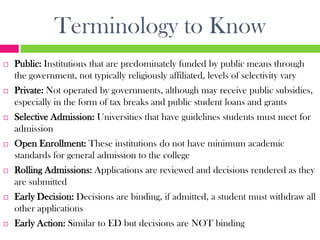
Terminology to Know
   Public: Institutions that are predominately funded by public means through
    the government, not typically religiously affiliated, levels of selectivity vary
   Private: Not operated by governments, although may receive public subsidies,
    especially in the form of tax breaks and public student loans and grants
   Selective Admission: Universities that have guidelines students must meet for
    admission
   Open Enrollment: These institutions do not have minimum academic
    standards for general admission to the college
   Rolling Admissions: Applications are reviewed and decisions rendered as they
    are submitted
   Early Decision: Decisions are binding, if admitted, a student must withdraw all
    other applications
   Early Action: Similar to ED but decisions are NOT binding
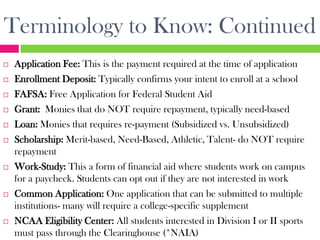
Terminology to Know: Continued
   Application Fee: This is the payment required at the time of application
   Enrollment Deposit: Typically confirms your intent to enroll at a school
   FAFSA: Free Application for Federal Student Aid
   Grant: Monies that do NOT require repayment, typically need-based
   Loan: Monies that requires re-payment (Subsidized vs. Unsubsidized)
   Scholarship: Merit-based, Need-Based, Athletic, Talent- do NOT require
    repayment
   Work-Study: This a form of financial aid where students work on campus
    for a paycheck. Students can opt out if they are not interested in work
   Common Application: One application that can be submitted to multiple
    institutions- many will require a college-specific supplement
   NCAA Eligibility Center: All students interested in Division I or II sports
    must pass through the Clearinghouse (*NAIA)
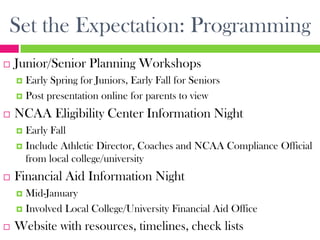
Set the Expectation: Programming
   Junior/Senior Planning Workshops
     Early Spring for Juniors, Early Fall for Seniors
     Post presentation online for parents to view

   NCAA Eligibility Center Information Night
     Early Fall
     Include Athletic Director, Coaches and NCAA Compliance Official
      from local college/university
   Financial Aid Information Night
     Mid-January
     Involved Local College/University Financial Aid Office

   Website with resources, timelines, check lists
Set the Expectation: College Visits
   Create a “college must-haves” list prior to your visits

   Schedule all visits at least two weeks in advance

   Meet with your academic area of interest

   Athlete? Set up a meeting with the coach

   Eat in a Dining Hall

   Check out the bulletin boards/ campus newspaper

   See if there is an event taking place on campus, join in!
Set the Expectation: College Fairs
   Create a “college must-haves” list prior to the fair

   Do you know what colleges are attending? Plot your route

   Plan your questions ahead of time

   Bring along address labels: saves time for conversation

   Students should ask the questions, not parents

   Take notes!
Set the Expectation:
             College Entrance Exams
   Register for the exam by the due date

   Provide photo when registering for exam.

   Need accommodations? Take action early.

   Register for “Question of the Day” e-mail/text service

   Study: guides, prep-courses, past curriculum

   Get a good night’s sleep, wake up early, eat breakfast

   Remind students to manage their time, to read each question
    thoroughly and to bring photo ID to exam.
Freshman Year
   Fall- Winter
     Build a strong foundation of classes, get the basics out of the way
     Get involved in extra/co-curricular activities

     Athlete? Be sure to learn the NCAA requirements

   Winter-Spring
     Keep your grades up
     Set sights on leadership roles

     Consider possible career fields

   Summer
     Get a part-time, summer job
     Keep reading to increase your vocabulary
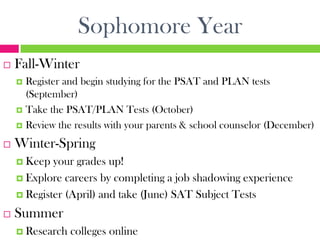
Sophomore Year
   Fall-Winter
     Register and begin studying for the PSAT and PLAN tests
      (September)
     Take the PSAT/PLAN Tests (October)

     Review the results with your parents & school counselor (December)

   Winter-Spring
     Keep  your grades up!
     Explore careers by completing a job shadowing experience

     Register (April) and take (June) SAT Subject Tests

   Summer
     Research   colleges online
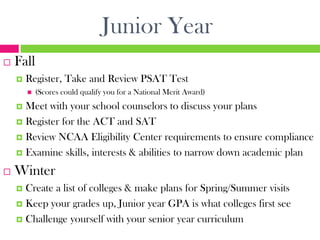
Junior Year
   Fall
       Register, Take and Review PSAT Test
           (Scores could qualify you for a National Merit Award)
     Meet with your school counselors to discuss your plans
     Register for the ACT and SAT

     Review NCAA Eligibility Center requirements to ensure compliance

     Examine skills, interests & abilities to narrow down academic plan

   Winter
     Create a list of colleges & make plans for Spring/Summer visits
     Keep your grades up, Junior year GPA is what colleges first see

     Challenge yourself with your senior year curriculum
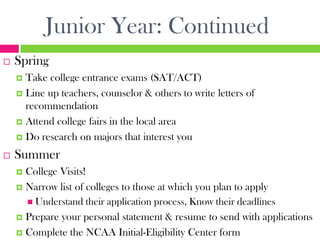
Junior Year: Continued
   Spring
     Take college entrance exams (SAT/ACT)
     Line up teachers, counselor & others to write letters of
      recommendation
     Attend college fairs in the local area

     Do research on majors that interest you

   Summer
     College Visits!
     Narrow list of colleges to those at which you plan to apply
       Understand their application process, Know their deadlines
     Prepare your personal statement & resume to send with applications

     Complete the NCAA Initial-Eligibility Center form
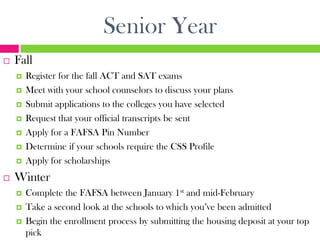
Senior Year
   Fall
       Register for the fall ACT and SAT exams
       Meet with your school counselors to discuss your plans
       Submit applications to the colleges you have selected
       Request that your official transcripts be sent
       Apply for a FAFSA Pin Number
       Determine if your schools require the CSS Profile
       Apply for scholarships
   Winter
       Complete the FAFSA between January 1st and mid-February
       Take a second look at the schools to which you’ve been admitted
       Begin the enrollment process by submitting the housing deposit at your top
        pick
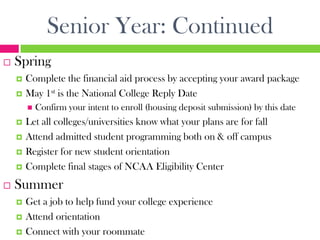
Senior Year: Continued
   Spring
       Complete the financial aid process by accepting your award package
       May 1st is the National College Reply Date
           Confirm your intent to enroll (housing deposit submission) by this date
       Let all colleges/universities know what your plans are for fall
       Attend admitted student programming both on & off campus
       Register for new student orientation
       Complete final stages of NCAA Eligibility Center
   Summer
       Get a job to help fund your college experience
       Attend orientation
       Connect with your roommate
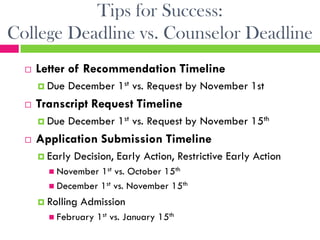
Tips for Success:
College Deadline vs. Counselor Deadline
     Letter of Recommendation Timeline
       Due   December 1st vs. Request by November 1st
     Transcript Request Timeline
       Due   December 1st vs. Request by November 15th
     Application Submission Timeline
       Early   Decision, Early Action, Restrictive Early Action
         November 1st vs. October 15th
         December 1st vs. November 15th

       Rolling   Admission
         February   1st vs. January 15th
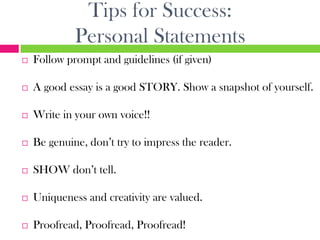
Tips for Success:
             Personal Statements
   Follow prompt and guidelines (if given)

   A good essay is a good STORY. Show a snapshot of yourself.

   Write in your own voice!!

   Be genuine, don’t try to impress the reader.

   SHOW don’t tell.

   Uniqueness and creativity are valued.

   Proofread, Proofread, Proofread!
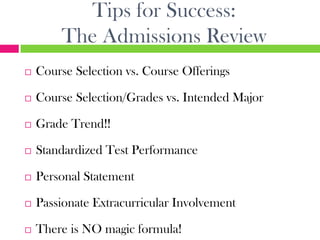
Tips for Success:
        The Admissions Review
   Course Selection vs. Course Offerings

   Course Selection/Grades vs. Intended Major

   Grade Trend!!

   Standardized Test Performance

   Personal Statement

   Passionate Extracurricular Involvement

   There is NO magic formula!
Tips for Success:
        Thriving in Your First Year
   Get Involved: Clubs, Organizations, Intramurals,
    Academics, Residence Hall
   Expand your horizons… meet new people
   Ask for help before you need it
   Learn about Resources: Library, Tutoring, Academic
    Advisor, Office Hours
   Work Hard & Manage your time well
   Find balance between work and play
   Make healthy choices: eat well, work out, relax
QUESTIONS?!

College planning timeline

  • 1.
    COLLEGE PLANNING TIMELINE Jill Okey Assistant Director Ohio University
  • 2.
    Terminology to Know  Public: Institutions that are predominately funded by public means through the government, not typically religiously affiliated, levels of selectivity vary  Private: Not operated by governments, although may receive public subsidies, especially in the form of tax breaks and public student loans and grants  Selective Admission: Universities that have guidelines students must meet for admission  Open Enrollment: These institutions do not have minimum academic standards for general admission to the college  Rolling Admissions: Applications are reviewed and decisions rendered as they are submitted  Early Decision: Decisions are binding, if admitted, a student must withdraw all other applications  Early Action: Similar to ED but decisions are NOT binding
  • 3.
    Terminology to Know:Continued  Application Fee: This is the payment required at the time of application  Enrollment Deposit: Typically confirms your intent to enroll at a school  FAFSA: Free Application for Federal Student Aid  Grant: Monies that do NOT require repayment, typically need-based  Loan: Monies that requires re-payment (Subsidized vs. Unsubsidized)  Scholarship: Merit-based, Need-Based, Athletic, Talent- do NOT require repayment  Work-Study: This a form of financial aid where students work on campus for a paycheck. Students can opt out if they are not interested in work  Common Application: One application that can be submitted to multiple institutions- many will require a college-specific supplement  NCAA Eligibility Center: All students interested in Division I or II sports must pass through the Clearinghouse (*NAIA)
  • 4.
    Set the Expectation:Programming  Junior/Senior Planning Workshops  Early Spring for Juniors, Early Fall for Seniors  Post presentation online for parents to view  NCAA Eligibility Center Information Night  Early Fall  Include Athletic Director, Coaches and NCAA Compliance Official from local college/university  Financial Aid Information Night  Mid-January  Involved Local College/University Financial Aid Office  Website with resources, timelines, check lists
  • 5.
    Set the Expectation:College Visits  Create a “college must-haves” list prior to your visits  Schedule all visits at least two weeks in advance  Meet with your academic area of interest  Athlete? Set up a meeting with the coach  Eat in a Dining Hall  Check out the bulletin boards/ campus newspaper  See if there is an event taking place on campus, join in!
  • 6.
    Set the Expectation:College Fairs  Create a “college must-haves” list prior to the fair  Do you know what colleges are attending? Plot your route  Plan your questions ahead of time  Bring along address labels: saves time for conversation  Students should ask the questions, not parents  Take notes!
  • 7.
    Set the Expectation: College Entrance Exams  Register for the exam by the due date  Provide photo when registering for exam.  Need accommodations? Take action early.  Register for “Question of the Day” e-mail/text service  Study: guides, prep-courses, past curriculum  Get a good night’s sleep, wake up early, eat breakfast  Remind students to manage their time, to read each question thoroughly and to bring photo ID to exam.
  • 8.
    Freshman Year  Fall- Winter  Build a strong foundation of classes, get the basics out of the way  Get involved in extra/co-curricular activities  Athlete? Be sure to learn the NCAA requirements  Winter-Spring  Keep your grades up  Set sights on leadership roles  Consider possible career fields  Summer  Get a part-time, summer job  Keep reading to increase your vocabulary
  • 9.
    Sophomore Year  Fall-Winter  Register and begin studying for the PSAT and PLAN tests (September)  Take the PSAT/PLAN Tests (October)  Review the results with your parents & school counselor (December)  Winter-Spring  Keep your grades up!  Explore careers by completing a job shadowing experience  Register (April) and take (June) SAT Subject Tests  Summer  Research colleges online
  • 10.
    Junior Year  Fall  Register, Take and Review PSAT Test  (Scores could qualify you for a National Merit Award)  Meet with your school counselors to discuss your plans  Register for the ACT and SAT  Review NCAA Eligibility Center requirements to ensure compliance  Examine skills, interests & abilities to narrow down academic plan  Winter  Create a list of colleges & make plans for Spring/Summer visits  Keep your grades up, Junior year GPA is what colleges first see  Challenge yourself with your senior year curriculum
  • 11.
    Junior Year: Continued  Spring  Take college entrance exams (SAT/ACT)  Line up teachers, counselor & others to write letters of recommendation  Attend college fairs in the local area  Do research on majors that interest you  Summer  College Visits!  Narrow list of colleges to those at which you plan to apply  Understand their application process, Know their deadlines  Prepare your personal statement & resume to send with applications  Complete the NCAA Initial-Eligibility Center form
  • 12.
    Senior Year  Fall  Register for the fall ACT and SAT exams  Meet with your school counselors to discuss your plans  Submit applications to the colleges you have selected  Request that your official transcripts be sent  Apply for a FAFSA Pin Number  Determine if your schools require the CSS Profile  Apply for scholarships  Winter  Complete the FAFSA between January 1st and mid-February  Take a second look at the schools to which you’ve been admitted  Begin the enrollment process by submitting the housing deposit at your top pick
  • 13.
    Senior Year: Continued  Spring  Complete the financial aid process by accepting your award package  May 1st is the National College Reply Date  Confirm your intent to enroll (housing deposit submission) by this date  Let all colleges/universities know what your plans are for fall  Attend admitted student programming both on & off campus  Register for new student orientation  Complete final stages of NCAA Eligibility Center  Summer  Get a job to help fund your college experience  Attend orientation  Connect with your roommate
  • 14.
    Tips for Success: CollegeDeadline vs. Counselor Deadline  Letter of Recommendation Timeline  Due December 1st vs. Request by November 1st  Transcript Request Timeline  Due December 1st vs. Request by November 15th  Application Submission Timeline  Early Decision, Early Action, Restrictive Early Action  November 1st vs. October 15th  December 1st vs. November 15th  Rolling Admission  February 1st vs. January 15th
  • 15.
    Tips for Success: Personal Statements  Follow prompt and guidelines (if given)  A good essay is a good STORY. Show a snapshot of yourself.  Write in your own voice!!  Be genuine, don’t try to impress the reader.  SHOW don’t tell.  Uniqueness and creativity are valued.  Proofread, Proofread, Proofread!
  • 16.
    Tips for Success: The Admissions Review  Course Selection vs. Course Offerings  Course Selection/Grades vs. Intended Major  Grade Trend!!  Standardized Test Performance  Personal Statement  Passionate Extracurricular Involvement  There is NO magic formula!
  • 17.
    Tips for Success: Thriving in Your First Year  Get Involved: Clubs, Organizations, Intramurals, Academics, Residence Hall  Expand your horizons… meet new people  Ask for help before you need it  Learn about Resources: Library, Tutoring, Academic Advisor, Office Hours  Work Hard & Manage your time well  Find balance between work and play  Make healthy choices: eat well, work out, relax
  • 18.