Is this IT? University of Pennsylvania Campus
Last semester and summer of eighth grade. The  Beginning   of the End:
First, some resources for  you: ConnectEdu.Net Collegeboard.com FAFSA.org Cappex.com ACT.com CollegeProwler.com Studentportal.Dadeschools.net BrightFutures.com PrincetonReview.com Make use of these!
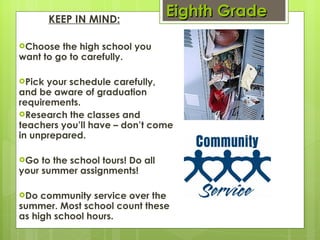
Eighth Grade KEEP IN MIND: Choose the high school you want to go to carefully. Pick your schedule carefully, and be aware of graduation requirements.  Research the classes and teachers you’ll have – don’t come in unprepared. Go to the school tours! Do all your summer assignments! Do community service over the summer. Most school count these as high school hours.
Ninth Grade Year It’s the year to not “bomb” out.
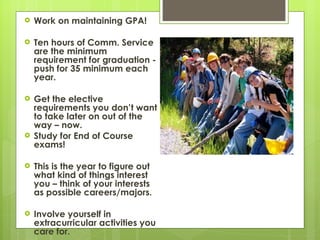
Work on maintaining GPA! Ten hours of Comm. Service are the minimum requirement for graduation - push for 35 minimum each year. Get the elective requirements you don’t want to take later on out of the way – now. Study for End of Course exams! This is the year to figure out what kind of things interest you – think of your interests as possible careers/majors.  Involve yourself in extracurricular activities you care for.
BLABLABLABLABLABLABLABLABLABLABLABLABLABLABLABLABLABLABLABLABLABLABLABLABLABLABLABLABLABLABLABLABLABLABLABLABLABLABLABLABLABLABLABLABLABLABLABLABLABLABLABLABLBLABLABLABLABLABLABLABLABLABLABLABLABLABLABLABLABLABLABLABLABLABLABLABLABLABLABLABLABLABLABLABLABLABLABLABLABLABLABLABLABLABLABLABLABLABLABLABLABLABLABLABLABLABLABLABLABLABLABLABLABLABLABLABLABLABLABLABLABLABLABLABLABLABLABLABLABLABLABLABLABLABLABLABLABLABLABLABLABLABLABLABLABLABLABLABLABLABLABLABLABLABLABLABLABLABLABLABLABLABLABLABLABLABLABLABLABLABLABLABLABLABLABLABLABLABLABLABLABLABLABLABLABLABLABLABLABLABLABLABLABLABLBLABLABLABLABLABLABLABLABLABLABLABLABLABLABLABLABLABLABLABLABLABLABLABLABLABLABLABLABLABLABLABLABLABLABLABLABLABLABLABLABLABLABLABLABLABLABLABLABLABLABLABLABLABLABLABLABLABLABLABLABLABLABLABLABLABLABLABLABLABLABLABLABLABLABLABLABLABLABLABLABLABLABLABLABLABLABLABLABLABLABLABLABLABLABLABLABLABLABLABLABLABLABLABLABLABLABLABLABLABLABLABLABLABLABLABLABLABLABLABLABLABLABLABLABLABLABLABLABLABLABLABLABLABLABLABLABLABLABLABLABLABLABLABLABLBLABLABLABLABLABLABLABLABLABLABLABLABLABLABLABLABLABLABLABLABLABLABLABLABLABLABLABLABLABLABLABLABLABLABLABLABLABLABLABLABLABLABLABLABLABLABLABLABLABLABLABLABLABLABLABLABLABLABLABLABLABLABLABLABLABLABLABLABLABLABLABLABLABLABLABLABLABLABLABLABLABLABLABLABLABLABLABLABLABLABLABLABLABLABLABLABLABLABLABLABLABLABLABLABLABLABLABLABLABLABLABLABLABLABLABLABLABLABLABLABLABLABLABLABLABLABLABLABLABLABLABLABLABLABLABLABLABLABLABLABLABLBLABLABLABLABLABLABLABLABLABLABLABLABLABLABLABLABLABLABLABLABLABLABLABLABLABLABLABLABLABLABLABLABLABLABLABLABLABLABLABLABLABLABLABLABLABLABLABLABLABLABLABLABLABLABLABLABLABLABLABLABLABLABLABLABLABLABLABLABLABLABLABLABLABLABLABLABLABLABLABLABLABLABLABLABLABLABLABLABLABLABLABLABLABLABLABLABLABLABLABLABLABLABLABLABLABLABLABLABLABLABLABLABLABLABLABLABLABLABLA
10 th  Grade- Fall GPA: Keep it up, it  stays  up.  Keep your requirements in check.  Preparing for PSAT+ good scores = NMSQT is  AWESOME. Pass the FCAT. 3 or higher    good for school, more classes for you! Prepare for End of Course (EOC) exams! Keep volunteering!
This should never be the case. Use your Student Portal. Stay aware!
S ummer  Before Junior Year Preparing for the upcoming year
JUNIOR YEAR - SUMMER HAVE FUN. If you haven’t already, get involved with something you care about, or that interests you. Keep in touch  with your counselors after July.  Do research.  Do get a library card. Keep busy!  –  do some studying, or volunteer work.
JUNIOR YEAR – Fall term. What to do NOW.
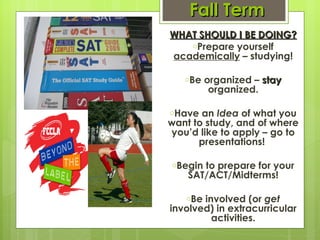
Fall Term WHAT SHOULD I BE DOING? Prepare yourself  academically  – studying! Be organized –  stay  organized. Have an  Idea  of what you want to study, and of where you’d like to apply – go to presentations!  Begin to prepare for your SAT/ACT/Midterms! Be involved (or  get  involved) in extracurricular activities.
JUNIOR YEAR – Spring Term. What to get ready for.
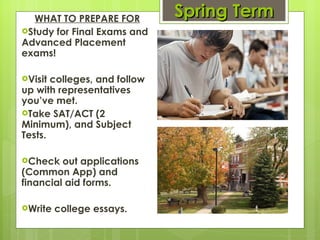
Spring Term WHAT TO PREPARE FOR Study for Final Exams and Advanced Placement exams! Visit colleges, and follow up with representatives you’ve met.  Take SAT/ACT (2 Minimum), and Subject Tests. Check out applications (Common App) and financial aid forms.  Write college essays.
JUNIOR YEAR SUMMER Almost there…
SENIOR SUMMER Coming Up: Keep in contact with counselors –  your schedule matters! Do all summer assignments. START COLLEGE APPLICATIONS.  NOW. Don’t let things pile up! Take your senior pictures. HAVE FUN .
THIS IS  TOO TRUE.
Insert a slide here of: * The collegeboard website *things to focus on the site. (use smartboard/animations, for emphasis? An example of a college site (must use a really basic one. No need to advertise.) Include –  Connectedu.net.
SENIOR YEAR It’s closer than you think.
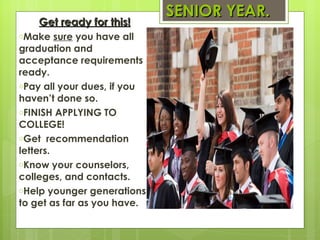
SENIOR YEAR. Get ready for this! Make  sure  you have all graduation and acceptance requirements ready. Pay all your dues, if you haven’t done so. FINISH APPLYING TO COLLEGE!  Get  recommendation letters. Know your counselors, colleges, and contacts. Help younger generations to get as far as you have.
What to do after you’ve been accepted
Weigh your personal preferences along with whatever financial aid a school may provide to you. Keep doors open! If you plan to seek a Masters degree or further, make sure to emphasize that to a college you turn down – they may be the one to accept you again four years down the line.
What if I don’t know where to apply? Know your options.
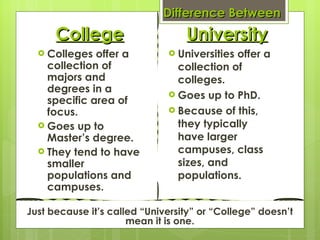
Difference Between  University College Colleges offer a collection of majors and degrees in a specific area of focus. Goes up to Master’s degree. They tend to have smaller populations and campuses.  Universities offer a collection of colleges. Goes up to PhD. Because of this, they typically have larger campuses, class sizes, and populations. Just because it’s called “University” or “College” doesn’t mean it is one.
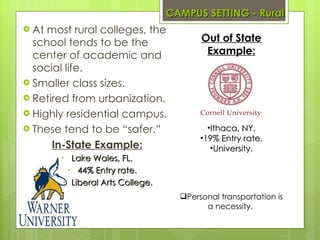
CAMPUS SETTING - Rural At most rural colleges, the school tends to be the center of academic and social life. Smaller class sizes. Retired from urbanization. Highly residential campus. These tend to be “safer.” In-State Example: Lake Wales, FL. 44% Entry rate. Liberal Arts College. Out of State Example: Ithaca, NY. 19% Entry rate. University. Personal transportation is a necessity.
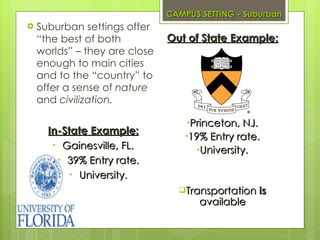
CAMPUS SETTING - Suburban Out of State Example: Princeton, NJ. 19% Entry rate. University. Transportation  is  available Suburban settings offer “the best of both worlds” – they are close enough to main cities and to the “country” to offer a sense of  nature  and  civilization. In-State Example: Gainesville, FL. 39% Entry rate. University.
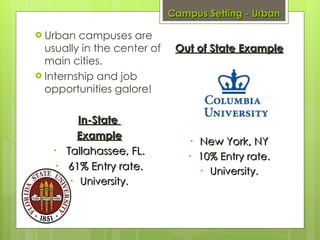
Campus Setting - Urban Out of State Example New York, NY 10% Entry rate. University. Urban campuses are usually in the center of main cities.  Internship and job opportunities galore! In-State  Example Tallahassee, FL. 61% Entry rate. University.
FOR HELP: Meet yout CAP Advisor!  Ms Sahwell is the CAP Advisor for Beach High, and she is typically in room 155, in the Counselor’s floor. Talk to your “Beach Advisory” [Homeroom] Teacher about your options. Ask a teacher, ask a friend…or, ask  now! 

College presentation (No Name)

Editor's Notes

  • #2 Stuff that needs to be included overall:Tutoring opportunities + scholarship search engines + major/career options? (another research engine)
  • #7 Add something about EOC Exams.
  • #8 Connectedu.net  go here
  • #14 90% of students go in undecided  about 50% of students change their majors
  • #16 Include S.T. in 9 th , 10th
  • #19 Credit goes to: Randall Munroe, XKCD.