Welcome to
College Night
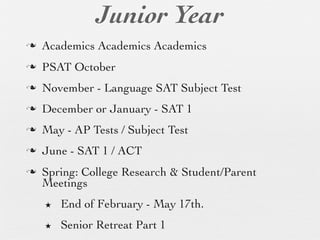
Junior Year
n   Academics Academics Academics
n   PSAT October
n   November - Language SAT Subject Test
n   December or January - SAT 1
n   May - AP Tests / Subject Test
n   June - SAT 1 / ACT
n   Spring: College Research & Student/Parent
     Meetings
     ★   End of February - May 17th.
     ★   Senior Retreat Part 1
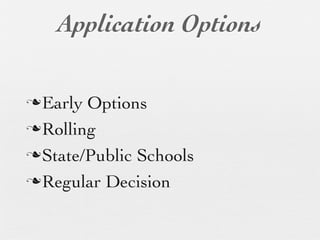
Application Options

n Early Options
n Rolling

n State/Public Schools

n Regular Decision
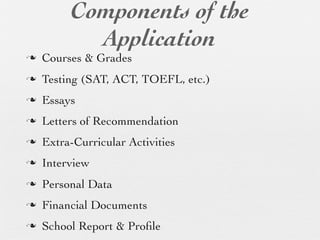
Components of the
            Application
n   Courses & Grades
n   Testing (SAT, ACT, TOEFL, etc.)
n   Essays
n   Letters of Recommendation
n   Extra-Curricular Activities
n   Interview
n   Personal Data
n   Financial Documents
n   School Report & Profile
The Transcript

The most important part of the application process!
Testing
Testing
     When to take the ACT/SAT?

 What SAT Subject Tests should I take?

Do our students need to take the TOEFL?
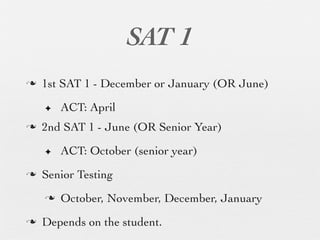
SAT 1
n   1st SAT 1 - December or January (OR June)

     ✦    ACT: April
n   2nd SAT 1 - June (OR Senior Year)

     ✦    ACT: October (senior year)
n   Senior Testing
     n   October, November, December, January
n   Depends on the student.
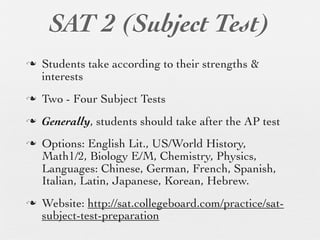
SAT 2 (Subject Test)
n   Students take according to their strengths &
     interests
n   Two - Four Subject Tests
n   Generally, students should take after the AP test
n   Options: English Lit., US/World History,
     Math1/2, Biology E/M, Chemistry, Physics,
     Languages: Chinese, German, French, Spanish,
     Italian, Latin, Japanese, Korean, Hebrew.
n   Website: http://sat.collegeboard.com/practice/sat-
     subject-test-preparation
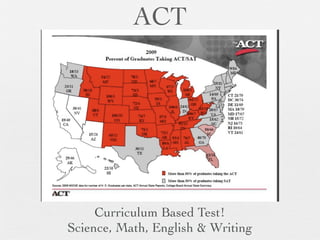
ACT


     Curriculum Based Test!
Science, Math, English & Writing
TOEFL
n   If the student scores below 580/600 (for highly
     selective schools: 650) on the SAT Critical
     Reading, he/she should take the TOEFL.
n   Citizenship from an English speaking country does
     not matter.
n   Growing up in an English speaking school helps,
     but does not exempt the student.
Please Allow Me to be
   Candid With You
Recommendations
n   Letters of Recommendation come from Junior/
     Senior Teachers
n   “If you want me to write a rec. for you - talk!
     Share your ideas! And listen to your peers!”
n   A correlation between the student’s vocal
     participation and the strength of the letter.
Essays

n   Arguably the most grueling task of the
     application, but the most rewarding!
n   Self-Reflection & Self-Advocacy!
n   Can the student write on the collegiate
     level?
Activities
n   Is your son/daughter involved?
     n   Is he/she involved in what they were last year?
     n   Is he/she involved in what they like?
n   Will your son/daughter continue this activity?
n   Questions:
     n   Why is he/she involved in this activity?
     n   What will he/she learn from it?
Senior Year Courses
n   IB Students continue with IB Diploma.
n   Choose electives based on interest & major
n   Some students take up to 5 AP courses. Should
     they? NO!
     n   Do some students do it anyway, YES!
     n   This is not our recommendation
n   We will discuss individual cases in Parent/Student
     meetings.
Summer 2013
n   Important!!!
n   College Visits
n   College Essays
n   Working opportunities (internships)
n   Community Service Trips
n   Summer Camps
Summer Enrichment
  TASP: http://www.tellurideassociation.org/
PROMYS: http://www.promys.org/
Cornell Nanobiotechnology Internship: http://
www.nbtc.cornell.edu/mainstre...nternship.html
SSP (Summer Science Program): http://
www.summerscience.org/home/index.php
HSHSP: http://www.msu.edu/~hshsp/
CCIS: http://ccis.stanford.edu/intern_program.html
COSMOS: http://www.ucop.edu/cosmos/
MITES: http://web.mit.edu/mites/www/
YSP (Young Scholars Program): http://ysp.ucdavis.edu/
RSI: http://www.cee.org/rsi/

       And there are many more out there...
The College Search
 n   Start thinking now!
 n   Consider:
      n   Location
      n   Size
      n   Academic Life/Curriculum
      n   Diversity
      n   Facilities/Resources
      n   Cost $$
      n   Reputation
           http://apps.collegeboard.com/fincalc/efc_welcome.jsp
“College is a match to be made, not a prize to be won.”
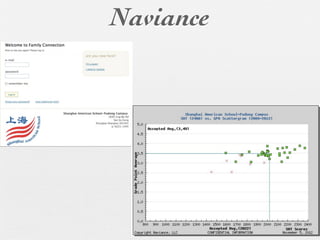
Naviance
Two Questions
     1. Will this student succeed academically?
2. What will this student bring to our community?

   In these two questions are three dimensions:
               *Student’s academic ability

                  *Student’s character

*Extracurricular involvement, leadership potential & what
           he/she will bring from their country.
Student Centered Process

n   Student: The center of everything! Coordinates
     communication among the parents, counselor,
     teachers and, in some circumstances, universities.
n   Parents, counselors and teachers take a supporting
     role!

Sas 11th grade college night 2012

  • 1.
  • 2.
    Junior Year n Academics Academics Academics n PSAT October n November - Language SAT Subject Test n December or January - SAT 1 n May - AP Tests / Subject Test n June - SAT 1 / ACT n Spring: College Research & Student/Parent Meetings ★ End of February - May 17th. ★ Senior Retreat Part 1
  • 3.
    Application Options n EarlyOptions n Rolling n State/Public Schools n Regular Decision
  • 4.
    Components of the Application n Courses & Grades n Testing (SAT, ACT, TOEFL, etc.) n Essays n Letters of Recommendation n Extra-Curricular Activities n Interview n Personal Data n Financial Documents n School Report & Profile
  • 5.
    The Transcript The mostimportant part of the application process!
  • 6.
  • 7.
    Testing When to take the ACT/SAT? What SAT Subject Tests should I take? Do our students need to take the TOEFL?
  • 8.
    SAT 1 n 1st SAT 1 - December or January (OR June) ✦ ACT: April n 2nd SAT 1 - June (OR Senior Year) ✦ ACT: October (senior year) n Senior Testing n October, November, December, January n Depends on the student.
  • 9.
    SAT 2 (SubjectTest) n Students take according to their strengths & interests n Two - Four Subject Tests n Generally, students should take after the AP test n Options: English Lit., US/World History, Math1/2, Biology E/M, Chemistry, Physics, Languages: Chinese, German, French, Spanish, Italian, Latin, Japanese, Korean, Hebrew. n Website: http://sat.collegeboard.com/practice/sat- subject-test-preparation
  • 10.
    ACT Curriculum Based Test! Science, Math, English & Writing
  • 11.
    TOEFL n If the student scores below 580/600 (for highly selective schools: 650) on the SAT Critical Reading, he/she should take the TOEFL. n Citizenship from an English speaking country does not matter. n Growing up in an English speaking school helps, but does not exempt the student.
  • 12.
    Please Allow Meto be Candid With You
  • 13.
    Recommendations n Letters of Recommendation come from Junior/ Senior Teachers n “If you want me to write a rec. for you - talk! Share your ideas! And listen to your peers!” n A correlation between the student’s vocal participation and the strength of the letter.
  • 14.
    Essays n Arguably the most grueling task of the application, but the most rewarding! n Self-Reflection & Self-Advocacy! n Can the student write on the collegiate level?
  • 15.
    Activities n Is your son/daughter involved? n Is he/she involved in what they were last year? n Is he/she involved in what they like? n Will your son/daughter continue this activity? n Questions: n Why is he/she involved in this activity? n What will he/she learn from it?
  • 16.
    Senior Year Courses n IB Students continue with IB Diploma. n Choose electives based on interest & major n Some students take up to 5 AP courses. Should they? NO! n Do some students do it anyway, YES! n This is not our recommendation n We will discuss individual cases in Parent/Student meetings.
  • 17.
    Summer 2013 n Important!!! n College Visits n College Essays n Working opportunities (internships) n Community Service Trips n Summer Camps
  • 18.
    Summer Enrichment TASP: http://www.tellurideassociation.org/ PROMYS: http://www.promys.org/ Cornell Nanobiotechnology Internship: http:// www.nbtc.cornell.edu/mainstre...nternship.html SSP (Summer Science Program): http:// www.summerscience.org/home/index.php HSHSP: http://www.msu.edu/~hshsp/ CCIS: http://ccis.stanford.edu/intern_program.html COSMOS: http://www.ucop.edu/cosmos/ MITES: http://web.mit.edu/mites/www/ YSP (Young Scholars Program): http://ysp.ucdavis.edu/ RSI: http://www.cee.org/rsi/ And there are many more out there...
  • 19.
    The College Search n Start thinking now! n Consider: n Location n Size n Academic Life/Curriculum n Diversity n Facilities/Resources n Cost $$ n Reputation http://apps.collegeboard.com/fincalc/efc_welcome.jsp “College is a match to be made, not a prize to be won.”
  • 20.
  • 21.
    Two Questions 1. Will this student succeed academically? 2. What will this student bring to our community? In these two questions are three dimensions: *Student’s academic ability *Student’s character *Extracurricular involvement, leadership potential & what he/she will bring from their country.
  • 22.
    Student Centered Process n Student: The center of everything! Coordinates communication among the parents, counselor, teachers and, in some circumstances, universities. n Parents, counselors and teachers take a supporting role!