The information contained in this presentation is subject to change and does not constitute legal advice.
Always consult a financial planner or a tax advisor for detailed information.
College
Financial Aid
101
What Is Financial Aid?
Expected Family Contribution
Grants & Scholarships
Federal Work-Study
How Much Will It Cost To Send My Child to College?
The Financial Aid Award Letter
Loan Options
Special Circumstances – How & When to Appeal
Tax Benefits & Tips
TABLE OF CONTENTS
2/36
The information contained in this presentation is subject to change and does not constitute legal advice.
Always consult a financial planner or a tax advisor for detailed information.
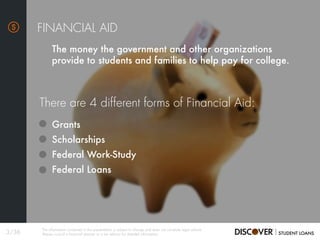
The money the government and other organizations
provide to students and families to help pay for college.
Grants
Scholarships
Federal Work-Study
Federal Loans
There are 4 different forms of Financial Aid:
FINANCIAL AID
3/36
The information contained in this presentation is subject to change and does not constitute legal advice.
Always consult a financial planner or a tax advisor for detailed information.
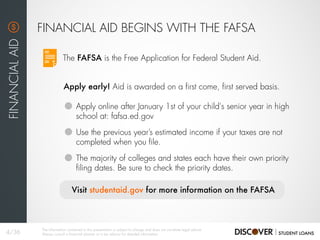
The FAFSA is the Free Application for Federal Student Aid.
FINANCIAL AID BEGINS WITH THE FAFSA
FINANCIALAID
Apply early! Aid is awarded on a first come, first served basis.
Apply online after January 1st of your child's senior year in high
school at: fafsa.ed.gov
Use the previous year’s estimated income if your taxes are not
completed when you file.
The majority of colleges and states each have their own priority
filing dates. Be sure to check the priority dates.
Visit studentaid.gov for more information on the FAFSA
4/36
The information contained in this presentation is subject to change and does not constitute legal advice.
Always consult a financial planner or a tax advisor for detailed information.
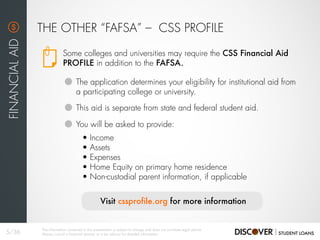
Some colleges and universities may require the CSS Financial Aid
PROFILE in addition to the FAFSA.
THE OTHER “FAFSA” – CSS PROFILE
FINANCIALAID
The application determines your eligibility for institutional aid from
a participating college or university.
This aid is separate from state and federal student aid.
You will be asked to provide:
• Income
• Assets
• Expenses
• Home Equity on primary home residence
• Non-custodial parent information, if applicable
Visit cssprofile.org for more information
5/36
The information contained in this presentation is subject to change and does not constitute legal advice.
Always consult a financial planner or a tax advisor for detailed information.
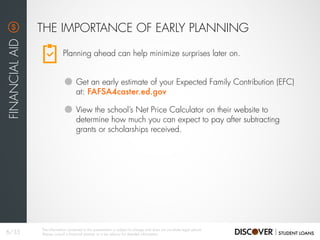
Planning ahead can help minimize surprises later on.
THE IMPORTANCE OF EARLY PLANNING
FINANCIALAID
Get an early estimate of your Expected Family Contribution (EFC)
at: FAFSA4caster.ed.gov
View the school’s Net Price Calculator on their website to
determine how much you can expect to pay after subtracting
grants or scholarships received.
6/35
The information contained in this presentation is subject to change and does not constitute legal advice.
Always consult a financial planner or a tax advisor for detailed information.
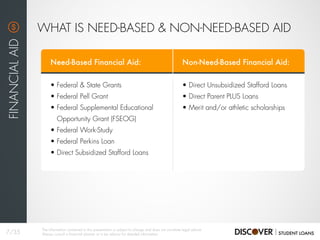
Need-Based Financial Aid:
• Federal & State Grants
• Federal Pell Grant
• Federal Supplemental Educational
Opportunity Grant (FSEOG)
• Federal Work-Study
• Federal Perkins Loan
• Direct Subsidized Stafford Loans
Non-Need-Based Financial Aid:
• Direct Unsubsidized Stafford Loans
• Direct Parent PLUS Loans
• Merit and/or athletic scholarships
WHAT IS NEED-BASED & NON-NEED-BASED AID
FINANCIALAID
7/35
The information contained in this presentation is subject to change and does not constitute legal advice.
Always consult a financial planner or a tax advisor for detailed information.
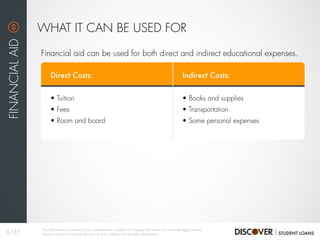
Direct Costs:
• Tuition
• Fees
• Room and board
Indirect Costs:
• Books and supplies
• Transportation
• Some personal expenses
Financial aid can be used for both direct and indirect educational expenses.
WHAT IT CAN BE USED FOR
FINANCIALAID
8/35
The information contained in this presentation is subject to change and does not constitute legal advice.
Always consult a financial planner or a tax advisor for detailed information.
The number used by schools to
calculate how much financial aid
a student or family receives.
EXPECTED FAMILY CONTRIBUTION
9/35
The information contained in this presentation is subject to change and does not constitute legal advice.
Always consult a financial planner or a tax advisor for detailed information.
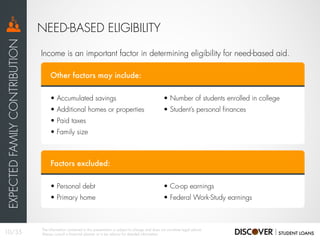
Other factors may include:
• Accumulated savings
• Additional homes or properties
• Paid taxes
• Family size
• Number of students enrolled in college
• Student’s personal finances
Factors excluded:
• Personal debt
• Primary home
• Co-op earnings
• Federal Work-Study earnings
Income is an important factor in determining eligibility for need-based aid.
NEED-BASED ELIGIBILITY
EXPECTEDFAMILYCONTRIBUTION
10/35
The information contained in this presentation is subject to change and does not constitute legal advice.
Always consult a financial planner or a tax advisor for detailed information.
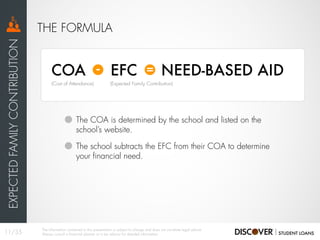
THE FORMULA
EXPECTEDFAMILYCONTRIBUTION
The COA is determined by the school and listed on the
school’s website.
The school subtracts the EFC from their COA to determine
your financial need.
(Cost of Attendance)
COA
(Expected Family Contribution)
EFC NEED-BASED AID- =
11/35
The information contained in this presentation is subject to change and does not constitute legal advice.
Always consult a financial planner or a tax advisor for detailed information.
There are thousands of grants and scholarships
available through public and private organizations,
colleges and the government.
GRANTS & SCHOLARSHIPS
12/35
The information contained in this presentation is subject to change and does not constitute legal advice.
Always consult a financial planner or a tax advisor for detailed information.
Grant amounts typically depend on:
FEDERAL & STATE GRANTS
GRANTS&SCHOLARSHIPS
Financial need
Cost of attendance
Enrollment status (full-time/part-time)
Visit studentaid.gov for more information on grants
13/35
The information contained in this presentation is subject to change and does not constitute legal advice.
Always consult a financial planner or a tax advisor for detailed information.
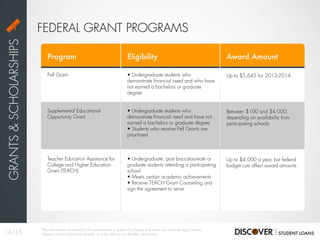
Program
Pell Grant
Supplemental Educational
Opportunity Grant
Teacher Education Assistance for
College and Higher Education
Grant (TEACH)
Award Amount
Up to $5,645 for 2013-2014
Between $100 and $4,000,
depending on availability from
participating schools
Up to $4,000 a year, but federal
budget cuts affect award amounts
Eligibility
• Undergraduate students who
demonstrate financial need and who have
not earned a bachelors or graduate
degree
• Undergraduate students who
demonstrate financial need and have not
earned a bachelors or graduate degree
• Students who receive Pell Grants are
prioritized
• Undergraduate, post baccalaureate or
graduate students attending a participating
school
• Meets certain academic achievements
• Receive TEACH Grant Counseling and
sign the agreement to serve
FEDERAL GRANT PROGRAMS
GRANTS&SCHOLARSHIPS
14/35
The information contained in this presentation is subject to change and does not constitute legal advice.
Always consult a financial planner or a tax advisor for detailed information.
GRANTS & SCHOLARSHIPS
GRANTS&SCHOLARSHIPS
DiscoverStudentLoans.com/Scholarship
no registration required to search for over 3 million scholarships
Studentaid.gov
a source to find and apply for federal grants
Fastweb.com
sends you personalized options for grants and scholarships
Scholarships.com
you customize your search results based on your profile
Many schools automatically consider you for grants and scholarships
when you apply for admission. For grants and scholarships not offered by
your school, the best place to start looking is on the Internet. Websites to
consider include:
Tip: Scholarship deadlines may vary, but you may want to consider applying as early
as the fall of your senior year of high school.
15/35
The information contained in this presentation is subject to change and does not constitute legal advice.
Always consult a financial planner or a tax advisor for detailed information.
BUILD A SUCCESS RESUME
GRANTS&SCHOLARSHIPS
While there are thousands of grants and scholarships available, other
applicants will be competing for the same awards.
Your student will need to clearly communicate who they are and what
distinguishes them from other applicants.
Parents should interview their student every year to ensure their
achievements are recorded.
A Success Resume should highlight:
• Grades and academic achievements
• Community service activities
• Leadership roles and any special talents
16/35
The information contained in this presentation is subject to change and does not constitute legal advice.
Always consult a financial planner or a tax advisor for detailed information.
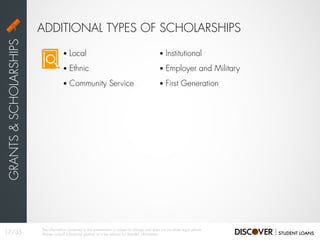
ADDITIONAL TYPES OF SCHOLARSHIPS
GRANTS&SCHOLARSHIPS
• Local
• Ethnic
• Community Service
• Institutional
• Employer and Military
• First Generation
17/35
The information contained in this presentation is subject to change and does not constitute legal advice.
Always consult a financial planner or a tax advisor for detailed information.
PARTNERS IN THE PROCESS
GRANTS&SCHOLARSHIPS
• High School Guidance Counselors
• College Financial Aid Administrators
• College Admissions Officers
• College Department Deans
18/35
The information contained in this presentation is subject to change and does not constitute legal advice.
Always consult a financial planner or a tax advisor for detailed information.
Part-time employment funded by the government
that allows students to earn money that can be
used to help pay for college.
FEDERAL WORK-STUDY
19/35
The information contained in this presentation is subject to change and does not constitute legal advice.
Always consult a financial planner or a tax advisor for detailed information.
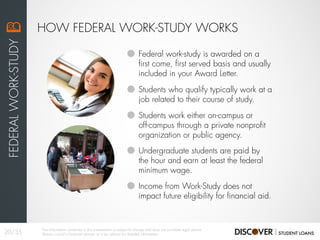
HOW FEDERAL WORK-STUDY WORKS
FEDERALWORK-STUDY
Students who qualify typically work at a
job related to their course of study.
Students work either on-campus or
off-campus through a private nonprofit
organization or public agency.
Undergraduate students are paid by
the hour and earn at least the federal
minimum wage.
Income from Work-Study does not
impact future eligibility for financial aid.
Federal work-study is awarded on a
first come, first served basis and usually
included in your Award Letter.
20/35
The information contained in this presentation is subject to change and does not constitute legal advice.
Always consult a financial planner or a tax advisor for detailed information.
When evaluating loan options, consider origination
fees, interest rates, repayment options and the total
cost of the loan.
LOAN OPTIONS
21/35
The information contained in this presentation is subject to change and does not constitute legal advice.
Always consult a financial planner or a tax advisor for detailed information.
FAFSA Required
Credit Check Required
Eligibility
Annual Loan Limit
Interest Rates
Origination Fees
Repayment Plans
Payment Deferment
While in School
Direct Stafford Loans
Yes
No
Available to undergraduate and graduate
students
Loan amount you are eligible to receive
each year will vary
• Fixed interest rate of 3.86% for
subsidized and unsubsidized loans for
undergraduate students
• Fixed interest rate of 5.41% for
unsubsidized loans for graduate students
1.072% of loan amount
Multiple repayment options
(visit studentaid.gov)
No payments due until 6-months after
graduation or enrollment in school less
than half-time
Federal Perkins Loans
Yes
No
Available to students with exceptional
financial need
Up to $5,000
Fixed interest rate of 5.00%
Zero
Varies by school
No payments due until 9-months after
graduation or enrollment in school less
than half-time
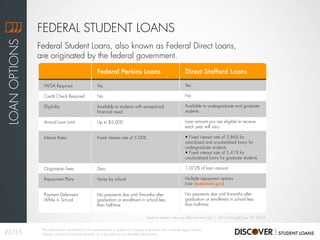
Federal Student Loans, also known as Federal Direct Loans,
are originated by the federal government.
FEDERAL STUDENT LOANS
LOANOPTIONS
22/35
The information contained in this presentation is subject to change and does not constitute legal advice.
Always consult a financial planner or a tax advisor for detailed information.
Federal interest rates are effective from July 1, 2013 through June 30, 2014.
Dependent Students
Independent Students
Year 1 – $5,500 (up to $3,500 subsidized, $2,000 unsubsidized)
Year 2 – $6,500 (up to $4,500 subsidized, $2,000 unsubsidized)
Year 3 – $7,500 (up to $5,500 subsidized, $2,000 unsubsidized)
Year 4 – $7,500 (up to $5,500 subsidized, $2,000 unsubsidized)
Year 5 – $7,500 (up to $5,500 subsidized, $2,000 unsubsidized)
Year 1 – $9,500 (up to $3,500 subsidized)
Year 2 – $10,500 (up to $4,500 subsidized)
Year 3 – $12,500 (up to $5,500 subsidized)
Year 4 – $12,500 (up to $5,500 subsidized)
Year 5 – $12,500 (up to $5,500 subsidized)
LOANOPTIONS
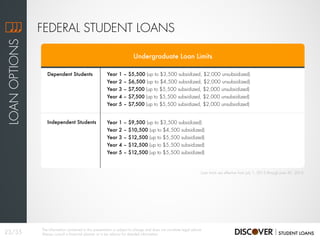
FEDERAL STUDENT LOANS
Undergraduate Loan Limits
23/35
The information contained in this presentation is subject to change and does not constitute legal advice.
Always consult a financial planner or a tax advisor for detailed information.
Loan limits are effective from July 1, 2013 through June 30, 2014.
FAFSA Required
Credit Check Required
Eligibility
Annual Loan Limit
Interest Rates
Origination Fees
Repayment Plans
Payment Deferment
While in School
Direct Parent PLUS Loans
Yes
Yes
Available to parents of dependent students
Up to 100% of the cost of attendance minus other financial aid
Fixed interest rate of 6.41%
4.288% of loan amount
Multiple repayment options
(visit studentaid.gov)
Repayment begins once the loan is fully disbursed, unless a
deferment is requested while the student is enrolled in school
at least half-time
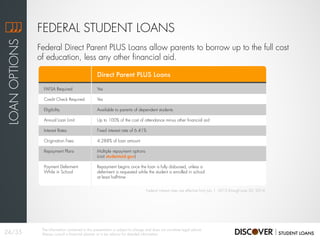
Federal Direct Parent PLUS Loans allow parents to borrow up to the full cost
of education, less any other financial aid.
FEDERAL STUDENT LOANS
LOANOPTIONS
24/35
The information contained in this presentation is subject to change and does not constitute legal advice.
Always consult a financial planner or a tax advisor for detailed information.
Federal interest rates are effective from July 1, 2013 through June 30, 2014.
We encourage you to compare federal and private student loans and
choose the loans that best fit your needs.
COMPARE YOUR OPTIONS
LOANOPTIONS
25/35
The information contained in this presentation is subject to change and does not constitute legal advice.
Always consult a financial planner or a tax advisor for detailed information.
Private student loans may help cover costs not fully covered
by federal financial aid.
Discover Student Loans offers options for undergraduates
and graduates, including masters and doctoral candidates.
To compare federal loans with Discover Student Loans visit:
discover.com/student-loans/compare-loans.html
The Award Letter outlines how much
financial aid you will receive.
THE AWARD LETTER
26/35
The information contained in this presentation is subject to change and does not constitute legal advice.
Always consult a financial planner or a tax advisor for detailed information.
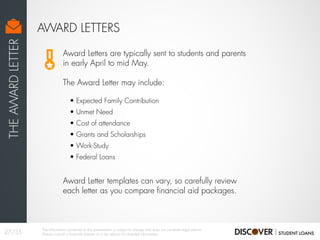
Award Letters are typically sent to students and parents
in early April to mid May.
The Award Letter may include:
Award Letter templates can vary, so carefully review
each letter as you compare financial aid packages.
AWARD LETTERS
THEAWARDLETTER
• Expected Family Contribution
• Unmet Need
• Cost of attendance
• Grants and Scholarships
• Work-Study
• Federal Loans
27/35
The information contained in this presentation is subject to change and does not constitute legal advice.
Always consult a financial planner or a tax advisor for detailed information.
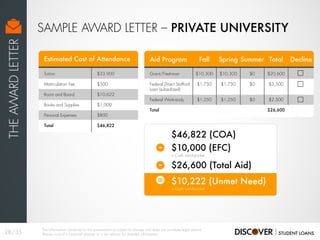
Tuition
Matriculation Fee
Room and Board
Books and Supplies
Personal Expenses
Total
$33,900
$500
$10,622
$1,000
$800
$46,822
Estimated Cost of Attendance Aid Program
Grant/Freshman
Federal Direct Stafford
Loan (subsidized)
Federal Work-study
Total
Fall
$10,300
$1,750
$1,250
Spring
$10,300
$1,750
$1,250
Summer
$0
$0
$0
Total
$20,600
$3,500
$2,500
$26,600
Decline
SAMPLE AWARD LETTER – PRIVATE UNIVERSITY
THEAWARDLETTER
= Cash out-of-pocket
$46,822 (COA)
$26,600 (Total Aid)
$10,000 (EFC)-
-
= = Cash out-of-pocket
$10,222 (Unmet Need)
28/35
The information contained in this presentation is subject to change and does not constitute legal advice.
Always consult a financial planner or a tax advisor for detailed information.
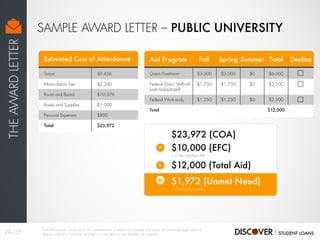
Tuition
Matriculation Fee
Room and Board
Books and Supplies
Personal Expenses
Total
$9,456
$2,340
$10,376
$1,000
$800
$23,972
Estimated Cost of Attendance Aid Program
Grant/Freshman
Federal Direct Stafford
Loan (subsidized)
Federal Work-study
Total
Fall
$3,000
$1,750
$1,250
Spring
$3,000
$1,750
$1,250
Summer
$0
$0
$0
Total
$6,000
$3,500
$2,500
$12,000
Decline
SAMPLE AWARD LETTER – PUBLIC UNIVERSITY
THEAWARDLETTER
= Cash out-of-pocket
$23,972 (COA)
$12,000 (Total Aid)
$10,000 (EFC)-
-
= = Cash out-of-pocket
$1,972 (Unmet Need)
29/35
The information contained in this presentation is subject to change and does not constitute legal advice.
Always consult a financial planner or a tax advisor for detailed information.
If your circumstances change, you have
options to appeal your Award Letter.
HOW & WHEN TO APPEAL
30/35
The information contained in this presentation is subject to change and does not constitute legal advice.
Always consult a financial planner or a tax advisor for detailed information.
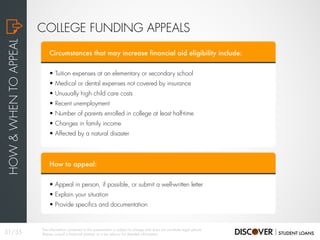
COLLEGE FUNDING APPEALS
HOW&WHENTOAPPEAL
Circumstances that may increase financial aid eligibility include:
• Tuition expenses at an elementary or secondary school
• Medical or dental expenses not covered by insurance
• Unusually high child care costs
• Recent unemployment
• Number of parents enrolled in college at least half-time
• Changes in family income
• Affected by a natural disaster
How to appeal:
• Appeal in person, if possible, or submit a well-written letter
• Explain your situation
• Provide specifics and documentation
31/35
The information contained in this presentation is subject to change and does not constitute legal advice.
Always consult a financial planner or a tax advisor for detailed information.
Potential tax savings are available through
education tax credits and savings plans.
TAX BENEFITS & TIPS
32/35
The information contained in this presentation is subject to change and does not constitute legal advice.
Always consult a financial planner or a tax advisor for detailed information.
The IRS provides tax savings to individuals
and families who pay for higher education.
TAX BENEFITS FOR EDUCATION
TAXBENEFITS&TIPS
Tax Credits:
American Opportunity Tax Credit
Hope Credit or Lifetime Learning Credit
Visit irs.gov for more information
33/35
The information contained in this presentation is subject to change and does not constitute legal advice.
Always consult a financial planner or a tax advisor for detailed information.
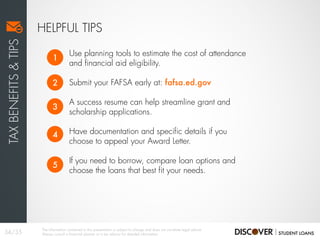
Use planning tools to estimate the cost of attendance
and financial aid eligibility.
Submit your FAFSA early at: fafsa.ed.gov
A success resume can help streamline grant and
scholarship applications.
Have documentation and specific details if you
choose to appeal your Award Letter.
If you need to borrow, compare loan options and
choose the loans that best fit your needs.
HELPFUL TIPS
TAXBENEFITS&TIPS
1
2
3
4
5
34/35
The information contained in this presentation is subject to change and does not constitute legal advice.
Always consult a financial planner or a tax advisor for detailed information.
For more information visit:
DiscoverStudentLoans.com
35/35
The information contained in this presentation is subject to change and does not constitute legal advice.
Always consult a financial planner or a tax advisor for detailed information.

College Financial Aid 101

  • 1.
    The information containedin this presentation is subject to change and does not constitute legal advice. Always consult a financial planner or a tax advisor for detailed information. College Financial Aid 101
  • 2.
    What Is FinancialAid? Expected Family Contribution Grants & Scholarships Federal Work-Study How Much Will It Cost To Send My Child to College? The Financial Aid Award Letter Loan Options Special Circumstances – How & When to Appeal Tax Benefits & Tips TABLE OF CONTENTS 2/36 The information contained in this presentation is subject to change and does not constitute legal advice. Always consult a financial planner or a tax advisor for detailed information.
  • 3.
    The money thegovernment and other organizations provide to students and families to help pay for college. Grants Scholarships Federal Work-Study Federal Loans There are 4 different forms of Financial Aid: FINANCIAL AID 3/36 The information contained in this presentation is subject to change and does not constitute legal advice. Always consult a financial planner or a tax advisor for detailed information.
  • 4.
    The FAFSA isthe Free Application for Federal Student Aid. FINANCIAL AID BEGINS WITH THE FAFSA FINANCIALAID Apply early! Aid is awarded on a first come, first served basis. Apply online after January 1st of your child's senior year in high school at: fafsa.ed.gov Use the previous year’s estimated income if your taxes are not completed when you file. The majority of colleges and states each have their own priority filing dates. Be sure to check the priority dates. Visit studentaid.gov for more information on the FAFSA 4/36 The information contained in this presentation is subject to change and does not constitute legal advice. Always consult a financial planner or a tax advisor for detailed information.
  • 5.
    Some colleges anduniversities may require the CSS Financial Aid PROFILE in addition to the FAFSA. THE OTHER “FAFSA” – CSS PROFILE FINANCIALAID The application determines your eligibility for institutional aid from a participating college or university. This aid is separate from state and federal student aid. You will be asked to provide: • Income • Assets • Expenses • Home Equity on primary home residence • Non-custodial parent information, if applicable Visit cssprofile.org for more information 5/36 The information contained in this presentation is subject to change and does not constitute legal advice. Always consult a financial planner or a tax advisor for detailed information.
  • 6.
    Planning ahead canhelp minimize surprises later on. THE IMPORTANCE OF EARLY PLANNING FINANCIALAID Get an early estimate of your Expected Family Contribution (EFC) at: FAFSA4caster.ed.gov View the school’s Net Price Calculator on their website to determine how much you can expect to pay after subtracting grants or scholarships received. 6/35 The information contained in this presentation is subject to change and does not constitute legal advice. Always consult a financial planner or a tax advisor for detailed information.
  • 7.
    Need-Based Financial Aid: •Federal & State Grants • Federal Pell Grant • Federal Supplemental Educational Opportunity Grant (FSEOG) • Federal Work-Study • Federal Perkins Loan • Direct Subsidized Stafford Loans Non-Need-Based Financial Aid: • Direct Unsubsidized Stafford Loans • Direct Parent PLUS Loans • Merit and/or athletic scholarships WHAT IS NEED-BASED & NON-NEED-BASED AID FINANCIALAID 7/35 The information contained in this presentation is subject to change and does not constitute legal advice. Always consult a financial planner or a tax advisor for detailed information.
  • 8.
    Direct Costs: • Tuition •Fees • Room and board Indirect Costs: • Books and supplies • Transportation • Some personal expenses Financial aid can be used for both direct and indirect educational expenses. WHAT IT CAN BE USED FOR FINANCIALAID 8/35 The information contained in this presentation is subject to change and does not constitute legal advice. Always consult a financial planner or a tax advisor for detailed information.
  • 9.
    The number usedby schools to calculate how much financial aid a student or family receives. EXPECTED FAMILY CONTRIBUTION 9/35 The information contained in this presentation is subject to change and does not constitute legal advice. Always consult a financial planner or a tax advisor for detailed information.
  • 10.
    Other factors mayinclude: • Accumulated savings • Additional homes or properties • Paid taxes • Family size • Number of students enrolled in college • Student’s personal finances Factors excluded: • Personal debt • Primary home • Co-op earnings • Federal Work-Study earnings Income is an important factor in determining eligibility for need-based aid. NEED-BASED ELIGIBILITY EXPECTEDFAMILYCONTRIBUTION 10/35 The information contained in this presentation is subject to change and does not constitute legal advice. Always consult a financial planner or a tax advisor for detailed information.
  • 11.
    THE FORMULA EXPECTEDFAMILYCONTRIBUTION The COAis determined by the school and listed on the school’s website. The school subtracts the EFC from their COA to determine your financial need. (Cost of Attendance) COA (Expected Family Contribution) EFC NEED-BASED AID- = 11/35 The information contained in this presentation is subject to change and does not constitute legal advice. Always consult a financial planner or a tax advisor for detailed information.
  • 12.
    There are thousandsof grants and scholarships available through public and private organizations, colleges and the government. GRANTS & SCHOLARSHIPS 12/35 The information contained in this presentation is subject to change and does not constitute legal advice. Always consult a financial planner or a tax advisor for detailed information.
  • 13.
    Grant amounts typicallydepend on: FEDERAL & STATE GRANTS GRANTS&SCHOLARSHIPS Financial need Cost of attendance Enrollment status (full-time/part-time) Visit studentaid.gov for more information on grants 13/35 The information contained in this presentation is subject to change and does not constitute legal advice. Always consult a financial planner or a tax advisor for detailed information.
  • 14.
    Program Pell Grant Supplemental Educational OpportunityGrant Teacher Education Assistance for College and Higher Education Grant (TEACH) Award Amount Up to $5,645 for 2013-2014 Between $100 and $4,000, depending on availability from participating schools Up to $4,000 a year, but federal budget cuts affect award amounts Eligibility • Undergraduate students who demonstrate financial need and who have not earned a bachelors or graduate degree • Undergraduate students who demonstrate financial need and have not earned a bachelors or graduate degree • Students who receive Pell Grants are prioritized • Undergraduate, post baccalaureate or graduate students attending a participating school • Meets certain academic achievements • Receive TEACH Grant Counseling and sign the agreement to serve FEDERAL GRANT PROGRAMS GRANTS&SCHOLARSHIPS 14/35 The information contained in this presentation is subject to change and does not constitute legal advice. Always consult a financial planner or a tax advisor for detailed information.
  • 15.
    GRANTS & SCHOLARSHIPS GRANTS&SCHOLARSHIPS DiscoverStudentLoans.com/Scholarship noregistration required to search for over 3 million scholarships Studentaid.gov a source to find and apply for federal grants Fastweb.com sends you personalized options for grants and scholarships Scholarships.com you customize your search results based on your profile Many schools automatically consider you for grants and scholarships when you apply for admission. For grants and scholarships not offered by your school, the best place to start looking is on the Internet. Websites to consider include: Tip: Scholarship deadlines may vary, but you may want to consider applying as early as the fall of your senior year of high school. 15/35 The information contained in this presentation is subject to change and does not constitute legal advice. Always consult a financial planner or a tax advisor for detailed information.
  • 16.
    BUILD A SUCCESSRESUME GRANTS&SCHOLARSHIPS While there are thousands of grants and scholarships available, other applicants will be competing for the same awards. Your student will need to clearly communicate who they are and what distinguishes them from other applicants. Parents should interview their student every year to ensure their achievements are recorded. A Success Resume should highlight: • Grades and academic achievements • Community service activities • Leadership roles and any special talents 16/35 The information contained in this presentation is subject to change and does not constitute legal advice. Always consult a financial planner or a tax advisor for detailed information.
  • 17.
    ADDITIONAL TYPES OFSCHOLARSHIPS GRANTS&SCHOLARSHIPS • Local • Ethnic • Community Service • Institutional • Employer and Military • First Generation 17/35 The information contained in this presentation is subject to change and does not constitute legal advice. Always consult a financial planner or a tax advisor for detailed information.
  • 18.
    PARTNERS IN THEPROCESS GRANTS&SCHOLARSHIPS • High School Guidance Counselors • College Financial Aid Administrators • College Admissions Officers • College Department Deans 18/35 The information contained in this presentation is subject to change and does not constitute legal advice. Always consult a financial planner or a tax advisor for detailed information.
  • 19.
    Part-time employment fundedby the government that allows students to earn money that can be used to help pay for college. FEDERAL WORK-STUDY 19/35 The information contained in this presentation is subject to change and does not constitute legal advice. Always consult a financial planner or a tax advisor for detailed information.
  • 20.
    HOW FEDERAL WORK-STUDYWORKS FEDERALWORK-STUDY Students who qualify typically work at a job related to their course of study. Students work either on-campus or off-campus through a private nonprofit organization or public agency. Undergraduate students are paid by the hour and earn at least the federal minimum wage. Income from Work-Study does not impact future eligibility for financial aid. Federal work-study is awarded on a first come, first served basis and usually included in your Award Letter. 20/35 The information contained in this presentation is subject to change and does not constitute legal advice. Always consult a financial planner or a tax advisor for detailed information.
  • 21.
    When evaluating loanoptions, consider origination fees, interest rates, repayment options and the total cost of the loan. LOAN OPTIONS 21/35 The information contained in this presentation is subject to change and does not constitute legal advice. Always consult a financial planner or a tax advisor for detailed information.
  • 22.
    FAFSA Required Credit CheckRequired Eligibility Annual Loan Limit Interest Rates Origination Fees Repayment Plans Payment Deferment While in School Direct Stafford Loans Yes No Available to undergraduate and graduate students Loan amount you are eligible to receive each year will vary • Fixed interest rate of 3.86% for subsidized and unsubsidized loans for undergraduate students • Fixed interest rate of 5.41% for unsubsidized loans for graduate students 1.072% of loan amount Multiple repayment options (visit studentaid.gov) No payments due until 6-months after graduation or enrollment in school less than half-time Federal Perkins Loans Yes No Available to students with exceptional financial need Up to $5,000 Fixed interest rate of 5.00% Zero Varies by school No payments due until 9-months after graduation or enrollment in school less than half-time Federal Student Loans, also known as Federal Direct Loans, are originated by the federal government. FEDERAL STUDENT LOANS LOANOPTIONS 22/35 The information contained in this presentation is subject to change and does not constitute legal advice. Always consult a financial planner or a tax advisor for detailed information. Federal interest rates are effective from July 1, 2013 through June 30, 2014.
  • 23.
    Dependent Students Independent Students Year1 – $5,500 (up to $3,500 subsidized, $2,000 unsubsidized) Year 2 – $6,500 (up to $4,500 subsidized, $2,000 unsubsidized) Year 3 – $7,500 (up to $5,500 subsidized, $2,000 unsubsidized) Year 4 – $7,500 (up to $5,500 subsidized, $2,000 unsubsidized) Year 5 – $7,500 (up to $5,500 subsidized, $2,000 unsubsidized) Year 1 – $9,500 (up to $3,500 subsidized) Year 2 – $10,500 (up to $4,500 subsidized) Year 3 – $12,500 (up to $5,500 subsidized) Year 4 – $12,500 (up to $5,500 subsidized) Year 5 – $12,500 (up to $5,500 subsidized) LOANOPTIONS FEDERAL STUDENT LOANS Undergraduate Loan Limits 23/35 The information contained in this presentation is subject to change and does not constitute legal advice. Always consult a financial planner or a tax advisor for detailed information. Loan limits are effective from July 1, 2013 through June 30, 2014.
  • 24.
    FAFSA Required Credit CheckRequired Eligibility Annual Loan Limit Interest Rates Origination Fees Repayment Plans Payment Deferment While in School Direct Parent PLUS Loans Yes Yes Available to parents of dependent students Up to 100% of the cost of attendance minus other financial aid Fixed interest rate of 6.41% 4.288% of loan amount Multiple repayment options (visit studentaid.gov) Repayment begins once the loan is fully disbursed, unless a deferment is requested while the student is enrolled in school at least half-time Federal Direct Parent PLUS Loans allow parents to borrow up to the full cost of education, less any other financial aid. FEDERAL STUDENT LOANS LOANOPTIONS 24/35 The information contained in this presentation is subject to change and does not constitute legal advice. Always consult a financial planner or a tax advisor for detailed information. Federal interest rates are effective from July 1, 2013 through June 30, 2014.
  • 25.
    We encourage youto compare federal and private student loans and choose the loans that best fit your needs. COMPARE YOUR OPTIONS LOANOPTIONS 25/35 The information contained in this presentation is subject to change and does not constitute legal advice. Always consult a financial planner or a tax advisor for detailed information. Private student loans may help cover costs not fully covered by federal financial aid. Discover Student Loans offers options for undergraduates and graduates, including masters and doctoral candidates. To compare federal loans with Discover Student Loans visit: discover.com/student-loans/compare-loans.html
  • 26.
    The Award Letteroutlines how much financial aid you will receive. THE AWARD LETTER 26/35 The information contained in this presentation is subject to change and does not constitute legal advice. Always consult a financial planner or a tax advisor for detailed information.
  • 27.
    Award Letters aretypically sent to students and parents in early April to mid May. The Award Letter may include: Award Letter templates can vary, so carefully review each letter as you compare financial aid packages. AWARD LETTERS THEAWARDLETTER • Expected Family Contribution • Unmet Need • Cost of attendance • Grants and Scholarships • Work-Study • Federal Loans 27/35 The information contained in this presentation is subject to change and does not constitute legal advice. Always consult a financial planner or a tax advisor for detailed information.
  • 28.
    Tuition Matriculation Fee Room andBoard Books and Supplies Personal Expenses Total $33,900 $500 $10,622 $1,000 $800 $46,822 Estimated Cost of Attendance Aid Program Grant/Freshman Federal Direct Stafford Loan (subsidized) Federal Work-study Total Fall $10,300 $1,750 $1,250 Spring $10,300 $1,750 $1,250 Summer $0 $0 $0 Total $20,600 $3,500 $2,500 $26,600 Decline SAMPLE AWARD LETTER – PRIVATE UNIVERSITY THEAWARDLETTER = Cash out-of-pocket $46,822 (COA) $26,600 (Total Aid) $10,000 (EFC)- - = = Cash out-of-pocket $10,222 (Unmet Need) 28/35 The information contained in this presentation is subject to change and does not constitute legal advice. Always consult a financial planner or a tax advisor for detailed information.
  • 29.
    Tuition Matriculation Fee Room andBoard Books and Supplies Personal Expenses Total $9,456 $2,340 $10,376 $1,000 $800 $23,972 Estimated Cost of Attendance Aid Program Grant/Freshman Federal Direct Stafford Loan (subsidized) Federal Work-study Total Fall $3,000 $1,750 $1,250 Spring $3,000 $1,750 $1,250 Summer $0 $0 $0 Total $6,000 $3,500 $2,500 $12,000 Decline SAMPLE AWARD LETTER – PUBLIC UNIVERSITY THEAWARDLETTER = Cash out-of-pocket $23,972 (COA) $12,000 (Total Aid) $10,000 (EFC)- - = = Cash out-of-pocket $1,972 (Unmet Need) 29/35 The information contained in this presentation is subject to change and does not constitute legal advice. Always consult a financial planner or a tax advisor for detailed information.
  • 30.
    If your circumstanceschange, you have options to appeal your Award Letter. HOW & WHEN TO APPEAL 30/35 The information contained in this presentation is subject to change and does not constitute legal advice. Always consult a financial planner or a tax advisor for detailed information.
  • 31.
    COLLEGE FUNDING APPEALS HOW&WHENTOAPPEAL Circumstancesthat may increase financial aid eligibility include: • Tuition expenses at an elementary or secondary school • Medical or dental expenses not covered by insurance • Unusually high child care costs • Recent unemployment • Number of parents enrolled in college at least half-time • Changes in family income • Affected by a natural disaster How to appeal: • Appeal in person, if possible, or submit a well-written letter • Explain your situation • Provide specifics and documentation 31/35 The information contained in this presentation is subject to change and does not constitute legal advice. Always consult a financial planner or a tax advisor for detailed information.
  • 32.
    Potential tax savingsare available through education tax credits and savings plans. TAX BENEFITS & TIPS 32/35 The information contained in this presentation is subject to change and does not constitute legal advice. Always consult a financial planner or a tax advisor for detailed information.
  • 33.
    The IRS providestax savings to individuals and families who pay for higher education. TAX BENEFITS FOR EDUCATION TAXBENEFITS&TIPS Tax Credits: American Opportunity Tax Credit Hope Credit or Lifetime Learning Credit Visit irs.gov for more information 33/35 The information contained in this presentation is subject to change and does not constitute legal advice. Always consult a financial planner or a tax advisor for detailed information.
  • 34.
    Use planning toolsto estimate the cost of attendance and financial aid eligibility. Submit your FAFSA early at: fafsa.ed.gov A success resume can help streamline grant and scholarship applications. Have documentation and specific details if you choose to appeal your Award Letter. If you need to borrow, compare loan options and choose the loans that best fit your needs. HELPFUL TIPS TAXBENEFITS&TIPS 1 2 3 4 5 34/35 The information contained in this presentation is subject to change and does not constitute legal advice. Always consult a financial planner or a tax advisor for detailed information.
  • 35.
    For more informationvisit: DiscoverStudentLoans.com 35/35 The information contained in this presentation is subject to change and does not constitute legal advice. Always consult a financial planner or a tax advisor for detailed information.