1/18
Introduction Collective Entity Linking Conclusion and perspectives Bibliographie
Using Knowledge Base Semantics in
Context-Aware Entity Linking
Cheikh Brahim El Vaigh, François Goasdoué, Guillaume Gravier
and Pascale Sébillot
DocEng ’19, September 23–26, 2019, Berlin, Germany
2/18
Introduction Collective Entity Linking Conclusion and perspectives Bibliographie
Context
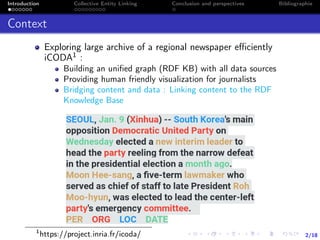
Exploring large archive of a regional newspaper efficiently
iCODA1 :
Building an unified graph (RDF KB) with all data sources
Providing human friendly visualization for journalists
Bridging content and data : Linking content to the RDF
Knowledge Base
1
https://project.inria.fr/icoda/
3/18
Introduction Collective Entity Linking Conclusion and perspectives Bibliographie
RDF Knowledge Bases (KB)?
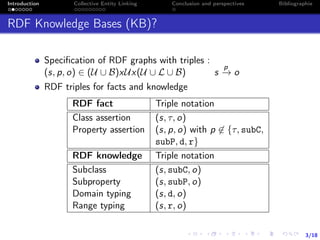
Specification of RDF graphs with triples :
(s, p, o) ∈ (U ∪ B)xUx(U ∪ L ∪ B) s
p
−→ o
RDF triples for facts and knowledge
RDF fact Triple notation
Class assertion (s, τ, o)
Property assertion (s, p, o) with p ∈ {τ, subC,
subP, d, r}
RDF knowledge Triple notation
Subclass (s, subC, o)
Subproperty (s, subP, o)
Domain typing (s, d, o)
Range typing (s, r, o)
4/18
Introduction Collective Entity Linking Conclusion and perspectives Bibliographie
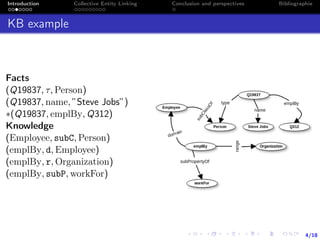
KB example
Facts
(Q19837, τ, Person)
(Q19837, name, ”Steve Jobs”)
∗(Q19837, emplBy, Q312)
Knowledge
(Employee, subC, Person)
(emplBy, d, Employee)
(emplBy, r, Organization)
(emplBy, subP, workFor)
5/18
Introduction Collective Entity Linking Conclusion and perspectives Bibliographie
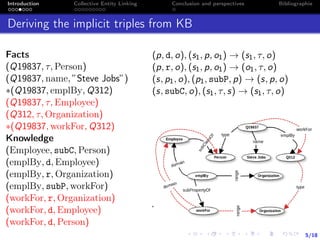
Deriving the implicit triples from KB
Facts
(Q19837, τ, Person)
(Q19837, name, ”Steve Jobs”)
∗(Q19837, emplBy, Q312)
(Q19837, τ, Employee)
(Q312, τ, Organization)
∗(Q19837, workFor, Q312)
Knowledge
(Employee, subC, Person)
(emplBy, d, Employee)
(emplBy, r, Organization)
(emplBy, subP, workFor)
(workFor, r, Organization)
(workFor, d, Employee)
(workFor, d, Person)
(p, d, o), (s1, p, o1) → (s1, τ, o)
(p, r, o), (s1, p, o1) → (o1, τ, o)
(s, p1, o), (p1, subP, p) → (s, p, o)
(s, subC, o), (s1, τ, s) → (s1, τ, o)
6/18
Introduction Collective Entity Linking Conclusion and perspectives Bibliographie
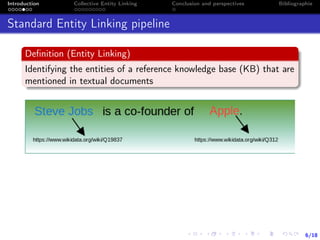
Standard Entity Linking pipeline
Definition (Entity Linking)
Identifying the entities of a reference knowledge base (KB) that are
mentioned in textual documents
6/18
Introduction Collective Entity Linking Conclusion and perspectives Bibliographie
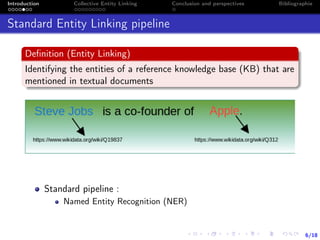
Standard Entity Linking pipeline
Definition (Entity Linking)
Identifying the entities of a reference knowledge base (KB) that are
mentioned in textual documents
Standard pipeline :
Named Entity Recognition (NER)
6/18
Introduction Collective Entity Linking Conclusion and perspectives Bibliographie
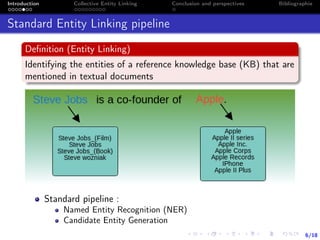
Standard Entity Linking pipeline
Definition (Entity Linking)
Identifying the entities of a reference knowledge base (KB) that are
mentioned in textual documents
Standard pipeline :
Named Entity Recognition (NER)
Candidate Entity Generation
6/18
Introduction Collective Entity Linking Conclusion and perspectives Bibliographie
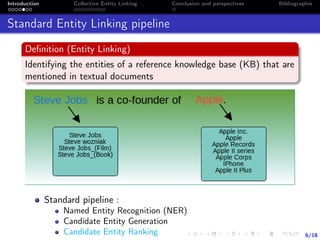
Standard Entity Linking pipeline
Definition (Entity Linking)
Identifying the entities of a reference knowledge base (KB) that are
mentioned in textual documents
Standard pipeline :
Named Entity Recognition (NER)
Candidate Entity Generation
Candidate Entity Ranking
7/18
Introduction Collective Entity Linking Conclusion and perspectives Bibliographie
Challenges
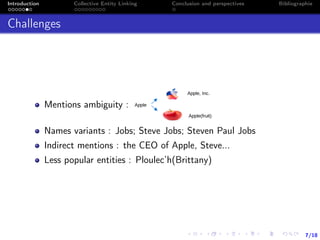
Mentions ambiguity :
Names variants : Jobs; Steve Jobs; Steven Paul Jobs
Indirect mentions : the CEO of Apple, Steve...
Less popular entities : Ploulec’h(Brittany)
8/18
Introduction Collective Entity Linking Conclusion and perspectives Bibliographie
Limits of Entity Linking Techniques
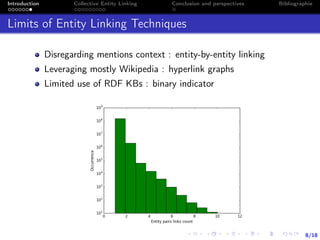
Disregarding mentions context : entity-by-entity linking
Leveraging mostly Wikipedia : hyperlink graphs
Limited use of RDF KBs : binary indicator
9/18
Introduction Collective Entity Linking Conclusion and perspectives Bibliographie
Collective Entity Linking
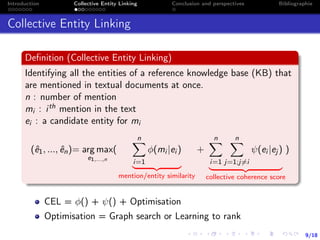
Definition (Collective Entity Linking)
Identifying all the entities of a reference knowledge base (KB) that
are mentioned in textual documents at once.
n : number of mention
mi : ith mention in the text
ei : a candidate entity for mi
(ˆe1, ..., ˆen)= arg max
e1,...,n
(
n
i=1
φ(mi |ei )
mention/entity similarity
+
n
i=1
n
j=1;j=i
ψ(ei |ej )
collective coherence score
)
CEL = φ() + ψ() + Optimisation
Optimisation = Graph search or Learning to rank
10/18
Introduction Collective Entity Linking Conclusion and perspectives Bibliographie
Candidate Entities Generation + Local score
Candidate Entities Generation :
Dictionary : Cross-Wiki
cross-wiki["stevejobs"] => [[’7412236’, 0.99],[’5042765’,0.01]]
Search engine : Wikipedia search
Local score (φ) :
Cosine similarity : cosine(Vmention, Vcandidate entity)
Wikipedia popularity(mention, candidate entity)
pop(m, e) =
n(m, e)
e ∈W
n(m, e )
(1)
n(m, e) = number of time m occurs as anchor of e
11/18
Introduction Collective Entity Linking Conclusion and perspectives Bibliographie
Word2vec computes φ()
Learning word representation based on its context.
Two models
Continuous Bag-of-Words (CBOW) : predicting word from
its context
Skip-Gram : predicting for a given word, its context
Example
dataset : the cat sits on the mat.
half-window : 1
CBOW :
([the,sits],cat),([cat,on],sits),([sits,the],on),([on,mat],the)
Skip-Gram :
(cat,[the,sits]),(sits,[cat,on]),(on,[sits,the]),(the,[on,mat])
Reflects semantic proximity
Computes cosine similarity
12/18
Introduction Collective Entity Linking Conclusion and perspectives Bibliographie
WSRM : Weighted Semantic Relatedness Measure
Contribution : WSRM
Generic definition over RDF KBs
Take advantages of RDF KBs semantics
More relations = strong similarity
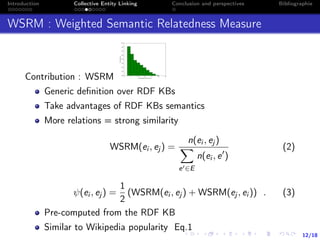
WSRM(ei , ej ) =
n(ei , ej )
e ∈E
n(ei , e )
(2)
ψ(ei , ej ) =
1
2
(WSRM(ei , ej ) + WSRM(ej , ei )) . (3)
Pre-computed from the RDF KB
Similar to Wikipedia popularity Eq.1
13/18
Introduction Collective Entity Linking Conclusion and perspectives Bibliographie
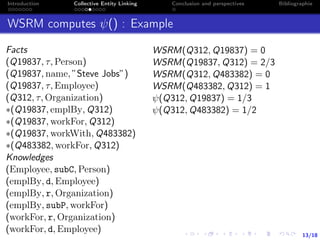
WSRM computes ψ() : Example
Facts
(Q19837, τ, Person)
(Q19837, name, ”Steve Jobs”)
(Q19837, τ, Employee)
(Q312, τ, Organization)
∗(Q19837, emplBy, Q312)
∗(Q19837, workFor, Q312)
∗(Q19837, workWith, Q483382)
∗(Q483382, workFor, Q312)
Knowledges
(Employee, subC, Person)
(emplBy, d, Employee)
(emplBy, r, Organization)
(emplBy, subP, workFor)
(workFor, r, Organization)
(workFor, d, Employee)
WSRM(Q312, Q19837) = 0
WSRM(Q19837, Q312) = 2/3
WSRM(Q312, Q483382) = 0
WSRM(Q483382, Q312) = 1
ψ(Q312, Q19837) = 1/3
ψ(Q312, Q483382) = 1/2
14/18
Introduction Collective Entity Linking Conclusion and perspectives Bibliographie
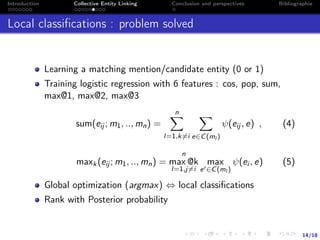
Local classifications : problem solved
Learning a matching mention/candidate entity (0 or 1)
Training logistic regression with 6 features : cos, pop, sum,
max@1, max@2, max@3
sum(eij ; m1, .., mn) =
n
l=1,k=i e∈C(ml )
ψ(eij , e) , (4)
maxk(eij ; m1, .., mn) =
n
max @k
l=1,j=i
max
e ∈C(ml )
ψ(ei , e) (5)
Global optimization (argmax) ⇔ local classifications
Rank with Posterior probability
15/18
Introduction Collective Entity Linking Conclusion and perspectives Bibliographie
Datasets
AIDA [4] : entity annotated corpus of Reuters news
documents
Reuters128 [9] : Economic news articles
RSS500 [9] : RSS feeds including all major worldwide
newspapers
TAC-KBP 2016-2017 datasets [5, 6] : Newswire and
forum-discussion documents
Dataset Nb. docs Nb. mentions Avg nb. mentions/doc
TAC-KBP 2016 eval 169 9231 54.6
TAC-KBP 2017 eval 167 6915 41.4
AIDA-train 846 18519 21.9
AIDA-valid 216 4784 22.1
AIDA-test 231 4479 19.4
Reuters128 128 881 6.9
RSS-500 500 1000 2
Table: Statistics on the used datasets.
16/18
Introduction Collective Entity Linking Conclusion and perspectives Bibliographie
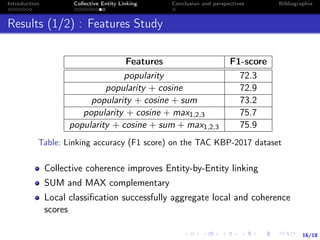
Results (1/2) : Features Study
Features F1-score
popularity 72.3
popularity + cosine 72.9
popularity + cosine + sum 73.2
popularity + cosine + max1,2,3 75.7
popularity + cosine + sum + max1,2,3 75.9
Table: Linking accuracy (F1 score) on the TAC KBP-2017 dataset
Collective coherence improves Entity-by-Entity linking
SUM and MAX complementary
Local classification successfully aggregate local and coherence
scores
17/18
Introduction Collective Entity Linking Conclusion and perspectives Bibliographie
Results (2/2) : Comparison to State-of-the-Art Approaches
Approach AIDA-A AIDA-B Reuters128 RSS-500
CNN [2] (Entity-by-Entity) - 85.5 - -
End-to-End [7] 89.4 82.4 54.6 42.2
NCEL [1] 79.0 80.0 - -
AGDISTIS [10] 57.5 57.8 68.9 54.2
Babelfy [8] 71.9 75.5 54.8 64.1
AIDA [4] 74.3 76.5 56.6 65.5
PBoH [3] 79.4 80.0 68.3 55.3
WSRM 90.6 87.7 79.9 79.3
Table: Micro-averaged F1 score for different methods on the four
datasets
WSRM stable for different datasets
18/18
Introduction Collective Entity Linking Conclusion and perspectives Bibliographie
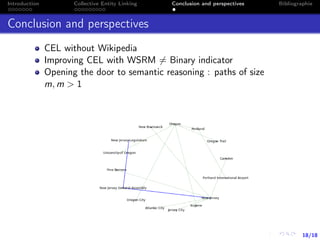
Conclusion and perspectives
CEL without Wikipedia
Improving CEL with WSRM = Binary indicator
Opening the door to semantic reasoning : paths of size
m, m > 1
18/18
Introduction Collective Entity Linking Conclusion and perspectives Bibliographie
Yixin Cao, Lei Hou, Juanzi Li, and Zhiyuan Liu.
Neural collective entity linking.
In Proceedings of the 27th International Conference on
Computational Linguistics, pages 675–686, 2018.
Matthew Francis-Landau, Greg Durrett, and Dan Klein.
Capturing semantic similarity for entity linking with
convolutional neural networks.
In Proceedings of the 15th Annual Conference of the North
American Chapter of the Association for Computational
Linguistics: Human Language Technologies, pages 1256–1261,
2016.
Octavian-Eugen Ganea, Marina Ganea, Aurelien Lucchi,
Carsten Eickhoff, and Thomas Hofmann.
Probabilistic bag-of-hyperlinks model for entity linking.
In Proceedings of the 25th International Conference on World
Wide Web, pages 927–938, 2016.
18/18
Introduction Collective Entity Linking Conclusion and perspectives Bibliographie
Johannes Hoffart, Mohamed Amir Yosef, Ilaria Bordino, Hagen
Fürstenau, Manfred Pinkal, Marc Spaniol, Bilyana Taneva,
Stefan Thater, and Gerhard Weikum.
Robust disambiguation of named entities in text.
In Proceedings of the 2011 Conference on Empirical Methods
in Natural Language Processing, pages 782–792, 2011.
Heng Ji and Nothman.
Overview of tac-kbp2016 tri-lingual edl and its impact on
end-to-end cold-start kbp.
Proceedings of the 2016 Text Analysis Conference, 2016.
Heng Ji, Xiaoman Pan, Boliang Zhang, Joel Nothman, James
Mayfield, Paul McNamee, and Cash Costello.
Overview of tac-kbp2017 13 languages entity discovery and
linking.
In Proceedings of the 2017 Text Analysis Conference, 2017.
Nikolaos Kolitsas, Octavian-Eugen Ganea, and Thomas
Hofmann.
18/18
Introduction Collective Entity Linking Conclusion and perspectives Bibliographie
End-to-end neural entity linking.
In Proceedings of the 22nd Conference on Computational
Natural Language Learning, pages 519–529, 2018.
Andrea Moro, Alessandro Raganato, and Roberto Navigli.
Entity linking meets word sense disambiguation: a unified
approach.
Transactions of the Association for Computational Linguistics,
2:231–244, 2014.
Michael Röder, Ricardo Usbeck, Sebastian Hellmann, Daniel
Gerber, and Andreas Both.
N3- a collection of datasets for named entity recognition and
disambiguation in the nlp interchange format.
In Proceedings of the 9th International Conference on
Language Resources and Evaluation, pages 3529–3533, 2014.
Ricardo Usbeck, Axel-Cyrille Ngonga Ngomo, Michael Röder,
Daniel Gerber, Sandro Athaide Coelho, Sören Auer, and
Andreas Both.
18/18
Introduction Collective Entity Linking Conclusion and perspectives Bibliographie
Agdistis - graph-based disambiguation of named entities using
linked data.
In Proceedings of the International Semantic Web Conference,
pages 457–471, 2014.

Collective entity linking with WSRM DocEng'19

  • 1.
    1/18 Introduction Collective EntityLinking Conclusion and perspectives Bibliographie Using Knowledge Base Semantics in Context-Aware Entity Linking Cheikh Brahim El Vaigh, François Goasdoué, Guillaume Gravier and Pascale Sébillot DocEng ’19, September 23–26, 2019, Berlin, Germany
  • 2.
    2/18 Introduction Collective EntityLinking Conclusion and perspectives Bibliographie Context Exploring large archive of a regional newspaper efficiently iCODA1 : Building an unified graph (RDF KB) with all data sources Providing human friendly visualization for journalists Bridging content and data : Linking content to the RDF Knowledge Base 1 https://project.inria.fr/icoda/
  • 3.
    3/18 Introduction Collective EntityLinking Conclusion and perspectives Bibliographie RDF Knowledge Bases (KB)? Specification of RDF graphs with triples : (s, p, o) ∈ (U ∪ B)xUx(U ∪ L ∪ B) s p −→ o RDF triples for facts and knowledge RDF fact Triple notation Class assertion (s, τ, o) Property assertion (s, p, o) with p ∈ {τ, subC, subP, d, r} RDF knowledge Triple notation Subclass (s, subC, o) Subproperty (s, subP, o) Domain typing (s, d, o) Range typing (s, r, o)
  • 4.
    4/18 Introduction Collective EntityLinking Conclusion and perspectives Bibliographie KB example Facts (Q19837, τ, Person) (Q19837, name, ”Steve Jobs”) ∗(Q19837, emplBy, Q312) Knowledge (Employee, subC, Person) (emplBy, d, Employee) (emplBy, r, Organization) (emplBy, subP, workFor)
  • 5.
    5/18 Introduction Collective EntityLinking Conclusion and perspectives Bibliographie Deriving the implicit triples from KB Facts (Q19837, τ, Person) (Q19837, name, ”Steve Jobs”) ∗(Q19837, emplBy, Q312) (Q19837, τ, Employee) (Q312, τ, Organization) ∗(Q19837, workFor, Q312) Knowledge (Employee, subC, Person) (emplBy, d, Employee) (emplBy, r, Organization) (emplBy, subP, workFor) (workFor, r, Organization) (workFor, d, Employee) (workFor, d, Person) (p, d, o), (s1, p, o1) → (s1, τ, o) (p, r, o), (s1, p, o1) → (o1, τ, o) (s, p1, o), (p1, subP, p) → (s, p, o) (s, subC, o), (s1, τ, s) → (s1, τ, o)
  • 6.
    6/18 Introduction Collective EntityLinking Conclusion and perspectives Bibliographie Standard Entity Linking pipeline Definition (Entity Linking) Identifying the entities of a reference knowledge base (KB) that are mentioned in textual documents
  • 7.
    6/18 Introduction Collective EntityLinking Conclusion and perspectives Bibliographie Standard Entity Linking pipeline Definition (Entity Linking) Identifying the entities of a reference knowledge base (KB) that are mentioned in textual documents Standard pipeline : Named Entity Recognition (NER)
  • 8.
    6/18 Introduction Collective EntityLinking Conclusion and perspectives Bibliographie Standard Entity Linking pipeline Definition (Entity Linking) Identifying the entities of a reference knowledge base (KB) that are mentioned in textual documents Standard pipeline : Named Entity Recognition (NER) Candidate Entity Generation
  • 9.
    6/18 Introduction Collective EntityLinking Conclusion and perspectives Bibliographie Standard Entity Linking pipeline Definition (Entity Linking) Identifying the entities of a reference knowledge base (KB) that are mentioned in textual documents Standard pipeline : Named Entity Recognition (NER) Candidate Entity Generation Candidate Entity Ranking
  • 10.
    7/18 Introduction Collective EntityLinking Conclusion and perspectives Bibliographie Challenges Mentions ambiguity : Names variants : Jobs; Steve Jobs; Steven Paul Jobs Indirect mentions : the CEO of Apple, Steve... Less popular entities : Ploulec’h(Brittany)
  • 11.
    8/18 Introduction Collective EntityLinking Conclusion and perspectives Bibliographie Limits of Entity Linking Techniques Disregarding mentions context : entity-by-entity linking Leveraging mostly Wikipedia : hyperlink graphs Limited use of RDF KBs : binary indicator
  • 12.
    9/18 Introduction Collective EntityLinking Conclusion and perspectives Bibliographie Collective Entity Linking Definition (Collective Entity Linking) Identifying all the entities of a reference knowledge base (KB) that are mentioned in textual documents at once. n : number of mention mi : ith mention in the text ei : a candidate entity for mi (ˆe1, ..., ˆen)= arg max e1,...,n ( n i=1 φ(mi |ei ) mention/entity similarity + n i=1 n j=1;j=i ψ(ei |ej ) collective coherence score ) CEL = φ() + ψ() + Optimisation Optimisation = Graph search or Learning to rank
  • 13.
    10/18 Introduction Collective EntityLinking Conclusion and perspectives Bibliographie Candidate Entities Generation + Local score Candidate Entities Generation : Dictionary : Cross-Wiki cross-wiki["stevejobs"] => [[’7412236’, 0.99],[’5042765’,0.01]] Search engine : Wikipedia search Local score (φ) : Cosine similarity : cosine(Vmention, Vcandidate entity) Wikipedia popularity(mention, candidate entity) pop(m, e) = n(m, e) e ∈W n(m, e ) (1) n(m, e) = number of time m occurs as anchor of e
  • 14.
    11/18 Introduction Collective EntityLinking Conclusion and perspectives Bibliographie Word2vec computes φ() Learning word representation based on its context. Two models Continuous Bag-of-Words (CBOW) : predicting word from its context Skip-Gram : predicting for a given word, its context Example dataset : the cat sits on the mat. half-window : 1 CBOW : ([the,sits],cat),([cat,on],sits),([sits,the],on),([on,mat],the) Skip-Gram : (cat,[the,sits]),(sits,[cat,on]),(on,[sits,the]),(the,[on,mat]) Reflects semantic proximity Computes cosine similarity
  • 15.
    12/18 Introduction Collective EntityLinking Conclusion and perspectives Bibliographie WSRM : Weighted Semantic Relatedness Measure Contribution : WSRM Generic definition over RDF KBs Take advantages of RDF KBs semantics More relations = strong similarity WSRM(ei , ej ) = n(ei , ej ) e ∈E n(ei , e ) (2) ψ(ei , ej ) = 1 2 (WSRM(ei , ej ) + WSRM(ej , ei )) . (3) Pre-computed from the RDF KB Similar to Wikipedia popularity Eq.1
  • 16.
    13/18 Introduction Collective EntityLinking Conclusion and perspectives Bibliographie WSRM computes ψ() : Example Facts (Q19837, τ, Person) (Q19837, name, ”Steve Jobs”) (Q19837, τ, Employee) (Q312, τ, Organization) ∗(Q19837, emplBy, Q312) ∗(Q19837, workFor, Q312) ∗(Q19837, workWith, Q483382) ∗(Q483382, workFor, Q312) Knowledges (Employee, subC, Person) (emplBy, d, Employee) (emplBy, r, Organization) (emplBy, subP, workFor) (workFor, r, Organization) (workFor, d, Employee) WSRM(Q312, Q19837) = 0 WSRM(Q19837, Q312) = 2/3 WSRM(Q312, Q483382) = 0 WSRM(Q483382, Q312) = 1 ψ(Q312, Q19837) = 1/3 ψ(Q312, Q483382) = 1/2
  • 17.
    14/18 Introduction Collective EntityLinking Conclusion and perspectives Bibliographie Local classifications : problem solved Learning a matching mention/candidate entity (0 or 1) Training logistic regression with 6 features : cos, pop, sum, max@1, max@2, max@3 sum(eij ; m1, .., mn) = n l=1,k=i e∈C(ml ) ψ(eij , e) , (4) maxk(eij ; m1, .., mn) = n max @k l=1,j=i max e ∈C(ml ) ψ(ei , e) (5) Global optimization (argmax) ⇔ local classifications Rank with Posterior probability
  • 18.
    15/18 Introduction Collective EntityLinking Conclusion and perspectives Bibliographie Datasets AIDA [4] : entity annotated corpus of Reuters news documents Reuters128 [9] : Economic news articles RSS500 [9] : RSS feeds including all major worldwide newspapers TAC-KBP 2016-2017 datasets [5, 6] : Newswire and forum-discussion documents Dataset Nb. docs Nb. mentions Avg nb. mentions/doc TAC-KBP 2016 eval 169 9231 54.6 TAC-KBP 2017 eval 167 6915 41.4 AIDA-train 846 18519 21.9 AIDA-valid 216 4784 22.1 AIDA-test 231 4479 19.4 Reuters128 128 881 6.9 RSS-500 500 1000 2 Table: Statistics on the used datasets.
  • 19.
    16/18 Introduction Collective EntityLinking Conclusion and perspectives Bibliographie Results (1/2) : Features Study Features F1-score popularity 72.3 popularity + cosine 72.9 popularity + cosine + sum 73.2 popularity + cosine + max1,2,3 75.7 popularity + cosine + sum + max1,2,3 75.9 Table: Linking accuracy (F1 score) on the TAC KBP-2017 dataset Collective coherence improves Entity-by-Entity linking SUM and MAX complementary Local classification successfully aggregate local and coherence scores
  • 20.
    17/18 Introduction Collective EntityLinking Conclusion and perspectives Bibliographie Results (2/2) : Comparison to State-of-the-Art Approaches Approach AIDA-A AIDA-B Reuters128 RSS-500 CNN [2] (Entity-by-Entity) - 85.5 - - End-to-End [7] 89.4 82.4 54.6 42.2 NCEL [1] 79.0 80.0 - - AGDISTIS [10] 57.5 57.8 68.9 54.2 Babelfy [8] 71.9 75.5 54.8 64.1 AIDA [4] 74.3 76.5 56.6 65.5 PBoH [3] 79.4 80.0 68.3 55.3 WSRM 90.6 87.7 79.9 79.3 Table: Micro-averaged F1 score for different methods on the four datasets WSRM stable for different datasets
  • 21.
    18/18 Introduction Collective EntityLinking Conclusion and perspectives Bibliographie Conclusion and perspectives CEL without Wikipedia Improving CEL with WSRM = Binary indicator Opening the door to semantic reasoning : paths of size m, m > 1
  • 22.
    18/18 Introduction Collective EntityLinking Conclusion and perspectives Bibliographie Yixin Cao, Lei Hou, Juanzi Li, and Zhiyuan Liu. Neural collective entity linking. In Proceedings of the 27th International Conference on Computational Linguistics, pages 675–686, 2018. Matthew Francis-Landau, Greg Durrett, and Dan Klein. Capturing semantic similarity for entity linking with convolutional neural networks. In Proceedings of the 15th Annual Conference of the North American Chapter of the Association for Computational Linguistics: Human Language Technologies, pages 1256–1261, 2016. Octavian-Eugen Ganea, Marina Ganea, Aurelien Lucchi, Carsten Eickhoff, and Thomas Hofmann. Probabilistic bag-of-hyperlinks model for entity linking. In Proceedings of the 25th International Conference on World Wide Web, pages 927–938, 2016.
  • 23.
    18/18 Introduction Collective EntityLinking Conclusion and perspectives Bibliographie Johannes Hoffart, Mohamed Amir Yosef, Ilaria Bordino, Hagen Fürstenau, Manfred Pinkal, Marc Spaniol, Bilyana Taneva, Stefan Thater, and Gerhard Weikum. Robust disambiguation of named entities in text. In Proceedings of the 2011 Conference on Empirical Methods in Natural Language Processing, pages 782–792, 2011. Heng Ji and Nothman. Overview of tac-kbp2016 tri-lingual edl and its impact on end-to-end cold-start kbp. Proceedings of the 2016 Text Analysis Conference, 2016. Heng Ji, Xiaoman Pan, Boliang Zhang, Joel Nothman, James Mayfield, Paul McNamee, and Cash Costello. Overview of tac-kbp2017 13 languages entity discovery and linking. In Proceedings of the 2017 Text Analysis Conference, 2017. Nikolaos Kolitsas, Octavian-Eugen Ganea, and Thomas Hofmann.
  • 24.
    18/18 Introduction Collective EntityLinking Conclusion and perspectives Bibliographie End-to-end neural entity linking. In Proceedings of the 22nd Conference on Computational Natural Language Learning, pages 519–529, 2018. Andrea Moro, Alessandro Raganato, and Roberto Navigli. Entity linking meets word sense disambiguation: a unified approach. Transactions of the Association for Computational Linguistics, 2:231–244, 2014. Michael Röder, Ricardo Usbeck, Sebastian Hellmann, Daniel Gerber, and Andreas Both. N3- a collection of datasets for named entity recognition and disambiguation in the nlp interchange format. In Proceedings of the 9th International Conference on Language Resources and Evaluation, pages 3529–3533, 2014. Ricardo Usbeck, Axel-Cyrille Ngonga Ngomo, Michael Röder, Daniel Gerber, Sandro Athaide Coelho, Sören Auer, and Andreas Both.
  • 25.
    18/18 Introduction Collective EntityLinking Conclusion and perspectives Bibliographie Agdistis - graph-based disambiguation of named entities using linked data. In Proceedings of the International Semantic Web Conference, pages 457–471, 2014.