Leveraging Knowledge Bases
for Contextual Entity Exploration Categories
Date:2015/09/17
Author:Joonseok Lee, Ariel Fuxman, Bo Zhao, Yuanhua Lv
Source:KDD'15
Advisor:Jia-ling Koh
Spearker:LIN,CI-JIE
1
Outline
Introduction
Method
Experiment
Conclusion
2
Outline
Introduction
Method
Experiment
Conclusion
3
Introduction
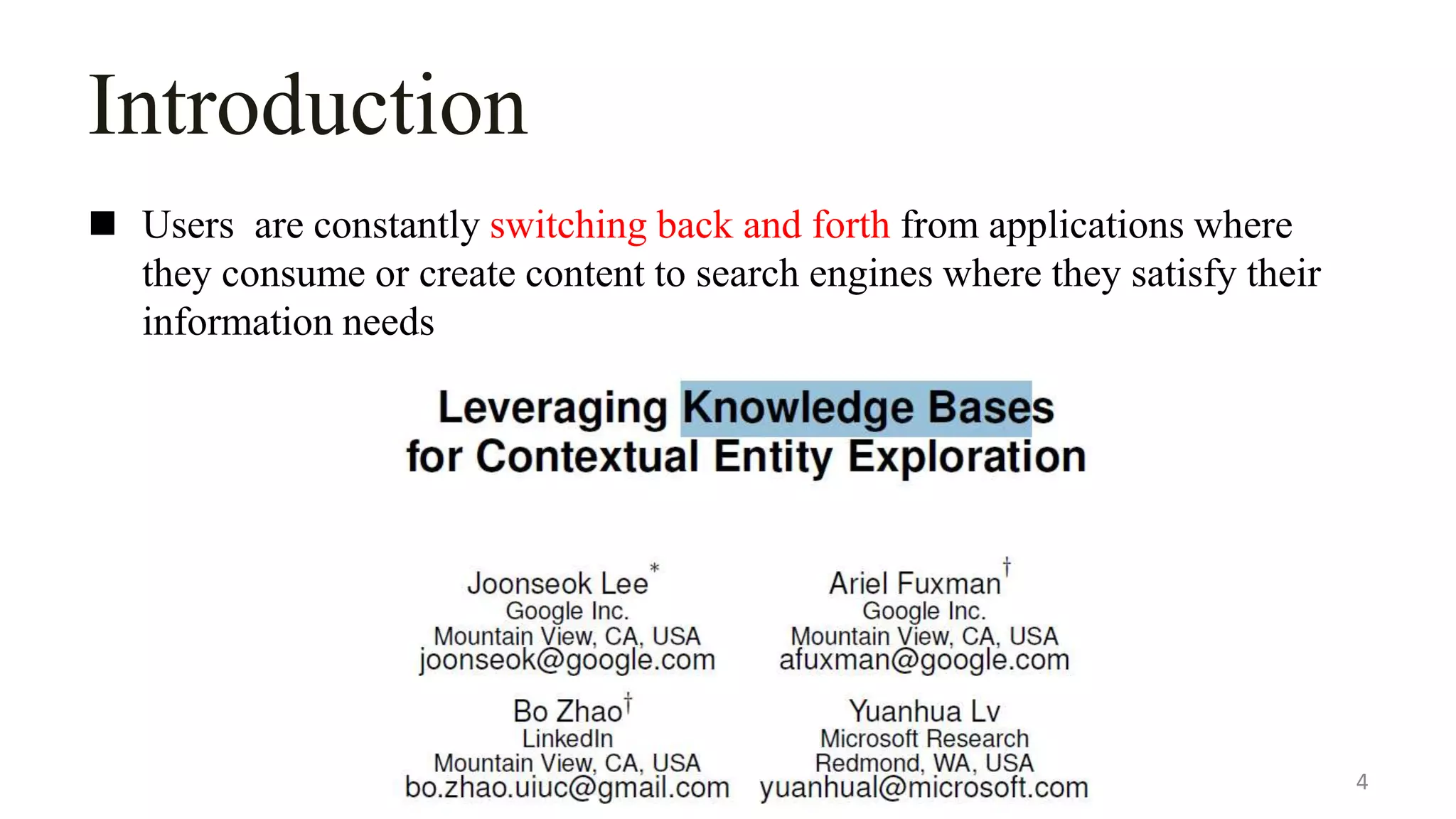
 Users are constantly switching back and forth from applications where
they consume or create content to search engines where they satisfy their
information needs
4
Introduction
 Existing work in the literature that can be applied to this
problem takes a standard bag-of-words information retrieval
approach
 syntactic match
5
Introduction
Goal
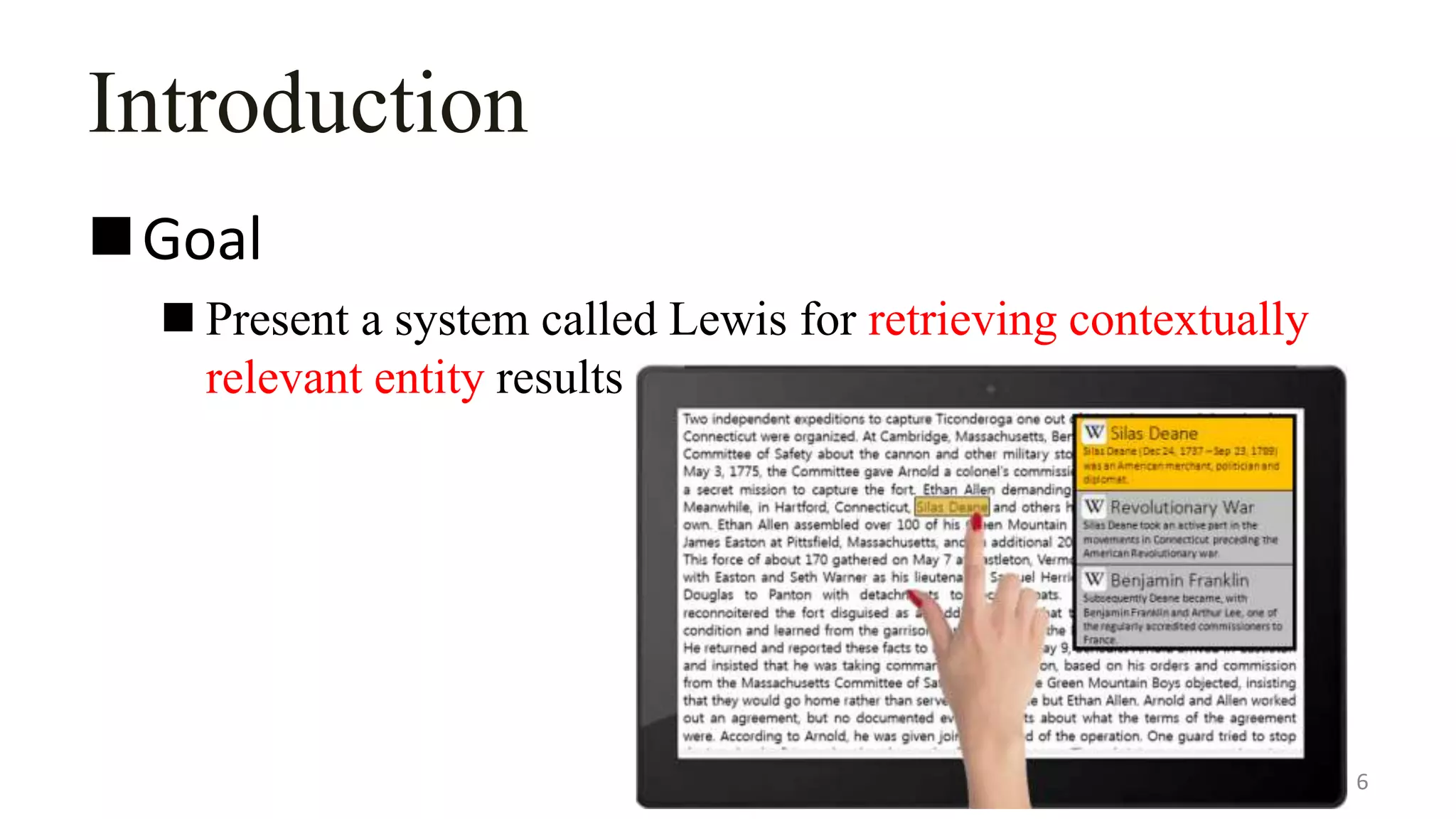
 Present a system called Lewis for retrieving contextually
relevant entity results
6
Outline
Introduction
Method
Experiment
Conclusion
7
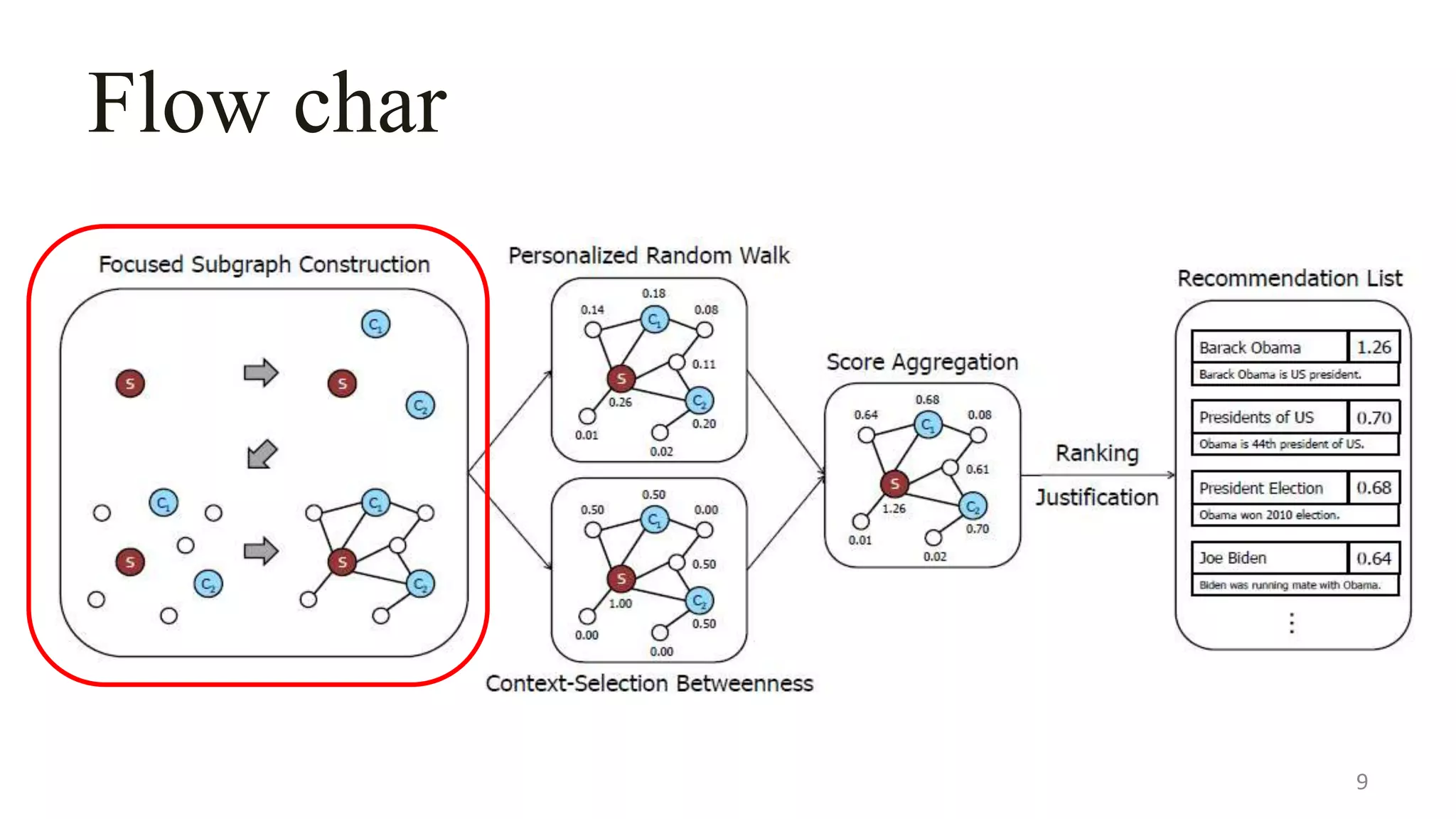
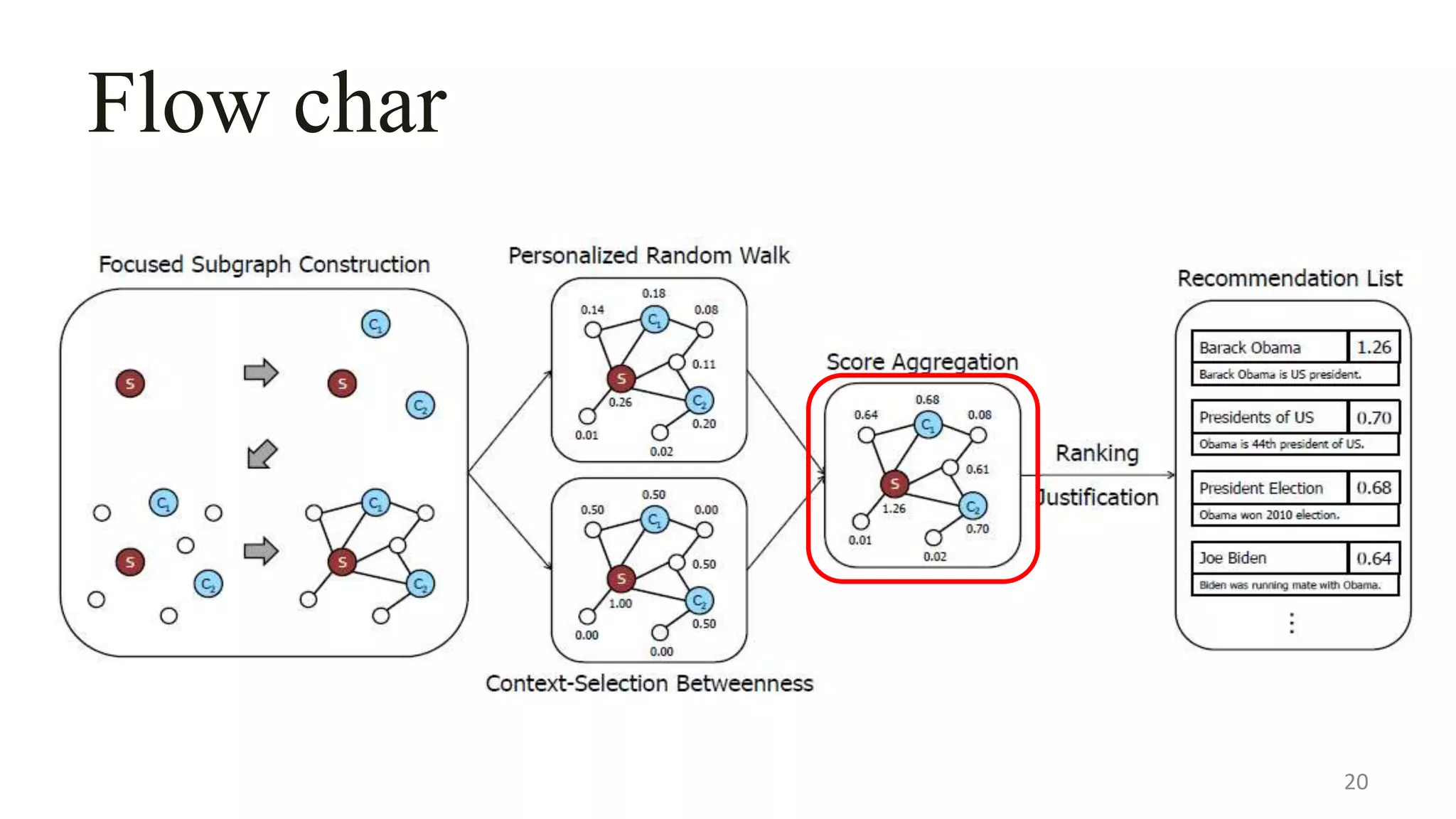
Flow char
8
Flow char
9
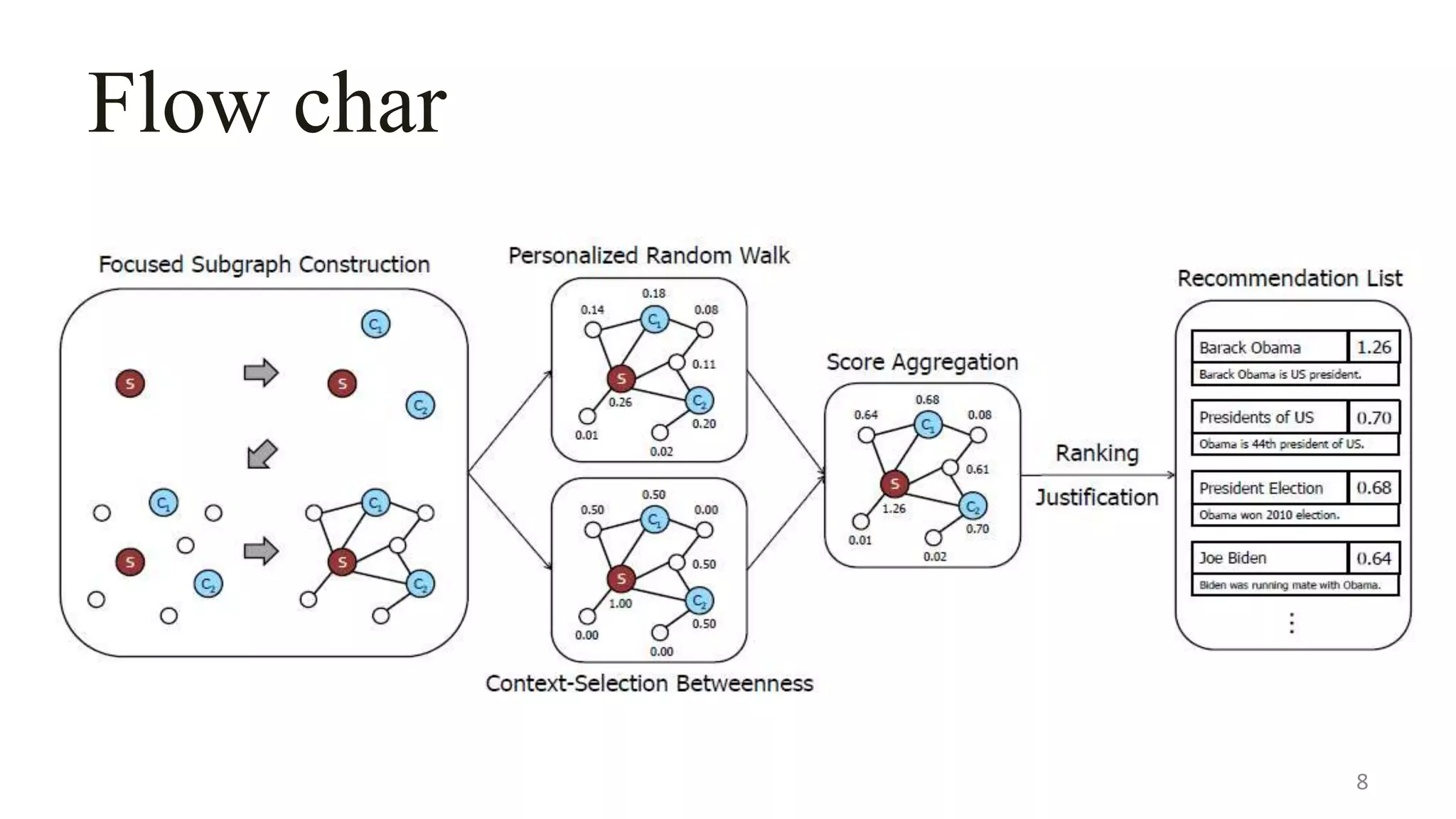
Focused Subgraph Construction
 Mapping the user selection S and the context C to nodes in the
knowledge graph
 Any off-the-shelf entity linking system[9]
10
Focused Subgraph Construction
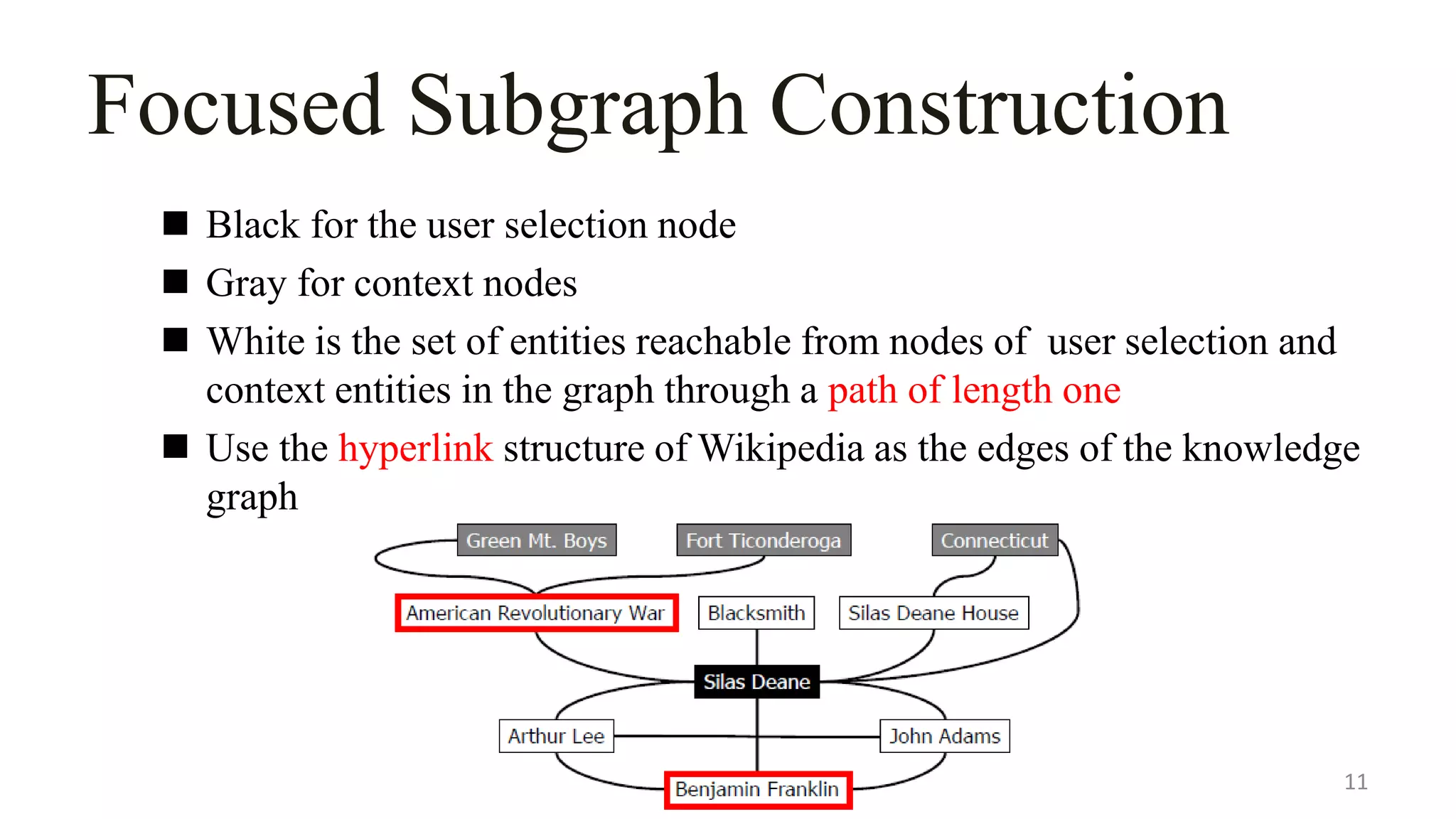
 Black for the user selection node
 Gray for context nodes
 White is the set of entities reachable from nodes of user selection and
context entities in the graph through a path of length one
 Use the hyperlink structure of Wikipedia as the edges of the knowledge
graph
11
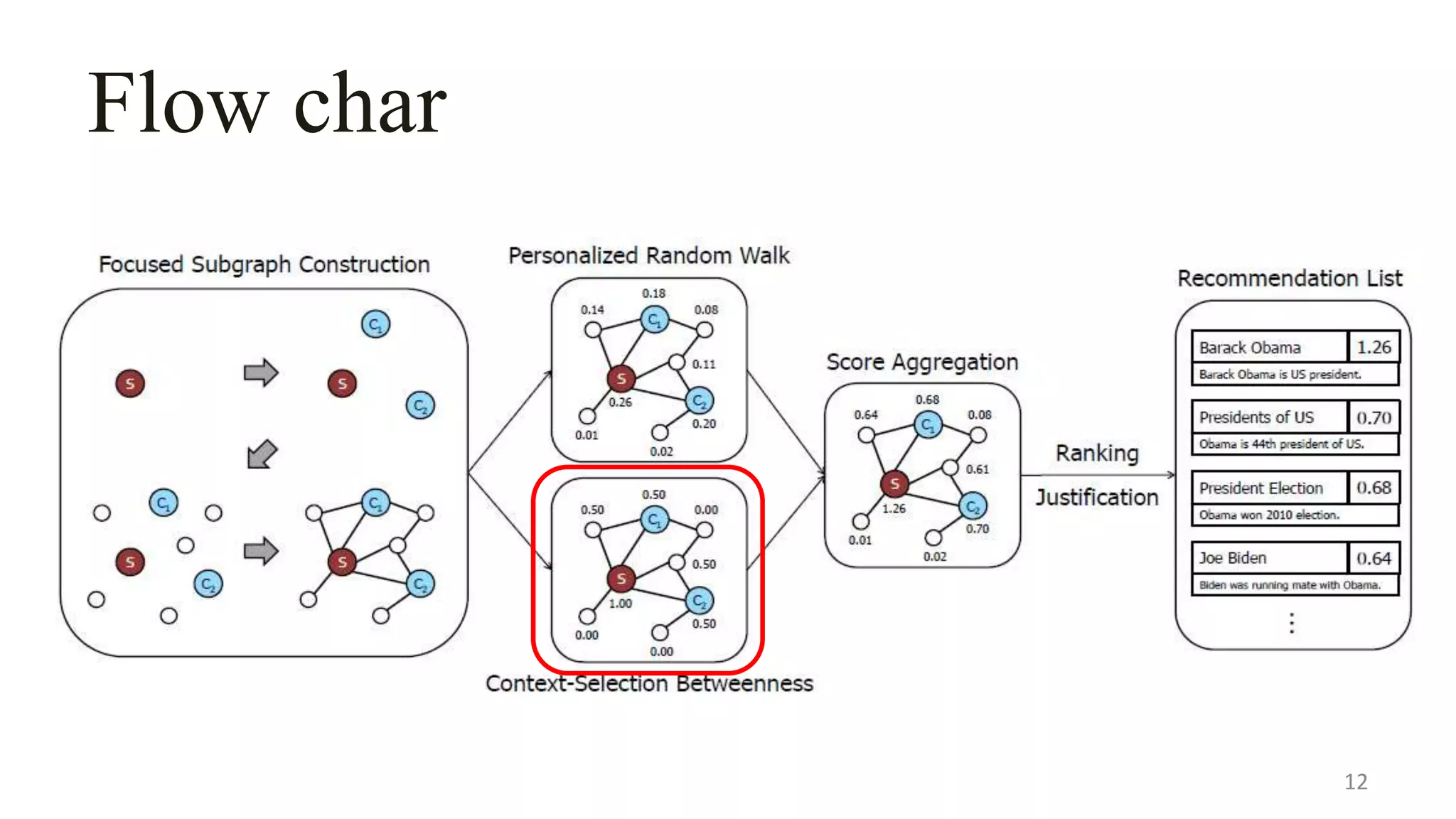
Flow char
12
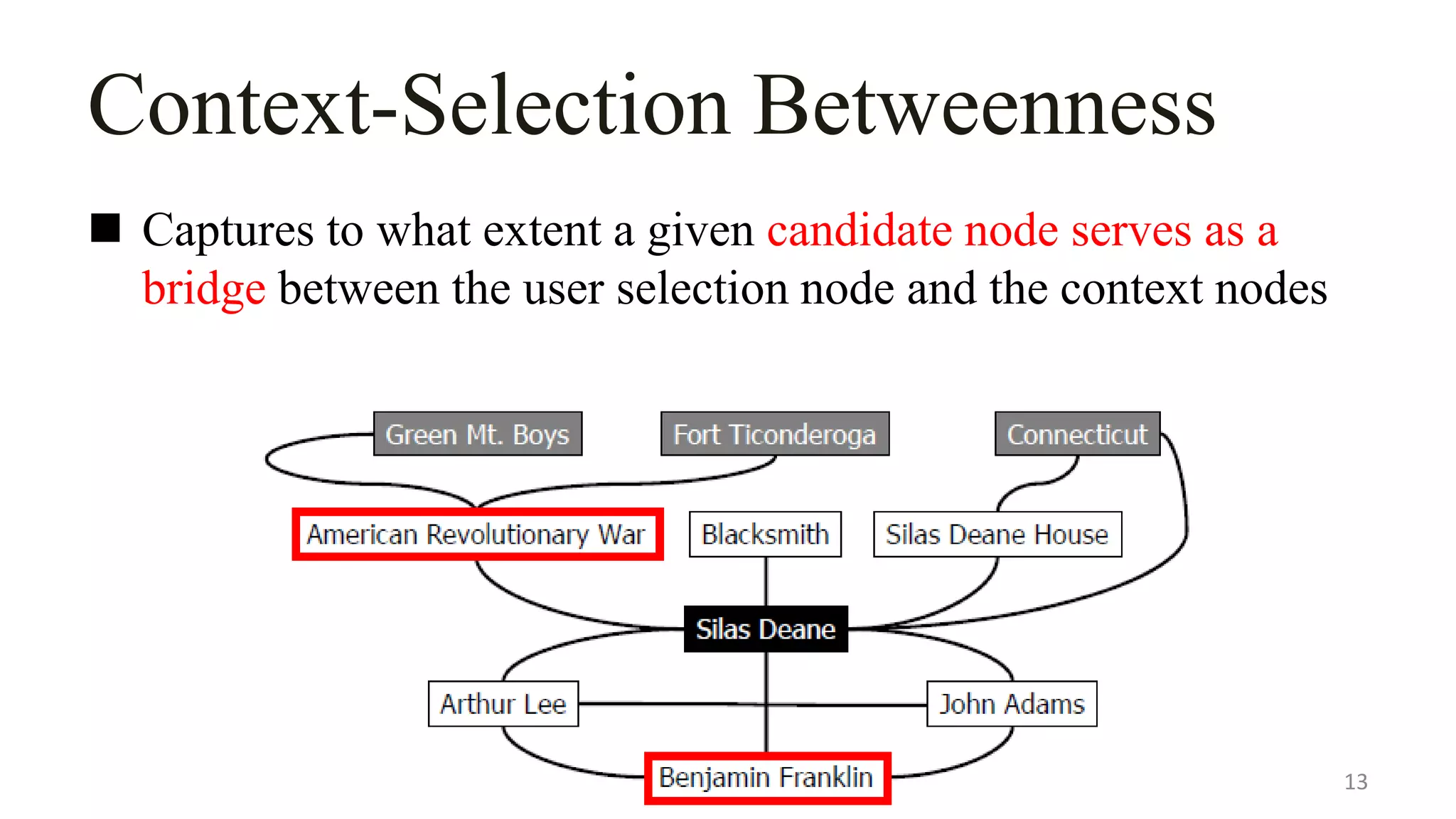
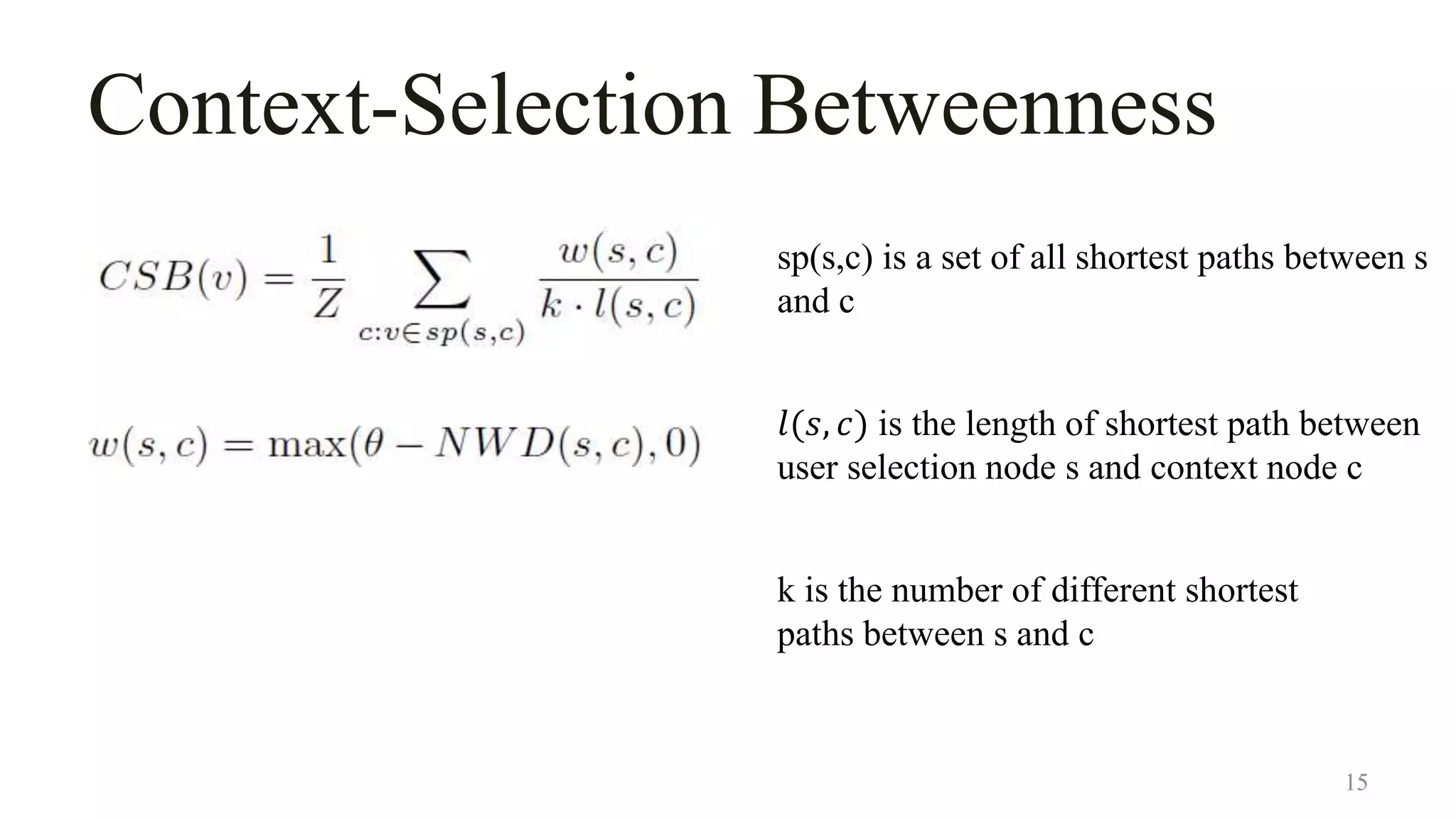
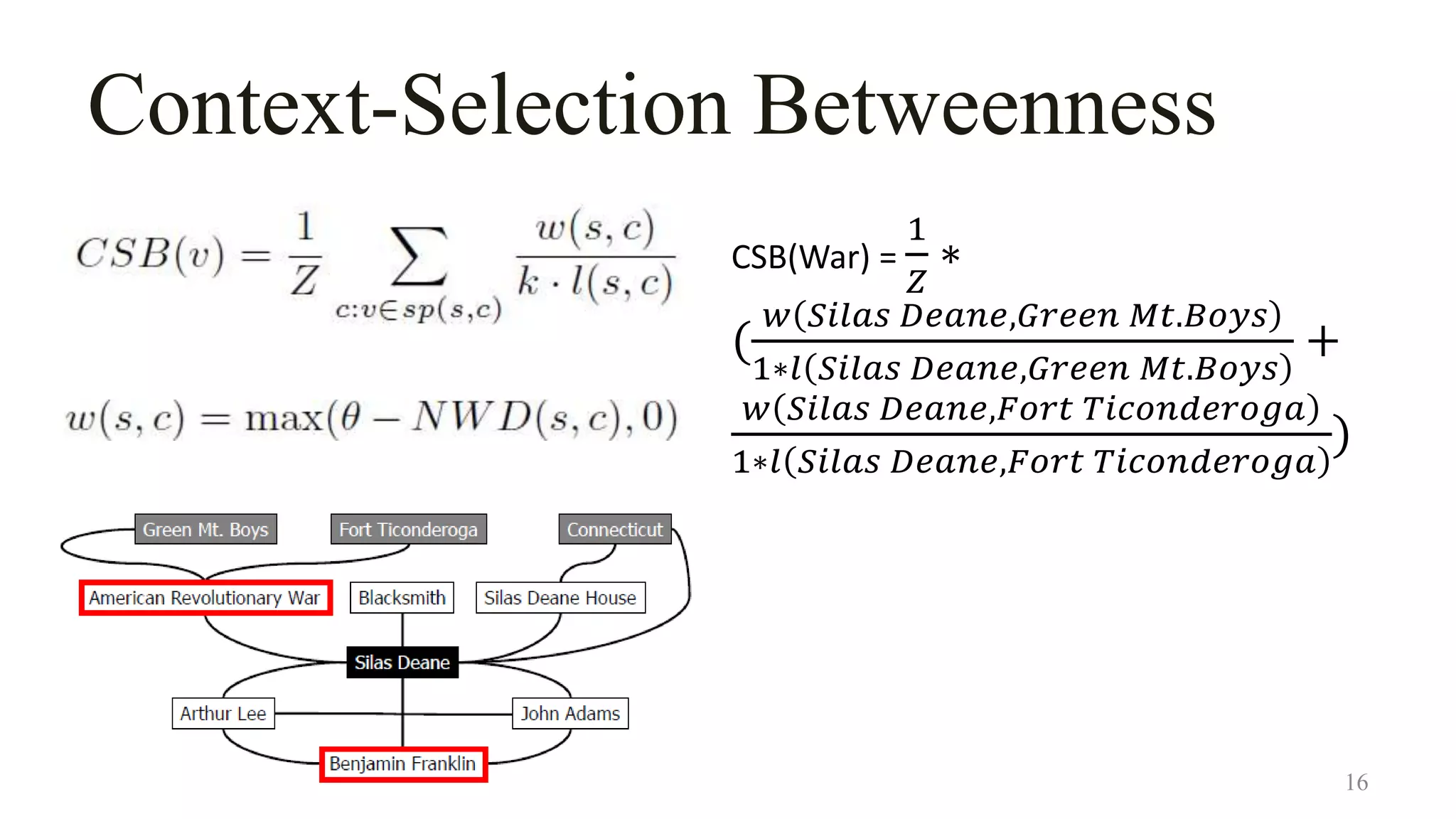
Context-Selection Betweenness
 Captures to what extent a given candidate node serves as a
bridge between the user selection node and the context nodes
13
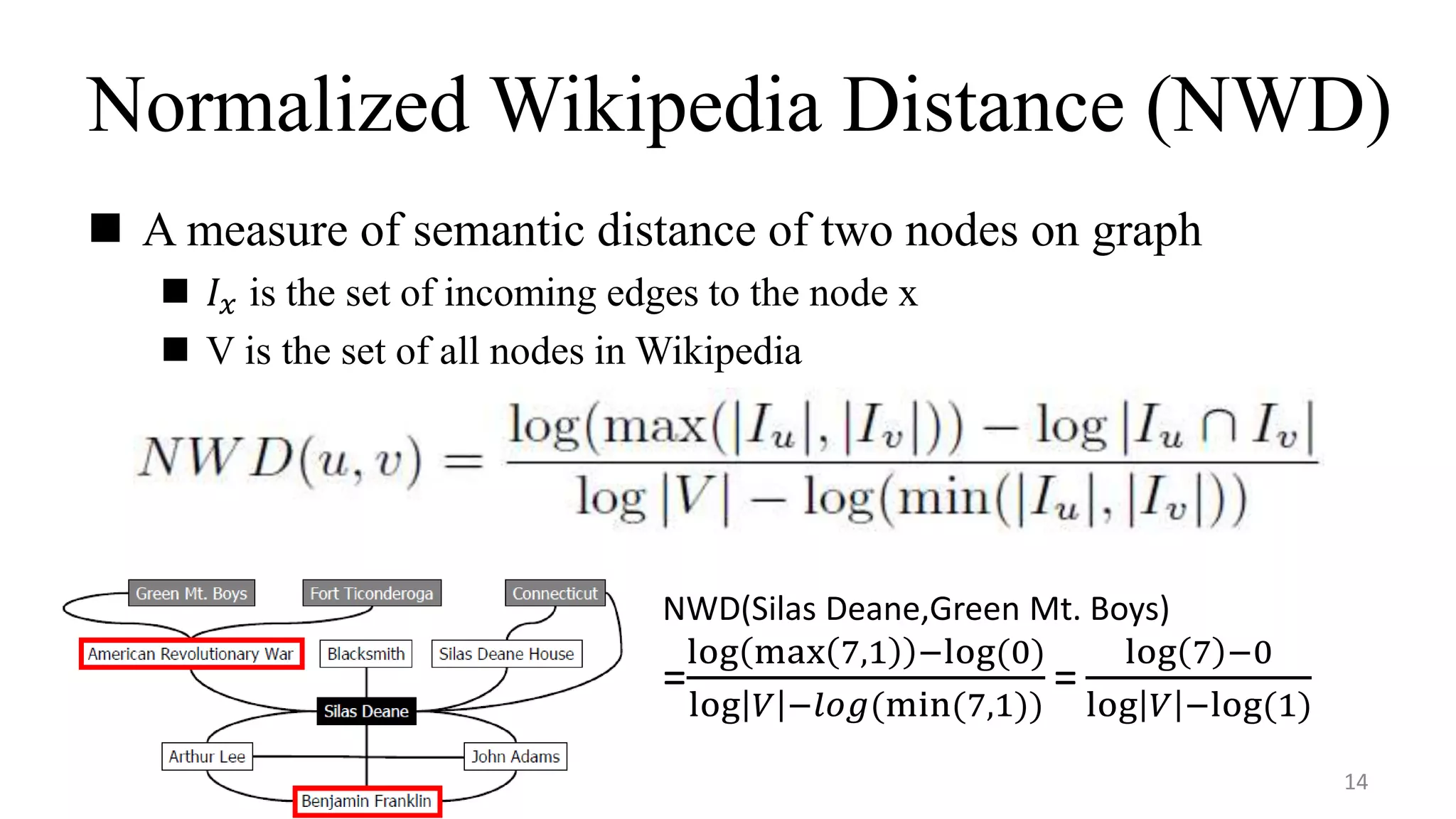
Normalized Wikipedia Distance (NWD)
 A measure of semantic distance of two nodes on graph
 𝐼 𝑥 is the set of incoming edges to the node x
 V is the set of all nodes in Wikipedia
14
NWD(Silas Deane,Green Mt. Boys)
=
log max 7,1 −log(0)
log 𝑉 −𝑙𝑜𝑔(min(7,1))
=
log 7 −0
log 𝑉 −log(1)
Context-Selection Betweenness
15
𝑙(𝑠, 𝑐) is the length of shortest path between
user selection node s and context node c
k is the number of different shortest
paths between s and c
sp(s,c) is a set of all shortest paths between s
and c
Context-Selection Betweenness
16
CSB(War) =
1
𝑍
∗
(
𝑤 𝑆𝑖𝑙𝑎𝑠 𝐷𝑒𝑎𝑛𝑒,𝐺𝑟𝑒𝑒𝑛 𝑀𝑡.𝐵𝑜𝑦𝑠
1∗𝑙 𝑆𝑖𝑙𝑎𝑠 𝐷𝑒𝑎𝑛𝑒,𝐺𝑟𝑒𝑒𝑛 𝑀𝑡.𝐵𝑜𝑦𝑠
+
𝑤 𝑆𝑖𝑙𝑎𝑠 𝐷𝑒𝑎𝑛𝑒,𝐹𝑜𝑟𝑡 𝑇𝑖𝑐𝑜𝑛𝑑𝑒𝑟𝑜𝑔𝑎
1∗𝑙 𝑆𝑖𝑙𝑎𝑠 𝐷𝑒𝑎𝑛𝑒,𝐹𝑜𝑟𝑡 𝑇𝑖𝑐𝑜𝑛𝑑𝑒𝑟𝑜𝑔𝑎
)
Flow char
17
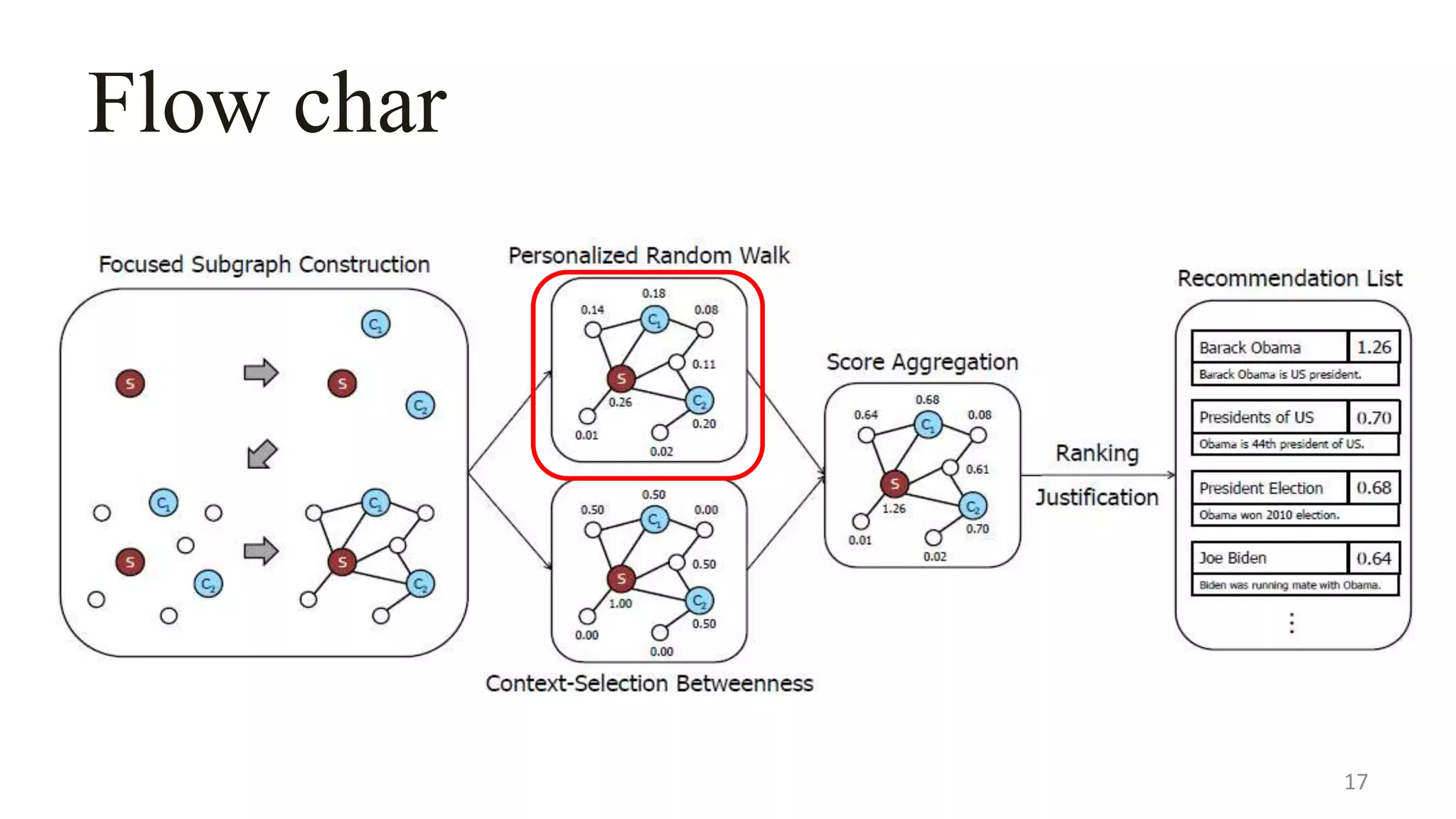
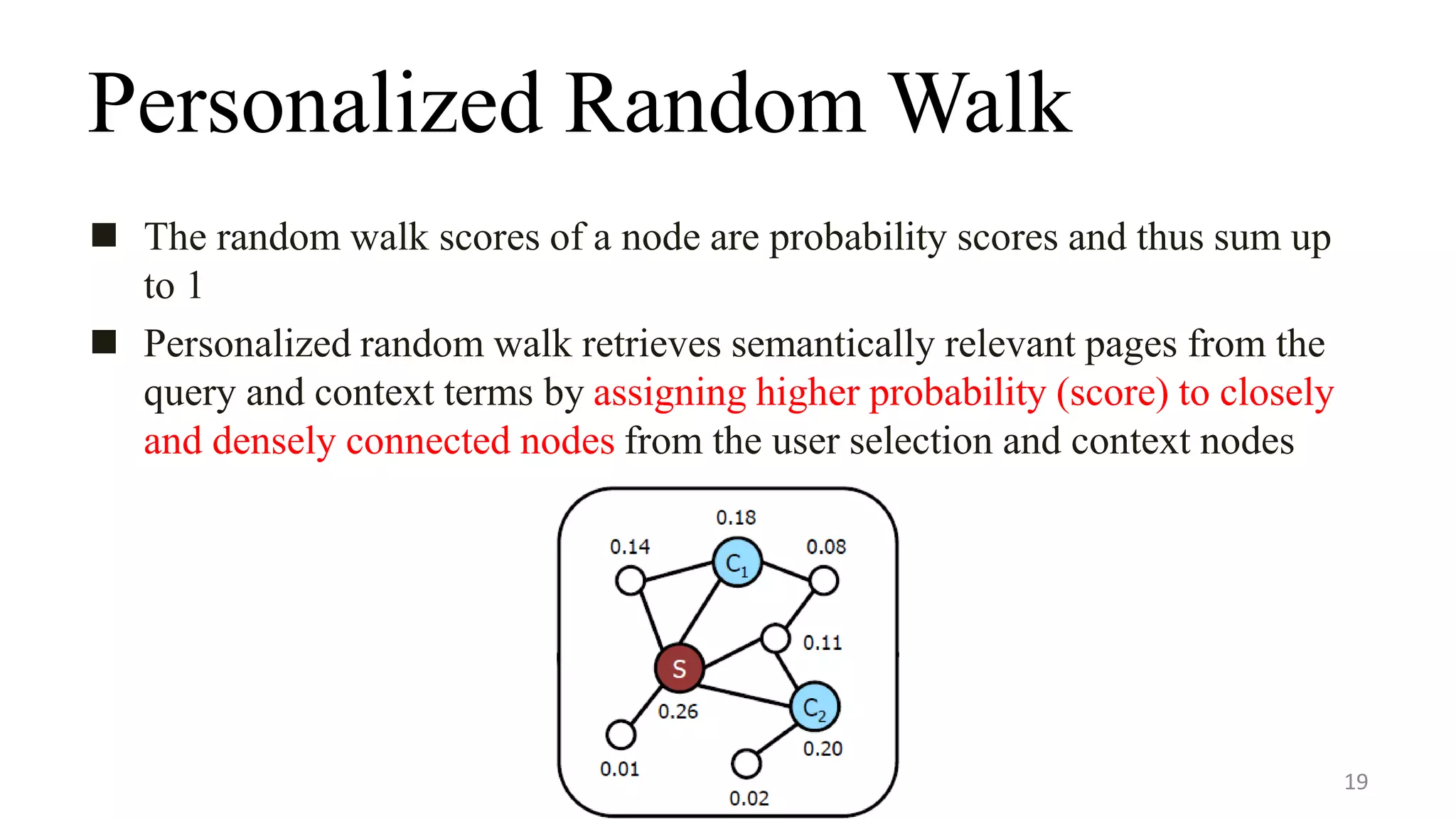
Personalized Random Walk
 The random walk[41] is simulating the behavior of a user
reading articles
18
Personalized Random Walk
 The random walk scores of a node are probability scores and thus sum up
to 1
 Personalized random walk retrieves semantically relevant pages from the
query and context terms by assigning higher probability (score) to closely
and densely connected nodes from the user selection and context nodes
19
Flow char
20
Score Aggregation
 The expected value of RW(v) gets smaller when we have more
nodes in the graph
 consider |V|RW(v) instead of RW(v) itself, where V is the set of nodes
in the focused graph
 interpret this score as how many times the node is preferred to visit
compared to expectation
21
Score Aggregation
 The CSB(v) score for each node tends to be inversely
proportional to the number of context nodes
 consider |C|CSB(v) instead of CSB(v)
 interpret |C|CSB(v) score as the expected number of shortest paths from
user selection s to any context node visiting v in the meanwhile
22
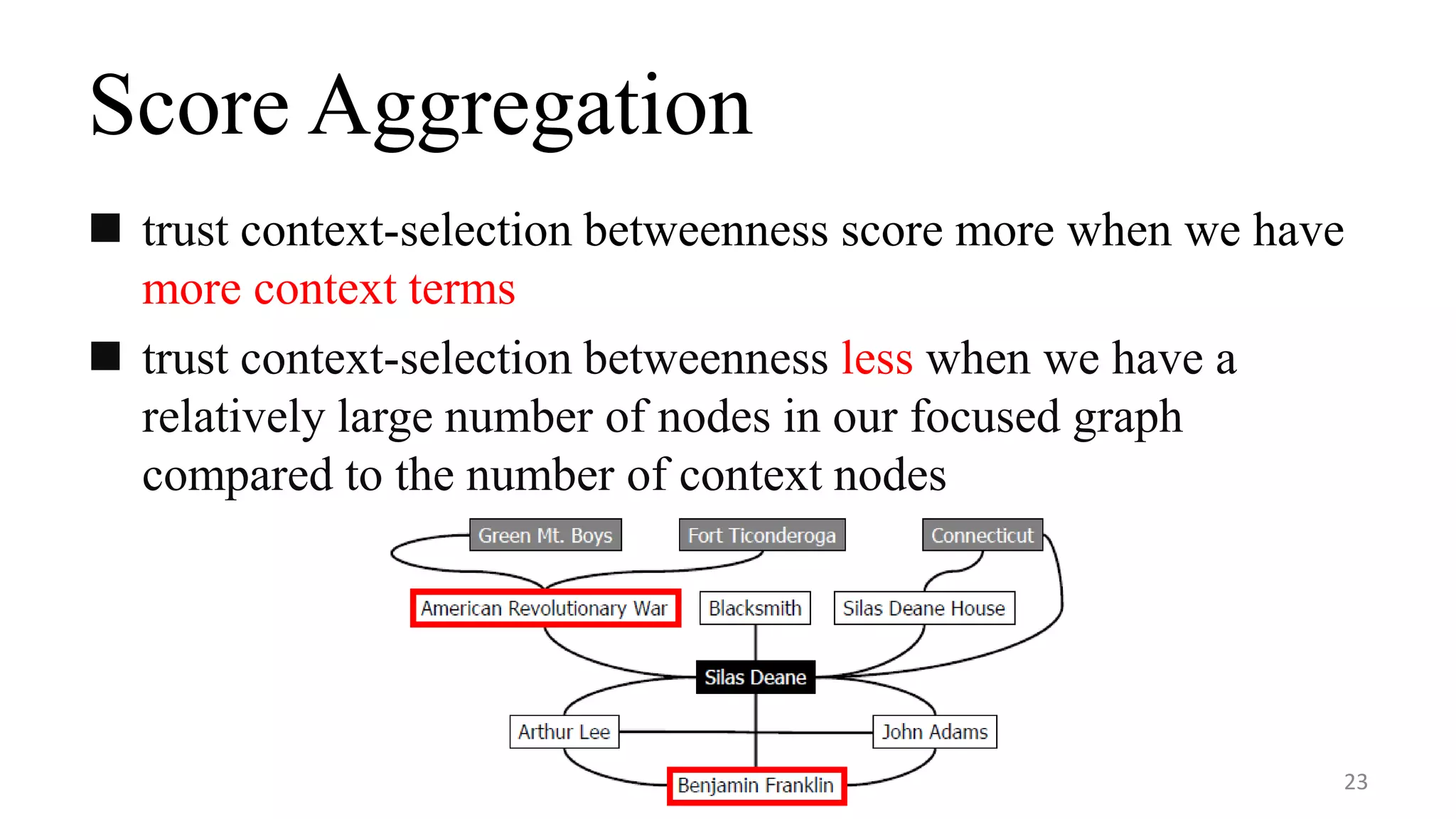
Score Aggregation
 Trust context-selection betweenness score more when we have
more context terms
 Trust context-selection betweenness less when we have a
relatively large number of nodes in our focused graph
compared to the number of context nodes
23
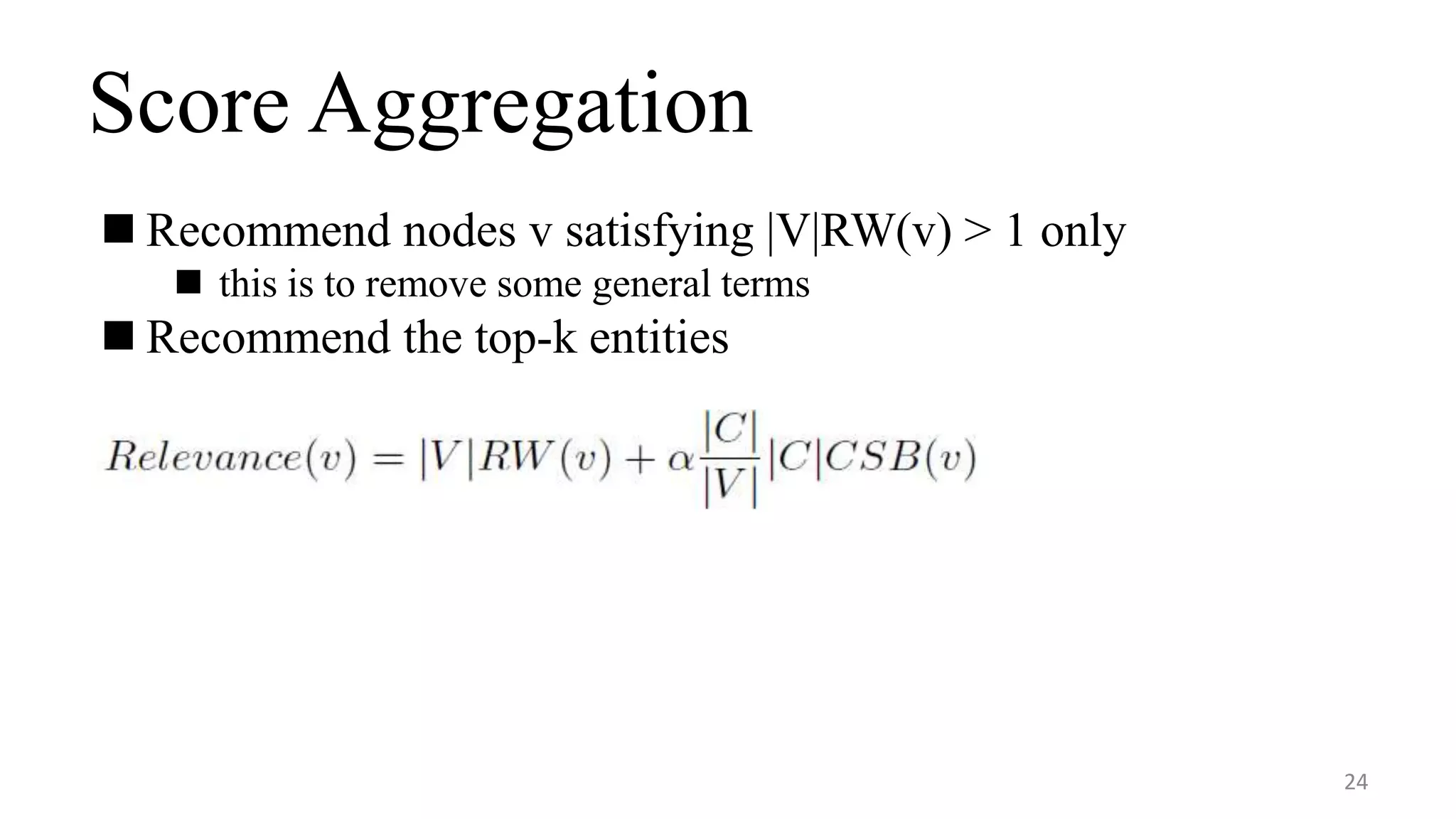
Score Aggregation
24
 Recommend nodes v satisfying |V|RW(v) > 1 only
 this is to remove some general terms
 Recommend the top-k entities
Outline
Introduction
Method
Experiment
Conclusion
25
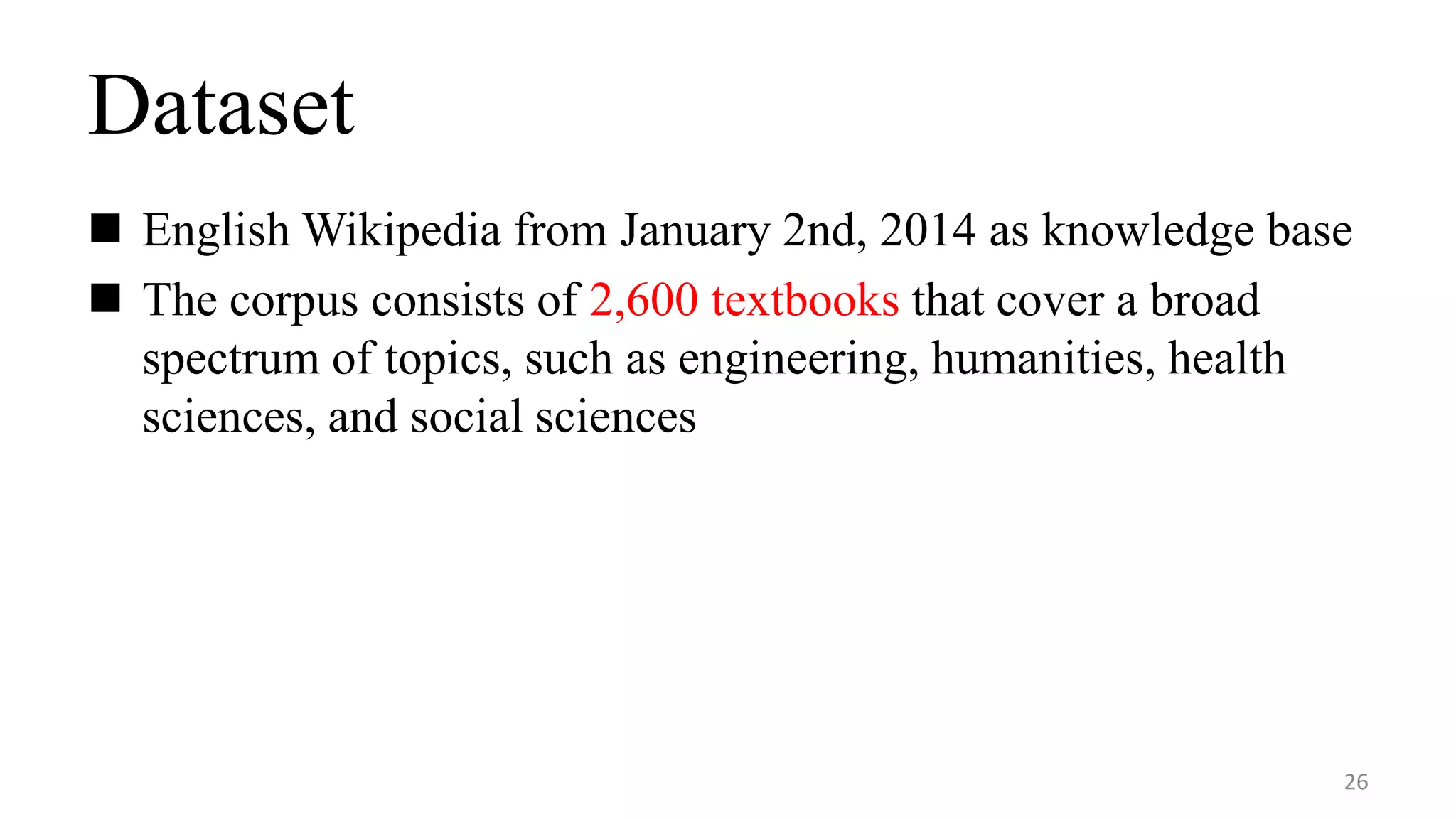
Dataset
 English Wikipedia from January 2nd, 2014 as knowledge base
 The corpus consists of 2,600 textbooks that cover a broad
spectrum of topics, such as engineering, humanities, health
sciences, and social sciences
26
Dataset
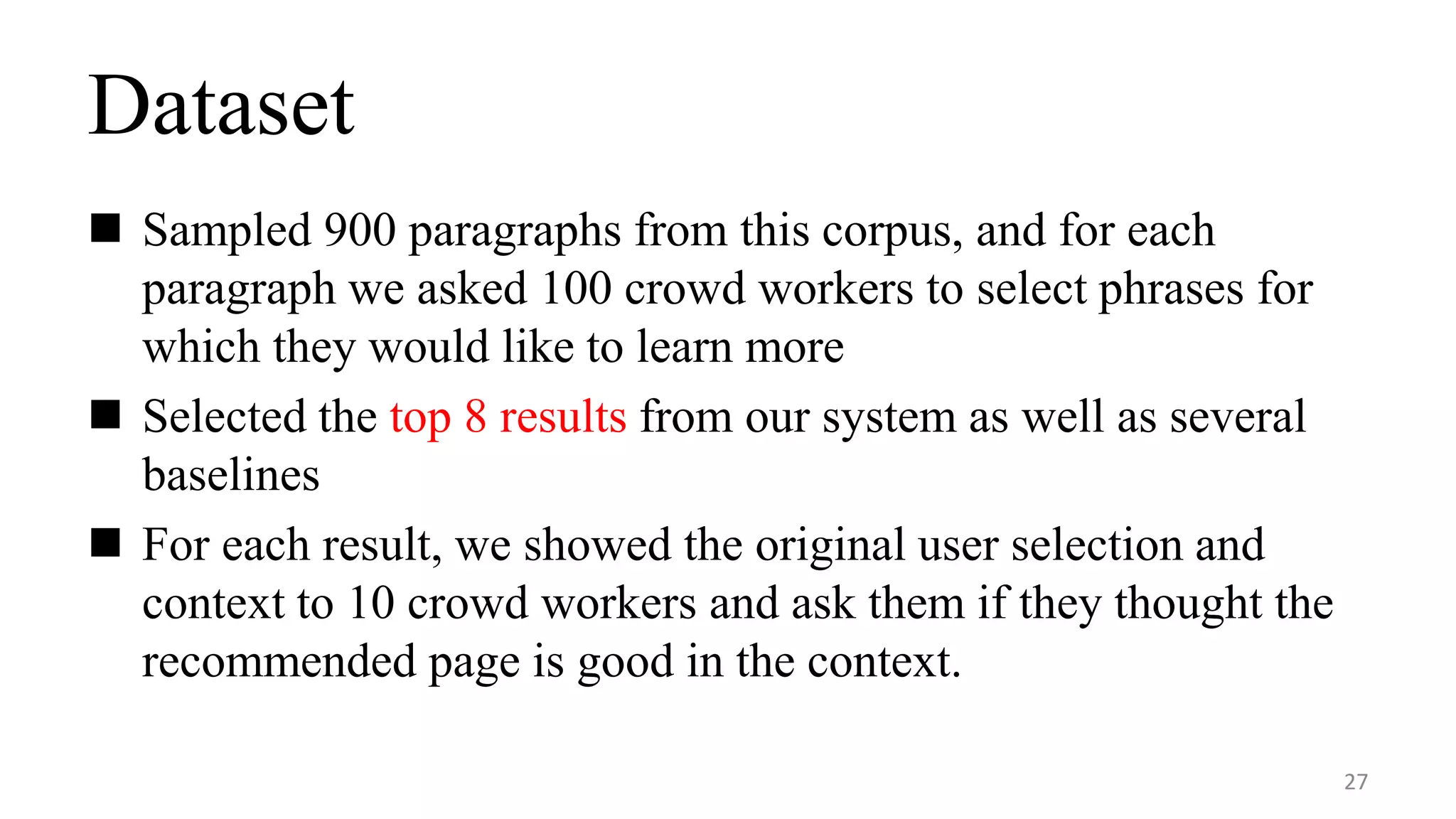
 Sampled 900 paragraphs from this corpus, and for each
paragraph we asked 100 crowd workers to select phrases for
which they would like to learn more
 Selected the top 8 results from our system as well as several
baselines
 For each result, we showed the original user selection and
context to 10 crowd workers and ask them if they thought the
recommended page is good in the context.
27
Dataset
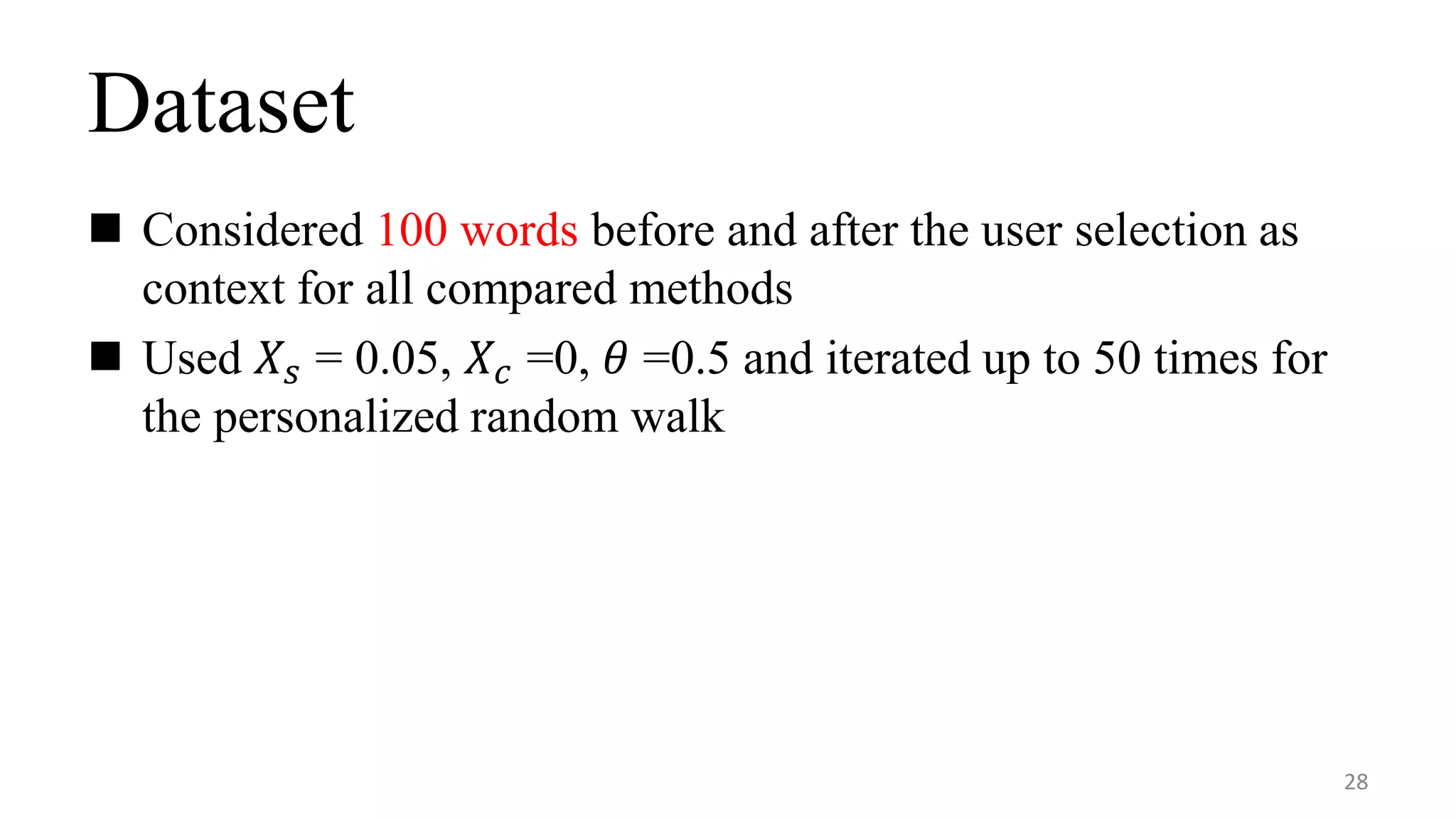
 Considered 100 words before and after the user selection as
context for all compared methods
 Used 𝑋𝑠 = 0.05, 𝑋𝑐 =0, 𝜃 =0.5 and iterated up to 50 times for
the personalized random walk
28
Results
29
Results
30
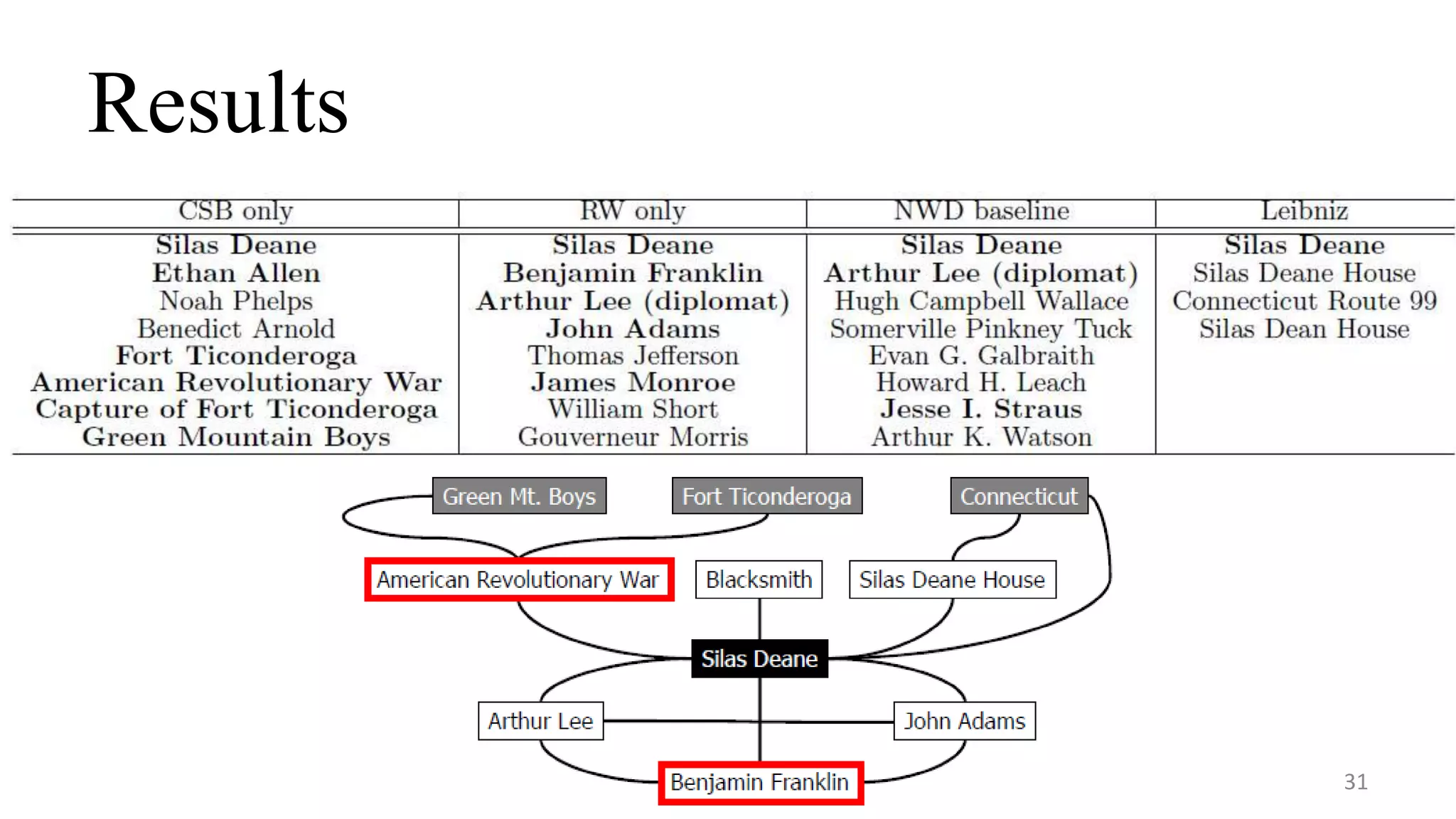
Results
31
Outline
Introduction
Method
Experiment
Conclusion
32
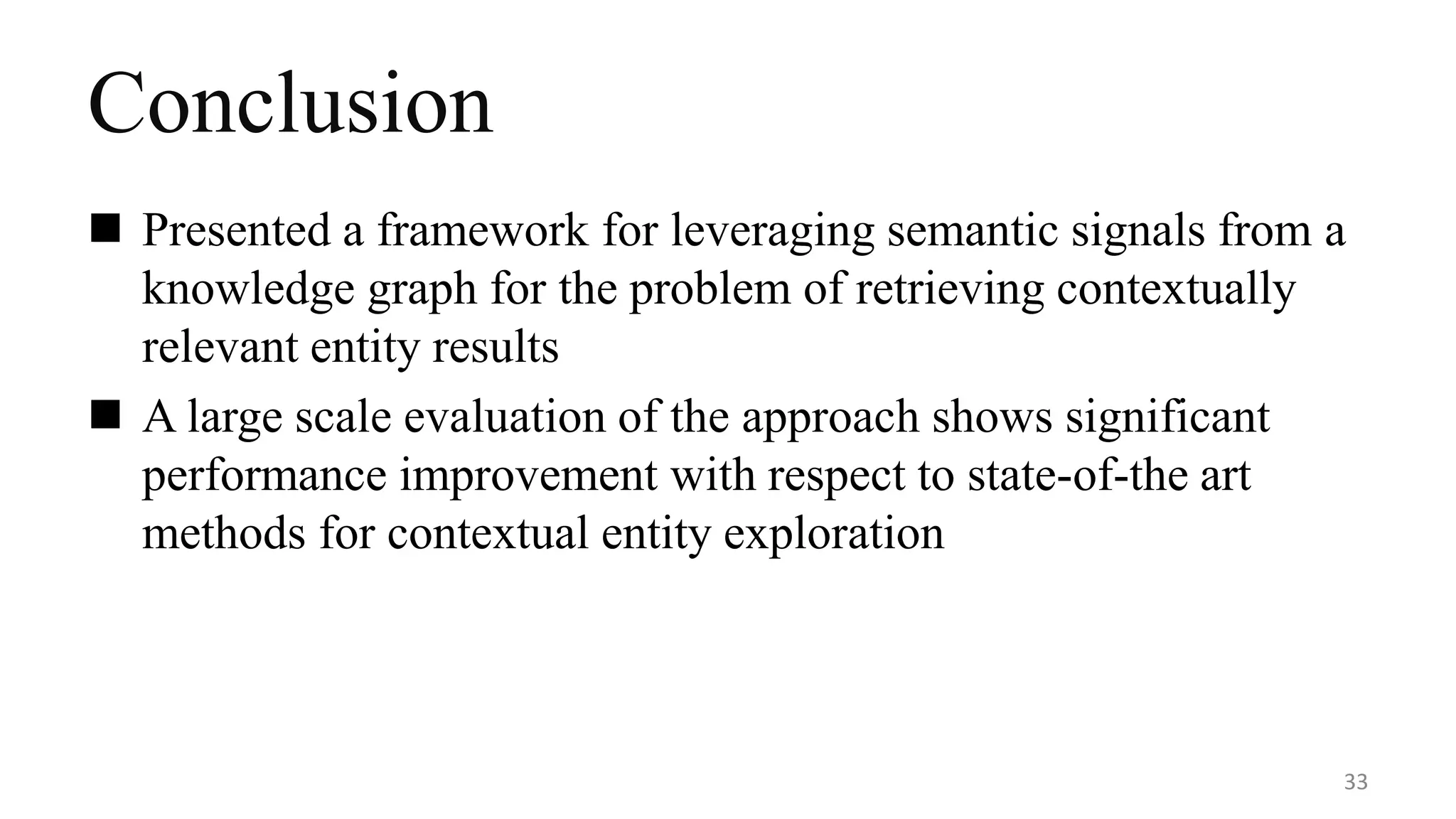
Conclusion
 Presented a framework for leveraging semantic signals from a
knowledge graph for the problem of retrieving contextually
relevant entity results
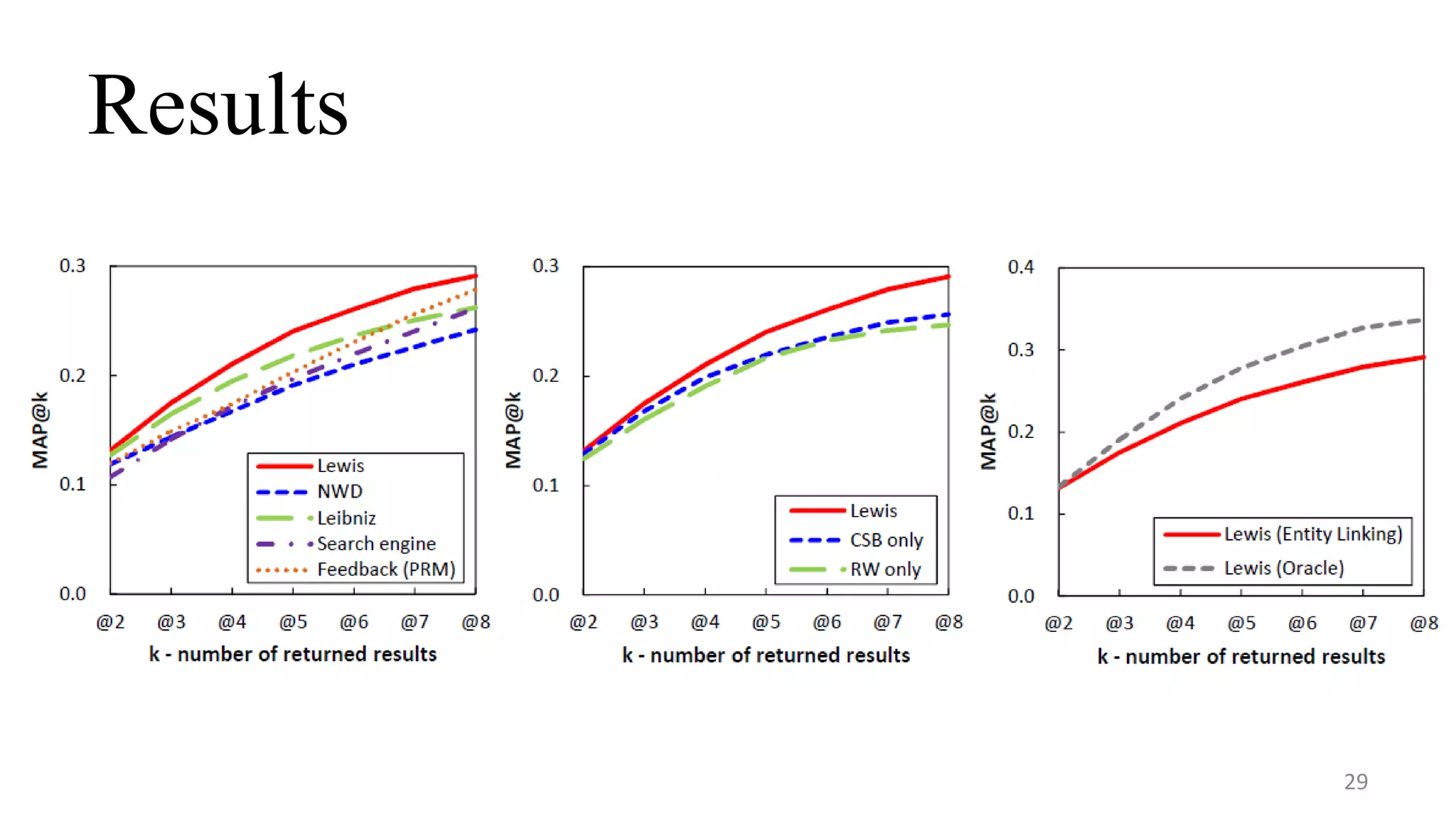
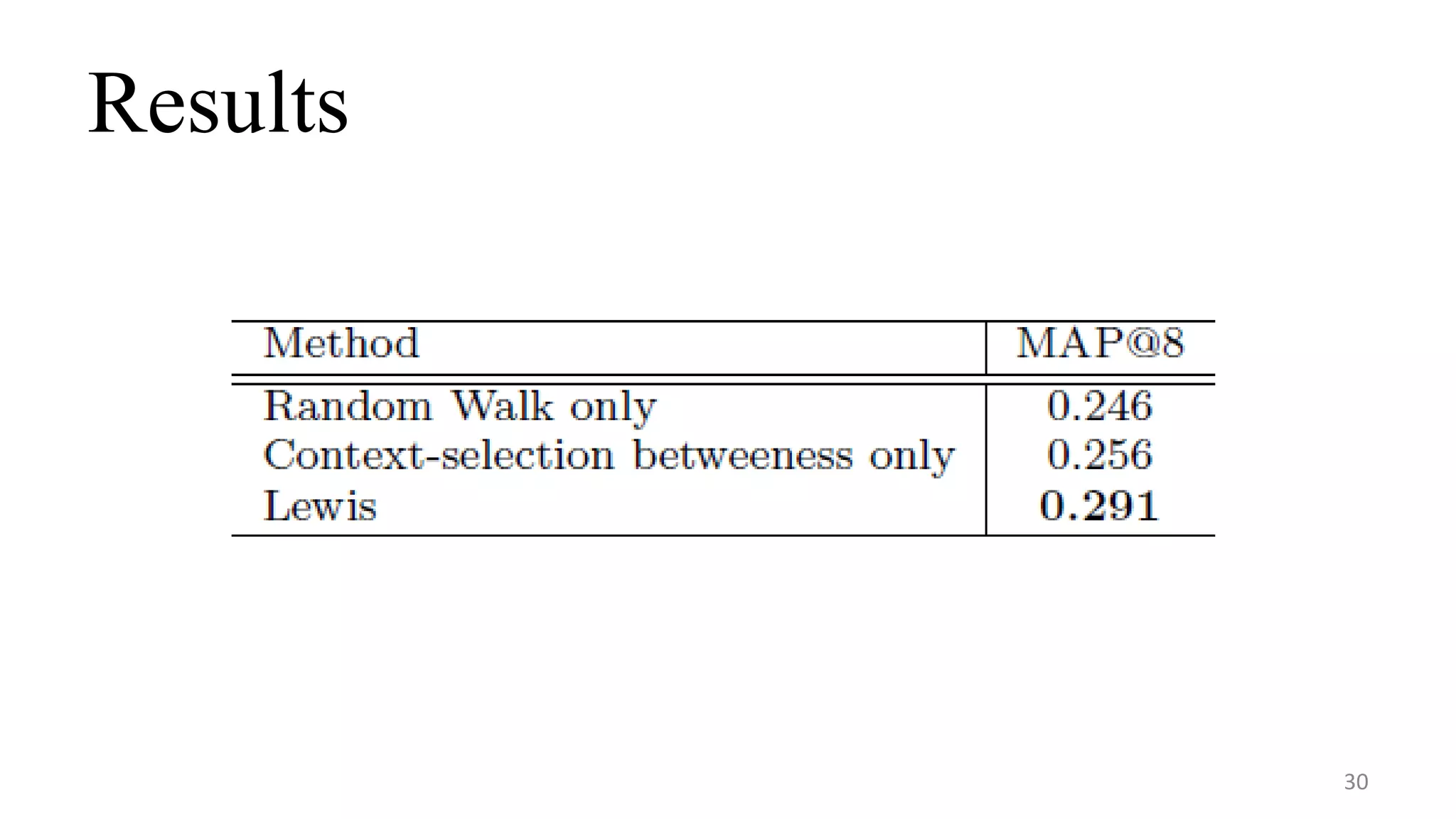
 A large scale evaluation of the approach shows significant
performance improvement with respect to state-of-the art
methods for contextual entity exploration
33
Thanks for listening
34
REFERENCES
41. E. Yeh, D. Ramage, C. D. Manning, E. Agirre, and A. Soroa. Wikiwalk:
Random walks on wikipedia for semantic relatedness. In Proc. of the
Workshop on Graph-based Methods for Natural Language rocessing,2009
35

Leveraging Knowledge Bases for Contextual Entity Exploration Categories

  • 1.
    Leveraging Knowledge Bases forContextual Entity Exploration Categories Date:2015/09/17 Author:Joonseok Lee, Ariel Fuxman, Bo Zhao, Yuanhua Lv Source:KDD'15 Advisor:Jia-ling Koh Spearker:LIN,CI-JIE 1
  • 2.
  • 3.
  • 4.
    Introduction  Users areconstantly switching back and forth from applications where they consume or create content to search engines where they satisfy their information needs 4
  • 5.
    Introduction  Existing workin the literature that can be applied to this problem takes a standard bag-of-words information retrieval approach  syntactic match 5
  • 6.
    Introduction Goal  Present asystem called Lewis for retrieving contextually relevant entity results 6
  • 7.
  • 8.
  • 9.
  • 10.
    Focused Subgraph Construction Mapping the user selection S and the context C to nodes in the knowledge graph  Any off-the-shelf entity linking system[9] 10
  • 11.
    Focused Subgraph Construction Black for the user selection node  Gray for context nodes  White is the set of entities reachable from nodes of user selection and context entities in the graph through a path of length one  Use the hyperlink structure of Wikipedia as the edges of the knowledge graph 11
  • 12.
  • 13.
    Context-Selection Betweenness  Capturesto what extent a given candidate node serves as a bridge between the user selection node and the context nodes 13
  • 14.
    Normalized Wikipedia Distance(NWD)  A measure of semantic distance of two nodes on graph  𝐼 𝑥 is the set of incoming edges to the node x  V is the set of all nodes in Wikipedia 14 NWD(Silas Deane,Green Mt. Boys) = log max 7,1 −log(0) log 𝑉 −𝑙𝑜𝑔(min(7,1)) = log 7 −0 log 𝑉 −log(1)
  • 15.
    Context-Selection Betweenness 15 𝑙(𝑠, 𝑐)is the length of shortest path between user selection node s and context node c k is the number of different shortest paths between s and c sp(s,c) is a set of all shortest paths between s and c
  • 16.
    Context-Selection Betweenness 16 CSB(War) = 1 𝑍 ∗ ( 𝑤𝑆𝑖𝑙𝑎𝑠 𝐷𝑒𝑎𝑛𝑒,𝐺𝑟𝑒𝑒𝑛 𝑀𝑡.𝐵𝑜𝑦𝑠 1∗𝑙 𝑆𝑖𝑙𝑎𝑠 𝐷𝑒𝑎𝑛𝑒,𝐺𝑟𝑒𝑒𝑛 𝑀𝑡.𝐵𝑜𝑦𝑠 + 𝑤 𝑆𝑖𝑙𝑎𝑠 𝐷𝑒𝑎𝑛𝑒,𝐹𝑜𝑟𝑡 𝑇𝑖𝑐𝑜𝑛𝑑𝑒𝑟𝑜𝑔𝑎 1∗𝑙 𝑆𝑖𝑙𝑎𝑠 𝐷𝑒𝑎𝑛𝑒,𝐹𝑜𝑟𝑡 𝑇𝑖𝑐𝑜𝑛𝑑𝑒𝑟𝑜𝑔𝑎 )
  • 17.
  • 18.
    Personalized Random Walk The random walk[41] is simulating the behavior of a user reading articles 18
  • 19.
    Personalized Random Walk The random walk scores of a node are probability scores and thus sum up to 1  Personalized random walk retrieves semantically relevant pages from the query and context terms by assigning higher probability (score) to closely and densely connected nodes from the user selection and context nodes 19
  • 20.
  • 21.
    Score Aggregation  Theexpected value of RW(v) gets smaller when we have more nodes in the graph  consider |V|RW(v) instead of RW(v) itself, where V is the set of nodes in the focused graph  interpret this score as how many times the node is preferred to visit compared to expectation 21
  • 22.
    Score Aggregation  TheCSB(v) score for each node tends to be inversely proportional to the number of context nodes  consider |C|CSB(v) instead of CSB(v)  interpret |C|CSB(v) score as the expected number of shortest paths from user selection s to any context node visiting v in the meanwhile 22
  • 23.
    Score Aggregation  Trustcontext-selection betweenness score more when we have more context terms  Trust context-selection betweenness less when we have a relatively large number of nodes in our focused graph compared to the number of context nodes 23
  • 24.
    Score Aggregation 24  Recommendnodes v satisfying |V|RW(v) > 1 only  this is to remove some general terms  Recommend the top-k entities
  • 25.
  • 26.
    Dataset  English Wikipediafrom January 2nd, 2014 as knowledge base  The corpus consists of 2,600 textbooks that cover a broad spectrum of topics, such as engineering, humanities, health sciences, and social sciences 26
  • 27.
    Dataset  Sampled 900paragraphs from this corpus, and for each paragraph we asked 100 crowd workers to select phrases for which they would like to learn more  Selected the top 8 results from our system as well as several baselines  For each result, we showed the original user selection and context to 10 crowd workers and ask them if they thought the recommended page is good in the context. 27
  • 28.
    Dataset  Considered 100words before and after the user selection as context for all compared methods  Used 𝑋𝑠 = 0.05, 𝑋𝑐 =0, 𝜃 =0.5 and iterated up to 50 times for the personalized random walk 28
  • 29.
  • 30.
  • 31.
  • 32.
  • 33.
    Conclusion  Presented aframework for leveraging semantic signals from a knowledge graph for the problem of retrieving contextually relevant entity results  A large scale evaluation of the approach shows significant performance improvement with respect to state-of-the art methods for contextual entity exploration 33
  • 34.
  • 35.
    REFERENCES 41. E. Yeh,D. Ramage, C. D. Manning, E. Agirre, and A. Soroa. Wikiwalk: Random walks on wikipedia for semantic relatedness. In Proc. of the Workshop on Graph-based Methods for Natural Language rocessing,2009 35