







Workshop 1 Writing Learning Outcomes Training Seminar Bologna Experts Madrid  June 30th - July 1st 2008
Introductory Questions Do we need this workshop? Why can´t we write learning outcomes right away? What is really different? Just rhetorics – or? Who are we in here? Let´s introduce ourselves Why do we meet? What are our expectations? Is the objective of the session suitable, acceptable, feasible, sustainable?
Introductory Questions What kind of material could help? Would a case study help at this time? Which information do we require about a case? Possible Examples National Framework Sectoral Framework Institutional Framework Module description
Session 1 From the identification of social and employability needs to profile definitions
Why  to start  and  how  to start  an academic programme?
Tuning Profile (of a degree programme) Developed from awareness of social needs Outcomes of consultation process of stakeholders Diversity based on institutional strengths In dialogue with European reference points Described in  competences  and  learning outcomes
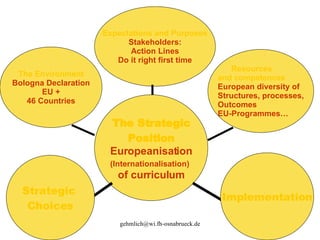
The Strategic Position Europeanisation (Internationalisation)   of curriculum The Environment Bologna Declaration EU + 46 Countries Expectations and Purposes Stakeholders: Action Lines Do it right first time Resources  and competences European diversity of  Structures, processes, Outcomes EU-Programmes… Strategic  Choices Implementation
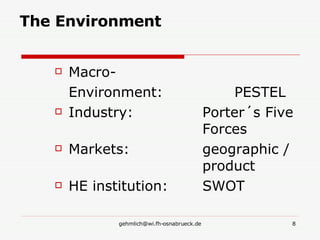
The Environment Macro- Environment:      PESTEL Industry:      Porter´s Five    Forces Markets:   geographic /    product HE institution:   SWOT
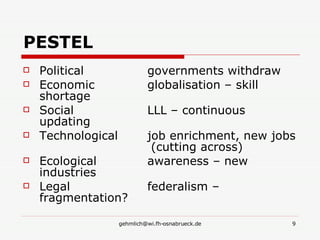
PESTEL Political   governments withdraw Economic   globalisation – skill shortage Social   LLL – continuous updating Technological   job enrichment, new jobs  (cutting across) Ecological   awareness – new industries Legal   federalism – fragmentation?
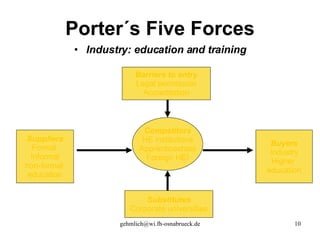
Porter´s Five Forces Industry: education and training Competitors HE institutions Apprenticeships Foreign HEI Suppliers Formal  Informal non-formal  education Buyers Industry Higher  education Substitutes Corporate universities Barriers to entry Legal permission Accreditation
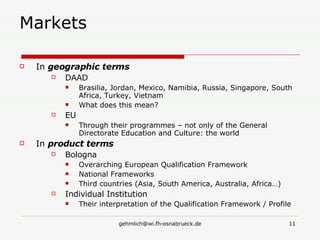
Markets In  geographic terms DAAD Brasilia, Jordan, Mexico, Namibia, Russia, Singapore, South Africa, Turkey, Vietnam What does this mean? EU Through their programmes – not only of the General Directorate Education and Culture: the world In  product terms Bologna Overarching European Qualification Framework National Frameworks Third countries (Asia, South America, Australia, Africa…) Individual Institution Their interpretation of the Qualification Framework / Profile
Ressources and Competences Bologna,  a unique selling point?
SWOT European higher education institutions: Strengths  Grants, living costs Variety of cultures…. Weaknesses Not one language  (EAIE experience) No transparency Seen in the light of the analyses of the environment, expectations and purposes to arrive at Opportunities and Threats
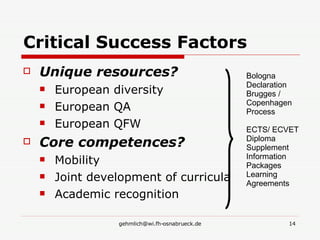
Critical Success Factors Unique resources? European diversity European QA European QFW Core competences? Mobility Joint development of curricula Academic recognition Bologna Declaration Brugges / Copenhagen Process ECTS/ ECVET Diploma Supplement Information Packages Learning Agreements
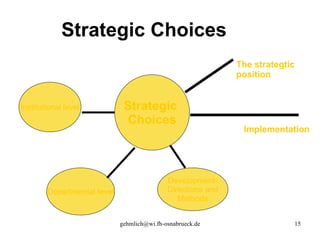
Strategic Choices Strategic  Choices Institutional level Departmental level Development- Directions and Methods The strategtic position Implementation
Why  /  When   should consultation of stakeholders take place?
Ideas Scenario technique might help: Highest impact - most unlikely
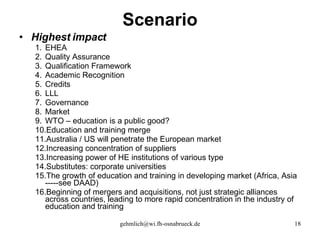
Scenario Highest impact EHEA Quality Assurance Qualification Framework Academic Recognition Credits LLL Governance Market WTO – education is a public good? Education and training merge Australia / US will penetrate the European market Increasing concentration of suppliers Increasing power of HE institutions of various type Substitutes: corporate universities The growth of education and training in developing market (Africa, Asia -----see DAAD) Beginning of mergers and acquisitions, not just strategic alliances across countries, leading to more rapid concentration in the industry of education and training
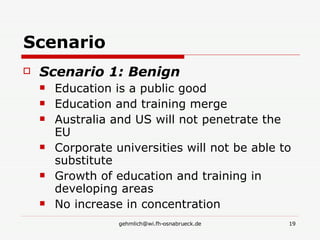
Scenario Scenario 1: Benign Education is a public good Education and training merge Australia and US will not penetrate the EU Corporate universities will not be able to substitute Growth of education and training in developing areas No increase in concentration
Scenario  Scenario 2: Hostile Education is a market good / service Education and training do not merge Australia and US will penetrate the EU Corporate universities will be able to substitute No growth of education and training in developing areas Increase in concentration
Scenario Scenario 3:„Industry wisdom“ Education is a market good / service Education and training merge Australia and US will not penetrate the EU Corporate universities will not be able to substitute Growth of education and training in developing areas No increase in concentration but in cooperation (platform, hub-and-spoke, one-stop-shop)
Consequences:  Example  cooperation   Types Partnerships Networks Joint ventures Strategic alliances Franchising
  Consequences:  Example  cooperation   Forms of cooperation  Strategic Alliances „ Dual“ Study-Programmes Models for Curricula design Platform Hub-and-spoke One-stop-shop Screwdriver institution
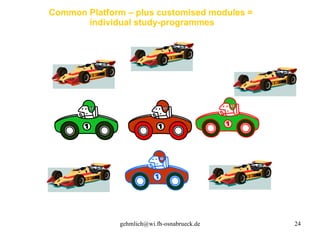
Common Platform – plus customised modules =  individual study-programmes
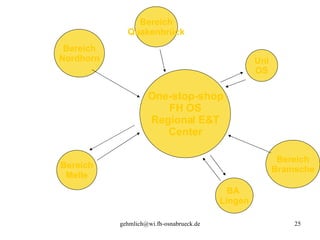
One-stop-shop FH OS Regional E&T Center Uni OS BA  Lingen Bereich Nordhorn Bereich Bramsche Bereich Quakenbrück Bereich Melle
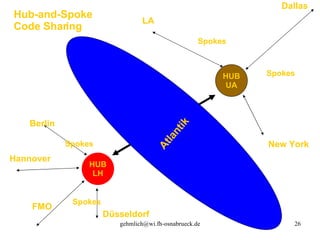
HUB LH HUB UA Atlantik Hub-and-Spoke Code Sharing Berlin FMO Düsseldorf Hannover LA New York Dallas Spokes Spokes Spokes Spokes
Consequences:  Example  cooperation WTO Dumping Local content Rule of origin
Consequences: Examples of  concentration Mergers (floated on the Stock Exchange, Humboldt Berkeley University) Acquisitions (floated, Chelsea Abramovitch University) Corporate Universities (floated, Microsoft Intel Google University) ….. The issue: Shareholder value
Which  methods  of consultation might be applied?
Regular platform Questionnaire Events Teaching Projects Dissertations….. Examples
How  to choose the relevant stakeholders  and  about which   issues should consultation take place?
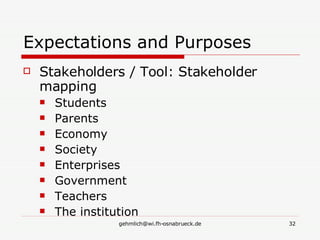
Expectations and Purposes Stakeholders / Tool: Stakeholder mapping Students Parents Economy Society Enterprises Government Teachers The institution
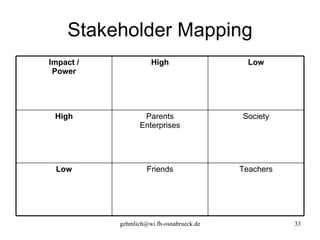
Stakeholder Mapping Teachers Friends Low Society Parents Enterprises High Low High Impact / Power
Exercise: Prepare a profile  (Each of you) Write a short profile of one of the bachelor study programme in which you are involved: pp 135-139
Group reflection
Session 2 From profile description to identification of critical competences and learning outcomes for the degree programme
Which methods  can be applied to select the main generic and subject specific competences?
When of relevance,  to what extent  should particular professions play a role in this selection process?
Who  should play a role in the selection of key competences?  What  should be their role?
How  can progression of learning outcomes be secured regarding the competence development of students in degree design?
Exercise: Prepare a set of learning outcomes LO can be written for a study-programme as well as for individual modules or course units pp154-155 pp147-159
Group reflection
Workshop 2 Using Learning Outcomes Training Seminar Bologna Experts Madrid  June 30th - July 1st 2008
Session 3 From learning outcomes to a suitable structure and a fair workload weight of the degree programme units
Which   methods   can be applied  to programme   the learning units ?
If thought useful,  how  to decide   on a  modular structure ?
Module Definition  A module is a self-contained, formally structured learning experience with a coherent and explicit set of learning outcomes and assessment criteria. Require  Define learning outcomes Allocate credits Facilitate Design of individual study-programmes (profiles) modularisation Different routes to identifiable degrees, certificates, profiles etc.
ECTS Good Practice to the advantage of LLL Modules are not a prerequisite for the introduction of ECTS but they facilitate it. A module carries credit as a whole. It is not possible to achieve credits for parts of a module.
Good Practice It is advisable that  a module lasts for a specified period of time preferably for no longer than one semester A module should neither be too small nor too large It is suggested that a module should not carry less than 5credits.  It is also proposed that a module should carry 5 or a multiple of 5 credits.
Which methods   can be applied to decide on the appropriate  weight of ECTS credits ?
Student-centred system Based on workload required to achieve learning outcomes “ Convention” that 60 credits represents an annual workload of a full-time student Allocated to all aspects of study programme Based on completion + assessment Respects the Learning Agreement between student and institutions (transfer + accumulation) ECTS - Key Features
ECTS – Key Features   About 40 weeks of full-time learning Workload of 1,500 – 1,800 hrs per year  Normally 1 credit equals 25-30 hours Time to be invested by the learner to achieve the learning outcomes, including independent studies Credits are allocated in such a way that the first academic degree can be obtained on the basis of 180-240 credits predetermined in a respective study-programme This has to be stated in the ECTS documents
ECTS and Qualifications Framework By the „ percentage“, „analytical“ or „determination“ method  and by  formative evaluation . A requirement is to know the profile of the learner or have at least an idea about him or her.
Which  leading criteria should play a role in the  credit allocation ?
Terminology Workload A quantitative measure of all learning activities that may be feasibly required for the achievement of the learning outcomes Credit A quantified means of expressing the volume of learning based on the achievement of learning outcomes and their associated workload
Workload in detail In ECTS the workload comprises the time spent for lectures, seminars, self-directed studies, preparation for and participation in examinations, etc. with the objective to learn
ECTS - Links Workload   =  Learning Learning assessed = Credits Requirement = Learning has to be  assessed this must  be possible) „ Assessability“ = by defining the  learning outcomes  Need = adequate method  of assessment
Exercise: Outline of a degree programme Prepare an outline of a degree programme in terms of units/modules with their appropriate weight of ECTS credits One for the degree programme  Chapter 2 Should be developed with the LO to be achieved and the competences to be developed in mind. It should contain possible course unit titles and/or topics to cover.  One in which the units are related to the competences to develop  Chapter 42 pp 88 Identify the competences to be developed for one course unit and write the set of related LO
Group reflection
Session 4 From learning outcomes to best strategies for teaching, learning and assessment
In  how far   does the new paradigm of student centred learning have an  impact on the teaching, learning and assessment  approaches to be applied?
Can  new approaches   be identified  in your field which suits this new paradigm better?
Can  convincing arguments   be identified to move from more traditional approaches to the new identified ones?
Should the  design of a course unit  start with the identification of the method to assess the learning outcomes identified for the unit?
Exercise: Prepare a document in which the ideal teaching, learning and assessment methods/ strategies for one educational unit are described Tuning planning form
Group reflection

Workshop 1 Writing Learning Outcomes

  • 1.
    Workshop 1 WritingLearning Outcomes Training Seminar Bologna Experts Madrid June 30th - July 1st 2008
  • 2.
    Introductory Questions Dowe need this workshop? Why can´t we write learning outcomes right away? What is really different? Just rhetorics – or? Who are we in here? Let´s introduce ourselves Why do we meet? What are our expectations? Is the objective of the session suitable, acceptable, feasible, sustainable?
  • 3.
    Introductory Questions Whatkind of material could help? Would a case study help at this time? Which information do we require about a case? Possible Examples National Framework Sectoral Framework Institutional Framework Module description
  • 4.
    Session 1 Fromthe identification of social and employability needs to profile definitions
  • 5.
    Why tostart and how to start an academic programme?
  • 6.
    Tuning Profile (ofa degree programme) Developed from awareness of social needs Outcomes of consultation process of stakeholders Diversity based on institutional strengths In dialogue with European reference points Described in competences and learning outcomes
  • 7.
    The Strategic PositionEuropeanisation (Internationalisation) of curriculum The Environment Bologna Declaration EU + 46 Countries Expectations and Purposes Stakeholders: Action Lines Do it right first time Resources and competences European diversity of Structures, processes, Outcomes EU-Programmes… Strategic Choices Implementation
  • 8.
    The Environment Macro-Environment: PESTEL Industry: Porter´s Five Forces Markets: geographic / product HE institution: SWOT
  • 9.
    PESTEL Political governments withdraw Economic globalisation – skill shortage Social LLL – continuous updating Technological job enrichment, new jobs (cutting across) Ecological awareness – new industries Legal federalism – fragmentation?
  • 10.
    Porter´s Five ForcesIndustry: education and training Competitors HE institutions Apprenticeships Foreign HEI Suppliers Formal Informal non-formal education Buyers Industry Higher education Substitutes Corporate universities Barriers to entry Legal permission Accreditation
  • 11.
    Markets In geographic terms DAAD Brasilia, Jordan, Mexico, Namibia, Russia, Singapore, South Africa, Turkey, Vietnam What does this mean? EU Through their programmes – not only of the General Directorate Education and Culture: the world In product terms Bologna Overarching European Qualification Framework National Frameworks Third countries (Asia, South America, Australia, Africa…) Individual Institution Their interpretation of the Qualification Framework / Profile
  • 12.
    Ressources and CompetencesBologna, a unique selling point?
  • 13.
    SWOT European highereducation institutions: Strengths Grants, living costs Variety of cultures…. Weaknesses Not one language (EAIE experience) No transparency Seen in the light of the analyses of the environment, expectations and purposes to arrive at Opportunities and Threats
  • 14.
    Critical Success FactorsUnique resources? European diversity European QA European QFW Core competences? Mobility Joint development of curricula Academic recognition Bologna Declaration Brugges / Copenhagen Process ECTS/ ECVET Diploma Supplement Information Packages Learning Agreements
  • 15.
    Strategic Choices Strategic Choices Institutional level Departmental level Development- Directions and Methods The strategtic position Implementation
  • 16.
    Why / When should consultation of stakeholders take place?
  • 17.
    Ideas Scenario techniquemight help: Highest impact - most unlikely
  • 18.
    Scenario Highest impactEHEA Quality Assurance Qualification Framework Academic Recognition Credits LLL Governance Market WTO – education is a public good? Education and training merge Australia / US will penetrate the European market Increasing concentration of suppliers Increasing power of HE institutions of various type Substitutes: corporate universities The growth of education and training in developing market (Africa, Asia -----see DAAD) Beginning of mergers and acquisitions, not just strategic alliances across countries, leading to more rapid concentration in the industry of education and training
  • 19.
    Scenario Scenario 1:Benign Education is a public good Education and training merge Australia and US will not penetrate the EU Corporate universities will not be able to substitute Growth of education and training in developing areas No increase in concentration
  • 20.
    Scenario Scenario2: Hostile Education is a market good / service Education and training do not merge Australia and US will penetrate the EU Corporate universities will be able to substitute No growth of education and training in developing areas Increase in concentration
  • 21.
    Scenario Scenario 3:„Industrywisdom“ Education is a market good / service Education and training merge Australia and US will not penetrate the EU Corporate universities will not be able to substitute Growth of education and training in developing areas No increase in concentration but in cooperation (platform, hub-and-spoke, one-stop-shop)
  • 22.
    Consequences: Example cooperation Types Partnerships Networks Joint ventures Strategic alliances Franchising
  • 23.
    Consequences: Example cooperation Forms of cooperation Strategic Alliances „ Dual“ Study-Programmes Models for Curricula design Platform Hub-and-spoke One-stop-shop Screwdriver institution
  • 24.
    Common Platform –plus customised modules = individual study-programmes
  • 25.
    One-stop-shop FH OSRegional E&T Center Uni OS BA Lingen Bereich Nordhorn Bereich Bramsche Bereich Quakenbrück Bereich Melle
  • 26.
    HUB LH HUBUA Atlantik Hub-and-Spoke Code Sharing Berlin FMO Düsseldorf Hannover LA New York Dallas Spokes Spokes Spokes Spokes
  • 27.
    Consequences: Example cooperation WTO Dumping Local content Rule of origin
  • 28.
    Consequences: Examples of concentration Mergers (floated on the Stock Exchange, Humboldt Berkeley University) Acquisitions (floated, Chelsea Abramovitch University) Corporate Universities (floated, Microsoft Intel Google University) ….. The issue: Shareholder value
  • 29.
    Which methods of consultation might be applied?
  • 30.
    Regular platform QuestionnaireEvents Teaching Projects Dissertations….. Examples
  • 31.
    How tochoose the relevant stakeholders and about which issues should consultation take place?
  • 32.
    Expectations and PurposesStakeholders / Tool: Stakeholder mapping Students Parents Economy Society Enterprises Government Teachers The institution
  • 33.
    Stakeholder Mapping TeachersFriends Low Society Parents Enterprises High Low High Impact / Power
  • 34.
    Exercise: Prepare aprofile (Each of you) Write a short profile of one of the bachelor study programme in which you are involved: pp 135-139
  • 35.
  • 36.
    Session 2 Fromprofile description to identification of critical competences and learning outcomes for the degree programme
  • 37.
    Which methods can be applied to select the main generic and subject specific competences?
  • 38.
    When of relevance, to what extent should particular professions play a role in this selection process?
  • 39.
    Who shouldplay a role in the selection of key competences? What should be their role?
  • 40.
    How canprogression of learning outcomes be secured regarding the competence development of students in degree design?
  • 41.
    Exercise: Prepare aset of learning outcomes LO can be written for a study-programme as well as for individual modules or course units pp154-155 pp147-159
  • 42.
  • 43.
    Workshop 2 UsingLearning Outcomes Training Seminar Bologna Experts Madrid June 30th - July 1st 2008
  • 44.
    Session 3 Fromlearning outcomes to a suitable structure and a fair workload weight of the degree programme units
  • 45.
    Which methods can be applied to programme the learning units ?
  • 46.
    If thought useful, how to decide on a modular structure ?
  • 47.
    Module Definition A module is a self-contained, formally structured learning experience with a coherent and explicit set of learning outcomes and assessment criteria. Require Define learning outcomes Allocate credits Facilitate Design of individual study-programmes (profiles) modularisation Different routes to identifiable degrees, certificates, profiles etc.
  • 48.
    ECTS Good Practiceto the advantage of LLL Modules are not a prerequisite for the introduction of ECTS but they facilitate it. A module carries credit as a whole. It is not possible to achieve credits for parts of a module.
  • 49.
    Good Practice Itis advisable that a module lasts for a specified period of time preferably for no longer than one semester A module should neither be too small nor too large It is suggested that a module should not carry less than 5credits. It is also proposed that a module should carry 5 or a multiple of 5 credits.
  • 50.
    Which methods can be applied to decide on the appropriate weight of ECTS credits ?
  • 51.
    Student-centred system Basedon workload required to achieve learning outcomes “ Convention” that 60 credits represents an annual workload of a full-time student Allocated to all aspects of study programme Based on completion + assessment Respects the Learning Agreement between student and institutions (transfer + accumulation) ECTS - Key Features
  • 52.
    ECTS – KeyFeatures About 40 weeks of full-time learning Workload of 1,500 – 1,800 hrs per year Normally 1 credit equals 25-30 hours Time to be invested by the learner to achieve the learning outcomes, including independent studies Credits are allocated in such a way that the first academic degree can be obtained on the basis of 180-240 credits predetermined in a respective study-programme This has to be stated in the ECTS documents
  • 53.
    ECTS and QualificationsFramework By the „ percentage“, „analytical“ or „determination“ method and by formative evaluation . A requirement is to know the profile of the learner or have at least an idea about him or her.
  • 54.
    Which leadingcriteria should play a role in the credit allocation ?
  • 55.
    Terminology Workload Aquantitative measure of all learning activities that may be feasibly required for the achievement of the learning outcomes Credit A quantified means of expressing the volume of learning based on the achievement of learning outcomes and their associated workload
  • 56.
    Workload in detailIn ECTS the workload comprises the time spent for lectures, seminars, self-directed studies, preparation for and participation in examinations, etc. with the objective to learn
  • 57.
    ECTS - LinksWorkload = Learning Learning assessed = Credits Requirement = Learning has to be assessed this must be possible) „ Assessability“ = by defining the learning outcomes Need = adequate method of assessment
  • 58.
    Exercise: Outline ofa degree programme Prepare an outline of a degree programme in terms of units/modules with their appropriate weight of ECTS credits One for the degree programme Chapter 2 Should be developed with the LO to be achieved and the competences to be developed in mind. It should contain possible course unit titles and/or topics to cover. One in which the units are related to the competences to develop Chapter 42 pp 88 Identify the competences to be developed for one course unit and write the set of related LO
  • 59.
  • 60.
    Session 4 Fromlearning outcomes to best strategies for teaching, learning and assessment
  • 61.
    In howfar does the new paradigm of student centred learning have an impact on the teaching, learning and assessment approaches to be applied?
  • 62.
    Can newapproaches be identified in your field which suits this new paradigm better?
  • 63.
    Can convincingarguments be identified to move from more traditional approaches to the new identified ones?
  • 64.
    Should the design of a course unit start with the identification of the method to assess the learning outcomes identified for the unit?
  • 65.
    Exercise: Prepare adocument in which the ideal teaching, learning and assessment methods/ strategies for one educational unit are described Tuning planning form
  • 66.