Harvard Business Review | A Case Study
INTRODUCTION
 The Colgate-Palmolive Company is an American worldwide
consumer products company focused on the production,
distribution and provision of household, health care and
personal products.
 In August 1992 it was poised to launch a new toothbrush in
United States tentatively naming “Colgate Precision”.
The Colgate-Palmolive Company: The Precision Toothbrush Marketing
ABOUT
 INFORMATION
 COMPANY BACKGROUND
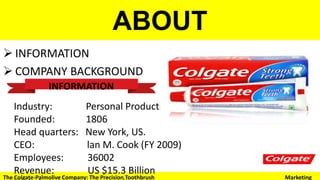
INFORMATION
Industry: Personal Products
Founded: 1806
Head quarters: New York, US.
CEO: lan M. Cook (FY 2009)
Employees: 36002
Revenue: US $15.3 Billion
Website: www.colgate.com
The Colgate-Palmolive Company: The Precision Toothbrush Marketing
ABOUT
BACKGROUND
 In 1991 the company witnessed sales of $6.06 billion with a gross profit of $2.76
billion.
CP’s five year plan 1991-1995 is to focus on core consumer products with
improved efficiencies in manufacturing and distribution. It also entered into new
geographic markets mainly emphasizing in new product launches.
With the development in Oral care division, Precision product manager Susan
Steinberg had recommended positioning, branding and communication strategies
to GM Nigel Burton.
The Colgate-Palmolive Company: The Precision Toothbrush Marketing
SITUATIONAL ANALYSIS
Market Analysis
Market Segmentation
Consumer Behavior
Competition
Advertising, Promotion and Distribution
The Colgate-Palmolive Company: The Precision Toothbrush Marketing
MARKET ANALYSIS
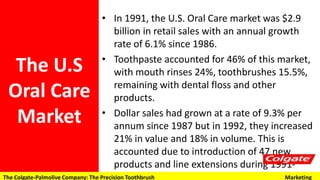
• In 1991, the U.S. Oral Care market was $2.9 billion
in retail sales with an annual growth rate of 6.1%
since 1986.
• Toothpaste accounted for 46% of this market, with
mouth rinses 24%, toothbrushes 15.5%, remaining
with dental floss and other products.
• Dollar sales had grown at a rate of 9.3% per annum
since 1987 but in 1992, they increased 21% in
value and 18% in volume. This is accounted due to
introduction of 47 new products and line
extensions during 1991-1992.
The U.S
Oral Care
Market
The Colgate-Palmolive Company: The Precision Toothbrush Marketing
MARKET
SEGMENTATION
• In the 1980s, the toothbrush category
was divided into two segments:
• Value
• Professional
• In the late 1980s, many new
toothbrushes were introduced on the
basis of aesthetics.
• A new segment of brushes emerged with
the name of “super-premium” which
were priced between $2.29 and $2.89
and accounted for 46% of dollar sales in
1992.
Product
Segments
The Colgate-Palmolive Company: The Precision Toothbrush Marketing
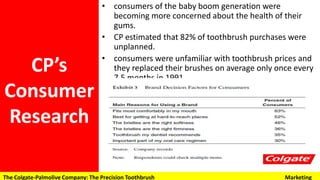
• consumers of the baby boom generation were becoming
more concerned about the health of their gums.
• CP estimated that 82% of toothbrush purchases were
unplanned.
• consumers were unfamiliar with toothbrush prices and
they replaced their brushes on average only once every 7.5
months in 1991.
• Brand choice was based on features, comfort and
professional recommendations.
CP’s
Consumer
Research
The Colgate-Palmolive Company: The Precision Toothbrush Marketing
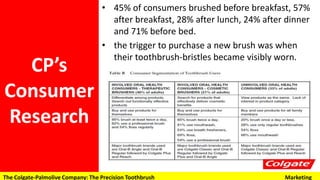
• 45% of consumers brushed before breakfast, 57%
after breakfast, 28% after lunch, 24% after dinner
and 71% before bed.
• the trigger to purchase a new brush was when
their toothbrush-bristles became visibly worn.
• Consumers differed in the intensity of their
involvement in oral hygiene.
CP’s
Consumer
Research
The Colgate-Palmolive Company: The Precision Toothbrush Marketing
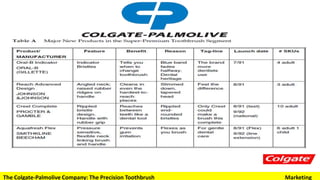
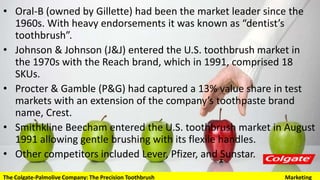
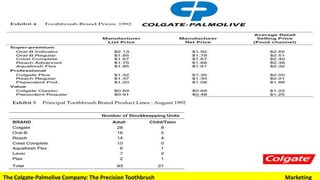
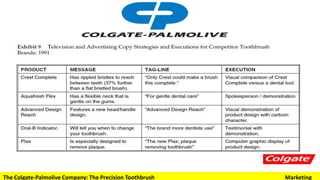
• Oral-B (owned by Gillette) had been the market leader since the 1960s.
With heavy endorsements it was known as “dentist’s toothbrush”.
• Johnson & Johnson (J&J) entered the U.S. toothbrush market in the
1970s with the Reach brand, which in 1991, comprised 18 SKUs.
• Procter & Gamble (P&G) had captured a 13% value share in test markets
with an extension of the company’s toothpaste brand name, Crest.
• Smithkline Beecham entered the U.S. toothbrush market in August 1991
allowing gentle brushing with its flexile handles.
• Other competitors included Lever, Pfizer, and Sunstar.
The Colgate-Palmolive Company: The Precision Toothbrush Marketing
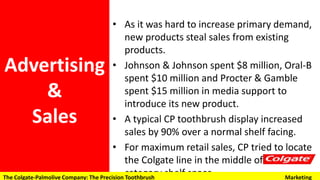
• As it was hard to increase primary demand,
new products steal sales from existing
products.
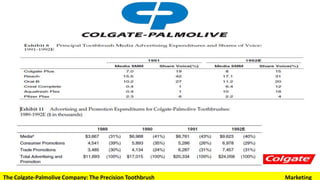
• Johnson & Johnson spent $8 million, Oral-B
spent $10 million and Procter & Gamble
spent $15 million in media support to
introduce its new product.
• A typical CP toothbrush display increased
sales by 90% over a normal shelf facing.

• For maximum retail sales, CP tried to locate
the Colgate line in the middle of the
category shelf space.
Advertising
&
Sales
The Colgate-Palmolive Company: The Precision Toothbrush Marketing
• In 1987, traditional food stores sold 75% of
oral care products.
• By 1992 they accounted for only 43% of
toothbrush sales and 47% of toothpaste
sales.
• Food stores began to expand shelf space
devoted to oral care products.
• Toothbrushes provided retailers with a
margin of 25-30%.
• With a dedicated sales force, Oral-B
dominated the toothbrush segment by
distributing to consumers by dentists.
Distribution
The Colgate-Palmolive Company: The Precision Toothbrush Marketing
THE COLGATE PRICISION MARKETING MIX
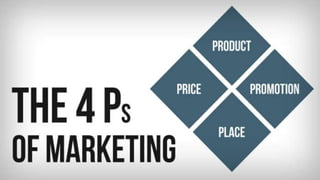
4P’s of Marketing
Positioning
Branding
Communication
The Colgate-Palmolive Company: The Precision Toothbrush Marketing
1. Product
Goals
• Understanding the varying techniques consumers
used when brushing their teeth.
• Testing the superiority of CP over Oral-B and Reach
in accessing the teeth.
• Establishing an index to score clinical plaque-
removal efficacy.
• Creating a bristle configuration and handle design
offering maximum plaque- removing efficacy.
• Determining the efficacy and acceptance of the
new toothbrush design through research.
The Colgate-Palmolive Company: The Precision Toothbrush Marketing
2. Price
• Colgate pricing depends on the
production costs including ware
housing costs and transport costs.
• Concerns about mainstream
toothbrush is the possibility of
cannibalization of Colgate plus.
The Colgate-Palmolive Company: The Precision Toothbrush Marketing
3. Place
• Targeting different geographic
locations leads to profits by
emphasizing on cultural norms.
• By targeting rural consumers and
increasing wholesale dealers.
The Colgate-Palmolive Company: The Precision Toothbrush Marketing
4. Promotion
• Advertising through all means of
media like TV, News paper, radio
broadcasting and social media.
• Through Billboards and
Hoardings at busy junctions in
cities and on Highways.
• Conducting camps by hiring
Dentists.
The Colgate-Palmolive Company: The Precision Toothbrush Marketing
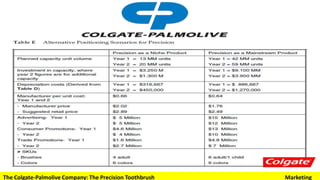
• Precision was developed ad best super premium toothbrush of top
range.
• It can be Positioned as
a) Niche Product
b) Mainstream Product
• Both have their own advantages and disadvantages.
• with a niche positioning retail sales would represent 3% volume share
of the toothbrush market in year 1 and 5% in year 2.
• With a mainstream positioning, these volume shares would be 10% in
year 1 and 14.7% in year 2.
The Colgate-Palmolive Company: The Precision Toothbrush Marketing
• The Colgate Precision name was consistently
viewed and deemed appropriate by 49% of
concept acceptors and 31% of them appealed.
• Stressing Precision as opposed to Colgate would
to limit the cannibalization of Colgate Plus.
• Colgate brand name was stressed but remain
unchanged if the Precision brand name was
stressed.
• corporate strategy was to build on the Colgate
brand equity.
The Colgate-Palmolive Company: The Precision Toothbrush Marketing
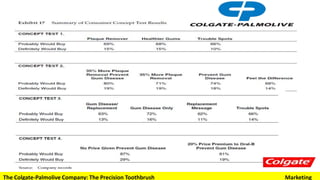
• After establishing the basic product design, Cp
conducted four concept tests 400 adults between
18-54 years old who were professional brush users
of Colgate Plus, Reach, and Oral-B.
The Colgate-Palmolive Company: The Precision Toothbrush Marketing
• Steinberg viewed Precision was more than a
simple line extension.
• Determined how precision should be positioned
following the path of development, testing,
pricing and communication.
• The case briefly outlined about U.S Oral Care
Market.
The Colgate-Palmolive Company: The Precision Toothbrush Marketing
DISCLAIMER
Created by Vicharapu Sai Nikesh, NIFFT Ranchi, during a
marketing internship by Prof. Sameer Mathur, IIM
Lucknow.

Colgate Palmolive: The precision Toothbrush

  • 1.
  • 2.
    INTRODUCTION  The Colgate-PalmoliveCompany is an American worldwide consumer products company focused on the production, distribution and provision of household, health care and personal products.  In August 1992 it was poised to launch a new toothbrush in United States tentatively naming “Colgate Precision”. The Colgate-Palmolive Company: The Precision Toothbrush Marketing
  • 3.
    ABOUT  INFORMATION  COMPANYBACKGROUND INFORMATION Industry: Personal Products Founded: 1806 Head quarters: New York, US. CEO: lan M. Cook (FY 2009) Employees: 36002 Revenue: US $15.3 Billion Website: www.colgate.com The Colgate-Palmolive Company: The Precision Toothbrush Marketing
  • 4.
    ABOUT BACKGROUND  In 1991the company witnessed sales of $6.06 billion with a gross profit of $2.76 billion. CP’s five year plan 1991-1995 is to focus on core consumer products with improved efficiencies in manufacturing and distribution. It also entered into new geographic markets mainly emphasizing in new product launches. With the development in Oral care division, Precision product manager Susan Steinberg had recommended positioning, branding and communication strategies to GM Nigel Burton. The Colgate-Palmolive Company: The Precision Toothbrush Marketing
  • 5.
    The Colgate-Palmolive Company:The Precision Toothbrush Marketing
  • 6.
    SITUATIONAL ANALYSIS Market Analysis MarketSegmentation Consumer Behavior Competition Advertising, Promotion and Distribution The Colgate-Palmolive Company: The Precision Toothbrush Marketing
  • 7.
  • 8.
    • In 1991,the U.S. Oral Care market was $2.9 billion in retail sales with an annual growth rate of 6.1% since 1986. • Toothpaste accounted for 46% of this market, with mouth rinses 24%, toothbrushes 15.5%, remaining with dental floss and other products. • Dollar sales had grown at a rate of 9.3% per annum since 1987 but in 1992, they increased 21% in value and 18% in volume. This is accounted due to introduction of 47 new products and line extensions during 1991-1992. The U.S Oral Care Market The Colgate-Palmolive Company: The Precision Toothbrush Marketing
  • 9.
    The Colgate-Palmolive Company:The Precision Toothbrush Marketing
  • 10.
  • 11.
    • In the1980s, the toothbrush category was divided into two segments: • Value • Professional • In the late 1980s, many new toothbrushes were introduced on the basis of aesthetics. • A new segment of brushes emerged with the name of “super-premium” which were priced between $2.29 and $2.89 and accounted for 46% of dollar sales in 1992. Product Segments The Colgate-Palmolive Company: The Precision Toothbrush Marketing
  • 12.
    The Colgate-Palmolive Company:The Precision Toothbrush Marketing
  • 14.
    • consumers ofthe baby boom generation were becoming more concerned about the health of their gums. • CP estimated that 82% of toothbrush purchases were unplanned. • consumers were unfamiliar with toothbrush prices and they replaced their brushes on average only once every 7.5 months in 1991. • Brand choice was based on features, comfort and professional recommendations. CP’s Consumer Research The Colgate-Palmolive Company: The Precision Toothbrush Marketing
  • 15.
    • 45% ofconsumers brushed before breakfast, 57% after breakfast, 28% after lunch, 24% after dinner and 71% before bed. • the trigger to purchase a new brush was when their toothbrush-bristles became visibly worn. • Consumers differed in the intensity of their involvement in oral hygiene. CP’s Consumer Research The Colgate-Palmolive Company: The Precision Toothbrush Marketing
  • 17.
    • Oral-B (ownedby Gillette) had been the market leader since the 1960s. With heavy endorsements it was known as “dentist’s toothbrush”. • Johnson & Johnson (J&J) entered the U.S. toothbrush market in the 1970s with the Reach brand, which in 1991, comprised 18 SKUs. • Procter & Gamble (P&G) had captured a 13% value share in test markets with an extension of the company’s toothpaste brand name, Crest. • Smithkline Beecham entered the U.S. toothbrush market in August 1991 allowing gentle brushing with its flexile handles. • Other competitors included Lever, Pfizer, and Sunstar. The Colgate-Palmolive Company: The Precision Toothbrush Marketing
  • 18.
    The Colgate-Palmolive Company:The Precision Toothbrush Marketing
  • 20.
    • As itwas hard to increase primary demand, new products steal sales from existing products. • Johnson & Johnson spent $8 million, Oral-B spent $10 million and Procter & Gamble spent $15 million in media support to introduce its new product. • A typical CP toothbrush display increased sales by 90% over a normal shelf facing. • For maximum retail sales, CP tried to locate the Colgate line in the middle of the category shelf space. Advertising & Sales The Colgate-Palmolive Company: The Precision Toothbrush Marketing

  • 21.
    The Colgate-Palmolive Company:The Precision Toothbrush Marketing
  • 22.
    The Colgate-Palmolive Company:The Precision Toothbrush Marketing
  • 23.
    • In 1987,traditional food stores sold 75% of oral care products. • By 1992 they accounted for only 43% of toothbrush sales and 47% of toothpaste sales. • Food stores began to expand shelf space devoted to oral care products. • Toothbrushes provided retailers with a margin of 25-30%. • With a dedicated sales force, Oral-B dominated the toothbrush segment by distributing to consumers by dentists. Distribution The Colgate-Palmolive Company: The Precision Toothbrush Marketing
  • 24.
    THE COLGATE PRICISIONMARKETING MIX 4P’s of Marketing Positioning Branding Communication The Colgate-Palmolive Company: The Precision Toothbrush Marketing
  • 26.
    1. Product Goals • Understandingthe varying techniques consumers used when brushing their teeth. • Testing the superiority of CP over Oral-B and Reach in accessing the teeth. • Establishing an index to score clinical plaque- removal efficacy. • Creating a bristle configuration and handle design offering maximum plaque- removing efficacy. • Determining the efficacy and acceptance of the new toothbrush design through research. The Colgate-Palmolive Company: The Precision Toothbrush Marketing
  • 27.
    2. Price • Colgatepricing depends on the production costs including ware housing costs and transport costs. • Concerns about mainstream toothbrush is the possibility of cannibalization of Colgate plus. The Colgate-Palmolive Company: The Precision Toothbrush Marketing
  • 28.
    3. Place • Targetingdifferent geographic locations leads to profits by emphasizing on cultural norms. • By targeting rural consumers and increasing wholesale dealers. The Colgate-Palmolive Company: The Precision Toothbrush Marketing
  • 29.
    4. Promotion • Advertisingthrough all means of media like TV, News paper, radio broadcasting and social media. • Through Billboards and Hoardings at busy junctions in cities and on Highways. • Conducting camps by hiring Dentists. The Colgate-Palmolive Company: The Precision Toothbrush Marketing
  • 31.
    • Precision wasdeveloped ad best super premium toothbrush of top range. • It can be Positioned as a) Niche Product b) Mainstream Product • Both have their own advantages and disadvantages. • with a niche positioning retail sales would represent 3% volume share of the toothbrush market in year 1 and 5% in year 2. • With a mainstream positioning, these volume shares would be 10% in year 1 and 14.7% in year 2. The Colgate-Palmolive Company: The Precision Toothbrush Marketing
  • 32.
    The Colgate-Palmolive Company:The Precision Toothbrush Marketing
  • 34.
    • The ColgatePrecision name was consistently viewed and deemed appropriate by 49% of concept acceptors and 31% of them appealed. • Stressing Precision as opposed to Colgate would to limit the cannibalization of Colgate Plus. • Colgate brand name was stressed but remain unchanged if the Precision brand name was stressed. • corporate strategy was to build on the Colgate brand equity. The Colgate-Palmolive Company: The Precision Toothbrush Marketing
  • 36.
    • After establishingthe basic product design, Cp conducted four concept tests 400 adults between 18-54 years old who were professional brush users of Colgate Plus, Reach, and Oral-B. The Colgate-Palmolive Company: The Precision Toothbrush Marketing
  • 37.
    The Colgate-Palmolive Company:The Precision Toothbrush Marketing
  • 39.
    • Steinberg viewedPrecision was more than a simple line extension. • Determined how precision should be positioned following the path of development, testing, pricing and communication. • The case briefly outlined about U.S Oral Care Market. The Colgate-Palmolive Company: The Precision Toothbrush Marketing
  • 43.
    DISCLAIMER Created by VicharapuSai Nikesh, NIFFT Ranchi, during a marketing internship by Prof. Sameer Mathur, IIM Lucknow.