Founded by William Colgate in 1806
Global leader in household and personal care products
with 1991 sales of $6.6 billion and gross profit of $2.76 billion
Rueben mark, CP’s CEO since 1984 had widely been praised for his
leadership transforming a “sleepy and inefficient” company into a
lean and profitable one
CP’s five year plan for 1991 to 1995 emphasized on new product
launches and entry into new geographic markets.
Product Manager
Division General Manager
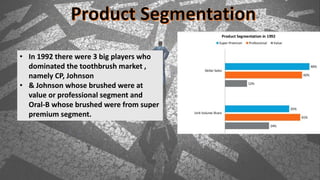
• In 1992 there were 3 big players who
dominated the toothbrush market ,
namely CP, Johnson
• & Johnson whose brushed were at
value or professional segment and
Oral-B whose brushed were from super
premium segment.
• Healthy Gums – Primary Issue
• Cavity Prevention- Secondary Issue
• Consumer ready to pay for premium
products
• Most consumers agree that
toothbrushes were as important as
toothpastes
• They believed that primary role of
toothbrush is to remove food particles
and gum stimulation were considered
Secondary.
46% Therapeutic brushers
21% Cosmetic brushers
33% uninvolved brushers
Fits most comfortably in mouth – 63%
Best for getting at had to reach places – 52%
Bristles are of right softness – 46%
Bristles are of right firmness - 36%
Dentist Recommendation – 35%
Important part of oral regime - 30%
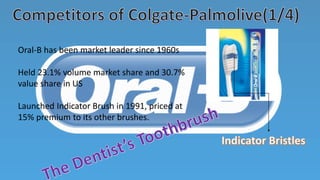
Oral-B has been market leader since 1960s
Held 23.1% volume market share and 30.7%
value share in US
Launched Indicator Brush in 1991, priced at
15% premium to its other brushes.
• Johnson & Johnson ranked 3rd in US retail toothbrush market with
19.4% volume share and 21.8% value share
• The reach line was positioned as the toothbrush which enabled
customers to brush to event he hardest parts, thereby increasing
efficiency of brushing
• J&J’s expected 1992 operation margin on toothbrushes, after ads
and promotion costs was 8.4% of factory sales.
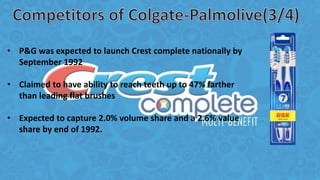
• P&G was expected to launch Crest complete nationally by
September 1992
• Claimed to have ability to reach teeth up to 47% farther
than leading flat brushes
• Expected to capture 2.0% volume share and a 2.6% value
share by end of 1992.
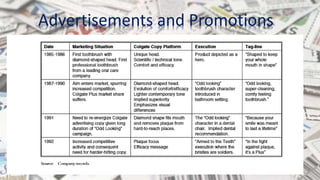
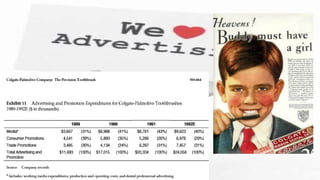
Advertisements and Promotions
Political: Relatively Insignificant
Economic: New entrants appeared in early
1990s
P&G and Smithkline Beecham
Positioned in Super premium category
Social :
Aesthetic appeal in late 1980’s
An additional Social development concern for gum
hralth – baby boom population
Cavity prevention was a serious concern
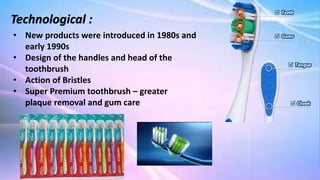
Technological :
• New products were introduced in 1980s and
early 1990s
• Design of the handles and head of the
toothbrush
• Action of Bristles
• Super Premium toothbrush – greater
plaque removal and gum care
SWOT ANALYSIS OF
COLGATE-
PALMOLIVE
NO.1 company in US RETAIL
markets
Extensive International Reach
Exclusive R&D team working
on new technologies
Innovate product Designs
Diversified Products
Lack professional Dental
endorsements
Smaller media expenditure layout
compared to rivals
Educational marketing is required for
their products to sell.
55% of testers have given positive feedback for COLGATE- precision
77% claimed that this product was more effective than any other brush
Informed customers are willing to pay more
Convert unplanned toothbrush purchases into sales through well directed
ads.
Baby boomers are willing to spend as they are highly concerned
with gum issues.
Emerging as the best product in super-premium category
Product Cannibalization
Intense Segment rivalry
Threat of substitute Products ( Electronic
Brushes )
Most of the purchases are unplanned, hence
converting such customers in extremely
difficult and unreliable.
Positioning
Branding
Communication and
Promotion
Positioning ( 1/4)
Allows for a concentrated marketing campaign who care about gum care
Niche marketing accounts for 46% of dollar sales and premium consumers
are willing ot pay higher prices
Precision wont have a chance to cannibalize Colgate plus or Colgate classic
Precision has a ready to go production schedule
Positioning ( 2/4)
Lesser revenue than mainstream positioning
Product reach is limited to specific section
Positioning ( 2/4)
Simple and direct campaigning
Greater and quicker return on investment
Large market share
Positioning ( 2/4)
Almost 1/3 population have little interests in oral hygiene ,
Precision wont appeal to them.
Cannibalization of Colgate plus and Colgate classic
Mainstream market is steadily declining
Precision Should be placed in niche market
Distinctive product like this will grow faster
Later it can be moved to mainstream to
get better revenues
Colgate precision appeared to be more popular from a survey but also increased the risk of
cannibalization of Colgate plus by 20%
Precision by Colgate had no cannibalization risk but it was unable to harness Colgate brand
Equity
Special coupons : A 50% off offer on any size of
Colgate toothpaste ( up to a volume of $1.00 in
conjunction with a coupon on Precision Brush in
strong Colgate markets.
Buy 1 Get 1 : A free 5oz. Of Colgate toothpaste with
the purchase of Colgate precision in strong
competitive markets
Concept Testing : Once product has been designed 4
concept test were run b/w 1990-1991 amongst ages
of 18-54. They were exposed to the various ads and
claims and later asked the likelihood of purchase of
this product.
• Niche Positing of the product is more profitable in such
kind of products
• Try to appeal to therapeutic consumers
• Market the product as providing superior and
distinctive oral care
• New product development specifically on gum care
• Price precision at competitive levels with super
premium products so as to offer more value to the
consumers
• Leverage existing distribution channels
• Invest industry standards amounts of capital into the
promotion of new toothbrush.
Created by Bharat
Maniam, VIT
Vellore, during a
marketing
Internship under
Prof. Sameer
Mathur, IIM-
Lucknow

Colgate palmolive - the precision toothbrush hbr case

  • 2.
    Founded by WilliamColgate in 1806 Global leader in household and personal care products with 1991 sales of $6.6 billion and gross profit of $2.76 billion Rueben mark, CP’s CEO since 1984 had widely been praised for his leadership transforming a “sleepy and inefficient” company into a lean and profitable one CP’s five year plan for 1991 to 1995 emphasized on new product launches and entry into new geographic markets.
  • 4.
  • 6.
    • In 1992there were 3 big players who dominated the toothbrush market , namely CP, Johnson • & Johnson whose brushed were at value or professional segment and Oral-B whose brushed were from super premium segment.
  • 7.
    • Healthy Gums– Primary Issue • Cavity Prevention- Secondary Issue • Consumer ready to pay for premium products • Most consumers agree that toothbrushes were as important as toothpastes • They believed that primary role of toothbrush is to remove food particles and gum stimulation were considered Secondary.
  • 8.
    46% Therapeutic brushers 21%Cosmetic brushers 33% uninvolved brushers
  • 9.
    Fits most comfortablyin mouth – 63% Best for getting at had to reach places – 52% Bristles are of right softness – 46% Bristles are of right firmness - 36% Dentist Recommendation – 35% Important part of oral regime - 30%
  • 10.
    Oral-B has beenmarket leader since 1960s Held 23.1% volume market share and 30.7% value share in US Launched Indicator Brush in 1991, priced at 15% premium to its other brushes.
  • 11.
    • Johnson &Johnson ranked 3rd in US retail toothbrush market with 19.4% volume share and 21.8% value share • The reach line was positioned as the toothbrush which enabled customers to brush to event he hardest parts, thereby increasing efficiency of brushing • J&J’s expected 1992 operation margin on toothbrushes, after ads and promotion costs was 8.4% of factory sales.
  • 12.
    • P&G wasexpected to launch Crest complete nationally by September 1992 • Claimed to have ability to reach teeth up to 47% farther than leading flat brushes • Expected to capture 2.0% volume share and a 2.6% value share by end of 1992.
  • 14.
  • 17.
    Political: Relatively Insignificant Economic:New entrants appeared in early 1990s P&G and Smithkline Beecham Positioned in Super premium category Social : Aesthetic appeal in late 1980’s An additional Social development concern for gum hralth – baby boom population Cavity prevention was a serious concern
  • 18.
    Technological : • Newproducts were introduced in 1980s and early 1990s • Design of the handles and head of the toothbrush • Action of Bristles • Super Premium toothbrush – greater plaque removal and gum care
  • 19.
  • 20.
    NO.1 company inUS RETAIL markets Extensive International Reach Exclusive R&D team working on new technologies Innovate product Designs Diversified Products
  • 21.
    Lack professional Dental endorsements Smallermedia expenditure layout compared to rivals Educational marketing is required for their products to sell.
  • 22.
    55% of testershave given positive feedback for COLGATE- precision 77% claimed that this product was more effective than any other brush Informed customers are willing to pay more Convert unplanned toothbrush purchases into sales through well directed ads. Baby boomers are willing to spend as they are highly concerned with gum issues. Emerging as the best product in super-premium category
  • 23.
    Product Cannibalization Intense Segmentrivalry Threat of substitute Products ( Electronic Brushes ) Most of the purchases are unplanned, hence converting such customers in extremely difficult and unreliable.
  • 25.
  • 26.
    Positioning ( 1/4) Allowsfor a concentrated marketing campaign who care about gum care Niche marketing accounts for 46% of dollar sales and premium consumers are willing ot pay higher prices Precision wont have a chance to cannibalize Colgate plus or Colgate classic Precision has a ready to go production schedule
  • 27.
    Positioning ( 2/4) Lesserrevenue than mainstream positioning Product reach is limited to specific section
  • 28.
    Positioning ( 2/4) Simpleand direct campaigning Greater and quicker return on investment Large market share
  • 29.
    Positioning ( 2/4) Almost1/3 population have little interests in oral hygiene , Precision wont appeal to them. Cannibalization of Colgate plus and Colgate classic Mainstream market is steadily declining
  • 30.
    Precision Should beplaced in niche market Distinctive product like this will grow faster Later it can be moved to mainstream to get better revenues
  • 32.
    Colgate precision appearedto be more popular from a survey but also increased the risk of cannibalization of Colgate plus by 20% Precision by Colgate had no cannibalization risk but it was unable to harness Colgate brand Equity
  • 33.
    Special coupons :A 50% off offer on any size of Colgate toothpaste ( up to a volume of $1.00 in conjunction with a coupon on Precision Brush in strong Colgate markets. Buy 1 Get 1 : A free 5oz. Of Colgate toothpaste with the purchase of Colgate precision in strong competitive markets Concept Testing : Once product has been designed 4 concept test were run b/w 1990-1991 amongst ages of 18-54. They were exposed to the various ads and claims and later asked the likelihood of purchase of this product.
  • 34.
    • Niche Positingof the product is more profitable in such kind of products • Try to appeal to therapeutic consumers • Market the product as providing superior and distinctive oral care • New product development specifically on gum care • Price precision at competitive levels with super premium products so as to offer more value to the consumers • Leverage existing distribution channels • Invest industry standards amounts of capital into the promotion of new toothbrush.
  • 35.
    Created by Bharat Maniam,VIT Vellore, during a marketing Internship under Prof. Sameer Mathur, IIM- Lucknow