Colgate-Palmolive
Company:Precision
Toothbrush
HBR School case study
What is Colgate-
Palmolive?
• The Colgate-Palmolive Company is an American
worldwide consumer products company focused on the
production, distribution and provision of household,
health care and personal products, such
as soaps, detergents, and oral hygiene products
(including toothpaste and toothbrushes)
Who are the players?
• Susan Steinberg - Precision product manager of
Colgate-Palmolive.
• Nigel Burton - division general manager.
• Reuben Mark - CEO of Colgate-Palmolive
• John Phillips - Colgate Plus product manager
What is the present
situation?
Situation analysis
Colgate Palmolive was the global leader in household and
health care products.
Well known brand in Oral care industry.
Creating new and innovative product.
Colgate-Palmolive upgraded 25 of 91 manufacturing plants.
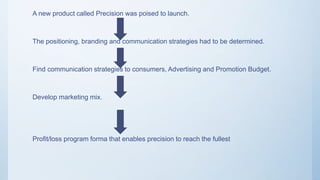
A new product called Precision was poised to launch.
The positioning, branding and communication strategies had to be determined.
Find communication strategies to consumers, Advertising and Promotion Budget.
Develop marketing mix.
Profit/loss program forma that enables precision to reach the fullest
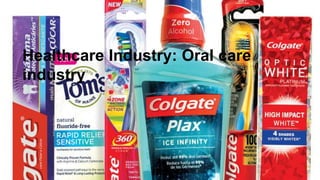
Healthcare Industry: Oral care
industry
Why study the
case?
Evolve a strategy for the company for the
positioning and branding of the new product by
evaluate primary research studies
conducting surveys to both consumers and
retailers.
Setting up of questionnaire
data analysis and interpretation.
Objectives of the case
Analysis of the attitude of typical
customer and his/her perception of this
low involvement product category
It’s (new product) stance in the market
Total Oral care market in US
In 1991 – $2.9 billion – annual growth rate – 6.1%
Toothpaste accounted for 46% of this market, mouth
rinses 24%, toothbrushes 15.5% and rest other
products.
In 1992 they increased by 21% in value and 18% in
volume due to line extension leading to wider
portfolio.
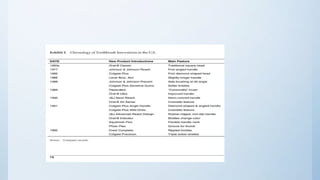
Innovation in toothbrush industry in
US
Questions which need to be
resolved from the case study
• How to position and communicate
Precision to consumers?
• How to brand the product?
• Advertising and promotion budget
needs to be fixed
CP’s 5 year plan.
• In order for Precision to be a successful product in the
toothbrush market the following two objectives must be met:
• * Increase market share by 8% within 2 years (3% in year 1 and 5%
increase in year 2).
• * Decrease the risk of cannibalization of the Colgate Plus market.
• * Expand into new geographic markets.
Colgate Palmolive’s share in US market
• In 1991 43% world’s tooth paste market, 16% tooth brush market
• In 1991 sales worth $6.06 billion and gross profit of $2.76 billion.
• CP’s total sales in US $77 million, operating profit $9.8 billion.
• 23.3% of toothbrush market in US
• International sales accounted for 67%.
Marketing mix
Positioning
There were 2 options for placing the product
Niche product
Mainstream product
Each had it’s own pros and cons
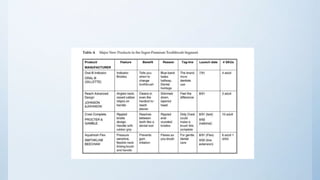
Competitors in super-premium
segment
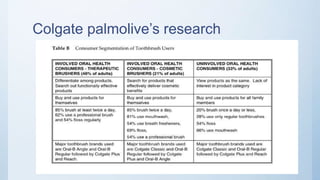
Colgate Palmolive’s Research
Price
Promotion
• Under niche positioning they can demonstrate their product’s superior
features and doctor’s recommendation through ad campaign.
• Under mainstream they can give coupons or different combined
together. Generating volume sales is the key in mainstream
positioning.
Research and Development
Taskforce had 5 goals
• Understand - varying techniques consumers used while brushing.
• Test - different tooth brush design accessibility.
• Index - to score clinical plaque removal efficiency.
• Bristle design configuration and handle design offer maximum
plaque removal.
• Clinical, consumer research, the efficacy and acceptance of
toothbrush design.
outcomes
• Brushing was often ineffective at removing plaque from the gum line
and between the teeth.
• CP’s new design was superior to both Oral-B and Reach in accessing
front and back teeth, using either horizontal or vertical brushing.
• Measured presence of plaque on each of the nine tooth areas.
Precision had a combination of small and large
bristles which proved it to be effective.
• Tests were conducted among 400 individuals between
age 18 to 54.
• Clinical trials established the new product was more
effective(35%) than other products in removing plaque.
• Product acceptance was tested through 18 month test
among different groups.
• Precision’s new design was superior to it’s existing
competitors.
Branding
• Colgate brand name on the Precision
toothbrush would cause additional
cannibalization of the existing Colgate
toothbrushes.
• Using Colgate’s name will also add to
Colgate’s brand equity.
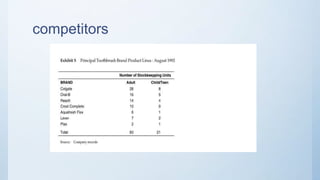
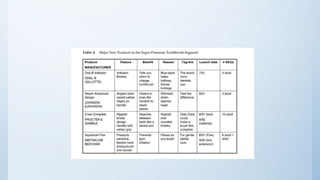
Competitors
Competitors
• Oral-B
• Reach
• Crest complete
• Aqua fresh
• Lever
• Plax
Reasons for people to buy
Target Audience
• CP’s research indicated that adults
born in (1940s,1950s,1960s) were
more concerned about gum health.
• This target was willing to pay more.
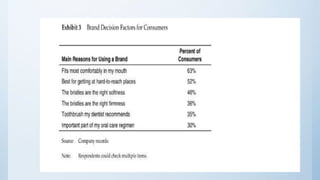
• Consumers chose brush based on
fit, sensitivity of gum and shape of
mouth
Consumer behaviour
• 82% toothbrush purchase were unplanned.
• Toothbrush replacement after 7.5 months in 1991
• People preferred brands which fit them the most.
• Adults were concerned about gum health and
were willing to pay premium.
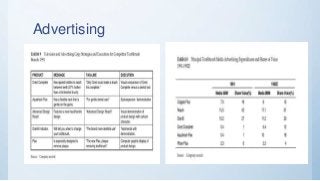
Advertising
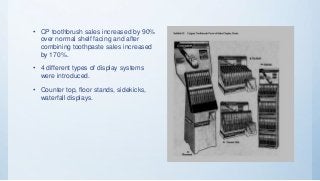
• CP toothbrush sales increased by 90%
over normal shelf facing and after
combining toothpaste sales increased
by 170%.
• 4 different types of display systems
were introduced.
• Counter top, floor stands, sidekicks,
waterfall displays.
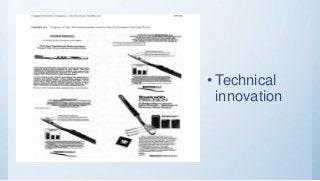
• Technical
innovation
Results of testing
• 55% customers found precision to be
different from their current toothbrushes.
• 77% found it more effective.
• With higher campaigning about the unique
feature of the product the more it gained
publicity.
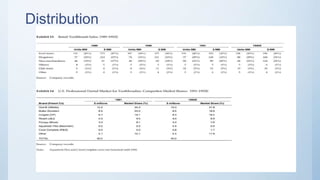
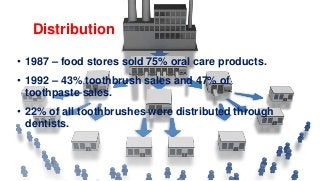
Distribution
• 1987 – food stores sold 75% oral care products.
• 1992 – 43% toothbrush sales and 47% of
toothpaste sales.
• 22% of all toothbrushes were distributed through
dentists.
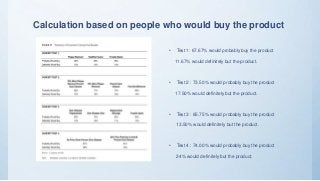
Calculation based on people who would buy the product
• Test 1: 67.67% would probably buy the product
11.67% would definitely but the product.
• Test 2 : 73.50% would probably buy the product
17.50% would definitely but the product.
• Test 3 : 65.75% would probably buy the product
13.50% would definitely but the product.
• Test 4 : 74.00% would probably buy the product
24% would definitely but the product.
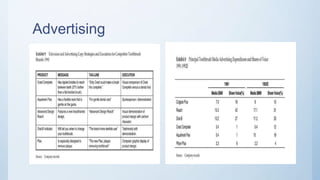
Advertising and promotion budget in
1992
•$24.1 million, $9.6 million in
advertising and $14.4 million in
consumer and trade promotion.
•They decided to spend an extra
$11.2 million for precision.
Recommendation
• The new product was designed specifically to curb plaque
• R&D investment concludes Super-Premium niche segment is more consistent
than mainstream market.
• Pro forma income statement analysis supports the decision as does the
cannibalization analysis.
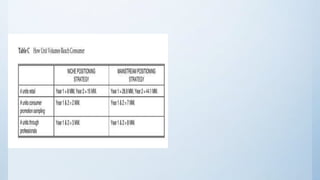
• Analysis of the Pro forma income statements shows the mainstream
positioning strategy will lose almost $6.7million in year1 and gain $16 million in
year2.
• A niche positioning loses $1.4 million dollars in year 1 and gain $7.4 million in
year 2.
• Pursue strong advertising campaign for niche positioning.
• Professional endorsements from dentists contribute a significant portion.
Conclusion
• Steinberg believed that it was more than niche
product, simple line extension.
• The product should be positioned following
development, testing and pricing.
• The case played a significant role in the US
Oral care industry.
Questionnaire
• Who has the biggest market share in the oral care
industry?
• What are the three segments of toothbrush market?
• Segmentation by price in the toothbrush market?
• Total money spent on advertising by Colgate in
1992?
DISCLAIMER
Created by S Prasanth Vasan during a
marketing internship with Prof. Sameer
Mathur,IIM Lucknow.
Thank you

Colgate palmolive company

  • 1.
  • 2.
    What is Colgate- Palmolive? •The Colgate-Palmolive Company is an American worldwide consumer products company focused on the production, distribution and provision of household, health care and personal products, such as soaps, detergents, and oral hygiene products (including toothpaste and toothbrushes)
  • 3.
    Who are theplayers? • Susan Steinberg - Precision product manager of Colgate-Palmolive. • Nigel Burton - division general manager. • Reuben Mark - CEO of Colgate-Palmolive • John Phillips - Colgate Plus product manager
  • 4.
    What is thepresent situation?
  • 5.
    Situation analysis Colgate Palmolivewas the global leader in household and health care products. Well known brand in Oral care industry. Creating new and innovative product. Colgate-Palmolive upgraded 25 of 91 manufacturing plants.
  • 6.
    A new productcalled Precision was poised to launch. The positioning, branding and communication strategies had to be determined. Find communication strategies to consumers, Advertising and Promotion Budget. Develop marketing mix. Profit/loss program forma that enables precision to reach the fullest
  • 7.
  • 8.
  • 9.
    Evolve a strategyfor the company for the positioning and branding of the new product by evaluate primary research studies conducting surveys to both consumers and retailers. Setting up of questionnaire data analysis and interpretation. Objectives of the case
  • 10.
    Objectives of thecase Analysis of the attitude of typical customer and his/her perception of this low involvement product category It’s (new product) stance in the market
  • 11.
    Total Oral caremarket in US In 1991 – $2.9 billion – annual growth rate – 6.1% Toothpaste accounted for 46% of this market, mouth rinses 24%, toothbrushes 15.5% and rest other products. In 1992 they increased by 21% in value and 18% in volume due to line extension leading to wider portfolio.
  • 12.
  • 13.
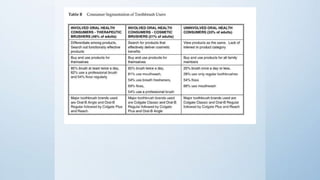
    Questions which needto be resolved from the case study • How to position and communicate Precision to consumers? • How to brand the product? • Advertising and promotion budget needs to be fixed
  • 14.
    CP’s 5 yearplan. • In order for Precision to be a successful product in the toothbrush market the following two objectives must be met: • * Increase market share by 8% within 2 years (3% in year 1 and 5% increase in year 2). • * Decrease the risk of cannibalization of the Colgate Plus market. • * Expand into new geographic markets.
  • 15.
    Colgate Palmolive’s sharein US market • In 1991 43% world’s tooth paste market, 16% tooth brush market • In 1991 sales worth $6.06 billion and gross profit of $2.76 billion. • CP’s total sales in US $77 million, operating profit $9.8 billion. • 23.3% of toothbrush market in US • International sales accounted for 67%.
  • 16.
  • 17.
    Positioning There were 2options for placing the product Niche product Mainstream product Each had it’s own pros and cons
  • 20.
  • 21.
  • 22.
  • 23.
    Promotion • Under nichepositioning they can demonstrate their product’s superior features and doctor’s recommendation through ad campaign. • Under mainstream they can give coupons or different combined together. Generating volume sales is the key in mainstream positioning.
  • 24.
    Research and Development Taskforcehad 5 goals • Understand - varying techniques consumers used while brushing. • Test - different tooth brush design accessibility. • Index - to score clinical plaque removal efficiency. • Bristle design configuration and handle design offer maximum plaque removal. • Clinical, consumer research, the efficacy and acceptance of toothbrush design.
  • 25.
    outcomes • Brushing wasoften ineffective at removing plaque from the gum line and between the teeth. • CP’s new design was superior to both Oral-B and Reach in accessing front and back teeth, using either horizontal or vertical brushing. • Measured presence of plaque on each of the nine tooth areas.
  • 26.
    Precision had acombination of small and large bristles which proved it to be effective.
  • 27.
    • Tests wereconducted among 400 individuals between age 18 to 54. • Clinical trials established the new product was more effective(35%) than other products in removing plaque. • Product acceptance was tested through 18 month test among different groups. • Precision’s new design was superior to it’s existing competitors.
  • 28.
    Branding • Colgate brandname on the Precision toothbrush would cause additional cannibalization of the existing Colgate toothbrushes. • Using Colgate’s name will also add to Colgate’s brand equity.
  • 29.
  • 30.
    Competitors • Oral-B • Reach •Crest complete • Aqua fresh • Lever • Plax
  • 31.
    Reasons for peopleto buy Target Audience • CP’s research indicated that adults born in (1940s,1950s,1960s) were more concerned about gum health. • This target was willing to pay more. • Consumers chose brush based on fit, sensitivity of gum and shape of mouth
  • 32.
    Consumer behaviour • 82%toothbrush purchase were unplanned. • Toothbrush replacement after 7.5 months in 1991 • People preferred brands which fit them the most. • Adults were concerned about gum health and were willing to pay premium.
  • 33.
  • 34.
    • CP toothbrushsales increased by 90% over normal shelf facing and after combining toothpaste sales increased by 170%. • 4 different types of display systems were introduced. • Counter top, floor stands, sidekicks, waterfall displays.
  • 35.
  • 36.
    Results of testing •55% customers found precision to be different from their current toothbrushes. • 77% found it more effective. • With higher campaigning about the unique feature of the product the more it gained publicity.
  • 37.
    Distribution • 1987 –food stores sold 75% oral care products. • 1992 – 43% toothbrush sales and 47% of toothpaste sales. • 22% of all toothbrushes were distributed through dentists.
  • 38.
    Calculation based onpeople who would buy the product • Test 1: 67.67% would probably buy the product 11.67% would definitely but the product. • Test 2 : 73.50% would probably buy the product 17.50% would definitely but the product. • Test 3 : 65.75% would probably buy the product 13.50% would definitely but the product. • Test 4 : 74.00% would probably buy the product 24% would definitely but the product.
  • 39.
    Advertising and promotionbudget in 1992 •$24.1 million, $9.6 million in advertising and $14.4 million in consumer and trade promotion. •They decided to spend an extra $11.2 million for precision.
  • 40.
    Recommendation • The newproduct was designed specifically to curb plaque • R&D investment concludes Super-Premium niche segment is more consistent than mainstream market. • Pro forma income statement analysis supports the decision as does the cannibalization analysis. • Analysis of the Pro forma income statements shows the mainstream positioning strategy will lose almost $6.7million in year1 and gain $16 million in year2. • A niche positioning loses $1.4 million dollars in year 1 and gain $7.4 million in year 2. • Pursue strong advertising campaign for niche positioning. • Professional endorsements from dentists contribute a significant portion.
  • 41.
    Conclusion • Steinberg believedthat it was more than niche product, simple line extension. • The product should be positioned following development, testing and pricing. • The case played a significant role in the US Oral care industry.
  • 42.
    Questionnaire • Who hasthe biggest market share in the oral care industry? • What are the three segments of toothbrush market? • Segmentation by price in the toothbrush market? • Total money spent on advertising by Colgate in 1992?
  • 43.
    DISCLAIMER Created by SPrasanth Vasan during a marketing internship with Prof. Sameer Mathur,IIM Lucknow.
  • 44.