Colgate-Palmolive Company:
The Precision Toothbrush
Harward Business School Case
What is the Case regarding?
In August 1992, Colgate Palmolive(CP),was poised to
launch a new toothbrush in the U.S. market, Colgate
Precision,developing for over 3 years.
But the market had become highly competitive with
substantial new product activity.
Susan Steinberg, product manager for the Precision
toothbrush had to recommend positioning, branding
and communication strategies to division general
manager, Nigel Burton.
Areas of focus
Market Competition
Consumer behavior
Positioning
Branding
Advertising and Marketing Budget
Communication and Promotion
Profits and Loss incurred
Eminent persons of the company
Susan Steinberg- Precision's product manager
Nigel Burton- Division General Manager
Ruben Mark- Company's CEO
Company Background and an Insight to
the Situation
In 1991 with a sale of $6.06 billion and gross profit of
$2.76 billion, Colgate Palmolive became a global
leader in household and personal care products.
275 new products were launched.
Manufacturing began in China an Europe.
Tough competition from International market such
as Henkel of Germany and Kao of Japan.
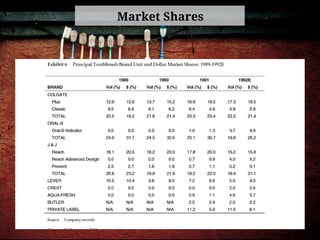
In 1991,Colgate held 43% of the world toothpaste
market and 16% of the world toothbrush market.
CP’s U.S. toothbrush sales in 1991 reached $77 million,
with operating profits of $9.8 million. 
Toothbrushes represented 19% of CP’s U.S. Oral Care
Division sales and profits, and CP held the number one
position in the U.S. retail toothbrush market with a
23.3% volume share.
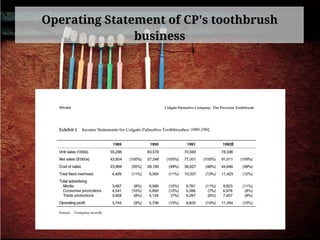
Operating Statement of CP's toothbrush
business
The U.S. Oral Care Market
In 1991, it was $2.9 billion in retail sales and annual growth
rate was 6.1% since 1986.
Toothpaste and toothbrush occupied 46% and 15.5% of the
market respectively.
Dollar sales had increased at an average rate of 9.3% since
1986 but had grown by 21% in value and 18% in volume in
1992.
Dollar sales had been greater than volume sales.
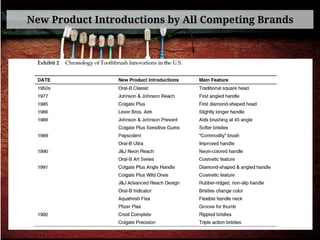
New Product Introductions by All Competing Brands
Product Segmentation
Two main categories-professional segment and value
based segment.
Late in 1980s the super-premium brushes
emerged,priced above $2.00 .
Three prominent players dominated the market;
Colgate-Palmolive and Johnson and Johnson in the
professional brushes market and  Oral-B for the super
premium segment.
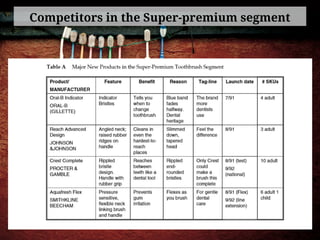
Competitors in the Super-premium segment
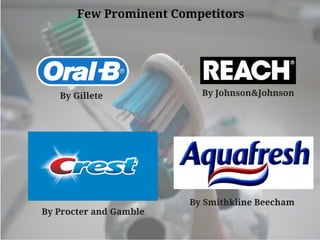
Few Prominent Competitors
By Gillete
By Procter and Gamble
By Johnson&Johnson
By Smithkline Beecham
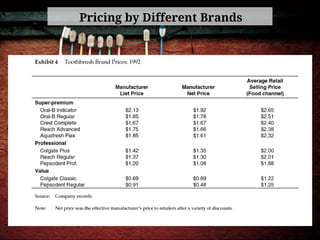
Pricing by Different Brands
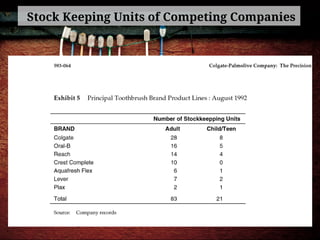
Stock Keeping Units of Competing Companies
Market Shares
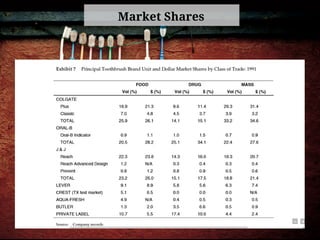
Market Shares
Consumer Behaviour
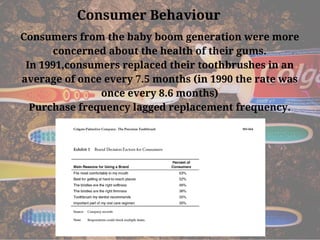
Consumers from the baby boom generation were more
concerned about the health of their gums.
In 1991,consumers replaced their toothbrushes in an
average of once every 7.5 months (in 1990 the rate was
once every 8.6 months)
Purchase frequency lagged replacement frequency.
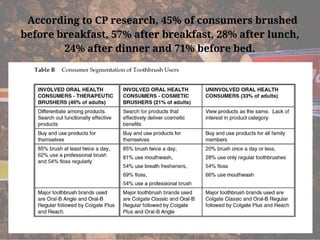
  According to CP research, 45% of consumers brushed
before breakfast, 57% after breakfast, 28% after lunch,
24% after dinner and 71% before bed.
Advertising and Promotion
Increased advertising and promotion enhanced the
category's visibility and fueled customer demands.
Media expenditures increased.
Increased frequency and value of customer promotion
events.
Retail advertising features and in store displays
increased the overall toothbrush sales.
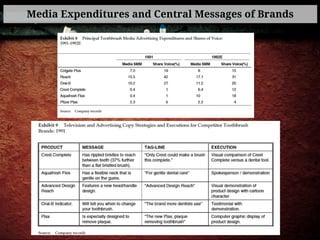
Media Expenditures and Central Messages of Brands
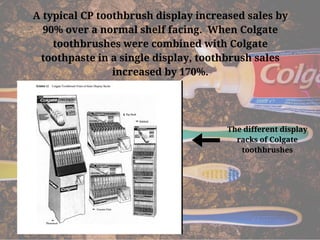
A typical CP toothbrush display increased sales by
90% over a normal shelf facing.  When Colgate
toothbrushes were combined with Colgate
toothpaste in a single display, toothbrush sales
increased by 170%.
The different display
racks of Colgate
toothbrushes
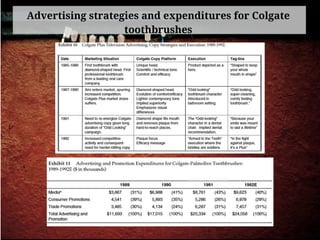
Advertising strategies and expenditures for Colgate
toothbrushes
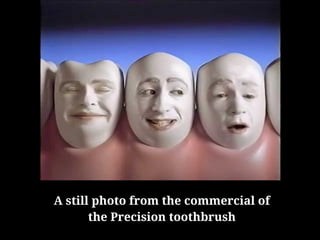
A still photo from the commercial of
the Precision toothbrush
Distribution
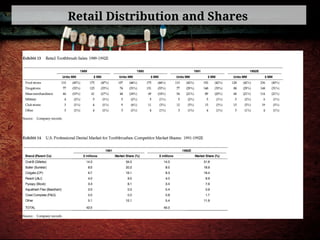
Traditional food store sold 75% of oral care products in
1987 but by 1992 it had reduced to 43%of toothbrush and
475 of toothpaste sales.
Mass merchandisers gained share due to increased in
store promotional support.
Toothbrushes provided with a profit of 25%-35%, twice of
what provided by toothpastes;so retailers more receptive
towards new toothbrush products.
22% of all toothbrushes were distributed by the dentists.
But this sevtor was mainly dominated by Oral-B.
Retail Distribution and Shares
Marketing Mix :
Precision
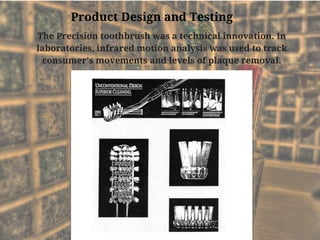
The Precision toothbrush was a technical innovation. In
laboratories, infrared motion analysis was used to track
consumer's movements and levels of plaque removal.
Product Design and Testing
Goals of the Task Force formed,presided by
Susan Steinberg
Understanding various brushing techniques.
Testing the in between teeth access of different
toothbrush designs.
Establishing plaque removal efficacy.
Creating a bristle and handle design suited for plaque
removal.
Determining efficacy and acceptance of new toothbrush
designs.
Conclusions of the Task Force
Brushing was successful in removing plaque from
tooth surface but inefficient in doing so from gum line
and in between teeth.
The new product was superior to Oral-B and Reach  in
accessing front and back teeth.
Clinical tests revealed that it removed plaque 35%
more as compared to all other brushes.
It was decide that Precision would be marketed in the
super -premium segment in same channels along with
Colgate Plus.
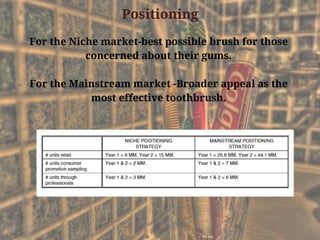
Positioning
For the Niche market-best possible brush for those
concerned about their gums.
For the Mainstream market -Broader appeal as the
most effective toothbrush.
Niche:Pros and Cons
Pros:
3% and 5% volume share in the first and second year
respectively.
Less cannibalization of Colgate Plus and Classic.
Entry into the super -premium segment.
Promotion of brand equity.
Not discarding any existing SKUs.
Cons:
Less profit incurred.
More potential competitors in the segment.
Mainstream:Pros and Cons
Pros:
10% and 14% volume shares in the market in the first
and the second year respectively.
Increased profit.
No need of specialized marketing.
Cons:
Inadequate supply due to huge demand.
Cannibalization of Colgate Plus and Classic.
Need of dropping existing slow moving SKUs.
Production Costs and Pricing
Production was subcontracted to Anchor Brush.
For the Niche Market Market segment  pricing was done
premium to Oral -B's regular and at par with Oral-B's
Indicator, at a price of $2.13.
The mainstream strategy price would be $1.85, at parity
with Oral-B regular.  In practice however, almost all sales
to the trade were made at a discount of approximately 5%.
 Eighty percent of sales through dental professionals
would be priced at $0.79 per unit; the remainder would be
sold at $0.95.
 
Branding
Concept test were carried out among customers and
name tests were carried out among positively disposed
ones.
The name Colgate Precision was approved by 49% of
concept acceptors and appealing by 31%.
Colgate Precision- This name laid focus on the brand
'Colgate';important for brand equity but increased
corrosion of Colgate Plus and Colgate Classic.
Precision by Colgate- Precision brand name
emphasized; could stand out alone and reduced
erosion of Colgate Plus and Classic.
Communication
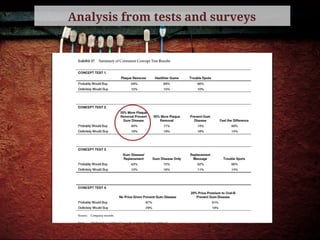
Four concept tests were conducted among 400 adult
customers ,aged between 18-35.
Consumers were exposed to various product claims in
prototype print advertisements and then asked about the
likelihood that they would purchase the product.
Analysis from tests and surveys
Analysis from Surveys
55% of test consumers found Precision to be very
different from their current toothbrushes.
  77% claimed that Precision was much more effective
than their current toothbrush.
Greater demand for toothbrushes removing gum
diseases.
Customers had mixed first impressions.
As customers came to know more of the product,their
enthusiasm increased.
Debate over Advertising Budget
  Some executives thought the budget should remain
level as a percentage of sales in 1993 and be allocated
among Classic, Plus, and Precision.
Others believed it should be increased substantially
to support the Precision launch with no reduction in
planned support for Classic and Plus. 
Steinberg wanted 80% increase in CP's advertising
budget with 75%  of it assigned to Precision and 25%
to Plus.
But Plus' product manager John Phillips argued that
Plus was the mainstream brand for Colgate and
hence no compromise should be made on it.
Promotions
For the Niche segment:
Aggressive advertisement campaigns.
Sampling done to attract loyal customers.
Market through drug stores, dentists and food stores.
People made aware of the technical superiority of the
toothbrush.
For the mainstream segment:
Consumer incentives:-
  A free 5 oz. tube of Colgate toothpaste (retail value
of $1.89) with the purchase of a Precision brush .
  50%-off offer on any size of Colgate toothpaste (up
to a value of $1.00) in conjunction with a 50¢ coupon
on the Precision brush .
Channeling and distributing through
merchandisers, club stores and food stores. 
Conclusions
Introducing Precision as a niche product would be
profitable in the short run and as a mainstream
product would bring long term profits.
The toothbrush should be given a unique identity and
should stand out on its own.
Brand name can be promoted by living up to the
promises so made and achieving a loyal cult.
Conclusions
Pricing has to be done accordingly depending on
whether the product is introduced for the mainstream
or for the niche segment.
Initially Precision should be introduced as a super
premium product at par with Oral-B Indicator and
later should be introduced as a mainstream
product,being at par with Oral-B regular.
DISCLAIMER
These slides were created by Surabhi  Shome,NIT
Durgapur, as a part of the marketing internship
under professor Sameer Mathur, IIM Lucknow.

Colgate Palmolive-The Precision Toothbrush

  • 1.
    Colgate-Palmolive Company: The PrecisionToothbrush Harward Business School Case
  • 2.
    What is theCase regarding? In August 1992, Colgate Palmolive(CP),was poised to launch a new toothbrush in the U.S. market, Colgate Precision,developing for over 3 years. But the market had become highly competitive with substantial new product activity. Susan Steinberg, product manager for the Precision toothbrush had to recommend positioning, branding and communication strategies to division general manager, Nigel Burton.
  • 3.
    Areas of focus MarketCompetition Consumer behavior Positioning Branding Advertising and Marketing Budget Communication and Promotion Profits and Loss incurred
  • 4.
    Eminent persons ofthe company Susan Steinberg- Precision's product manager Nigel Burton- Division General Manager Ruben Mark- Company's CEO
  • 5.
    Company Background andan Insight to the Situation In 1991 with a sale of $6.06 billion and gross profit of $2.76 billion, Colgate Palmolive became a global leader in household and personal care products. 275 new products were launched. Manufacturing began in China an Europe. Tough competition from International market such as Henkel of Germany and Kao of Japan.
  • 6.
    In 1991,Colgate held43% of the world toothpaste market and 16% of the world toothbrush market. CP’s U.S. toothbrush sales in 1991 reached $77 million, with operating profits of $9.8 million.  Toothbrushes represented 19% of CP’s U.S. Oral Care Division sales and profits, and CP held the number one position in the U.S. retail toothbrush market with a 23.3% volume share.
  • 7.
    Operating Statement ofCP's toothbrush business
  • 8.
    The U.S. OralCare Market In 1991, it was $2.9 billion in retail sales and annual growth rate was 6.1% since 1986. Toothpaste and toothbrush occupied 46% and 15.5% of the market respectively. Dollar sales had increased at an average rate of 9.3% since 1986 but had grown by 21% in value and 18% in volume in 1992. Dollar sales had been greater than volume sales.
  • 9.
    New Product Introductionsby All Competing Brands
  • 10.
    Product Segmentation Two maincategories-professional segment and value based segment. Late in 1980s the super-premium brushes emerged,priced above $2.00 . Three prominent players dominated the market; Colgate-Palmolive and Johnson and Johnson in the professional brushes market and  Oral-B for the super premium segment.
  • 11.
    Competitors in theSuper-premium segment
  • 12.
    Few Prominent Competitors ByGillete By Procter and Gamble By Johnson&Johnson By Smithkline Beecham
  • 13.
  • 14.
    Stock Keeping Unitsof Competing Companies
  • 15.
  • 16.
  • 17.
    Consumer Behaviour Consumers fromthe baby boom generation were more concerned about the health of their gums. In 1991,consumers replaced their toothbrushes in an average of once every 7.5 months (in 1990 the rate was once every 8.6 months) Purchase frequency lagged replacement frequency.
  • 18.
      According toCP research, 45% of consumers brushed before breakfast, 57% after breakfast, 28% after lunch, 24% after dinner and 71% before bed.
  • 19.
    Advertising and Promotion Increasedadvertising and promotion enhanced the category's visibility and fueled customer demands. Media expenditures increased. Increased frequency and value of customer promotion events. Retail advertising features and in store displays increased the overall toothbrush sales.
  • 20.
    Media Expenditures andCentral Messages of Brands
  • 21.
    A typical CPtoothbrush display increased sales by 90% over a normal shelf facing.  When Colgate toothbrushes were combined with Colgate toothpaste in a single display, toothbrush sales increased by 170%. The different display racks of Colgate toothbrushes
  • 22.
    Advertising strategies andexpenditures for Colgate toothbrushes
  • 23.
    A still photofrom the commercial of the Precision toothbrush
  • 24.
    Distribution Traditional food storesold 75% of oral care products in 1987 but by 1992 it had reduced to 43%of toothbrush and 475 of toothpaste sales. Mass merchandisers gained share due to increased in store promotional support. Toothbrushes provided with a profit of 25%-35%, twice of what provided by toothpastes;so retailers more receptive towards new toothbrush products. 22% of all toothbrushes were distributed by the dentists. But this sevtor was mainly dominated by Oral-B.
  • 25.
  • 26.
  • 27.
    The Precision toothbrushwas a technical innovation. In laboratories, infrared motion analysis was used to track consumer's movements and levels of plaque removal. Product Design and Testing
  • 28.
    Goals of theTask Force formed,presided by Susan Steinberg Understanding various brushing techniques. Testing the in between teeth access of different toothbrush designs. Establishing plaque removal efficacy. Creating a bristle and handle design suited for plaque removal. Determining efficacy and acceptance of new toothbrush designs.
  • 29.
    Conclusions of theTask Force Brushing was successful in removing plaque from tooth surface but inefficient in doing so from gum line and in between teeth. The new product was superior to Oral-B and Reach  in accessing front and back teeth. Clinical tests revealed that it removed plaque 35% more as compared to all other brushes. It was decide that Precision would be marketed in the super -premium segment in same channels along with Colgate Plus.
  • 30.
    Positioning For the Nichemarket-best possible brush for those concerned about their gums. For the Mainstream market -Broader appeal as the most effective toothbrush.
  • 31.
    Niche:Pros and Cons Pros: 3%and 5% volume share in the first and second year respectively. Less cannibalization of Colgate Plus and Classic. Entry into the super -premium segment. Promotion of brand equity. Not discarding any existing SKUs. Cons: Less profit incurred. More potential competitors in the segment.
  • 32.
    Mainstream:Pros and Cons Pros: 10%and 14% volume shares in the market in the first and the second year respectively. Increased profit. No need of specialized marketing. Cons: Inadequate supply due to huge demand. Cannibalization of Colgate Plus and Classic. Need of dropping existing slow moving SKUs.
  • 33.
    Production Costs andPricing Production was subcontracted to Anchor Brush. For the Niche Market Market segment  pricing was done premium to Oral -B's regular and at par with Oral-B's Indicator, at a price of $2.13. The mainstream strategy price would be $1.85, at parity with Oral-B regular.  In practice however, almost all sales to the trade were made at a discount of approximately 5%.  Eighty percent of sales through dental professionals would be priced at $0.79 per unit; the remainder would be sold at $0.95.  
  • 34.
    Branding Concept test werecarried out among customers and name tests were carried out among positively disposed ones.
  • 35.
    The name ColgatePrecision was approved by 49% of concept acceptors and appealing by 31%. Colgate Precision- This name laid focus on the brand 'Colgate';important for brand equity but increased corrosion of Colgate Plus and Colgate Classic. Precision by Colgate- Precision brand name emphasized; could stand out alone and reduced erosion of Colgate Plus and Classic.
  • 36.
    Communication Four concept testswere conducted among 400 adult customers ,aged between 18-35. Consumers were exposed to various product claims in prototype print advertisements and then asked about the likelihood that they would purchase the product.
  • 37.
  • 38.
    Analysis from Surveys 55%of test consumers found Precision to be very different from their current toothbrushes.   77% claimed that Precision was much more effective than their current toothbrush. Greater demand for toothbrushes removing gum diseases. Customers had mixed first impressions. As customers came to know more of the product,their enthusiasm increased.
  • 39.
    Debate over AdvertisingBudget   Some executives thought the budget should remain level as a percentage of sales in 1993 and be allocated among Classic, Plus, and Precision. Others believed it should be increased substantially to support the Precision launch with no reduction in planned support for Classic and Plus.  Steinberg wanted 80% increase in CP's advertising budget with 75%  of it assigned to Precision and 25% to Plus. But Plus' product manager John Phillips argued that Plus was the mainstream brand for Colgate and hence no compromise should be made on it.
  • 40.
    Promotions For the Nichesegment: Aggressive advertisement campaigns. Sampling done to attract loyal customers. Market through drug stores, dentists and food stores. People made aware of the technical superiority of the toothbrush.
  • 41.
    For the mainstreamsegment: Consumer incentives:-   A free 5 oz. tube of Colgate toothpaste (retail value of $1.89) with the purchase of a Precision brush .   50%-off offer on any size of Colgate toothpaste (up to a value of $1.00) in conjunction with a 50¢ coupon on the Precision brush . Channeling and distributing through merchandisers, club stores and food stores. 
  • 42.
    Conclusions Introducing Precision asa niche product would be profitable in the short run and as a mainstream product would bring long term profits. The toothbrush should be given a unique identity and should stand out on its own. Brand name can be promoted by living up to the promises so made and achieving a loyal cult.
  • 43.
    Conclusions Pricing has tobe done accordingly depending on whether the product is introduced for the mainstream or for the niche segment. Initially Precision should be introduced as a super premium product at par with Oral-B Indicator and later should be introduced as a mainstream product,being at par with Oral-B regular.
  • 45.
    DISCLAIMER These slides werecreated by Surabhi  Shome,NIT Durgapur, as a part of the marketing internship under professor Sameer Mathur, IIM Lucknow.