
INTRODUCTION
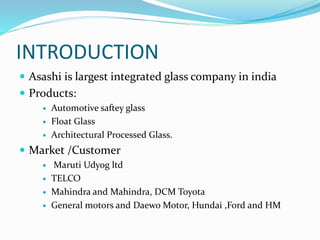
 Asashi is largest integrated glass company in india
 Products:
 Automotive saftey glass
 Float Glass
 Architectural Processed Glass.
 Market /Customer
 Maruti Udyog ltd
 TELCO
 Mahindra and Mahindra, DCM Toyota
 General motors and Daewo Motor, Hundai ,Ford and HM
Asahi India Glass Limited
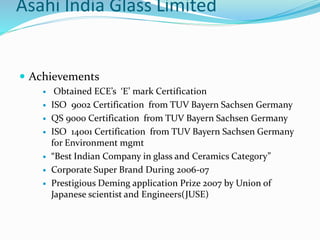
 Achievements
 Obtained ECE’s ‘E’ mark Certification
 ISO 9002 Certification from TUV Bayern Sachsen Germany
 QS 9000 Certification from TUV Bayern Sachsen Germany
 ISO 14001 Certification from TUV Bayern Sachsen Germany
for Environment mgmt
 “Best Indian Company in glass and Ceramics Category”
 Corporate Super Brand During 2006-07
 Prestigious Deming application Prize 2007 by Union of
Japanese scientist and Engineers(JUSE)
Asahi India Glass Limited
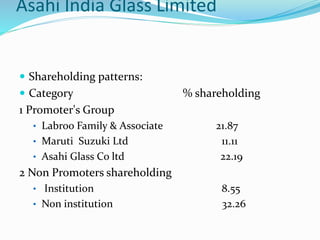
 Shareholding patterns:
 Category % shareholding
1 Promoter's Group
• Labroo Family & Associate 21.87
• Maruti Suzuki Ltd 11.11
• Asahi Glass Co ltd 22.19
2 Non Promoters shareholding
• Institution 8.55
• Non institution 32.26
Asahi India Glass Limited
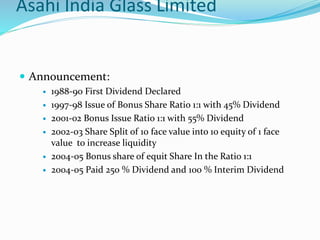
 Announcement:
 1988-90 First Dividend Declared
 1997-98 Issue of Bonus Share Ratio 1:1 with 45% Dividend
 2001-02 Bonus Issue Ratio 1:1 with 55% Dividend
 2002-03 Share Split of 10 face value into 10 equity of 1 face
value to increase liquidity
 2004-05 Bonus share of equit Share In the Ratio 1:1
 2004-05 Paid 250 % Dividend and 100 % Interim Dividend
Asahi India Glass Limited
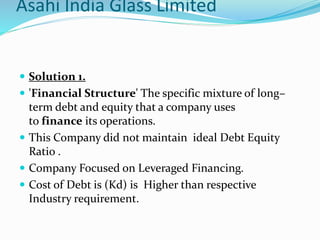
 Solution 1.
 'Financial Structure' The specific mixture of long–
term debt and equity that a company uses
to finance its operations.
 This Company did not maintain ideal Debt Equity
Ratio .
 Company Focused on Leveraged Financing.
 Cost of Debt is (Kd) is Higher than respective
Industry requirement.
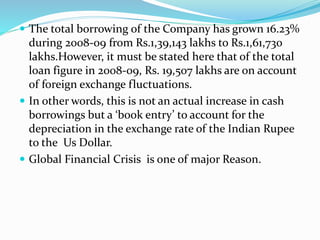
 The total borrowing of the Company has grown 16.23%
during 2008-09 from Rs.1,39,143 lakhs to Rs.1,61,730
lakhs.However, it must be stated here that of the total
loan figure in 2008-09, Rs. 19,507 lakhs are on account
of foreign exchange fluctuations.
 In other words, this is not an actual increase in cash
borrowings but a ‘book entry’ to account for the
depreciation in the exchange rate of the Indian Rupee
to the Us Dollar.
 Global Financial Crisis is one of major Reason.
Asahi India Glass Limited
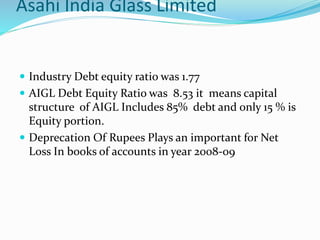
 Industry Debt equity ratio was 1.77
 AIGL Debt Equity Ratio was 8.53 it means capital
structure of AIGL Includes 85% debt and only 15 % is
Equity portion.
 Deprecation Of Rupees Plays an important for Net
Loss In books of accounts in year 2008-09
Asahi India Glass Limited
 Solution 2
 The Company uses foreign currency forward contracts to
hedge its risks associated with foreign currency fluctuations
relating to firm commitments.
 Transactions in foreign currencies are recorded at the
exchange rates prevailing on the date of transactions.
 Foreign Currency Monetary Item Translation Difference
Account' in the financial statements and amortised over the
balance period of such long term asset/liability
Asahi India Glass Limited
 Transactions outstanding at the year end are
translated at exchange rates prevailing at the year end
and the profit/loss so determined is recognised in the
Profit and Loss Account except for long term foreign
currency monetary items in respect of which the
Company has exercised the option.
 Exchange rate 48.92 rs / Dollar
 Real cost of foreign currency loan 49.50 million
Thank you

Ashi india limited

  • 2.
    INTRODUCTION  Asashi islargest integrated glass company in india  Products:  Automotive saftey glass  Float Glass  Architectural Processed Glass.  Market /Customer  Maruti Udyog ltd  TELCO  Mahindra and Mahindra, DCM Toyota  General motors and Daewo Motor, Hundai ,Ford and HM
  • 3.
    Asahi India GlassLimited  Achievements  Obtained ECE’s ‘E’ mark Certification  ISO 9002 Certification from TUV Bayern Sachsen Germany  QS 9000 Certification from TUV Bayern Sachsen Germany  ISO 14001 Certification from TUV Bayern Sachsen Germany for Environment mgmt  “Best Indian Company in glass and Ceramics Category”  Corporate Super Brand During 2006-07  Prestigious Deming application Prize 2007 by Union of Japanese scientist and Engineers(JUSE)
  • 4.
    Asahi India GlassLimited  Shareholding patterns:  Category % shareholding 1 Promoter's Group • Labroo Family & Associate 21.87 • Maruti Suzuki Ltd 11.11 • Asahi Glass Co ltd 22.19 2 Non Promoters shareholding • Institution 8.55 • Non institution 32.26
  • 5.
    Asahi India GlassLimited  Announcement:  1988-90 First Dividend Declared  1997-98 Issue of Bonus Share Ratio 1:1 with 45% Dividend  2001-02 Bonus Issue Ratio 1:1 with 55% Dividend  2002-03 Share Split of 10 face value into 10 equity of 1 face value to increase liquidity  2004-05 Bonus share of equit Share In the Ratio 1:1  2004-05 Paid 250 % Dividend and 100 % Interim Dividend
  • 6.
    Asahi India GlassLimited  Solution 1.  'Financial Structure' The specific mixture of long– term debt and equity that a company uses to finance its operations.  This Company did not maintain ideal Debt Equity Ratio .  Company Focused on Leveraged Financing.  Cost of Debt is (Kd) is Higher than respective Industry requirement.
  • 7.
     The totalborrowing of the Company has grown 16.23% during 2008-09 from Rs.1,39,143 lakhs to Rs.1,61,730 lakhs.However, it must be stated here that of the total loan figure in 2008-09, Rs. 19,507 lakhs are on account of foreign exchange fluctuations.  In other words, this is not an actual increase in cash borrowings but a ‘book entry’ to account for the depreciation in the exchange rate of the Indian Rupee to the Us Dollar.  Global Financial Crisis is one of major Reason.
  • 8.
    Asahi India GlassLimited  Industry Debt equity ratio was 1.77  AIGL Debt Equity Ratio was 8.53 it means capital structure of AIGL Includes 85% debt and only 15 % is Equity portion.  Deprecation Of Rupees Plays an important for Net Loss In books of accounts in year 2008-09
  • 9.
    Asahi India GlassLimited  Solution 2  The Company uses foreign currency forward contracts to hedge its risks associated with foreign currency fluctuations relating to firm commitments.  Transactions in foreign currencies are recorded at the exchange rates prevailing on the date of transactions.  Foreign Currency Monetary Item Translation Difference Account' in the financial statements and amortised over the balance period of such long term asset/liability
  • 10.
    Asahi India GlassLimited  Transactions outstanding at the year end are translated at exchange rates prevailing at the year end and the profit/loss so determined is recognised in the Profit and Loss Account except for long term foreign currency monetary items in respect of which the Company has exercised the option.  Exchange rate 48.92 rs / Dollar  Real cost of foreign currency loan 49.50 million
  • 11.