


Group#4
Anirudh Venkat GSEP13CMM020
Avinash Singh GSEP13CMM023
Prajakta Talathi GSEP13CMM031
Manish Barapatre GSEP13CMM028
Introduction
This presentation will discuss Fair & Lovely and present information on the following areas:
• An outline of the product
• Market Segments
• Target Market
• Ad Evaluation
• The internal influences
• The external influences
• The implications for marketers
• Recommendations
• The conclusions and observations.
2
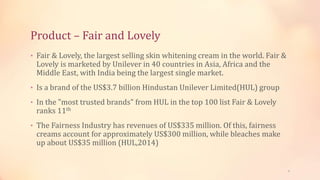
Product – Fair and Lovely
• Fair & Lovely, the largest selling skin whitening cream in the world. Fair &
Lovely is marketed by Unilever in 40 countries in Asia, Africa and the
Middle East, with India being the largest single market.
• Is a brand of the US$3.7 billion Hindustan Unilever Limited(HUL) group
• In the "most trusted brands" from HUL in the top 100 list Fair & Lovely
ranks 11th
• The Fairness Industry has revenues of US$335 million. Of this, fairness
creams account for approximately US$300 million, while bleaches make
up about US$35 million (HUL,2014)
3
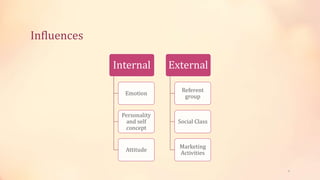
Influences
Internal
Emotion
Personality
and self
concept
Attitude
External
Referent
group
Social Class
Marketing
Activities
4
Market Segmentation
• Segmentation:
• A market can rarely satisfy everyone. Not everyone has same motives and needs. That is
why marketers start dividing the market into segments (KOTLER & KELLER, 2012).
• Segmentation Criteria:
Demographic
• Gender: Females/Males
• Age: Below 16, 16-25, 26-35, 35-45, above 45
• Income Level: High Income, Low Income, Middle Income
Psychographic
• Social Status: High Class, Middle Class, Lower Class
• Self-Image and Social image: Actual and ideal self-image, actual and Ideal social-image
(Leon Schiffman et all, 2011)
5
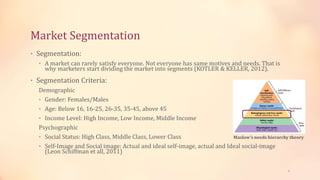
Maslow’s needs hierarchy theory
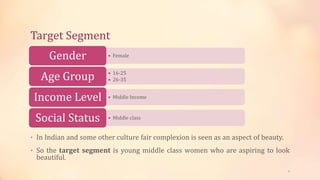
Target Segment
• In Indian and some other culture fair complexion is seen as an aspect of beauty.
• So the target segment is young middle class women who are aspiring to look
beautiful.
• FemaleGender
• 16-25
• 26-35Age Group
• Middle IncomeIncome Level
• Middle classSocial Status
6
Effectiveness of Advertisements and Promotions
7
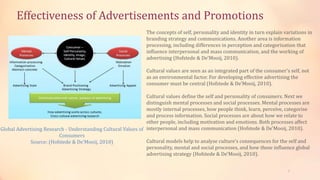
Global Advertising Research - Understanding Cultural Values of
Consumers
Source: (Hofstede & De'Mooij, 2010)
The concepts of self, personality and identity in turn explain variations in
branding strategy and communications. Another area is information
processing, including differences in perception and categorisation that
influence interpersonal and mass communication, and the working of
advertising (Hofstede & De'Mooij, 2010).
Cultural values are seen as an integrated part of the consumer's self, not
as an environmental factor. For developing effective advertising the
consumer must be central (Hofstede & De'Mooij, 2010).
Cultural values define the self and personality of consumers. Next we
distinguish mental processes and social processes. Mental processes are
mostly internal processes, how people think, learn, perceive, categorise
and process information. Social processes are about how we relate to
other people, including motivation and emotions. Both processes affect
interpersonal and mass communication (Hofstede & De'Mooij, 2010).
Cultural models help to analyse culture's consequences for the self and
personality, mental and social processes, and how these influence global
advertising strategy (Hofstede & De'Mooij, 2010).
Effectiveness of Advertisements and Promotions
8
Attitude
Emotions
Memory
Source: Adapted from (Zain-Ul-Abideen & Salman , 2012).
Hofstede, G., & De'Mooij, M. (2010). The Hofstede Model –
Applications to Global Branding and Advertising Strategy and
Research. Intenational Journal of Advertising.
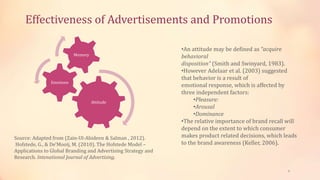
•An attitude may be defined as “acquire
behavioral
disposition” (Smith and Swinyard, 1983).
•However Adelaar et al. (2003) suggested
that behavior is a result of
emotional response, which is affected by
three independent factors:
•Pleasure:
•Arousal
•Dominance
•The relative importance of brand recall will
depend on the extent to which consumer
makes product related decisions, which leads
to the brand awareness (Keller, 2006).
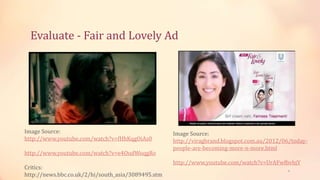
Evaluate - Fair and Lovely Ad
9
Image Source:
http://www.youtube.com/watch?v=fHhKqgOiAs0
http://www.youtube.com/watch?v=e4OudWoqgRo
Critics:
http://news.bbc.co.uk/2/hi/south_asia/3089495.stm
Image Source:
http://viragbrand.blogspot.com.au/2012/06/today-
people-are-becoming-more-n-more.html
http://www.youtube.com/watch?v=UrAFwfbvbjY
Internal Influences
10
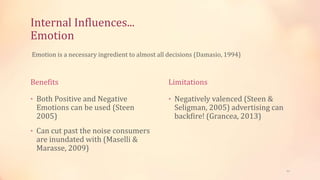
Internal Influences...
Emotion
Benefits
• Both Positive and Negative
Emotions can be used (Steen
2005)
• Can cut past the noise consumers
are inundated with (Maselli &
Marasse, 2009)
Limitations
• Negatively valenced (Steen &
Seligman, 2005) advertising can
backfire! (Grancea, 2013)
Emotion is a necessary ingredient to almost all decisions (Damasio, 1994)
11
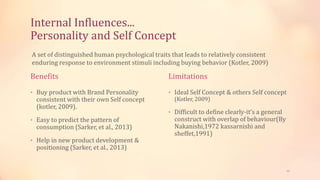
Internal Influences...
Personality and Self Concept
Benefits
• Buy product with Brand Personality
consistent with their own Self concept
(kotler, 2009).
• Easy to predict the pattern of
consumption (Sarker, et al., 2013)
• Help in new product development &
positioning (Sarker, et al., 2013)
Limitations
• Ideal Self Concept & others Self concept
(Kotler, 2009)
• Difficult to define clearly-it’s a general
construct with overlap of behaviour(By
Nakanishi,1972 kassarnishi and
sheffet,1991)
A set of distinguished human psychological traits that leads to relatively consistent
enduring response to environment stimuli including buying behavior (Kotler, 2009)
12
External Influences
13
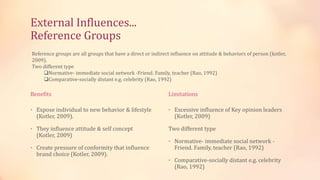
External Influences...
Reference Groups
Benefits
• Expose individual to new behavior & lifestyle
(Kotler, 2009).
• They influence attitude & self concept
(Kotler, 2009)
• Create pressure of conformity that influence
brand choice (Kotler, 2009).
Limitations
• Excessive influence of Key opinion leaders
(Kotler, 2009)
Two different type
• Normative- immediate social network -
Friend. Family, teacher (Rao, 1992)
• Comparative-socially distant e.g. celebrity
(Rao, 1992)
Reference groups are all groups that have a direct or indirect influence on attitude & behaviors of person (kotler,
2009).
Two different type
Normative- immediate social network -Friend. Family, teacher (Rao, 1992)
Comparative-socially distant e.g. celebrity (Rao, 1992)
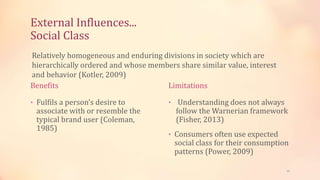
External Influences...
Social Class
Benefits
• Fulfils a person’s desire to
associate with or resemble the
typical brand user (Coleman,
1985)
Limitations
• Understanding does not always
follow the Warnerian framework
(Fisher, 2013)
• Consumers often use expected
social class for their consumption
patterns (Power, 2009)
Relatively homogeneous and enduring divisions in society which are
hierarchically ordered and whose members share similar value, interest
and behavior (Kotler, 2009)
15
Recommendations
16
Recommendations
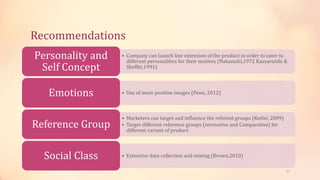
• Company can launch line extension of the product in order to cater to
different personalities for their motives (Nakanishi,1972 Kassarnishi &
Sheffet,1991)
Personality and
Self Concept
• Use of more positive images (Penn, 2012)Emotions
• Marketers can target and influence the referent groups (Kotler, 2009)
• Target different reference groups (normative and Comparative) for
different variant of product
Reference Group
• Extensive data collection and mining (Brown,2010)Social Class
17
Conclusion
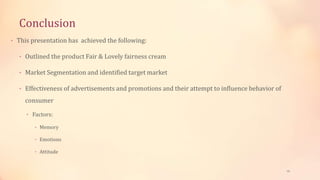
• This presentation has achieved the following:
• Outlined the product Fair & Lovely fairness cream
• Market Segmentation and identified target market
• Effectiveness of advertisements and promotions and their attempt to influence behavior of
consumer
• Factors:
• Memory
• Emotions
• Attitude
18
Conclusion
• Presented the internal & external influences which influence the consumer’s buying behavior
• Internal Influences
• Emotion
• Self concept / Personality
• External Influences
• Social Class
• Reference Group
• Presented the benefits and limits of the above influences
• Concluded with Observations and Recommendations
• Line extension of product to satisfy different groups
• Use of positive images
• Influence the influencers
• Analyse the modern trends of society with data analystics
19
References
• Hofstede, G., & De'Mooij, M. (2010). The Hofstede Model – Applications to
Global Branding and Advertising Strategy and Research. Intemational
Journal of Advertising.
• Zain-Ul-Abideen, & Salman , S. (2012). Effective advertising and its
influence on consumer buying behavior. European Journal of Business and
Management, 3(3).
• Latif, Abdul and Abideen, Zain Ul. (2011). Effects of Television Advertising
on Children: A Pakistani Perspective. European Journal of Economics,
Finance and Administrative Sciences, Issue, 30, pp. 38-49.
20
Bibliography
• Katke, K. (2007). The Impact of Television Advertising on Child Health &
Family Spending. International Marketing Conference on Marketing &
Society. Retrieved on Dated: 16-04-2014 from
http://www.itu.int/ITUD/ict/newslog/content/binary/20-2008jpg
• http://news.bbc.co.uk/2/hi/south_asia/3089495.stm
• http://www.youtube.com/watch?v=fHhKqgOiAs0
• http://www.youtube.com/watch?v=e4OudWoqgRo
• http://viragbrand.blogspot.com.au/2012/06/today-people-are-
becoming-more-n-more.html
• http://www.youtube.com/watch?v=UrAFwfbvbjY
21
Thank you
22

Fair and Lovely - Repositioning

  • 1.
    Group#4 Anirudh Venkat GSEP13CMM020 AvinashSingh GSEP13CMM023 Prajakta Talathi GSEP13CMM031 Manish Barapatre GSEP13CMM028
  • 2.
    Introduction This presentation willdiscuss Fair & Lovely and present information on the following areas: • An outline of the product • Market Segments • Target Market • Ad Evaluation • The internal influences • The external influences • The implications for marketers • Recommendations • The conclusions and observations. 2
  • 3.
    Product – Fairand Lovely • Fair & Lovely, the largest selling skin whitening cream in the world. Fair & Lovely is marketed by Unilever in 40 countries in Asia, Africa and the Middle East, with India being the largest single market. • Is a brand of the US$3.7 billion Hindustan Unilever Limited(HUL) group • In the "most trusted brands" from HUL in the top 100 list Fair & Lovely ranks 11th • The Fairness Industry has revenues of US$335 million. Of this, fairness creams account for approximately US$300 million, while bleaches make up about US$35 million (HUL,2014) 3
  • 4.
  • 5.
    Market Segmentation • Segmentation: •A market can rarely satisfy everyone. Not everyone has same motives and needs. That is why marketers start dividing the market into segments (KOTLER & KELLER, 2012). • Segmentation Criteria: Demographic • Gender: Females/Males • Age: Below 16, 16-25, 26-35, 35-45, above 45 • Income Level: High Income, Low Income, Middle Income Psychographic • Social Status: High Class, Middle Class, Lower Class • Self-Image and Social image: Actual and ideal self-image, actual and Ideal social-image (Leon Schiffman et all, 2011) 5 Maslow’s needs hierarchy theory
  • 6.
    Target Segment • InIndian and some other culture fair complexion is seen as an aspect of beauty. • So the target segment is young middle class women who are aspiring to look beautiful. • FemaleGender • 16-25 • 26-35Age Group • Middle IncomeIncome Level • Middle classSocial Status 6
  • 7.
    Effectiveness of Advertisementsand Promotions 7 Global Advertising Research - Understanding Cultural Values of Consumers Source: (Hofstede & De'Mooij, 2010) The concepts of self, personality and identity in turn explain variations in branding strategy and communications. Another area is information processing, including differences in perception and categorisation that influence interpersonal and mass communication, and the working of advertising (Hofstede & De'Mooij, 2010). Cultural values are seen as an integrated part of the consumer's self, not as an environmental factor. For developing effective advertising the consumer must be central (Hofstede & De'Mooij, 2010). Cultural values define the self and personality of consumers. Next we distinguish mental processes and social processes. Mental processes are mostly internal processes, how people think, learn, perceive, categorise and process information. Social processes are about how we relate to other people, including motivation and emotions. Both processes affect interpersonal and mass communication (Hofstede & De'Mooij, 2010). Cultural models help to analyse culture's consequences for the self and personality, mental and social processes, and how these influence global advertising strategy (Hofstede & De'Mooij, 2010).
  • 8.
    Effectiveness of Advertisementsand Promotions 8 Attitude Emotions Memory Source: Adapted from (Zain-Ul-Abideen & Salman , 2012). Hofstede, G., & De'Mooij, M. (2010). The Hofstede Model – Applications to Global Branding and Advertising Strategy and Research. Intenational Journal of Advertising. •An attitude may be defined as “acquire behavioral disposition” (Smith and Swinyard, 1983). •However Adelaar et al. (2003) suggested that behavior is a result of emotional response, which is affected by three independent factors: •Pleasure: •Arousal •Dominance •The relative importance of brand recall will depend on the extent to which consumer makes product related decisions, which leads to the brand awareness (Keller, 2006).
  • 9.
    Evaluate - Fairand Lovely Ad 9 Image Source: http://www.youtube.com/watch?v=fHhKqgOiAs0 http://www.youtube.com/watch?v=e4OudWoqgRo Critics: http://news.bbc.co.uk/2/hi/south_asia/3089495.stm Image Source: http://viragbrand.blogspot.com.au/2012/06/today- people-are-becoming-more-n-more.html http://www.youtube.com/watch?v=UrAFwfbvbjY
  • 10.
  • 11.
    Internal Influences... Emotion Benefits • BothPositive and Negative Emotions can be used (Steen 2005) • Can cut past the noise consumers are inundated with (Maselli & Marasse, 2009) Limitations • Negatively valenced (Steen & Seligman, 2005) advertising can backfire! (Grancea, 2013) Emotion is a necessary ingredient to almost all decisions (Damasio, 1994) 11
  • 12.
    Internal Influences... Personality andSelf Concept Benefits • Buy product with Brand Personality consistent with their own Self concept (kotler, 2009). • Easy to predict the pattern of consumption (Sarker, et al., 2013) • Help in new product development & positioning (Sarker, et al., 2013) Limitations • Ideal Self Concept & others Self concept (Kotler, 2009) • Difficult to define clearly-it’s a general construct with overlap of behaviour(By Nakanishi,1972 kassarnishi and sheffet,1991) A set of distinguished human psychological traits that leads to relatively consistent enduring response to environment stimuli including buying behavior (Kotler, 2009) 12
  • 13.
  • 14.
    External Influences... Reference Groups Benefits •Expose individual to new behavior & lifestyle (Kotler, 2009). • They influence attitude & self concept (Kotler, 2009) • Create pressure of conformity that influence brand choice (Kotler, 2009). Limitations • Excessive influence of Key opinion leaders (Kotler, 2009) Two different type • Normative- immediate social network - Friend. Family, teacher (Rao, 1992) • Comparative-socially distant e.g. celebrity (Rao, 1992) Reference groups are all groups that have a direct or indirect influence on attitude & behaviors of person (kotler, 2009). Two different type Normative- immediate social network -Friend. Family, teacher (Rao, 1992) Comparative-socially distant e.g. celebrity (Rao, 1992)
  • 15.
    External Influences... Social Class Benefits •Fulfils a person’s desire to associate with or resemble the typical brand user (Coleman, 1985) Limitations • Understanding does not always follow the Warnerian framework (Fisher, 2013) • Consumers often use expected social class for their consumption patterns (Power, 2009) Relatively homogeneous and enduring divisions in society which are hierarchically ordered and whose members share similar value, interest and behavior (Kotler, 2009) 15
  • 16.
  • 17.
    Recommendations • Company canlaunch line extension of the product in order to cater to different personalities for their motives (Nakanishi,1972 Kassarnishi & Sheffet,1991) Personality and Self Concept • Use of more positive images (Penn, 2012)Emotions • Marketers can target and influence the referent groups (Kotler, 2009) • Target different reference groups (normative and Comparative) for different variant of product Reference Group • Extensive data collection and mining (Brown,2010)Social Class 17
  • 18.
    Conclusion • This presentationhas achieved the following: • Outlined the product Fair & Lovely fairness cream • Market Segmentation and identified target market • Effectiveness of advertisements and promotions and their attempt to influence behavior of consumer • Factors: • Memory • Emotions • Attitude 18
  • 19.
    Conclusion • Presented theinternal & external influences which influence the consumer’s buying behavior • Internal Influences • Emotion • Self concept / Personality • External Influences • Social Class • Reference Group • Presented the benefits and limits of the above influences • Concluded with Observations and Recommendations • Line extension of product to satisfy different groups • Use of positive images • Influence the influencers • Analyse the modern trends of society with data analystics 19
  • 20.
    References • Hofstede, G.,& De'Mooij, M. (2010). The Hofstede Model – Applications to Global Branding and Advertising Strategy and Research. Intemational Journal of Advertising. • Zain-Ul-Abideen, & Salman , S. (2012). Effective advertising and its influence on consumer buying behavior. European Journal of Business and Management, 3(3). • Latif, Abdul and Abideen, Zain Ul. (2011). Effects of Television Advertising on Children: A Pakistani Perspective. European Journal of Economics, Finance and Administrative Sciences, Issue, 30, pp. 38-49. 20
  • 21.
    Bibliography • Katke, K.(2007). The Impact of Television Advertising on Child Health & Family Spending. International Marketing Conference on Marketing & Society. Retrieved on Dated: 16-04-2014 from http://www.itu.int/ITUD/ict/newslog/content/binary/20-2008jpg • http://news.bbc.co.uk/2/hi/south_asia/3089495.stm • http://www.youtube.com/watch?v=fHhKqgOiAs0 • http://www.youtube.com/watch?v=e4OudWoqgRo • http://viragbrand.blogspot.com.au/2012/06/today-people-are- becoming-more-n-more.html • http://www.youtube.com/watch?v=UrAFwfbvbjY 21
  • 22.