Colgate Palmolive
The Precision Toothbrush
About the Company
• Industry : Consumer goods
• Founded : In 1806 by William Colgate
• Headquarters : New York City, New York, U.S.
• Employees : 37,900
• Website : www.colgate.com
Company Background
• The company had sales of $6.06 billion and a gross
profit of $2.76 billion in 1991 making it a global leader
in household and personal care products.
• CP’s five-year plan (1991-95) emphasized new
product launches and entry into new geographic
markets, along with improved efficiencies in
manufacturing and distribution and a continuing focus
on consumer products.
Brands
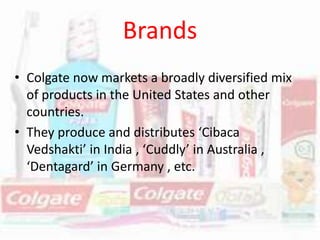
• Colgate now markets a broadly diversified mix
of products in the United States and other
countries.
• They produce and distributes ‘Cibaca
Vedshakti’ in India , ‘Cuddly’ in Australia ,
‘Dentagard’ in Germany , etc.
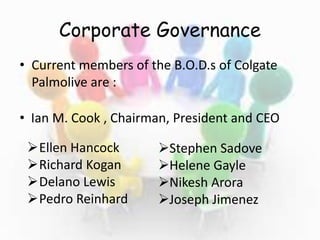
Corporate Governance
• Current members of the B.O.D.s of Colgate
Palmolive are :
Ellen Hancock
Richard Kogan
Delano Lewis
Pedro Reinhard
Stephen Sadove
Helene Gayle
Nikesh Arora
Joseph Jimenez
• Ian M. Cook , Chairman, President and CEO
Achievements
• Colgate Palmolive received the 2012 Safe-in-
Sound Excellence in Hearing Loss Prevention
Award.
• CP was named one of the “100 Best
Companies for Working Mothers” by Working
Mother Magazine.
• The 2012 Human Rights Campaign “report
card” on American business gave Colgate an A
for its support of diversity in the workplace.
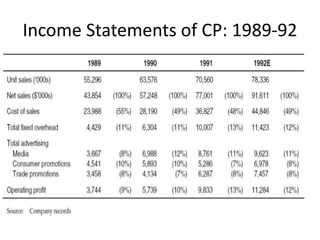
Income Statements of CP: 1989-92
“The Precision Toothbrush”
About the Toothbrush
• In August 1992, CP was about to launch a
technologically superior Toothbrush in U.S.,
named Colgate Precision.
• CP’s Oral Care division had been developing
this toothbrush for over 3 years.
• Susan Steinberg, Precision product manager,
had managed the entire new product
development process.
The Key People
i. Susan Steinberg (Precision Product Manager)
ii. Reuben Mark (Colgate Palmolive’s CEO)
iii. John Philips (Colgate Plus Manager)
iv. Nigel Burton (Division General Manager)
Situation Analysis
• CP is poised to launch “Precision Toothbrush”
as a line extension after significant research.
• Feared competition from competitors in
premium akin to the value segment.
• Conducting Market Surveys to fulfil Consumer
Needs.
• Contemplating on the process of brand’s
Segmentation, Targeting and Positioning.
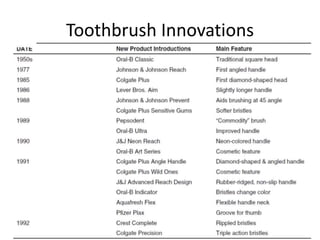
Toothbrush Innovations
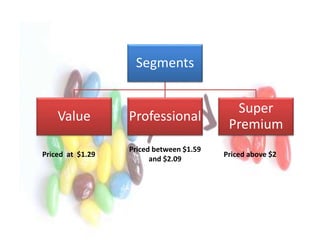
Segments
Value Professional
Super
Premium
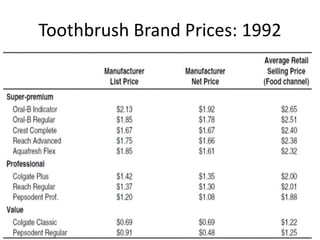
Priced at $1.29
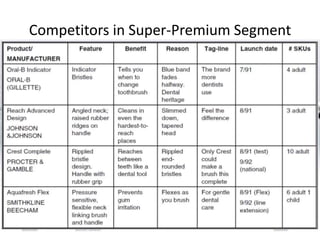
Priced between $1.59
and $2.09
Priced above $2
Competitors in Super-Premium Segment
Toothbrush Brand Prices: 1992
Trends
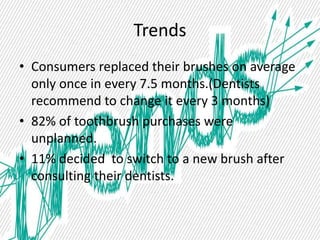
• Consumers replaced their brushes on average
only once in every 7.5 months.(Dentists
recommend to change it every 3 months)
• 82% of toothbrush purchases were
unplanned.
• 11% decided to switch to a new brush after
consulting their dentists.
• CP’s Consumer Research indicate that
consumers of the baby boom generation were
more concerned about the health of their
gums.
• Consumers agreed that toothbrushes were as
crucial as toothpaste to remove Plaque, food
particles and gum stimulation.
• Consumer were willing to experiment with
new toothbrushes.
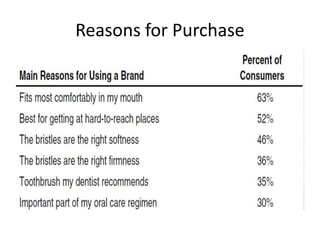
Reasons for Purchase
I.
• Market leader since the 1960’s.
• Relied professionals endorsements.
• Also known by the name of “The dentist’s
toothbrush”
• Promoted it’s product with coupons, buy-one-
get-one-free and mail-in refund offers.
• Entered the market in 1970’s with “Reach”.
• Second product in 1988 – P which had handle
bevelled at 45%.
• In 1991, J&J ranked third in the U.S. Retail
toothbrush market.
• Relied mainly on T.V. Commercials.
II.
III.
• Most recent entrant into the market of
toothbrush with its Crest Complete.
• Planned to launch Crest Complete nationally in
the U.S. Toothbrush market in Sept. 1992.
• Claimed the ability to reach between the teeth up
to 37% farther than leading flat brushes.
• Promotions already included 55 cent coupons
and $1.99 refunds on toothbrushes bought from
floor stands.
IV.
• Entered the U.S. toothbrush market in Aug.
1991 with Aquafresh Flex.
• It had flexible handles for gentle brushing.
• Aquafresh stood for gentleness and flexibility.
• Promoted their toothbrush by attractive offers
like buy-two-get-one-free, toothbrush free
with toothpaste.
• The company was expected to make an
operational loss on toothbrushes in 1992.
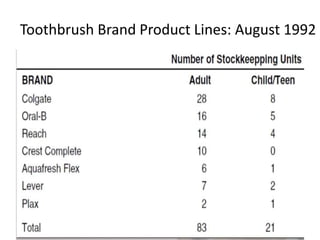
Toothbrush Brand Product Lines: August 1992
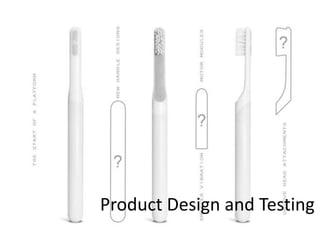
Product Design and Testing
• CP’s Researchers implemented infrared motion
analysis to know the consumers’ brushing
movements.
• With computer aided design, CP introduced a
unique brush with bristles of three different
lengths – Longer outer, Long inner and Shorter
bristles, which gave triple-action brushing effect.
• Mission : “develop a superior, technical, plaque
removing device.”
Positioning
Modes of Positioning
• Precision was developed with the objective
of creating the best brush possible and as such
becoming a super premium product.
• Company had two choices :
(i) Niche Product
•Targeting consumers concerned about gum disease.
•Could capture only 3% of US market by the end of first year.
(ii) Mainstream Product
•Positioning it as the most effective toothbrush available in the market.
•Could capture only 10% of the US market by the end of the first year.
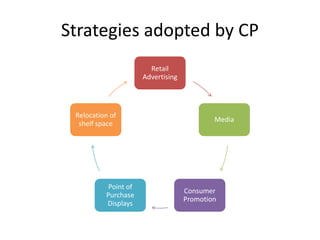
Strategies adopted by CP
Retail
Advertising
Media
Consumer
Promotion
Point of
Purchase
Displays
Relocation of
shelf space
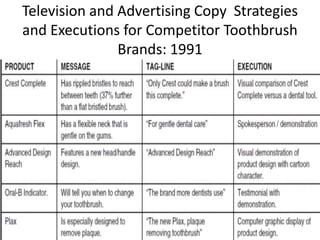
Television and Advertising Copy Strategies
and Executions for Competitor Toothbrush
Brands: 1991
Distribution
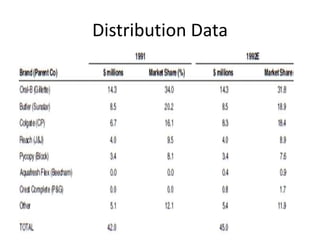
Distribution Data
Strengths
• Strong Brand Image.
• A dedicated R&D team to introduce a
significant product.
• Technical Innovation.
• Financially strong.
Weaknesses
• Cut-throat competitors like Oral-B, J&J,
SmithKline Beecham.

• Recent entrant in super premium segment.
Opportunities
• Dominate the super premium segment.
• Increase in customer base.
• Augmentation of brand equity.
Threats
• Brand cannibalization.
• Not being widely accepted in the market.
• Expenses on communication and promotion.
Conclusion
• Susan believed that the Precision was more than
a niche product or merely a line extension with
proven advantages to consumers representing a
technological breakthrough.
• So she positioned the product for niche segment
where the competition was incredible and CP’s
product performed well.
• This helped CP, reducing the impact of brand
cannibalisation.
Recommendations
• Initially placing it as a niche product and then
expanding it to mainstream segment, because
it would have been fetched higher return.
• Expansion of production capacity with the
required lead time.
Disclaimer!
Created by Shivang Thakkar, SEMCOM, SPU,
during a marketing internship under Prof.
Sameer Mathur, IIM-Lucknow.
Prof. Sameer Mathur
IIM-Lucknow
Shivang Thakkar
SEMCOM

THE PRECISION TOOTHBRUSH

  • 1.
  • 2.
    About the Company •Industry : Consumer goods • Founded : In 1806 by William Colgate • Headquarters : New York City, New York, U.S. • Employees : 37,900 • Website : www.colgate.com
  • 3.
    Company Background • Thecompany had sales of $6.06 billion and a gross profit of $2.76 billion in 1991 making it a global leader in household and personal care products. • CP’s five-year plan (1991-95) emphasized new product launches and entry into new geographic markets, along with improved efficiencies in manufacturing and distribution and a continuing focus on consumer products.
  • 4.
    Brands • Colgate nowmarkets a broadly diversified mix of products in the United States and other countries. • They produce and distributes ‘Cibaca Vedshakti’ in India , ‘Cuddly’ in Australia , ‘Dentagard’ in Germany , etc.
  • 5.
    Corporate Governance • Currentmembers of the B.O.D.s of Colgate Palmolive are : Ellen Hancock Richard Kogan Delano Lewis Pedro Reinhard Stephen Sadove Helene Gayle Nikesh Arora Joseph Jimenez • Ian M. Cook , Chairman, President and CEO
  • 6.
    Achievements • Colgate Palmolivereceived the 2012 Safe-in- Sound Excellence in Hearing Loss Prevention Award. • CP was named one of the “100 Best Companies for Working Mothers” by Working Mother Magazine. • The 2012 Human Rights Campaign “report card” on American business gave Colgate an A for its support of diversity in the workplace.
  • 7.
  • 8.
  • 9.
    About the Toothbrush •In August 1992, CP was about to launch a technologically superior Toothbrush in U.S., named Colgate Precision. • CP’s Oral Care division had been developing this toothbrush for over 3 years. • Susan Steinberg, Precision product manager, had managed the entire new product development process.
  • 10.
    The Key People i.Susan Steinberg (Precision Product Manager) ii. Reuben Mark (Colgate Palmolive’s CEO) iii. John Philips (Colgate Plus Manager) iv. Nigel Burton (Division General Manager)
  • 11.
    Situation Analysis • CPis poised to launch “Precision Toothbrush” as a line extension after significant research. • Feared competition from competitors in premium akin to the value segment. • Conducting Market Surveys to fulfil Consumer Needs. • Contemplating on the process of brand’s Segmentation, Targeting and Positioning.
  • 12.
  • 14.
    Segments Value Professional Super Premium Priced at$1.29 Priced between $1.59 and $2.09 Priced above $2
  • 15.
  • 16.
  • 18.
    Trends • Consumers replacedtheir brushes on average only once in every 7.5 months.(Dentists recommend to change it every 3 months) • 82% of toothbrush purchases were unplanned. • 11% decided to switch to a new brush after consulting their dentists.
  • 19.
    • CP’s ConsumerResearch indicate that consumers of the baby boom generation were more concerned about the health of their gums. • Consumers agreed that toothbrushes were as crucial as toothpaste to remove Plaque, food particles and gum stimulation. • Consumer were willing to experiment with new toothbrushes.
  • 20.
  • 22.
    I. • Market leadersince the 1960’s. • Relied professionals endorsements. • Also known by the name of “The dentist’s toothbrush” • Promoted it’s product with coupons, buy-one- get-one-free and mail-in refund offers.
  • 23.
    • Entered themarket in 1970’s with “Reach”. • Second product in 1988 – P which had handle bevelled at 45%. • In 1991, J&J ranked third in the U.S. Retail toothbrush market. • Relied mainly on T.V. Commercials. II.
  • 24.
    III. • Most recententrant into the market of toothbrush with its Crest Complete. • Planned to launch Crest Complete nationally in the U.S. Toothbrush market in Sept. 1992. • Claimed the ability to reach between the teeth up to 37% farther than leading flat brushes. • Promotions already included 55 cent coupons and $1.99 refunds on toothbrushes bought from floor stands.
  • 25.
    IV. • Entered theU.S. toothbrush market in Aug. 1991 with Aquafresh Flex. • It had flexible handles for gentle brushing. • Aquafresh stood for gentleness and flexibility. • Promoted their toothbrush by attractive offers like buy-two-get-one-free, toothbrush free with toothpaste. • The company was expected to make an operational loss on toothbrushes in 1992.
  • 26.
    Toothbrush Brand ProductLines: August 1992
  • 28.
  • 29.
    • CP’s Researchersimplemented infrared motion analysis to know the consumers’ brushing movements. • With computer aided design, CP introduced a unique brush with bristles of three different lengths – Longer outer, Long inner and Shorter bristles, which gave triple-action brushing effect. • Mission : “develop a superior, technical, plaque removing device.”
  • 30.
  • 31.
    Modes of Positioning •Precision was developed with the objective of creating the best brush possible and as such becoming a super premium product. • Company had two choices : (i) Niche Product •Targeting consumers concerned about gum disease. •Could capture only 3% of US market by the end of first year. (ii) Mainstream Product •Positioning it as the most effective toothbrush available in the market. •Could capture only 10% of the US market by the end of the first year.
  • 33.
    Strategies adopted byCP Retail Advertising Media Consumer Promotion Point of Purchase Displays Relocation of shelf space
  • 34.
    Television and AdvertisingCopy Strategies and Executions for Competitor Toothbrush Brands: 1991
  • 35.
  • 36.
  • 38.
    Strengths • Strong BrandImage. • A dedicated R&D team to introduce a significant product. • Technical Innovation. • Financially strong.
  • 39.
    Weaknesses • Cut-throat competitorslike Oral-B, J&J, SmithKline Beecham. • Recent entrant in super premium segment.
  • 40.
    Opportunities • Dominate thesuper premium segment. • Increase in customer base. • Augmentation of brand equity.
  • 41.
    Threats • Brand cannibalization. •Not being widely accepted in the market. • Expenses on communication and promotion.
  • 42.
    Conclusion • Susan believedthat the Precision was more than a niche product or merely a line extension with proven advantages to consumers representing a technological breakthrough. • So she positioned the product for niche segment where the competition was incredible and CP’s product performed well. • This helped CP, reducing the impact of brand cannibalisation.
  • 43.
    Recommendations • Initially placingit as a niche product and then expanding it to mainstream segment, because it would have been fetched higher return. • Expansion of production capacity with the required lead time.
  • 44.
    Disclaimer! Created by ShivangThakkar, SEMCOM, SPU, during a marketing internship under Prof. Sameer Mathur, IIM-Lucknow. Prof. Sameer Mathur IIM-Lucknow Shivang Thakkar SEMCOM