COLGATE - PALMOLIVE :
THE PRECISION
TOOTHBRUSH
CASE STUDY
A Global Leader in the Personal and
HealthCare Products
SITUATION
In August 1992, Colgate-
Palmolive was planning to launch
a new technologically superior
toothbrush which it had been
developing for three years.
Decisions to be
Made
•Positioning
•Branding
•Product Pricing
•Communication and Promotion
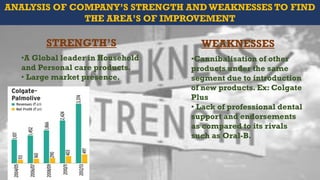
ANALYSIS OF COMPANY’S STRENGTH AND WEAKNESSES TO FIND
THE AREA’S OF IMPROVEMENT
STRENGTH’S
•A Global leader in Household
and Personal care products.
• Large market presence.
WEAKNESSES
•Cannibalisation of other
products under the same
segment due to introduction
of new products. Ex: Colgate
Plus
• Lack of professional dental
support and endorsements
as compared to its rivals
such as Oral-B.
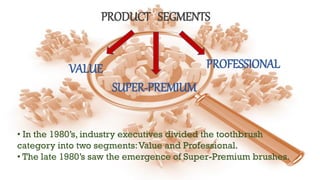
PRODUCT SEGMENTS
VALUE
SUPER-PREMIUM
PROFESSIONAL
• In the 1980’s, industry executives divided the toothbrush
category into two segments:Value and Professional.
• The late 1980’s saw the emergence of Super-Premium brushes.
CONSUMER BEHAVIOUR
• Consumers were more concernedabout the healthof theirgums and were willingto pay
a premiumfor new productsaddressingthisissue.
• Brand choice wasbasedon features, comfort and Professional recommendations.
Consumers chose a brushto satisfytheirindividual needs: size and shape of
mouth, sensitivity of gums etc.
• Forty-eight percent of consumersclaimedto changetheirbrushes every3 months.
But, purchasefrequencylaggedthereplacement frequencyduring1991.
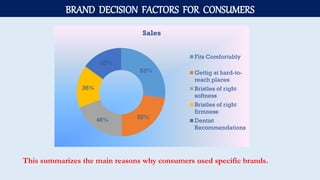
63%
52%46%
36%
35%
Sales
Fits Comfortably
Gettig at hard-to-
reach places
Bristles of right
softness
Bristles of right
firmness
Dentist
Recommendations
BRAND DECISION FACTORS FOR CONSUMERS
This summarizes the main reasons why consumers used specific brands.
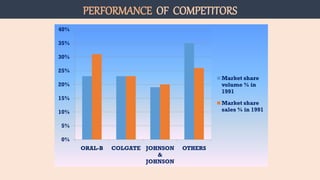
0%
5%
10%
15%
20%
25%
30%
35%
40%
ORAL-B COLGATE JOHNSON
&
JOHNSON
OTHERS
Market share
volume % in
1991
Market share
sales % in 1991
PERFORMANCE OF COMPETITORS
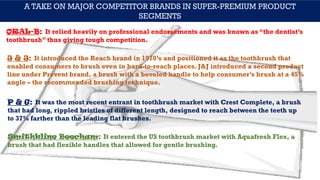
A TAKE ON MAJOR COMPETITOR BRANDS IN SUPER-PREMIUM PRODUCT
SEGMENTS
ORAL-B: It relied heavily on professional endorsements and was known as “the dentist’s
toothbrush” thus giving tough competition.
J & J: It introduced the Reach brand in 1970’s and positioned it as the toothbrush that
enabled consumers to brush even in hard-to-reach places. J&J introduced a second product
line under Prevent brand, a brush with a beveled handle to help consumer’s brush at a 45%
angle – the recommended brushing technique.
P & G: It was the most recent entrant in toothbrush market with Crest Complete, a brush
that had long, rippled bristles of different length, designed to reach between the teeth up
to 37% farther than the leading flat brushes.
Smithkline Beecham: It entered the US toothbrush market with Aquafresh Flex, a
brush that had flexible handles that allowed for gentle brushing.
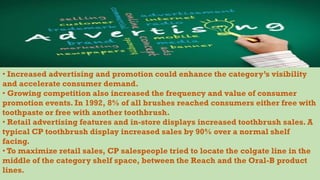
• Increased advertising and promotion could enhance the category’s visibility
and accelerate consumer demand.
• Growing competition also increased the frequency and value of consumer
promotion events. In 1992, 8% of all brushes reached consumers either free with
toothpaste or free with another toothbrush.
• Retail advertising features and in-store displays increased toothbrush sales. A
typical CP toothbrush display increased sales by 90% over a normal shelf
facing.
• To maximize retail sales, CP salespeople tried to locate the colgate line in the
middle of the category shelf space, between the Reach and the Oral-B product
lines.
PRODUCT DESIGN
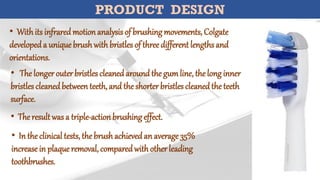
• Withits infraredmotionanalysis of brushingmovements, Colgate
developeda uniquebrushwithbristles of threedifferent lengthsand
orientations.
• The longerouterbristles cleanedaroundthe gumline, the long inner
bristles cleanedbetweenteeth,and the shorterbristles cleanedthe teeth
surface.
• Theresultwas a triple-actionbrushingeffect.
• In theclinical tests, thebrushachievedan average35%
increasein plaqueremoval, comparedwithotherleading
toothbrushes.
POSITIONING Precisionwas developedwith
the intention of makingit a
super-premiumproduct.
The positioning of Precision
had two scenarios:
• Niche Positioning.
• MainstreamPositioning.
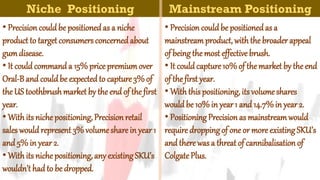
Niche Positioning
• Precision couldbe positionedas a niche
product to target consumers concernedabout
gumdisease.
• It couldcommanda 15%price premiumover
Oral-Band couldbe expectedto capture3% of
the US toothbrushmarket by the end of the first
year.
• With its nichepositioning,Precisionretail
sales wouldrepresent 3% volumeshare in year1
and5% in year2.
• With its nichepositioning,any existingSKU’s
wouldn’t hadto be dropped.
Mainstream Positioning
• Precision couldbe positionedas a
mainstreamproduct, withthe broaderappeal
of beingthemost effective brush.
• It couldcapture10%of themarket by theend
of the first year.
• Withthispositioning, its volumeshares
wouldbe 10%in year1 and 14.7%in year2.
• PositioningPrecisionas mainstreamwould
requiredroppingof one or more existingSKU’s
andtherewasa threat of cannibalisation of
ColgatePlus.
• Executives who believed that the
product could stand alone
, recommended that the Precision
brand name should be specified.
• Stressing Precision as opposed to
Colgate would limit the extent of
cannibalization of Colgate Plus.
• It was estimated, both under the niche
and mainstream positioning
scenarios, that cannibalization figures
for Colgate would increase by 20% if the
Colgate brand name was stressed but
remain unchanged if the Precision
brand name was stressed.
ADDITIONAL CONSUMER RESEARCH
• 55%test consumers found Precision to be very different from their current
toothbrushes and 77% claimedThat it was much more effective tha others.
• Precision’s unique design could remove more plaque from the teeth but its
unusual look sometimes had mixed first impressions.
• The benefit of reduced gum disease from extra plaque removal was difficult
to translate into a message with broad consumer appeal.
• The researchrevealed that the more test consumers were told about Precision
and how it worked, the greater their enthusiasmfor the product.
POSITIONING
1. Precisionshouldbe positionedinitially as a niche product so that:
• Thecompany can satisfythedemandwithits current productioncapacity.
• It can reducethe effect of cannibalismon ColgatePlus.
• Any existingSKU’s neednot to be dropped.
2. Later, Precision shouldbe positionedas a mainstreamproduct so that:
• Thecompany can increaseits productioncapacityand satisfy the demand.
• Precision by thistime wouldhave increasedits popularityand recognition.
• A relativelygreaterproportionof sales wouldoccurthroughmass merchandisers and
club-stores.
BRANDING
• Emphasizing theColgatenameon thenew Precisiontoothbrushwould cause
additional cannibalizationof the existingColgatetooth-brushes. Ex: Colgate-Plus.
• So, “Precisionby Colgate”wouldbe moreappropriate.
COMMUNICATION
• Advertisingandpromotional activitiesshouldbe increasedwithmore investment as
it will increase the products reach, recognitionand it will give a head-start to the
product.
• Several kinds of promotional activitiesshouldbe used to induce the consumers
towards the product.
ADVERTISEMENTS
•This was one of the print ads which depicted the
three different types of bristles in the Precision
toothbrush and its advantages in the context of health.
•Print Ads and advertisements have better reach
into the consumers and they are always more
appealing.
PROMOTIONS
• Important tactic is to use dentists to sample
consumers since professional endorsementsare
believedimportant to establishthe credibility of
a new toothbrush.
• Buyone, Get one offer or a 50%off offercan
be introducedin marketsinvolvingheavy
competition.
• Combinational packsof toothbrushand
toothpaste shouldbe introducedwhichwill
boost the company’ssales.
S
U
M
M
A
R
Y
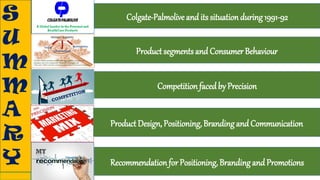
Colgate-Palmolive and its situation during1991-92
Product segmentsand ConsumerBehaviour
Competitionfacedby Precision
Product Design, Positioning,Brandingand Communication
Recommendationfor Positioning,Brandingand Promotions
DISCLAIMER
Created by Akhil Kumar, NIT Raipur, during a
marketing internship by Prof. Sameer Mathur, IIM
Lucknow.

Colgate-Palmolive Co. : The Precision Toothbrush

  • 1.
    COLGATE - PALMOLIVE: THE PRECISION TOOTHBRUSH CASE STUDY
  • 2.
    A Global Leaderin the Personal and HealthCare Products
  • 3.
    SITUATION In August 1992,Colgate- Palmolive was planning to launch a new technologically superior toothbrush which it had been developing for three years. Decisions to be Made •Positioning •Branding •Product Pricing •Communication and Promotion
  • 4.
    ANALYSIS OF COMPANY’SSTRENGTH AND WEAKNESSES TO FIND THE AREA’S OF IMPROVEMENT STRENGTH’S •A Global leader in Household and Personal care products. • Large market presence. WEAKNESSES •Cannibalisation of other products under the same segment due to introduction of new products. Ex: Colgate Plus • Lack of professional dental support and endorsements as compared to its rivals such as Oral-B.
  • 5.
    PRODUCT SEGMENTS VALUE SUPER-PREMIUM PROFESSIONAL • Inthe 1980’s, industry executives divided the toothbrush category into two segments:Value and Professional. • The late 1980’s saw the emergence of Super-Premium brushes.
  • 6.
    CONSUMER BEHAVIOUR • Consumerswere more concernedabout the healthof theirgums and were willingto pay a premiumfor new productsaddressingthisissue. • Brand choice wasbasedon features, comfort and Professional recommendations. Consumers chose a brushto satisfytheirindividual needs: size and shape of mouth, sensitivity of gums etc. • Forty-eight percent of consumersclaimedto changetheirbrushes every3 months. But, purchasefrequencylaggedthereplacement frequencyduring1991.
  • 7.
    63% 52%46% 36% 35% Sales Fits Comfortably Gettig athard-to- reach places Bristles of right softness Bristles of right firmness Dentist Recommendations BRAND DECISION FACTORS FOR CONSUMERS This summarizes the main reasons why consumers used specific brands.
  • 9.
    0% 5% 10% 15% 20% 25% 30% 35% 40% ORAL-B COLGATE JOHNSON & JOHNSON OTHERS Marketshare volume % in 1991 Market share sales % in 1991 PERFORMANCE OF COMPETITORS
  • 10.
    A TAKE ONMAJOR COMPETITOR BRANDS IN SUPER-PREMIUM PRODUCT SEGMENTS ORAL-B: It relied heavily on professional endorsements and was known as “the dentist’s toothbrush” thus giving tough competition. J & J: It introduced the Reach brand in 1970’s and positioned it as the toothbrush that enabled consumers to brush even in hard-to-reach places. J&J introduced a second product line under Prevent brand, a brush with a beveled handle to help consumer’s brush at a 45% angle – the recommended brushing technique. P & G: It was the most recent entrant in toothbrush market with Crest Complete, a brush that had long, rippled bristles of different length, designed to reach between the teeth up to 37% farther than the leading flat brushes. Smithkline Beecham: It entered the US toothbrush market with Aquafresh Flex, a brush that had flexible handles that allowed for gentle brushing.
  • 11.
    • Increased advertisingand promotion could enhance the category’s visibility and accelerate consumer demand. • Growing competition also increased the frequency and value of consumer promotion events. In 1992, 8% of all brushes reached consumers either free with toothpaste or free with another toothbrush. • Retail advertising features and in-store displays increased toothbrush sales. A typical CP toothbrush display increased sales by 90% over a normal shelf facing. • To maximize retail sales, CP salespeople tried to locate the colgate line in the middle of the category shelf space, between the Reach and the Oral-B product lines.
  • 13.
    PRODUCT DESIGN • Withitsinfraredmotionanalysis of brushingmovements, Colgate developeda uniquebrushwithbristles of threedifferent lengthsand orientations. • The longerouterbristles cleanedaroundthe gumline, the long inner bristles cleanedbetweenteeth,and the shorterbristles cleanedthe teeth surface. • Theresultwas a triple-actionbrushingeffect. • In theclinical tests, thebrushachievedan average35% increasein plaqueremoval, comparedwithotherleading toothbrushes.
  • 14.
    POSITIONING Precisionwas developedwith theintention of makingit a super-premiumproduct. The positioning of Precision had two scenarios: • Niche Positioning. • MainstreamPositioning.
  • 15.
    Niche Positioning • Precisioncouldbe positionedas a niche product to target consumers concernedabout gumdisease. • It couldcommanda 15%price premiumover Oral-Band couldbe expectedto capture3% of the US toothbrushmarket by the end of the first year. • With its nichepositioning,Precisionretail sales wouldrepresent 3% volumeshare in year1 and5% in year2. • With its nichepositioning,any existingSKU’s wouldn’t hadto be dropped. Mainstream Positioning • Precision couldbe positionedas a mainstreamproduct, withthe broaderappeal of beingthemost effective brush. • It couldcapture10%of themarket by theend of the first year. • Withthispositioning, its volumeshares wouldbe 10%in year1 and 14.7%in year2. • PositioningPrecisionas mainstreamwould requiredroppingof one or more existingSKU’s andtherewasa threat of cannibalisation of ColgatePlus.
  • 17.
    • Executives whobelieved that the product could stand alone , recommended that the Precision brand name should be specified. • Stressing Precision as opposed to Colgate would limit the extent of cannibalization of Colgate Plus. • It was estimated, both under the niche and mainstream positioning scenarios, that cannibalization figures for Colgate would increase by 20% if the Colgate brand name was stressed but remain unchanged if the Precision brand name was stressed.
  • 18.
    ADDITIONAL CONSUMER RESEARCH •55%test consumers found Precision to be very different from their current toothbrushes and 77% claimedThat it was much more effective tha others. • Precision’s unique design could remove more plaque from the teeth but its unusual look sometimes had mixed first impressions. • The benefit of reduced gum disease from extra plaque removal was difficult to translate into a message with broad consumer appeal. • The researchrevealed that the more test consumers were told about Precision and how it worked, the greater their enthusiasmfor the product.
  • 20.
    POSITIONING 1. Precisionshouldbe positionedinitiallyas a niche product so that: • Thecompany can satisfythedemandwithits current productioncapacity. • It can reducethe effect of cannibalismon ColgatePlus. • Any existingSKU’s neednot to be dropped. 2. Later, Precision shouldbe positionedas a mainstreamproduct so that: • Thecompany can increaseits productioncapacityand satisfy the demand. • Precision by thistime wouldhave increasedits popularityand recognition. • A relativelygreaterproportionof sales wouldoccurthroughmass merchandisers and club-stores.
  • 21.
    BRANDING • Emphasizing theColgatenameonthenew Precisiontoothbrushwould cause additional cannibalizationof the existingColgatetooth-brushes. Ex: Colgate-Plus. • So, “Precisionby Colgate”wouldbe moreappropriate. COMMUNICATION • Advertisingandpromotional activitiesshouldbe increasedwithmore investment as it will increase the products reach, recognitionand it will give a head-start to the product. • Several kinds of promotional activitiesshouldbe used to induce the consumers towards the product.
  • 22.
    ADVERTISEMENTS •This was oneof the print ads which depicted the three different types of bristles in the Precision toothbrush and its advantages in the context of health. •Print Ads and advertisements have better reach into the consumers and they are always more appealing.
  • 23.
    PROMOTIONS • Important tacticis to use dentists to sample consumers since professional endorsementsare believedimportant to establishthe credibility of a new toothbrush. • Buyone, Get one offer or a 50%off offercan be introducedin marketsinvolvingheavy competition. • Combinational packsof toothbrushand toothpaste shouldbe introducedwhichwill boost the company’ssales.
  • 24.
    S U M M A R Y Colgate-Palmolive and itssituation during1991-92 Product segmentsand ConsumerBehaviour Competitionfacedby Precision Product Design, Positioning,Brandingand Communication Recommendationfor Positioning,Brandingand Promotions
  • 25.
    DISCLAIMER Created by AkhilKumar, NIT Raipur, during a marketing internship by Prof. Sameer Mathur, IIM Lucknow.