Reply Speeches


       www.monashdebaters.com | monash_debaters@hotmail.com
Basics
• 3-4 minute speech at the end of the
  debate.
• Happen in reverse order (neg then aff).
• Delivered by either your 1st or 2nd
  speaker.
• Summary of the debate and why your
  team won.
• Reflective (past tense), sound objective.
                      www.monashdebaters.com | monash_debaters@hotmail.com
Aim of replies
• Not like any other speech in a debate.
• About why your side won, not why your
  side is right (subtle difference).
• Biased adjudication.
• Changes depending on the debate:
  sometimes to win back a debate,
  sometimes to hold the lead, sometimes
  to minimise margin.
                     www.monashdebaters.com | monash_debaters@hotmail.com
Cont.
• Refocus the debate/re-characterize the
  clash and issues
• Add focus to the debate


                     www.monashdebaters.com | monash_debaters@hotmail.com
Method
• ONLY HAVE 3-4 mins so structure is vital.
  – Don’t give too much depth to arguments.
  – Minimal intro
• Like anything, no right or wrong way, just less
  good ways.
• Usually have 2 themes, questions or areas of
  clash. (You will run out of time for 3)
• Don’t just reuse your 3rd speaker’s themes.

                           www.monashdebaters.com | monash_debaters@hotmail.com
Matter
• Depends on the debate: See types of replies
• Usually use it to either
   – Win back lost issues
   – Increase importance of won issues
• Look for things that are clear fails from
  opposition
   – Contradictions/case shifts
   – Lack of responses or missing analyis

                        www.monashdebaters.com | monash_debaters@hotmail.com
Manner
• Very calm, very reflective.
• Remember, the debate is over, you are
  just telling us why you are better than
  them... Keep the claws away.
• Use past tense.
• Calm does not mean inaudible or boring


                     www.monashdebaters.com | monash_debaters@hotmail.com
Neg Block
• The negative team gets 12 uninterrupted minutes...
   – Negative teams should use this carefully.
      • Don’t summarise in 3rd neg... It’s a waste.
      • Smash key issues at 3rd, win things back, push
        winning points harder, then reply them good.
   – Affirmative teams should prepare for this.
      • Summary in 3rd aff is really important now.
      • Don’t respond to 3rd neg or neg reply, but be
        cautious of what issues that have won back.


                             www.monashdebaters.com | monash_debaters@hotmail.com
Yours or theirs?
• Focus on your case when:
  – You are in the winning position
  – When you had a strong positive case, but
    weak rebuttal of opp (nothing you can do
    about it now)
  – When they had strong rebuttal and you
    need to remind the judge what your case
    looked like before it fell apart
  – Usually when you are Aff
                        www.monashdebaters.com | monash_debaters@hotmail.com
Cont.
• Focus on their case when:
  – When your positive case was crap, or less
    important
  – When you had strong rebuttal and they
    failed to rebuild/respond
  – When the opposition made bad tactical
    errors (were inconsistent, case
    shifts/slides, liberal with concessions)
  – Usually when you are Neg
                        www.monashdebaters.com | monash_debaters@hotmail.com
Basic Reply
• Gives a clear summary of the debate
• Has two themes: principle and practical
• Works for most debates, but especially
  when you feel you are winning
• These are a safe option
• You should all start here


                      www.monashdebaters.com | monash_debaters@hotmail.com
Narrative Reply
• Takes you on a journey in the world
  where the policy is implemented.
  Chronological order: before (problem,
  principles), during (practical stuff), after
  (long-term benefits/harms)
• Best done from the Aff, where the focus
  is your own case, and why you were
  successful at proving it.
                        www.monashdebaters.com | monash_debaters@hotmail.com
Cont.
• Most effective in model heavy debates, which
  have become a messy fight about practicality
  (implementation and outcomes)
• Good to reintroduce the bigger picture
  discussion when the debates has been
  focused on niggly issues


                        www.monashdebaters.com | monash_debaters@hotmail.com
Narrow Reply
• Most replies attempt to cover whole
  debate
• Sometimes it can be tactical to focus on
  minor issues or smaller parts of the
  debate


                      www.monashdebaters.com | monash_debaters@hotmail.com
Cont.
• Should be used when: you feel your
  team has won the biggest issue, and
  you want to minimise the significance of
  all other issues
• Or when your opposition has made a
  key tactical error which you want to
  exploit

                      www.monashdebaters.com | monash_debaters@hotmail.com
Cont.
• You would usually employ when you
  feel the debate is weighted against you,
  or you feel you are losing in the reply.


                      www.monashdebaters.com | monash_debaters@hotmail.com
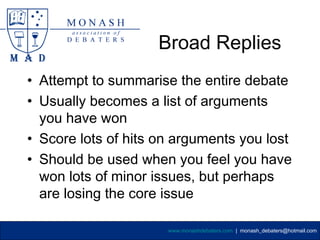
Broad Replies
• Attempt to summarise the entire debate
• Usually becomes a list of arguments
  you have won
• Score lots of hits on arguments you lost
• Should be used when you feel you have
  won lots of minor issues, but perhaps
  are losing the core issue

                      www.monashdebaters.com | monash_debaters@hotmail.com
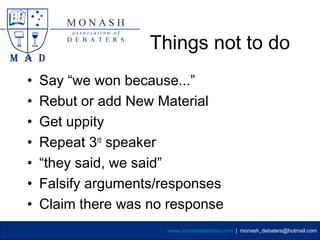
Things not to do
•   Say “we won because...”
•   Rebut or add New Material
•   Get uppity
•   Repeat 3rd speaker
•   “they said, we said”
•   Falsify arguments/responses
•   Claim there was no response
                      www.monashdebaters.com | monash_debaters@hotmail.com
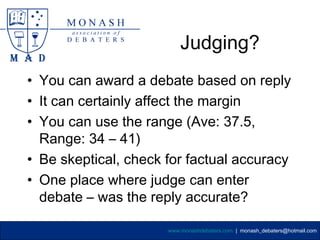
Judging?
• You can award a debate based on reply
• It can certainly affect the margin
• You can use the range (Ave: 37.5,
  Range: 34 – 41)
• Be skeptical, check for factual accuracy
• One place where judge can enter
  debate – was the reply accurate?

                      www.monashdebaters.com | monash_debaters@hotmail.com
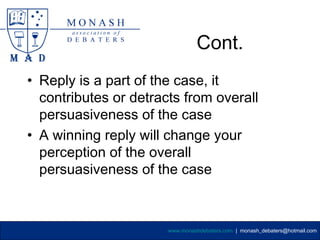
Cont.
• Reply is a part of the case, it
  contributes or detracts from overall
  persuasiveness of the case
• A winning reply will change your
  perception of the overall
  persuasiveness of the case


                       www.monashdebaters.com | monash_debaters@hotmail.com

Introduction to Replies by Gemma Buckley

  • 1.
    Reply Speeches www.monashdebaters.com | monash_debaters@hotmail.com
  • 2.
    Basics • 3-4 minutespeech at the end of the debate. • Happen in reverse order (neg then aff). • Delivered by either your 1st or 2nd speaker. • Summary of the debate and why your team won. • Reflective (past tense), sound objective. www.monashdebaters.com | monash_debaters@hotmail.com
  • 3.
    Aim of replies •Not like any other speech in a debate. • About why your side won, not why your side is right (subtle difference). • Biased adjudication. • Changes depending on the debate: sometimes to win back a debate, sometimes to hold the lead, sometimes to minimise margin. www.monashdebaters.com | monash_debaters@hotmail.com
  • 4.
    Cont. • Refocus thedebate/re-characterize the clash and issues • Add focus to the debate www.monashdebaters.com | monash_debaters@hotmail.com
  • 5.
    Method • ONLY HAVE3-4 mins so structure is vital. – Don’t give too much depth to arguments. – Minimal intro • Like anything, no right or wrong way, just less good ways. • Usually have 2 themes, questions or areas of clash. (You will run out of time for 3) • Don’t just reuse your 3rd speaker’s themes. www.monashdebaters.com | monash_debaters@hotmail.com
  • 6.
    Matter • Depends onthe debate: See types of replies • Usually use it to either – Win back lost issues – Increase importance of won issues • Look for things that are clear fails from opposition – Contradictions/case shifts – Lack of responses or missing analyis www.monashdebaters.com | monash_debaters@hotmail.com
  • 7.
    Manner • Very calm,very reflective. • Remember, the debate is over, you are just telling us why you are better than them... Keep the claws away. • Use past tense. • Calm does not mean inaudible or boring www.monashdebaters.com | monash_debaters@hotmail.com
  • 8.
    Neg Block • Thenegative team gets 12 uninterrupted minutes... – Negative teams should use this carefully. • Don’t summarise in 3rd neg... It’s a waste. • Smash key issues at 3rd, win things back, push winning points harder, then reply them good. – Affirmative teams should prepare for this. • Summary in 3rd aff is really important now. • Don’t respond to 3rd neg or neg reply, but be cautious of what issues that have won back. www.monashdebaters.com | monash_debaters@hotmail.com
  • 9.
    Yours or theirs? •Focus on your case when: – You are in the winning position – When you had a strong positive case, but weak rebuttal of opp (nothing you can do about it now) – When they had strong rebuttal and you need to remind the judge what your case looked like before it fell apart – Usually when you are Aff www.monashdebaters.com | monash_debaters@hotmail.com
  • 10.
    Cont. • Focus ontheir case when: – When your positive case was crap, or less important – When you had strong rebuttal and they failed to rebuild/respond – When the opposition made bad tactical errors (were inconsistent, case shifts/slides, liberal with concessions) – Usually when you are Neg www.monashdebaters.com | monash_debaters@hotmail.com
  • 11.
    Basic Reply • Givesa clear summary of the debate • Has two themes: principle and practical • Works for most debates, but especially when you feel you are winning • These are a safe option • You should all start here www.monashdebaters.com | monash_debaters@hotmail.com
  • 12.
    Narrative Reply • Takesyou on a journey in the world where the policy is implemented. Chronological order: before (problem, principles), during (practical stuff), after (long-term benefits/harms) • Best done from the Aff, where the focus is your own case, and why you were successful at proving it. www.monashdebaters.com | monash_debaters@hotmail.com
  • 13.
    Cont. • Most effectivein model heavy debates, which have become a messy fight about practicality (implementation and outcomes) • Good to reintroduce the bigger picture discussion when the debates has been focused on niggly issues www.monashdebaters.com | monash_debaters@hotmail.com
  • 14.
    Narrow Reply • Mostreplies attempt to cover whole debate • Sometimes it can be tactical to focus on minor issues or smaller parts of the debate www.monashdebaters.com | monash_debaters@hotmail.com
  • 15.
    Cont. • Should beused when: you feel your team has won the biggest issue, and you want to minimise the significance of all other issues • Or when your opposition has made a key tactical error which you want to exploit www.monashdebaters.com | monash_debaters@hotmail.com
  • 16.
    Cont. • You wouldusually employ when you feel the debate is weighted against you, or you feel you are losing in the reply. www.monashdebaters.com | monash_debaters@hotmail.com
  • 17.
    Broad Replies • Attemptto summarise the entire debate • Usually becomes a list of arguments you have won • Score lots of hits on arguments you lost • Should be used when you feel you have won lots of minor issues, but perhaps are losing the core issue www.monashdebaters.com | monash_debaters@hotmail.com
  • 18.
    Things not todo • Say “we won because...” • Rebut or add New Material • Get uppity • Repeat 3rd speaker • “they said, we said” • Falsify arguments/responses • Claim there was no response www.monashdebaters.com | monash_debaters@hotmail.com
  • 19.
    Judging? • You canaward a debate based on reply • It can certainly affect the margin • You can use the range (Ave: 37.5, Range: 34 – 41) • Be skeptical, check for factual accuracy • One place where judge can enter debate – was the reply accurate? www.monashdebaters.com | monash_debaters@hotmail.com
  • 20.
    Cont. • Reply isa part of the case, it contributes or detracts from overall persuasiveness of the case • A winning reply will change your perception of the overall persuasiveness of the case www.monashdebaters.com | monash_debaters@hotmail.com