The Cold War
Cold War—the post World War II struggle for global power and influence waged between the United States and the Soviet Union, mostly on political and economic fronts rather than on the battlefields.
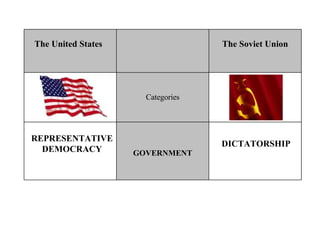
REPRESENTATIVE DEMOCRACY DICTATORSHIP The United States   The Soviet Union Categories GOVERNMENT
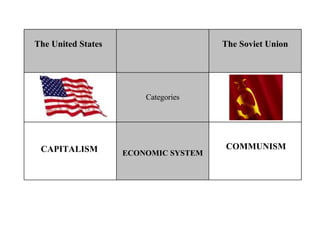
COMMUNISM CAPITALISM The United States   The Soviet Union Categories ECONOMIC SYSTEM
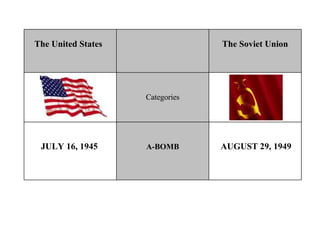
AUGUST 29, 1949 JULY 16, 1945 The United States   The Soviet Union Categories A-BOMB
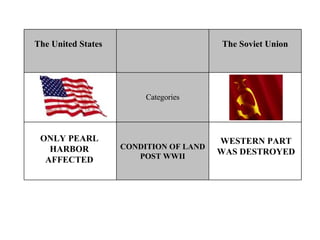
WESTERN PART WAS DESTROYED ONLY PEARL HARBOR AFFECTED The United States   The Soviet Union Categories CONDITION OF LAND POST WWII
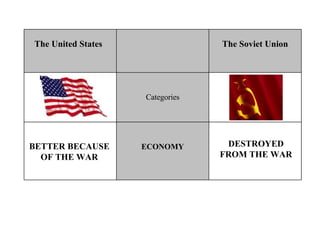
DESTROYED FROM THE WAR BETTER BECAUSE OF THE WAR The United States   The Soviet Union Categories ECONOMY
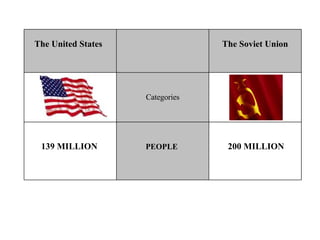
200 MILLION 139 MILLION The United States   The Soviet Union Categories PEOPLE
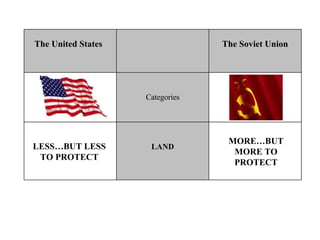
MORE…BUT MORE TO PROTECT LESS…BUT LESS TO PROTECT The United States   The Soviet Union Categories LAND
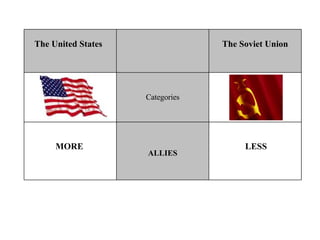
LESS MORE The United States   The Soviet Union Categories ALLIES
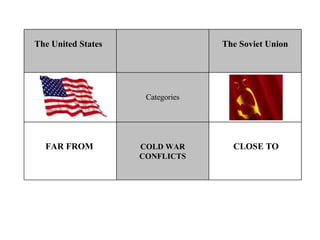
CLOSE TO FAR FROM The United States   The Soviet Union Categories COLD WAR CONFLICTS
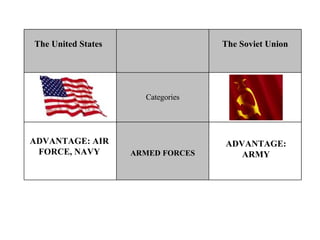
ADVANTAGE: ARMY ADVANTAGE: AIR FORCE, NAVY The United States   The Soviet Union Categories ARMED FORCES
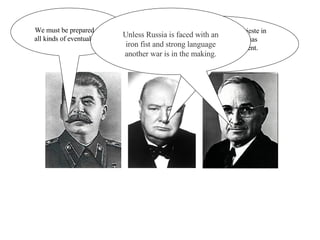
We must be prepared for all kinds of eventualities. From Stettin in the Baltic to Trieste in the Adriatic, an iron curtain has descended across the Continent. Unless Russia is faced with an iron fist and strong language another war is in the making.
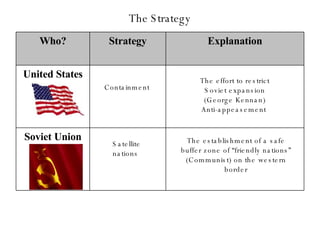
The Strategy The establishment of a safe buffer zone of “friendly nations” (Communist) on the western border The effort to restrict Soviet expansion (George Kennan) Anti-appeasement   Satellite nations   Containment  Who? Strategy Explanation United States Soviet Union
 
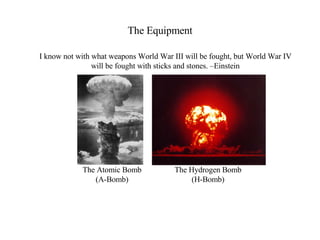
The Equipment I know not with what weapons World War III will be fought, but World War IV will be fought with sticks and stones. –Einstein The Atomic Bomb (A-Bomb) The Hydrogen Bomb (H-Bomb)
 

Cold War

  • 1.
  • 2.
    Cold War—the postWorld War II struggle for global power and influence waged between the United States and the Soviet Union, mostly on political and economic fronts rather than on the battlefields.
  • 3.
    REPRESENTATIVE DEMOCRACY DICTATORSHIPThe United States The Soviet Union Categories GOVERNMENT
  • 4.
    COMMUNISM CAPITALISM TheUnited States The Soviet Union Categories ECONOMIC SYSTEM
  • 5.
    AUGUST 29, 1949JULY 16, 1945 The United States The Soviet Union Categories A-BOMB
  • 6.
    WESTERN PART WASDESTROYED ONLY PEARL HARBOR AFFECTED The United States The Soviet Union Categories CONDITION OF LAND POST WWII
  • 7.
    DESTROYED FROM THEWAR BETTER BECAUSE OF THE WAR The United States The Soviet Union Categories ECONOMY
  • 8.
    200 MILLION 139MILLION The United States The Soviet Union Categories PEOPLE
  • 9.
    MORE…BUT MORE TOPROTECT LESS…BUT LESS TO PROTECT The United States The Soviet Union Categories LAND
  • 10.
    LESS MORE TheUnited States The Soviet Union Categories ALLIES
  • 11.
    CLOSE TO FARFROM The United States The Soviet Union Categories COLD WAR CONFLICTS
  • 12.
    ADVANTAGE: ARMY ADVANTAGE:AIR FORCE, NAVY The United States The Soviet Union Categories ARMED FORCES
  • 13.
    We must beprepared for all kinds of eventualities. From Stettin in the Baltic to Trieste in the Adriatic, an iron curtain has descended across the Continent. Unless Russia is faced with an iron fist and strong language another war is in the making.
  • 14.
    The Strategy Theestablishment of a safe buffer zone of “friendly nations” (Communist) on the western border The effort to restrict Soviet expansion (George Kennan) Anti-appeasement Satellite nations Containment Who? Strategy Explanation United States Soviet Union
  • 15.
  • 16.
    The Equipment Iknow not with what weapons World War III will be fought, but World War IV will be fought with sticks and stones. –Einstein The Atomic Bomb (A-Bomb) The Hydrogen Bomb (H-Bomb)
  • 17.