Beauty in the Universe
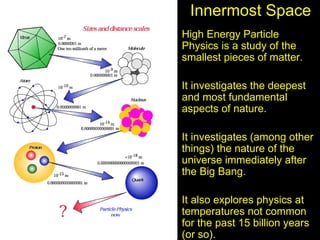
Innermost Space
High Energy Particle
Physics is a study of the
smallest pieces of matter.

It investigates the deepest
and most fundamental
aspects of nature.

It investigates (among other
things) the nature of the
universe immediately after
the Big Bang.

It also explores physics at
temperatures not common
for the past 15 billion years
(or so).
Helium           Neon
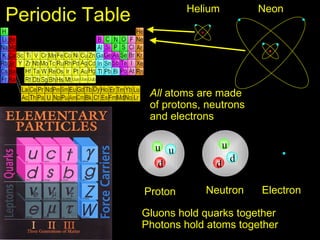
Periodic Table


                  All atoms are made
                  of protons, neutrons
                  and electrons

                   u u             u
                                       d
                    d           d

                 Proton      Neutron       Electron

                 Gluons hold quarks together
                 Photons hold atoms together
u
                      d


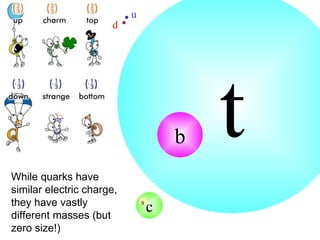
While quarks have
                                       b   t
similar electric charge,
they have vastly               s
different masses (but
                                   c
zero size!)
e
                                    rs
                                 ve
                               ni
                            U
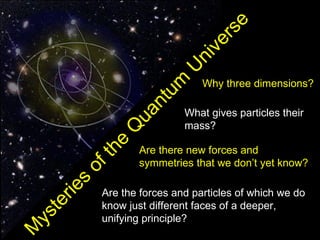
                                  Why three dimensions?


                         m
                     n tu
                              What gives particles their

                  ua
                Q             mass?
             he
                    Are there new forces and
            t

                    symmetries that we don’t yet know?
         of
         s
    rie


             Are the forces and particles of which we do
    te


             know just different faces of a deeper,
ys


             unifying principle?
M
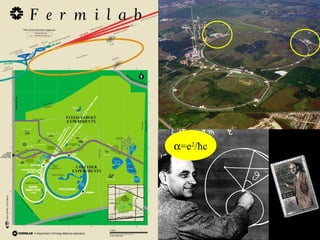
α=e2/ħc
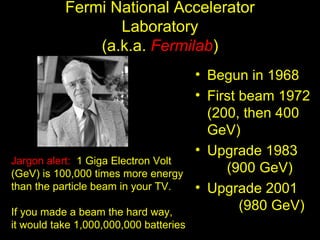
Fermi National Accelerator
                  Laboratory
               (a.k.a. Fermilab)
                                        • Begun in 1968
                                        • First beam 1972
                                          (200, then 400
                                          GeV)
                                        • Upgrade 1983
Jargon alert: 1 Giga Electron Volt
(GeV) is 100,000 times more energy           (900 GeV)
than the particle beam in your TV.      • Upgrade 2001
If you made a beam the hard way,
                                                (980 GeV)
it would take 1,000,000,000 batteries
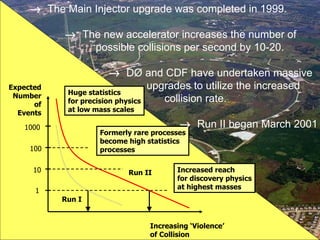
→ The Main Injector upgrade was completed in 1999.

           → The new accelerator increases the number of
               possible collisions per second by 10-20.

                        → DØ and CDF have undertaken massive
Expected                          upgrades to utilize the increased
 Number     Huge statistics
      of    for precision physics    collision rate.
  Events    at low mass scales

   1000                                  → Run II began March 2001
                    Formerly rare processes
                    become high statistics
     100            processes

      10                    Run II      Increased reach
                                        for discovery physics
                                        at highest masses
      1
           Run I


                                 Increasing ‘Violence’
                                 of Collision
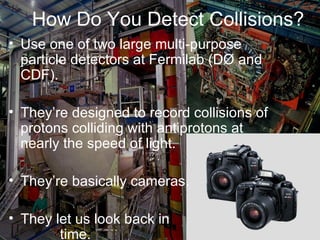
How Do You Detect Collisions?
• Use one of two large multi-purpose
  particle detectors at Fermilab (DØ and
  CDF).

• They’re designed to record collisions of
  protons colliding with antiprotons at
  nearly the speed of light.

• They’re basically cameras.

• They let us look back in
        time.
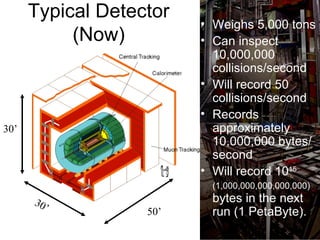
Typical Detector
                         • Weighs 5,000 tons
           (Now)         • Can inspect
                           10,000,000
                           collisions/second
                         • Will record 50
                           collisions/second
                         • Records
30’                        approximately
                           10,000,000 bytes/
                           second
                         • Will record 1015
                          (1,000,000,000,000,000)
      30                  bytes in the next
        ’          50’    run (1 PetaByte).
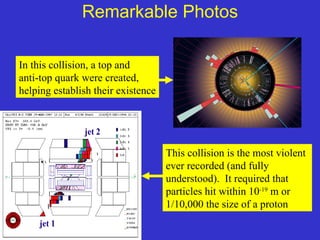
Remarkable Photos

In this collision, a top and
anti-top quark were created,
helping establish their existence


                                    This collision is the most violent
                                    ever recorded (and fully
                                    understood). It required that
                                    particles hit within 10-19 m or
                                    1/10,000 the size of a proton
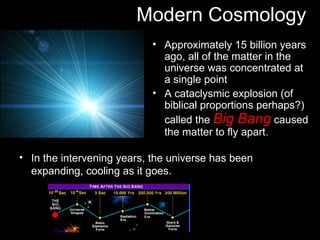
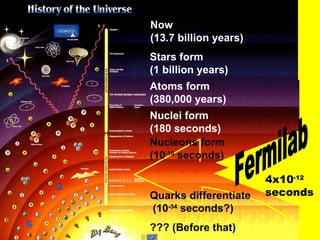
Modern Cosmology
                           • Approximately 15 billion years
                             ago, all of the matter in the
                             universe was concentrated at
                             a single point
                           • A cataclysmic explosion (of
                             biblical proportions perhaps?)
                             called the Big Bang caused
                             the matter to fly apart.

• In the intervening years, the universe has been
  expanding, cooling as it goes.
Now
(13.7 billion years)
Stars form
(1 billion years)
Atoms form
(380,000 years)
Nuclei form
(180 seconds)
Nucleons form
(10-10 seconds)

                       4x10-12
Quarks differentiate   seconds
(10-34 seconds?)
??? (Before that)
e
                                     rs
                                 ve
                               ni
                             U
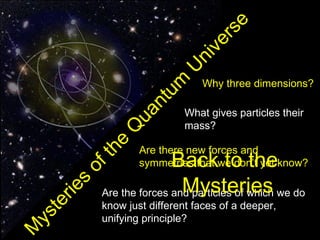
                                  Why three dimensions?


                          m
                     n tu
                               What gives particles their

                  ua
                Q              mass?
             he
                     Are there new forces and
                            Back to the
            t

                     symmetries that we don’t yet know?
         of


                              Mysteries
         s
    rie


             Are the forces and particles of which we do
    te


             know just different faces of a deeper,
ys


             unifying principle?
M
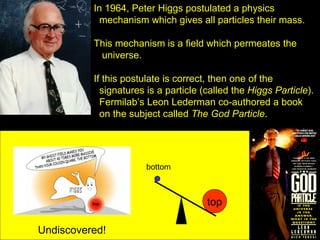
In 1964, Peter Higgs postulated a physics
           mechanism which gives all particles their mass.

          This mechanism is a field which permeates the
           universe.

          If this postulate is correct, then one of the
            signatures is a particle (called the Higgs Particle).
            Fermilab’s Leon Lederman co-authored a book
            on the subject called The God Particle.


                       bottom


                                      top

Undiscovered!
Higgs: An
Analogy
Hunting for Higgs
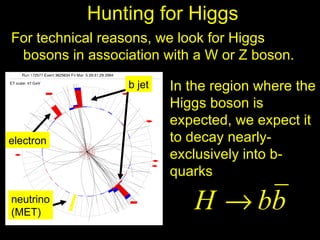
For technical reasons, we look for Higgs
 bosons in association with a W or Z boson.

                 b jet   In the region where the
                         Higgs boson is
                         expected, we expect it
electron                 to decay nearly-
                         exclusively into b-
                         quarks
neutrino
(MET)
                            H → bb
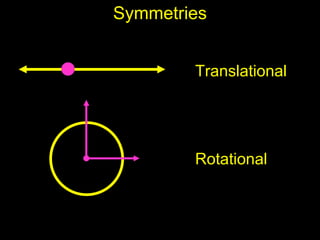
Symmetries


        Translational


        Rotational
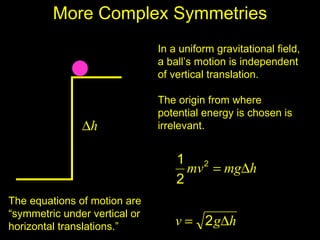
More Complex Symmetries
                               In a uniform gravitational field,
                               a ball’s motion is independent
                               of vertical translation.

                               The origin from where
                               potential energy is chosen is
               ∆h              irrelevant.


                                   1 2
                                     mv = mg∆h
                                   2
The equations of motion are
“symmetric under vertical or
horizontal translations.”          v = 2 g∆h
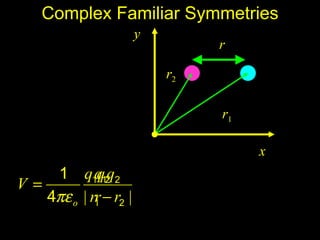
Complex Familiar Symmetries
                       y
                                r

                           r2

                                r1

                                     x
    1 q1q12 2qq
V=
   4πε o | r1 − r2 |
            r
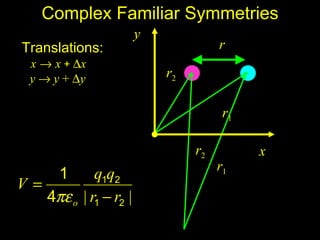
Complex Familiar Symmetries
                       y
Translations:                        r
  x → x + ∆x
  y → y + ∆y               r2

                                      r1

                                r2         x
                                     r1
    1       q1q2
V=
   4πε o | r1 − r2 |
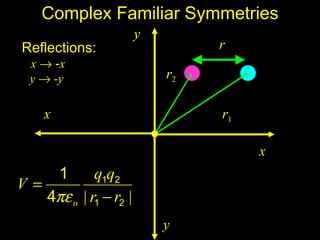
Complex Familiar Symmetries
                       y
Reflections:                    r
  x → -x
  y → -y                   r2

    x                           r1

                                     x
    1       q1q2
V=
   4πε o | r1 − r2 |
                           y
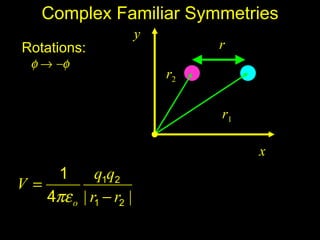
Complex Familiar Symmetries
                       y
Rotations:                      r
  φ → −φ
                           r2

                                r1

                                     x
    1       q1q2
V=
   4πε o | r1 − r2 |
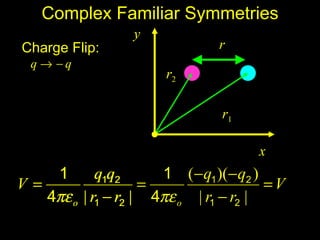
Complex Familiar Symmetries
                 y
Charge Flip:                  r
  q→−q
                      r2

                               r1

                                     x
    1       q1q2      1 (−q1 )(− q2 )
V=                  =                  =V
   4πε o | r1 − r2 | 4πε o | r1 − r2 |
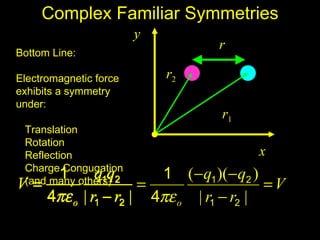
Complex Familiar Symmetries
                        y
                                 r
Bottom Line:

Electromagnetic force       r2
exhibits a symmetry
under:
                                 r1
Translation
Rotation
Reflection                             x
Charge Congugation
        1    q1q         1 (−q1 )(− q2 )
V=
(and many others) 2    =                  =V
      4πε o | r1 − r2 | 4πε o | r1 − r2 |
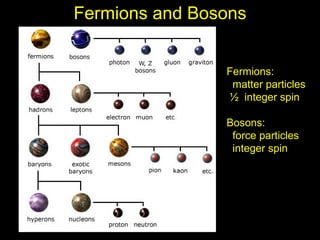
Fermions and Bosons


                Fermions:
                 matter particles
                ½ integer spin

                Bosons:
                 force particles
                 integer spin
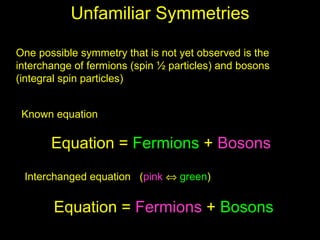
Unfamiliar Symmetries

One possible symmetry that is not yet observed is the
interchange of fermions (spin ½ particles) and bosons
(integral spin particles)


 Known equation

       Equation = Fermions + Bosons
 Interchanged equation (pink ⇔ green)


       Equation = Fermions + Bosons
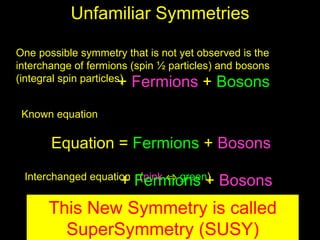
Unfamiliar Symmetries

One possible symmetry that is not yet observed is the
interchange of fermions (spin ½ particles) and bosons
(integral spin particles) Fermions + Bosons
                        +
 Known equation

       Equation = Fermions + Bosons
 Interchanged equation (pink ⇔ green)
                     + Fermions + Bosons
      This New=Symmetry+is called
      Equation Fermions Bosons
        SuperSymmetry (SUSY)
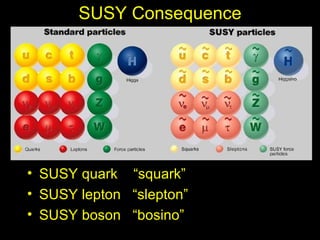
SUSY Consequence


• SUSY quark “squark”
• SUSY lepton “slepton”
• SUSY boson “bosino”
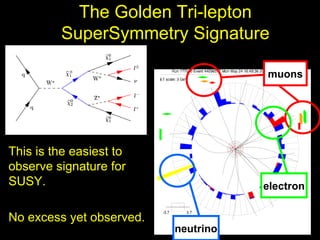
The Golden Tri-lepton
         SuperSymmetry Signature

                                     muons


This is the easiest to
observe signature for
SUSY.                                electron

No excess yet observed.
                          neutrino
The Conundrum of Gravity
• Why is gravity so much weaker
  (~10-35×) the other forces?

  – Completely unknown


• One possibility is that gravity can
  access more dimensions than the other
  forces
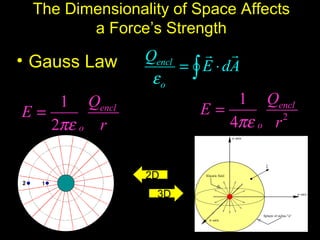
The Dimensionality of Space Affects
          a Force’s Strength
                Qencl      
• Gauss Law           = ∫ E ⋅ dA
                  εo
     1 Qencl                    1 Qencl
 E=                      E=
    2πε o r                    4πε o r 2


                  2D
                    3D
Are More Dimensions Tenable?
• Newton’s Law of Gravity

              Gm1m2
           F=    2
               r

• Clearly indicates a 3D space structure.


             Or does it?
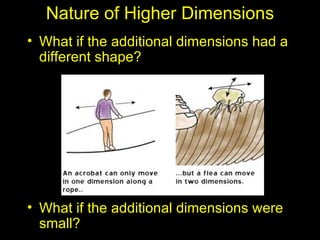
Nature of Higher Dimensions
• What if the additional dimensions had a
  different shape?


• What if the additional dimensions were
  small?
Access to Additional Dimensions
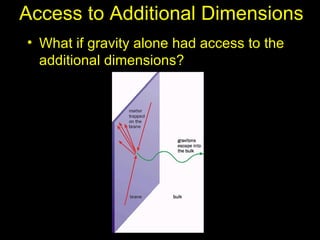
• What if gravity alone had access to the
  additional dimensions?
Access to Additional Dimensions
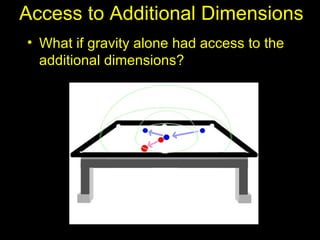
• What if gravity alone had access to the
  additional dimensions?
A Model with “n” Dimensions.
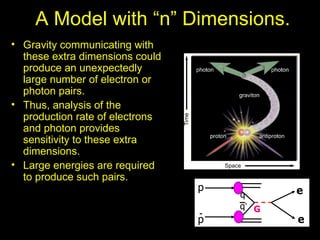
• Gravity communicating with
  these extra dimensions could
  produce an unexpectedly
  large number of electron or
  photon pairs.
• Thus, analysis of the
  production rate of electrons
  and photon provides
  sensitivity to these extra
  dimensions.
• Large energies are required
  to produce such pairs.
                                 p          e
                                     q
                                     q’ G
                                 p          e
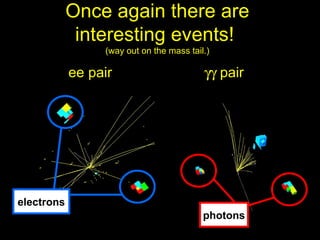
Once again there are
             interesting events!
                 (way out on the mass tail.)

            ee pair                       γγ pair


electrons
                                          photons
Data-Model Comparison
Summary
• Particle physics allows us to study some
  of the deepest mysteries of reality.

• We know a whole bunch of stuff.
  Send students.
• The things we don’t know, we’re studying
  like mad.

• The mysteries mentioned here are
  unsolved. We need help.
www-d0.fnal.gov/~lucifer/PowerPoint/Teacher_Colloquium.ppt
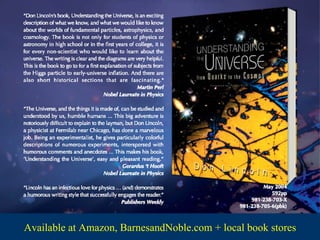
Available at Amazon, BarnesandNoble.com + local book stores

Teachers colloquium

  • 2.
    Beauty in theUniverse
  • 3.
    Innermost Space High EnergyParticle Physics is a study of the smallest pieces of matter. It investigates the deepest and most fundamental aspects of nature. It investigates (among other things) the nature of the universe immediately after the Big Bang. It also explores physics at temperatures not common for the past 15 billion years (or so).
  • 4.
    Helium Neon Periodic Table All atoms are made of protons, neutrons and electrons u u u d d d Proton Neutron Electron Gluons hold quarks together Photons hold atoms together
  • 5.
    u d While quarks have b t similar electric charge, they have vastly s different masses (but c zero size!)
  • 7.
    e rs ve ni U Why three dimensions? m n tu What gives particles their ua Q mass? he Are there new forces and t symmetries that we don’t yet know? of s rie Are the forces and particles of which we do te know just different faces of a deeper, ys unifying principle? M
  • 8.
  • 9.
    Fermi National Accelerator Laboratory (a.k.a. Fermilab) • Begun in 1968 • First beam 1972 (200, then 400 GeV) • Upgrade 1983 Jargon alert: 1 Giga Electron Volt (GeV) is 100,000 times more energy (900 GeV) than the particle beam in your TV. • Upgrade 2001 If you made a beam the hard way, (980 GeV) it would take 1,000,000,000 batteries
  • 11.
    → The MainInjector upgrade was completed in 1999. → The new accelerator increases the number of possible collisions per second by 10-20. → DØ and CDF have undertaken massive Expected upgrades to utilize the increased Number Huge statistics of for precision physics collision rate. Events at low mass scales 1000 → Run II began March 2001 Formerly rare processes become high statistics 100 processes 10 Run II Increased reach for discovery physics at highest masses 1 Run I Increasing ‘Violence’ of Collision
  • 12.
    How Do YouDetect Collisions? • Use one of two large multi-purpose particle detectors at Fermilab (DØ and CDF). • They’re designed to record collisions of protons colliding with antiprotons at nearly the speed of light. • They’re basically cameras. • They let us look back in time.
  • 13.
    Typical Detector • Weighs 5,000 tons (Now) • Can inspect 10,000,000 collisions/second • Will record 50 collisions/second • Records 30’ approximately 10,000,000 bytes/ second • Will record 1015 (1,000,000,000,000,000) 30 bytes in the next ’ 50’ run (1 PetaByte).
  • 14.
    Remarkable Photos In thiscollision, a top and anti-top quark were created, helping establish their existence This collision is the most violent ever recorded (and fully understood). It required that particles hit within 10-19 m or 1/10,000 the size of a proton
  • 16.
    Modern Cosmology • Approximately 15 billion years ago, all of the matter in the universe was concentrated at a single point • A cataclysmic explosion (of biblical proportions perhaps?) called the Big Bang caused the matter to fly apart. • In the intervening years, the universe has been expanding, cooling as it goes.
  • 17.
    Now (13.7 billion years) Starsform (1 billion years) Atoms form (380,000 years) Nuclei form (180 seconds) Nucleons form (10-10 seconds) 4x10-12 Quarks differentiate seconds (10-34 seconds?) ??? (Before that)
  • 18.
    e rs ve ni U Why three dimensions? m n tu What gives particles their ua Q mass? he Are there new forces and Back to the t symmetries that we don’t yet know? of Mysteries s rie Are the forces and particles of which we do te know just different faces of a deeper, ys unifying principle? M
  • 19.
    In 1964, PeterHiggs postulated a physics mechanism which gives all particles their mass. This mechanism is a field which permeates the universe. If this postulate is correct, then one of the signatures is a particle (called the Higgs Particle). Fermilab’s Leon Lederman co-authored a book on the subject called The God Particle. bottom top Undiscovered!
  • 20.
  • 21.
    Hunting for Higgs Fortechnical reasons, we look for Higgs bosons in association with a W or Z boson. b jet In the region where the Higgs boson is expected, we expect it electron to decay nearly- exclusively into b- quarks neutrino (MET) H → bb
  • 22.
    Symmetries Translational Rotational
  • 23.
    More Complex Symmetries In a uniform gravitational field, a ball’s motion is independent of vertical translation. The origin from where potential energy is chosen is ∆h irrelevant. 1 2 mv = mg∆h 2 The equations of motion are “symmetric under vertical or horizontal translations.” v = 2 g∆h
  • 24.
    Complex Familiar Symmetries y r r2 r1 x 1 q1q12 2qq V= 4πε o | r1 − r2 | r
  • 25.
    Complex Familiar Symmetries y Translations: r x → x + ∆x y → y + ∆y r2 r1 r2 x r1 1 q1q2 V= 4πε o | r1 − r2 |
  • 26.
    Complex Familiar Symmetries y Reflections: r x → -x y → -y r2 x r1 x 1 q1q2 V= 4πε o | r1 − r2 | y
  • 27.
    Complex Familiar Symmetries y Rotations: r φ → −φ r2 r1 x 1 q1q2 V= 4πε o | r1 − r2 |
  • 28.
    Complex Familiar Symmetries y Charge Flip: r q→−q r2 r1 x 1 q1q2 1 (−q1 )(− q2 ) V= = =V 4πε o | r1 − r2 | 4πε o | r1 − r2 |
  • 29.
    Complex Familiar Symmetries y r Bottom Line: Electromagnetic force r2 exhibits a symmetry under: r1 Translation Rotation Reflection x Charge Congugation 1 q1q 1 (−q1 )(− q2 ) V= (and many others) 2 = =V 4πε o | r1 − r2 | 4πε o | r1 − r2 |
  • 30.
    Fermions and Bosons Fermions: matter particles ½ integer spin Bosons: force particles integer spin
  • 31.
    Unfamiliar Symmetries One possiblesymmetry that is not yet observed is the interchange of fermions (spin ½ particles) and bosons (integral spin particles) Known equation Equation = Fermions + Bosons Interchanged equation (pink ⇔ green) Equation = Fermions + Bosons
  • 32.
    Unfamiliar Symmetries One possiblesymmetry that is not yet observed is the interchange of fermions (spin ½ particles) and bosons (integral spin particles) Fermions + Bosons + Known equation Equation = Fermions + Bosons Interchanged equation (pink ⇔ green) + Fermions + Bosons This New=Symmetry+is called Equation Fermions Bosons SuperSymmetry (SUSY)
  • 33.
    SUSY Consequence • SUSYquark “squark” • SUSY lepton “slepton” • SUSY boson “bosino”
  • 34.
    The Golden Tri-lepton SuperSymmetry Signature muons This is the easiest to observe signature for SUSY. electron No excess yet observed. neutrino
  • 35.
    The Conundrum ofGravity • Why is gravity so much weaker (~10-35×) the other forces? – Completely unknown • One possibility is that gravity can access more dimensions than the other forces
  • 36.
    The Dimensionality ofSpace Affects a Force’s Strength Qencl   • Gauss Law = ∫ E ⋅ dA εo 1 Qencl 1 Qencl E= E= 2πε o r 4πε o r 2 2D 3D
  • 37.
    Are More DimensionsTenable? • Newton’s Law of Gravity Gm1m2 F= 2 r • Clearly indicates a 3D space structure. Or does it?
  • 38.
    Nature of HigherDimensions • What if the additional dimensions had a different shape? • What if the additional dimensions were small?
  • 39.
    Access to AdditionalDimensions • What if gravity alone had access to the additional dimensions?
  • 40.
    Access to AdditionalDimensions • What if gravity alone had access to the additional dimensions?
  • 41.
    A Model with“n” Dimensions. • Gravity communicating with these extra dimensions could produce an unexpectedly large number of electron or photon pairs. • Thus, analysis of the production rate of electrons and photon provides sensitivity to these extra dimensions. • Large energies are required to produce such pairs. p e q q’ G p e
  • 42.
    Once again thereare interesting events! (way out on the mass tail.) ee pair γγ pair electrons photons
  • 43.
  • 44.
  • 45.
    Summary • Particle physicsallows us to study some of the deepest mysteries of reality. • We know a whole bunch of stuff. Send students. • The things we don’t know, we’re studying like mad. • The mysteries mentioned here are unsolved. We need help.
  • 46.
  • 47.
    Available at Amazon,BarnesandNoble.com + local book stores