Co-infection Studies in Farmed Fish:
Complexity & Implications
College of Fisheries, Dholi
(Dr Rajendra Prasad Central Agricultural University)
Muzaffarpur, Bihar – 843 121 (India)
By
Rajiv Kumar Brahmachari
• Global loss due to disease:
US$ 1.05 - US$ 9.58 billion annually (Shinn et
al., 2015)
• Global loss due to parasites:
U.S. $107.31 million to $134.14 million (Shinn et
al., 2015)
• Loss due to argulosis in Indian carp
aquaculture:
US$ 615.0 ha−1 annually (Sahoo et al., 2013)
• Loss due to sea lice in salmonid aquaculture:
> US$ 300 million annually (Costelo, 2009)
Highlights of some estimated
losses due to diseases in finfish
• Disease – a leading cause of economic losses in
aquaculture industry
− general assumption - infections = single
pathogen
• Co-infections may lead to increased mortality
− mechanics and prevalence - poorly documented
− affect host-pathogen dynamics, disease
severity, duration of infection and host
pathology
• other terms-
concurrent infections, concomitant infections,
mixed infections, multiple infections,
polymicrobial diseases, complicated infections,
dual infections, secondary infections
super infections
Introduction
Co-Infections
• “Infection of the host by two or more genetically different pathogens where each pathogen
has pathogenic effects and causes harm to the host” (Cox, 2001).
• Occur frequently in nature
• It can occur from two primary pathogens infecting the host concurrently, or one pathogen
can develop as a secondary infection (Kotob et al., 2016).
• During co-infections, one pathogen can alter the immune response of the host against the
subsequent infections by other pathogens either by suppressing or priming the immune
system (Lello et al., 2004; Telfer et al., 2008).
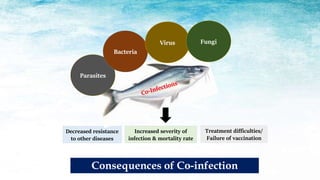
Consequences of Co-infection
Decreased resistance
to other diseases
Increased severity of
infection & mortality rate
Treatment difficulties/
Failure of vaccination
Parasites
Bacteria
Virus Fungi
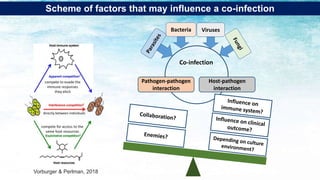
Pathogen-pathogen
interaction
Host-pathogen
interaction
Co-infection
Bacteria Viruses
Scheme of factors that may influence a co-infection
directly between individuals
compete to evade the
immune responses
they elicit
compete for access to the
same host resources
Vorburger & Perlman, 2018
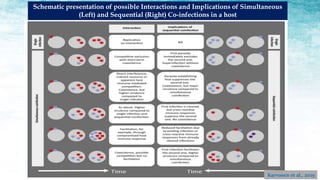
Schematic presentation of possible Interactions and Implications of Simultaneous
(Left) and Sequential (Right) Co-infections in a host
Karvonen et al., 2019
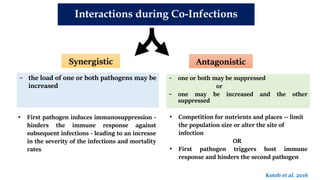
− the load of one or both pathogens may be
increased
Interactions during Co-Infections
Synergistic Antagonistic
− one or both may be suppressed
or
− one may be increased and the other
suppressed
• Competition for nutrients and places -- limit
the population size or alter the site of
infection
OR
• First pathogen triggers host immune
response and hinders the second pathogen
• First pathogen induces immunosuppression -
hinders the immune response against
subsequent infections - leading to an increase
in the severity of the infections and mortality
rates
Kotob et al. 2016
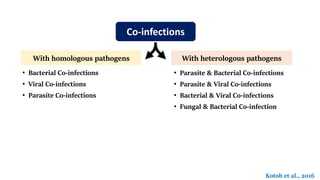
• Bacterial Co-infections
• Viral Co-infections
• Parasite Co-infections
With homologous pathogens With heterologous pathogens
• Parasite & Bacterial Co-infections
• Parasite & Viral Co-infections
• Bacterial & Viral Co-infections
• Fungal & Bacterial Co-infection
Co-infections
Kotob et al., 2016
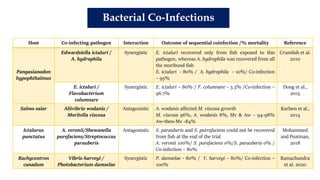
Bacterial Co-Infections
Host Co-infecting pathogen Interaction Outcome of sequential coinfection /% mortality Reference
Pangasianodon
hypophthalmus
Edwardsiella ictaluri /
A. hydrophila
Synergistic E. ictaluri recovered only from fish exposed to this
pathogen, whereas A. hydrophila was recovered from all
the moribund fish
E. ictaluri - 80% / A. hydrophila – 10%/ Co-infection
– 95%
Crumlish et al.
2010
E. ictaluri /
Flavobacterium
columnare
Synergistic E. ictaluri – 80% / F. columnare - 3.3% /Co-infection –
96.7%
Dong et al.,
2015
Salmo salar Aliivibrio wodanis /
Moritella viscosa
Antagonistic A. wodanis affected M. viscosa growth
M. viscosa 96%, A. wodanis 8%, Mv & Aw – 94-98%
Aw-then-Mv -84%
Karlsen et al.,
2014
Ictalurus
punctatus
A. veronii/Shewanella
purefaciens/Streptococcus
parauberis
Antagonistic S. parauberis and S. putrefaciens could not be recovered
from fish at the end of the trial
A. veronii 100%/ S. purefaciens 0%/S. parauberis 0% /
Co-infection – 80%
Mohammed
and Peatman,
2018
Rachycentron
canadum
Vibrio harveyi /
Photobacterium damselae
Synergistic P. damselae - 80% / V. harveyi – 80%/ Co-infection –
100%
Ramachandra
et al. 2020
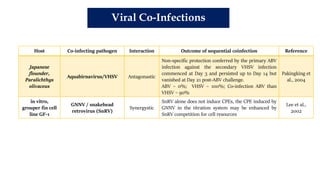
Host Co-infecting pathogen Interaction Outcome of sequential coinfection Reference
Japanese
flounder,
Paralichthys
olivaceus
Aquabirnavirus/VHSV Antagonastic
Non-specific protection conferred by the primary ABV
infection against the secondary VHSV infection
commenced at Day 3 and persisted up to Day 14 but
vanished at Day 21 post-ABV challenge.
ABV – 0%; VHSV – 100%; Co-infection ABV than
VHSV – 90%
Pakingking et
al., 2004
in vitro,
grouper fin cell
line GF-1
GNNV / snakehead
retrovirus (SnRV)
Synergystic
SnRV alone does not induce CPEs, the CPE induced by
GNNV in the titration system may be enhanced by
SnRV competition for cell resources
Lee et al.,
2002
Viral Co-Infections
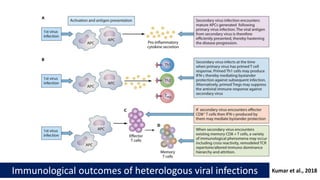
Kumar et al., 2018
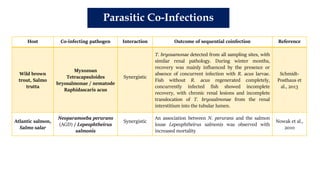
Immunological outcomes of heterologous viral infections
Host Co-infecting pathogen Interaction Outcome of sequential coinfection Reference
Wild brown
trout, Salmo
trutta
Myxozoan
Tetracapsuloides
bryosalmonae / nematode
Raphidascaris acus
Synergistic
T. bryosamonae detected from all sampling sites, with
similar renal pathology. During winter months,
recovery was mainly influenced by the presence or
absence of concurrent infection with R. acus larvae.
Fish without R. acus regenerated completely,
concurrently infected fish showed incomplete
recovery, with chronic renal lesions and incomplete
translocation of T. bryosalmonae from the renal
interstitium into the tubular lumen.
Schmidt-
Posthaus et
al., 2013
Atlantic salmon,
Salmo salar
Neoparamoeba perurans
(AGD) / Lepeophtheirus
salmonis
Synergistic
An association between N. perurans and the salmon
louse Lepeophtheirus salmonis was observed with
increased mortality
Nowak et al.,
2010
Parasitic Co-Infections
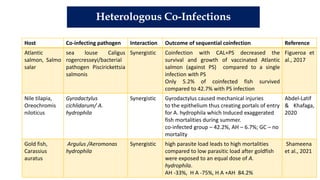
Heterologous Co-Infections
Host Co-infecting pathogen Interaction Outcome of sequential coinfection Reference
Atlantic
salmon, Salmo
salar
sea louse Caligus
rogercresseyi/bacterial
pathogen Piscirickettsia
salmonis
Synergistic Coinfection with CAL+PS decreased the
survival and growth of vaccinated Atlantic
salmon (against PS) compared to a single
infection with PS
Only 5.2% of coinfected fish survived
compared to 42.7% with PS infection
Figueroa et
al., 2017
Nile tilapia,
Oreochromis
niloticus
Gyrodactylus
cichlidarum/ A.
hydrophila
Synergistic Gyrodactylus caused mechanical injuries
to the epithelium thus creating portals of entry
for A. hydrophila which Induced exaggerated
fish mortalities during summer.
co-infected group – 42.2%, AH – 6.7%; GC – no
mortality
Abdel-Latif
& Khafaga,
2020
Gold fish,
Carassius
auratus
Argulus /Aeromonas
hydrophila
Synergistic high parasite load leads to high mortalities
compared to low parasitic load after goldfish
were exposed to an equal dose of A.
hydrophila.
AH -33%, H A -75%, H A +AH 84.2%
Shameena
et al., 2021
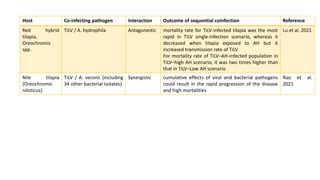
Host Co-infecting pathogen Interaction Outcome of sequential coinfection Reference
Red hybrid
tilapia,
Oreochromis
spp.
TiLV / A. hydrophila Antagonestic mortality rate for TiLV-infected tilapia was the most
rapid in TiLV single-infection scenario, whereas it
decreased when tilapia exposed to AH but it
increased transmission rate of TiLV
For mortality rate of TiLV–AH-infected population in
TiLV–high AH scenario, it was two times higher than
that in TiLV–Low AH scenario
Lu et al. 2021
Nile tilapia
(Oreochromis
niloticus)
TiLV / A. veronii (including
34 other bacterial isolates)
Synergistic cumulative effects of viral and bacterial pathogens
could result in the rapid progression of the disease
and high mortalities
Rao et al.
2021
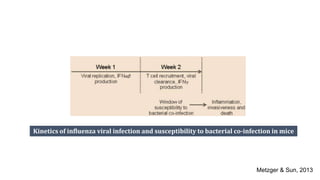
Kinetics of influenza viral infection and susceptibility to bacterial co-infection in mice
Metzger & Sun, 2013
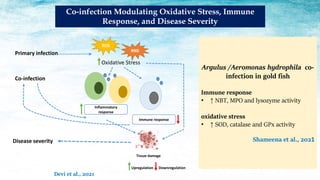
Co-infection Modulating Oxidative Stress, Immune
Response, and Disease Severity
Devi et al., 2021
Downregulation
Primary infection
Co-infection
ROS
Oxidative Stress
Inflammatory
response
Immune response
Tissue damage
Disease severity
RNS
Upregulation
Argulus /Aeromonas hydrophila co-
infection in gold fish
Immune response
• ↑ NBT, MPO and lysozyme activity
oxidative stress
• ↑ SOD, catalase and GPx activity
Shameena et al., 2021
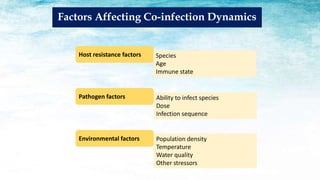
Factors Affecting Co-infection Dynamics
Host resistance factors
Pathogen factors
Environmental factors
Species
Age
Immune state
Ability to infect species
Dose
Infection sequence
Population density
Temperature
Water quality
Other stressors
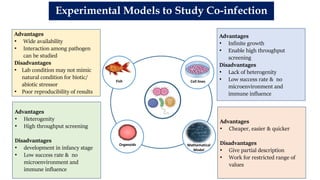
Experimental Models to Study Co-infection
Cell lines
Mathematical
Model
Organoids
Fish
Advantages
• Infinite growth
• Enable high throughput
screening
Disadvantages
• Lack of heterogenity
• Low success rate & no
microenvironment and
immune influence
Advantages
• Cheaper, easier & quicker
Disadvantages
• Give partial description
• Work for restricted range of
values
Advantages
• Heterogenity
• High throughput screening
Disadvantages
• development in infancy stage
• Low success rate & no
microenvironment and
immune influence
Advantages
• Wide availability
• Interaction among pathogen
can be studied
Disadvantages
• Lab condition may not mimic
natural condition for biotic/
abiotic stressor
• Poor reproducibility of results
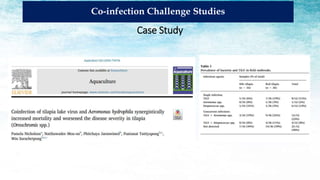
Co-infection Challenge Studies
Case Study
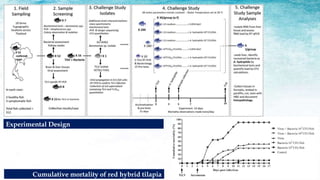
Experimental Design
Cumulative mortality of red hybrid tilapia
Mathematical Modelling for Coinfection study
Lu et al., 2021
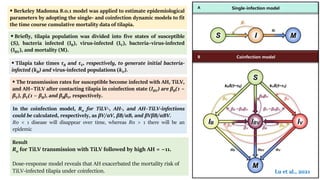
 Berkeley Madonna 8.0.1 model was applied to estimate epidemiological
parameters by adopting the single- and coinfection dynamic models to fit
the time course cumulative mortality data of tilapia.
 Briefly, tilapia population was divided into five states of susceptible
(S), bacteria infected (IB), virus-infected (IV), bacteria–virus-infected
(IBV), and mortality (M).
 Tilapia take times τB and τV, respectively, to generate initial bacteria-
infected (kB) and virus-infected populations (kV).
 The transmission rates for susceptible become infected with AH, TiLV,
and AH−TiLV after contacting tilapia in coinfection state (IBV) are βB(1 −
βV), βV(1 − βB), and βBβV, respectively.
In the coinfection model, R0 for TiLV-, AH-, and AH–TiLV-infections
could be calculated, respectively, as βV/αV, βB/αB, and βVβB/αBV.
R0 < 1 disease will disappear over time, whereas R0 > 1 there will be an
epidemic
Result
R0 for TiLV transmission with TiLV followed by high AH = ~11.
Dose-response model reveals that AH exacerbated the mortality risk of
TiLV-infected tilapia under coinfection.
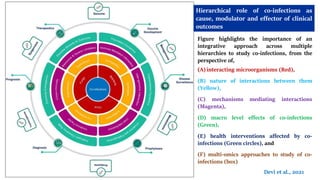
Figure highlights the importance of an
integrative approach across multiple
hierarchies to study co-infections, from the
perspective of,
(A)interacting microorganisms (Red),
(B) nature of interactions between them
(Yellow),
(C) mechanisms mediating interactions
(Magenta),
(D) macro level effects of co-infections
(Green),
(E) health interventions affected by co-
infections (Green circles), and
(F) multi-omics approaches to study of co-
infections (box)
Devi et al., 2021
Hierarchical role of co-infections as
cause, modulator and effector of clinical
outcomes
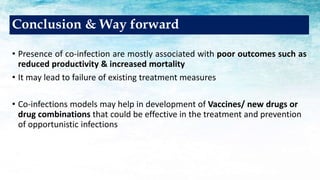
• Presence of co-infection are mostly associated with poor outcomes such as
reduced productivity & increased mortality
• It may lead to failure of existing treatment measures
• Co-infections models may help in development of Vaccines/ new drugs or
drug combinations that could be effective in the treatment and prevention
of opportunistic infections
Conclusion & Way forward
• Abdel‐Latif, H.M. and Khafaga, A.F., 2020. Natural co‐infection of cultured Nile tilapia Oreochromis niloticus with Aeromonas hydrophila and Gyrodactylus cichlidarum
experiencing high mortality during summer. Aquaculture Research, 51(5), pp.1880-1892.
• Costello, M., 2009. The global economic cost of sea lice to the salmonid farming industry. Journal of fish diseases, 32(1), p.115.
• COX, F.E., 2001. Concomitant infections, parasites and immune responses. Parasitology, 122(S1), pp.S23-S38.
• Crumlish, M., Thanh, P.C., Koesling, J., Tung, V.T. and Gravningen, K., 2010. Experimental challenge studies in Vietnamese catfish, Pangasianodon hypophthalmus
(Sauvage), exposed to Edwardsiella ictaluri and Aeromonas hydrophila. Journal of fish diseases, 33(9), pp.717-722.
• Devi, P., Khan, A., Chattopadhyay, P., Mehta, P., Sahni, S., Sharma, S. and Pandey, R., 2021. Co-infections as Modulators of Disease Outcome: Minor Players or Major
Players?. Frontiers in Microbiology, p.1894.
• Dong, H.T., Nguyen, V.V., Phiwsaiya, K., Gangnonngiw, W., Withyachumnarnkul, B., Rodkhum, C. and Senapin, S., 2015. Concurrent infections of Flavobacterium
columnare and Edwardsiella ictaluri in striped catfish, Pangasianodon hypophthalmus in Thailand. Aquaculture, 448, pp.142-150.
• Figueroa, C., Bustos, P., Torrealba, D., Dixon, B., Soto, C., Conejeros, P. and Gallardo, J.A., 2017. Coinfection takes its toll: Sea lice override the protective effects of
vaccination against a bacterial pathogen in Atlantic salmon. Scientific reports, 7(1), pp.1-8.
• Karvonen, A., Jokela, J. and Laine, A.L., 2019. Importance of sequence and timing in parasite coinfections. Trends in parasitology, 35(2), pp.109-118.
• Kotob, M.H., Menanteau-Ledouble, S., Kumar, G., Abdelzaher, M. and El-Matbouli, M., 2017. The impact of co-infections on fish: a review. Veterinary research, 47(1),
pp.1-12.
• Kumar, N., Sharma, S., Barua, S., Tripathi, B.N. and Rouse, B.T., 2018. Virological and immunological outcomes of coinfections. Clinical microbiology reviews, 31(4),
pp.e00111-17.
• Lee, K.W., Chi, S.C. and Cheng, T.M., 2002. Interference of the life cycle of fish nodavirus with fish retrovirus. Journal of general virology, 83(10), pp.2469-2474.
• Lello, J., Boag, B., Fenton, A., Stevenson, I.R. and Hudson, P.J., 2004. Competition and mutualism among the gut helminths of a mammalian host. Nature, 428(6985),
pp.840-844.
• Lu, T.H., Chen, C.Y. and Liao, C.M., 2021. Aeromonas hydrophila as an environmental indicator to detect TiLV-infected tilapia under coinfection threat. Environmental
and Sustainability Indicators, 11, p.100135.
References
• Metzger, D.W. and Sun, K., 2013. Immune dysfunction and bacterial coinfections following influenza. The Journal of Immunology, 191(5), pp.2047-2052.
• Mohammed, H.H. and Peatman, E., 2018. Winter kill in intensively stocked channel catfish (Ictalurus punctatus): Coinfection with Aeromonas veronii,
Streptococcus parauberis and Shewanella putrefaciens. Journal of fish diseases, 41(9), pp.1339-1347.
• Nicholson, P., Mon-on, N., Jaemwimol, P., Tattiyapong, P. and Surachetpong, W., 2020. Coinfection of tilapia lake virus and Aeromonas hydrophila synergistically
increased mortality and worsened the disease severity in tilapia (Oreochromis spp.). Aquaculture, 520, p.734746.
• Pakingking Jr, R., Okinaka, Y., Mori, K.I., Arimoto, M., Muroga, K. and Nakai, T., 2004. In vivo and in vitro analysis of the resistance against viral haemorrhagic
septicaemia virus in Japanese flounder (Paralichthys olivaceus) precedingly infected with aquabirnavirus. Fish & Shellfish Immunology, 17(1), pp.1-11.
• Ramachandra, K.S., Dube, P.N., Pandikkadan Sundaran, S., Kalappurakkal Gopalan, M., Mangottil Ayyappan, P. and Nandiath Karayi, S., 2021. Coinfection with
two strains of Photobacterium damselae subsp. damselae and Vibrio harveyi in cage farmed cobia, Rachycentron canadum (Linnaeus, 1766). Aquaculture
Research, 52(4), pp.1525-1537.
• Rao, M., Kumar, S.H., Kumar, S., Bedekar, M.K., Tripathi, G. and Kooloth Valappil, R., 2021. Microbiological investigation of Tilapia lake virus–associated
mortalities in cage-farmed Oreochromis niloticus in India. Aquaculture International, 29(2), pp.511-526.
• Sahoo, P.K., Mohanty, J., Garnayak, S.K., Mohanty, B.R., Kar, B., Prasanth, H. and Jena, J.K., 2013. Estimation of loss due to argulosis in carp culture ponds in
India. Indian J Fish, 60(2), pp.99-102.
• Schmidt‐Posthaus, H., Polkinghorne, A., Nufer, L., Schifferli, A., Zimmermann, D.R., Segner, H., Steiner, P. and Vaughan, L., 2012. A natural freshwater origin for
two chlamydial species, Candidatus Piscichlamydia salmonis and Candidatus Clavochlamydia salmonicola, causing mixed infections in wild brown trout (Salmo
trutta). Environmental microbiology, 14(8), pp.2048-2057.
• Shameena, S.S., Kumar, K., Kumar, S., Kumari, P., Krishnan, R., Karmakar, S., Kumar, H.S., Rajendran, K.V. and Raman, R.P., 2021. Dose-dependent co-infection of
Argulus sp. and Aeromonas hydrophila in goldfish (Carassius auratus) modulates innate immune response and antioxidative stress enzymes. Fish & Shellfish
Immunology, 114, pp.199-206.
• Shinn, A.P., Pratoomyot, J., Bron, J.E., Paladini, G., Brooker, E.E. and Brooker, A.J., 2015. Economic costs of protistan and metazoan parasites to global
mariculture. Parasitology, 142(1), pp.196-270.
• Telfer, S., Birtles, R., Bennett, M., Lambin, X., Paterson, S. and Begon, M., 2008. Parasite interactions in natural populations: insights from longitudinal
data. Parasitology, 135(7), pp.767-781.
Thank You!

Co-infection in cultured fish.pptx

  • 1.
    Co-infection Studies inFarmed Fish: Complexity & Implications College of Fisheries, Dholi (Dr Rajendra Prasad Central Agricultural University) Muzaffarpur, Bihar – 843 121 (India) By Rajiv Kumar Brahmachari
  • 2.
    • Global lossdue to disease: US$ 1.05 - US$ 9.58 billion annually (Shinn et al., 2015) • Global loss due to parasites: U.S. $107.31 million to $134.14 million (Shinn et al., 2015) • Loss due to argulosis in Indian carp aquaculture: US$ 615.0 ha−1 annually (Sahoo et al., 2013) • Loss due to sea lice in salmonid aquaculture: > US$ 300 million annually (Costelo, 2009) Highlights of some estimated losses due to diseases in finfish • Disease – a leading cause of economic losses in aquaculture industry − general assumption - infections = single pathogen • Co-infections may lead to increased mortality − mechanics and prevalence - poorly documented − affect host-pathogen dynamics, disease severity, duration of infection and host pathology • other terms- concurrent infections, concomitant infections, mixed infections, multiple infections, polymicrobial diseases, complicated infections, dual infections, secondary infections super infections Introduction
  • 3.
    Co-Infections • “Infection ofthe host by two or more genetically different pathogens where each pathogen has pathogenic effects and causes harm to the host” (Cox, 2001). • Occur frequently in nature • It can occur from two primary pathogens infecting the host concurrently, or one pathogen can develop as a secondary infection (Kotob et al., 2016). • During co-infections, one pathogen can alter the immune response of the host against the subsequent infections by other pathogens either by suppressing or priming the immune system (Lello et al., 2004; Telfer et al., 2008).
  • 4.
    Consequences of Co-infection Decreasedresistance to other diseases Increased severity of infection & mortality rate Treatment difficulties/ Failure of vaccination Parasites Bacteria Virus Fungi
  • 5.
    Pathogen-pathogen interaction Host-pathogen interaction Co-infection Bacteria Viruses Scheme offactors that may influence a co-infection directly between individuals compete to evade the immune responses they elicit compete for access to the same host resources Vorburger & Perlman, 2018
  • 6.
    Schematic presentation ofpossible Interactions and Implications of Simultaneous (Left) and Sequential (Right) Co-infections in a host Karvonen et al., 2019
  • 7.
    − the loadof one or both pathogens may be increased Interactions during Co-Infections Synergistic Antagonistic − one or both may be suppressed or − one may be increased and the other suppressed • Competition for nutrients and places -- limit the population size or alter the site of infection OR • First pathogen triggers host immune response and hinders the second pathogen • First pathogen induces immunosuppression - hinders the immune response against subsequent infections - leading to an increase in the severity of the infections and mortality rates Kotob et al. 2016
  • 8.
    • Bacterial Co-infections •Viral Co-infections • Parasite Co-infections With homologous pathogens With heterologous pathogens • Parasite & Bacterial Co-infections • Parasite & Viral Co-infections • Bacterial & Viral Co-infections • Fungal & Bacterial Co-infection Co-infections Kotob et al., 2016
  • 9.
    Bacterial Co-Infections Host Co-infectingpathogen Interaction Outcome of sequential coinfection /% mortality Reference Pangasianodon hypophthalmus Edwardsiella ictaluri / A. hydrophila Synergistic E. ictaluri recovered only from fish exposed to this pathogen, whereas A. hydrophila was recovered from all the moribund fish E. ictaluri - 80% / A. hydrophila – 10%/ Co-infection – 95% Crumlish et al. 2010 E. ictaluri / Flavobacterium columnare Synergistic E. ictaluri – 80% / F. columnare - 3.3% /Co-infection – 96.7% Dong et al., 2015 Salmo salar Aliivibrio wodanis / Moritella viscosa Antagonistic A. wodanis affected M. viscosa growth M. viscosa 96%, A. wodanis 8%, Mv & Aw – 94-98% Aw-then-Mv -84% Karlsen et al., 2014 Ictalurus punctatus A. veronii/Shewanella purefaciens/Streptococcus parauberis Antagonistic S. parauberis and S. putrefaciens could not be recovered from fish at the end of the trial A. veronii 100%/ S. purefaciens 0%/S. parauberis 0% / Co-infection – 80% Mohammed and Peatman, 2018 Rachycentron canadum Vibrio harveyi / Photobacterium damselae Synergistic P. damselae - 80% / V. harveyi – 80%/ Co-infection – 100% Ramachandra et al. 2020
  • 10.
    Host Co-infecting pathogenInteraction Outcome of sequential coinfection Reference Japanese flounder, Paralichthys olivaceus Aquabirnavirus/VHSV Antagonastic Non-specific protection conferred by the primary ABV infection against the secondary VHSV infection commenced at Day 3 and persisted up to Day 14 but vanished at Day 21 post-ABV challenge. ABV – 0%; VHSV – 100%; Co-infection ABV than VHSV – 90% Pakingking et al., 2004 in vitro, grouper fin cell line GF-1 GNNV / snakehead retrovirus (SnRV) Synergystic SnRV alone does not induce CPEs, the CPE induced by GNNV in the titration system may be enhanced by SnRV competition for cell resources Lee et al., 2002 Viral Co-Infections
  • 11.
    Kumar et al.,2018 Immunological outcomes of heterologous viral infections
  • 12.
    Host Co-infecting pathogenInteraction Outcome of sequential coinfection Reference Wild brown trout, Salmo trutta Myxozoan Tetracapsuloides bryosalmonae / nematode Raphidascaris acus Synergistic T. bryosamonae detected from all sampling sites, with similar renal pathology. During winter months, recovery was mainly influenced by the presence or absence of concurrent infection with R. acus larvae. Fish without R. acus regenerated completely, concurrently infected fish showed incomplete recovery, with chronic renal lesions and incomplete translocation of T. bryosalmonae from the renal interstitium into the tubular lumen. Schmidt- Posthaus et al., 2013 Atlantic salmon, Salmo salar Neoparamoeba perurans (AGD) / Lepeophtheirus salmonis Synergistic An association between N. perurans and the salmon louse Lepeophtheirus salmonis was observed with increased mortality Nowak et al., 2010 Parasitic Co-Infections
  • 13.
    Heterologous Co-Infections Host Co-infectingpathogen Interaction Outcome of sequential coinfection Reference Atlantic salmon, Salmo salar sea louse Caligus rogercresseyi/bacterial pathogen Piscirickettsia salmonis Synergistic Coinfection with CAL+PS decreased the survival and growth of vaccinated Atlantic salmon (against PS) compared to a single infection with PS Only 5.2% of coinfected fish survived compared to 42.7% with PS infection Figueroa et al., 2017 Nile tilapia, Oreochromis niloticus Gyrodactylus cichlidarum/ A. hydrophila Synergistic Gyrodactylus caused mechanical injuries to the epithelium thus creating portals of entry for A. hydrophila which Induced exaggerated fish mortalities during summer. co-infected group – 42.2%, AH – 6.7%; GC – no mortality Abdel-Latif & Khafaga, 2020 Gold fish, Carassius auratus Argulus /Aeromonas hydrophila Synergistic high parasite load leads to high mortalities compared to low parasitic load after goldfish were exposed to an equal dose of A. hydrophila. AH -33%, H A -75%, H A +AH 84.2% Shameena et al., 2021
  • 14.
    Host Co-infecting pathogenInteraction Outcome of sequential coinfection Reference Red hybrid tilapia, Oreochromis spp. TiLV / A. hydrophila Antagonestic mortality rate for TiLV-infected tilapia was the most rapid in TiLV single-infection scenario, whereas it decreased when tilapia exposed to AH but it increased transmission rate of TiLV For mortality rate of TiLV–AH-infected population in TiLV–high AH scenario, it was two times higher than that in TiLV–Low AH scenario Lu et al. 2021 Nile tilapia (Oreochromis niloticus) TiLV / A. veronii (including 34 other bacterial isolates) Synergistic cumulative effects of viral and bacterial pathogens could result in the rapid progression of the disease and high mortalities Rao et al. 2021
  • 15.
    Kinetics of influenzaviral infection and susceptibility to bacterial co-infection in mice Metzger & Sun, 2013
  • 16.
    Co-infection Modulating OxidativeStress, Immune Response, and Disease Severity Devi et al., 2021 Downregulation Primary infection Co-infection ROS Oxidative Stress Inflammatory response Immune response Tissue damage Disease severity RNS Upregulation Argulus /Aeromonas hydrophila co- infection in gold fish Immune response • ↑ NBT, MPO and lysozyme activity oxidative stress • ↑ SOD, catalase and GPx activity Shameena et al., 2021
  • 17.
    Factors Affecting Co-infectionDynamics Host resistance factors Pathogen factors Environmental factors Species Age Immune state Ability to infect species Dose Infection sequence Population density Temperature Water quality Other stressors
  • 18.
    Experimental Models toStudy Co-infection Cell lines Mathematical Model Organoids Fish Advantages • Infinite growth • Enable high throughput screening Disadvantages • Lack of heterogenity • Low success rate & no microenvironment and immune influence Advantages • Cheaper, easier & quicker Disadvantages • Give partial description • Work for restricted range of values Advantages • Heterogenity • High throughput screening Disadvantages • development in infancy stage • Low success rate & no microenvironment and immune influence Advantages • Wide availability • Interaction among pathogen can be studied Disadvantages • Lab condition may not mimic natural condition for biotic/ abiotic stressor • Poor reproducibility of results
  • 19.
  • 20.
  • 21.
    Mathematical Modelling forCoinfection study
  • 22.
    Lu et al.,2021  Berkeley Madonna 8.0.1 model was applied to estimate epidemiological parameters by adopting the single- and coinfection dynamic models to fit the time course cumulative mortality data of tilapia.  Briefly, tilapia population was divided into five states of susceptible (S), bacteria infected (IB), virus-infected (IV), bacteria–virus-infected (IBV), and mortality (M).  Tilapia take times τB and τV, respectively, to generate initial bacteria- infected (kB) and virus-infected populations (kV).  The transmission rates for susceptible become infected with AH, TiLV, and AH−TiLV after contacting tilapia in coinfection state (IBV) are βB(1 − βV), βV(1 − βB), and βBβV, respectively. In the coinfection model, R0 for TiLV-, AH-, and AH–TiLV-infections could be calculated, respectively, as βV/αV, βB/αB, and βVβB/αBV. R0 < 1 disease will disappear over time, whereas R0 > 1 there will be an epidemic Result R0 for TiLV transmission with TiLV followed by high AH = ~11. Dose-response model reveals that AH exacerbated the mortality risk of TiLV-infected tilapia under coinfection.
  • 23.
    Figure highlights theimportance of an integrative approach across multiple hierarchies to study co-infections, from the perspective of, (A)interacting microorganisms (Red), (B) nature of interactions between them (Yellow), (C) mechanisms mediating interactions (Magenta), (D) macro level effects of co-infections (Green), (E) health interventions affected by co- infections (Green circles), and (F) multi-omics approaches to study of co- infections (box) Devi et al., 2021 Hierarchical role of co-infections as cause, modulator and effector of clinical outcomes
  • 24.
    • Presence ofco-infection are mostly associated with poor outcomes such as reduced productivity & increased mortality • It may lead to failure of existing treatment measures • Co-infections models may help in development of Vaccines/ new drugs or drug combinations that could be effective in the treatment and prevention of opportunistic infections Conclusion & Way forward
  • 25.
    • Abdel‐Latif, H.M.and Khafaga, A.F., 2020. Natural co‐infection of cultured Nile tilapia Oreochromis niloticus with Aeromonas hydrophila and Gyrodactylus cichlidarum experiencing high mortality during summer. Aquaculture Research, 51(5), pp.1880-1892. • Costello, M., 2009. The global economic cost of sea lice to the salmonid farming industry. Journal of fish diseases, 32(1), p.115. • COX, F.E., 2001. Concomitant infections, parasites and immune responses. Parasitology, 122(S1), pp.S23-S38. • Crumlish, M., Thanh, P.C., Koesling, J., Tung, V.T. and Gravningen, K., 2010. Experimental challenge studies in Vietnamese catfish, Pangasianodon hypophthalmus (Sauvage), exposed to Edwardsiella ictaluri and Aeromonas hydrophila. Journal of fish diseases, 33(9), pp.717-722. • Devi, P., Khan, A., Chattopadhyay, P., Mehta, P., Sahni, S., Sharma, S. and Pandey, R., 2021. Co-infections as Modulators of Disease Outcome: Minor Players or Major Players?. Frontiers in Microbiology, p.1894. • Dong, H.T., Nguyen, V.V., Phiwsaiya, K., Gangnonngiw, W., Withyachumnarnkul, B., Rodkhum, C. and Senapin, S., 2015. Concurrent infections of Flavobacterium columnare and Edwardsiella ictaluri in striped catfish, Pangasianodon hypophthalmus in Thailand. Aquaculture, 448, pp.142-150. • Figueroa, C., Bustos, P., Torrealba, D., Dixon, B., Soto, C., Conejeros, P. and Gallardo, J.A., 2017. Coinfection takes its toll: Sea lice override the protective effects of vaccination against a bacterial pathogen in Atlantic salmon. Scientific reports, 7(1), pp.1-8. • Karvonen, A., Jokela, J. and Laine, A.L., 2019. Importance of sequence and timing in parasite coinfections. Trends in parasitology, 35(2), pp.109-118. • Kotob, M.H., Menanteau-Ledouble, S., Kumar, G., Abdelzaher, M. and El-Matbouli, M., 2017. The impact of co-infections on fish: a review. Veterinary research, 47(1), pp.1-12. • Kumar, N., Sharma, S., Barua, S., Tripathi, B.N. and Rouse, B.T., 2018. Virological and immunological outcomes of coinfections. Clinical microbiology reviews, 31(4), pp.e00111-17. • Lee, K.W., Chi, S.C. and Cheng, T.M., 2002. Interference of the life cycle of fish nodavirus with fish retrovirus. Journal of general virology, 83(10), pp.2469-2474. • Lello, J., Boag, B., Fenton, A., Stevenson, I.R. and Hudson, P.J., 2004. Competition and mutualism among the gut helminths of a mammalian host. Nature, 428(6985), pp.840-844. • Lu, T.H., Chen, C.Y. and Liao, C.M., 2021. Aeromonas hydrophila as an environmental indicator to detect TiLV-infected tilapia under coinfection threat. Environmental and Sustainability Indicators, 11, p.100135. References
  • 26.
    • Metzger, D.W.and Sun, K., 2013. Immune dysfunction and bacterial coinfections following influenza. The Journal of Immunology, 191(5), pp.2047-2052. • Mohammed, H.H. and Peatman, E., 2018. Winter kill in intensively stocked channel catfish (Ictalurus punctatus): Coinfection with Aeromonas veronii, Streptococcus parauberis and Shewanella putrefaciens. Journal of fish diseases, 41(9), pp.1339-1347. • Nicholson, P., Mon-on, N., Jaemwimol, P., Tattiyapong, P. and Surachetpong, W., 2020. Coinfection of tilapia lake virus and Aeromonas hydrophila synergistically increased mortality and worsened the disease severity in tilapia (Oreochromis spp.). Aquaculture, 520, p.734746. • Pakingking Jr, R., Okinaka, Y., Mori, K.I., Arimoto, M., Muroga, K. and Nakai, T., 2004. In vivo and in vitro analysis of the resistance against viral haemorrhagic septicaemia virus in Japanese flounder (Paralichthys olivaceus) precedingly infected with aquabirnavirus. Fish & Shellfish Immunology, 17(1), pp.1-11. • Ramachandra, K.S., Dube, P.N., Pandikkadan Sundaran, S., Kalappurakkal Gopalan, M., Mangottil Ayyappan, P. and Nandiath Karayi, S., 2021. Coinfection with two strains of Photobacterium damselae subsp. damselae and Vibrio harveyi in cage farmed cobia, Rachycentron canadum (Linnaeus, 1766). Aquaculture Research, 52(4), pp.1525-1537. • Rao, M., Kumar, S.H., Kumar, S., Bedekar, M.K., Tripathi, G. and Kooloth Valappil, R., 2021. Microbiological investigation of Tilapia lake virus–associated mortalities in cage-farmed Oreochromis niloticus in India. Aquaculture International, 29(2), pp.511-526. • Sahoo, P.K., Mohanty, J., Garnayak, S.K., Mohanty, B.R., Kar, B., Prasanth, H. and Jena, J.K., 2013. Estimation of loss due to argulosis in carp culture ponds in India. Indian J Fish, 60(2), pp.99-102. • Schmidt‐Posthaus, H., Polkinghorne, A., Nufer, L., Schifferli, A., Zimmermann, D.R., Segner, H., Steiner, P. and Vaughan, L., 2012. A natural freshwater origin for two chlamydial species, Candidatus Piscichlamydia salmonis and Candidatus Clavochlamydia salmonicola, causing mixed infections in wild brown trout (Salmo trutta). Environmental microbiology, 14(8), pp.2048-2057. • Shameena, S.S., Kumar, K., Kumar, S., Kumari, P., Krishnan, R., Karmakar, S., Kumar, H.S., Rajendran, K.V. and Raman, R.P., 2021. Dose-dependent co-infection of Argulus sp. and Aeromonas hydrophila in goldfish (Carassius auratus) modulates innate immune response and antioxidative stress enzymes. Fish & Shellfish Immunology, 114, pp.199-206. • Shinn, A.P., Pratoomyot, J., Bron, J.E., Paladini, G., Brooker, E.E. and Brooker, A.J., 2015. Economic costs of protistan and metazoan parasites to global mariculture. Parasitology, 142(1), pp.196-270. • Telfer, S., Birtles, R., Bennett, M., Lambin, X., Paterson, S. and Begon, M., 2008. Parasite interactions in natural populations: insights from longitudinal data. Parasitology, 135(7), pp.767-781.
  • 27.

Editor's Notes

  • #8 Synergistic effects – first pathogen induces immunosuppression - hinders the immune response against subsequent infections - leading to an increase in the severity of the infections and mortality rates Antagonistic effects – competition for nutrients and places -- limit the population size and, in some cases, alter the site of infection OR when the first pathogen triggers and modulates the host immune response and hinders the second pathogen
  • #11 grouper nervous necrosis virus
  • #13 Proliferative kidney disease (PKD) is a temperature-dependent disease caused by the myxozoan Tetracapsuloides bryosalmonae.
  • #16 The mouse infection model is well-accepted for studying influenza infection. In both humans and mice, influenza virus titers in the lung reach a peak at 3 to 5 days after infection and the virus begins to be cleared thereafter, with resolution of infection nearly completed by days 10–12. Murine models of virus-bacterial co-infection have also been established by several groups (16–20) and these models appear to accurately mimic clinical observations regarding the high susceptibility to secondary bacterial infection following influenza, with greatly enhanced disease severity and fatality rates. The viral strain most commonly used for murine co-infection studies is the mouse-adapted H1N1 A/PR/8/34 but nonadapted H1N1 CAL/04/09 has also been employed (21). The greatest susceptibility to secondary bacterial infection in both humans and mice is seen around day 7, at the time of influenza virus clearance, and lasts approximately one week (Fig. 1). Nonetheless, there are differences in the detailed experimental conditions utilized in different mouse studies, and these differences are mainly related to whether the individual focus is on understanding influenza-induced susceptibility to secondary bacterial infection or the resulting poor disease outcome.
  • #17 . The primary infection leads to an increase in oxidative stress, which is further enhanced by the secondary infection and eventually leads to dysregulation of the immune response. Taken together, this leads to tissue damage and acute disease outcomes. - cumulative effects of continuous feeding of Argulus and hemorrhage from skin injuries + lytic activity of A. hydrophila (aerolysin genes - red blood cell lytic activities for nutrient acquisition and cause anaemia) WBC may have a significant role during the parasitic and bacterial infection by stimulating the inflammatory responses Respiratory burst (RB) and MPO activity represent the capacity of active phagocytic cells to produce reactive oxygen species (ROS) and haloperoxidase molecules. These molecules are toxic to diverse pathogens based on non-specific antigens but also toward the host cells [34]. Similarly, lysozyme is an essential enzyme in the blood that actively lyses the cell wall of Gram-positive bacteria. An increase in the level was considered a natural protection mechanism for fish Reduction in RBA, MPO, and serum lysozyme activity in high Argulus infested group and corresponding co-infected group suggests the exhaustion of innate immune response of host due to severe acute injury and inflammation. The significant increase in the SOD activity observed in fishes co-infected with low to moderate Argulus and A. hydrophila can be related to the fact that SOD catalyzes the dismutation of superoxide radicals (O2-) to H2O2 and O2 to protect the cells from oxidative stress increase in the catalase and GPx activity found in this study may be related to their function of catalyzing the decomposition of H2O2 into H2O and O2, and thus retaining an optimal balance between formation and elimination of ROS, which is necessary for the proper functioning of the innate defense system.
  • #19 organoid is a miniaturized and simplified version of an organ produced in vitro in three dimensions that shows realistic micro-anatomy scientists have successfully differentiated human and mouse stem cells into retinal organoids primary embryonic pluripotent cells from medaka and zebrafish can also form retinal organoids
  • #24 Co-infection biology is known to be modulated by the nature of interaction at multiple hierarchies between interacting microorganisms within the common host, which explains the complex non-linear dynamics of infectious diseases severity and clinical outcome (Figure 5). The degree of facilitation or inhibition between interacting pathogens, dependent upon the co-infecting species, in turn, decides the severity of a disease. A mechanistic understanding of the nature of these interactions, whether synergistic or antagonistic, has major consequences for treatment-specific decision making. The interactions between microbes at the cellular level are driven by a multiplicity of factors. Changes in cell surface receptor presentation may be altered by a pathogen, which may, in turn, lead to super-infection suppression or exclusion. Co-infecting pathogen dynamics within the host are driven by ecological constraints inclusive of resource and space limitation. Coinfecting microbes modulate the infection outcomes by altering the nature and extent of immunological response within the host. Co-infection biology is also important to evaluate the nature of response to pharmacological interventions. Patients with coinfections, when subjected to antimicrobial chemotherapies, may facilitate the emergence of multi-drug resistant species and propagation of Antimicrobial Resistance (AMR).