R. K. Brahmchari
Assistant Professor
College of Fisheries, Dholi
(RPCAU)
Muzaffarpur, Bihar
Disease Development
Process in Aquaculture
Introduction
 To gain insight into the process of disease development,
it is very essential to understand the role of various
pathogens such as:
 The adaptive modifications they have,
 The functional importance of the target tissue,
 interaction between pathogen and host at the target
tissue level,
 Pathogenicity mechanism of pathogens etc..
 The process of disease development is very
complicated.
 Environmental factors & Stress often can accelerate this
process.
 The sequence of disease development will to a large
extent depend on the:
 Nature of pathogen (parasite, bacteria, virus, fungi)
 Environmental factors
 Size of the host
 Pathogen load or intensity per unit area or unit weight of
the host.
Pathological Processes
of
Disease Development
 Pathology is the study of disease.
 it involves the investigation of the causes (etiology)
of disease as well as the underlying mechanisms
(pathogenesis) that result in the presenting signs and
symptoms of the diseased fish.
 Pathologists use a variety of molecular,
microbiological, and immunological techniques to
understand the biochemical, structural, and
functional changes that occur in cells, tissues, and
organs.
 Pathology in simple is the outcome of three basic
process:
A) Cellular responses to pathogen induced injury
B) Inflammatoryresponse exhibited by the host
C) Pathogenicity mechanisms of the pathogen
 The interaction of these three processes in the target
tissue of the host produce series of pathological
changes.
 Functional failure of the target tissue leads to clinical
manifestation of the disease followed by morbidity
and mortality.
❶ Cellular Responses to injury
 The cellular environment is constantly changing
and as a consequence, cells have to make
continuousadjustments to accommodate these
changes.
 The cells have a great capacity for adaptation to
their environment.
 Cells may respond to pathological stimuli by extending
their normal physiological adaptive processes.
 These adaptive processes include:
A) Increased cellular activity
i) increase in cell size (hypertrophy)
ii) increase in cell number (hyperplasia)
B) Decreased cellular activity
i) reduced cell size (cell atrophy)
ii) reduced number of cell (tissue or organ atrophy)
C) Change in cell type
i) modification in morphology & function to a
cell type more suited to the changed
environment (metaplasia)
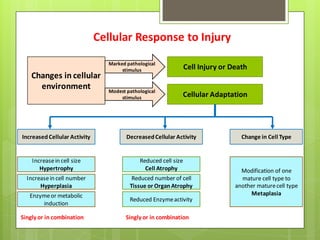
Changes in cellular
environment
Marked pathological
stimulus
Modest pathological
stimulus
Cell Injury or Death
Cellular Adaptation
IncreasedCellular Activity DecreasedCellular Activity Change in Cell Type
Increasein cell size
Hypertrophy
Increasein cell number
Hyperplasia
Enzymeor metabolic
induction
Reduced cell size
Cell Atrophy
Reduced number of cell
Tissue or OrganAtrophy
Reduced Enzymeactivity
Modification of one
mature cell type to
another maturecell type
Metaplasia
Singly or in combination Singly or in combination
Cellular Response to Injury
Increased cellular activity
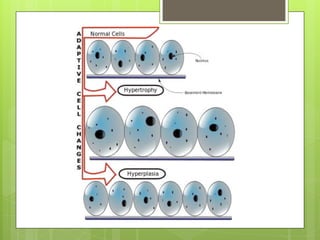
Hypertrophy:
 increased cell size,
 often in response to increased workload;
 induced by mechanical stress and by growth
factors;
 occurs in tissues incapable of cell division
Hyperplasia:
 increased cell numbers in response to hormones and
other growth factors;
 occurs in tissues whose cells are able to divide
Decreased cellular activity
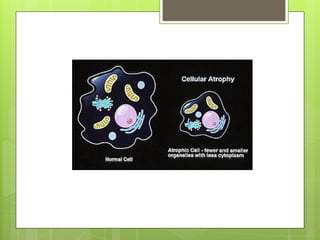
Atrophy:
 decreased cell and organ size,
 as a result of decreased nutrient supply or disuse;
 associated with decreased synthesis and increased
proteolytic breakdown of cellular organelles
Change in cell type
Metaplasia
 It is the replacement of one differentiated cell
type by another
 Associated conditions include chronic irritation
and vitamin A deficiency.
Failure of Cellular adaptation
 Cells which are intrinsically unable to adapt, begin
to show structural changes which indicate their
failure to withstand the changed environment.
 Injury may progress through a reversible stage
and culminate in cell death
Reversible cell injury
 In early stages or mild forms of injury the functional
and morphologic changes are reversible if the
damaging stimulus is removed.
 At this stage, although there may be significant
structural and functional abnormalities, the injury
has typically not progressedto severe membrane
damage and nuclear dissolution.
Cell death
 With continuing damage, the injury becomes
irreversible, at which time the cell cannot recover
(point of no return) and it dies.
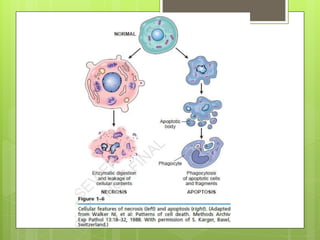
 There are two types of cell death— necrosis and
apoptosis
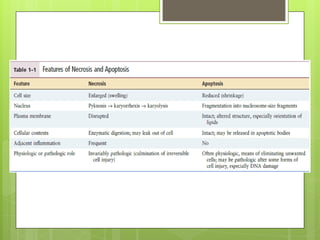
 Necrosis is always a pathologicprocess, apoptosis
serves many normal functions and is not
necessarily associatedwith pathologic cell injury
Necrosis
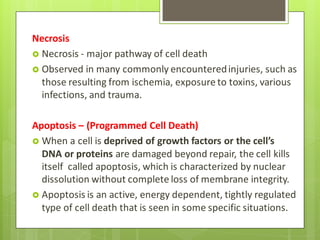
 Necrosis - major pathway of cell death
 Observed in many commonly encounteredinjuries, such as
those resulting from ischemia, exposure to toxins, various
infections, and trauma.
Apoptosis – (Programmed Cell Death)
 When a cell is deprived of growth factors or the cell’s
DNA or proteins are damaged beyond repair, the cell kills
itself called apoptosis, which is characterized by nuclear
dissolution without complete loss of membrane integrity.
 Apoptosis is an active, energy dependent, tightly regulated
type of cell death that is seen in some specific situations.
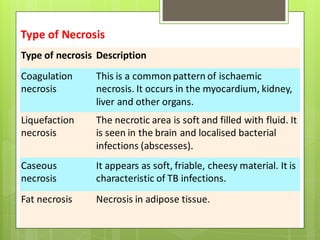
Type of necrosis Description
Coagulation
necrosis
This is a common pattern of ischaemic
necrosis. It occurs in the myocardium, kidney,
liver and other organs.
Liquefaction
necrosis
The necrotic area is soft and filled with fluid. It
is seen in the brain and localised bacterial
infections (abscesses).
Caseous
necrosis
It appears as soft, friable, cheesy material. It is
characteristic of TB infections.
Fat necrosis Necrosis in adipose tissue.
Type of Necrosis
CAUSES OF CELL INJURY
 Oxygen Deprivation – Hypoxia
 Chemical Agents – Poison, air pollutants, insecticides,
CO2, asbestos, therapeutic drugs etc.
 Infectious Agents
 Immunologic Reactions
 Genetic Defects
 Nutritional Imbalances
 Physical Agents – Trauma
 Aging
❷ INFLAMMATORY RESPONSE
 “Inflame” – to set fire.
 Inflammation is “A complex biological response of
body tissues to harmful stimuli.”
 It is a non-specific, protective response.
 It serves to bring defense & healing mechanisms to the
site of injury.
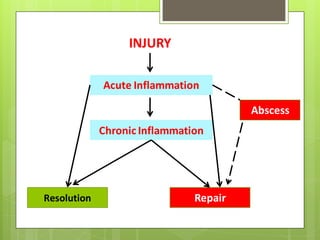
INJURY
Acute Inflammation
Chronic Inflammation
Resolution Repair
Abscess
Etiologies
Microbial infections: bacterial, viral, fungal, etc.
Physical agents: trauma--like cuts,
Chemicals: drugs, toxins,
Immunologic reactions: rheumatoid arthritis.
Cardinal Signs of Inflammation
 Celsus described the local reaction of injury in terms
that have come to be known as the cardinal signs of
inflammation.
 These signs are:
 rubor (redness) - Hyperaemia
 tumor (swelling) - Exudation
 calor (heat) - Hyperaemia
 dolor (pain) - Nerve, Chemical mediators
 functio laesa, or loss of function (In the second
century AD, the Greek physician Galen added this
fifth cardinal sign)
Time course
 Acute inflammation: Less than 48 hours
 Chronic inflammation: Greater than 48 hours (weeks,
months, years)
Cell type
 Acute inflammation: Neutrophils
 Chronic inflammation: Mononuclear cells (Macrophages,
Lymphocytes, Plasma cells).
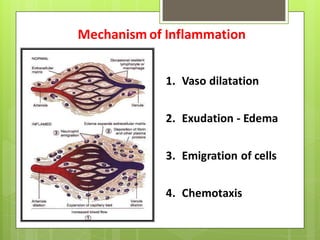
Mechanism of Inflammation
1. Vaso dilatation
2. Exudation - Edema
3. Emigration of cells
4. Chemotaxis
Lymphatics in inflammation
Lymphatics are responsible for draining edema.
Edema: An excess of fluid in the interstitial tissue;
either a transudate or an exudate
Transudate:
 An ultrafiltrate of blood plasma
 permeability of endothelium is usually normal.
 low protein content ( mostly albumin)
Exudate:
 A filtrate of blood plasma mixed with inflammatory
cells and cellular debris.
 permeability of endothelium is usually altered
 high protein content.
Leukocyte exudation
 Divided into 4 steps
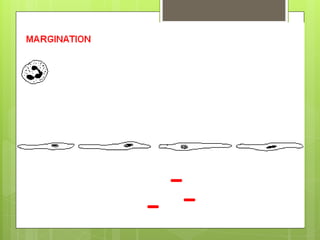
 Margination, rolling, and adhesion to endothelium
 Diapedesis (trans-migration across the endothelium)
 Migration toward a chemotactic stimuli from the source
of tissue injury.
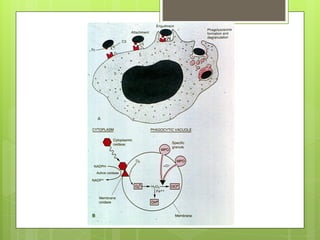
 Phagocytosis
Phagocytosis
 3 distinct steps
 Recognition and attachment
 Engulfment
 Killing or degradation
Chemical Mediators
Chemical substancessynthesised or released and mediate the
changes in inflammation.
 Histamine by mast cells - vasodilatation.
 Prostaglandins – Cause pain & fever.
❸Pathogenicity mechanism
 Ability or potential to cause disease attributed to a genus or
species
 High virulence ↔ low virulence ↔ avirulent (virulence is lost)
– increasing virulence: mutations, GMO, bioterrorism
– decreasing virulence: mutations, attenuation
 Dependent on ability to
 enter the host
 adapt and multiply in the host
 exit from the host
 transmit to new host
Mechanisms of Bacterial Pathogenicity
 On the basis of pathogenicity, bacteria can be
organized into three major groups.
 Primary pathogens - When isolated from a
diseased fish, are considered to be probable agents
of disease.
 Opportunistic pathogens - are those isolated from
diseased fish whose host defense mechanisms
have been compromised.
 Non-pathogens - they rarely or never cause
disease. E.g. Lactobacillus acidophilus
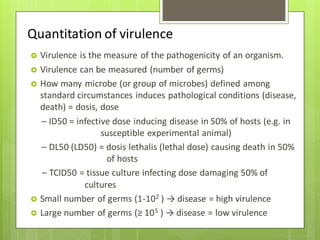
Quantitation of virulence
 Virulence is the measure of the pathogenicity of an organism.
 Virulence can be measured (number of germs)
 How many microbe (or group of microbes) defined among
standard circumstances induces pathological conditions (disease,
death) = dosis, dose
– ID50 = infective dose inducing disease in 50% of hosts (e.g. in
susceptible experimental animal)
– DL50 (LD50) = dosis lethalis (lethal dose) causing death in 50%
of hosts
– TCID50 = tissue culture infecting dose damaging 50% of
cultures
 Small number of germs (1-102 ) → disease = high virulence
 Large number of germs (≥ 105 ) → disease = low virulence
 Virulence factors should never be considered
independently of the host's defenses.
 An infection begins when the balance between
bacterial pathogenicity and host resistance is upset.
 Two broad qualities of disease causing bacteria underlie
the means by which they cause disease:
 1. Invasiveness is the ability to invade tissues.
 It encompasses mechanisms for colonization (adherence
and initial multiplication),
 production of extracellular substances which facilitate
invasion(invasins)and
 abilityto bypass or overcomehost defense mechanisms.
 2. Toxigenesis is the ability to produce toxins.
Exotoxins & endotoxins
 Pathogenic mechanisms of viral disease include
(1) implantation of virus at the portal of entry,
(2) local replication,
(3) spread to target organs (disease sites), and
(4) spread to sites of shedding of virus into the
environment.
 Factors that affect pathogenic mechanisms are
(1) accessibility of virus to tissue,
(2) cell susceptibility to virus multiplication, and
(3) virus susceptibility to host defenses.
Pathogenicity Mechanisms of Viruses
 Cellular Pathogenesis
 Direct cell damage and death from viral infection may result
from
(1) diversion of the cell's energy,
(2) shutoff of cell macromolecular synthesis,
(3) competition of viral mRNA for cellular ribosomes,
(4) competition of viral promoters and transcriptional
enhancers for cellular transcriptional factors such as RNA
polymerases, and inhibition of the interferon defense
mechanisms.
 Indirect cell damage can result from integration of the viral
genome, induction of mutations in the host genome,
inflammation, and the host immune response.
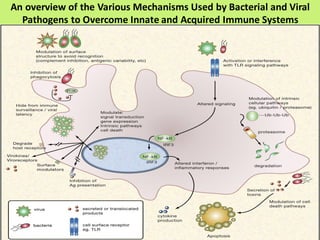
An overview of the Various Mechanisms Used by Bacterial and Viral
Pathogens to Overcome Innate and Acquired Immune Systems
 Ectoparasite use to establish on the host and derive
nourishment, induce necrotic changes at the cellular
& tissue level.
 Endoparasites, mechanism of penetration and
migration, mode of deriving nourishment, mode of
reproduction and route of exit from host will all
contribute to pathology.
Pathogenicity Mechanisms of Parasites
Immune evasion mechanism of endoparasites
 In spite of immune surveillance certain endoparasite often
enter blood stream, become resistant to immune effector
mechanism.
 Some of the mechanism are:
1. Antigenic Masking:
 It is ability of a parasite to escape immune detection by
covering itself with host antigens.
 Some protozoans become non immunogenic/ non antigenic
by masking themselves with host antigens.
 eg. Trypanosoma.
2. Blocking of Serum Factors:
 Some parasites acquire a coating of antigen- antibody
complexes or noncytotoxic antibodies that blocks the
binding of specific antibody or lymphocytes to the parasite
surface antigens.
3. Intracellular Location:
 The anatomic sequestration (intracellular habitat) of some
protozoan parasites protects them from the direct effects of
the host's immune response.
 Their intracellular habitat conceals the parasite antigens and
delays detection by the immune system.
4. Antigenic Variation:
 Some endoparasites change their surface antigens during the
course of an infection.
 Parasites carrying the new antigens escape the immune
response to the original antigens.
5. Antigen sheding:
 Some protozoans shed their antigen coats either
spontaneouslyor after binding with specific antibodies eg. E.
histolytica.
6. Hypo immunogenic:
 Some protozoa become hypo immunogenic at certain stages
of their life for example cyst stage of many protozoan will not
stimulate host response.
7. Immunosuppression:
 Sometimes immune suppression is caused directly by
parasite products and sometimes involves antigenic mimicry,
which often appears in association with parasitic diseases
(abnormalities in cytokine production, deficient T cell
activation) eg. Trypanosoma
 Disease results when fungi accidentally penetrate host
barriers or when immunologic defects or other debilitating
conditions exist that favor fungal entry and growth.
 Fungi often develop both virulence mechanisms (e.g.,
capsule and ability to grow at 37oC) and morphologic forms
(e.g., yeasts, hyphae, spherules, and sclerotic bodies) that
facilitate their multiplication within the host.
 The histolytic properties of the invading fungal hyphae
induce necrotic changes in the concerned target tissue.
Pathogenicity Mechanisms of Fungus

Pathological process of disease development process in fish

  • 1.
    R. K. Brahmchari AssistantProfessor College of Fisheries, Dholi (RPCAU) Muzaffarpur, Bihar Disease Development Process in Aquaculture
  • 2.
    Introduction  To gaininsight into the process of disease development, it is very essential to understand the role of various pathogens such as:  The adaptive modifications they have,  The functional importance of the target tissue,  interaction between pathogen and host at the target tissue level,  Pathogenicity mechanism of pathogens etc..
  • 3.
     The processof disease development is very complicated.  Environmental factors & Stress often can accelerate this process.  The sequence of disease development will to a large extent depend on the:  Nature of pathogen (parasite, bacteria, virus, fungi)  Environmental factors  Size of the host  Pathogen load or intensity per unit area or unit weight of the host.
  • 4.
  • 5.
     Pathology isthe study of disease.  it involves the investigation of the causes (etiology) of disease as well as the underlying mechanisms (pathogenesis) that result in the presenting signs and symptoms of the diseased fish.  Pathologists use a variety of molecular, microbiological, and immunological techniques to understand the biochemical, structural, and functional changes that occur in cells, tissues, and organs.
  • 6.
     Pathology insimple is the outcome of three basic process: A) Cellular responses to pathogen induced injury B) Inflammatoryresponse exhibited by the host C) Pathogenicity mechanisms of the pathogen
  • 7.
     The interactionof these three processes in the target tissue of the host produce series of pathological changes.  Functional failure of the target tissue leads to clinical manifestation of the disease followed by morbidity and mortality.
  • 8.
    ❶ Cellular Responsesto injury  The cellular environment is constantly changing and as a consequence, cells have to make continuousadjustments to accommodate these changes.  The cells have a great capacity for adaptation to their environment.
  • 9.
     Cells mayrespond to pathological stimuli by extending their normal physiological adaptive processes.  These adaptive processes include: A) Increased cellular activity i) increase in cell size (hypertrophy) ii) increase in cell number (hyperplasia) B) Decreased cellular activity i) reduced cell size (cell atrophy) ii) reduced number of cell (tissue or organ atrophy)
  • 10.
    C) Change incell type i) modification in morphology & function to a cell type more suited to the changed environment (metaplasia)
  • 11.
    Changes in cellular environment Markedpathological stimulus Modest pathological stimulus Cell Injury or Death Cellular Adaptation IncreasedCellular Activity DecreasedCellular Activity Change in Cell Type Increasein cell size Hypertrophy Increasein cell number Hyperplasia Enzymeor metabolic induction Reduced cell size Cell Atrophy Reduced number of cell Tissue or OrganAtrophy Reduced Enzymeactivity Modification of one mature cell type to another maturecell type Metaplasia Singly or in combination Singly or in combination Cellular Response to Injury
  • 12.
    Increased cellular activity Hypertrophy: increased cell size,  often in response to increased workload;  induced by mechanical stress and by growth factors;  occurs in tissues incapable of cell division
  • 13.
    Hyperplasia:  increased cellnumbers in response to hormones and other growth factors;  occurs in tissues whose cells are able to divide
  • 15.
    Decreased cellular activity Atrophy: decreased cell and organ size,  as a result of decreased nutrient supply or disuse;  associated with decreased synthesis and increased proteolytic breakdown of cellular organelles
  • 17.
    Change in celltype Metaplasia  It is the replacement of one differentiated cell type by another  Associated conditions include chronic irritation and vitamin A deficiency.
  • 18.
    Failure of Cellularadaptation  Cells which are intrinsically unable to adapt, begin to show structural changes which indicate their failure to withstand the changed environment.  Injury may progress through a reversible stage and culminate in cell death
  • 19.
    Reversible cell injury In early stages or mild forms of injury the functional and morphologic changes are reversible if the damaging stimulus is removed.  At this stage, although there may be significant structural and functional abnormalities, the injury has typically not progressedto severe membrane damage and nuclear dissolution.
  • 20.
    Cell death  Withcontinuing damage, the injury becomes irreversible, at which time the cell cannot recover (point of no return) and it dies.  There are two types of cell death— necrosis and apoptosis  Necrosis is always a pathologicprocess, apoptosis serves many normal functions and is not necessarily associatedwith pathologic cell injury
  • 21.
    Necrosis  Necrosis -major pathway of cell death  Observed in many commonly encounteredinjuries, such as those resulting from ischemia, exposure to toxins, various infections, and trauma. Apoptosis – (Programmed Cell Death)  When a cell is deprived of growth factors or the cell’s DNA or proteins are damaged beyond repair, the cell kills itself called apoptosis, which is characterized by nuclear dissolution without complete loss of membrane integrity.  Apoptosis is an active, energy dependent, tightly regulated type of cell death that is seen in some specific situations.
  • 24.
    Type of necrosisDescription Coagulation necrosis This is a common pattern of ischaemic necrosis. It occurs in the myocardium, kidney, liver and other organs. Liquefaction necrosis The necrotic area is soft and filled with fluid. It is seen in the brain and localised bacterial infections (abscesses). Caseous necrosis It appears as soft, friable, cheesy material. It is characteristic of TB infections. Fat necrosis Necrosis in adipose tissue. Type of Necrosis
  • 25.
    CAUSES OF CELLINJURY  Oxygen Deprivation – Hypoxia  Chemical Agents – Poison, air pollutants, insecticides, CO2, asbestos, therapeutic drugs etc.  Infectious Agents  Immunologic Reactions  Genetic Defects  Nutritional Imbalances  Physical Agents – Trauma  Aging
  • 26.
    ❷ INFLAMMATORY RESPONSE “Inflame” – to set fire.  Inflammation is “A complex biological response of body tissues to harmful stimuli.”  It is a non-specific, protective response.  It serves to bring defense & healing mechanisms to the site of injury.
  • 27.
  • 28.
    Etiologies Microbial infections: bacterial,viral, fungal, etc. Physical agents: trauma--like cuts, Chemicals: drugs, toxins, Immunologic reactions: rheumatoid arthritis.
  • 29.
    Cardinal Signs ofInflammation  Celsus described the local reaction of injury in terms that have come to be known as the cardinal signs of inflammation.  These signs are:  rubor (redness) - Hyperaemia  tumor (swelling) - Exudation  calor (heat) - Hyperaemia  dolor (pain) - Nerve, Chemical mediators  functio laesa, or loss of function (In the second century AD, the Greek physician Galen added this fifth cardinal sign)
  • 30.
    Time course  Acuteinflammation: Less than 48 hours  Chronic inflammation: Greater than 48 hours (weeks, months, years) Cell type  Acute inflammation: Neutrophils  Chronic inflammation: Mononuclear cells (Macrophages, Lymphocytes, Plasma cells).
  • 31.
    Mechanism of Inflammation 1.Vaso dilatation 2. Exudation - Edema 3. Emigration of cells 4. Chemotaxis
  • 32.
    Lymphatics in inflammation Lymphaticsare responsible for draining edema. Edema: An excess of fluid in the interstitial tissue; either a transudate or an exudate
  • 33.
    Transudate:  An ultrafiltrateof blood plasma  permeability of endothelium is usually normal.  low protein content ( mostly albumin) Exudate:  A filtrate of blood plasma mixed with inflammatory cells and cellular debris.  permeability of endothelium is usually altered  high protein content.
  • 34.
    Leukocyte exudation  Dividedinto 4 steps  Margination, rolling, and adhesion to endothelium  Diapedesis (trans-migration across the endothelium)  Migration toward a chemotactic stimuli from the source of tissue injury.  Phagocytosis
  • 36.
    Phagocytosis  3 distinctsteps  Recognition and attachment  Engulfment  Killing or degradation
  • 38.
    Chemical Mediators Chemical substancessynthesisedor released and mediate the changes in inflammation.  Histamine by mast cells - vasodilatation.  Prostaglandins – Cause pain & fever.
  • 39.
    ❸Pathogenicity mechanism  Abilityor potential to cause disease attributed to a genus or species  High virulence ↔ low virulence ↔ avirulent (virulence is lost) – increasing virulence: mutations, GMO, bioterrorism – decreasing virulence: mutations, attenuation  Dependent on ability to  enter the host  adapt and multiply in the host  exit from the host  transmit to new host
  • 40.
    Mechanisms of BacterialPathogenicity  On the basis of pathogenicity, bacteria can be organized into three major groups.  Primary pathogens - When isolated from a diseased fish, are considered to be probable agents of disease.  Opportunistic pathogens - are those isolated from diseased fish whose host defense mechanisms have been compromised.  Non-pathogens - they rarely or never cause disease. E.g. Lactobacillus acidophilus
  • 41.
    Quantitation of virulence Virulence is the measure of the pathogenicity of an organism.  Virulence can be measured (number of germs)  How many microbe (or group of microbes) defined among standard circumstances induces pathological conditions (disease, death) = dosis, dose – ID50 = infective dose inducing disease in 50% of hosts (e.g. in susceptible experimental animal) – DL50 (LD50) = dosis lethalis (lethal dose) causing death in 50% of hosts – TCID50 = tissue culture infecting dose damaging 50% of cultures  Small number of germs (1-102 ) → disease = high virulence  Large number of germs (≥ 105 ) → disease = low virulence
  • 42.
     Virulence factorsshould never be considered independently of the host's defenses.  An infection begins when the balance between bacterial pathogenicity and host resistance is upset.
  • 43.
     Two broadqualities of disease causing bacteria underlie the means by which they cause disease:  1. Invasiveness is the ability to invade tissues.  It encompasses mechanisms for colonization (adherence and initial multiplication),  production of extracellular substances which facilitate invasion(invasins)and  abilityto bypass or overcomehost defense mechanisms.  2. Toxigenesis is the ability to produce toxins. Exotoxins & endotoxins
  • 44.
     Pathogenic mechanismsof viral disease include (1) implantation of virus at the portal of entry, (2) local replication, (3) spread to target organs (disease sites), and (4) spread to sites of shedding of virus into the environment.  Factors that affect pathogenic mechanisms are (1) accessibility of virus to tissue, (2) cell susceptibility to virus multiplication, and (3) virus susceptibility to host defenses. Pathogenicity Mechanisms of Viruses
  • 45.
     Cellular Pathogenesis Direct cell damage and death from viral infection may result from (1) diversion of the cell's energy, (2) shutoff of cell macromolecular synthesis, (3) competition of viral mRNA for cellular ribosomes, (4) competition of viral promoters and transcriptional enhancers for cellular transcriptional factors such as RNA polymerases, and inhibition of the interferon defense mechanisms.  Indirect cell damage can result from integration of the viral genome, induction of mutations in the host genome, inflammation, and the host immune response.
  • 46.
    An overview ofthe Various Mechanisms Used by Bacterial and Viral Pathogens to Overcome Innate and Acquired Immune Systems
  • 47.
     Ectoparasite useto establish on the host and derive nourishment, induce necrotic changes at the cellular & tissue level.  Endoparasites, mechanism of penetration and migration, mode of deriving nourishment, mode of reproduction and route of exit from host will all contribute to pathology. Pathogenicity Mechanisms of Parasites
  • 48.
    Immune evasion mechanismof endoparasites  In spite of immune surveillance certain endoparasite often enter blood stream, become resistant to immune effector mechanism.  Some of the mechanism are: 1. Antigenic Masking:  It is ability of a parasite to escape immune detection by covering itself with host antigens.  Some protozoans become non immunogenic/ non antigenic by masking themselves with host antigens.  eg. Trypanosoma.
  • 49.
    2. Blocking ofSerum Factors:  Some parasites acquire a coating of antigen- antibody complexes or noncytotoxic antibodies that blocks the binding of specific antibody or lymphocytes to the parasite surface antigens. 3. Intracellular Location:  The anatomic sequestration (intracellular habitat) of some protozoan parasites protects them from the direct effects of the host's immune response.  Their intracellular habitat conceals the parasite antigens and delays detection by the immune system.
  • 50.
    4. Antigenic Variation: Some endoparasites change their surface antigens during the course of an infection.  Parasites carrying the new antigens escape the immune response to the original antigens. 5. Antigen sheding:  Some protozoans shed their antigen coats either spontaneouslyor after binding with specific antibodies eg. E. histolytica. 6. Hypo immunogenic:  Some protozoa become hypo immunogenic at certain stages of their life for example cyst stage of many protozoan will not stimulate host response.
  • 51.
    7. Immunosuppression:  Sometimesimmune suppression is caused directly by parasite products and sometimes involves antigenic mimicry, which often appears in association with parasitic diseases (abnormalities in cytokine production, deficient T cell activation) eg. Trypanosoma
  • 52.
     Disease resultswhen fungi accidentally penetrate host barriers or when immunologic defects or other debilitating conditions exist that favor fungal entry and growth.  Fungi often develop both virulence mechanisms (e.g., capsule and ability to grow at 37oC) and morphologic forms (e.g., yeasts, hyphae, spherules, and sclerotic bodies) that facilitate their multiplication within the host.  The histolytic properties of the invading fungal hyphae induce necrotic changes in the concerned target tissue. Pathogenicity Mechanisms of Fungus