Coffee Rust: A Threat
to Coffee Growers
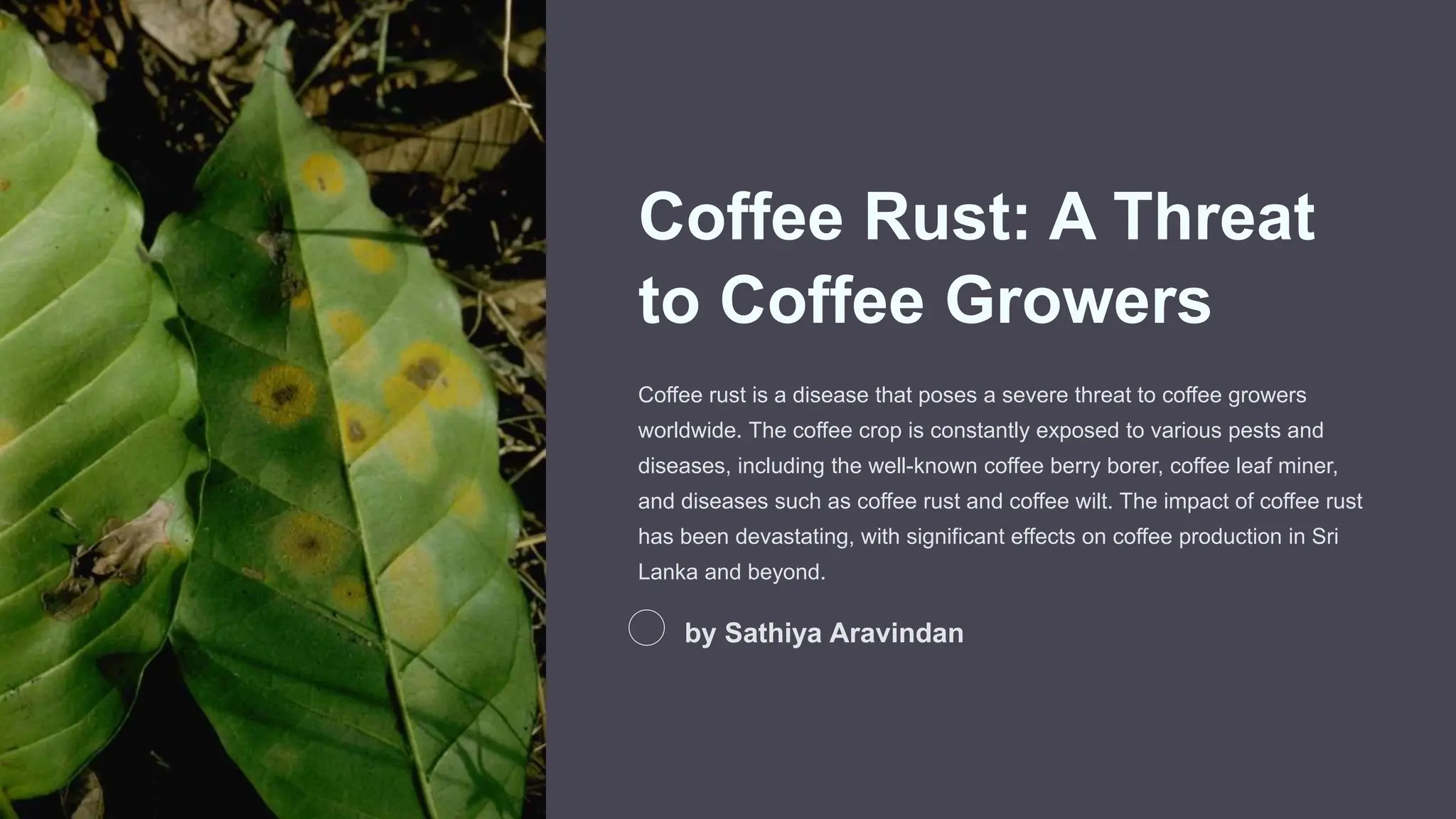
Coffee rust is a disease that poses a severe threat to coffee growers
worldwide. The coffee crop is constantly exposed to various pests and
diseases, including the well-known coffee berry borer, coffee leaf miner,
and diseases such as coffee rust and coffee wilt. The impact of coffee rust
has been devastating, with significant effects on coffee production in Sri
Lanka and beyond.
by Sathiya Aravindan
Identification and Impact
1 Identification
The disease is caused by the fungus Hemileia vastatrix, later renamed as
Wardia vastatrix. It was first reported by H.J Berkeley in 1870.
2 Spread and Devastation
In the 1970s, coffee rust spread from Africa to Brazil, causing severe
devastation. Efforts to contain the spread, such as creating a safety zone,
were unsuccessful.
3 Impact on Sri Lanka
Coffee rust has had a significant impact on coffee production in Sri Lanka,
leading to substantial yield reduction.
Systematic Position and
Symptomatology
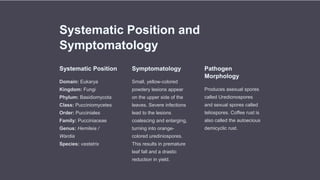
Systematic Position
Domain: Eukarya
Kingdom: Fungi
Phylum: Basidiomycota
Class: Pucciniomycetes
Order: Pucciniales
Family: Pucciniaceae
Genus: Hemileia /
Wardia
Species: vastatrix
Symptomatology
Small, yellow-colored
powdery lesions appear
on the upper side of the
leaves. Severe infections
lead to the lesions
coalescing and enlarging,
turning into orange-
colored urediniospores.
This results in premature
leaf fall and a drastic
reduction in yield.
Pathogen
Morphology
Produces asexual spores
called Uredionospores
and sexual spores called
teliospores. Coffee rust is
also called the autoecious
demicyclic rust.
Epidemiology and Management
Strategies
1 Epidemiology
The spores mainly enter through the
stomata and require good rain
splash for germination. Temperature
between 15 to 28 ℃ is highly
conducive for spore germination.
2 Management Strategies
Cultural methods include growing
resistant varieties and planting
seedlings in a well-spaced manner.
Chemical methods involve
employing Sulphur fungicide, while
biological methods use biocontrol
agents.
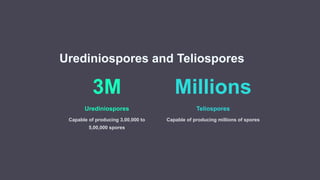
Urediniospores and Teliospores
3M
Urediniospores
Capable of producing 3,00,000 to
5,00,000 spores
Millions
Teliospores
Capable of producing millions of spores
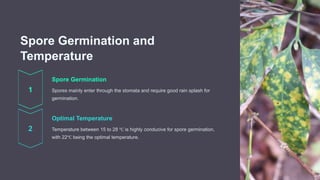
Spore Germination and
Temperature
Spore Germination
Spores mainly enter through the stomata and require good rain splash for
germination.
Optimal Temperature
Temperature between 15 to 28 ℃ is highly conducive for spore germination,
with 22℃ being the optimal temperature.
Resistant Varieties and Seedling
Planting
Resistant Varieties
Growing resistant varieties such as
Cauvery to minimize yield loss.
Seedling Planting
Planting seedlings in a well-spaced
manner to avoid dampness and create
unfavorable conditions for disease
development.
Chemical and Biological Methods
Chemical Methods Sulphur dusting at the rate of 25kg/ha
Biological Methods Employing biocontrol agents such as
Darluca filum and Penicillium
brevicompactum
Devastating Effect and Spread
1 Devastating Effect
Coffee rust has caused severe
devastation, with significant effects
on coffee production.
2 Spread
In the 1970s, coffee rust spread from
Africa to Brazil, causing widespread
damage.
Autoecious Demicyclic Rust
Autoecious Rust
The rust pathogen does not require any
other host to complete its life cycle.
Demicyclic Rust
The rust pathogen completely lacks the
uredial stage in its lifecycle, a concept still
under investigation.
V. Sathiya Aravindan
M.Sc., Agri Plant Pathology
Annamalai University

coffee rust and its management.pptx

  • 1.
    Coffee Rust: AThreat to Coffee Growers Coffee rust is a disease that poses a severe threat to coffee growers worldwide. The coffee crop is constantly exposed to various pests and diseases, including the well-known coffee berry borer, coffee leaf miner, and diseases such as coffee rust and coffee wilt. The impact of coffee rust has been devastating, with significant effects on coffee production in Sri Lanka and beyond. by Sathiya Aravindan
  • 2.
    Identification and Impact 1Identification The disease is caused by the fungus Hemileia vastatrix, later renamed as Wardia vastatrix. It was first reported by H.J Berkeley in 1870. 2 Spread and Devastation In the 1970s, coffee rust spread from Africa to Brazil, causing severe devastation. Efforts to contain the spread, such as creating a safety zone, were unsuccessful. 3 Impact on Sri Lanka Coffee rust has had a significant impact on coffee production in Sri Lanka, leading to substantial yield reduction.
  • 3.
    Systematic Position and Symptomatology SystematicPosition Domain: Eukarya Kingdom: Fungi Phylum: Basidiomycota Class: Pucciniomycetes Order: Pucciniales Family: Pucciniaceae Genus: Hemileia / Wardia Species: vastatrix Symptomatology Small, yellow-colored powdery lesions appear on the upper side of the leaves. Severe infections lead to the lesions coalescing and enlarging, turning into orange- colored urediniospores. This results in premature leaf fall and a drastic reduction in yield. Pathogen Morphology Produces asexual spores called Uredionospores and sexual spores called teliospores. Coffee rust is also called the autoecious demicyclic rust.
  • 4.
    Epidemiology and Management Strategies 1Epidemiology The spores mainly enter through the stomata and require good rain splash for germination. Temperature between 15 to 28 ℃ is highly conducive for spore germination. 2 Management Strategies Cultural methods include growing resistant varieties and planting seedlings in a well-spaced manner. Chemical methods involve employing Sulphur fungicide, while biological methods use biocontrol agents.
  • 5.
    Urediniospores and Teliospores 3M Urediniospores Capableof producing 3,00,000 to 5,00,000 spores Millions Teliospores Capable of producing millions of spores
  • 6.
    Spore Germination and Temperature SporeGermination Spores mainly enter through the stomata and require good rain splash for germination. Optimal Temperature Temperature between 15 to 28 ℃ is highly conducive for spore germination, with 22℃ being the optimal temperature.
  • 7.
    Resistant Varieties andSeedling Planting Resistant Varieties Growing resistant varieties such as Cauvery to minimize yield loss. Seedling Planting Planting seedlings in a well-spaced manner to avoid dampness and create unfavorable conditions for disease development.
  • 8.
    Chemical and BiologicalMethods Chemical Methods Sulphur dusting at the rate of 25kg/ha Biological Methods Employing biocontrol agents such as Darluca filum and Penicillium brevicompactum
  • 9.
    Devastating Effect andSpread 1 Devastating Effect Coffee rust has caused severe devastation, with significant effects on coffee production. 2 Spread In the 1970s, coffee rust spread from Africa to Brazil, causing widespread damage.
  • 10.
    Autoecious Demicyclic Rust AutoeciousRust The rust pathogen does not require any other host to complete its life cycle. Demicyclic Rust The rust pathogen completely lacks the uredial stage in its lifecycle, a concept still under investigation.
  • 11.
    V. Sathiya Aravindan M.Sc.,Agri Plant Pathology Annamalai University