Commercial Exploitation
of RNA Interference/Post
Transcriptional Gene
Silencing
There are various techniques available for the control of plant diseases, but
the most economically feasible method is host plant resistance or host plant
immunization. In the 21st century, RNA interference (RNAi) or post
transcriptional gene silencing has gained attention for the control of plant
diseases and pests.
by Sathiya Aravindan
Notorious Pests and Diseases Controlled via
RNAi/Post Transcriptional Gene Silencing
(PTG’s)
1 Cross Protection in CTV and TMV
Control of Citrus tristeza virus (CTV) and
Tobacco mosaic virus (TMV) through cross
protection.
2 Control of Root Knot Nematode
Effective control of Meloidogyne incognita in
tobacco plants.
3 Control of Citrus Greening Disease
Management of Citrus greening disease
caused by Asian citrus psyllids.
4 Foliar Application of Bio-clay Coated
ds-RNA
Use of bio-clay coated ds-RNA for controlling
the Whitefly vector.
Genetically Modified Plants (GMO) and
RNAi/PTGS
Inhibition of Potyviruses
GMO Soybeans developed using the PTG’S
technique inhibit the replication of Potyviruses.
Carrier Coated ds-RNA
Application of carrier coated ds-RNA effectively
sensitive for all growth stages of Lepidopteran
larvae.
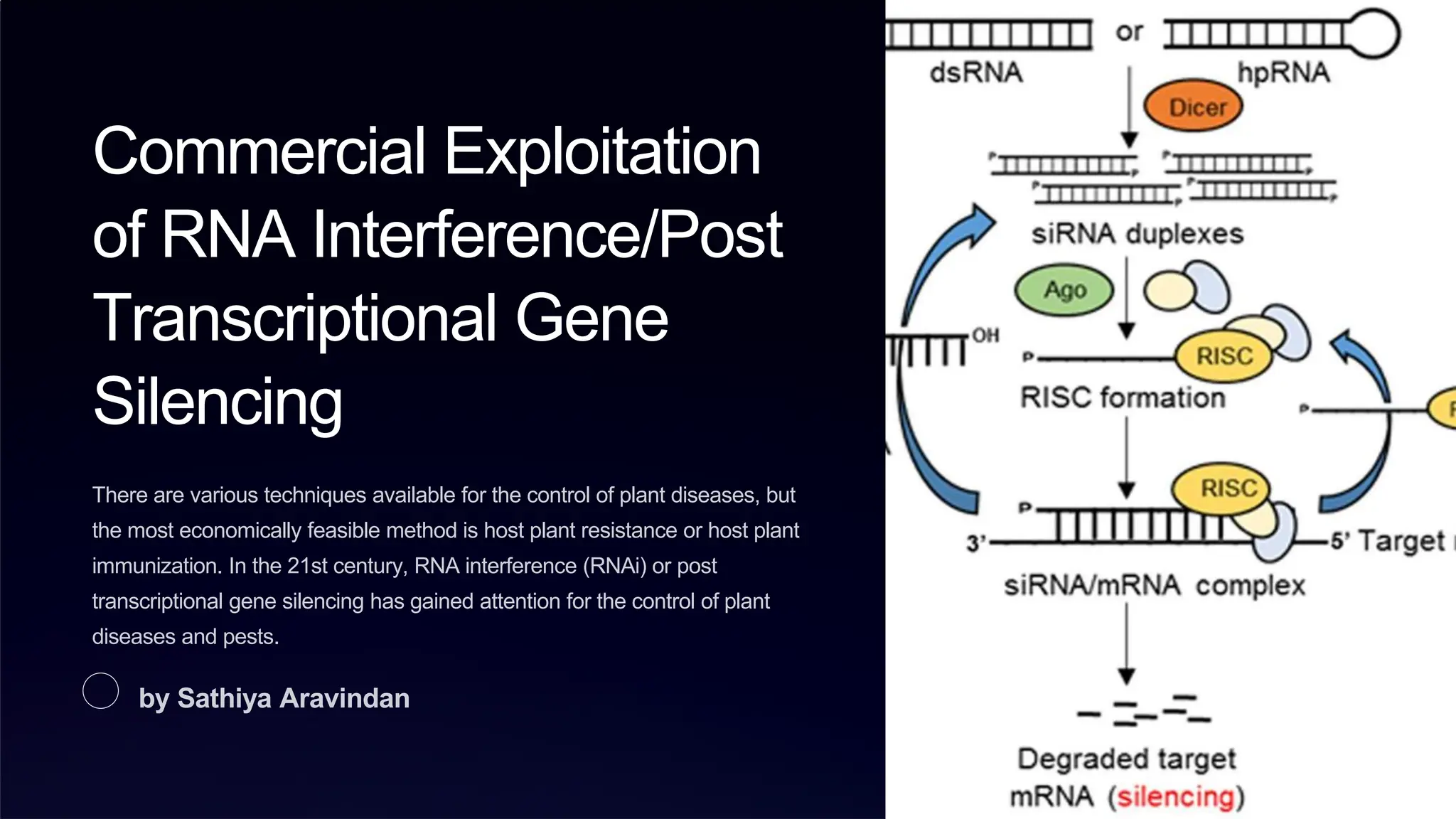
Working of RNAi/PTGS
1 Formation of ds-RNA
Cells have the ability to produce ds-RNA either naturally or as a result of viral
infection or aberrant bi-directional read through.
2 Production of siRNA, shRNA, and miRNA
ds-RNA duplexes have the ability to produce small RNA molecules such as
siRNA, shRNA, and miRNA.
3 RNA Mediated Gene Silencing
RNA molecules break the m-RNA, leading to gene silencing with the aid of the
RISC factor.
Commercial Exploitation of RNAi
Foliar Application of Clay-Delivered RNA Interference
Extracted ds-RNA coated with bio-clay particles or Nano-particles is sprayed on the foliar
surface.
Working Process in Plants
1 Gene Altered GMO Plants
Plants produce both sense and anti-sense
strands of RNA (ds-RNA) after incorporating
specific genes from the vector.
2 Production of si-RNA, sh-RNA,
and mi-RNA
ds-RNA is cleaved into small RNA molecules
with the help of the host-produced RNAse-III
(Dicer enzyme).
Working Process in Targeted Pests/Vector
or Pathogens
1 Activated RISC
When genetically modified plants/ds-RNA
treated plants are eaten up or infected by
targeted pests or pathogens, the RISC
complex gets activated.
2 Post Transcriptional Gene Silencing
The silencing occurs only after transcription
takes place, hence it is also called 'Post
Transcriptional Gene Silencing'.
Developers of RNAi/PTGS
1998
Year of Development
RNAi/PTGS was developed by Andrew Fire and Craig Mello in 1998.
Enzyme Dicer and RISC Complex
Role of Dicer
The enzyme Dicer cuts the ds-RNA, producing
small RNA molecules (siRNA, shRNA, miRNA).
RISC Complex
The RISC complex, formed by the RISC factor
combining with proteins such as Argonaut or
Slicer, binds with the targeted m-RNA and silences
it.
Application of RNA Interference in Plants
Gene Cleavage and
Incorporation
Specific genes are cleaved
from the host and
incorporated with the specific
vector, becoming r-DNA and
inserted into the host plants.
Production of ds-RNA
The gene-altered GMO plants
produce both sense and anti-
sense strands of RNA (ds-
RNA).
Activation of RISC
Complex
When eaten up or infected by
targeted pests or pathogens,
the RISC complex gets
activated.
FOR STUDY NOTES:
https://getscientified.blogspot.com/2024/02/
commercial-exploitation-of-rna.html
YOUTUBE VIDEO LINK:
https://youtu.be/L4gMC7S3FnY

Commercial-Exploitation-of-RNA-Interference/Post-Transcriptional-Gene-Silencing.pptx

  • 1.
    Commercial Exploitation of RNAInterference/Post Transcriptional Gene Silencing There are various techniques available for the control of plant diseases, but the most economically feasible method is host plant resistance or host plant immunization. In the 21st century, RNA interference (RNAi) or post transcriptional gene silencing has gained attention for the control of plant diseases and pests. by Sathiya Aravindan
  • 2.
    Notorious Pests andDiseases Controlled via RNAi/Post Transcriptional Gene Silencing (PTG’s) 1 Cross Protection in CTV and TMV Control of Citrus tristeza virus (CTV) and Tobacco mosaic virus (TMV) through cross protection. 2 Control of Root Knot Nematode Effective control of Meloidogyne incognita in tobacco plants. 3 Control of Citrus Greening Disease Management of Citrus greening disease caused by Asian citrus psyllids. 4 Foliar Application of Bio-clay Coated ds-RNA Use of bio-clay coated ds-RNA for controlling the Whitefly vector.
  • 3.
    Genetically Modified Plants(GMO) and RNAi/PTGS Inhibition of Potyviruses GMO Soybeans developed using the PTG’S technique inhibit the replication of Potyviruses. Carrier Coated ds-RNA Application of carrier coated ds-RNA effectively sensitive for all growth stages of Lepidopteran larvae.
  • 4.
    Working of RNAi/PTGS 1Formation of ds-RNA Cells have the ability to produce ds-RNA either naturally or as a result of viral infection or aberrant bi-directional read through. 2 Production of siRNA, shRNA, and miRNA ds-RNA duplexes have the ability to produce small RNA molecules such as siRNA, shRNA, and miRNA. 3 RNA Mediated Gene Silencing RNA molecules break the m-RNA, leading to gene silencing with the aid of the RISC factor.
  • 5.
    Commercial Exploitation ofRNAi Foliar Application of Clay-Delivered RNA Interference Extracted ds-RNA coated with bio-clay particles or Nano-particles is sprayed on the foliar surface.
  • 6.
    Working Process inPlants 1 Gene Altered GMO Plants Plants produce both sense and anti-sense strands of RNA (ds-RNA) after incorporating specific genes from the vector. 2 Production of si-RNA, sh-RNA, and mi-RNA ds-RNA is cleaved into small RNA molecules with the help of the host-produced RNAse-III (Dicer enzyme).
  • 7.
    Working Process inTargeted Pests/Vector or Pathogens 1 Activated RISC When genetically modified plants/ds-RNA treated plants are eaten up or infected by targeted pests or pathogens, the RISC complex gets activated. 2 Post Transcriptional Gene Silencing The silencing occurs only after transcription takes place, hence it is also called 'Post Transcriptional Gene Silencing'.
  • 8.
    Developers of RNAi/PTGS 1998 Yearof Development RNAi/PTGS was developed by Andrew Fire and Craig Mello in 1998.
  • 9.
    Enzyme Dicer andRISC Complex Role of Dicer The enzyme Dicer cuts the ds-RNA, producing small RNA molecules (siRNA, shRNA, miRNA). RISC Complex The RISC complex, formed by the RISC factor combining with proteins such as Argonaut or Slicer, binds with the targeted m-RNA and silences it.
  • 10.
    Application of RNAInterference in Plants Gene Cleavage and Incorporation Specific genes are cleaved from the host and incorporated with the specific vector, becoming r-DNA and inserted into the host plants. Production of ds-RNA The gene-altered GMO plants produce both sense and anti- sense strands of RNA (ds- RNA). Activation of RISC Complex When eaten up or infected by targeted pests or pathogens, the RISC complex gets activated.
  • 11.