GUTTERCREDITTK
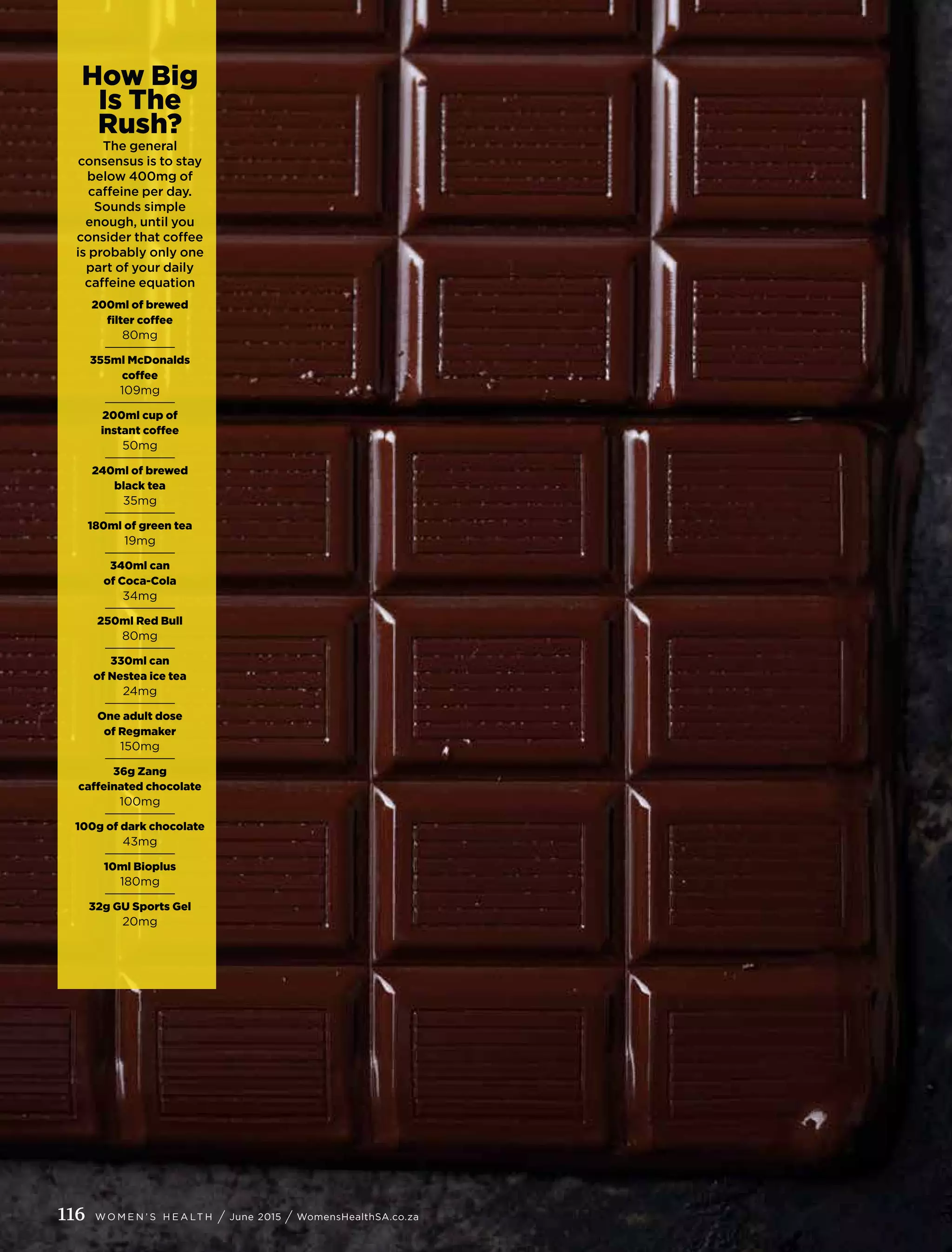
How Big
Is The
Rush?
The general
consensus is to stay
below 400mg of
caffeine per day.
Sounds simple
enough, until you
consider that coffee
is probably only one
part of your daily
caffeine equation
200ml of brewed
filter coffee
80mg
355ml McDonalds
coffee
109mg
200ml cup of
instant coffee
50mg
240ml of brewed
black tea
35mg
180ml of green tea
19mg
340ml can
of Coca-Cola
34mg
250ml Red Bull
80mg
330ml can
of Nestea ice tea
24mg
One adult dose
of Regmaker
150mg
36g Zang
caffeinated chocolate
100mg
100g of dark chocolate
43mg
10ml Bioplus
180mg
32g GU Sports Gel
20mg
116 W O M E N ’ S H E A LT H / June 2015 / WomensHealthSA.co.za
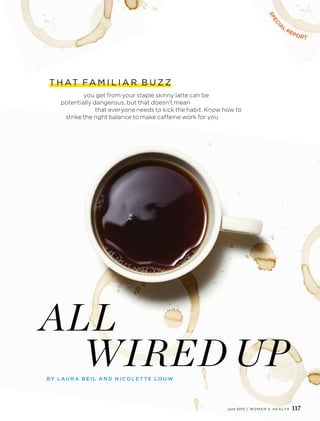
T H AT FA M I L I A R B U Z Z
you get from your staple skinny latte can be
potentially dangerous, but that doesn’t mean
that everyone needs to kick the habit. Know how to
strike the right balance to make caffeine work for you
SPECI
A
L
REPORT
ALL
WIRED UPB Y L A U R A B E I L A N D N I C O L E T T E L O U W
June 2015 / W O M E N ’ S H E A LT H 117
118 W O M E N ’ S H E A LT H / June 2015 / WomensHealthSA.co.za
Caffeine lovers now have more
options than ever to get their
buzz on. There are the obvious
sources, such as energy drinks
– now a R120-billion business
worldwide. But caffeine is also
found in tea, including ice tea,
some fizzy cooldrinks, cocoa-
based products, slimming
products and medication.
If these are how you score
your hits, labels can make it
easier to track your caffeine
consumption. For example,
in 2011, draft amendments
were published in the South
African Government Gazette
proposing stricter labelling
requirements for “highly
caffeinated energy drinks”,
such as Red Bull, Monster
Energy Drink and PowerPlay.
Regular coffee drinkers, on
the other hand, may be over
their caffeine limit, but could
becompletelyoblivioustothe
fact. And, with many food,
drink and pharmaceutical
companies adding caffeine
to theirproducts,non-coffee-
consumers may be even
more unaware of their intake,
resulting in side effects such
as irritability, headaches and
restlessnessbeingbrushedoff.
But is it really such
a concern in the first place?
Experts remain divided.
“There are a number
of conflicting studies on
the positive and negative
consequences of caffeine,”
says Demitri Constantinou,
adjunct professor of Sports
and Exercise Medicine at
Wits University and director
for the Centre for Exercise
Science and Sports Medicine.
“There is some evidence
of the health benefits
and there are differences
in individual responses.
There is a level of tolerance,
so some of the effects may
subside overtime.Theproblems
mostlyrelatetothesideeffects,
such as sleep disturbances,
abdominalcramps,heartburn,
diarrhoea, palpitations,
anxiety, hand tremors
and excessive sweating.”
No wonder we’re confused.
BEHIND
THE JOLT
One of the oldest drugs in
human history and found
in dozens of plants, beans
and seeds, caffeine works
by blocking a sleep-inducing
chemical called adenosine
(see “Your Body On Caffeine”).
Inthepast,mostpeoplewould
get their regular caffeine
dose from a cup of coffee
and it was easy to stay under
the recommended limit of
400mg for adult consumption.
Today, however, with caffeine
not always listed on food and
drink labels, consumption is
harder to track. And, despite
decades of research, no one
really knows the lifelong
consequences of ingesting
too much. After all, studying
a drug that the majority of
people already consume is
a challenge.Plus,pro-caffeine
findings may not take into
account the negative effects of
fatigue and tiredness resulting
from caffeine’s effect on sleep
quality, adds Constantinou.
That said, scientists have
gleaned some insights.
CLOUDED
BENEFITS
Caffeine can reputedly affect
an athlete’s mental alertness
and physical performance, says
Constantinou. “This is based
on the physiological effect of
central-nervous stimulation
and some potential effect
on metabolism.” Moderate
to heavy coffee intake may
also decrease your risk for
diabetes, inflammatory
diseases, Parkinson’s and
dementia and improve
memory function. Plus,
coffee drinkers live slightly
longer than non-drinkers,
according to a 2012 study.
Yet, every pro-caffeine
statistic is followed up by
an anti-caffeine statistic (see
“Mixed Messages”). In 2013,
a study concluded that coffee
drinkers may have shorter
life spans and that caffeine
can also disrupt sleep,
further leading to a list of
problems, such as weight gain,
weakened immunity and poor
concentration. New research
has also found that it has the
ability to leave people wanting
more, driving them towards
sugary drinks. Caffeine may be
natural, but it’s also an overused
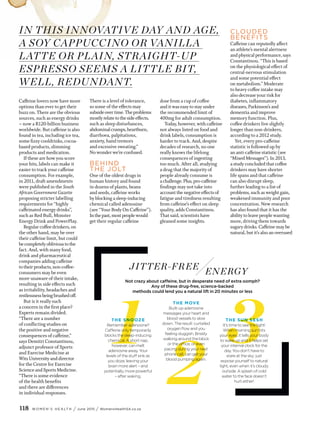
JITTER-FREE
THE SNOOZE
Remember adenosine?
Caffeine only temporarily
blocks the sleep-inducing
chemical. A short nap,
however, can melt
adenosine away. Your
levels of the stuff sink as
you doze, leaving your
brain more alert – and
potentially, more powerful
– after waking.
THE SUN SESH
It’s time to see the light!
When morning sun hits
your eyes, it tells your body
to wake up and it helps set
your internal clock for the
day. You don’t have to
stare at the sky; just
expose yourself to natural
light, even when it’s cloudy
outside. A splash of cold
water to the face doesn’t
hurt either!
1
2
3
THE MOVE
Built-up adenosine
messages your heart and
blood vessels to slow
down. The result: curtailed
oxygen flow and you
feeling sluggish. Briskly
walking around the block
or the office, or even
pacing during your next
phone call, can get your
blood pumping again.
Not crazy about caffeine, but in desperate need of extra oomph?
Any of these drug-free, science-backed
methods could lend you a natural lift in 20 minutes or less
IN THIS INNOVATIVE DAY AND AGE,
A SOY CAPPUCCINO OR VANILLA
LATTE OR PLAIN, STRAIGHT-UP
ESPRESSO SEEMS A LITTLE BIT,
WELL, REDUNDANT.
ENERGY
June 2015 / W O M E N ’ S H E A LT H 119
LISASHIN(COFFEE);RUSSELLSMITH(CHOCOLATE)
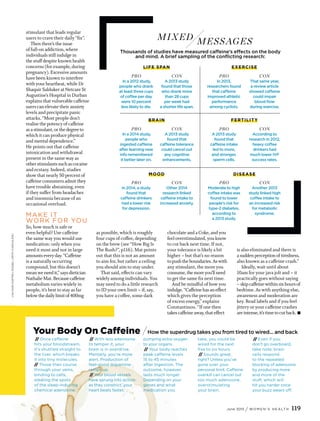
LIFE SPAN
PRO
In a 2012 study,
people who drank
at least three cups
of coffee per day
were 10 percent
less likely to die.
CON
A 2013 study
found that those
who drank more
than 28 cups
per week had
a shorter life span.
Thousands of studies have measured caffeine’s effects on the body
and mind. A brief sampling of the conflicting research:
BRAIN
PRO
In a 2014 study,
people who
ingested caffeine
after learning new
info remembered
it better later on.
CON
A 2013 study
found that
caffeine tolerance
could cancel out
any cognitive
enhancements.
MOOD
PRO
In 2014, a study
found that
caffeine drinkers
had a lower risk
for depression.
CON
Other 2014
research linked
caffeine intake to
increased anxiety.
EXERCISE
PRO
In 2013,
researchers found
that caffeine
improved athletic
performance
among cyclists.
CON
That same year,
a review article
showed caffeine
could impair
blood flow
during exercise.
FERTILITY
PRO
A 2013 study
found that
caffeine intake
led to more,
and stronger,
sperm cells.
CON
According to
research in 2012,
heavy coffee
drinkers had
much lower IVF
success rates.
DISEASE
PRO
Moderate to high
coffee intake was
found to lower
people’s risk for
type-2 diabetes,
according to
a 2013 study.
CON
Another 2013
study linked high
coffee intake to
an increased risk
for metabolic
syndrome.
MIXED MESSAGES
// Once caffeine
hits your bloodstream,
it’s shuttled straight to
the liver, which breaks
it into tiny molecules.
// Those then course
through your veins,
binding to cells,
stealing the spots
of the sleep-inducing
chemical adenosine.
// With less adenosine
to temper it, your
brain is in overdrive.
Mentally, you’re more
alert. Production of
feel-good dopamine
ramps up.
// Your blood vessels
have sprung into action:
as they constrict, your
heart beats faster,
pumping extra oxygen
to your organs.
// Your body reaches
peak caffeine levels
15 to 45 minutes
after ingestion. The
outcome, however,
lasts much longer.
Depending on your
genes and what
medication you
take, you could be
wired for the next
five to six hours.
// Sounds great,
right? Unless you’ve
gone over your
personal limit. Caffeine
overkill can cancel out
too much adenosine,
overstimulating
your brain.
// Even if you
don’t go overboard,
take note: brain
cells respond
to the repeated
blocking of adenosine
by producing more
and more of the
stuff, which will
hit you harder once
your buzz wears off.
Your Body On Caffeine /How the superdrug takes you from tired to wired... and back
stimulant that leads regular
users to crave their daily “fix”.
Then there’s the issue
of full-on addiction, where
individuals still indulge in
the stuff despite known health
concerns (for example, during
pregnancy). Excessive amounts
have been known to interfere
with your heartbeat, while Dr
Shaquir Salduker at Netcare St
Augustine’s Hospital in Durban
explains that vulnerable caffeine
users can elevate their anxiety
levels and precipitate panic
attacks. “Most people don’t
realise the potency of caffeine
asastimulant,orthedegreeto
which it can produce physical
and mental dependence.”
He points out that caffeine
intoxication and withdrawal
present in the same way as
other stimulantssuchascocaine
and ecstasy. Indeed, studies
show that nearly 50 percent of
caffeine consumers admit they
have trouble abstaining, even
if they suffer from headaches
and insomnia because of an
occasional overload.
MAKE IT
WORK FOR YOU
So, how much is safe or
even helpful? Use caffeine
the same way you would use
medication: only when you
need it most and not in large
amountsevery day.“Caffeine
is a naturally occurring
compound, but this doesn’t
meanweneedit,”saysdietician
NathalieMat.Becausecaffeine
metabolism varies widely in
people, it’s best to stay as far
belowthedailylimitof400mg
as possible, which is roughly
four cups of coffee, depending
on the brew (see “How Big Is
The Rush?”, p116). Mat points
out that this is not an amount
to aim for, but rather a ceiling
you should aim to stay under.
That said, effects can vary
widely among individuals. You
may need to do a little research
to ID your own limit – if, say,
you have a coffee, some dark
chocolate and a Coke, and you
feel overstimulated, you know
to cut back next time. If not,
your tolerance is likely a bit
higher – but that’s no reason
to pushtheboundaries.Aswith
any stimulant, the more you
consume,themoreyou’llneed
to get the same fix next time.
And be mindful of how you
indulge.“Caffeinehasaneffect
which gives the perception
of excess energy,” explains
Constantinou. “If one then
takescaffeineaway,thateffect
is also eliminated and there is
a suddenperceptionoftiredness,
also known as a caffeine crash.”
Ideally, wait until about
10am for your java jolt and – it
practically goes without saying
– skipcaffeinewithinsixhoursof
bedtime. As with anything else,
awareness and moderation are
key. Read labels and if you feel
jittery or your caffeine crashes
areintense,it’stimetocutback.

Coffee Feature

  • 1.
    GUTTERCREDITTK How Big Is The Rush? Thegeneral consensus is to stay below 400mg of caffeine per day. Sounds simple enough, until you consider that coffee is probably only one part of your daily caffeine equation 200ml of brewed filter coffee 80mg 355ml McDonalds coffee 109mg 200ml cup of instant coffee 50mg 240ml of brewed black tea 35mg 180ml of green tea 19mg 340ml can of Coca-Cola 34mg 250ml Red Bull 80mg 330ml can of Nestea ice tea 24mg One adult dose of Regmaker 150mg 36g Zang caffeinated chocolate 100mg 100g of dark chocolate 43mg 10ml Bioplus 180mg 32g GU Sports Gel 20mg 116 W O M E N ’ S H E A LT H / June 2015 / WomensHealthSA.co.za
  • 2.
    T H ATFA M I L I A R B U Z Z you get from your staple skinny latte can be potentially dangerous, but that doesn’t mean that everyone needs to kick the habit. Know how to strike the right balance to make caffeine work for you SPECI A L REPORT ALL WIRED UPB Y L A U R A B E I L A N D N I C O L E T T E L O U W June 2015 / W O M E N ’ S H E A LT H 117
  • 3.
    118 W OM E N ’ S H E A LT H / June 2015 / WomensHealthSA.co.za Caffeine lovers now have more options than ever to get their buzz on. There are the obvious sources, such as energy drinks – now a R120-billion business worldwide. But caffeine is also found in tea, including ice tea, some fizzy cooldrinks, cocoa- based products, slimming products and medication. If these are how you score your hits, labels can make it easier to track your caffeine consumption. For example, in 2011, draft amendments were published in the South African Government Gazette proposing stricter labelling requirements for “highly caffeinated energy drinks”, such as Red Bull, Monster Energy Drink and PowerPlay. Regular coffee drinkers, on the other hand, may be over their caffeine limit, but could becompletelyoblivioustothe fact. And, with many food, drink and pharmaceutical companies adding caffeine to theirproducts,non-coffee- consumers may be even more unaware of their intake, resulting in side effects such as irritability, headaches and restlessnessbeingbrushedoff. But is it really such a concern in the first place? Experts remain divided. “There are a number of conflicting studies on the positive and negative consequences of caffeine,” says Demitri Constantinou, adjunct professor of Sports and Exercise Medicine at Wits University and director for the Centre for Exercise Science and Sports Medicine. “There is some evidence of the health benefits and there are differences in individual responses. There is a level of tolerance, so some of the effects may subside overtime.Theproblems mostlyrelatetothesideeffects, such as sleep disturbances, abdominalcramps,heartburn, diarrhoea, palpitations, anxiety, hand tremors and excessive sweating.” No wonder we’re confused. BEHIND THE JOLT One of the oldest drugs in human history and found in dozens of plants, beans and seeds, caffeine works by blocking a sleep-inducing chemical called adenosine (see “Your Body On Caffeine”). Inthepast,mostpeoplewould get their regular caffeine dose from a cup of coffee and it was easy to stay under the recommended limit of 400mg for adult consumption. Today, however, with caffeine not always listed on food and drink labels, consumption is harder to track. And, despite decades of research, no one really knows the lifelong consequences of ingesting too much. After all, studying a drug that the majority of people already consume is a challenge.Plus,pro-caffeine findings may not take into account the negative effects of fatigue and tiredness resulting from caffeine’s effect on sleep quality, adds Constantinou. That said, scientists have gleaned some insights. CLOUDED BENEFITS Caffeine can reputedly affect an athlete’s mental alertness and physical performance, says Constantinou. “This is based on the physiological effect of central-nervous stimulation and some potential effect on metabolism.” Moderate to heavy coffee intake may also decrease your risk for diabetes, inflammatory diseases, Parkinson’s and dementia and improve memory function. Plus, coffee drinkers live slightly longer than non-drinkers, according to a 2012 study. Yet, every pro-caffeine statistic is followed up by an anti-caffeine statistic (see “Mixed Messages”). In 2013, a study concluded that coffee drinkers may have shorter life spans and that caffeine can also disrupt sleep, further leading to a list of problems, such as weight gain, weakened immunity and poor concentration. New research has also found that it has the ability to leave people wanting more, driving them towards sugary drinks. Caffeine may be natural, but it’s also an overused JITTER-FREE THE SNOOZE Remember adenosine? Caffeine only temporarily blocks the sleep-inducing chemical. A short nap, however, can melt adenosine away. Your levels of the stuff sink as you doze, leaving your brain more alert – and potentially, more powerful – after waking. THE SUN SESH It’s time to see the light! When morning sun hits your eyes, it tells your body to wake up and it helps set your internal clock for the day. You don’t have to stare at the sky; just expose yourself to natural light, even when it’s cloudy outside. A splash of cold water to the face doesn’t hurt either! 1 2 3 THE MOVE Built-up adenosine messages your heart and blood vessels to slow down. The result: curtailed oxygen flow and you feeling sluggish. Briskly walking around the block or the office, or even pacing during your next phone call, can get your blood pumping again. Not crazy about caffeine, but in desperate need of extra oomph? Any of these drug-free, science-backed methods could lend you a natural lift in 20 minutes or less IN THIS INNOVATIVE DAY AND AGE, A SOY CAPPUCCINO OR VANILLA LATTE OR PLAIN, STRAIGHT-UP ESPRESSO SEEMS A LITTLE BIT, WELL, REDUNDANT. ENERGY
  • 4.
    June 2015 /W O M E N ’ S H E A LT H 119 LISASHIN(COFFEE);RUSSELLSMITH(CHOCOLATE) LIFE SPAN PRO In a 2012 study, people who drank at least three cups of coffee per day were 10 percent less likely to die. CON A 2013 study found that those who drank more than 28 cups per week had a shorter life span. Thousands of studies have measured caffeine’s effects on the body and mind. A brief sampling of the conflicting research: BRAIN PRO In a 2014 study, people who ingested caffeine after learning new info remembered it better later on. CON A 2013 study found that caffeine tolerance could cancel out any cognitive enhancements. MOOD PRO In 2014, a study found that caffeine drinkers had a lower risk for depression. CON Other 2014 research linked caffeine intake to increased anxiety. EXERCISE PRO In 2013, researchers found that caffeine improved athletic performance among cyclists. CON That same year, a review article showed caffeine could impair blood flow during exercise. FERTILITY PRO A 2013 study found that caffeine intake led to more, and stronger, sperm cells. CON According to research in 2012, heavy coffee drinkers had much lower IVF success rates. DISEASE PRO Moderate to high coffee intake was found to lower people’s risk for type-2 diabetes, according to a 2013 study. CON Another 2013 study linked high coffee intake to an increased risk for metabolic syndrome. MIXED MESSAGES // Once caffeine hits your bloodstream, it’s shuttled straight to the liver, which breaks it into tiny molecules. // Those then course through your veins, binding to cells, stealing the spots of the sleep-inducing chemical adenosine. // With less adenosine to temper it, your brain is in overdrive. Mentally, you’re more alert. Production of feel-good dopamine ramps up. // Your blood vessels have sprung into action: as they constrict, your heart beats faster, pumping extra oxygen to your organs. // Your body reaches peak caffeine levels 15 to 45 minutes after ingestion. The outcome, however, lasts much longer. Depending on your genes and what medication you take, you could be wired for the next five to six hours. // Sounds great, right? Unless you’ve gone over your personal limit. Caffeine overkill can cancel out too much adenosine, overstimulating your brain. // Even if you don’t go overboard, take note: brain cells respond to the repeated blocking of adenosine by producing more and more of the stuff, which will hit you harder once your buzz wears off. Your Body On Caffeine /How the superdrug takes you from tired to wired... and back stimulant that leads regular users to crave their daily “fix”. Then there’s the issue of full-on addiction, where individuals still indulge in the stuff despite known health concerns (for example, during pregnancy). Excessive amounts have been known to interfere with your heartbeat, while Dr Shaquir Salduker at Netcare St Augustine’s Hospital in Durban explains that vulnerable caffeine users can elevate their anxiety levels and precipitate panic attacks. “Most people don’t realise the potency of caffeine asastimulant,orthedegreeto which it can produce physical and mental dependence.” He points out that caffeine intoxication and withdrawal present in the same way as other stimulantssuchascocaine and ecstasy. Indeed, studies show that nearly 50 percent of caffeine consumers admit they have trouble abstaining, even if they suffer from headaches and insomnia because of an occasional overload. MAKE IT WORK FOR YOU So, how much is safe or even helpful? Use caffeine the same way you would use medication: only when you need it most and not in large amountsevery day.“Caffeine is a naturally occurring compound, but this doesn’t meanweneedit,”saysdietician NathalieMat.Becausecaffeine metabolism varies widely in people, it’s best to stay as far belowthedailylimitof400mg as possible, which is roughly four cups of coffee, depending on the brew (see “How Big Is The Rush?”, p116). Mat points out that this is not an amount to aim for, but rather a ceiling you should aim to stay under. That said, effects can vary widely among individuals. You may need to do a little research to ID your own limit – if, say, you have a coffee, some dark chocolate and a Coke, and you feel overstimulated, you know to cut back next time. If not, your tolerance is likely a bit higher – but that’s no reason to pushtheboundaries.Aswith any stimulant, the more you consume,themoreyou’llneed to get the same fix next time. And be mindful of how you indulge.“Caffeinehasaneffect which gives the perception of excess energy,” explains Constantinou. “If one then takescaffeineaway,thateffect is also eliminated and there is a suddenperceptionoftiredness, also known as a caffeine crash.” Ideally, wait until about 10am for your java jolt and – it practically goes without saying – skipcaffeinewithinsixhoursof bedtime. As with anything else, awareness and moderation are key. Read labels and if you feel jittery or your caffeine crashes areintense,it’stimetocutback.