Caffeine
Addiction
Coffee and Caffeine health
affects and benefits
Megan Whitten
TABLE OF CONTENTS
PART ONE
- Introduction
- Caffeine vs. Coffee
- Where can you find
caffeine?
- Reasons for consumption
- Consumption statistics
PART TWO
- Is caffeine addiction real?
- Effects on the body
- Safe consumption
- Caffeine alternatives
- Conclusion
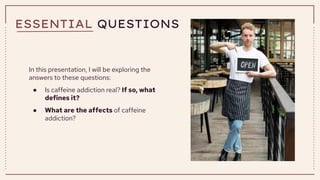
ESSENTIAL QUESTIONS
In this presentation, I will be exploring the
answers to these questions:
● Is caffeine addiction real? If so, what
defines it?
● What are the affects of caffeine
addiction?
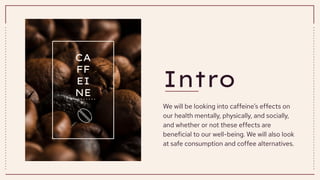
Intro
We will be looking into caffeine’s effects on
our health mentally, physically, and socially,
and whether or not these effects are
beneficial to our well-being. We will also look
at safe consumption and coffee alternatives.
CA
FF
EI
NE
PART
ONE
01
Caffeine is a stimulant obtained
from over 60 different types of
plants worldwide. It is considered to
be the most commonly used
psychoactive drug in the world. You
can find it in cocoa beans, kola nuts,
tea leaves, and coffee beans are the
most well-known. Unlike many other
psychoactive substances, it is legal
and unregulated in nearly all parts of
the world.
Caffeine
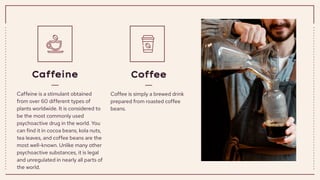
Coffee is simply a brewed drink
prepared from roasted coffee
beans.
Coffee
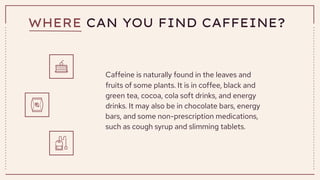
WHERE CAN YOU FIND CAFFEINE?
Caffeine is naturally found in the leaves and
fruits of some plants. It is in coffee, black and
green tea, cocoa, cola soft drinks, and energy
drinks. It may also be in chocolate bars, energy
bars, and some non-prescription medications,
such as cough syrup and slimming tablets.
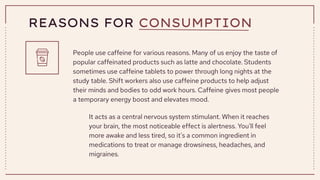
REASONS FOR CONSUMPTION
People use caffeine for various reasons. Many of us enjoy the taste of
popular caffeinated products such as latte and chocolate. Students
sometimes use caffeine tablets to power through long nights at the
study table. Shift workers also use caffeine products to help adjust
their minds and bodies to odd work hours. Caffeine gives most people
a temporary energy boost and elevates mood.
It acts as a central nervous system stimulant. When it reaches
your brain, the most noticeable effect is alertness. You'll feel
more awake and less tired, so it's a common ingredient in
medications to treat or manage drowsiness, headaches, and
migraines.
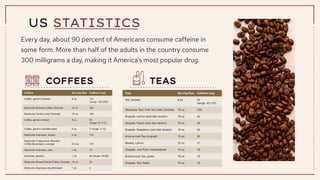
US STATISTICS
COFFEES TEAS
Every day, about 90 percent of Americans consume caffeine in
some form. More than half of the adults in the country consume
300 milligrams a day, making it America’s most popular drug.
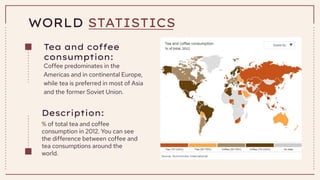
WORLD STATISTICS
Coffee predominates in the
Americas and in continental Europe,
while tea is preferred in most of Asia
and the former Soviet Union.
Tea and coffee
consumption:
% of total tea and coffee
consumption in 2012. You can see
the difference between coffee and
tea consumptions around the
world.
Description:
PART
TWO
02
IS CAFFEINE ADDICTION REAL?
Scientists have classified caffeine as a psychoactive drug that can alter moods and
behavior. Known medically as trimethylxanthine, caffeine in its pure form is a white,
bitter-tasting powder. It affects you in a similar way that amphetamines, cocaine and heroin
stimulate your brain. Although it has a much milder effect, caffeine has the same addictive
qualities as these other drugs.
Caffeine temporarily blocks adenosine, a chemical in your body that promotes
sleepiness and muscle fatigue, resulting in an energy boost or heightened alertness.
The drug can also increase your heartbeat and metabolism as well as cause you to
produce more stomach acid and urine.
Many prescription and over-the-counter drugs contain synthetically
prepared caffeine because it increases the effectiveness of painkillers
and helps the drug take effect faster. This type of caffeine is an
ingredient in stimulants, pain relievers, diuretics, cold medicines, and
weight control products.
TOLERANCE, DEPENDENCE, WITHDRAWAL
Repeated consumption of caffeine can lead to tolerance, dependence, and withdrawal.
Tolerance takes place when you must consume larger or more frequent doses in order to have
the same effects. Dependence involves needing to keep taking the substance in order to ward
off unpleasant withdrawal effects.
While using caffeine can lead to becoming physically or
psychologically dependent on it, it does not fit the
definition of true addiction.
People often continue to use caffeine as a way to
reduce any negative symptoms of caffeine
withdrawal that they might experience. The
withdrawal usually begins within 12 to 24 hours after
consuming the last dose and can range from mild to
more severe depending on how much caffeine you
are used to consuming. It can lead to a number of
unpleasant withdrawal effects including:
● Headaches
● Lack of energy
● Tremors
● Irritability
● Anxiety
● Fatigue and drowsiness
● Problems concentrating
● Low mood
EFFECTS
OF CAFFEINE
MENTALLY PHYSICALLY
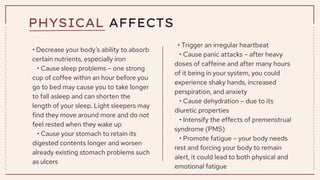
PHYSICAL AFFECTS
• Decrease your body’s ability to absorb
certain nutrients, especially iron
• Cause sleep problems – one strong
cup of coffee within an hour before you
go to bed may cause you to take longer
to fall asleep and can shorten the
length of your sleep. Light sleepers may
find they move around more and do not
feel rested when they wake up
• Cause your stomach to retain its
digested contents longer and worsen
already existing stomach problems such
as ulcers
• Trigger an irregular heartbeat
• Cause panic attacks – after heavy
doses of caffeine and after many hours
of it being in your system, you could
experience shaky hands, increased
perspiration, and anxiety
• Cause dehydration – due to its
diuretic properties
• Intensify the effects of premenstrual
syndrome (PMS)
• Promote fatigue – your body needs
rest and forcing your body to remain
alert, it could lead to both physical and
emotional fatigue
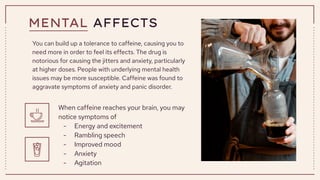
MENTAL AFFECTS
You can build up a tolerance to caffeine, causing you to
need more in order to feel its effects. The drug is
notorious for causing the jitters and anxiety, particularly
at higher doses. People with underlying mental health
issues may be more susceptible. Caffeine was found to
aggravate symptoms of anxiety and panic disorder.
When caffeine reaches your brain, you may
notice symptoms of
- Energy and excitement
- Rambling speech
- Improved mood
- Anxiety
- Agitation
Safe consumption:
Along with any addiction, you can’t get rid of the cravings immediately, but you can
work on replacing them with healthier choices. Here are some easy ways to cut
back on your caffeine intake:
- Analyze your caffeine intake.
- Cut back gradually.
- Caffeinate wisely.
- Go for an espresso shot. These contain only about half the amount of
caffeine as a cup of regular coffee.
- Try coffee-like alternatives, like non-caffeinated tea.
- Make healthy swaps. Instead of soda, grab juice or water instead.
- Drink lots of water!
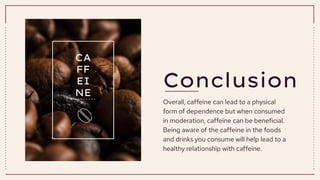
Conclusion
Overall, caffeine can lead to a physical
form of dependence but when consumed
in moderation, caffeine can be beneficial.
Being aware of the caffeine in the foods
and drinks you consume will help lead to a
healthy relationship with caffeine.
CA
FF
EI
NE
CREDITS: This presentation template was created by Slidesgo,
including icons by Flaticon, infographics & images by Freepik
THANKS
Sources:
P.s. “caffeine” break the “i” before “e” rule and it angers
me
CA
FF
EI
NE
MedicineNet
Merriam-Webster
Better Health
HereToHelp
Kids Health
HealthLine
Kuakini
PEWResearch
Very Well Mind
American Psychological
Association
Health: US News

Caffeine Addiction

  • 1.
    Caffeine Addiction Coffee and Caffeinehealth affects and benefits Megan Whitten
  • 2.
    TABLE OF CONTENTS PARTONE - Introduction - Caffeine vs. Coffee - Where can you find caffeine? - Reasons for consumption - Consumption statistics PART TWO - Is caffeine addiction real? - Effects on the body - Safe consumption - Caffeine alternatives - Conclusion
  • 3.
    ESSENTIAL QUESTIONS In thispresentation, I will be exploring the answers to these questions: ● Is caffeine addiction real? If so, what defines it? ● What are the affects of caffeine addiction?
  • 4.
    Intro We will belooking into caffeine’s effects on our health mentally, physically, and socially, and whether or not these effects are beneficial to our well-being. We will also look at safe consumption and coffee alternatives. CA FF EI NE
  • 5.
  • 6.
    Caffeine is astimulant obtained from over 60 different types of plants worldwide. It is considered to be the most commonly used psychoactive drug in the world. You can find it in cocoa beans, kola nuts, tea leaves, and coffee beans are the most well-known. Unlike many other psychoactive substances, it is legal and unregulated in nearly all parts of the world. Caffeine Coffee is simply a brewed drink prepared from roasted coffee beans. Coffee
  • 7.
    WHERE CAN YOUFIND CAFFEINE? Caffeine is naturally found in the leaves and fruits of some plants. It is in coffee, black and green tea, cocoa, cola soft drinks, and energy drinks. It may also be in chocolate bars, energy bars, and some non-prescription medications, such as cough syrup and slimming tablets.
  • 8.
    REASONS FOR CONSUMPTION Peopleuse caffeine for various reasons. Many of us enjoy the taste of popular caffeinated products such as latte and chocolate. Students sometimes use caffeine tablets to power through long nights at the study table. Shift workers also use caffeine products to help adjust their minds and bodies to odd work hours. Caffeine gives most people a temporary energy boost and elevates mood. It acts as a central nervous system stimulant. When it reaches your brain, the most noticeable effect is alertness. You'll feel more awake and less tired, so it's a common ingredient in medications to treat or manage drowsiness, headaches, and migraines.
  • 9.
    US STATISTICS COFFEES TEAS Everyday, about 90 percent of Americans consume caffeine in some form. More than half of the adults in the country consume 300 milligrams a day, making it America’s most popular drug.
  • 10.
    WORLD STATISTICS Coffee predominatesin the Americas and in continental Europe, while tea is preferred in most of Asia and the former Soviet Union. Tea and coffee consumption: % of total tea and coffee consumption in 2012. You can see the difference between coffee and tea consumptions around the world. Description:
  • 11.
  • 12.
    IS CAFFEINE ADDICTIONREAL? Scientists have classified caffeine as a psychoactive drug that can alter moods and behavior. Known medically as trimethylxanthine, caffeine in its pure form is a white, bitter-tasting powder. It affects you in a similar way that amphetamines, cocaine and heroin stimulate your brain. Although it has a much milder effect, caffeine has the same addictive qualities as these other drugs. Caffeine temporarily blocks adenosine, a chemical in your body that promotes sleepiness and muscle fatigue, resulting in an energy boost or heightened alertness. The drug can also increase your heartbeat and metabolism as well as cause you to produce more stomach acid and urine. Many prescription and over-the-counter drugs contain synthetically prepared caffeine because it increases the effectiveness of painkillers and helps the drug take effect faster. This type of caffeine is an ingredient in stimulants, pain relievers, diuretics, cold medicines, and weight control products.
  • 13.
    TOLERANCE, DEPENDENCE, WITHDRAWAL Repeatedconsumption of caffeine can lead to tolerance, dependence, and withdrawal. Tolerance takes place when you must consume larger or more frequent doses in order to have the same effects. Dependence involves needing to keep taking the substance in order to ward off unpleasant withdrawal effects. While using caffeine can lead to becoming physically or psychologically dependent on it, it does not fit the definition of true addiction. People often continue to use caffeine as a way to reduce any negative symptoms of caffeine withdrawal that they might experience. The withdrawal usually begins within 12 to 24 hours after consuming the last dose and can range from mild to more severe depending on how much caffeine you are used to consuming. It can lead to a number of unpleasant withdrawal effects including: ● Headaches ● Lack of energy ● Tremors ● Irritability ● Anxiety ● Fatigue and drowsiness ● Problems concentrating ● Low mood
  • 14.
  • 15.
    PHYSICAL AFFECTS • Decreaseyour body’s ability to absorb certain nutrients, especially iron • Cause sleep problems – one strong cup of coffee within an hour before you go to bed may cause you to take longer to fall asleep and can shorten the length of your sleep. Light sleepers may find they move around more and do not feel rested when they wake up • Cause your stomach to retain its digested contents longer and worsen already existing stomach problems such as ulcers • Trigger an irregular heartbeat • Cause panic attacks – after heavy doses of caffeine and after many hours of it being in your system, you could experience shaky hands, increased perspiration, and anxiety • Cause dehydration – due to its diuretic properties • Intensify the effects of premenstrual syndrome (PMS) • Promote fatigue – your body needs rest and forcing your body to remain alert, it could lead to both physical and emotional fatigue
  • 16.
    MENTAL AFFECTS You canbuild up a tolerance to caffeine, causing you to need more in order to feel its effects. The drug is notorious for causing the jitters and anxiety, particularly at higher doses. People with underlying mental health issues may be more susceptible. Caffeine was found to aggravate symptoms of anxiety and panic disorder. When caffeine reaches your brain, you may notice symptoms of - Energy and excitement - Rambling speech - Improved mood - Anxiety - Agitation
  • 17.
    Safe consumption: Along withany addiction, you can’t get rid of the cravings immediately, but you can work on replacing them with healthier choices. Here are some easy ways to cut back on your caffeine intake: - Analyze your caffeine intake. - Cut back gradually. - Caffeinate wisely. - Go for an espresso shot. These contain only about half the amount of caffeine as a cup of regular coffee. - Try coffee-like alternatives, like non-caffeinated tea. - Make healthy swaps. Instead of soda, grab juice or water instead. - Drink lots of water!
  • 18.
    Conclusion Overall, caffeine canlead to a physical form of dependence but when consumed in moderation, caffeine can be beneficial. Being aware of the caffeine in the foods and drinks you consume will help lead to a healthy relationship with caffeine. CA FF EI NE
  • 19.
    CREDITS: This presentationtemplate was created by Slidesgo, including icons by Flaticon, infographics & images by Freepik THANKS Sources: P.s. “caffeine” break the “i” before “e” rule and it angers me CA FF EI NE MedicineNet Merriam-Webster Better Health HereToHelp Kids Health HealthLine Kuakini PEWResearch Very Well Mind American Psychological Association Health: US News