Caffeine Safety Review over Three Decades: Is the Increased Concern Justified? 
James R. Coughlin, PhD CFS 
President, Coughlin & Associates 
Aliso Viejo, California 
jrcoughlin@cox.net 
www.linkedin.com/in/jamescoughlin 
25th International Conference on 
Coffee Science 
Armenia, Colombia 
September 9, 2014
Is the Increased Concern Justified? I Don’tBelieve It Is! 
2
Agenda 
• 
Caffeine & Health Issues -My Historical Perspective since 1981 
• 
Caffeine Issues in 2013-2014… 
• 
Coffee is NOT Just Caffeine 
• 
Energy Drinks & Other Foods / Beverages 
• 
Coffee is still the #1 Source of Caffeine 
• 
U.S. Congress & FDA, Health Canada, EFSA 
• 
Cardiovascular Issues are Key 
3
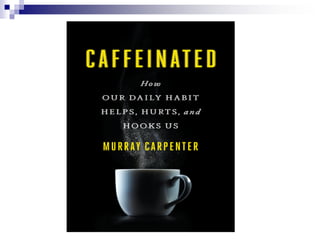
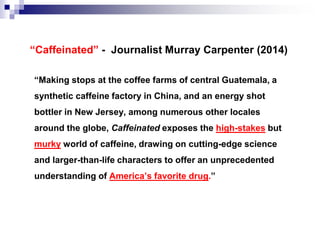
“Caffeinated” -Journalist Murray Carpenter (2014) 
“Making stops at the coffee farms of central Guatemala, a synthetic caffeine factory in China, and an energy shot bottler in New Jersey, among numerous other locales around the globe, Caffeinatedexposes thehigh-stakesbut murkyworld of caffeine, drawing on cutting-edge science and larger-than-life characters to offer an unprecedented understanding of America’s favorite drug.”
My 30+ Year Perspective on Caffeine / Health 
…on Rats, Mice & Humans and Almost Every Disease 
…on “Good” & “Bad” Science, Policy & Media Coverage 
…on Caffeine’s BeneficialHealth Effects 
… First 20 Years: Much Bad News! Caffeine was linked to many animal toxicities and human diseases! 
… Last 15 or so Years…Very Big Turn Around: “Good News” is that almost all of the Bad News about caffeine was WRONG! 
7
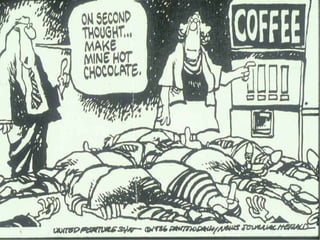
Caffeine’s “Maligning” Started in 1970’s and Ballooned in the 1980’s and Early 1990’s 
• 
Coffee and heart attacks…was it the caffeine? 
• 
Caffeine and birth defects in rats (U.S. FDA, 1978); hundreds of subsequent studies on reproductive & developmental effects in humans 
• 
Caffeine and urinary calcium loss; osteoporosis risk? 
• 
Central Nervous System: anxiety, sleep disturbance, “addiction”? 
8
What Science Allowed the Bad Myths to Happen and Why Do a Few Still Persist? 
… Acute vs. Chronic effects: 
 
Partial / full tolerance to caffeine develops in humans consistently consuming caffeine and coffee daily 
… Most of the Myths and Fears are based on: 
 
Acute effects testing of non-caffeine consuming subjects 
 
Massive doses of caffeine fed to pregnant animals 
 
Smaller, poorly done and not well controlled human studies. 10
But since 2000 or so… 
 
The “Good News” is that almost all of the earlier bad news about coffee and caffeine was WRONG! 
 
Medical evidence has been building strongly that coffee and caffeine may actually be GOOD for us!!! 
 
Let’s briefly examine the evidence for some of the myths and facts. 11
12
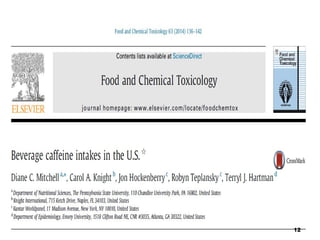
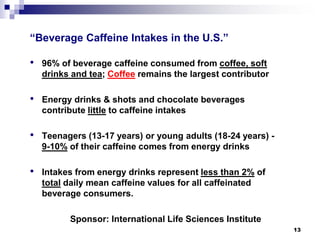
“Beverage Caffeine Intakes in the U.S.” 
• 
96% of beverage caffeine consumed from coffee, soft drinks and tea; Coffeeremains the largest contributor 
• 
Energy drinks & shots and chocolate beverages contribute littleto caffeine intakes 
• 
Teenagers (13-17 years) or young adults (18-24 years) - 9-10%of their caffeine comes from energy drinks 
• 
Intakes from energy drinks represent less than 2%of totaldaily mean caffeine values for all caffeinated beverage consumers. 
Sponsor: International Life Sciences Institute 
13
14
Caffeine and Reproductive Effects 
• 
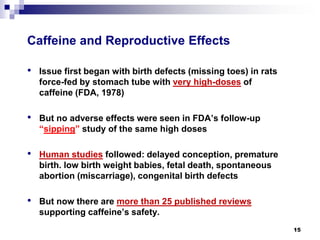
Issue first began with birth defects (missing toes) in rats force-fed by stomach tube with very high-dosesof caffeine (FDA, 1978) 
• 
But no adverse effects were seen in FDA’s follow-up “sipping” study of the same high doses 
• 
Human studiesfollowed: delayed conception, premature birth. low birth weight babies, fetal death, spontaneous abortion (miscarriage), congenital birth defects 
• 
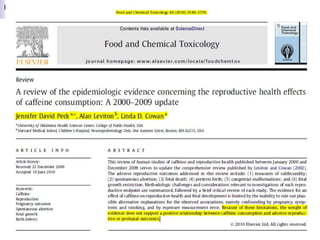
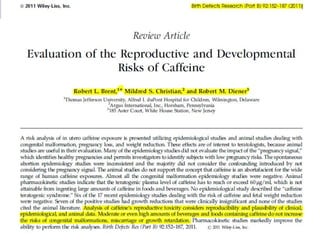
But now there are more than 25 published reviews supporting caffeine’s safety. 
15
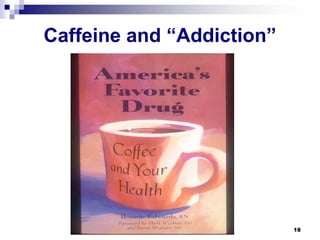
Caffeine and “Addiction” 
18
Caffeine and “Addiction” 
• 
Dependence, tolerance and withdrawal headache were cited in many published studies going back to the late 1980’s (but mostly among psychiatric patients consuming up to 20 cups/day) 
• 
Current view is very reassuring: 
• 
Caffeine use was notclassified as a “substance use disorder” (the new term for addiction) in the American Psychiatric Assn’s DSM-5 “bible” (published May 2013) 
• 
However, DSM-5 did recognize caffeine intoxication and withdrawal disorders 
• 
Addiction over-warningstrivialize dangers of realdrugs of abuse. 
19
Caffeine and Osteoporosis 
• 
Excess calcium loss & bone loss in post-menopausal womencauses millions of bone fractures (mostly hip) 
• 
Acute, 24-hour human studies done in the 1980’s on non-caffeine consumingsubjects were originally misinterpreted 
• 
Many longer-term, human clinical studies have since shown littleexcess calcium or bone loss and noincreased risk of osteoporosis. 
20
Coffee/Caffeine and Cancer Risk 
• 
Coffee contains trace levels of animalcarcinogens produced by heat in the “Maillard Browning Reaction,” including acrylamide and furan 
• 
Over 550 human epidemiology studies have been published since the 1970’s on many human organs 
• 
Most health authorities across the globe now agree that coffee drinking (and caffeine) is NOTa cancer risk, and coffee may actually reduce the risk of numerous cancers 
• 
I have termed this the “Coffee-Cancer Paradox” 
21
Summary Conclusions on the “Bad” Health Effects 
• 
Long established history of safeglobal caffeinated coffee consumption (and decaffeinated as well) 
• 
But more animal, clinical & epidemiologic studies will be published, and continued media attention is sure to come 
• 
More recentstudies and re-examinations of older disease issues have been quite reassuring 
• 
Consumers can be assured that their health will notbe adversely affected by the enjoyment of coffee and caffeine as currently consumed. 
22
Caffeine’s Beneficial Physiological Effects 
• 
Mild central nervous system (CNS) stimulant 
• 
Improves cognitiveperformance and mental processing; increases wakefulness;improvesworkperformance and enhances mood 
• 
Increases capacity for physicalwork & exercise; improves muscular performance and endurance sports 
• 
Relaxes smooth muscle, especially bronchial (opens airways), and increases blood flowin heart and kidneys 
• 
Produces a slightly higher metabolic rate(some evidence of an ergogenic “fat burning” effect) 
• 
Riskreductionsfor Parkinson’s & Alzheimer’s diseases, depression & suicide. 
23
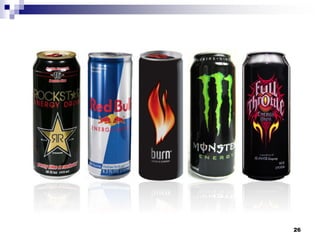
So with all this more recent goodnews, why are we still worrying about Caffeine? New safety concerns have been raised for Energy Drinksand new food products containing addedCaffeine 
24
U.S. Congress and FDA Concerns over Caffeine and Energy Drinks 
25
26
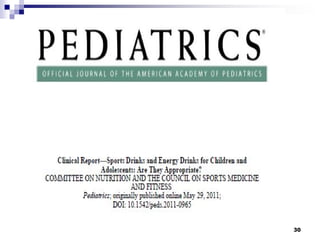
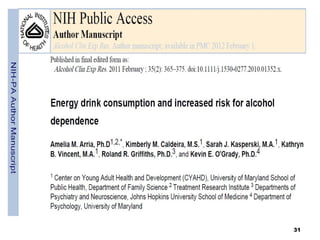
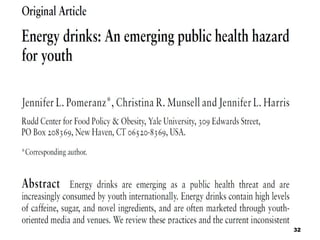
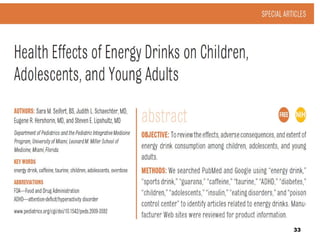
Very Recent Studies / Reviews on Concerns over Energy Drinks… …done by researchers who do notknow the 30+ years of caffeine literature…on hypertension, arrhythmias, heart attacks, strokes, reduced mortality 
27
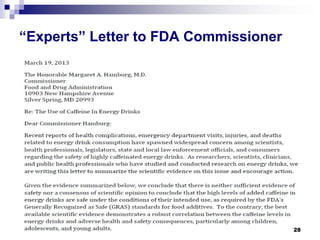
“Experts” Letter to FDA Commissioner 
28
29
30
31
32
33
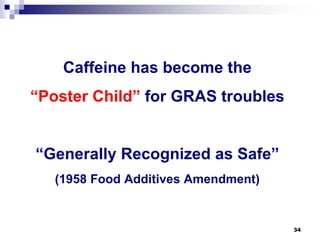
Caffeine has become the “Poster Child” for GRAS troubles “Generally Recognized as Safe” (1958 Food Additives Amendment) 
34
35
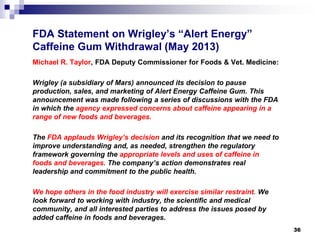
FDA Statement on Wrigley’s “Alert Energy” Caffeine Gum Withdrawal (May 2013) 
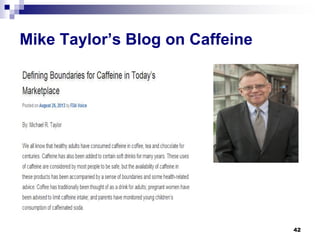
Michael R. Taylor, FDA Deputy Commissioner for Foods & Vet. Medicine: 
Wrigley (a subsidiary of Mars) announced its decision to pause production, sales, and marketing of Alert Energy Caffeine Gum. This announcement was made following a series of discussions with the FDA in which the agency expressed concerns about caffeine appearing in a range of new foods and beverages. 
The FDA applauds Wrigley’s decision and its recognition that we need to improve understanding and, as needed, strengthen the regulatory framework governing the appropriate levels and uses of caffeine in foods and beverages. The company’s action demonstrates real leadership and commitment to the public health. 
We hope others in the food industry will exercise similar restraint. We look forward to working with industry, the scientific and medical community, and all interested parties to address the issues posed by added caffeine in foods and beverages. 
36
37
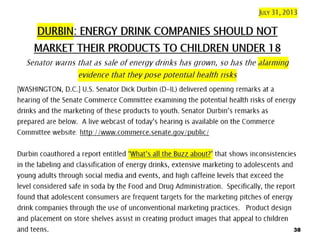
38
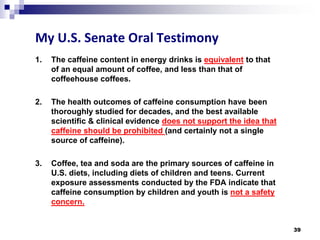
My U.S. Senate Oral Testimony 
1. 
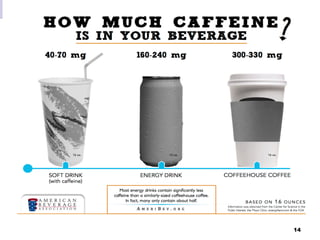
The caffeine content in energy drinks is equivalentto that of an equal amount of coffee, and less than that of coffeehouse coffees. 
2. 
The health outcomes of caffeine consumption have been thoroughly studied for decades, and the best available scientific & clinical evidence does not support the idea that caffeine should be prohibited (and certainly not a single source of caffeine). 
3. 
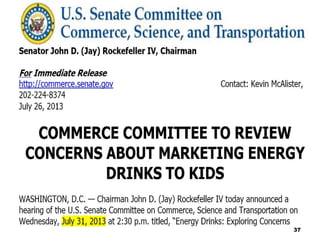
Coffee, tea and soda are the primary sources of caffeine in U.S. diets, including diets of children and teens. Current exposure assessments conducted by the FDA indicate that caffeine consumption by children and youth is not a safety concern. 39
40
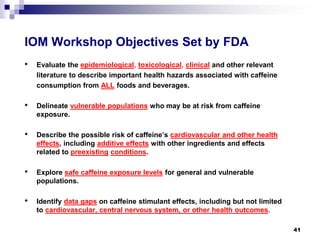
IOM Workshop Objectives Set by FDA 
• 
Evaluate the epidemiological, toxicological, clinicaland other relevant 
literature to describe important health hazards associated with caffeine 
consumption from ALLfoods and beverages. 
• 
Delineate vulnerable populationswho may be at risk from caffeine exposure. 
• 
Describe the possible risk of caffeine’s cardiovascular and other health effects, including additive effectswith other ingredients and effects related to preexistingconditions. 
• 
Explore safe caffeine exposure levelsfor general and vulnerable populations. 
• 
Identify data gapson caffeine stimulant effects, including but not limited to cardiovascular, central nervous system, or other health outcomes. 
41
Mike Taylor’s Blog on Caffeine 
42
Concerns of Other Regulatory Agencies are Similar 43
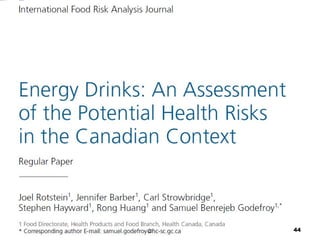
44
European Food Safety Authority (EFSA) 
• 
Zucconiet al., 2013. “Gathering consumption data on specific consumer groups of energy drinks.” [190 pages] www.efsa.europa.eu/publications 
• 
EFSA opinion on caffeine’s safety was requested by the EC (Feb 2013); established a Working Group on Caffeine… 
• 
Maximum levels of caffeine intake from all sources 
• 
Risk of interaction of caffeine with alcohol and other ingredients of “Energy Drinks” 
• 
Focus: general population, adults performing physical activities of various intensities, pregnant & lactating women, children & adolescents 
• 
Several meetings of the Scientific Panel on Dietetic Products, Nutrition and Allergies (NDA Panel) 
• 
Draft Opinion will issue early November,public consultation for 6-8 weeks, adoption by Spring 2015. 45
Food Standards Australia New Zealand (FSANZ) 
46
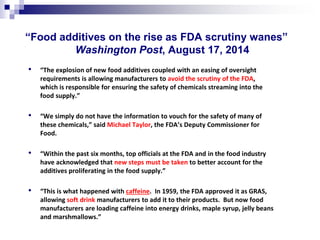
“Food additives on the rise as FDA scrutiny wanes” Washington Post, August 17, 2014 
• 
“The explosion of new food additives coupled with an easing of oversight requirements is allowing manufacturers to avoid the scrutiny of the FDA, which is responsible for ensuring the safety of chemicals streaming into the food supply.” 
• 
“We simply do not have the information to vouch for the safety of many of these chemicals,” said Michael Taylor, the FDA’s Deputy Commissioner for Food. 
• 
“Within the past six months, top officials at the FDA and in the food industry have acknowledged that new steps must be taken to better account for the additives proliferating in the food supply.” 
• 
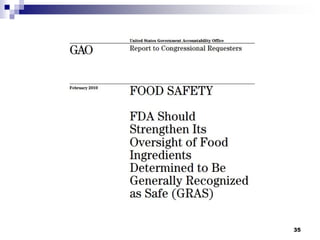
“This is what happened with caffeine. In 1959, the FDA approved it as GRAS, allowing soft drink manufacturers to add it to their products. But now food manufacturers are loading caffeine into energy drinks, maple syrup, jelly beans and marshmallows.”
48
49
Cardiovascular Issues 
50
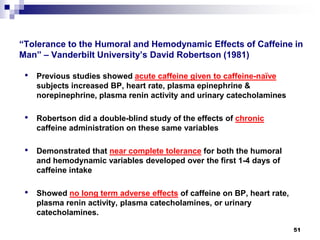
“Tolerance to the Humoral and Hemodynamic Effects of Caffeine in Man” –Vanderbilt University’s David Robertson (1981) 
• 
Previous studies showed acute caffeine given to caffeine-naïvesubjects increased BP, heart rate, plasma epinephrine & norepinephrine, plasma renin activity and urinary catecholamines 
• 
Robertson did a double-blind study of the effects of chroniccaffeine administration on these same variables 
• 
Demonstrated that near complete tolerancefor both the humoral and hemodynamic variables developed over the first 1-4 days of caffeine intake 
• 
Showed no long term adverse effectsof caffeine on BP, heart rate, plasma renin activity, plasma catecholamines, or urinary catecholamines. 51
52
53
54
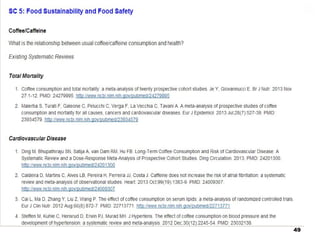
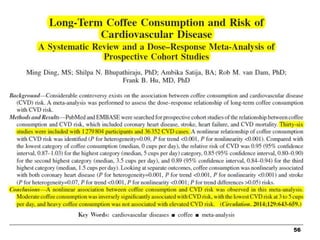
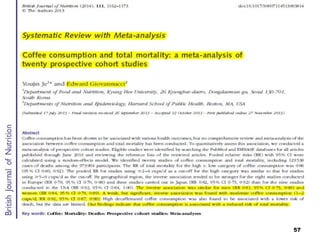
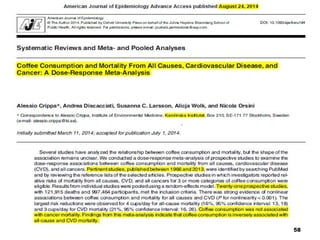
Cardiovascular Disease (CHD), Stroke and Overall Mortality of Coffee / Caffeine Consumption 
*All studies –either noincreased risk or reducedrisk * 
• 
Andersen 2006 –Iowa Women’s Health Study, coffee 
• 
Lopez-Garcia 2006, 2006, 2008, 2011 –Harvard cohort studies, coffee & caffeine 
• 
Greenberg 2008 –Framingham cohort, caffeinated coffee 
• 
Zhang 2009, 2009 –Harvard Nurses & Health Professionals cohort, men & women, coffee 
• 
Wu 2009 –Meta-analysis of 21 cohort studies, coffee 
• 
de KoningGans2010 –Coffee / tea & CHD / mortality / stroke 
• 
Larsson 2011 –Meta-analysis, coffee / stroke 
• 
Mesas 2011 –Meta-analysis, hypertensives, coffee RCTs & cohort studies 
• 
Freedman 2012 –NIH-AARP cohort, coffee, total & cause-specific mortality 
• 
Floegel2012 –EPIC / Europe cohort study, coffee / chronic diseases 
55
56
57
58
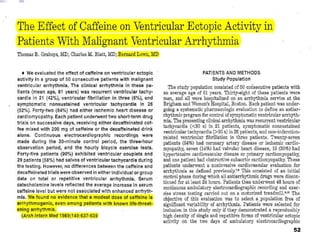
Take Home Messages… ~ Attackers should understand the Caffeine literature beforethey accuse it as the causative agent! ~ Caffeine in coffee & other foods and beverages is safefor human consumption! 
59
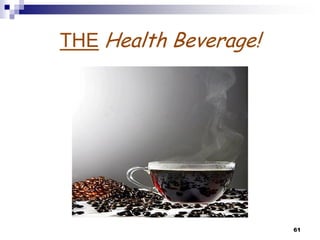
THEHealth Beverage! 
61
Thank You for Your Attention

Coughlin_Caffeine Safety at 25th ASIC, Armenia, Colombia, Sept 9 2014

  • 1.
    Caffeine Safety Reviewover Three Decades: Is the Increased Concern Justified? James R. Coughlin, PhD CFS President, Coughlin & Associates Aliso Viejo, California jrcoughlin@cox.net www.linkedin.com/in/jamescoughlin 25th International Conference on Coffee Science Armenia, Colombia September 9, 2014
  • 2.
    Is the IncreasedConcern Justified? I Don’tBelieve It Is! 2
  • 3.
    Agenda • Caffeine& Health Issues -My Historical Perspective since 1981 • Caffeine Issues in 2013-2014… • Coffee is NOT Just Caffeine • Energy Drinks & Other Foods / Beverages • Coffee is still the #1 Source of Caffeine • U.S. Congress & FDA, Health Canada, EFSA • Cardiovascular Issues are Key 3
  • 6.
    “Caffeinated” -Journalist MurrayCarpenter (2014) “Making stops at the coffee farms of central Guatemala, a synthetic caffeine factory in China, and an energy shot bottler in New Jersey, among numerous other locales around the globe, Caffeinatedexposes thehigh-stakesbut murkyworld of caffeine, drawing on cutting-edge science and larger-than-life characters to offer an unprecedented understanding of America’s favorite drug.”
  • 7.
    My 30+ YearPerspective on Caffeine / Health …on Rats, Mice & Humans and Almost Every Disease …on “Good” & “Bad” Science, Policy & Media Coverage …on Caffeine’s BeneficialHealth Effects … First 20 Years: Much Bad News! Caffeine was linked to many animal toxicities and human diseases! … Last 15 or so Years…Very Big Turn Around: “Good News” is that almost all of the Bad News about caffeine was WRONG! 7
  • 8.
    Caffeine’s “Maligning” Startedin 1970’s and Ballooned in the 1980’s and Early 1990’s • Coffee and heart attacks…was it the caffeine? • Caffeine and birth defects in rats (U.S. FDA, 1978); hundreds of subsequent studies on reproductive & developmental effects in humans • Caffeine and urinary calcium loss; osteoporosis risk? • Central Nervous System: anxiety, sleep disturbance, “addiction”? 8
  • 10.
    What Science Allowedthe Bad Myths to Happen and Why Do a Few Still Persist? … Acute vs. Chronic effects:  Partial / full tolerance to caffeine develops in humans consistently consuming caffeine and coffee daily … Most of the Myths and Fears are based on:  Acute effects testing of non-caffeine consuming subjects  Massive doses of caffeine fed to pregnant animals  Smaller, poorly done and not well controlled human studies. 10
  • 11.
    But since 2000or so…  The “Good News” is that almost all of the earlier bad news about coffee and caffeine was WRONG!  Medical evidence has been building strongly that coffee and caffeine may actually be GOOD for us!!!  Let’s briefly examine the evidence for some of the myths and facts. 11
  • 12.
  • 13.
    “Beverage Caffeine Intakesin the U.S.” • 96% of beverage caffeine consumed from coffee, soft drinks and tea; Coffeeremains the largest contributor • Energy drinks & shots and chocolate beverages contribute littleto caffeine intakes • Teenagers (13-17 years) or young adults (18-24 years) - 9-10%of their caffeine comes from energy drinks • Intakes from energy drinks represent less than 2%of totaldaily mean caffeine values for all caffeinated beverage consumers. Sponsor: International Life Sciences Institute 13
  • 14.
  • 15.
    Caffeine and ReproductiveEffects • Issue first began with birth defects (missing toes) in rats force-fed by stomach tube with very high-dosesof caffeine (FDA, 1978) • But no adverse effects were seen in FDA’s follow-up “sipping” study of the same high doses • Human studiesfollowed: delayed conception, premature birth. low birth weight babies, fetal death, spontaneous abortion (miscarriage), congenital birth defects • But now there are more than 25 published reviews supporting caffeine’s safety. 15
  • 18.
  • 19.
    Caffeine and “Addiction” • Dependence, tolerance and withdrawal headache were cited in many published studies going back to the late 1980’s (but mostly among psychiatric patients consuming up to 20 cups/day) • Current view is very reassuring: • Caffeine use was notclassified as a “substance use disorder” (the new term for addiction) in the American Psychiatric Assn’s DSM-5 “bible” (published May 2013) • However, DSM-5 did recognize caffeine intoxication and withdrawal disorders • Addiction over-warningstrivialize dangers of realdrugs of abuse. 19
  • 20.
    Caffeine and Osteoporosis • Excess calcium loss & bone loss in post-menopausal womencauses millions of bone fractures (mostly hip) • Acute, 24-hour human studies done in the 1980’s on non-caffeine consumingsubjects were originally misinterpreted • Many longer-term, human clinical studies have since shown littleexcess calcium or bone loss and noincreased risk of osteoporosis. 20
  • 21.
    Coffee/Caffeine and CancerRisk • Coffee contains trace levels of animalcarcinogens produced by heat in the “Maillard Browning Reaction,” including acrylamide and furan • Over 550 human epidemiology studies have been published since the 1970’s on many human organs • Most health authorities across the globe now agree that coffee drinking (and caffeine) is NOTa cancer risk, and coffee may actually reduce the risk of numerous cancers • I have termed this the “Coffee-Cancer Paradox” 21
  • 22.
    Summary Conclusions onthe “Bad” Health Effects • Long established history of safeglobal caffeinated coffee consumption (and decaffeinated as well) • But more animal, clinical & epidemiologic studies will be published, and continued media attention is sure to come • More recentstudies and re-examinations of older disease issues have been quite reassuring • Consumers can be assured that their health will notbe adversely affected by the enjoyment of coffee and caffeine as currently consumed. 22
  • 23.
    Caffeine’s Beneficial PhysiologicalEffects • Mild central nervous system (CNS) stimulant • Improves cognitiveperformance and mental processing; increases wakefulness;improvesworkperformance and enhances mood • Increases capacity for physicalwork & exercise; improves muscular performance and endurance sports • Relaxes smooth muscle, especially bronchial (opens airways), and increases blood flowin heart and kidneys • Produces a slightly higher metabolic rate(some evidence of an ergogenic “fat burning” effect) • Riskreductionsfor Parkinson’s & Alzheimer’s diseases, depression & suicide. 23
  • 24.
    So with allthis more recent goodnews, why are we still worrying about Caffeine? New safety concerns have been raised for Energy Drinksand new food products containing addedCaffeine 24
  • 25.
    U.S. Congress andFDA Concerns over Caffeine and Energy Drinks 25
  • 26.
  • 27.
    Very Recent Studies/ Reviews on Concerns over Energy Drinks… …done by researchers who do notknow the 30+ years of caffeine literature…on hypertension, arrhythmias, heart attacks, strokes, reduced mortality 27
  • 28.
    “Experts” Letter toFDA Commissioner 28
  • 29.
  • 30.
  • 31.
  • 32.
  • 33.
  • 34.
    Caffeine has becomethe “Poster Child” for GRAS troubles “Generally Recognized as Safe” (1958 Food Additives Amendment) 34
  • 35.
  • 36.
    FDA Statement onWrigley’s “Alert Energy” Caffeine Gum Withdrawal (May 2013) Michael R. Taylor, FDA Deputy Commissioner for Foods & Vet. Medicine: Wrigley (a subsidiary of Mars) announced its decision to pause production, sales, and marketing of Alert Energy Caffeine Gum. This announcement was made following a series of discussions with the FDA in which the agency expressed concerns about caffeine appearing in a range of new foods and beverages. The FDA applauds Wrigley’s decision and its recognition that we need to improve understanding and, as needed, strengthen the regulatory framework governing the appropriate levels and uses of caffeine in foods and beverages. The company’s action demonstrates real leadership and commitment to the public health. We hope others in the food industry will exercise similar restraint. We look forward to working with industry, the scientific and medical community, and all interested parties to address the issues posed by added caffeine in foods and beverages. 36
  • 37.
  • 38.
  • 39.
    My U.S. SenateOral Testimony 1. The caffeine content in energy drinks is equivalentto that of an equal amount of coffee, and less than that of coffeehouse coffees. 2. The health outcomes of caffeine consumption have been thoroughly studied for decades, and the best available scientific & clinical evidence does not support the idea that caffeine should be prohibited (and certainly not a single source of caffeine). 3. Coffee, tea and soda are the primary sources of caffeine in U.S. diets, including diets of children and teens. Current exposure assessments conducted by the FDA indicate that caffeine consumption by children and youth is not a safety concern. 39
  • 40.
  • 41.
    IOM Workshop ObjectivesSet by FDA • Evaluate the epidemiological, toxicological, clinicaland other relevant literature to describe important health hazards associated with caffeine consumption from ALLfoods and beverages. • Delineate vulnerable populationswho may be at risk from caffeine exposure. • Describe the possible risk of caffeine’s cardiovascular and other health effects, including additive effectswith other ingredients and effects related to preexistingconditions. • Explore safe caffeine exposure levelsfor general and vulnerable populations. • Identify data gapson caffeine stimulant effects, including but not limited to cardiovascular, central nervous system, or other health outcomes. 41
  • 42.
    Mike Taylor’s Blogon Caffeine 42
  • 43.
    Concerns of OtherRegulatory Agencies are Similar 43
  • 44.
  • 45.
    European Food SafetyAuthority (EFSA) • Zucconiet al., 2013. “Gathering consumption data on specific consumer groups of energy drinks.” [190 pages] www.efsa.europa.eu/publications • EFSA opinion on caffeine’s safety was requested by the EC (Feb 2013); established a Working Group on Caffeine… • Maximum levels of caffeine intake from all sources • Risk of interaction of caffeine with alcohol and other ingredients of “Energy Drinks” • Focus: general population, adults performing physical activities of various intensities, pregnant & lactating women, children & adolescents • Several meetings of the Scientific Panel on Dietetic Products, Nutrition and Allergies (NDA Panel) • Draft Opinion will issue early November,public consultation for 6-8 weeks, adoption by Spring 2015. 45
  • 46.
    Food Standards AustraliaNew Zealand (FSANZ) 46
  • 47.
    “Food additives onthe rise as FDA scrutiny wanes” Washington Post, August 17, 2014 • “The explosion of new food additives coupled with an easing of oversight requirements is allowing manufacturers to avoid the scrutiny of the FDA, which is responsible for ensuring the safety of chemicals streaming into the food supply.” • “We simply do not have the information to vouch for the safety of many of these chemicals,” said Michael Taylor, the FDA’s Deputy Commissioner for Food. • “Within the past six months, top officials at the FDA and in the food industry have acknowledged that new steps must be taken to better account for the additives proliferating in the food supply.” • “This is what happened with caffeine. In 1959, the FDA approved it as GRAS, allowing soft drink manufacturers to add it to their products. But now food manufacturers are loading caffeine into energy drinks, maple syrup, jelly beans and marshmallows.”
  • 48.
  • 49.
  • 50.
  • 51.
    “Tolerance to theHumoral and Hemodynamic Effects of Caffeine in Man” –Vanderbilt University’s David Robertson (1981) • Previous studies showed acute caffeine given to caffeine-naïvesubjects increased BP, heart rate, plasma epinephrine & norepinephrine, plasma renin activity and urinary catecholamines • Robertson did a double-blind study of the effects of chroniccaffeine administration on these same variables • Demonstrated that near complete tolerancefor both the humoral and hemodynamic variables developed over the first 1-4 days of caffeine intake • Showed no long term adverse effectsof caffeine on BP, heart rate, plasma renin activity, plasma catecholamines, or urinary catecholamines. 51
  • 52.
  • 53.
  • 54.
  • 55.
    Cardiovascular Disease (CHD),Stroke and Overall Mortality of Coffee / Caffeine Consumption *All studies –either noincreased risk or reducedrisk * • Andersen 2006 –Iowa Women’s Health Study, coffee • Lopez-Garcia 2006, 2006, 2008, 2011 –Harvard cohort studies, coffee & caffeine • Greenberg 2008 –Framingham cohort, caffeinated coffee • Zhang 2009, 2009 –Harvard Nurses & Health Professionals cohort, men & women, coffee • Wu 2009 –Meta-analysis of 21 cohort studies, coffee • de KoningGans2010 –Coffee / tea & CHD / mortality / stroke • Larsson 2011 –Meta-analysis, coffee / stroke • Mesas 2011 –Meta-analysis, hypertensives, coffee RCTs & cohort studies • Freedman 2012 –NIH-AARP cohort, coffee, total & cause-specific mortality • Floegel2012 –EPIC / Europe cohort study, coffee / chronic diseases 55
  • 56.
  • 57.
  • 58.
  • 59.
    Take Home Messages…~ Attackers should understand the Caffeine literature beforethey accuse it as the causative agent! ~ Caffeine in coffee & other foods and beverages is safefor human consumption! 59
  • 61.
  • 62.
    Thank You forYour Attention