Codes and Conventions
Fashion magazines
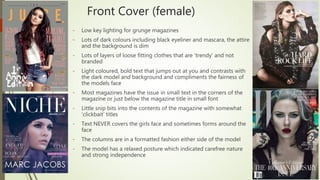
Front Cover (female)
- Low key lighting for grunge magazines
- Lots of dark colours including black eyeliner and mascara, the attire
and the background is dim
- Lots of layers of loose fitting clothes that are ‘trendy’ and not
branded
- Light coloured, bold text that jumps out at you and contrasts with
the dark model and background and compliments the fairness of
the models face
- Most magazines have the issue in small text in the corners of the
magazine or just below the magazine title in small font
- Little snip bits into the contents of the magazine with somewhat
‘clickbait’ titles
- Text NEVER covers the girls face and sometimes forms around the
face
- The columns are in a formatted fashion either side of the model
- The model has a relaxed posture which indicated carefree nature
and strong independence
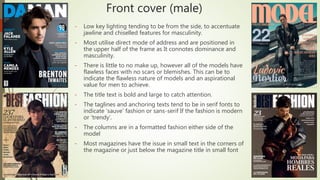
Front cover (male)
- Low key lighting tending to be from the side, to accentuate
jawline and chiselled features for masculinity.
- Most utilise direct mode of address and are positioned in
the upper half of the frame as It connotes dominance and
masculinity.
- There is little to no make up, however all of the models have
flawless faces with no scars or blemishes. This can be to
indicate the flawless nature of models and an aspirational
value for men to achieve.
- The title text is bold and large to catch attention.
- The taglines and anchoring texts tend to be in serif fonts to
indicate ‘sauve’ fashion or sans-serif If the fashion is modern
or ‘trendy’.
- The columns are in a formatted fashion either side of the
model
- Most magazines have the issue in small text in the corners of
the magazine or just below the magazine title in small font
Contents pages
- Contents pages tend to have a lot more images that are not as
defining as the main image on the front but still are intended to
attract the readers attention.
- There is a lot more text in the contents page, with descriptions
beneath a headline to provide information and substance
- There is sometimes a caption or a name to the images that
provide anchorage and meaning to them, perhaps advertising a
famous person or the fashion they are wearing to entice the
reader.
- There is a heavy sense of column formatting in contents pages
as they are more information heavy, and want to easily portray
the information to the audience in an easily navigable manner.

Codes and conventions

  • 1.
  • 2.
    Front Cover (female) -Low key lighting for grunge magazines - Lots of dark colours including black eyeliner and mascara, the attire and the background is dim - Lots of layers of loose fitting clothes that are ‘trendy’ and not branded - Light coloured, bold text that jumps out at you and contrasts with the dark model and background and compliments the fairness of the models face - Most magazines have the issue in small text in the corners of the magazine or just below the magazine title in small font - Little snip bits into the contents of the magazine with somewhat ‘clickbait’ titles - Text NEVER covers the girls face and sometimes forms around the face - The columns are in a formatted fashion either side of the model - The model has a relaxed posture which indicated carefree nature and strong independence
  • 3.
    Front cover (male) -Low key lighting tending to be from the side, to accentuate jawline and chiselled features for masculinity. - Most utilise direct mode of address and are positioned in the upper half of the frame as It connotes dominance and masculinity. - There is little to no make up, however all of the models have flawless faces with no scars or blemishes. This can be to indicate the flawless nature of models and an aspirational value for men to achieve. - The title text is bold and large to catch attention. - The taglines and anchoring texts tend to be in serif fonts to indicate ‘sauve’ fashion or sans-serif If the fashion is modern or ‘trendy’. - The columns are in a formatted fashion either side of the model - Most magazines have the issue in small text in the corners of the magazine or just below the magazine title in small font
  • 4.
    Contents pages - Contentspages tend to have a lot more images that are not as defining as the main image on the front but still are intended to attract the readers attention. - There is a lot more text in the contents page, with descriptions beneath a headline to provide information and substance - There is sometimes a caption or a name to the images that provide anchorage and meaning to them, perhaps advertising a famous person or the fashion they are wearing to entice the reader. - There is a heavy sense of column formatting in contents pages as they are more information heavy, and want to easily portray the information to the audience in an easily navigable manner.