Language and dialects
 What are the essential differences between
a language and a dialect?
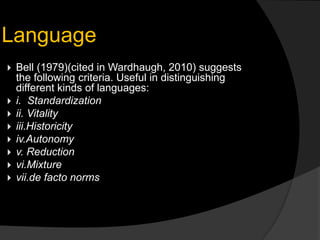
 Bell (1979)(cited in Wardhaugh, 2010) suggests
the following criteria. Useful in distinguishing
different kinds of languages:
 i. Standardization
 ii. Vitality
 iii.Historicity
 iv.Autonomy
 v. Reduction
 vi.Mixture
 vii.de facto norms
Language
Video
 Watch the video “Does everyone speak in a dialect” and
answer the following questions:
 (1). What is the difference between dialect and accent?
 (2). What does she mean when she says that there are two
varieties of English, not separate languages.
 (3). “Why do you think Max Weinreich said that language is a
dialect with an army and a navy?”
 (4). What are the advantages of speaking in a dialect?
 https://www.youtube.com/watch?v=gv-
WOqFMe24&ab_channel=Babbel
Question
 What is your understanding of the term
‘code’?
Code
 A language or a variety of a language may also be
referred to as a ‘code’.
 The term is useful because it is neutral.
 The term can be used to refer to any kind of
system that two or more people employ for
communication (Wardhaugh, 1998).
CODE SWITCHING
 What is ‘code switching’?
 https://www.youtube.com/watch?v=7Na4
UvRIhu4
CODE SWITCHING
 Happens when a bilingual talks to another
bilingual with the same linguistics background and
changes from one language to another in the
course of the conversation.
 Code-switching is an extremely common practice
among bilinguals and takes many forms (Li Wei,
2007)
 Code switching involves skilled manipulation of
overlapping sections of two (or more) grammars,
and that there is virtually no instance of
ungrammatical combination of two languages in
code-switching, regardless of the bilingual ability
of the speaker (Li Wei, 2007).
 In bilingual code switching, the two languages
involved do not play the same role in sentence
making.
 One language sets the grammatical framework,
with the other providing certain items to fit into the
framework.
 Code switching is not a simple combination of two
sets of grammatical rules but grammatical
integration of one language in another (Li Wei,
2007).
 Bilingual speakers of different proficiency levels in
their two languages or speaking two typologically
different languages can engage in code switching
and vary it according to their needs.
 Code switching provides strong evidence for what
some researchers have termed as ‘bilingual
competence’ – the capacity to coordinate two or
more languages in accordance with the
grammatical constraints of both or all languages
(Li Wei, 2007).
 Bilingual speakers have a unique linguistic and
psychological profile; their two languages are
constantly in different states of activation;
 They are able to call upon their linguistic
knowledge and resources according to the context
and adapt their behavior to the task in hand (Li
Wei, 2007)
 Exp. Interpreters, translators, etc.
Code Switching
 Most individuals have a repertoire of codes
available to them, and can switch from one code to
the next when speaking – from casual to formal
style (‘telephone voice’) or vice versa, into different
accents (as in telling a story or joke), or into
different dialects.
 These different uses of different codes are tied to
different situations or ‘domains’. The choice of
code is determined by the domain in which
speakers perceive themselves to be in.
Types
 When a speaker moves from one domain into
another, and changes their code as a result, this is
called ‘situational code switching’ (exp. non-formal
to formal situation) (Stockwell, 2002).
 A speaker can deliberately change codes in the
middle of a situation, in order to indicate to the
hearer that they consider a new domain to be ‘in
operation’. This is called ‘metaphorical code
switching’ (exp. bringing a conversation to a close)
(Stockwell, 2002).
 Where a domain is not well defined or two
domains could be seen to be operating (exp.
meeting a family friend in an expensive restaurant,
or having a work colleague around for a family
occasion).
 Speakers can be heard ‘code mixing’ – in which
the switch between languages can occur within
utterances (Stockwell, 2002).
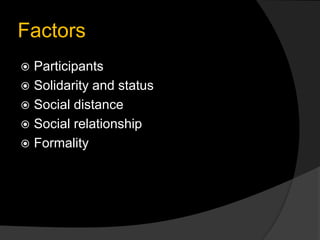
Factors
 Participants
 Solidarity and status
 Social distance
 Social relationship
 Formality
Question
 Difference between code mixing and
‘borrowing’?
Question
 Implications to the Malaysian language
classroom context?
Language Attitude and
Motivation
 What is the difference between attitude
and motivation?
Attitude and Performance
 What are the relationships between an individual’s
attitudes/motivation, and success (academic
performance) in language learning?
 McGroarty (2002).
 Complex and reciprocal connections with each
other.
 Positive attitudes about language and language
learning may be as much the result of success as
the cause.
 Students with positive general attitudes may not
be particularly successful if these attitudes are
not linked with effective strategies that enable
them to take advantage of instructional
opportunities presented to them.
 Students are affected by the attitudes and examples of their
peers, teachers, and parents, with respect to language
study, and by social and institutional language policies as
reflected in, for example, required courses of language
study, both first and second, in schools.
The status of a language in a society, whether native or
second language, further shapes the social climate for
language study.
 Exp. English – language diffusion and the
nativization of English around the world mean that
distinctions such as second language or foreign
language are increasingly hard to draw, because
of varieties of English and norms for use emerge
in response to local communicative needs
(Chesire, 1991; Kachru & Nelson, 1996)(cited in
McGroarty, 2002
 Attitudes and motivation affect learners and
teachers in ways that, though perhaps powerful,
are often unconscious, thus it is difficult to
identify their influence readily or unambiguously.
Exp. Semantic differential scale (Osgood, Suci, and
Tannenbaum, 1957), classic direct measures of
individual attitudes and motivation (Gardner &
Lambert, 1959, 1972), matched guise technique
(Lambert, 1972), orientation index (Gardner,
1985)
Question
 What are the implications of language
attitude to language teaching in the
classroom?
Language attitudes and
Implications to Language Teaching
(1). Promote individual, classroom, and
schoolwide motivation
¬ each teacher must take steps to identify the variety
of goals, interests, and predispositions about
language that students bring to the language
classroom and capitalize on them (Oxford &
Sheerin, 1994)(cited in McGroarty, 2002).
¬ teachers identify effective ways to diversity
instruction and make students more aware of their
own learning processes and the rewards of
language study, both intrinsic and extrinsic.
(2). Discover the language relevant for
instruction
 What forms of language and literacy are
relevant in the lives of students and their
parents?
 Teachers should identify what functions and
forms of language and which language
varieties (and what form of knowledge) matter
in the communities in which they work, in
terms of both present activities and future
aspirations (McGroarty, 2002).
(3). Expand opportunities to use multiple
forms of language
 Teachers need to recognize a wide variety of
language behaviours and realize that their own
and their students’ pre-existing attitudes toward
language skills and literacy abilities will affect
student participation, and they must find ways to
recognize multiple abilities and use them as a
springboard in developing better language and
literacy skills (Cohen, 1994)(cited in McGroarty,
2002).
 Teachers must create in their classroom a range
of participation opportunities so that students can
experience a wide variety of language forms and
functions, oral and literate, including those that
will provide for success in the public arena in their
societies (McGroarty, 2002).

Code switching and code mixing.ppt

  • 2.
    Language and dialects What are the essential differences between a language and a dialect?
  • 3.
     Bell (1979)(citedin Wardhaugh, 2010) suggests the following criteria. Useful in distinguishing different kinds of languages:  i. Standardization  ii. Vitality  iii.Historicity  iv.Autonomy  v. Reduction  vi.Mixture  vii.de facto norms Language
  • 4.
    Video  Watch thevideo “Does everyone speak in a dialect” and answer the following questions:  (1). What is the difference between dialect and accent?  (2). What does she mean when she says that there are two varieties of English, not separate languages.  (3). “Why do you think Max Weinreich said that language is a dialect with an army and a navy?”  (4). What are the advantages of speaking in a dialect?  https://www.youtube.com/watch?v=gv- WOqFMe24&ab_channel=Babbel
  • 5.
    Question  What isyour understanding of the term ‘code’?
  • 6.
    Code  A languageor a variety of a language may also be referred to as a ‘code’.  The term is useful because it is neutral.  The term can be used to refer to any kind of system that two or more people employ for communication (Wardhaugh, 1998).
  • 7.
    CODE SWITCHING  Whatis ‘code switching’?  https://www.youtube.com/watch?v=7Na4 UvRIhu4
  • 8.
    CODE SWITCHING  Happenswhen a bilingual talks to another bilingual with the same linguistics background and changes from one language to another in the course of the conversation.  Code-switching is an extremely common practice among bilinguals and takes many forms (Li Wei, 2007)
  • 9.
     Code switchinginvolves skilled manipulation of overlapping sections of two (or more) grammars, and that there is virtually no instance of ungrammatical combination of two languages in code-switching, regardless of the bilingual ability of the speaker (Li Wei, 2007).  In bilingual code switching, the two languages involved do not play the same role in sentence making.
  • 10.
     One languagesets the grammatical framework, with the other providing certain items to fit into the framework.  Code switching is not a simple combination of two sets of grammatical rules but grammatical integration of one language in another (Li Wei, 2007).
  • 11.
     Bilingual speakersof different proficiency levels in their two languages or speaking two typologically different languages can engage in code switching and vary it according to their needs.  Code switching provides strong evidence for what some researchers have termed as ‘bilingual competence’ – the capacity to coordinate two or more languages in accordance with the grammatical constraints of both or all languages (Li Wei, 2007).
  • 12.
     Bilingual speakershave a unique linguistic and psychological profile; their two languages are constantly in different states of activation;  They are able to call upon their linguistic knowledge and resources according to the context and adapt their behavior to the task in hand (Li Wei, 2007)  Exp. Interpreters, translators, etc.
  • 13.
    Code Switching  Mostindividuals have a repertoire of codes available to them, and can switch from one code to the next when speaking – from casual to formal style (‘telephone voice’) or vice versa, into different accents (as in telling a story or joke), or into different dialects.  These different uses of different codes are tied to different situations or ‘domains’. The choice of code is determined by the domain in which speakers perceive themselves to be in.
  • 14.
    Types  When aspeaker moves from one domain into another, and changes their code as a result, this is called ‘situational code switching’ (exp. non-formal to formal situation) (Stockwell, 2002).
  • 15.
     A speakercan deliberately change codes in the middle of a situation, in order to indicate to the hearer that they consider a new domain to be ‘in operation’. This is called ‘metaphorical code switching’ (exp. bringing a conversation to a close) (Stockwell, 2002).
  • 16.
     Where adomain is not well defined or two domains could be seen to be operating (exp. meeting a family friend in an expensive restaurant, or having a work colleague around for a family occasion).  Speakers can be heard ‘code mixing’ – in which the switch between languages can occur within utterances (Stockwell, 2002).
  • 17.
    Factors  Participants  Solidarityand status  Social distance  Social relationship  Formality
  • 18.
    Question  Difference betweencode mixing and ‘borrowing’?
  • 19.
    Question  Implications tothe Malaysian language classroom context?
  • 20.
    Language Attitude and Motivation What is the difference between attitude and motivation?
  • 21.
    Attitude and Performance What are the relationships between an individual’s attitudes/motivation, and success (academic performance) in language learning?
  • 22.
     McGroarty (2002). Complex and reciprocal connections with each other.  Positive attitudes about language and language learning may be as much the result of success as the cause.
  • 23.
     Students withpositive general attitudes may not be particularly successful if these attitudes are not linked with effective strategies that enable them to take advantage of instructional opportunities presented to them.
  • 24.
     Students areaffected by the attitudes and examples of their peers, teachers, and parents, with respect to language study, and by social and institutional language policies as reflected in, for example, required courses of language study, both first and second, in schools. The status of a language in a society, whether native or second language, further shapes the social climate for language study.
  • 25.
     Exp. English– language diffusion and the nativization of English around the world mean that distinctions such as second language or foreign language are increasingly hard to draw, because of varieties of English and norms for use emerge in response to local communicative needs (Chesire, 1991; Kachru & Nelson, 1996)(cited in McGroarty, 2002
  • 26.
     Attitudes andmotivation affect learners and teachers in ways that, though perhaps powerful, are often unconscious, thus it is difficult to identify their influence readily or unambiguously. Exp. Semantic differential scale (Osgood, Suci, and Tannenbaum, 1957), classic direct measures of individual attitudes and motivation (Gardner & Lambert, 1959, 1972), matched guise technique (Lambert, 1972), orientation index (Gardner, 1985)
  • 27.
    Question  What arethe implications of language attitude to language teaching in the classroom?
  • 28.
    Language attitudes and Implicationsto Language Teaching (1). Promote individual, classroom, and schoolwide motivation ¬ each teacher must take steps to identify the variety of goals, interests, and predispositions about language that students bring to the language classroom and capitalize on them (Oxford & Sheerin, 1994)(cited in McGroarty, 2002). ¬ teachers identify effective ways to diversity instruction and make students more aware of their own learning processes and the rewards of language study, both intrinsic and extrinsic.
  • 29.
    (2). Discover thelanguage relevant for instruction  What forms of language and literacy are relevant in the lives of students and their parents?  Teachers should identify what functions and forms of language and which language varieties (and what form of knowledge) matter in the communities in which they work, in terms of both present activities and future aspirations (McGroarty, 2002).
  • 30.
    (3). Expand opportunitiesto use multiple forms of language  Teachers need to recognize a wide variety of language behaviours and realize that their own and their students’ pre-existing attitudes toward language skills and literacy abilities will affect student participation, and they must find ways to recognize multiple abilities and use them as a springboard in developing better language and literacy skills (Cohen, 1994)(cited in McGroarty, 2002).
  • 31.
     Teachers mustcreate in their classroom a range of participation opportunities so that students can experience a wide variety of language forms and functions, oral and literate, including those that will provide for success in the public arena in their societies (McGroarty, 2002).