Coal and Petroleum;
Fuel, Fad and Fashion
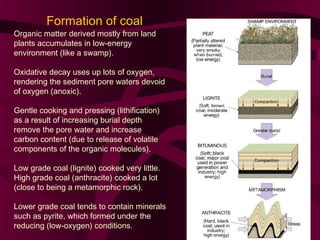
Formation of coal
Organic matter derived mostly from land
plants accumulates in low-energy
environment (like a swamp).
Oxidative decay uses up lots of oxygen,
rendering the sediment pore waters devoid
of oxygen (anoxic).
Gentle cooking and pressing (lithification)
as a result of increasing burial depth
remove the pore water and increase
carbon content (due to release of volatile
components of the organic molecules).
Low grade coal (lignite) cooked very little.
High grade coal (anthracite) cooked a lot
(close to being a metamorphic rock).
Lower grade coal tends to contain minerals
such as pyrite, which formed under the
reducing (low-oxygen) conditions.
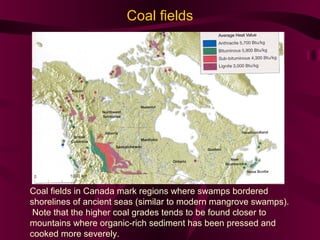
Coal fields

Coal fields in Canada mark regions where swamps bordered
shorelines of ancient seas (similar to modern mangrove swamps).
Note that the higher coal grades tends to be found closer to
mountains where organic-rich sediment has been pressed and
cooked more severely.
Uses of Coal
Fuel: Canada does not use as much coal as many other
countries do for fuel (due to large hydroelectric and nuclear
power developments and small population). However, coal is a
very important fuel throughout Asia and remains highly
significant in the U.S.A, this country having the largest known
coal reserves in the world.
Coke: Bituminous coal that is cooked (charred) to remove
nearly all of the remaining volatiles is transformed into a
spongy substance called coke (some of the removed gases,
e.g. methane, can themselves be used as fuel).
Coke is predominantly burned in blast furnaces to smelt iron
from iron ore because it provides the high temperature and
gases required for the smelting process (prevents oxidation of
the elemental molten iron). It is also used in the production of
cement (cooking of limestone and silica).
Byproducts: A number of by-products from processed coal
are also useful. These include organic substances used to
make some plastics, medicines, and solvents.

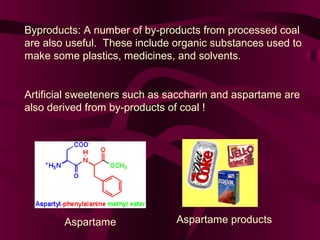
Artificial sweeteners such as saccharin and aspartame are
also derived from by-products of coal !

Aspartame

Aspartame products
• Oil and natural gas
• Oil and natural gas, consisting of various
hydrocarbon compounds, are produced in a similar
manner though are typically derived from different
sources of organic remains.
• Derived from the remains of marine plants and
animals (mostly plankton).
• Oil and natural gas result from the chemical
breakdown of these remains in the absence of
oxygen, as depth of burial (and therefore
temperature) increases.
• The oxygen and nitrogen in the original organics are
driven off, leaving hydrocarbon compounds
(compounds of carbon and hydrogen).
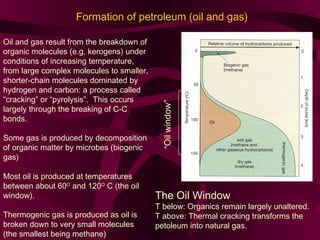
Oil and gas result from the breakdown of
organic molecules (e.g. kerogens) under
conditions of increasing temperature,
from large complex molecules to smaller,
shorter-chain molecules dominated by
hydrogen and carbon: a process called
“cracking” or “pyrolysis”. This occurs
largely through the breaking of C-C
bonds.
Some gas is produced by decomposition
of organic matter by microbes (biogenic
gas)
Most oil is produced at temperatures
between about 60O and 120O C (the oil
window).
Thermogenic gas is produced as oil is
broken down to very small molecules
(the smallest being methane)

“Oil window”

Formation of petroleum (oil and gas)

The Oil Window
T below: Organics remain largely unaltered.
T above: Thermal cracking transforms the
petoleum into natural gas.
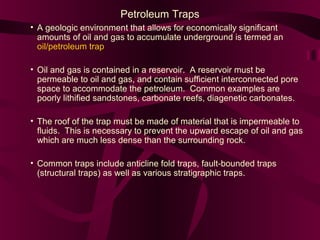
Petroleum Traps
• A geologic environment that allows for economically significant
amounts of oil and gas to accumulate underground is termed an
oil/petroleum trap
• Oil and gas is contained in a reservoir. A reservoir must be
permeable to oil and gas, and contain sufficient interconnected pore
space to accommodate the petroleum. Common examples are
poorly lithified sandstones, carbonate reefs, diagenetic carbonates.
• The roof of the trap must be made of material that is impermeable to
fluids. This is necessary to prevent the upward escape of oil and gas
which are much less dense than the surrounding rock.
• Common traps include anticline fold traps, fault-bounded traps
(structural traps) as well as various stratigraphic traps.
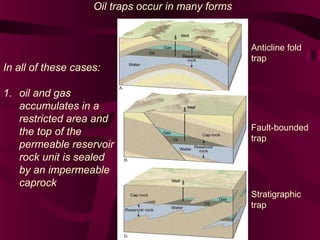
Oil traps occur in many forms

In all of these cases:
1. oil and gas
accumulates in a
restricted area and
the top of the
permeable reservoir
rock unit is sealed
by an impermeable
caprock

Anticline fold
trap

Fault-bounded
trap

Stratigraphic
trap
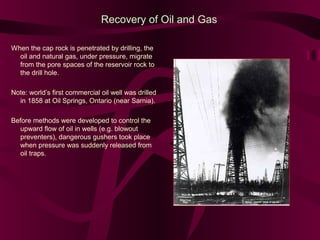
Recovery of Oil and Gas
When the cap rock is penetrated by drilling, the
oil and natural gas, under pressure, migrate
from the pore spaces of the reservoir rock to
the drill hole.
Note: world’s first commercial oil well was drilled
in 1858 at Oil Springs, Ontario (near Sarnia).
Before methods were developed to control the
upward flow of oil in wells (e.g. blowout
preventers), dangerous gushers took place
when pressure was suddenly released from
oil traps.
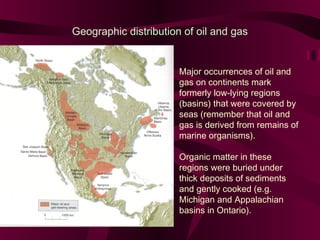
Geographic distribution of oil and gas

Major occurrences of oil and
gas on continents mark
formerly low-lying regions
(basins) that were covered by
seas (remember that oil and
gas is derived from remains of
marine organisms).
Organic matter in these
regions were buried under
thick deposits of sediments
and gently cooked (e.g.
Michigan and Appalachian
basins in Ontario).
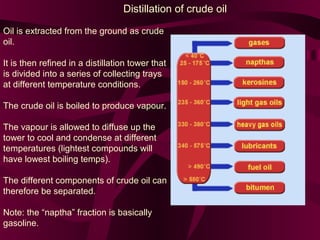
Distillation of crude oil
Oil is extracted from the ground as crude
oil.
It is then refined in a distillation tower that
is divided into a series of collecting trays
at different temperature conditions.
The crude oil is boiled to produce vapour.
The vapour is allowed to diffuse up the
tower to cool and condense at different
temperatures (lightest compounds will
have lowest boiling temps).
The different components of crude oil can
therefore be separated.
Note: the “naptha” fraction is basically
gasoline.
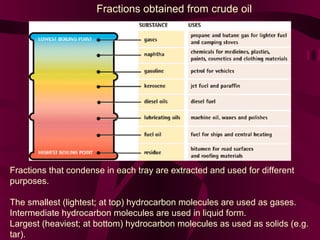
Fractions obtained from crude oil

Fractions that condense in each tray are extracted and used for different
purposes.
The smallest (lightest; at top) hydrocarbon molecules are used as gases.
Intermediate hydrocarbon molecules are used in liquid form.
Largest (heaviest; at bottom) hydrocarbon molecules as used as solids (e.g.
tar).
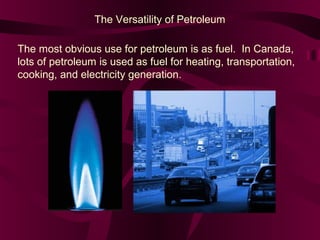
The Versatility of Petroleum
The most obvious use for petroleum is as fuel. In Canada,
lots of petroleum is used as fuel for heating, transportation,
cooking, and electricity generation.
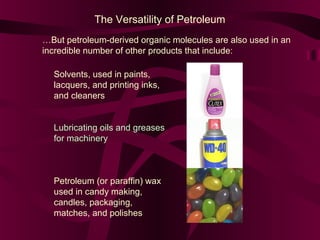
The Versatility of Petroleum
…But petroleum-derived organic molecules are also used in an
incredible number of other products that include:
Solvents, used in paints,
lacquers, and printing inks,
and cleaners
Lubricating oils and greases
for machinery

Petroleum (or paraffin) wax
used in candy making,
candles, packaging,
matches, and polishes
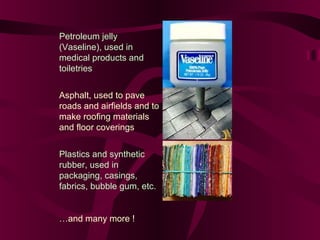
Petroleum jelly
(Vaseline), used in
medical products and
toiletries
Asphalt, used to pave
roads and airfields and to
make roofing materials
and floor coverings
Plastics and synthetic
rubber, used in
packaging, casings,
fabrics, bubble gum, etc.

…and many more !
Plastics
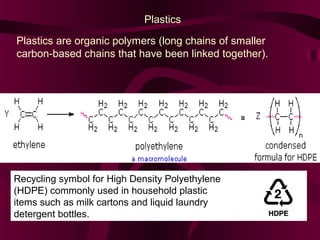
Plastics are organic polymers (long chains of smaller
carbon-based chains that have been linked together).

Recycling symbol for High Density Polyethylene
(HDPE) commonly used in household plastic
items such as milk cartons and liquid laundry
detergent bottles.
Linkages of more complex units, cont’d
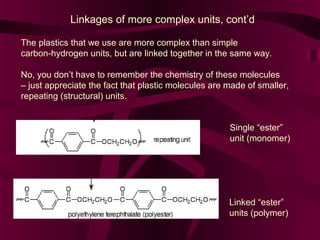
The plastics that we use are more complex than simple
carbon-hydrogen units, but are linked together in the same way.
No, you don’t have to remember the chemistry of these molecules
– just appreciate the fact that plastic molecules are made of smaller,
repeating (structural) units.
Single “ester”
unit (monomer)

Linked “ester”
units (polymer)
Some desirable qualities of plastics:

Can be made lightweight or heavy
Can be very weak or very strong
Can be moulded into solid pieces or extruded as fibres
Are excellent insulators
Various forms range from strong and brittle to weak and
elastic
Waterproof
Relatively cheap to manufacture
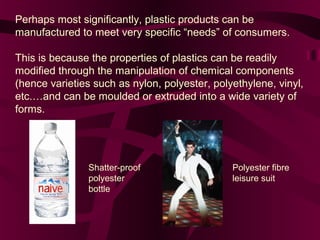
Perhaps most significantly, plastic products can be
manufactured to meet very specific “needs” of consumers.
This is because the properties of plastics can be readily
modified through the manipulation of chemical components
(hence varieties such as nylon, polyester, polyethylene, vinyl,
etc.…and can be moulded or extruded into a wide variety of
forms.

Shatter-proof
polyester
bottle

Polyester fibre
leisure suit
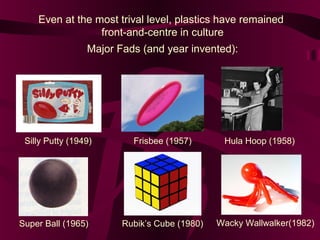
Even at the most trival level, plastics have remained
front-and-centre in culture
Major Fads (and year invented):

Silly Putty (1949)

Super Ball (1965)

Frisbee (1957)

Rubik’s Cube (1980)

Hula Hoop (1958)

Wacky Wallwalker(1982)
END OF LECTURE

Coalpetroleum

  • 1.
  • 2.
    Formation of coal Organicmatter derived mostly from land plants accumulates in low-energy environment (like a swamp). Oxidative decay uses up lots of oxygen, rendering the sediment pore waters devoid of oxygen (anoxic). Gentle cooking and pressing (lithification) as a result of increasing burial depth remove the pore water and increase carbon content (due to release of volatile components of the organic molecules). Low grade coal (lignite) cooked very little. High grade coal (anthracite) cooked a lot (close to being a metamorphic rock). Lower grade coal tends to contain minerals such as pyrite, which formed under the reducing (low-oxygen) conditions.
  • 3.
    Coal fields Coal fieldsin Canada mark regions where swamps bordered shorelines of ancient seas (similar to modern mangrove swamps). Note that the higher coal grades tends to be found closer to mountains where organic-rich sediment has been pressed and cooked more severely.
  • 4.
    Uses of Coal Fuel:Canada does not use as much coal as many other countries do for fuel (due to large hydroelectric and nuclear power developments and small population). However, coal is a very important fuel throughout Asia and remains highly significant in the U.S.A, this country having the largest known coal reserves in the world. Coke: Bituminous coal that is cooked (charred) to remove nearly all of the remaining volatiles is transformed into a spongy substance called coke (some of the removed gases, e.g. methane, can themselves be used as fuel). Coke is predominantly burned in blast furnaces to smelt iron from iron ore because it provides the high temperature and gases required for the smelting process (prevents oxidation of the elemental molten iron). It is also used in the production of cement (cooking of limestone and silica).
  • 5.
    Byproducts: A numberof by-products from processed coal are also useful. These include organic substances used to make some plastics, medicines, and solvents. Artificial sweeteners such as saccharin and aspartame are also derived from by-products of coal ! Aspartame Aspartame products
  • 6.
    • Oil andnatural gas • Oil and natural gas, consisting of various hydrocarbon compounds, are produced in a similar manner though are typically derived from different sources of organic remains. • Derived from the remains of marine plants and animals (mostly plankton). • Oil and natural gas result from the chemical breakdown of these remains in the absence of oxygen, as depth of burial (and therefore temperature) increases. • The oxygen and nitrogen in the original organics are driven off, leaving hydrocarbon compounds (compounds of carbon and hydrogen).
  • 7.
    Oil and gasresult from the breakdown of organic molecules (e.g. kerogens) under conditions of increasing temperature, from large complex molecules to smaller, shorter-chain molecules dominated by hydrogen and carbon: a process called “cracking” or “pyrolysis”. This occurs largely through the breaking of C-C bonds. Some gas is produced by decomposition of organic matter by microbes (biogenic gas) Most oil is produced at temperatures between about 60O and 120O C (the oil window). Thermogenic gas is produced as oil is broken down to very small molecules (the smallest being methane) “Oil window” Formation of petroleum (oil and gas) The Oil Window T below: Organics remain largely unaltered. T above: Thermal cracking transforms the petoleum into natural gas.
  • 8.
    Petroleum Traps • Ageologic environment that allows for economically significant amounts of oil and gas to accumulate underground is termed an oil/petroleum trap • Oil and gas is contained in a reservoir. A reservoir must be permeable to oil and gas, and contain sufficient interconnected pore space to accommodate the petroleum. Common examples are poorly lithified sandstones, carbonate reefs, diagenetic carbonates. • The roof of the trap must be made of material that is impermeable to fluids. This is necessary to prevent the upward escape of oil and gas which are much less dense than the surrounding rock. • Common traps include anticline fold traps, fault-bounded traps (structural traps) as well as various stratigraphic traps.
  • 9.
    Oil traps occurin many forms In all of these cases: 1. oil and gas accumulates in a restricted area and the top of the permeable reservoir rock unit is sealed by an impermeable caprock Anticline fold trap Fault-bounded trap Stratigraphic trap
  • 10.
    Recovery of Oiland Gas When the cap rock is penetrated by drilling, the oil and natural gas, under pressure, migrate from the pore spaces of the reservoir rock to the drill hole. Note: world’s first commercial oil well was drilled in 1858 at Oil Springs, Ontario (near Sarnia). Before methods were developed to control the upward flow of oil in wells (e.g. blowout preventers), dangerous gushers took place when pressure was suddenly released from oil traps.
  • 11.
    Geographic distribution ofoil and gas Major occurrences of oil and gas on continents mark formerly low-lying regions (basins) that were covered by seas (remember that oil and gas is derived from remains of marine organisms). Organic matter in these regions were buried under thick deposits of sediments and gently cooked (e.g. Michigan and Appalachian basins in Ontario).
  • 12.
    Distillation of crudeoil Oil is extracted from the ground as crude oil. It is then refined in a distillation tower that is divided into a series of collecting trays at different temperature conditions. The crude oil is boiled to produce vapour. The vapour is allowed to diffuse up the tower to cool and condense at different temperatures (lightest compounds will have lowest boiling temps). The different components of crude oil can therefore be separated. Note: the “naptha” fraction is basically gasoline.
  • 13.
    Fractions obtained fromcrude oil Fractions that condense in each tray are extracted and used for different purposes. The smallest (lightest; at top) hydrocarbon molecules are used as gases. Intermediate hydrocarbon molecules are used in liquid form. Largest (heaviest; at bottom) hydrocarbon molecules as used as solids (e.g. tar).
  • 14.
    The Versatility ofPetroleum The most obvious use for petroleum is as fuel. In Canada, lots of petroleum is used as fuel for heating, transportation, cooking, and electricity generation.
  • 15.
    The Versatility ofPetroleum …But petroleum-derived organic molecules are also used in an incredible number of other products that include: Solvents, used in paints, lacquers, and printing inks, and cleaners Lubricating oils and greases for machinery Petroleum (or paraffin) wax used in candy making, candles, packaging, matches, and polishes
  • 16.
    Petroleum jelly (Vaseline), usedin medical products and toiletries Asphalt, used to pave roads and airfields and to make roofing materials and floor coverings Plastics and synthetic rubber, used in packaging, casings, fabrics, bubble gum, etc. …and many more !
  • 17.
    Plastics Plastics are organicpolymers (long chains of smaller carbon-based chains that have been linked together). Recycling symbol for High Density Polyethylene (HDPE) commonly used in household plastic items such as milk cartons and liquid laundry detergent bottles.
  • 18.
    Linkages of morecomplex units, cont’d The plastics that we use are more complex than simple carbon-hydrogen units, but are linked together in the same way. No, you don’t have to remember the chemistry of these molecules – just appreciate the fact that plastic molecules are made of smaller, repeating (structural) units. Single “ester” unit (monomer) Linked “ester” units (polymer)
  • 19.
    Some desirable qualitiesof plastics: Can be made lightweight or heavy Can be very weak or very strong Can be moulded into solid pieces or extruded as fibres Are excellent insulators Various forms range from strong and brittle to weak and elastic Waterproof Relatively cheap to manufacture
  • 20.
    Perhaps most significantly,plastic products can be manufactured to meet very specific “needs” of consumers. This is because the properties of plastics can be readily modified through the manipulation of chemical components (hence varieties such as nylon, polyester, polyethylene, vinyl, etc.…and can be moulded or extruded into a wide variety of forms. Shatter-proof polyester bottle Polyester fibre leisure suit
  • 21.
    Even at themost trival level, plastics have remained front-and-centre in culture Major Fads (and year invented): Silly Putty (1949) Super Ball (1965) Frisbee (1957) Rubik’s Cube (1980) Hula Hoop (1958) Wacky Wallwalker(1982)
  • 22.