Colloidal Applications for
Environment - Contaminant
Capture
Jaskaran Singh Malhotra
Contents
● Colloidal chemistry and Nanostructures
● Case study - Zr-based Metal Organic Frameworks (MOFs)
● Case study - CuZr bimetallic NPs for Carbon Capture
● More design strategies
● Challenges
● Future scope
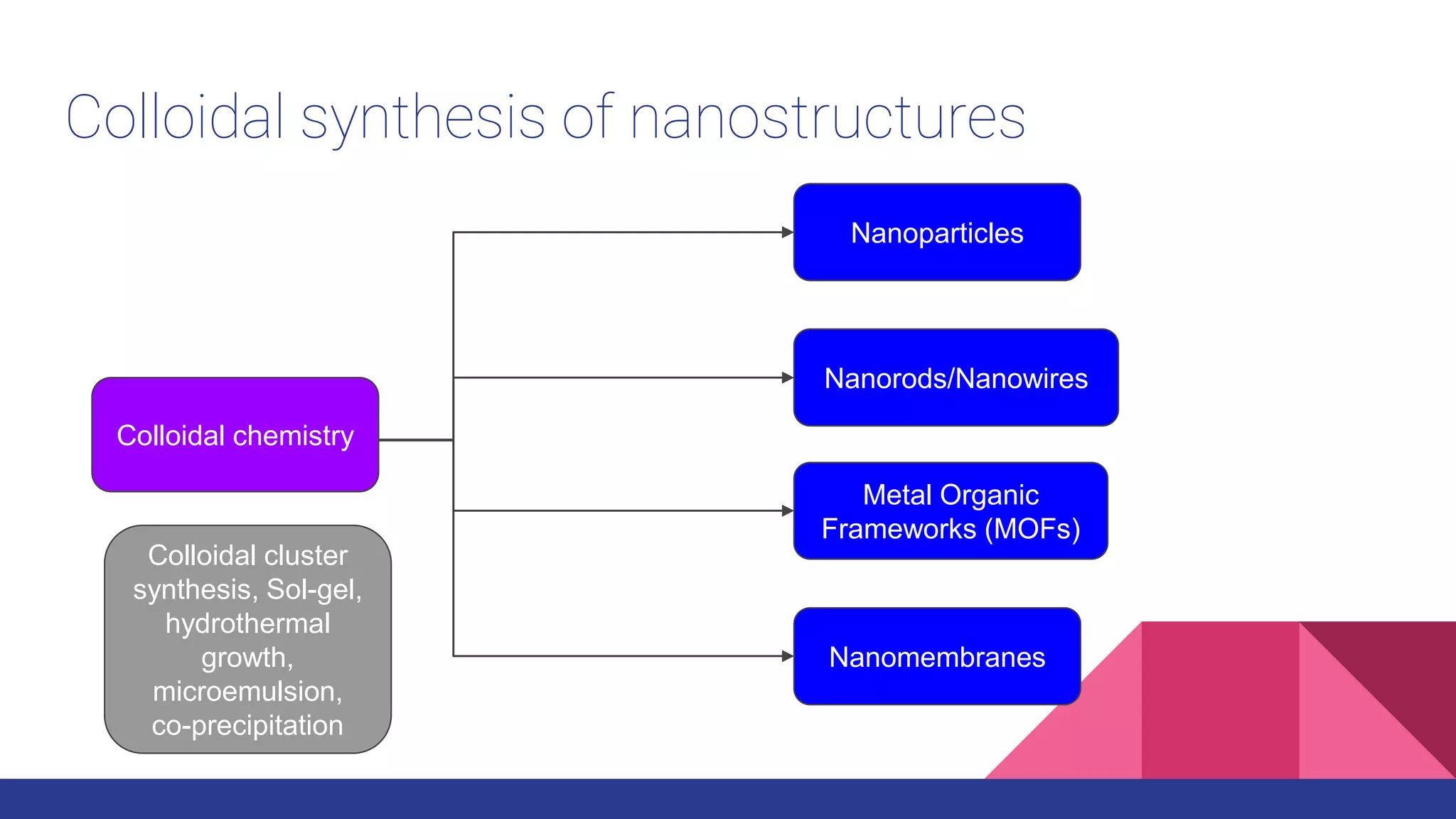
Colloidal synthesis of nanostructures
Colloidal chemistry
Colloidal chemistry
Nanoparticles
Nanorods/Nanowires
Metal Organic
Frameworks (MOFs)
Nanomembranes
Colloidal cluster
synthesis, Sol-gel,
hydrothermal
growth,
microemulsion,
co-precipitation
Why nanostructures?
Colloidal chemistry
Nanostructures
Large Surface Area High reactivity
Easy synthesis Tunability
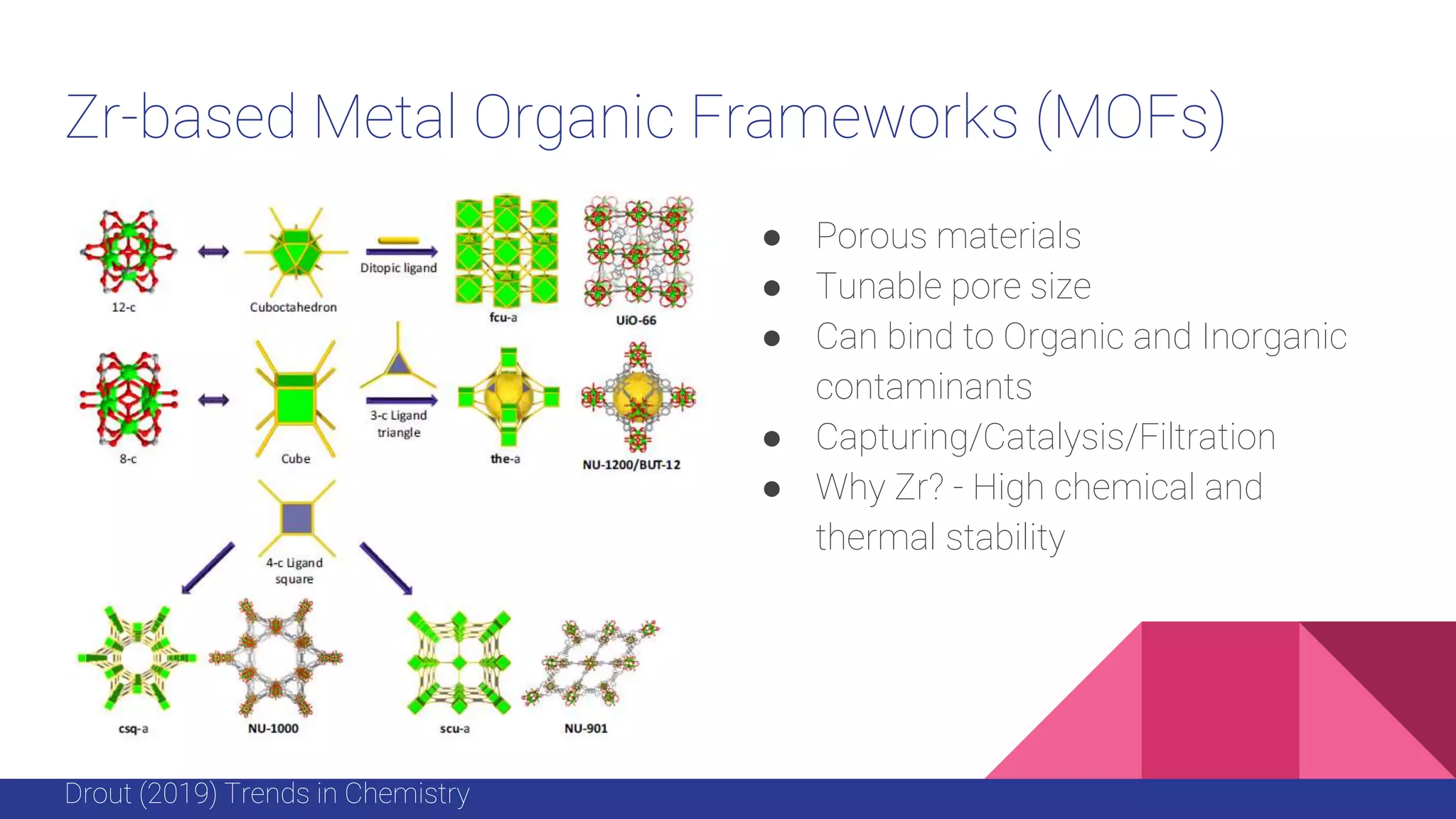
Zr-based Metal Organic Frameworks (MOFs)
● Porous materials
● Tunable pore size
● Can bind to Organic and Inorganic
contaminants
● Capturing/Catalysis/Filtration
● Why Zr? - High chemical and
thermal stability
Drout (2019) Trends in Chemistry
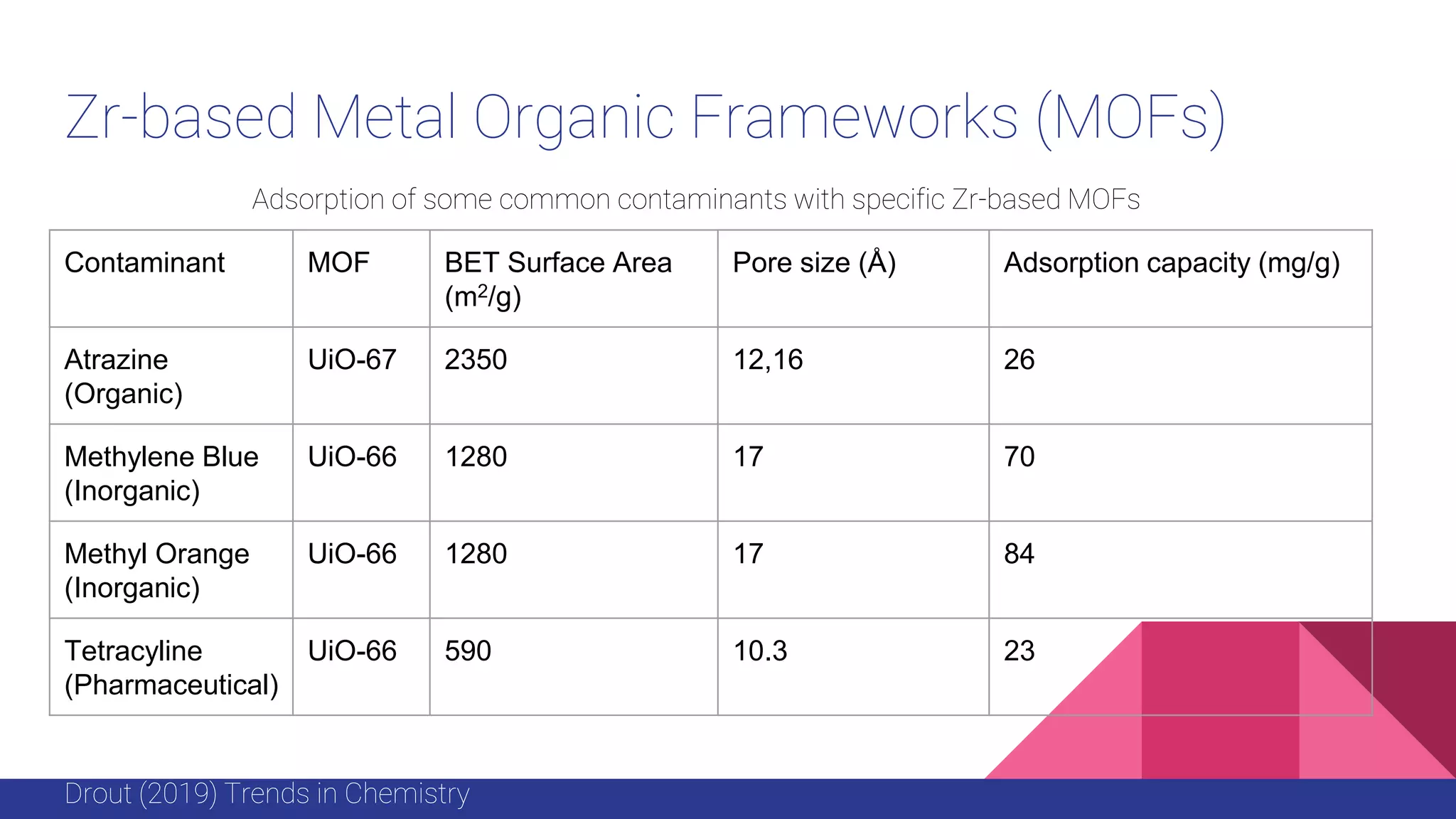
Zr-based Metal Organic Frameworks (MOFs)
Drout (2019) Trends in Chemistry
Contaminant MOF BET Surface Area
(m2/g)
Pore size (Å) Adsorption capacity (mg/g)
Atrazine
(Organic)
UiO-67 2350 12,16 26
Methylene Blue
(Inorganic)
UiO-66 1280 17 70
Methyl Orange
(Inorganic)
UiO-66 1280 17 84
Tetracyline
(Pharmaceutical)
UiO-66 590 10.3 23
Adsorption of some common contaminants with specific Zr-based MOFs
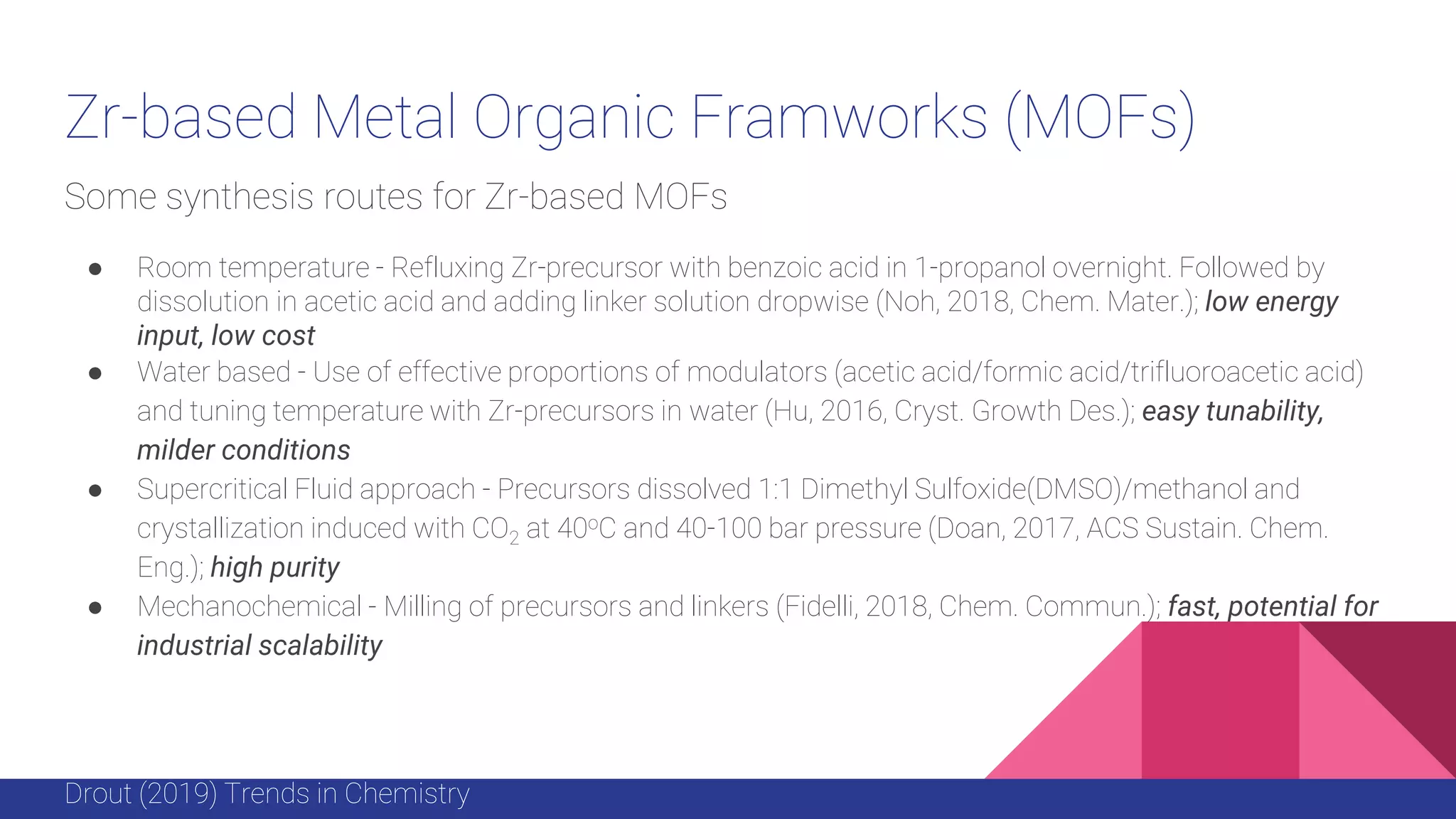
Zr-based Metal Organic Framworks (MOFs)
Some synthesis routes for Zr-based MOFs
● Room temperature - Refluxing Zr-precursor with benzoic acid in 1-propanol overnight. Followed by
dissolution in acetic acid and adding linker solution dropwise (Noh, 2018, Chem. Mater.); low energy
input, low cost
● Water based - Use of effective proportions of modulators (acetic acid/formic acid/trifluoroacetic acid)
and tuning temperature with Zr-precursors in water (Hu, 2016, Cryst. Growth Des.); easy tunability,
milder conditions
● Supercritical Fluid approach - Precursors dissolved 1:1 Dimethyl Sulfoxide(DMSO)/methanol and
crystallization induced with CO2 at 40oC and 40-100 bar pressure (Doan, 2017, ACS Sustain. Chem.
Eng.); high purity
● Mechanochemical - Milling of precursors and linkers (Fidelli, 2018, Chem. Commun.); fast, potential for
industrial scalability
Drout (2019) Trends in Chemistry
Carbon capture
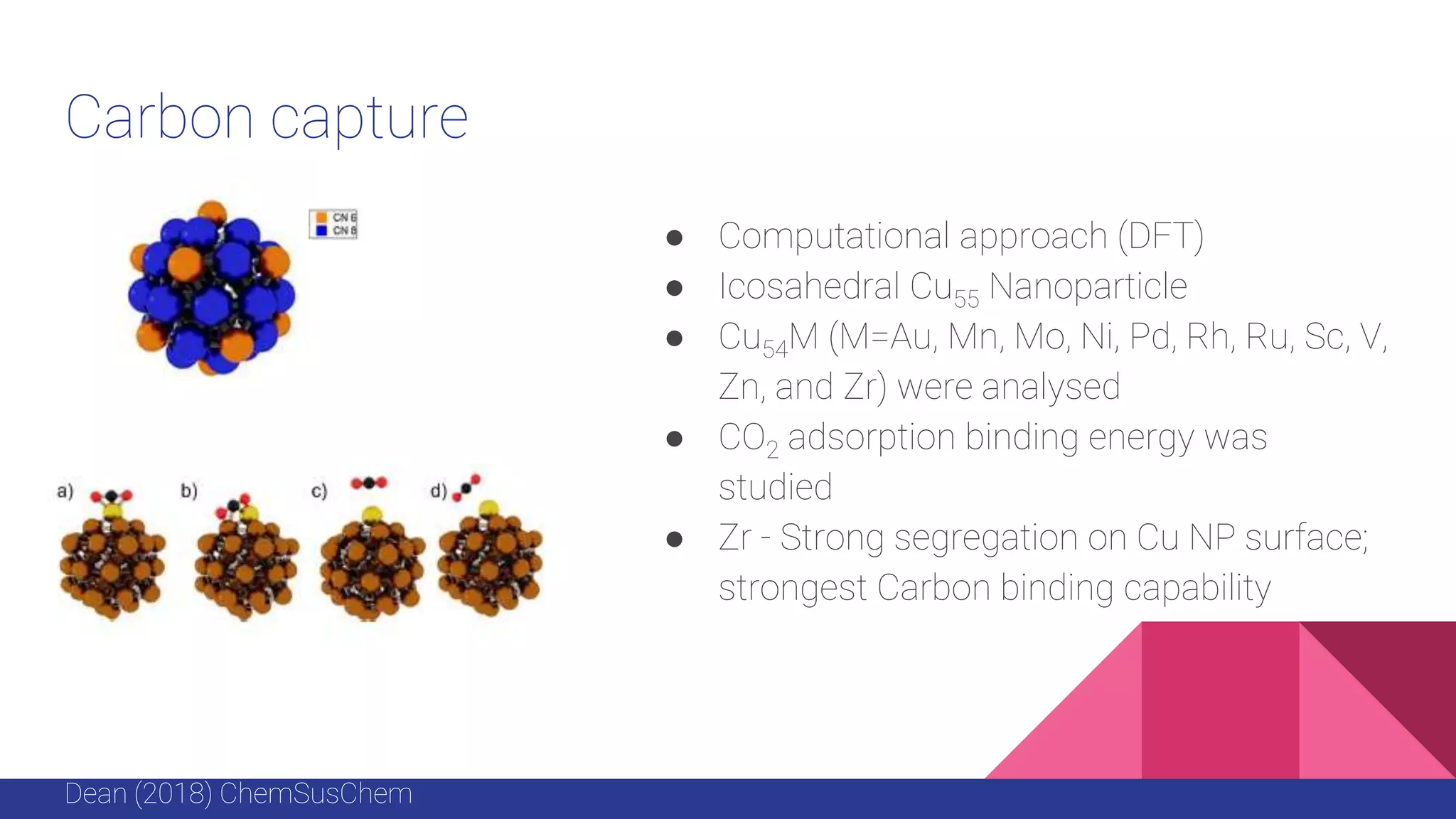
● Computational approach (DFT)
● Icosahedral Cu55 Nanoparticle
● Cu54M (M=Au, Mn, Mo, Ni, Pd, Rh, Ru, Sc, V,
Zn, and Zr) were analysed
● CO2 adsorption binding energy was
studied
● Zr - Strong segregation on Cu NP surface;
strongest Carbon binding capability
Dean (2018) ChemSusChem
Carbon capture
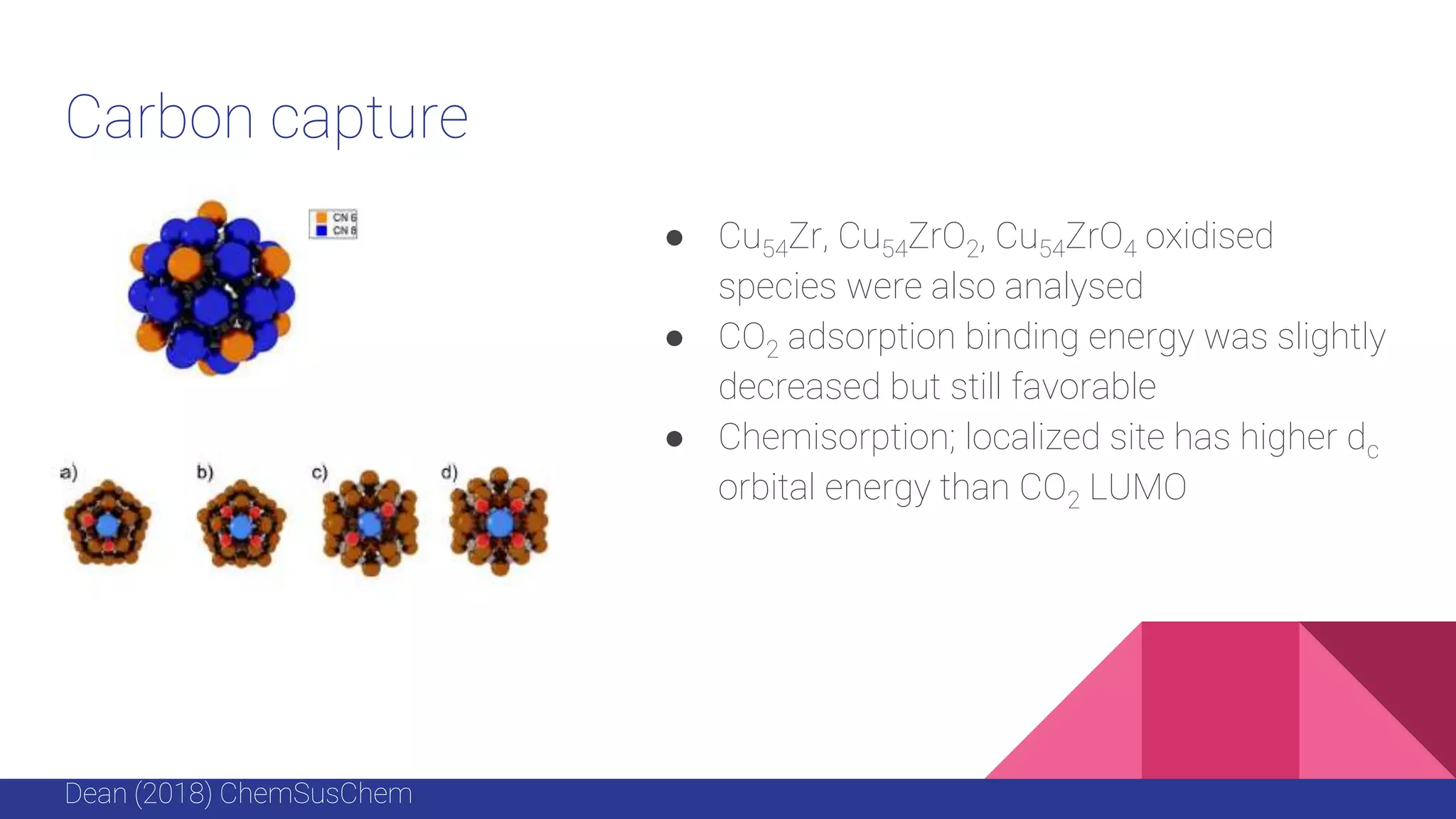
● Cu54Zr, Cu54ZrO2, Cu54ZrO4 oxidised
species were also analysed
● CO2 adsorption binding energy was slightly
decreased but still favorable
● Chemisorption; localized site has higher dc
orbital energy than CO2 LUMO
Dean (2018) ChemSusChem
Carbon capture
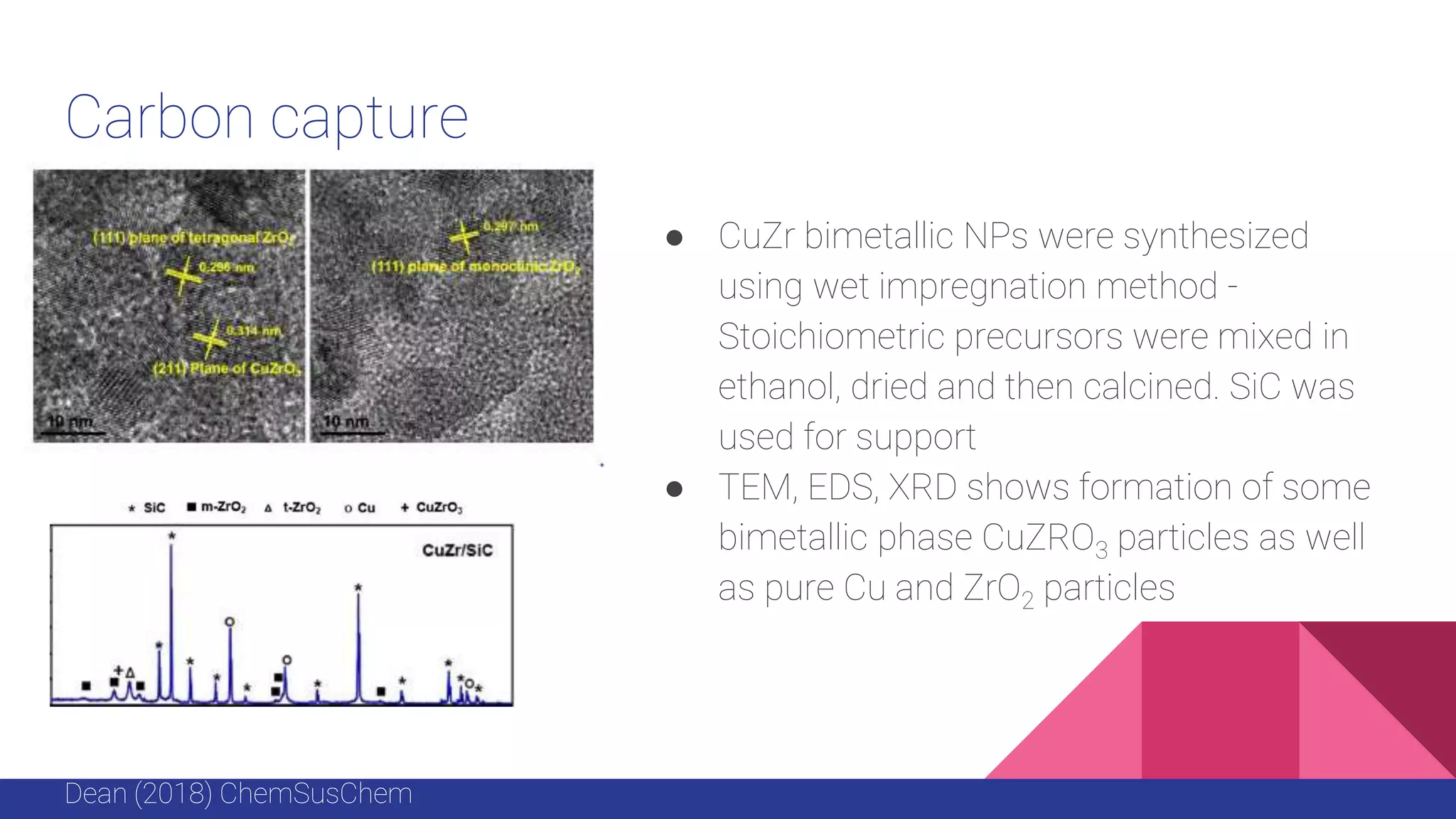
● CuZr bimetallic NPs were synthesized
using wet impregnation method -
Stoichiometric precursors were mixed in
ethanol, dried and then calcined. SiC was
used for support
● TEM, EDS, XRD shows formation of some
bimetallic phase CuZRO3 particles as well
as pure Cu and ZrO2 particles
Dean (2018) ChemSusChem
Carbon capture
● CO2 capture ability was studied by
Temperature Programmed Desorption
(TPD) on CuZr, pure ZrO2 and pure Cu (all
on SiC substrate) for reference
● For pure Cu, almost no CO2 signal is
observed
● For Bimetallic CuZr, strong CO2 signal is
observed
Dean (2018) ChemSusChem
MOFilters for PM capture
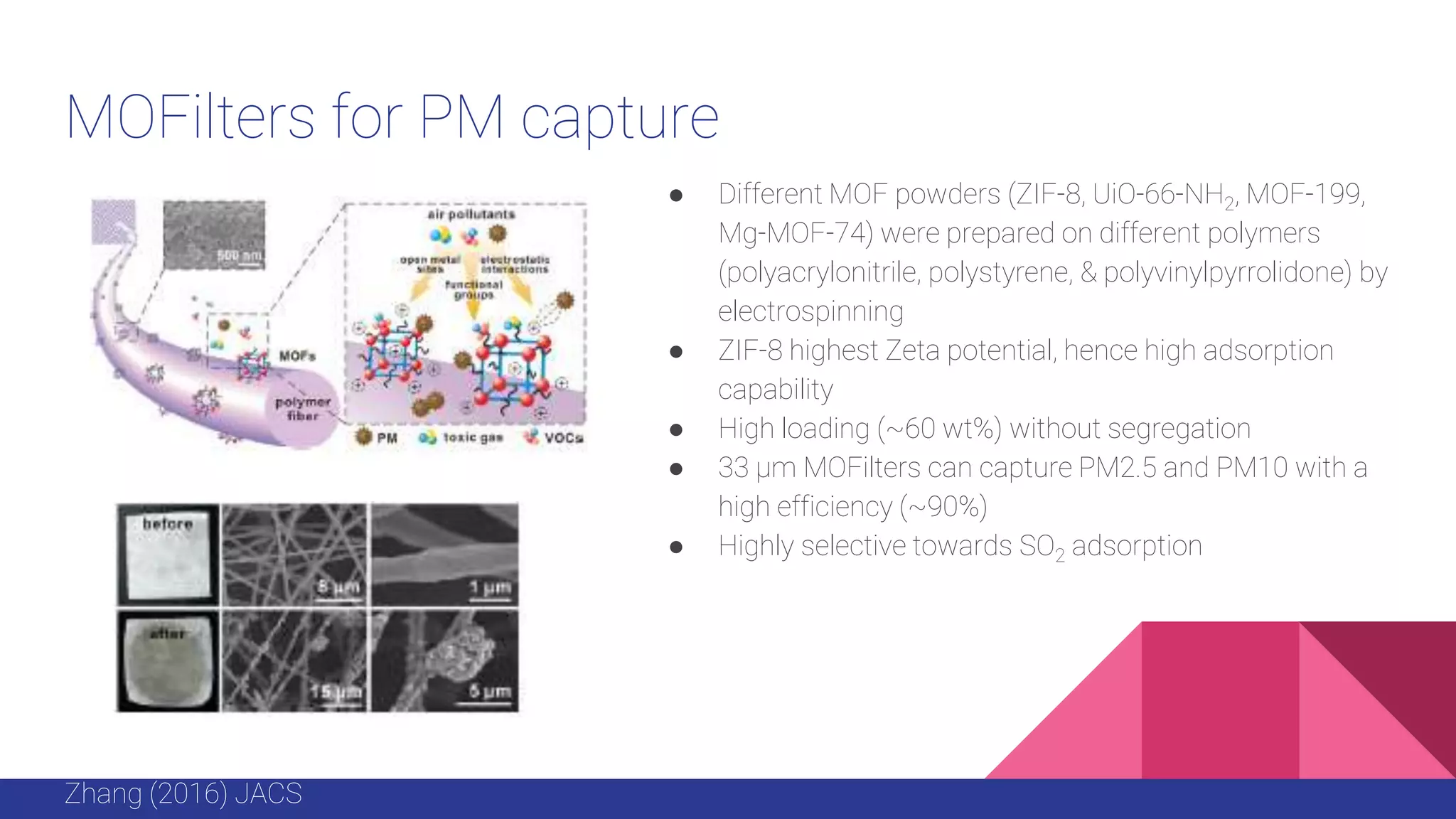
● Different MOF powders (ZIF-8, UiO-66-NH2, MOF-199,
Mg-MOF-74) were prepared on different polymers
(polyacrylonitrile, polystyrene, & polyvinylpyrrolidone) by
electrospinning
● ZIF-8 highest Zeta potential, hence high adsorption
capability
● High loading (~60 wt%) without segregation
● 33 μm MOFilters can capture PM2.5 and PM10 with a
high efficiency (~90%)
● Highly selective towards SO2 adsorption
Zhang (2016) JACS
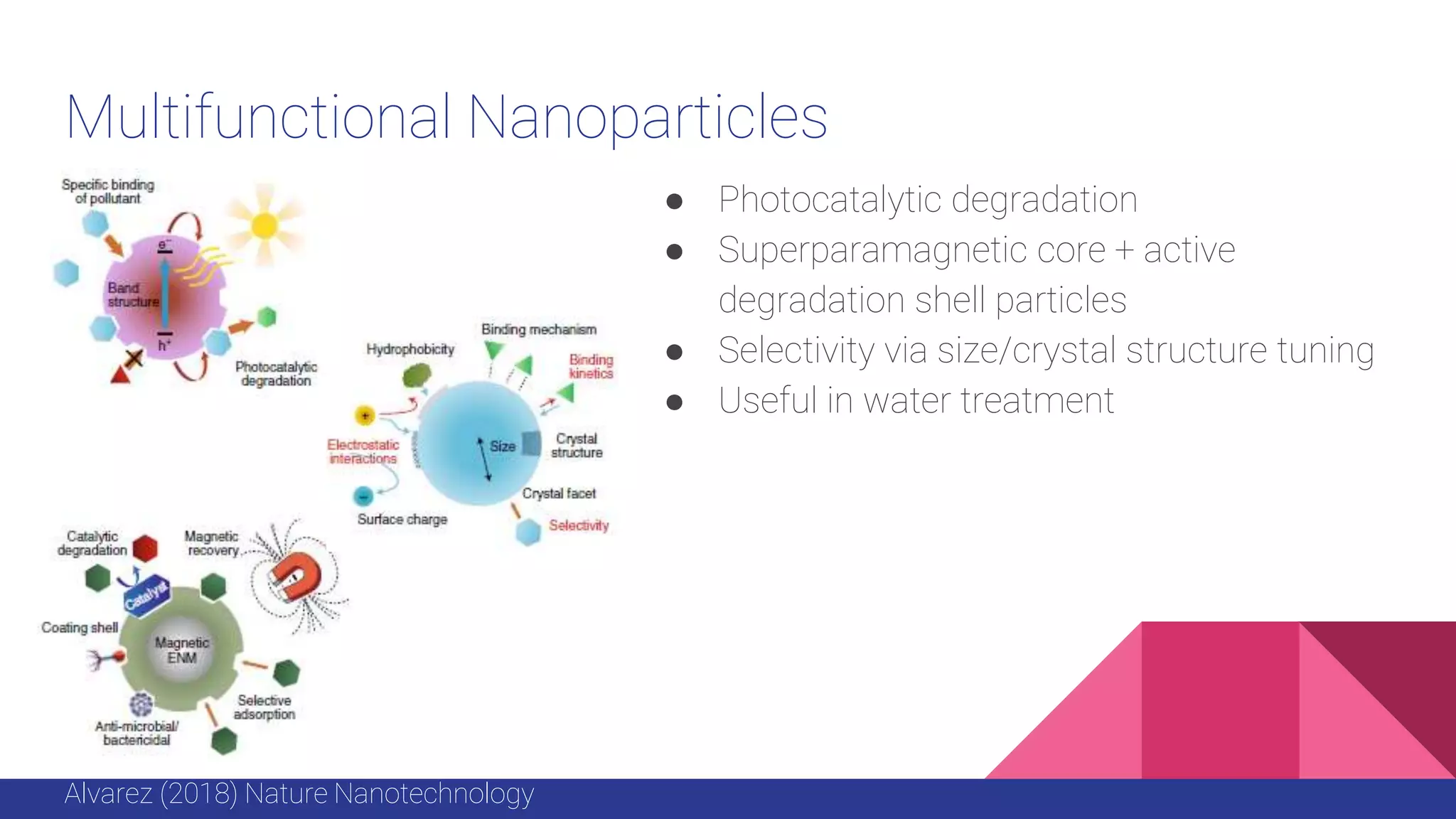
Multifunctional Nanoparticles
● Photocatalytic degradation
● Superparamagnetic core + active
degradation shell particles
● Selectivity via size/crystal structure tuning
● Useful in water treatment
Alvarez (2018) Nature Nanotechnology
Challenges
● Scaling
● Rigidity - loss of structure
● Environmental concern - when the structures themselves disintegrate
● Functional device feasibility
● High Selectivity
More Applications and future scope
● “Capturing Nanostructures” can also be synthesised to capture rare elements
from seawater
● Can also be used as catalysts reactions highly efficient
● Medical - Artificial Red Blood Cells
Thank You

CO2 capture with nanomaterials

  • 1.
    Colloidal Applications for Environment- Contaminant Capture Jaskaran Singh Malhotra
  • 2.
    Contents ● Colloidal chemistryand Nanostructures ● Case study - Zr-based Metal Organic Frameworks (MOFs) ● Case study - CuZr bimetallic NPs for Carbon Capture ● More design strategies ● Challenges ● Future scope
  • 3.
    Colloidal synthesis ofnanostructures Colloidal chemistry Colloidal chemistry Nanoparticles Nanorods/Nanowires Metal Organic Frameworks (MOFs) Nanomembranes Colloidal cluster synthesis, Sol-gel, hydrothermal growth, microemulsion, co-precipitation
  • 4.
    Why nanostructures? Colloidal chemistry Nanostructures LargeSurface Area High reactivity Easy synthesis Tunability
  • 5.
    Zr-based Metal OrganicFrameworks (MOFs) ● Porous materials ● Tunable pore size ● Can bind to Organic and Inorganic contaminants ● Capturing/Catalysis/Filtration ● Why Zr? - High chemical and thermal stability Drout (2019) Trends in Chemistry
  • 6.
    Zr-based Metal OrganicFrameworks (MOFs) Drout (2019) Trends in Chemistry Contaminant MOF BET Surface Area (m2/g) Pore size (Å) Adsorption capacity (mg/g) Atrazine (Organic) UiO-67 2350 12,16 26 Methylene Blue (Inorganic) UiO-66 1280 17 70 Methyl Orange (Inorganic) UiO-66 1280 17 84 Tetracyline (Pharmaceutical) UiO-66 590 10.3 23 Adsorption of some common contaminants with specific Zr-based MOFs
  • 7.
    Zr-based Metal OrganicFramworks (MOFs) Some synthesis routes for Zr-based MOFs ● Room temperature - Refluxing Zr-precursor with benzoic acid in 1-propanol overnight. Followed by dissolution in acetic acid and adding linker solution dropwise (Noh, 2018, Chem. Mater.); low energy input, low cost ● Water based - Use of effective proportions of modulators (acetic acid/formic acid/trifluoroacetic acid) and tuning temperature with Zr-precursors in water (Hu, 2016, Cryst. Growth Des.); easy tunability, milder conditions ● Supercritical Fluid approach - Precursors dissolved 1:1 Dimethyl Sulfoxide(DMSO)/methanol and crystallization induced with CO2 at 40oC and 40-100 bar pressure (Doan, 2017, ACS Sustain. Chem. Eng.); high purity ● Mechanochemical - Milling of precursors and linkers (Fidelli, 2018, Chem. Commun.); fast, potential for industrial scalability Drout (2019) Trends in Chemistry
  • 8.
    Carbon capture ● Computationalapproach (DFT) ● Icosahedral Cu55 Nanoparticle ● Cu54M (M=Au, Mn, Mo, Ni, Pd, Rh, Ru, Sc, V, Zn, and Zr) were analysed ● CO2 adsorption binding energy was studied ● Zr - Strong segregation on Cu NP surface; strongest Carbon binding capability Dean (2018) ChemSusChem
  • 9.
    Carbon capture ● Cu54Zr,Cu54ZrO2, Cu54ZrO4 oxidised species were also analysed ● CO2 adsorption binding energy was slightly decreased but still favorable ● Chemisorption; localized site has higher dc orbital energy than CO2 LUMO Dean (2018) ChemSusChem
  • 10.
    Carbon capture ● CuZrbimetallic NPs were synthesized using wet impregnation method - Stoichiometric precursors were mixed in ethanol, dried and then calcined. SiC was used for support ● TEM, EDS, XRD shows formation of some bimetallic phase CuZRO3 particles as well as pure Cu and ZrO2 particles Dean (2018) ChemSusChem
  • 11.
    Carbon capture ● CO2capture ability was studied by Temperature Programmed Desorption (TPD) on CuZr, pure ZrO2 and pure Cu (all on SiC substrate) for reference ● For pure Cu, almost no CO2 signal is observed ● For Bimetallic CuZr, strong CO2 signal is observed Dean (2018) ChemSusChem
  • 12.
    MOFilters for PMcapture ● Different MOF powders (ZIF-8, UiO-66-NH2, MOF-199, Mg-MOF-74) were prepared on different polymers (polyacrylonitrile, polystyrene, & polyvinylpyrrolidone) by electrospinning ● ZIF-8 highest Zeta potential, hence high adsorption capability ● High loading (~60 wt%) without segregation ● 33 μm MOFilters can capture PM2.5 and PM10 with a high efficiency (~90%) ● Highly selective towards SO2 adsorption Zhang (2016) JACS
  • 13.
    Multifunctional Nanoparticles ● Photocatalyticdegradation ● Superparamagnetic core + active degradation shell particles ● Selectivity via size/crystal structure tuning ● Useful in water treatment Alvarez (2018) Nature Nanotechnology
  • 14.
    Challenges ● Scaling ● Rigidity- loss of structure ● Environmental concern - when the structures themselves disintegrate ● Functional device feasibility ● High Selectivity
  • 15.
    More Applications andfuture scope ● “Capturing Nanostructures” can also be synthesised to capture rare elements from seawater ● Can also be used as catalysts reactions highly efficient ● Medical - Artificial Red Blood Cells
  • 16.