CO 225-53
Business and Professional
Communication
PROFESSOR MARINO
Agenda
• About the Professor
• About the Course
• How to Succeed in CO 225 Without Really Trying
• Business and Professional Excellence in the Workplace
• Resumes, Interviews, and Negotiations
• Homework
About the Professor
• Alumni: Point Pleasant Borough High School, Stockton University [BA],
Georgian Court University [MBA], Bowling Green State University [MEd]
• Currently pursuing EdD at the University of West Florida
• Adjunct Professor at Monmouth University, Ocean County College and
Bowling Green State University
• Small Business Owner and Founder/Board President of a Non-Profit
• Financial Blogger – Nasdaq, The Street, and Seeking Alpha
About the Course
Course Meets:
• Tuesdays
• 6:05 to 9 PM
• A 606
Review Syllabus and eCampus
About the Course cont.
Currently on eCampus
• Course Syllabus
• Course Assignments
• Course Content to be added
• mamarino@Monmouth.edu
My Email Address for MU
• Tuesdays After Class
• A 606
Office Hours
• 848-333-8637
Emergency Contact
How to Succeed in CO 225 Without Really Trying
1. Come to Class on Time [Time is Money]
2. When I say “Alright Young Scholars” Class Begins
3. Treat this course as a Job. Conduct yourself in a Professional and Ethical manner
4. Complete all assignments based on the instructions provided
5. Complete all assignments on time
6. Check eCampus and your E-mail often
7. Don’t Ask for Extra Credit at the end of the semester
1. Extra credit opportunities will be provided throughout the course of the semester. It is your
responsibility to complete them. They will require effort, but can only help your grade.
Business and Professional
Excellence in the Workplace
CHAPTER 1 IN COURSE TEXTBOOK
What is involved in this course?
• Interviewing
• Relational Communication
• Mediated Communication
• Presentational Speaking
• Written Documents
• Interpersonal Communication at Work
Important Factors of Communication
• Feedback
• Previous experience
• Physical surroundings
• Communication Channels
• Culture
• Relationships
Important Factors in CO 225
• Verbal and Nonverbal
Communication
• Resumes, Interviews, and
Negotiations
• Diversity
• Communication at Work
• Team/Group Work
• Technology
• Business and Professional
Writing
• Leadership and Conflict
Management
• Presentations
• Work-Life Balance
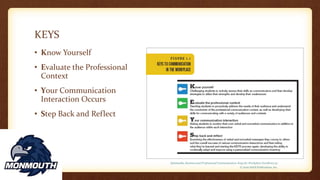
KEYS
• Know Yourself
• Evaluate the Professional
Context
• Your Communication
Interaction Occurs
• Step Back and Reflect
Quintanilla, Business and Professional Communication: Keys for Workplace Excellence 3e
© 2016 SAGE Publications, Inc.
Communication Definitions
• Communication – The process of understanding our experiences and
the experiences of others through the use of verbal and nonverbal
messages
• Communication Bravado - Perceiving communication as effective,
while others perceive it as ineffective
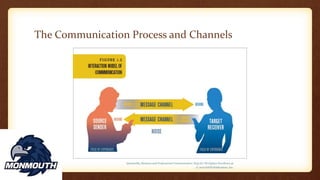
The Communication Process and Channels
Quintanilla, Business and Professional Communication: Keys for Workplace Excellence 3e
© 2016 SAGE Publications, Inc.
Communication Apprehension
• Types
• Trait Apprehension
• Context Apprehension
• Audience-based Apprehension
• Situational Apprehension
• Causes
• Novelty
• Formality
• Subordinate status
• Peer evaluation
• Dissimilarity
• Conspicuousness
• Lack of Attention
• Prior History
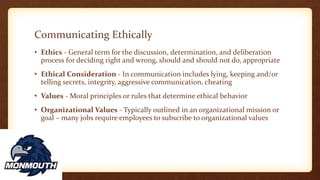
Communicating Ethically
• Ethics - General term for the discussion, determination, and deliberation
process for deciding right and wrong, should and should not do, appropriate
• Ethical Consideration - In communication includes lying, keeping and/or
telling secrets, integrity, aggressive communication, cheating
• Values - Moral principles or rules that determine ethical behavior
• Organizational Values - Typically outlined in an organizational mission or
goal – many jobs require employees to subscribe to organizational values
Resumes, Interviews, and
Negotiations
CHAPTER 4 IN COURSE TEXTBOOK
Job Seeking Process Stage 1 Exploring
• Self-Exploration
• Asking yourself what your strengths,
interests, and priorities are
• Career Exploration
• Researching opportunities that
match your interests, including
shadowing and internships
Job Seeking Process Stage 2 Researching
• Research openings – online, word of mouth, company website, etc.
• LinkedIn, Monster, Career Builder, etc.
• Research company – what do they do? What are their standards? What is
their mission?
• Best place for this info is right on the company’s website or in the job advertisement
• Research job - what are the job duties or responsibilities?
• O*NET, Bureau of Labor Statistics, Career One Stop, etc.
Job Seeking Process Stage 3 Applying
• Cover Letter
• Introduces you to the employer
• 1 to 2 pages
• Connect with job advertisement
• Use examples
• Appropriately Formatted
• Modify for ALL Jobs
• Resume
• Defines all job experience
• Shows qualifications
• Include anything that shows you’ve
worked well with others
• Appropriately Formatted
• Modify based on field
Job Seeking Process Stage 4 Interviewing
• Having a successful interview ties to your research
• Be prepared to spend 2 minutes answering interview questions
• Answer the question
• Provide an example/supporting statement
• Tie the answer to the company
• Be prepared, but don’t sound overly scripted
• Be ready for phone, in-person, or videoconference interview [rarely you won’t even
interview]
• DRESS APPROPRIATELY
Job Seeking Process Stage 5 Following Up
• Thank interviewer(s) at the end of the interview
• Send a Thank You note expressing your appreciation for the interview and
how you look forward to joining the team. Mention anything from the
interview you found interesting.
• Thank you note can be hand written, typed, or even emailed
• Once the thank you note is sent become radio silent unless the job listing is still active a
month after interview or they follow up with you.
• Communicating too frequently after interviewing paints you in a negative light
Job Seeking Process Stage 6 Negotiating
• It is rare you’ll discuss anything related to salary or benefits in an interview
• After you receive a job offer it is okay to discuss salary, benefits, schedule, and
other perks associated with the job
• Often it will be the company offering you something and you may accept or counter propose
• Counterproposal requires tact; as company may have a few candidates in mind and will hire
the person who best fits what they’re willing to offer
• Understand your value
Think Realistically
• Applying for a job doesn’t guarantee you get it
• Having a great Cover Letter, Resume, and Interview doesn’t guarantee you a
job either
• Be able to stand out in your Cover Letter
• Have a Resume that features experience in line with job advertisement
• Leave the interviewer with no choice to hire you
• Understand nepotism and cronyism can play a role in hiring, but often lack of experience or being
over qualified are the main reasons candidates are rejected. This is to some degree labeled “fit.”
Homework
• Cover Letter for Print [9/18]
• Cover Letter for Email [9/18]
• Resume [9/18]
• 1st Draft of LinkedIn [9/18]
• Purchase Course Textbook
• Introduction Post [9/18]
• Create LinkedIn Notes
• Begin working on textbook
questions posted on eCampus
CO 225-53
Business and Professional
Communication
PROFESSOR MARINO
Agenda
• Speech Design
• Delivering a Speech with Professional Excellence
• Business and Professional Writing
• In-Class Exercise
• Homework
Speech Design
CHAPTER 12 IN COURSE TEXTBOOK
Designing a Speech Considerations
• Audience – don’t focus on PPTs, focus on audience
• Context – how is the speech delivered?
• Research – what info is necessary?
• Interest
• Purpose
Monroe’s Motivated Sequence
• Attention step – hook/intro
• Need step – establish the problem
• Satisfaction step – reveal the solution
• Visualization step – increase desire
• Actions step – call to action
Other Considerations
• Transitions
• Hook/Intro
• Who you are, not important
• What you will say, important
• Body Language
• Language
• Conclusions
• Summarize
Delivering a Speech with
Professional Excellence
CHAPTER 13 IN COURSE TEXTBOOK
How to Succeed in Presenting?
• Avoid Adrenaline Rush
• Reduce anxieties
• Adrenaline rush can lead to
• Sweating
• Rushing
• Filler words
• Lack of volume control
• Lack of speed control
• Lack of eye contact
• What to Do?
• Sense of Play
• Create an Outline
• Visual Aids
• Practice
• Feedback
• Reduces anxiety
• Increases comfort
Presenting as a Team
• Similar to individual, but one big speech with all members involved
• Transitions important
• Repetition should be minimal
• Audience and info critical
• Organized by who is presenting
In-Class Exercise
• Create outline for Presentation #1
• Write down three ways you intend to reduce anxiety and adrenaline
prior to next week’s 3 minute presentation
• Consider past presentations; what is one area of weakness? How will
you address it?
• Write on paper; hand in at end of class
Business and Professional Writing
CHAPTER 9 IN COURSE TEXTBOOK
Sending the Message
• Message Clarity
• Message Structure
• Message Presentation
• Practice and Re-Write
Types of Professional Written Documents
• Important in this class:
• Cover Letter
• Resume
• Thank You Note
• Press Release
• Other Types:
• Employee Reviews
• Recommendation Letters
• Memos
• Proposals
• Planning Documents
• Proactive Media
• E-mail
Homework
• Introduction Post [9/18]
• Cover Letter for Print [9/18]
• Cover Letter for Email [9/18]
• Resume [9/18]
• 1st Draft of LinkedIn [9/18]
• Prepare for Presentation #1 [in-class 9/18]
CO 225-53
Business and Professional
Communication
PROFESSOR MARINO
Agenda
• Presentation #1
• Review Cover Letter, Resume, and LinkedIn thoughts individually
• Homework
Homework
• Self Reflection for Presentation #1
CO 225-53
Business and Professional
Communication
PROFESSOR MARINO
Agenda
• Verbal and Nonverbal Communication
• Job Interview In-Class Exercise
• Listening
• Homework
Verbal and Nonverbal
Communication
CHAPTER 2 IN COURSE TEXTBOOK
Communication
• Verbal
• Language
• Words and fillers
• Meaning and context
• Nonverbal
• 65 to 93% of communication is
nonverbal
• All communication not in words
• Express emotion
• Convey attitude
• Personality
• Accompanies verbal communication
Communication Rules
• Regulative Communication
Rules
• Describes when, how, where, and
with whom to talk about certain
things
• Constitutive Communication
Rules
• Defines what communication
means, such as eye contact, showing
affection, and showing
appropriateness
More on Nonverbal Communication
• Repeat, conflict, substitute, or
complement
• Three Dimensions
• Immediacy – positive or negative
• Status – perception
• Responsiveness – active or passive
• Vocal Expression/Vocalics
• Space/Proxemics
• Environment
• Physical Appearance
• Kinesics
• Facial Expression and Eye
Behavior
• Touch/Haptics
Job Interview In-Class Exercise
• Pair up with another person in
class
• Take out a piece of paper
• Write your name on it, make it clear
who you are interviewing
• Write down key points to their
responses
• Each person will be interviewed
by asking 5 common questions
in interviews
• 5 Common Questions
• Tell me about yourself
• What do you think is your biggest
weakness?
• Where do you see yourself in five
years?
• If you were an animal, which would
you want to be?
• How would others describe you?
Listening
CHAPTER 3 IN COURSE TEXTBOOK
Hearing vs. Listening
• Hearing
• Physical ability to detect sounds
• Listening
• Concentrating on communication to
find meaning
• The stronger the listener, the better
the job
Barriers to Listening
• Noise – external and internal
• Jargon
• Message Overload
• Receiver Apprehension
• Bias
• Failing to actively listen
Types of Listeners
• Informational listener – focuses
on content
• Empathetic listener – seeks to
understand the speaker’s point
of view
• Passive listener – taking in a
message without feedback or
verification
• People-oriented listeners -
Interested in demonstrating
concern for others' emotions and
interests, finding common
ground, and responding
• Action-oriented listeners-
Interested in direct, concise,
error-free communication that
accomplishes a goal
• Active listeners – work to make
sense of message and verify
More Types of Listeners
• Content-oriented listeners - Interested in intellectual challenge and complex
information
• Time-oriented listeners - Prefer brief communication, to the point
• Conversational listeners in interpersonal situations
• Professional listeners in speaking and listener situations
HURIER Model
• Hearing
• Understanding
• Remembering
• Interpreting
• Evaluating
• Responding
Homework
• Create an Interview Thank You Note [to person who interviewed you in
class today]
• Begin research on company and job you want
CO 225-53
Business and Professional
Communication
PROFESSOR MARINO
Agenda
• Diverse Workplace
• Interpersonal Communication at Work
• Strengthening Teams and Conducting Meetings
• Homework
Getting to Know Your Diverse
Workplace
CHAPTER 5 IN COURSE TEXTBOOK
Key Considerations
• Socialization - The experiences that shape our attitudes, perceptions,
emotions, and communication choices
• Culture - The rules of living and functioning in society
• Organizational culture - The way an organization operates, The
attitudes the employees have, The overall tone and approach to any
given business
• Assimilation - The adjustment period and “settling in” that's common
for anyone starting a new job
Key Considerations cont.
• Cultural Diversity Awareness and
Worldview
• Cultural Competence
• Mutual Respect or Mutual
Understanding
• Gender
• Ethnicity and Race
• Language Differences
• Religion
• Disabilities
Interpersonal Communication at
Work
CHAPTER 6 IN COURSE TEXTBOOK
Types of Work Communication
• Superior-Subordinate
Relationships
• Coworker Relationships
• Customer/Client Relationships
• Romance or intimacy can arise
because of time spent together
• Should be discouraged because it
can cause distractions and
favoritism
• Sexual harassment is
communicative behaviors that
can lead to hostile work
environment
Distorted Messages
• Gatekeeping – some information withheld
• Summarization – messages summarized to emphasize parts of message
• Withholding – information not passed on
• General distortion – message changed
Ways to Avoid Distorted Message
• Limit the number of people a message travels through
• Go to source of message for clarification
• Keep communication channels open with subordinates and customers
• Never “shoot the messenger”
Etiquette and Privacy
• Etiquette:
• Professional etiquette is a matter of
displaying social etiquette or good
manners in a professional setting
• Privacy:
• Communication Privacy
Management
• In the workplace, decisions must be
made about what we keep private,
share, or self-disclose
• Communication privacy
management impacts
communication about sexual
identity
Strengthening Teams and
Conducting Meetings
CHAPTER 7 IN COURSE TEXTBOOK
Groups vs. Teams
• A Group Is:
• Three or more people who are
working toward a common goal or
share a common purpose
• A Team Is:
• A group that shares leadership
responsibility
• Creates a team identity
• Achieves mutually defined goals
• Fosters innovative thinking
Important Aspects of Meetings
• Environment – Time & Location
• Topic/Agenda
• Participants
Norms
• Norms are unwritten rules of behavior that influence our behavior in
the workplace
• Reflect on the norms in your workplace
• Read the employee handbook
• Work to eliminate negative norms by
• Addressing them promptly
• Working to fix them
Team Roles
• Initiator
• Information Giver
• Information Seeker
• Opinion Giver
• Opinion Seeker
• Coordinator
• Procedural Developer
• Summarizer
• Supporter
• Harmonizer
• Gatekeeper
• Blocker
• Dominator
• Attacker
• Clown
• Explorer
• Artist
• Judge
• Warrior
Problem Solving - Dewey
• John Dewey’s Reflective
Thinking Process
• Step 1: Describe and Analyze the
Problem
• Discuss and identify the problem, share
experiences and feedback
• Step 2: Generate Possible Solutions
• Techniques: Brainstorming, nominal
group technique, idea writing, and role
playing
• Step 3: Evaluate all Solutions
• Use a criterion or standard to make
decisions
• Techniques: keep/scratch, value
rating, T-chart,
• Step 4: Decide on a Solution
• Techniques: decision by leader,
majority rule, compromise, and
consensus
• Step 5: Planning How to
Implement the Solution
Problem Solving Approaches
• Decision by Leader Approach
• Not truly functioning as a team
• Role of members is to recommend or
advise the leader
• Majority Rule Approach
• Team members cast a vote for the
solution they find most meritorious
• Can lead to division and lack of
innovation
• Compromise Approach
• Lose-lose approach to decision
making
• Goal becomes narrowing options
rather than developing innovative
ideas
• Consensus Approach
• More time consuming
• A solution or agreement is reached
that all team members can support
Conflict, for lack of a better word, is Good
• Groupthink is the tendency for cohesive
groups to make faulty decisions
• Groupthink Causes: highly cohesive
group led by charismatic leader
• Avoiding Groupthink: introduce
conflict, divide into subgroups, have
leader withhold thoughts and
conclusions
• Meetingthink is the suspension of
critical thinking
• False Empowerment: leader acting as
though group has a say, but leader will
have ultimate say
• Overload: when group members
cannot concentrate on issue due to
having other things on their mind
• Poorly Run Meetings: disorganized due
to lack of agenda, too lengthy, wrong
participants
• Avoiding Meetingthink: consider the
environment, use agenda, invite right
people, stick to topic at hand
5 Stages of Team Development – Productive Conflict
• Forming: groups are polite and impersonal as they test the waters
• Storming: conflict appears and members engage in infighting and
often clash with the leader
• Norming: group develops procedures for organizing, giving feedback,
and confronting
• Performing: members carry out the duties of the group
• Adjourning: group completes its work, resolves issues, and comes to a
close
Homework
• Prepare for Presentation #2
CO 225-53
Business and Professional
Communication
PROFESSOR MARINO
Agenda
• Presentation #2
• Informing and Persuading
• Homework
Informing and Persuading
CHAPTER 11 IN COURSE TEXTBOOK
Presenting – Tell a Story
• Practice to avoid fear of speaking
• Seek out opportunities
• Develop stronger
communication skills
• Informative Speeches
• Present facts
• Persuasive Speeches
• Presents an argument
• Passive – agree or disagree
• Call to Action
• Specific Purpose
• Clearly covered by end of speech
Presenting to Inform
• Backed by facts
• Definitions
• Examples
• Statistics
• Quotes
• Objective
• Ethos and Logos
• Level of audience knowledge
• Incorporate Supporting Material
• General Purpose – to inform
• Specific Purpose
• Analyze audience/context
• Intro/Conclusion
• Clear and easy to follow
Speaking to Persuade
• Ethos, Logos, and Pathos
• General Purpose – to persuade
• Specific Purpose
• Analyze audience/context
• Intro/Conclusion
• Clear and easy to follow
• Entire speech persuasive/not
opinion
• Backed by credible evidence
• Present based on
audience/context
Ethos
Your credibility as a presenter &
the credibility of your information
• Your expertise
• Cite sources
• Find common ground
Pathos
Emotional Appeal
Select words with strong
emotional or implied
meaning
• Argue like an attorney
Logos
Words of presentation in context
of organization and info
• Organization of presentation
• Is it supported?
• Grammar/Punctuation, etc.
Types of Reasoning
• Inductive Reasoning
• Use examples/info to generalize
• Deductive Reasoning
• General info to specific conclusion
• Cognitive Dissonance
• Two ideas that contradict each other
• Reduce or resolve contradiction
• Casual Reasoning
• Cause and effect relationship
• Analogical Reasoning
• Reasoning from analogies
Homework
• Presentation #2 Self Reflection
• LinkedIn Profile
• Prepare Sales Pitch #1
CO 225-53
Business and Professional
Communication
PROFESSOR MARINO
Agenda
• Sales Pitch #1
• Work Life Balance
• Technology in the Workplace
• Homework
Work Life Balance
CHAPTER 14 IN COURSE TEXTBOOK
What’s Work-Life Balance?
• Defined as boundary between work and life
• Lack of work-life balance can lead to negative communications
• Work-life balance occurs when we are successful at navigating the role-
related expectations between the individual and his or her partners in
work, family, and community
Why’s Work-Life Balance Important?
• Avoid burnout
• Greater control over working life
• Have the time to focus on life outside work
• Don’t bring problems from home and vice versa
• Shown loyalty and commitment
• Have improved self-esteem, health, concentration, and confidence
• Have better relations with management
• Feel a greater responsibility and sense of ownership
Why’s Work-Life Balance Important to the Employer?
• Employee retention – getting
employees to continue working for the
same company
• Employee attrition – the loss or
turnover of employees to other jobs and
industries perceived as having healthier
workplace cultures
• Maximized available labor
• Reduced costs
• Retaining valued employees
• Reputation of being an employer of
choice
• Reduced absenteeism
• Increased productivity
• Attracting a wider range of candidates,
such as older, part-time workers
• Making employees feel valued
Burnout
• Burnout is caused by:
• Same work with little variation
• Giving a lot and getting little thanks
back
• No sense of accomplishment or
meaning in work
• Under constant pressure to produce,
perform, and meet unrealistic
deadlines
• Working with difficult people
• Conflict and tension among workers
and abundance of criticism
• Lack of trust between supervisors and
workers
• No opportunities for personal
expression or growth
• Unrealistic demands on time and
energy
• Having jobs that are both personally
and professionally taxing without
opportunity for continuing training and
growth
• Unresolved personal conflicts beyond
the job situation
Triggers
• Experience
• Personality
• Angry Customers and Clients
• Workplace Bullying
• Workplace Mobbing
• Life Demands
• Health
• Find Balance:
• Say No
• Grow Emotional Intelligence
• Develop Time Management
Skills
• Organize with Technology
• Take a Vacation
Personality
Type A
• Highly competitive, driven,
focused on time and deadlines,
aggressive, find it difficult to
relax
• Get a lot done but have difficulty
finding work-life balance
Type B
• Laid back, easygoing, don’t find
it difficult to relax
• Leads to procrastination and
last-minute pushes to finish
projects
Type AB
• combination of both types
Technology in the Workplace
CHAPTER 8 IN COURSE TEXTBOOK
Pros and Cons
Positives:
• Easier to communicate
• Time Management
Negatives:
• Record of Communication
• Security Issues
• May Be Inappropriate in a certain
setting
• Employee Surveillance
• Time Management
• Information Overload - three main
types: email forwarding, SPAM, and
Phishing
• Electronic Aggression
Computer Mediated Communication (CMC)
• Communication Using Technology is Computer-Mediated
Communication (CMC)
• Virtual work teams accomplish traditional tasks using CMC
• Virtual teams save time and money
• Technology should not be a barrier to effective communication
Homework
• Sales Pitch #1 Self Reflection
CO 225-53
Business and Professional
Communication
PROFESSOR MARINO
Agenda
• In-Class Interviews
• Come during your designated time slot
• Homework
Homework
• Rough Draft of Press Release
• Rough Draft of Video Resume
• Interview Reflection
CO 225-53
Business and Professional
Communication
PROFESSOR MARINO
Agenda
• Workplace Conduct
• Job Transitioning
• Homework
Workplace Conduct
NOT IN COURSE TEXTBOOK
Respectful Workplace
• A respectful workplace is one where all employees
• are treated fairly
• difference is acknowledged and valued
• communication is open and civil
• conflict is addressed early
• there is a culture of empowerment and cooperation
106
Respectful Workplace Cont.
• The respectful workplace requires you to treat people well
• Understand the following concepts:
• Diversity
• Sexual Harassment
• Ethics
• Code of Conduct of Organization
• Human Resources provided documentation
• State Law
• Federal Law
• Norms of the organization and job field
107
Understanding Culture
• Remember Googliness?
• Any place you work will have a specific culture associated with it
• Culture:
• Can differ from company to company
• Is largely perceived
• Can be difficult to explain to others, but people employed in organization know the
culture
• Culture within may be different from outside perception
108
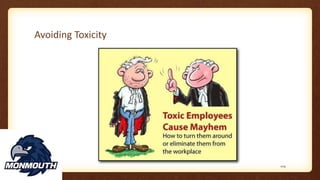
Avoiding Toxicity
109
Workplace Toxicity Visual Example
110
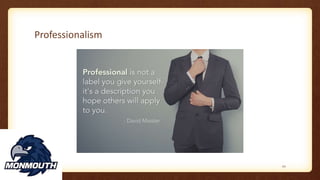
Professionalism
111
Workplace UNProfessionalism Visual Example
112
Job Transitioning
NOT IN COURSE TEXTBOOK
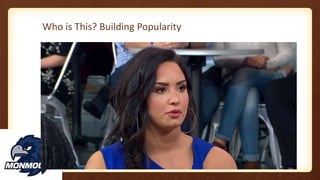
Who is This? Building Popularity
114
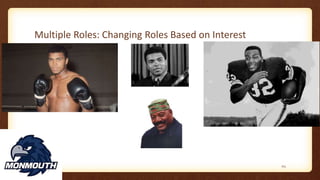
Multiple Roles: Changing Roles Based on Interest
115
Types of Job Transitions
• Termination – you’re fired
• Laid-off – you’re fired, but small chance you could be back
• Quitting/Resigning – you leave on your terms for a variety of reasons
• Relocation – you leave on your own terms or potentially due to a transfer
to another location
116
Dealing: Termination or Laid-off
• These Job Transitions aren’t ones you wanted, so how do you deal with
them:
• Know being re-hired is very unlikely barring something illegal had occurred
• Career Counseling
• Temp Agencies
• Unemployment Office’s “Retraining Center”
• Revise Resume & Cover Letter
• Apply for new jobs
• Consult with friends, family, and former co-workers
117
Dealing: Leaving by Your Terms
• In some cases you change jobs because you want to
• Have $ saved
• Have confidence
• Exhibit the skills you believe will make you successful elsewhere
• Visit employment sites like Monster for tips
• Have a plan
• Have a plan B
• Have a plan C
• Consider Entrepreneurship/Small Business Management
• If relocating, ask why, you may find you’re an asset that could be better used elsewhere
118
School to Work
• The Bureau of Labor Statistics (2016) reported that employees change jobs
every 4.2 years; potentially 10 to 15 job changes of your lifetime
• Understand your degree won’t define your job
• Bachelor’s is the new High School diploma
• Have someone else pay for advanced degrees
• Brand yourself – cover letter, resume, personal website, social media, etc.
• Experience – internships, volunteer work, job shadowing, etc.
• Most jobs are looking for college graduates with 5+ years experience for entry level jobs
• Ask for help – professors, parents, friends, Career Center, etc.
• Prep for transition
119
Too Good to be True
120
Homework
• Prepare Sales Pitch #2
CO 225-53
Business and Professional
Communication
PROFESSOR MARINO
Agenda
• Sales Pitch #2
• Leadership and Conflict Management
• Homework
Leadership and Conflict
Management
CHAPTER 10 IN COURSE TEXTBOOK
Leadership
• Leadership qualities are debated
• Leadership used to be viewed solely as certain traits such as charisma
or job title
• Physical traits, social background traits, social traits, personality traits,
and task related traits also played a role
• Now leadership is viewed as a collaborative relationship of mutual
influence and common purposes
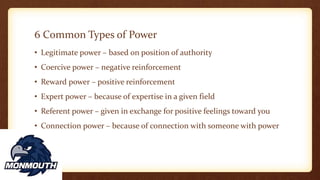
6 Common Types of Power
• Legitimate power – based on position of authority
• Coercive power – negative reinforcement
• Reward power – positive reinforcement
• Expert power – because of expertise in a given field
• Referent power – given in exchange for positive feelings toward you
• Connection power – because of connection with someone with power
Managerial vs. Leadership Power
• Managerial Power – represents
legitimate power from having
the title of manager
• Leadership Power – represents a
variety of types of power
Leadership Theories
Broad Categories:
• Authoritative style – leader makes all
the decisions with little input from
team
• Laissez-faire style – team makes the
decisions with little input from the
leader
• Democratic style – leader follows
will of team
Behavioral Theories:
• Theory X – managers view
employees as lacking motivation,
prefer being told what to do, and
disliking work
• Theory Y – managers view
employees as responsible, motivated
by goals, want to work, organizations
don’t use employees to their full
potential
Situational Leadership
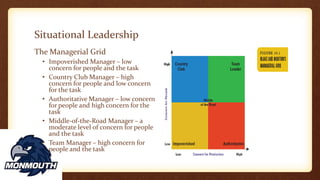
The Managerial Grid
• Impoverished Manager – low
concern for people and the task
• Country Club Manager – high
concern for people and low concern
for the task
• Authoritative Manager – low concern
for people and high concern for the
task
• Middle-of-the-Road Manager – a
moderate level of concern for people
and the task
• Team Manager – high concern for
people and the task
Situational Leadership cont.
• Situational Leadership Theory
considers maturity and readiness
• Contingency Theory - no best
way
• Consider relationship, structure, and
power
• Telling
• Selling
• Participating
• Delegating
Transformational Leadership
Transformative leaders:
• Articulate a goal or vision to an organization
• Inspire followers to make that vision a reality
• Lead the organization to move beyond personal interests for the good
of the organization
Leadership and Hiring
• Leaders should be involved in all
hiring decisions, pay attention to
needs, and those who fit the needs
• Leaders should be open about what
the company has to offer
• During an interview leaders are
prepared, professional, and make
the interviewee feel relaxed
• Leaders make sure new employees
are properly trained and have
resources necessary to complete all
job duties
• Effective leaders follow up with new
employees to make sure they are
successful in their tasks and so they
can acknowledge their successes
• Provide feedback
• Hold them accountable
• Be specific and clear
Giving Feedback
Goal-Setting Theory –
• Idea that developing and setting
goals for the team is more
effective and motivating than
setting goals for individual
members
• Enacting Consequences – Firing
• Use scripting – mentally
rehearsing what you will say
• Difficult but sometimes
necessary
• No reason to feel guilty if all the
steps to help employee have been
taken
• Sociopaths are a concern – only 1
in 25
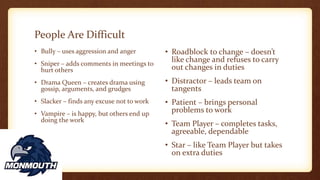
People Are Difficult
• Bully – uses aggression and anger
• Sniper – adds comments in meetings to
hurt others
• Drama Queen – creates drama using
gossip, arguments, and grudges
• Slacker – finds any excuse not to work
• Vampire – is happy, but others end up
doing the work
• Roadblock to change – doesn’t
like change and refuses to carry
out changes in duties
• Distractor – leads team on
tangents
• Patient – brings personal
problems to work
• Team Player – completes tasks,
agreeable, dependable
• Star – like Team Player but takes
on extra duties
Public Image
• Public Image – impression you give or present to others verbally and
nonverbally
• Public Image you present should be that of a leader with professional
excellence
• Impression Management - directing impression
• Don’t try to create a false impression
• If you want to be viewed as a leader, act and dress like a leader
Homework
• Sales Pitch #2 Self Reflection
• Prepare Presentation #3
CO 225-53
Business and Professional
Communication
PROFESSOR MARINO
Agenda
• Presentation #3
• Work on Job Portfolio
• Homework
Job Portfolio
• Meet with individual students to discuss in-class interview
• Spend class time working on:
• Presentation #3 Reflection
• Updated Resume
• Updated Cover Letter
• Updated Press Release
• Interview Reflection
• Work on updating Video Resume at home – may be too loud in class [unless you’re just
editing]
Homework
• Presentation #3 Self Reflection
• Textbook Questions
• Job Portfolio
CO 225-53
Business and Professional
Communication
PROFESSOR MARINO
Agenda
• Take Home Section of Final Exam Review
• In-Class Section of Final Exam Review
• Homework
Take Home Section of Final Exam
• 50 Multiple Choice Questions on eCampus [Quiz in Final Exam folder]
• 61 Questions and Answers are presented; 50 of them are on the exam
• Best piece of advice is to go somewhere and print this PPT to use when
taking the take home portion so you receive a perfect score; as in-class
portion is essay/short answer
What does KEYS stand for?
• Know yourself, Evaluate the professional context, Your
communication interaction occurs, & Step back and reflect
What is workplace professionalism?
• acting appropriately in a workplace environment; includes attire,
attitude, and language
How does workplace culture influence conduct?
• culture starts at the top of an organization and new employees follow
the conduct they see
What is required to know to have a respectful
workplace?
• understanding of laws, ethics, and proper treatment of individuals
What is a respectful workplace?
• one where all employees are treated fairly, difference is acknowledged
and valued, communication is open and civil, conflict is addressed
early, there is a culture of empowerment and cooperation
What is workplace toxicity?
• an uncomfortable work environment usually caused by inappropriate
actions of individuals or a group which can influence the entire
workplace
What can change the meaning of a message?
• tone and inflection
What are generational differences?
• differences in understanding the same concept/situation based on
generation an individual was born into
What types of reasoning exist?
• Inductive, casual, deductive, & analogical
What is your public image?
• Impression you give or present to others verbally & nonverbally
What is cultural competence?
• Level of knowledge a person has about others who are different
What can be used to evaluate a team decision?
• decision matrix
What does a team achieve?
• mutually defined goals
What is a distractor?
• Leads team on tangents
What do warriors do?
• Develop & carry out the plan
What is the majority rule approach?
• Team members cast a vote for the solution
What is context apprehension?
• fear of communicating in certain contexts
What is the grapevine?
• primarily gossip and misinformation spread by an unreliable source
What is message clarity?
• Specific language with precise references
What is general distortion?
• Message has been changed
What is gatekeeping?
• Some information is withheld
What technology can distract you from work-life
balance?
• e-mail
How have Google & YouTube helped you in this
course?
• resume templates, cover letter templates, and video resume examples
What are add-ons to a presentation?
• visual enhancements to the presentation, such as pictures or videos
What is electronic aggression?
• Aggressive emotion-filled messages
What is communication using technology?
• Computer-Mediated Communication (CMC)
What is the most important thing to do before an
interview?
• research/prepare
What do resumes do?
• get you in the door for an interview
What are three job search strategies?
• Search for any job, search for current qualifications, and search for
future qualifications
When do job negotiations begin?
• Once job is offered
Which is required at the beginning of an interview?
• Firm handshake
What are the two types of speeches?
• Informative & persuasive
What are two common behavioral theories?
• Theory X & Theory Y
Which two responses occur to handle conflict?
• Fight or flight
What is involved in the Applying stage of the job-
seeking process?
• Developing resumes & cover letters
Which types of noise are barriers to listening?
• External & Internal
What are the 3 personality types?
• Type A, Type B, & Type AB
Which are leadership theories/styles?
• Situational, contingency, transformational
What three issues contribute to information overload
via technology?
• E-mail forwards, SPAM, Phishing
What can cause a poorly run meeting?
• Lack of agenda, too length, or wrong participants
How can interviews occur?
• Telephone, videoconferencing, face-to-face
What are 6 types of listening styles?
• active, people oriented, action oriented, content oriented, time
oriented, informational
What are the 6 parts of the communication process?
• sender, encoding, channel, decoding, receiver, feedback
What are 6 general types of power?
• Legitimate, coercive, reward, expert, referent, connection
What are the 6 stages of the job-seeking process?
• Exploring, researching, applying, interviewing, following up, &
negotiating
What are the 6 steps of the HURIER model?
• Hearing, understanding, remembering, interpreting, evaluating, &
responding
What is haptics?
• Touch
What is proxemics?
• Space
What are 5 management styles?
• Impoverished, country club, authoritative, middle-of-the-road, & team
What are the 5 stages of Team Development?
• Forming, storming, norming, performing, & adjourning
What are the steps of Dewey’s reflective thinking
process?
• Describe & analyze problem, generate possible solutions, evaluate
solutions, decide on solution, and plan how to implement solution
What is cognitive dissonance?
• Holding two contradictory ideas
What is pathos?
• Emotional appeal
What is logos?
• Words of presentation in context of organization & supporting info
What is ethos?
• Credibility as presenter & credibility of info
What are norms?
• Unwritten rules of behavior that influence our behavior in the
workplace
What is jargon?
• Organizational/field specific language
Communicating with supervisors can be done in what
two ways?
• Ingratiation & advocacy
What are the two types of communication rules?
• Regulative & Constitutive
What % of communication are nonverbal symbols?
• 65 % to 93%
What is communication bravado?
• Perceiving communication as effective, while others perceive it as
ineffective
In-Class Section of Final Exam
• 10 Essay/Short Answer Questions
• 3 Extra Credit Essay/Short Answer Questions
• Bring paper to write responses on [December 18th]
Explain the components of the communication model.
• 9-4 Agenda
• Slide 13
• Picture and Notes
Compare & contrast verbal & nonverbal
communication.
• 9-25 Agenda
• Slide 4
Define the HURIER model & explain how it can
improve listening.
• 9-25 Agenda
• Slide 13
• 9-25 Additional Info
Discuss the 6 stages of the job-seeking process.
• 9-4 Agenda
• Slides 17-22
• Notes too
Consider diversity, interpersonal communication, & technology in the
workplace & explain the roles they may play in your work behavior.
• Answers should vary on this question
• Discuss all three concepts and tie them to your work behavior
Discuss the differences between thank-you letters,
press releases, & email communication.
• Thank you letters – 9-4 Agenda Slide 21
• Press Releases – discussed in class and examples given
• Email Communication – pros and cons 10-23 Agenda Slide 11
Discuss various types of power.
• 11-13 Agenda
• Slide 5
Explain the role ethos, logos, & pathos play in
persuasive speeches.
• 10-9 Agenda
• Slides 5-9
Explain how "triggers to imbalance" in work-life balance influence the
imbalance & how they can be avoided.
• 10-23 Agenda
• Slide 8
Explain the Second Act concept obtaining to job
transitions.
• 11-6 Agenda
• Slides 15-17
Explain what body language is. Give 3 examples.
• Response will vary by person
Describe the advantages and disadvantages of a hand-
written thank you note to an interviewer.
• 9-4 Agenda
• Slide 21
• Notes too
Define job transitioning. Discuss the importance of
understanding job-transitioning processes.
• 11-6 Agenda
• Slides 14 and 17
Homework
• Textbook Questions
• Job Portfolio
CO 225-53
Business and Professional
Communication
PROFESSOR MARINO
Agenda
• Presentation #4
• Homework
Homework
• Self Reflection for Presentation #4
• Group Presentation Assessment

CO 225-53 9-4-18 Agenda.pptx

  • 1.
    CO 225-53 Business andProfessional Communication PROFESSOR MARINO
  • 2.
    Agenda • About theProfessor • About the Course • How to Succeed in CO 225 Without Really Trying • Business and Professional Excellence in the Workplace • Resumes, Interviews, and Negotiations • Homework
  • 3.
    About the Professor •Alumni: Point Pleasant Borough High School, Stockton University [BA], Georgian Court University [MBA], Bowling Green State University [MEd] • Currently pursuing EdD at the University of West Florida • Adjunct Professor at Monmouth University, Ocean County College and Bowling Green State University • Small Business Owner and Founder/Board President of a Non-Profit • Financial Blogger – Nasdaq, The Street, and Seeking Alpha
  • 4.
    About the Course CourseMeets: • Tuesdays • 6:05 to 9 PM • A 606 Review Syllabus and eCampus
  • 5.
    About the Coursecont. Currently on eCampus • Course Syllabus • Course Assignments • Course Content to be added • mamarino@Monmouth.edu My Email Address for MU • Tuesdays After Class • A 606 Office Hours • 848-333-8637 Emergency Contact
  • 6.
    How to Succeedin CO 225 Without Really Trying 1. Come to Class on Time [Time is Money] 2. When I say “Alright Young Scholars” Class Begins 3. Treat this course as a Job. Conduct yourself in a Professional and Ethical manner 4. Complete all assignments based on the instructions provided 5. Complete all assignments on time 6. Check eCampus and your E-mail often 7. Don’t Ask for Extra Credit at the end of the semester 1. Extra credit opportunities will be provided throughout the course of the semester. It is your responsibility to complete them. They will require effort, but can only help your grade.
  • 7.
    Business and Professional Excellencein the Workplace CHAPTER 1 IN COURSE TEXTBOOK
  • 8.
    What is involvedin this course? • Interviewing • Relational Communication • Mediated Communication • Presentational Speaking • Written Documents • Interpersonal Communication at Work
  • 9.
    Important Factors ofCommunication • Feedback • Previous experience • Physical surroundings • Communication Channels • Culture • Relationships
  • 10.
    Important Factors inCO 225 • Verbal and Nonverbal Communication • Resumes, Interviews, and Negotiations • Diversity • Communication at Work • Team/Group Work • Technology • Business and Professional Writing • Leadership and Conflict Management • Presentations • Work-Life Balance
  • 11.
    KEYS • Know Yourself •Evaluate the Professional Context • Your Communication Interaction Occurs • Step Back and Reflect Quintanilla, Business and Professional Communication: Keys for Workplace Excellence 3e © 2016 SAGE Publications, Inc.
  • 12.
    Communication Definitions • Communication– The process of understanding our experiences and the experiences of others through the use of verbal and nonverbal messages • Communication Bravado - Perceiving communication as effective, while others perceive it as ineffective
  • 13.
    The Communication Processand Channels Quintanilla, Business and Professional Communication: Keys for Workplace Excellence 3e © 2016 SAGE Publications, Inc.
  • 14.
    Communication Apprehension • Types •Trait Apprehension • Context Apprehension • Audience-based Apprehension • Situational Apprehension • Causes • Novelty • Formality • Subordinate status • Peer evaluation • Dissimilarity • Conspicuousness • Lack of Attention • Prior History
  • 15.
    Communicating Ethically • Ethics- General term for the discussion, determination, and deliberation process for deciding right and wrong, should and should not do, appropriate • Ethical Consideration - In communication includes lying, keeping and/or telling secrets, integrity, aggressive communication, cheating • Values - Moral principles or rules that determine ethical behavior • Organizational Values - Typically outlined in an organizational mission or goal – many jobs require employees to subscribe to organizational values
  • 16.
  • 17.
    Job Seeking ProcessStage 1 Exploring • Self-Exploration • Asking yourself what your strengths, interests, and priorities are • Career Exploration • Researching opportunities that match your interests, including shadowing and internships
  • 18.
    Job Seeking ProcessStage 2 Researching • Research openings – online, word of mouth, company website, etc. • LinkedIn, Monster, Career Builder, etc. • Research company – what do they do? What are their standards? What is their mission? • Best place for this info is right on the company’s website or in the job advertisement • Research job - what are the job duties or responsibilities? • O*NET, Bureau of Labor Statistics, Career One Stop, etc.
  • 19.
    Job Seeking ProcessStage 3 Applying • Cover Letter • Introduces you to the employer • 1 to 2 pages • Connect with job advertisement • Use examples • Appropriately Formatted • Modify for ALL Jobs • Resume • Defines all job experience • Shows qualifications • Include anything that shows you’ve worked well with others • Appropriately Formatted • Modify based on field
  • 20.
    Job Seeking ProcessStage 4 Interviewing • Having a successful interview ties to your research • Be prepared to spend 2 minutes answering interview questions • Answer the question • Provide an example/supporting statement • Tie the answer to the company • Be prepared, but don’t sound overly scripted • Be ready for phone, in-person, or videoconference interview [rarely you won’t even interview] • DRESS APPROPRIATELY
  • 21.
    Job Seeking ProcessStage 5 Following Up • Thank interviewer(s) at the end of the interview • Send a Thank You note expressing your appreciation for the interview and how you look forward to joining the team. Mention anything from the interview you found interesting. • Thank you note can be hand written, typed, or even emailed • Once the thank you note is sent become radio silent unless the job listing is still active a month after interview or they follow up with you. • Communicating too frequently after interviewing paints you in a negative light
  • 22.
    Job Seeking ProcessStage 6 Negotiating • It is rare you’ll discuss anything related to salary or benefits in an interview • After you receive a job offer it is okay to discuss salary, benefits, schedule, and other perks associated with the job • Often it will be the company offering you something and you may accept or counter propose • Counterproposal requires tact; as company may have a few candidates in mind and will hire the person who best fits what they’re willing to offer • Understand your value
  • 23.
    Think Realistically • Applyingfor a job doesn’t guarantee you get it • Having a great Cover Letter, Resume, and Interview doesn’t guarantee you a job either • Be able to stand out in your Cover Letter • Have a Resume that features experience in line with job advertisement • Leave the interviewer with no choice to hire you • Understand nepotism and cronyism can play a role in hiring, but often lack of experience or being over qualified are the main reasons candidates are rejected. This is to some degree labeled “fit.”
  • 24.
    Homework • Cover Letterfor Print [9/18] • Cover Letter for Email [9/18] • Resume [9/18] • 1st Draft of LinkedIn [9/18] • Purchase Course Textbook • Introduction Post [9/18] • Create LinkedIn Notes • Begin working on textbook questions posted on eCampus
  • 25.
    CO 225-53 Business andProfessional Communication PROFESSOR MARINO
  • 26.
    Agenda • Speech Design •Delivering a Speech with Professional Excellence • Business and Professional Writing • In-Class Exercise • Homework
  • 27.
    Speech Design CHAPTER 12IN COURSE TEXTBOOK
  • 28.
    Designing a SpeechConsiderations • Audience – don’t focus on PPTs, focus on audience • Context – how is the speech delivered? • Research – what info is necessary? • Interest • Purpose
  • 29.
    Monroe’s Motivated Sequence •Attention step – hook/intro • Need step – establish the problem • Satisfaction step – reveal the solution • Visualization step – increase desire • Actions step – call to action
  • 30.
    Other Considerations • Transitions •Hook/Intro • Who you are, not important • What you will say, important • Body Language • Language • Conclusions • Summarize
  • 31.
    Delivering a Speechwith Professional Excellence CHAPTER 13 IN COURSE TEXTBOOK
  • 32.
    How to Succeedin Presenting? • Avoid Adrenaline Rush • Reduce anxieties • Adrenaline rush can lead to • Sweating • Rushing • Filler words • Lack of volume control • Lack of speed control • Lack of eye contact • What to Do? • Sense of Play • Create an Outline • Visual Aids • Practice • Feedback • Reduces anxiety • Increases comfort
  • 33.
    Presenting as aTeam • Similar to individual, but one big speech with all members involved • Transitions important • Repetition should be minimal • Audience and info critical • Organized by who is presenting
  • 34.
    In-Class Exercise • Createoutline for Presentation #1 • Write down three ways you intend to reduce anxiety and adrenaline prior to next week’s 3 minute presentation • Consider past presentations; what is one area of weakness? How will you address it? • Write on paper; hand in at end of class
  • 35.
    Business and ProfessionalWriting CHAPTER 9 IN COURSE TEXTBOOK
  • 36.
    Sending the Message •Message Clarity • Message Structure • Message Presentation • Practice and Re-Write
  • 37.
    Types of ProfessionalWritten Documents • Important in this class: • Cover Letter • Resume • Thank You Note • Press Release • Other Types: • Employee Reviews • Recommendation Letters • Memos • Proposals • Planning Documents • Proactive Media • E-mail
  • 38.
    Homework • Introduction Post[9/18] • Cover Letter for Print [9/18] • Cover Letter for Email [9/18] • Resume [9/18] • 1st Draft of LinkedIn [9/18] • Prepare for Presentation #1 [in-class 9/18]
  • 39.
    CO 225-53 Business andProfessional Communication PROFESSOR MARINO
  • 40.
    Agenda • Presentation #1 •Review Cover Letter, Resume, and LinkedIn thoughts individually • Homework
  • 41.
    Homework • Self Reflectionfor Presentation #1
  • 42.
    CO 225-53 Business andProfessional Communication PROFESSOR MARINO
  • 43.
    Agenda • Verbal andNonverbal Communication • Job Interview In-Class Exercise • Listening • Homework
  • 44.
  • 45.
    Communication • Verbal • Language •Words and fillers • Meaning and context • Nonverbal • 65 to 93% of communication is nonverbal • All communication not in words • Express emotion • Convey attitude • Personality • Accompanies verbal communication
  • 46.
    Communication Rules • RegulativeCommunication Rules • Describes when, how, where, and with whom to talk about certain things • Constitutive Communication Rules • Defines what communication means, such as eye contact, showing affection, and showing appropriateness
  • 47.
    More on NonverbalCommunication • Repeat, conflict, substitute, or complement • Three Dimensions • Immediacy – positive or negative • Status – perception • Responsiveness – active or passive • Vocal Expression/Vocalics • Space/Proxemics • Environment • Physical Appearance • Kinesics • Facial Expression and Eye Behavior • Touch/Haptics
  • 48.
    Job Interview In-ClassExercise • Pair up with another person in class • Take out a piece of paper • Write your name on it, make it clear who you are interviewing • Write down key points to their responses • Each person will be interviewed by asking 5 common questions in interviews • 5 Common Questions • Tell me about yourself • What do you think is your biggest weakness? • Where do you see yourself in five years? • If you were an animal, which would you want to be? • How would others describe you?
  • 49.
    Listening CHAPTER 3 INCOURSE TEXTBOOK
  • 50.
    Hearing vs. Listening •Hearing • Physical ability to detect sounds • Listening • Concentrating on communication to find meaning • The stronger the listener, the better the job
  • 51.
    Barriers to Listening •Noise – external and internal • Jargon • Message Overload • Receiver Apprehension • Bias • Failing to actively listen
  • 52.
    Types of Listeners •Informational listener – focuses on content • Empathetic listener – seeks to understand the speaker’s point of view • Passive listener – taking in a message without feedback or verification • People-oriented listeners - Interested in demonstrating concern for others' emotions and interests, finding common ground, and responding • Action-oriented listeners- Interested in direct, concise, error-free communication that accomplishes a goal • Active listeners – work to make sense of message and verify
  • 53.
    More Types ofListeners • Content-oriented listeners - Interested in intellectual challenge and complex information • Time-oriented listeners - Prefer brief communication, to the point • Conversational listeners in interpersonal situations • Professional listeners in speaking and listener situations
  • 54.
    HURIER Model • Hearing •Understanding • Remembering • Interpreting • Evaluating • Responding
  • 55.
    Homework • Create anInterview Thank You Note [to person who interviewed you in class today] • Begin research on company and job you want
  • 56.
    CO 225-53 Business andProfessional Communication PROFESSOR MARINO
  • 57.
    Agenda • Diverse Workplace •Interpersonal Communication at Work • Strengthening Teams and Conducting Meetings • Homework
  • 58.
    Getting to KnowYour Diverse Workplace CHAPTER 5 IN COURSE TEXTBOOK
  • 59.
    Key Considerations • Socialization- The experiences that shape our attitudes, perceptions, emotions, and communication choices • Culture - The rules of living and functioning in society • Organizational culture - The way an organization operates, The attitudes the employees have, The overall tone and approach to any given business • Assimilation - The adjustment period and “settling in” that's common for anyone starting a new job
  • 60.
    Key Considerations cont. •Cultural Diversity Awareness and Worldview • Cultural Competence • Mutual Respect or Mutual Understanding • Gender • Ethnicity and Race • Language Differences • Religion • Disabilities
  • 61.
  • 62.
    Types of WorkCommunication • Superior-Subordinate Relationships • Coworker Relationships • Customer/Client Relationships • Romance or intimacy can arise because of time spent together • Should be discouraged because it can cause distractions and favoritism • Sexual harassment is communicative behaviors that can lead to hostile work environment
  • 63.
    Distorted Messages • Gatekeeping– some information withheld • Summarization – messages summarized to emphasize parts of message • Withholding – information not passed on • General distortion – message changed
  • 64.
    Ways to AvoidDistorted Message • Limit the number of people a message travels through • Go to source of message for clarification • Keep communication channels open with subordinates and customers • Never “shoot the messenger”
  • 65.
    Etiquette and Privacy •Etiquette: • Professional etiquette is a matter of displaying social etiquette or good manners in a professional setting • Privacy: • Communication Privacy Management • In the workplace, decisions must be made about what we keep private, share, or self-disclose • Communication privacy management impacts communication about sexual identity
  • 66.
    Strengthening Teams and ConductingMeetings CHAPTER 7 IN COURSE TEXTBOOK
  • 67.
    Groups vs. Teams •A Group Is: • Three or more people who are working toward a common goal or share a common purpose • A Team Is: • A group that shares leadership responsibility • Creates a team identity • Achieves mutually defined goals • Fosters innovative thinking
  • 68.
    Important Aspects ofMeetings • Environment – Time & Location • Topic/Agenda • Participants
  • 69.
    Norms • Norms areunwritten rules of behavior that influence our behavior in the workplace • Reflect on the norms in your workplace • Read the employee handbook • Work to eliminate negative norms by • Addressing them promptly • Working to fix them
  • 70.
    Team Roles • Initiator •Information Giver • Information Seeker • Opinion Giver • Opinion Seeker • Coordinator • Procedural Developer • Summarizer • Supporter • Harmonizer • Gatekeeper • Blocker • Dominator • Attacker • Clown • Explorer • Artist • Judge • Warrior
  • 71.
    Problem Solving -Dewey • John Dewey’s Reflective Thinking Process • Step 1: Describe and Analyze the Problem • Discuss and identify the problem, share experiences and feedback • Step 2: Generate Possible Solutions • Techniques: Brainstorming, nominal group technique, idea writing, and role playing • Step 3: Evaluate all Solutions • Use a criterion or standard to make decisions • Techniques: keep/scratch, value rating, T-chart, • Step 4: Decide on a Solution • Techniques: decision by leader, majority rule, compromise, and consensus • Step 5: Planning How to Implement the Solution
  • 72.
    Problem Solving Approaches •Decision by Leader Approach • Not truly functioning as a team • Role of members is to recommend or advise the leader • Majority Rule Approach • Team members cast a vote for the solution they find most meritorious • Can lead to division and lack of innovation • Compromise Approach • Lose-lose approach to decision making • Goal becomes narrowing options rather than developing innovative ideas • Consensus Approach • More time consuming • A solution or agreement is reached that all team members can support
  • 73.
    Conflict, for lackof a better word, is Good • Groupthink is the tendency for cohesive groups to make faulty decisions • Groupthink Causes: highly cohesive group led by charismatic leader • Avoiding Groupthink: introduce conflict, divide into subgroups, have leader withhold thoughts and conclusions • Meetingthink is the suspension of critical thinking • False Empowerment: leader acting as though group has a say, but leader will have ultimate say • Overload: when group members cannot concentrate on issue due to having other things on their mind • Poorly Run Meetings: disorganized due to lack of agenda, too lengthy, wrong participants • Avoiding Meetingthink: consider the environment, use agenda, invite right people, stick to topic at hand
  • 74.
    5 Stages ofTeam Development – Productive Conflict • Forming: groups are polite and impersonal as they test the waters • Storming: conflict appears and members engage in infighting and often clash with the leader • Norming: group develops procedures for organizing, giving feedback, and confronting • Performing: members carry out the duties of the group • Adjourning: group completes its work, resolves issues, and comes to a close
  • 75.
    Homework • Prepare forPresentation #2
  • 76.
    CO 225-53 Business andProfessional Communication PROFESSOR MARINO
  • 77.
    Agenda • Presentation #2 •Informing and Persuading • Homework
  • 78.
    Informing and Persuading CHAPTER11 IN COURSE TEXTBOOK
  • 79.
    Presenting – Tella Story • Practice to avoid fear of speaking • Seek out opportunities • Develop stronger communication skills • Informative Speeches • Present facts • Persuasive Speeches • Presents an argument • Passive – agree or disagree • Call to Action • Specific Purpose • Clearly covered by end of speech
  • 80.
    Presenting to Inform •Backed by facts • Definitions • Examples • Statistics • Quotes • Objective • Ethos and Logos • Level of audience knowledge • Incorporate Supporting Material • General Purpose – to inform • Specific Purpose • Analyze audience/context • Intro/Conclusion • Clear and easy to follow
  • 81.
    Speaking to Persuade •Ethos, Logos, and Pathos • General Purpose – to persuade • Specific Purpose • Analyze audience/context • Intro/Conclusion • Clear and easy to follow • Entire speech persuasive/not opinion • Backed by credible evidence • Present based on audience/context
  • 82.
    Ethos Your credibility asa presenter & the credibility of your information • Your expertise • Cite sources • Find common ground
  • 83.
    Pathos Emotional Appeal Select wordswith strong emotional or implied meaning • Argue like an attorney
  • 84.
    Logos Words of presentationin context of organization and info • Organization of presentation • Is it supported? • Grammar/Punctuation, etc.
  • 85.
    Types of Reasoning •Inductive Reasoning • Use examples/info to generalize • Deductive Reasoning • General info to specific conclusion • Cognitive Dissonance • Two ideas that contradict each other • Reduce or resolve contradiction • Casual Reasoning • Cause and effect relationship • Analogical Reasoning • Reasoning from analogies
  • 86.
    Homework • Presentation #2Self Reflection • LinkedIn Profile • Prepare Sales Pitch #1
  • 87.
    CO 225-53 Business andProfessional Communication PROFESSOR MARINO
  • 88.
    Agenda • Sales Pitch#1 • Work Life Balance • Technology in the Workplace • Homework
  • 89.
    Work Life Balance CHAPTER14 IN COURSE TEXTBOOK
  • 90.
    What’s Work-Life Balance? •Defined as boundary between work and life • Lack of work-life balance can lead to negative communications • Work-life balance occurs when we are successful at navigating the role- related expectations between the individual and his or her partners in work, family, and community
  • 91.
    Why’s Work-Life BalanceImportant? • Avoid burnout • Greater control over working life • Have the time to focus on life outside work • Don’t bring problems from home and vice versa • Shown loyalty and commitment • Have improved self-esteem, health, concentration, and confidence • Have better relations with management • Feel a greater responsibility and sense of ownership
  • 92.
    Why’s Work-Life BalanceImportant to the Employer? • Employee retention – getting employees to continue working for the same company • Employee attrition – the loss or turnover of employees to other jobs and industries perceived as having healthier workplace cultures • Maximized available labor • Reduced costs • Retaining valued employees • Reputation of being an employer of choice • Reduced absenteeism • Increased productivity • Attracting a wider range of candidates, such as older, part-time workers • Making employees feel valued
  • 93.
    Burnout • Burnout iscaused by: • Same work with little variation • Giving a lot and getting little thanks back • No sense of accomplishment or meaning in work • Under constant pressure to produce, perform, and meet unrealistic deadlines • Working with difficult people • Conflict and tension among workers and abundance of criticism • Lack of trust between supervisors and workers • No opportunities for personal expression or growth • Unrealistic demands on time and energy • Having jobs that are both personally and professionally taxing without opportunity for continuing training and growth • Unresolved personal conflicts beyond the job situation
  • 94.
    Triggers • Experience • Personality •Angry Customers and Clients • Workplace Bullying • Workplace Mobbing • Life Demands • Health • Find Balance: • Say No • Grow Emotional Intelligence • Develop Time Management Skills • Organize with Technology • Take a Vacation
  • 95.
    Personality Type A • Highlycompetitive, driven, focused on time and deadlines, aggressive, find it difficult to relax • Get a lot done but have difficulty finding work-life balance Type B • Laid back, easygoing, don’t find it difficult to relax • Leads to procrastination and last-minute pushes to finish projects Type AB • combination of both types
  • 96.
    Technology in theWorkplace CHAPTER 8 IN COURSE TEXTBOOK
  • 97.
    Pros and Cons Positives: •Easier to communicate • Time Management Negatives: • Record of Communication • Security Issues • May Be Inappropriate in a certain setting • Employee Surveillance • Time Management • Information Overload - three main types: email forwarding, SPAM, and Phishing • Electronic Aggression
  • 98.
    Computer Mediated Communication(CMC) • Communication Using Technology is Computer-Mediated Communication (CMC) • Virtual work teams accomplish traditional tasks using CMC • Virtual teams save time and money • Technology should not be a barrier to effective communication
  • 99.
    Homework • Sales Pitch#1 Self Reflection
  • 100.
    CO 225-53 Business andProfessional Communication PROFESSOR MARINO
  • 101.
    Agenda • In-Class Interviews •Come during your designated time slot • Homework
  • 102.
    Homework • Rough Draftof Press Release • Rough Draft of Video Resume • Interview Reflection
  • 103.
    CO 225-53 Business andProfessional Communication PROFESSOR MARINO
  • 104.
    Agenda • Workplace Conduct •Job Transitioning • Homework
  • 105.
    Workplace Conduct NOT INCOURSE TEXTBOOK
  • 106.
    Respectful Workplace • Arespectful workplace is one where all employees • are treated fairly • difference is acknowledged and valued • communication is open and civil • conflict is addressed early • there is a culture of empowerment and cooperation 106
  • 107.
    Respectful Workplace Cont. •The respectful workplace requires you to treat people well • Understand the following concepts: • Diversity • Sexual Harassment • Ethics • Code of Conduct of Organization • Human Resources provided documentation • State Law • Federal Law • Norms of the organization and job field 107
  • 108.
    Understanding Culture • RememberGoogliness? • Any place you work will have a specific culture associated with it • Culture: • Can differ from company to company • Is largely perceived • Can be difficult to explain to others, but people employed in organization know the culture • Culture within may be different from outside perception 108
  • 109.
  • 110.
  • 111.
  • 112.
  • 113.
    Job Transitioning NOT INCOURSE TEXTBOOK
  • 114.
    Who is This?Building Popularity 114
  • 115.
    Multiple Roles: ChangingRoles Based on Interest 115
  • 116.
    Types of JobTransitions • Termination – you’re fired • Laid-off – you’re fired, but small chance you could be back • Quitting/Resigning – you leave on your terms for a variety of reasons • Relocation – you leave on your own terms or potentially due to a transfer to another location 116
  • 117.
    Dealing: Termination orLaid-off • These Job Transitions aren’t ones you wanted, so how do you deal with them: • Know being re-hired is very unlikely barring something illegal had occurred • Career Counseling • Temp Agencies • Unemployment Office’s “Retraining Center” • Revise Resume & Cover Letter • Apply for new jobs • Consult with friends, family, and former co-workers 117
  • 118.
    Dealing: Leaving byYour Terms • In some cases you change jobs because you want to • Have $ saved • Have confidence • Exhibit the skills you believe will make you successful elsewhere • Visit employment sites like Monster for tips • Have a plan • Have a plan B • Have a plan C • Consider Entrepreneurship/Small Business Management • If relocating, ask why, you may find you’re an asset that could be better used elsewhere 118
  • 119.
    School to Work •The Bureau of Labor Statistics (2016) reported that employees change jobs every 4.2 years; potentially 10 to 15 job changes of your lifetime • Understand your degree won’t define your job • Bachelor’s is the new High School diploma • Have someone else pay for advanced degrees • Brand yourself – cover letter, resume, personal website, social media, etc. • Experience – internships, volunteer work, job shadowing, etc. • Most jobs are looking for college graduates with 5+ years experience for entry level jobs • Ask for help – professors, parents, friends, Career Center, etc. • Prep for transition 119
  • 120.
    Too Good tobe True 120
  • 121.
  • 122.
    CO 225-53 Business andProfessional Communication PROFESSOR MARINO
  • 123.
    Agenda • Sales Pitch#2 • Leadership and Conflict Management • Homework
  • 124.
  • 125.
    Leadership • Leadership qualitiesare debated • Leadership used to be viewed solely as certain traits such as charisma or job title • Physical traits, social background traits, social traits, personality traits, and task related traits also played a role • Now leadership is viewed as a collaborative relationship of mutual influence and common purposes
  • 126.
    6 Common Typesof Power • Legitimate power – based on position of authority • Coercive power – negative reinforcement • Reward power – positive reinforcement • Expert power – because of expertise in a given field • Referent power – given in exchange for positive feelings toward you • Connection power – because of connection with someone with power
  • 127.
    Managerial vs. LeadershipPower • Managerial Power – represents legitimate power from having the title of manager • Leadership Power – represents a variety of types of power
  • 128.
    Leadership Theories Broad Categories: •Authoritative style – leader makes all the decisions with little input from team • Laissez-faire style – team makes the decisions with little input from the leader • Democratic style – leader follows will of team Behavioral Theories: • Theory X – managers view employees as lacking motivation, prefer being told what to do, and disliking work • Theory Y – managers view employees as responsible, motivated by goals, want to work, organizations don’t use employees to their full potential
  • 129.
    Situational Leadership The ManagerialGrid • Impoverished Manager – low concern for people and the task • Country Club Manager – high concern for people and low concern for the task • Authoritative Manager – low concern for people and high concern for the task • Middle-of-the-Road Manager – a moderate level of concern for people and the task • Team Manager – high concern for people and the task
  • 130.
    Situational Leadership cont. •Situational Leadership Theory considers maturity and readiness • Contingency Theory - no best way • Consider relationship, structure, and power • Telling • Selling • Participating • Delegating
  • 131.
    Transformational Leadership Transformative leaders: •Articulate a goal or vision to an organization • Inspire followers to make that vision a reality • Lead the organization to move beyond personal interests for the good of the organization
  • 132.
    Leadership and Hiring •Leaders should be involved in all hiring decisions, pay attention to needs, and those who fit the needs • Leaders should be open about what the company has to offer • During an interview leaders are prepared, professional, and make the interviewee feel relaxed • Leaders make sure new employees are properly trained and have resources necessary to complete all job duties • Effective leaders follow up with new employees to make sure they are successful in their tasks and so they can acknowledge their successes • Provide feedback • Hold them accountable • Be specific and clear
  • 133.
    Giving Feedback Goal-Setting Theory– • Idea that developing and setting goals for the team is more effective and motivating than setting goals for individual members • Enacting Consequences – Firing • Use scripting – mentally rehearsing what you will say • Difficult but sometimes necessary • No reason to feel guilty if all the steps to help employee have been taken • Sociopaths are a concern – only 1 in 25
  • 134.
    People Are Difficult •Bully – uses aggression and anger • Sniper – adds comments in meetings to hurt others • Drama Queen – creates drama using gossip, arguments, and grudges • Slacker – finds any excuse not to work • Vampire – is happy, but others end up doing the work • Roadblock to change – doesn’t like change and refuses to carry out changes in duties • Distractor – leads team on tangents • Patient – brings personal problems to work • Team Player – completes tasks, agreeable, dependable • Star – like Team Player but takes on extra duties
  • 135.
    Public Image • PublicImage – impression you give or present to others verbally and nonverbally • Public Image you present should be that of a leader with professional excellence • Impression Management - directing impression • Don’t try to create a false impression • If you want to be viewed as a leader, act and dress like a leader
  • 136.
    Homework • Sales Pitch#2 Self Reflection • Prepare Presentation #3
  • 137.
    CO 225-53 Business andProfessional Communication PROFESSOR MARINO
  • 138.
    Agenda • Presentation #3 •Work on Job Portfolio • Homework
  • 139.
    Job Portfolio • Meetwith individual students to discuss in-class interview • Spend class time working on: • Presentation #3 Reflection • Updated Resume • Updated Cover Letter • Updated Press Release • Interview Reflection • Work on updating Video Resume at home – may be too loud in class [unless you’re just editing]
  • 140.
    Homework • Presentation #3Self Reflection • Textbook Questions • Job Portfolio
  • 141.
    CO 225-53 Business andProfessional Communication PROFESSOR MARINO
  • 142.
    Agenda • Take HomeSection of Final Exam Review • In-Class Section of Final Exam Review • Homework
  • 143.
    Take Home Sectionof Final Exam • 50 Multiple Choice Questions on eCampus [Quiz in Final Exam folder] • 61 Questions and Answers are presented; 50 of them are on the exam • Best piece of advice is to go somewhere and print this PPT to use when taking the take home portion so you receive a perfect score; as in-class portion is essay/short answer
  • 144.
    What does KEYSstand for? • Know yourself, Evaluate the professional context, Your communication interaction occurs, & Step back and reflect
  • 145.
    What is workplaceprofessionalism? • acting appropriately in a workplace environment; includes attire, attitude, and language
  • 146.
    How does workplaceculture influence conduct? • culture starts at the top of an organization and new employees follow the conduct they see
  • 147.
    What is requiredto know to have a respectful workplace? • understanding of laws, ethics, and proper treatment of individuals
  • 148.
    What is arespectful workplace? • one where all employees are treated fairly, difference is acknowledged and valued, communication is open and civil, conflict is addressed early, there is a culture of empowerment and cooperation
  • 149.
    What is workplacetoxicity? • an uncomfortable work environment usually caused by inappropriate actions of individuals or a group which can influence the entire workplace
  • 150.
    What can changethe meaning of a message? • tone and inflection
  • 151.
    What are generationaldifferences? • differences in understanding the same concept/situation based on generation an individual was born into
  • 152.
    What types ofreasoning exist? • Inductive, casual, deductive, & analogical
  • 153.
    What is yourpublic image? • Impression you give or present to others verbally & nonverbally
  • 154.
    What is culturalcompetence? • Level of knowledge a person has about others who are different
  • 155.
    What can beused to evaluate a team decision? • decision matrix
  • 156.
    What does ateam achieve? • mutually defined goals
  • 157.
    What is adistractor? • Leads team on tangents
  • 158.
    What do warriorsdo? • Develop & carry out the plan
  • 159.
    What is themajority rule approach? • Team members cast a vote for the solution
  • 160.
    What is contextapprehension? • fear of communicating in certain contexts
  • 161.
    What is thegrapevine? • primarily gossip and misinformation spread by an unreliable source
  • 162.
    What is messageclarity? • Specific language with precise references
  • 163.
    What is generaldistortion? • Message has been changed
  • 164.
    What is gatekeeping? •Some information is withheld
  • 165.
    What technology candistract you from work-life balance? • e-mail
  • 166.
    How have Google& YouTube helped you in this course? • resume templates, cover letter templates, and video resume examples
  • 167.
    What are add-onsto a presentation? • visual enhancements to the presentation, such as pictures or videos
  • 168.
    What is electronicaggression? • Aggressive emotion-filled messages
  • 169.
    What is communicationusing technology? • Computer-Mediated Communication (CMC)
  • 170.
    What is themost important thing to do before an interview? • research/prepare
  • 171.
    What do resumesdo? • get you in the door for an interview
  • 172.
    What are threejob search strategies? • Search for any job, search for current qualifications, and search for future qualifications
  • 173.
    When do jobnegotiations begin? • Once job is offered
  • 174.
    Which is requiredat the beginning of an interview? • Firm handshake
  • 175.
    What are thetwo types of speeches? • Informative & persuasive
  • 176.
    What are twocommon behavioral theories? • Theory X & Theory Y
  • 177.
    Which two responsesoccur to handle conflict? • Fight or flight
  • 178.
    What is involvedin the Applying stage of the job- seeking process? • Developing resumes & cover letters
  • 179.
    Which types ofnoise are barriers to listening? • External & Internal
  • 180.
    What are the3 personality types? • Type A, Type B, & Type AB
  • 181.
    Which are leadershiptheories/styles? • Situational, contingency, transformational
  • 182.
    What three issuescontribute to information overload via technology? • E-mail forwards, SPAM, Phishing
  • 183.
    What can causea poorly run meeting? • Lack of agenda, too length, or wrong participants
  • 184.
    How can interviewsoccur? • Telephone, videoconferencing, face-to-face
  • 185.
    What are 6types of listening styles? • active, people oriented, action oriented, content oriented, time oriented, informational
  • 186.
    What are the6 parts of the communication process? • sender, encoding, channel, decoding, receiver, feedback
  • 187.
    What are 6general types of power? • Legitimate, coercive, reward, expert, referent, connection
  • 188.
    What are the6 stages of the job-seeking process? • Exploring, researching, applying, interviewing, following up, & negotiating
  • 189.
    What are the6 steps of the HURIER model? • Hearing, understanding, remembering, interpreting, evaluating, & responding
  • 190.
  • 191.
  • 192.
    What are 5management styles? • Impoverished, country club, authoritative, middle-of-the-road, & team
  • 193.
    What are the5 stages of Team Development? • Forming, storming, norming, performing, & adjourning
  • 194.
    What are thesteps of Dewey’s reflective thinking process? • Describe & analyze problem, generate possible solutions, evaluate solutions, decide on solution, and plan how to implement solution
  • 195.
    What is cognitivedissonance? • Holding two contradictory ideas
  • 196.
    What is pathos? •Emotional appeal
  • 197.
    What is logos? •Words of presentation in context of organization & supporting info
  • 198.
    What is ethos? •Credibility as presenter & credibility of info
  • 199.
    What are norms? •Unwritten rules of behavior that influence our behavior in the workplace
  • 200.
    What is jargon? •Organizational/field specific language
  • 201.
    Communicating with supervisorscan be done in what two ways? • Ingratiation & advocacy
  • 202.
    What are thetwo types of communication rules? • Regulative & Constitutive
  • 203.
    What % ofcommunication are nonverbal symbols? • 65 % to 93%
  • 204.
    What is communicationbravado? • Perceiving communication as effective, while others perceive it as ineffective
  • 205.
    In-Class Section ofFinal Exam • 10 Essay/Short Answer Questions • 3 Extra Credit Essay/Short Answer Questions • Bring paper to write responses on [December 18th]
  • 206.
    Explain the componentsof the communication model. • 9-4 Agenda • Slide 13 • Picture and Notes
  • 207.
    Compare & contrastverbal & nonverbal communication. • 9-25 Agenda • Slide 4
  • 208.
    Define the HURIERmodel & explain how it can improve listening. • 9-25 Agenda • Slide 13 • 9-25 Additional Info
  • 209.
    Discuss the 6stages of the job-seeking process. • 9-4 Agenda • Slides 17-22 • Notes too
  • 210.
    Consider diversity, interpersonalcommunication, & technology in the workplace & explain the roles they may play in your work behavior. • Answers should vary on this question • Discuss all three concepts and tie them to your work behavior
  • 211.
    Discuss the differencesbetween thank-you letters, press releases, & email communication. • Thank you letters – 9-4 Agenda Slide 21 • Press Releases – discussed in class and examples given • Email Communication – pros and cons 10-23 Agenda Slide 11
  • 212.
    Discuss various typesof power. • 11-13 Agenda • Slide 5
  • 213.
    Explain the roleethos, logos, & pathos play in persuasive speeches. • 10-9 Agenda • Slides 5-9
  • 214.
    Explain how "triggersto imbalance" in work-life balance influence the imbalance & how they can be avoided. • 10-23 Agenda • Slide 8
  • 215.
    Explain the SecondAct concept obtaining to job transitions. • 11-6 Agenda • Slides 15-17
  • 216.
    Explain what bodylanguage is. Give 3 examples. • Response will vary by person
  • 217.
    Describe the advantagesand disadvantages of a hand- written thank you note to an interviewer. • 9-4 Agenda • Slide 21 • Notes too
  • 218.
    Define job transitioning.Discuss the importance of understanding job-transitioning processes. • 11-6 Agenda • Slides 14 and 17
  • 219.
  • 220.
    CO 225-53 Business andProfessional Communication PROFESSOR MARINO
  • 221.
  • 222.
    Homework • Self Reflectionfor Presentation #4 • Group Presentation Assessment

Editor's Notes

  • #9 Interviewing – practice helps Relational – normal communication Mediated – beyond individual conversations; will discuss more as computer mediated communication Written Documents – Resume, Cover Letter, etc.
  • #14 Senders encode messages for receivers to decode, co-creating message meaning [ie the message could have a different meaning to each party] Messages include verbal and nonverbal communication Feedback from a receiver lets sender know if message was communicated properly Communication Channels are methods of sending communication like reports, F2F, emails, or texts Each channel has strengths and weaknesses Communication Context includes the location, time and occasion where/when communication occurs Noises influence communication. External noises are actual sounds. Internal noises are other factors inside you like fatigue and hunger
  • #15 Trait Apprehension – shy people feel anxious. Your apprehensive to communicate due to a certain trait you have. Context Apprehension – the setting makes you apprehensive. Time, location, etc. Audience-based Apprehension – the people or groups involved make you apprehensive. Situational Apprehension – similar to Context Apprehension, but includes the circumstances associated with the communication Identifying the cause of apprehension can reduce your fears when communicating
  • #18 Self-Exploration; like Career Aptitude tests Career Exploration leads into Stage 2
  • #19 In essence this process helps you prepare for a strong interview and knowing about the job
  • #20 Cover Letter requires you to show interest, qualifications, skills on your resume, examples, and your closing should express a desire to discuss the job further Resume should highlight skills, be customized based on fields, have your contact info, education, experience, skills, and awards Don’t include objective or Reference Upon Request on a Resume; as they’re outdated Should be able to submit documents online or have them scannable
  • #21 Ask questions to the employer at the end of the interview [it shows you researched job and company] Reduce your anxiety before an interview Avoid illegal questions [both parties] Men – suit or dress shirt/pants with tie Women – suit/blouse Avoid open toed shoes Arrive early/Firm handshake Listen/Monitor nonverbal communication/Positivity
  • #22 For hand written thank you notes hand in, in person if nearby [10 mile radius or 25 minute drive]
  • #23 Have leverage when negotiating
  • #29 Who is my audience? If an audience is standing keep the speech short
  • #60 Who is my audience? If an audience is standing keep the speech short
  • #80 Who is my audience? If an audience is standing keep the speech short
  • #91 Who is my audience? If an audience is standing keep the speech short
  • #109 How does workplace culture influence conduct? culture starts at the top of an organization and new employees follow the conduct they see
  • #110 http://www.approachablelawyer.com/html/blob.php?attach=false&documentCode=2017&filetypecode=4&elementId=11362
  • #111 https://www.youtube.com/watch?v=GivnBisdZYg What is workplace toxicity? an uncomfortable work environment usually caused by inappropriate actions of individuals or a group which can influence the entire workplace
  • #112 https://peterstark.com/wp-content/uploads/2015/03/professionalism_1000.jpg
  • #113 https://www.youtube.com/watch?v=na5oecJbEW8 What is workplace professionalism? acting appropriately in a workplace environment; includes attire, attitude, and language
  • #115 The first picture is Demi Lovato circa 2009 when she was primarily known as being a groupie of the Jonas Brothers. As I’m sure you’re all aware last summer she had the “hit of the summer” with her song “Sorry, Not Sorry” that played on the radio every five minutes. The purpose of this is showing that everyone needs to redefine/reinvent themselves at some point in their career/life.
  • #120 https://www.thebalance.com/how-often-do-people-change-jobs-2060467
  • #121 https://www.youtube.com/watch?v=NGFToiLtXro https://www.careerattraction.com/job-too-good-to-be-true/
  • #126 Who is my audience? If an audience is standing keep the speech short
  • #140 Who is my audience? If an audience is standing keep the speech short
  • #144 Who is my audience? If an audience is standing keep the speech short
  • #206 Who is my audience? If an audience is standing keep the speech short