7We Care
CNS TUBERCULOSIS
MAJ MANOJ
7We Care
Incidence
• 10% cases of TB have CNS involvement
• 60-80 % between age of 06 mnths to 05 yrs.
• Male pedominence
• Case fatality 100% in untreated cases.
7We Care
• While pulmonary disease is the most common
manifestation of TB
• the involvement of the CNS and tuberculous
meningitis represents its most severe form
• The case fatality rate of untreated TBM is
almost 100% and a delay in treatment may
lead to permanent neurological damage
7We Care
• The causative agents of TBM is M. tuberculosis
and less commonly NTM.
• The incidence of CNS infection due to the
latter has increased since the onset of the HIV
epidemic mainly mycobacterium avium
complex (MAC)
7We Care
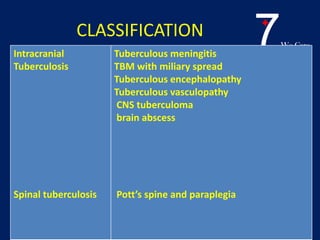
CLASSIFICATION
Intracranial
Tuberculosis
Spinal tuberculosis
Tuberculous meningitis
TBM with miliary spread
Tuberculous encephalopathy
Tuberculous vasculopathy
CNS tuberculoma
brain abscess
Pott’s spine and paraplegia
7We Care
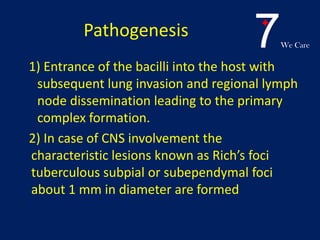
Pathogenesis
1) Entrance of the bacilli into the host with
subsequent lung invasion and regional lymph
node dissemination leading to the primary
complex formation.
2) In case of CNS involvement the
characteristic lesions known as Rich’s foci
tuberculous subpial or subependymal foci
about 1 mm in diameter are formed
7We Care
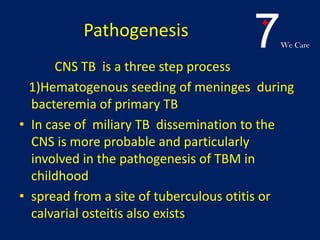
Pathogenesis
CNS TB is a three step process
1)Hematogenous seeding of meninges during
bacteremia of primary TB
• In case of miliary TB dissemination to the
CNS is more probable and particularly
involved in the pathogenesis of TBM in
childhood
• spread from a site of tuberculous otitis or
calvarial osteitis also exists
7We Care
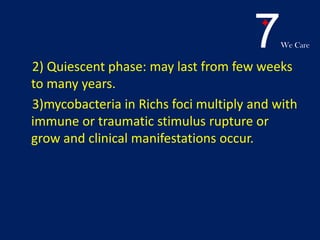
2) Quiescent phase: may last from few weeks
to many years.
3)mycobacteria in Richs foci multiply and with
immune or traumatic stimulus rupture or
grow and clinical manifestations occur.
7We Care
• In adults and older children there may not be
any immune response and cause latent
disease or
• immune recognition or reactivation causes
formation of the CNS lesions
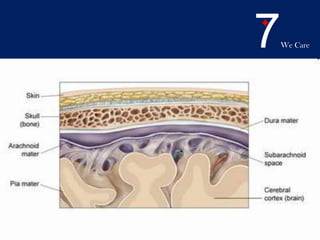
• the rupture of a Rich’s focus and release of
bacilli into subarachnoid space giving rise to a
T cell granulomatous response leading to TBM
7We Care
• Triad of a) macrophages b) T helper
lymphocytes and c) host plays a central role
• interferon interleukin1 TNF
• granuloma formation
7We Care
7We Care
PATHOGENESIS OF
COMPLICATIONS
Inflammatory reaction can lead to
• Adhesion formation due to the cell and fibrin
rich basal meningeal exudates
• Obliterative vasculitis: mainly affecting the
internal carotid artery, proximal middle
cerebral artery and perforating vessels of the
basal ganglia
• Encephalitis: due to extention into the
parenchyma
7We Care
• Cranial n palsies: adhesions in the
interpendicular fossa cranial nerves II IV and
VI are affected.
• Hydrocephalus: obstruction of the basal
cisterns the outflow of the forth ventricle or
the cerebral aqueduct and have poor
prognosis .
• Spinal meningitis: direct extension from
vertebrea or intracranial spread.
7We Care
Clinical staging
Stage I ( alert no focal neurological signs)
Irritability
Excessive cry
Apathy
Low grade fever
7We Care
• Stage II(non comatose)
• Signs of meningeal irritation
• Signs of increased ICT
• Altered sensorium
• Convulsions
• Focal neurodeficits
7We Care
Stage III(comatose)
• Deep coma
• Multiple cranial N palsies
• Decerebrate or decorticate rigidity
7We Care
Clinical features
• Prodromal:
A)Infants: 1.poor feeding 2. irritability 3.
drowsiness 4. bulging fontanelles
B)Elder : headache and mental state changes
• Cranial N : 20-30% .
A) II III IV VI VII blindness squint diplopia VI MC
B) IX X XI XI less commonly.
7We Care
• Vascular : MCA ACA involvement or vascular
endarteritis
N deficits monoparesis hemiparesis
• Cerebral edema: raised ICT hydrocephalus
tentorial herniation seizures
• Tuberculoma: seizures localizing sign raised
ICT
7We Care
• Meningoencephalitis: altered sensorium to
terminal illness.
7We Care
DIAGNOSIS
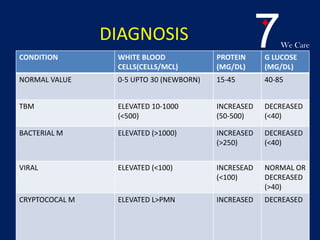
• CSF:increase in pressure with the appearance
clear to slightly turbid with a delicate web-like
clot formation, due to the high protein level
• Pleocytosis of 10–1000 leucocytes/ mm3 with
a lymphocytic predominance.
• CSF biochemistry reduced glucose levels
increased lactate levels while protein levels
increased
7We Care
DIAGNOSIS
CONDITION WHITE BLOOD
CELLS(CELLS/MCL)
PROTEIN
(MG/DL)
G LUCOSE
(MG/DL)
NORMAL VALUE 0-5 UPTO 30 (NEWBORN) 15-45 40-85
TBM ELEVATED 10-1000
(<500)
INCREASED
(50-500)
DECREASED
(<40)
BACTERIAL M ELEVATED (>1000) INCREASED
(>250)
DECREASED
(<40)
VIRAL ELEVATED (<100) INCRESEAD
(<100)
NORMAL OR
DECREASED
(>40)
CRYPTOCOCAL M ELEVATED L>PMN INCREASED DECREASED
7We Care
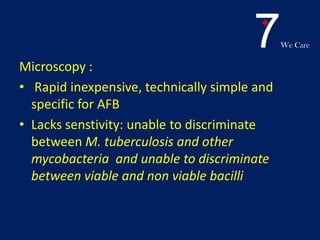
Microscopy :
• Rapid inexpensive, technically simple and
specific for AFB
• Lacks senstivity: unable to discriminate
between M. tuberculosis and other
mycobacteria and unable to discriminate
between viable and non viable bacilli
7We Care
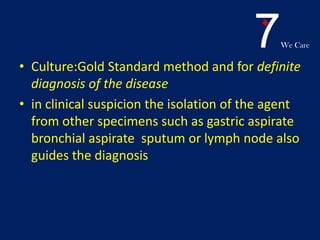
• Culture:Gold Standard method and for definite
diagnosis of the disease
• in clinical suspicion the isolation of the agent
from other specimens such as gastric aspirate
bronchial aspirate sputum or lymph node also
guides the diagnosis
7We Care
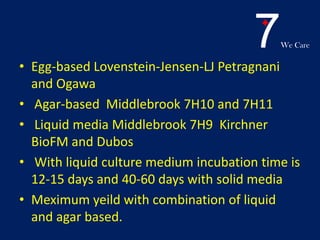
• Egg-based Lovenstein-Jensen-LJ Petragnani
and Ogawa
• Agar-based Middlebrook 7H10 and 7H11
• Liquid media Middlebrook 7H9 Kirchner
BioFM and Dubos
• With liquid culture medium incubation time is
12-15 days and 40-60 days with solid media
• Meximum yeild with combination of liquid
and agar based.
7We Care
• liquid cultures a mix of growth supplements
(OADC- Oleic acid, Albumin, Dextrose,
• Catalase) and antibiotics (PANTA- Polymyxin B,
Amphotericin B, Nalidixic acid Trimethoprim,
Azlocillin) are used, which collectively prevent
the growth of environmental bacteria.
• A positive result must be confirmed by
performing a ZN smear of the colonies with
AFB being demonstrated.
7We Care
• Adenosine deaminase levels and TBM
• enzyme involved in the purine catabolism
related to the activated T lymphocytes and
macrophages in response to TB antigens
7We Care
Molecular diagnosis
• Nucleic acid-based amplification (NAA) tests
allow the direct detection of mycobacterial
DNA or RNA
Post-amplification analysis includes
electrophoresis
hybridization
restriction or sequencing of the products
• hybridization being the most commonly used
one
7We Care
• Newer techniques based on real-time PCR
amplify simultaneously different DNA targets
followed by fluorimetric detection
• The low sensitivity may be due to
paucibacillary nature of CSF
• minimum suggested volume of the fluid is 2ml
7We Care
Neuroimaging
CT finding in case of non-complicated TBM
• can be entirely normal
• diffuse brain edema and lepto-meningeal
inflammation with increased uptake of
contrast material in CECT
• The meningeal enhancement is more
pronounced in the basal cisterns.
7We Care
CT finding of complicated cases
• communicating hydrocephalus
• ventriculitis
• parenchymal spread (infarction, cerebritis and
abscess)
• Empyema (epidural, subdural)
• tuberculomas in the brain.
7We Care
7We Care
7We Care
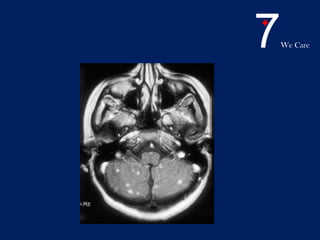
• MRI is the most sensitive test
• superior to CT in detecting parenchymal
abnormalities, such as tuberculomas,
abscesses, and infarctions.
• MRI also readily depicts hydrocephalus
7We Care
7We Care
Treatment
• Start as soon as there is suspicion for TB
meningitis
• Same Guidelines as those for pulmonary TB
– Intensive Phase: 4 drug regimen of
Isoniazid, Rifampin, Pyrazinamide, and
Ethambutol or Streptomycin for 2 months
– Continuation Phase: Isoniazid and Rifampin for
another 7 – 10 months
7We Care
Role of steroids
• Glucocorticoids Indicated with:
– rapid progression from one stage to the next
– elevated OP on LP, CT evidence of cerebral edema
– worsening clinical signs after starting antiTb meds
– increased basilar enhancement, or moderate to advancing
hydrocephalus on head CT
• Glucocorticoid Dosing: Dexamethasone 12 mg/d x 3
weeks followed by a slow taper
7We Care
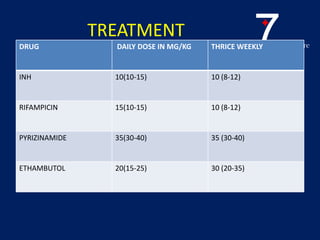
TREATMENT
DRUG DAILY DOSE IN MG/KG THRICE WEEKLY
INH 10(10-15) 10 (8-12)
RIFAMPICIN 15(10-15) 10 (8-12)
PYRIZINAMIDE 35(30-40) 35 (30-40)
ETHAMBUTOL 20(15-25) 30 (20-35)
7We Care
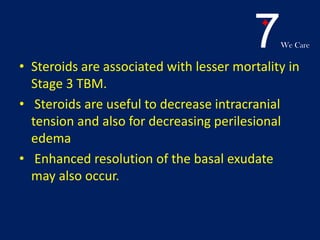
• Steroids are associated with lesser mortality in
Stage 3 TBM.
• Steroids are useful to decrease intracranial
tension and also for decreasing perilesional
edema
• Enhanced resolution of the basal exudate
may also occur.
7We Care
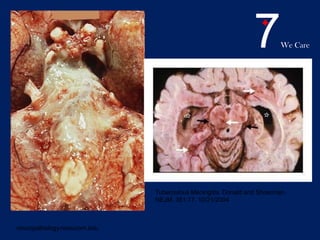
neuropathology.neoucom.edu
Tuberculous Meningitis. Donald and Shoerman,
NEJM. 351:17. 10/21/2004
7We Care
Differential Diagnosis
• Fungal Meningitis
– Crypto, Histo, Blasto, Cocci
• Viral meningoencephalitis – HSV, mumps
• Parameningeal Infection
– Sphenoid sinusitis, brain abscess, spinal epidural abscess
• Incompletely treated Bacterial meningitis
• Neurosynphilis
• Neoplastic Meningitis – Lymphoma
• Neurosarcoid
• Neurobrucellosis
7We Care
Treatment: Antimicrobial
Therapy
• Start as soon as there is suspicion for TB
meningitis
• Same Guidelines as those for pulmonary TB
– Intensive Phase: 4 drug regimen of Isoniazid,
Rifampin, Pyrazinamide, and Ethambutol or
Streptomycin for 2 months
– Continuation Phase: Isoniazid and Rifampin for
another 7 – 10 months
7We Care
Treatment: Adjunctive
Therapy
• Glucocorticoids Indicated with:
– rapid progression from one stage to the next
– elevated OP on LP, CT evidence of cerebral edema
– worsening clinical signs after starting antiTb meds
– increased basilar enhancement, or moderate to advancing
hydrocephalus on head CT
• Glucocorticoid Dosing: Dexamethasone 12 mg/d x 3
weeks followed by a slow taper
• Surgery: Ventriculostomy placement
7We Care
TB Meningitis in HIV
population
• Study in S Africa compared 20 HIV + pts vs. 17 HIV - pts
• Similar findings in both groups:
– Presentation: HA, neck stiffness, fever
– CSF analysis: Similar amounts of
lymphocytes, neutrophils, protein, glucose, ADA levels
– Outcomes predicted by GCS score upon admission
• -Differences
– Both groups showed same incidence of abnormal Head CT, but HIV +
more likely to have ventricular dilatation and infarct
– HIV + patients were more likely to suffer no neurologic deficit on
discharge than HIV - pts
7We Care
Outcomes
• Overall Poor
• Pts presenting in Stage I have 19% mortality
• Pts presenting in Stage III have 69% mortality
• Only 1/3 - 1/2 of patients demonstrate complete
neurologic recovery
• Up to 1/3 of patients have residual severe neurologic
deficits such as hemiparesis, blindness, seizure DO
7We Care
References
• http://www.cdc.gov/TB/statistics/reports/surv2005/PDF/table27.pd
f
• Donald, PR and Schoerman, JF. Tuberculous Meningitis. NEJM,
351:17. 2004.
• Schutte, CM. Clincial, Cerebrospinal Fluid and Pathological Findings
and Outcomes in HIV-Positive and HIV-negative Patients with
Tuberculous Meningitis. Infection 2001: 29: 213-217.
• Jacob, H et al. Acute Forms of Tuberculosis in Adults. The American
Journal of Medicine (2009) 122, 12-17.
• Principles and Practice of Infectious Diseases. 4th Ed, c 1995.
• Central Nervous System Tuberculosis. www.uptodate.com

CNS TB

  • 1.
  • 2.
    7We Care Incidence • 10%cases of TB have CNS involvement • 60-80 % between age of 06 mnths to 05 yrs. • Male pedominence • Case fatality 100% in untreated cases.
  • 3.
    7We Care • Whilepulmonary disease is the most common manifestation of TB • the involvement of the CNS and tuberculous meningitis represents its most severe form • The case fatality rate of untreated TBM is almost 100% and a delay in treatment may lead to permanent neurological damage
  • 4.
    7We Care • Thecausative agents of TBM is M. tuberculosis and less commonly NTM. • The incidence of CNS infection due to the latter has increased since the onset of the HIV epidemic mainly mycobacterium avium complex (MAC)
  • 5.
    7We Care CLASSIFICATION Intracranial Tuberculosis Spinal tuberculosis Tuberculousmeningitis TBM with miliary spread Tuberculous encephalopathy Tuberculous vasculopathy CNS tuberculoma brain abscess Pott’s spine and paraplegia
  • 6.
    7We Care Pathogenesis 1) Entranceof the bacilli into the host with subsequent lung invasion and regional lymph node dissemination leading to the primary complex formation. 2) In case of CNS involvement the characteristic lesions known as Rich’s foci tuberculous subpial or subependymal foci about 1 mm in diameter are formed
  • 7.
    7We Care Pathogenesis CNS TBis a three step process 1)Hematogenous seeding of meninges during bacteremia of primary TB • In case of miliary TB dissemination to the CNS is more probable and particularly involved in the pathogenesis of TBM in childhood • spread from a site of tuberculous otitis or calvarial osteitis also exists
  • 8.
    7We Care 2) Quiescentphase: may last from few weeks to many years. 3)mycobacteria in Richs foci multiply and with immune or traumatic stimulus rupture or grow and clinical manifestations occur.
  • 9.
    7We Care • Inadults and older children there may not be any immune response and cause latent disease or • immune recognition or reactivation causes formation of the CNS lesions • the rupture of a Rich’s focus and release of bacilli into subarachnoid space giving rise to a T cell granulomatous response leading to TBM
  • 10.
    7We Care • Triadof a) macrophages b) T helper lymphocytes and c) host plays a central role • interferon interleukin1 TNF • granuloma formation
  • 11.
  • 12.
    7We Care PATHOGENESIS OF COMPLICATIONS Inflammatoryreaction can lead to • Adhesion formation due to the cell and fibrin rich basal meningeal exudates • Obliterative vasculitis: mainly affecting the internal carotid artery, proximal middle cerebral artery and perforating vessels of the basal ganglia • Encephalitis: due to extention into the parenchyma
  • 13.
    7We Care • Cranialn palsies: adhesions in the interpendicular fossa cranial nerves II IV and VI are affected. • Hydrocephalus: obstruction of the basal cisterns the outflow of the forth ventricle or the cerebral aqueduct and have poor prognosis . • Spinal meningitis: direct extension from vertebrea or intracranial spread.
  • 14.
    7We Care Clinical staging StageI ( alert no focal neurological signs) Irritability Excessive cry Apathy Low grade fever
  • 15.
    7We Care • StageII(non comatose) • Signs of meningeal irritation • Signs of increased ICT • Altered sensorium • Convulsions • Focal neurodeficits
  • 16.
    7We Care Stage III(comatose) •Deep coma • Multiple cranial N palsies • Decerebrate or decorticate rigidity
  • 17.
    7We Care Clinical features •Prodromal: A)Infants: 1.poor feeding 2. irritability 3. drowsiness 4. bulging fontanelles B)Elder : headache and mental state changes • Cranial N : 20-30% . A) II III IV VI VII blindness squint diplopia VI MC B) IX X XI XI less commonly.
  • 18.
    7We Care • Vascular: MCA ACA involvement or vascular endarteritis N deficits monoparesis hemiparesis • Cerebral edema: raised ICT hydrocephalus tentorial herniation seizures • Tuberculoma: seizures localizing sign raised ICT
  • 19.
    7We Care • Meningoencephalitis:altered sensorium to terminal illness.
  • 20.
    7We Care DIAGNOSIS • CSF:increasein pressure with the appearance clear to slightly turbid with a delicate web-like clot formation, due to the high protein level • Pleocytosis of 10–1000 leucocytes/ mm3 with a lymphocytic predominance. • CSF biochemistry reduced glucose levels increased lactate levels while protein levels increased
  • 21.
    7We Care DIAGNOSIS CONDITION WHITEBLOOD CELLS(CELLS/MCL) PROTEIN (MG/DL) G LUCOSE (MG/DL) NORMAL VALUE 0-5 UPTO 30 (NEWBORN) 15-45 40-85 TBM ELEVATED 10-1000 (<500) INCREASED (50-500) DECREASED (<40) BACTERIAL M ELEVATED (>1000) INCREASED (>250) DECREASED (<40) VIRAL ELEVATED (<100) INCRESEAD (<100) NORMAL OR DECREASED (>40) CRYPTOCOCAL M ELEVATED L>PMN INCREASED DECREASED
  • 22.
    7We Care Microscopy : •Rapid inexpensive, technically simple and specific for AFB • Lacks senstivity: unable to discriminate between M. tuberculosis and other mycobacteria and unable to discriminate between viable and non viable bacilli
  • 23.
    7We Care • Culture:GoldStandard method and for definite diagnosis of the disease • in clinical suspicion the isolation of the agent from other specimens such as gastric aspirate bronchial aspirate sputum or lymph node also guides the diagnosis
  • 24.
    7We Care • Egg-basedLovenstein-Jensen-LJ Petragnani and Ogawa • Agar-based Middlebrook 7H10 and 7H11 • Liquid media Middlebrook 7H9 Kirchner BioFM and Dubos • With liquid culture medium incubation time is 12-15 days and 40-60 days with solid media • Meximum yeild with combination of liquid and agar based.
  • 25.
    7We Care • liquidcultures a mix of growth supplements (OADC- Oleic acid, Albumin, Dextrose, • Catalase) and antibiotics (PANTA- Polymyxin B, Amphotericin B, Nalidixic acid Trimethoprim, Azlocillin) are used, which collectively prevent the growth of environmental bacteria. • A positive result must be confirmed by performing a ZN smear of the colonies with AFB being demonstrated.
  • 26.
    7We Care • Adenosinedeaminase levels and TBM • enzyme involved in the purine catabolism related to the activated T lymphocytes and macrophages in response to TB antigens
  • 27.
    7We Care Molecular diagnosis •Nucleic acid-based amplification (NAA) tests allow the direct detection of mycobacterial DNA or RNA Post-amplification analysis includes electrophoresis hybridization restriction or sequencing of the products • hybridization being the most commonly used one
  • 28.
    7We Care • Newertechniques based on real-time PCR amplify simultaneously different DNA targets followed by fluorimetric detection • The low sensitivity may be due to paucibacillary nature of CSF • minimum suggested volume of the fluid is 2ml
  • 29.
    7We Care Neuroimaging CT findingin case of non-complicated TBM • can be entirely normal • diffuse brain edema and lepto-meningeal inflammation with increased uptake of contrast material in CECT • The meningeal enhancement is more pronounced in the basal cisterns.
  • 30.
    7We Care CT findingof complicated cases • communicating hydrocephalus • ventriculitis • parenchymal spread (infarction, cerebritis and abscess) • Empyema (epidural, subdural) • tuberculomas in the brain.
  • 31.
  • 32.
  • 33.
    7We Care • MRIis the most sensitive test • superior to CT in detecting parenchymal abnormalities, such as tuberculomas, abscesses, and infarctions. • MRI also readily depicts hydrocephalus
  • 34.
  • 35.
    7We Care Treatment • Startas soon as there is suspicion for TB meningitis • Same Guidelines as those for pulmonary TB – Intensive Phase: 4 drug regimen of Isoniazid, Rifampin, Pyrazinamide, and Ethambutol or Streptomycin for 2 months – Continuation Phase: Isoniazid and Rifampin for another 7 – 10 months
  • 36.
    7We Care Role ofsteroids • Glucocorticoids Indicated with: – rapid progression from one stage to the next – elevated OP on LP, CT evidence of cerebral edema – worsening clinical signs after starting antiTb meds – increased basilar enhancement, or moderate to advancing hydrocephalus on head CT • Glucocorticoid Dosing: Dexamethasone 12 mg/d x 3 weeks followed by a slow taper
  • 37.
    7We Care TREATMENT DRUG DAILYDOSE IN MG/KG THRICE WEEKLY INH 10(10-15) 10 (8-12) RIFAMPICIN 15(10-15) 10 (8-12) PYRIZINAMIDE 35(30-40) 35 (30-40) ETHAMBUTOL 20(15-25) 30 (20-35)
  • 38.
    7We Care • Steroidsare associated with lesser mortality in Stage 3 TBM. • Steroids are useful to decrease intracranial tension and also for decreasing perilesional edema • Enhanced resolution of the basal exudate may also occur.
  • 39.
    7We Care neuropathology.neoucom.edu Tuberculous Meningitis.Donald and Shoerman, NEJM. 351:17. 10/21/2004
  • 40.
    7We Care Differential Diagnosis •Fungal Meningitis – Crypto, Histo, Blasto, Cocci • Viral meningoencephalitis – HSV, mumps • Parameningeal Infection – Sphenoid sinusitis, brain abscess, spinal epidural abscess • Incompletely treated Bacterial meningitis • Neurosynphilis • Neoplastic Meningitis – Lymphoma • Neurosarcoid • Neurobrucellosis
  • 41.
    7We Care Treatment: Antimicrobial Therapy •Start as soon as there is suspicion for TB meningitis • Same Guidelines as those for pulmonary TB – Intensive Phase: 4 drug regimen of Isoniazid, Rifampin, Pyrazinamide, and Ethambutol or Streptomycin for 2 months – Continuation Phase: Isoniazid and Rifampin for another 7 – 10 months
  • 42.
    7We Care Treatment: Adjunctive Therapy •Glucocorticoids Indicated with: – rapid progression from one stage to the next – elevated OP on LP, CT evidence of cerebral edema – worsening clinical signs after starting antiTb meds – increased basilar enhancement, or moderate to advancing hydrocephalus on head CT • Glucocorticoid Dosing: Dexamethasone 12 mg/d x 3 weeks followed by a slow taper • Surgery: Ventriculostomy placement
  • 43.
    7We Care TB Meningitisin HIV population • Study in S Africa compared 20 HIV + pts vs. 17 HIV - pts • Similar findings in both groups: – Presentation: HA, neck stiffness, fever – CSF analysis: Similar amounts of lymphocytes, neutrophils, protein, glucose, ADA levels – Outcomes predicted by GCS score upon admission • -Differences – Both groups showed same incidence of abnormal Head CT, but HIV + more likely to have ventricular dilatation and infarct – HIV + patients were more likely to suffer no neurologic deficit on discharge than HIV - pts
  • 44.
    7We Care Outcomes • OverallPoor • Pts presenting in Stage I have 19% mortality • Pts presenting in Stage III have 69% mortality • Only 1/3 - 1/2 of patients demonstrate complete neurologic recovery • Up to 1/3 of patients have residual severe neurologic deficits such as hemiparesis, blindness, seizure DO
  • 45.
    7We Care References • http://www.cdc.gov/TB/statistics/reports/surv2005/PDF/table27.pd f •Donald, PR and Schoerman, JF. Tuberculous Meningitis. NEJM, 351:17. 2004. • Schutte, CM. Clincial, Cerebrospinal Fluid and Pathological Findings and Outcomes in HIV-Positive and HIV-negative Patients with Tuberculous Meningitis. Infection 2001: 29: 213-217. • Jacob, H et al. Acute Forms of Tuberculosis in Adults. The American Journal of Medicine (2009) 122, 12-17. • Principles and Practice of Infectious Diseases. 4th Ed, c 1995. • Central Nervous System Tuberculosis. www.uptodate.com