” Convolutional Neural Networks (CNN)”
University of Manouba.
Tunis Higher School of Business
Preparedby:
Sirine BEN AMMAR
2023-2024
Sirine BEN AMMAR
Outline
1 General context
5 CNN Components
Sirine BEN AMMAR 2/ 21
CNN Architecture
4
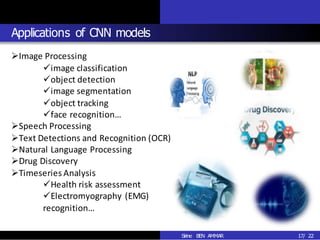
Applications of CNN models
6
Implementation
7
3 Properties of CNN models
Definition
2
Some recent articles
8
Conclusions
9
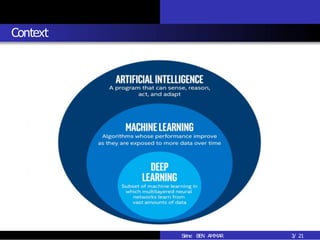
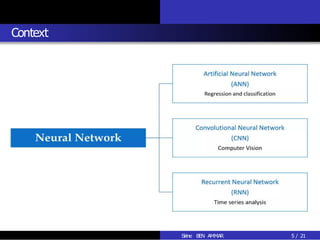
Context
2
3
3/ 21
Sirine BEN AMMAR
Context
2
3
4 / 21
Sirine BEN AMMAR
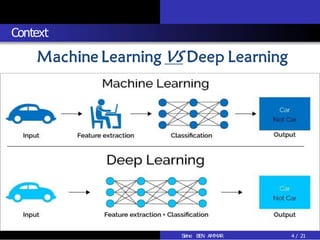
Machine Learning VS Deep Learning
Context
2
3
5 / 21
Sirine BEN AMMAR
Context
2
3
6 / 21
Sirine BEN AMMAR
Definition
2
3
7 / 22
Sirine BEN AMMAR
❑Convolutional Neural
Networks (CNNs) learns
multi-level features and
classifier in a joint fashion and
performs much better than
traditional approaches for
various image classification
and segmentation problems.
Properties of CNN models
2
3
8/ 22
Sirine BEN AMMAR
➢Sparseinteractions between NN units (through kernels of small
size)
✓fewer parameters to learn
✓less computation resources arerequired
➢Parameter sharing (samekernel is applied throughout theinput)
✓Maintain the same feature detection throughout the
input.
➢Ability to (automatically) learn local structure
➢Can handle variable-sized inputs.
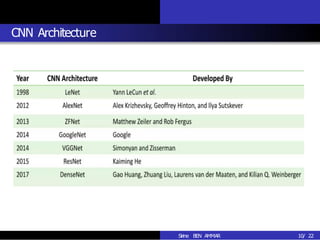
CNN Architecture
2
3
9/ 22
Sirine BEN AMMAR
➢Typically, a CNN model consists of convolution layers, for feature selection,
followedby fullyconnected layers that perform the prediction task.
CNN Architecture
2
3
10/ 22
Sirine BEN AMMAR
CNN Components
2
3
11/ 22
Sirine BEN AMMAR
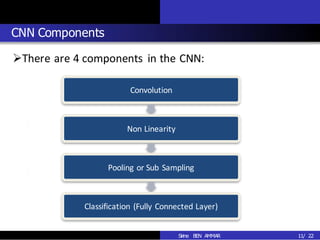
Convolution
Non Linearity
Pooling or Sub Sampling
Classification (Fully Connected Layer)
➢There are 4 components in the CNN:
CNN Components
2
3
12/ 22
Sirine BEN AMMAR
Input:
•An image is a matrix of pixel values.
➢If we consider a gray scale image, the
value of each pixel in the matrix will range
from 0 to 255.
➢If we consider an RGB image,
each pixel will have the combined
values of R, G and B.
CNN Components
2
3
13/ 22
Sirine BEN AMMAR
Convolution Non Linearity Pooling Classification
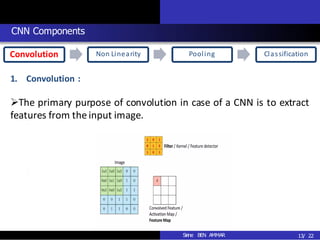
1. Convolution :
➢The primary purpose of convolution in case of a CNN is to extract
features from the input image.
CNN Components
2
3
14/ 22
Sirine BEN AMMAR
Convolution Non Linearity Pooling Classification
2. Non Linearity (ReLU):
➢ Replaces all negative pixel values in the
feature map by zero.
➢ The purpose of ReLU isto introduce
non-linearityin CNN, since most of the
real-world data would be non-linear.
➢ Other non-linearfunctions such as
tanh (-1, 1) or sigmoid (0, 1) can also
be used instead of ReLU (0, input).
CNN Components
2
3
15/ 22
Sirine BEN AMMAR
Convolution Non Linearity Pooling Classification
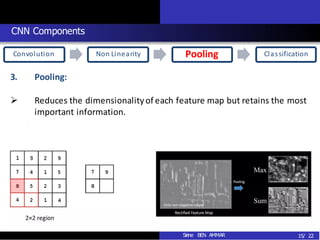
3. Pooling:
➢ Reduces the dimensionalityof each feature map but retains the most
important information.
CNN Components
3
12/ 22
Sirine BEN AMMAR 16/ 22
Sirine BEN AMMAR
Convolution Non Linearity Pooling Classification
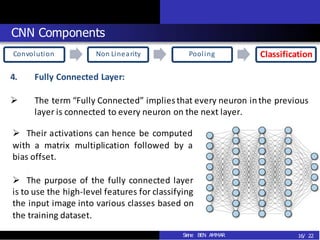
4. Fully Connected Layer:
➢ The term “Fully Connected” impliesthat every neuron inthe previous
layer is connected to every neuron on the next layer.
➢ Their activations can hence be computed
with a matrix multiplication followed by a
bias offset.
➢ The purpose of the fully connected layer
is to use the high-level features for classifying
the input image into various classes based on
the training dataset.
Applications of CNN models
2
3
17/ 22
Sirine BEN AMMAR
➢Image Processing
✓image classification
✓object detection
✓image segmentation
✓object tracking
✓face recognition…
➢Speech Processing
➢Text Detections and Recognition (OCR)
➢Natural Language Processing
➢Drug Discovery
➢Timeseries Analysis
✓Health risk assessment
✓Electromyography (EMG)
recognition…
Implementation
2
3
18/ 22
Sirine BEN AMMAR
Link: https://colab.research.google.com/drive/17Svx0pQE_0g-
4uz22W_F0nFdsySiurt0
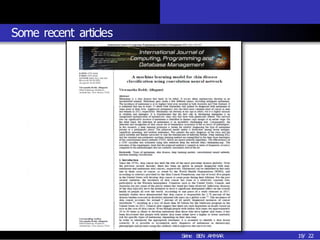
Some recent articles
2
3
19/ 22
Sirine BEN AMMAR
Some recent articles
2
3
20/ 22
Sirine BEN AMMAR
Conclusions
2
3
21/ 22
➢In conclusion, Convolutional Neural Networks represent a major
breakthrough in deep learningwith vast and varied applications.
➢As we wrap up this presentation, let's look to the future: new
challenges, technological advancements, and extendedapplications.
➢Ongoing commitment to research and development is crucial to
fully harness the potential of thisever-evolving technology.
Sirine BEN AMMAR
2
3
Sirine BEN AMMAR
Thank you!

convolutional neural network and its application.pdf

  • 1.
    ” Convolutional NeuralNetworks (CNN)” University of Manouba. Tunis Higher School of Business Preparedby: Sirine BEN AMMAR 2023-2024 Sirine BEN AMMAR
  • 2.
    Outline 1 General context 5CNN Components Sirine BEN AMMAR 2/ 21 CNN Architecture 4 Applications of CNN models 6 Implementation 7 3 Properties of CNN models Definition 2 Some recent articles 8 Conclusions 9
  • 3.
  • 4.
    Context 2 3 4 / 21 SirineBEN AMMAR Machine Learning VS Deep Learning
  • 5.
  • 6.
  • 7.
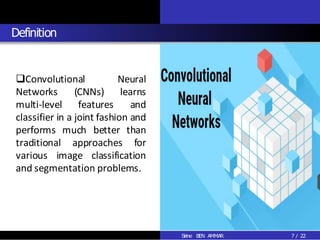
    Definition 2 3 7 / 22 SirineBEN AMMAR ❑Convolutional Neural Networks (CNNs) learns multi-level features and classifier in a joint fashion and performs much better than traditional approaches for various image classification and segmentation problems.
  • 8.
    Properties of CNNmodels 2 3 8/ 22 Sirine BEN AMMAR ➢Sparseinteractions between NN units (through kernels of small size) ✓fewer parameters to learn ✓less computation resources arerequired ➢Parameter sharing (samekernel is applied throughout theinput) ✓Maintain the same feature detection throughout the input. ➢Ability to (automatically) learn local structure ➢Can handle variable-sized inputs.
  • 9.
    CNN Architecture 2 3 9/ 22 SirineBEN AMMAR ➢Typically, a CNN model consists of convolution layers, for feature selection, followedby fullyconnected layers that perform the prediction task.
  • 10.
  • 11.
    CNN Components 2 3 11/ 22 SirineBEN AMMAR Convolution Non Linearity Pooling or Sub Sampling Classification (Fully Connected Layer) ➢There are 4 components in the CNN:
  • 12.
    CNN Components 2 3 12/ 22 SirineBEN AMMAR Input: •An image is a matrix of pixel values. ➢If we consider a gray scale image, the value of each pixel in the matrix will range from 0 to 255. ➢If we consider an RGB image, each pixel will have the combined values of R, G and B.
  • 13.
    CNN Components 2 3 13/ 22 SirineBEN AMMAR Convolution Non Linearity Pooling Classification 1. Convolution : ➢The primary purpose of convolution in case of a CNN is to extract features from the input image.
  • 14.
    CNN Components 2 3 14/ 22 SirineBEN AMMAR Convolution Non Linearity Pooling Classification 2. Non Linearity (ReLU): ➢ Replaces all negative pixel values in the feature map by zero. ➢ The purpose of ReLU isto introduce non-linearityin CNN, since most of the real-world data would be non-linear. ➢ Other non-linearfunctions such as tanh (-1, 1) or sigmoid (0, 1) can also be used instead of ReLU (0, input).
  • 15.
    CNN Components 2 3 15/ 22 SirineBEN AMMAR Convolution Non Linearity Pooling Classification 3. Pooling: ➢ Reduces the dimensionalityof each feature map but retains the most important information.
  • 16.
    CNN Components 3 12/ 22 SirineBEN AMMAR 16/ 22 Sirine BEN AMMAR Convolution Non Linearity Pooling Classification 4. Fully Connected Layer: ➢ The term “Fully Connected” impliesthat every neuron inthe previous layer is connected to every neuron on the next layer. ➢ Their activations can hence be computed with a matrix multiplication followed by a bias offset. ➢ The purpose of the fully connected layer is to use the high-level features for classifying the input image into various classes based on the training dataset.
  • 17.
    Applications of CNNmodels 2 3 17/ 22 Sirine BEN AMMAR ➢Image Processing ✓image classification ✓object detection ✓image segmentation ✓object tracking ✓face recognition… ➢Speech Processing ➢Text Detections and Recognition (OCR) ➢Natural Language Processing ➢Drug Discovery ➢Timeseries Analysis ✓Health risk assessment ✓Electromyography (EMG) recognition…
  • 18.
    Implementation 2 3 18/ 22 Sirine BENAMMAR Link: https://colab.research.google.com/drive/17Svx0pQE_0g- 4uz22W_F0nFdsySiurt0
  • 19.
    Some recent articles 2 3 19/22 Sirine BEN AMMAR
  • 20.
    Some recent articles 2 3 20/22 Sirine BEN AMMAR
  • 21.
    Conclusions 2 3 21/ 22 ➢In conclusion,Convolutional Neural Networks represent a major breakthrough in deep learningwith vast and varied applications. ➢As we wrap up this presentation, let's look to the future: new challenges, technological advancements, and extendedapplications. ➢Ongoing commitment to research and development is crucial to fully harness the potential of thisever-evolving technology. Sirine BEN AMMAR
  • 22.