Sulaimani Polytechnic University
Chamchamal Technical Institute Department
of Information Technology Class: 2nd Stage
Mr.Halo Fariq
Halo.sidiq@spu.edu.iq Date: February, 2021
Chapter 5
CNF(Computer Network Fundamentals)
Network Terminologies
Routing Protocols
1
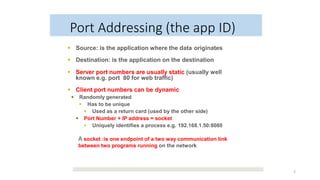
Port Addressing (the app ID)
 Source: is the application where the data originates
 Destination: is the application on the destination
 Server port numbers are usually static (usually well
known e.g. port 80 for web traffic)
 Client port numbers can be dynamic
 Randomly generated
 Has to be unique
 Used as a return card (used by the other side)
 Port Number + IP address = socket
 Uniquely identifies a process e.g. 192.168.1.50:8080
2
A socket :is one endpoint of a two way communication link
between two programs running on the network
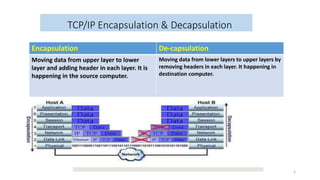
TCP/IP Encapsulation & Decapsulation
3
Encapsulation De-capsulation
Moving data from upper layer to lower
layer and adding header in each layer. It is
happening in the source computer.
Moving data from lower layers to upper layers by
removing headers in each layer. It happening in
destination computer.
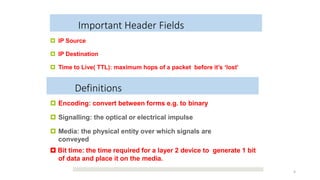
Important Header Fields
 IP Source
 IP Destination
 Time to Live( TTL): maximum hops of a packet before it’s ‘lost’
4
 Encoding: convert between forms e.g. to binary
 Signalling: the optical or electrical impulse
 Media: the physical entity over which signals are
conveyed
 Bit time: the time required for a layer 2 device to generate 1 bit
of data and place it on the media.
Definitions
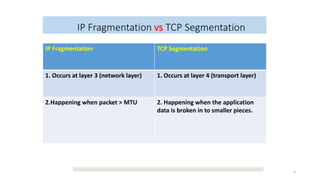
IP Fragmentation vs TCP Segmentation
5
IP Fragmentation TCP Segmentation
1. Occurs at layer 3 (network layer) 1. Occurs at layer 4 (transport layer)
2.Happening when packet > MTU 2. Happening when the application
data is broken in to smaller pieces.
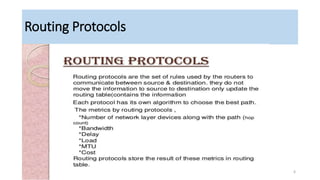
Routing Protocols
6
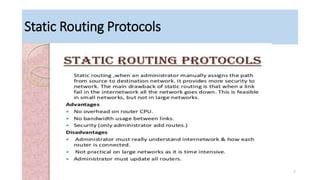
Static Routing Protocols
7
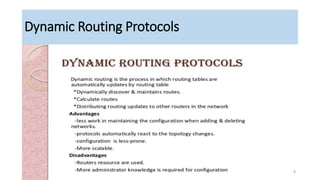
Dynamic Routing Protocols
8
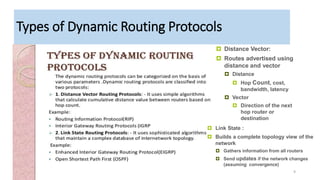
Types of Dynamic Routing Protocols
 Distance Vector:
 Routes advertised using
distance and vector
 Distance
 Hop Count, cost,
bandwidth, latency
 Vector
 Direction of the next
hop router or
destination
 Link State :
 Builds a complete topology view of the
network
 Gathers information from all routers
 Send updates if the network changes
(assuming convergence)
9
10
Initialization of tables in distance vector routing
In distance vector routing, each node shares its table with
its immediate neighbor periodically (eg every 30s) and when
there is a change.
Routing Protocols
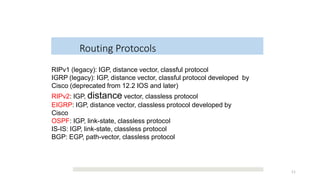
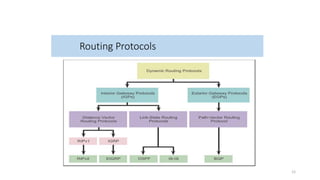
RIPv1 (legacy): IGP, distance vector, classful protocol
IGRP (legacy): IGP, distance vector, classful protocol developed by
Cisco (deprecated from 12.2 IOS and later)
RIPv2: IGP, distance vector, classless protocol
EIGRP: IGP, distance vector, classless protocol developed by
Cisco
OSPF: IGP, link-state, classless protocol
IS-IS: IGP, link-state, classless protocol
BGP: EGP, path-vector, classless protocol
11
Routing Protocols
12
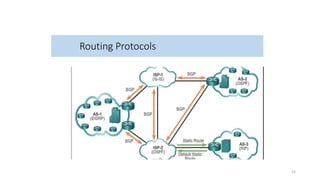
Routing Protocols
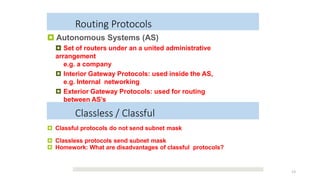
 Autonomous Systems (AS)
 Set of routers under an a united administrative
arrangement
e.g. a company
 Interior Gateway Protocols: used inside the AS,
e.g. Internal networking
 Exterior Gateway Protocols: used for routing
between AS’s
Classless / Classful
 Classful protocols do not send subnet mask
 Classless protocols send subnet mask
 Homework: What are disadvantages of classful protocols?
13
Routing Protocols
14
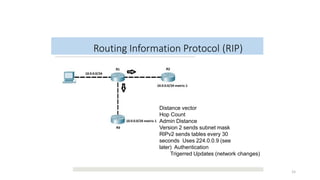
Routing Information Protocol (RIP)
Distance vector
Hop Count
Admin Distance
Version 2 sends subnet mask
RIPv2 sends tables every 30
seconds Uses 224.0.0.9 (see
later) Authentication
Trigerred Updates (network changes)
15
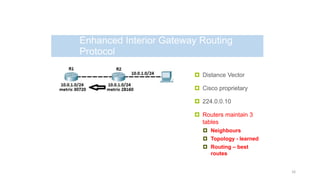
Enhanced Interior Gateway Routing
Protocol
 Distance Vector
 Cisco proprietary
 224.0.0.10
 Routers maintain 3
tables
 Neighbours
 Topology - learned
 Routing – best
routes
16
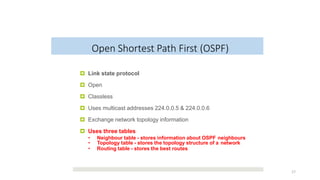
Open Shortest Path First (OSPF)
 Link state protocol
 Open
 Classless
 Uses multicast addresses 224.0.0.5 & 224.0.0.6
 Exchange network topology information
 Uses three tables
• Neighbour table - stores information about OSPF neighbours
• Topology table - stores the topology structure of a network
• Routing table - stores the best routes
17

CNF.Chap.5.pptx

  • 1.
    Sulaimani Polytechnic University ChamchamalTechnical Institute Department of Information Technology Class: 2nd Stage Mr.Halo Fariq Halo.sidiq@spu.edu.iq Date: February, 2021 Chapter 5 CNF(Computer Network Fundamentals) Network Terminologies Routing Protocols 1
  • 2.
    Port Addressing (theapp ID)  Source: is the application where the data originates  Destination: is the application on the destination  Server port numbers are usually static (usually well known e.g. port 80 for web traffic)  Client port numbers can be dynamic  Randomly generated  Has to be unique  Used as a return card (used by the other side)  Port Number + IP address = socket  Uniquely identifies a process e.g. 192.168.1.50:8080 2 A socket :is one endpoint of a two way communication link between two programs running on the network
  • 3.
    TCP/IP Encapsulation &Decapsulation 3 Encapsulation De-capsulation Moving data from upper layer to lower layer and adding header in each layer. It is happening in the source computer. Moving data from lower layers to upper layers by removing headers in each layer. It happening in destination computer.
  • 4.
    Important Header Fields IP Source  IP Destination  Time to Live( TTL): maximum hops of a packet before it’s ‘lost’ 4  Encoding: convert between forms e.g. to binary  Signalling: the optical or electrical impulse  Media: the physical entity over which signals are conveyed  Bit time: the time required for a layer 2 device to generate 1 bit of data and place it on the media. Definitions
  • 5.
    IP Fragmentation vsTCP Segmentation 5 IP Fragmentation TCP Segmentation 1. Occurs at layer 3 (network layer) 1. Occurs at layer 4 (transport layer) 2.Happening when packet > MTU 2. Happening when the application data is broken in to smaller pieces.
  • 6.
  • 7.
  • 8.
  • 9.
    Types of DynamicRouting Protocols  Distance Vector:  Routes advertised using distance and vector  Distance  Hop Count, cost, bandwidth, latency  Vector  Direction of the next hop router or destination  Link State :  Builds a complete topology view of the network  Gathers information from all routers  Send updates if the network changes (assuming convergence) 9
  • 10.
    10 Initialization of tablesin distance vector routing In distance vector routing, each node shares its table with its immediate neighbor periodically (eg every 30s) and when there is a change.
  • 11.
    Routing Protocols RIPv1 (legacy):IGP, distance vector, classful protocol IGRP (legacy): IGP, distance vector, classful protocol developed by Cisco (deprecated from 12.2 IOS and later) RIPv2: IGP, distance vector, classless protocol EIGRP: IGP, distance vector, classless protocol developed by Cisco OSPF: IGP, link-state, classless protocol IS-IS: IGP, link-state, classless protocol BGP: EGP, path-vector, classless protocol 11
  • 12.
  • 13.
    Routing Protocols  AutonomousSystems (AS)  Set of routers under an a united administrative arrangement e.g. a company  Interior Gateway Protocols: used inside the AS, e.g. Internal networking  Exterior Gateway Protocols: used for routing between AS’s Classless / Classful  Classful protocols do not send subnet mask  Classless protocols send subnet mask  Homework: What are disadvantages of classful protocols? 13
  • 14.
  • 15.
    Routing Information Protocol(RIP) Distance vector Hop Count Admin Distance Version 2 sends subnet mask RIPv2 sends tables every 30 seconds Uses 224.0.0.9 (see later) Authentication Trigerred Updates (network changes) 15
  • 16.
    Enhanced Interior GatewayRouting Protocol  Distance Vector  Cisco proprietary  224.0.0.10  Routers maintain 3 tables  Neighbours  Topology - learned  Routing – best routes 16
  • 17.
    Open Shortest PathFirst (OSPF)  Link state protocol  Open  Classless  Uses multicast addresses 224.0.0.5 & 224.0.0.6  Exchange network topology information  Uses three tables • Neighbour table - stores information about OSPF neighbours • Topology table - stores the topology structure of a network • Routing table - stores the best routes 17