February 3-6, 2015

Brainstorming

 Before we begin…
…please confirm that you have your white binders on
your desks.
Writing Workshop

 …use punctuation to give their writing effect.
 file://localhost/<iframe width="560" height="315"
src="https/::www.youtube.com:embed:KS6f1MKpLGM"
frameborder="0" allowfullscreen><:iframe>
 How could this scene have been changed to produce a more
interested effect by the readers?
 Turn and talk to your partner and see if you can come up
with a suggestion about how the dialogue in that scene
could have been made more exciting.
 Let’s share our ideas…
Writers…

 Let’s consider how we might be able to increase the attention
and interest of our readers by considering adding some more
punctuation to our stories.
 Have we provided our readers with enough excitement,
interest and thought provoking dialogue to keep their
interest?
 Can we add some punctuation to our stories to make them
more interesting or exciting?
 Let’s brainstorm on paper…
Writers…

 Start by opening up to a blank sheet of paper in your white
binder…behind the 3rd tab, Revising.
 As you read your draft, consider what may be missing…as
you read each paragraph…ask yourself, “Could this be
rewritten in a more exciting way?”
 Then just write down words and expressions on your blank
sheet that could be referred to later when you once again
rewrite your revisions.
 You have 15 minutes…
Writers…
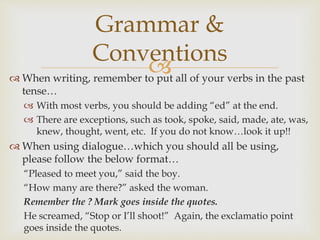
 When writing, remember to put all of your verbs in the past
tense…
 With most verbs, you should be adding “ed” at the end.
 There are exceptions, such as took, spoke, said, made, ate, was,
knew, thought, went, etc. If you do not know…look it up!!
 When using dialogue…which you should all be using,
please follow the below format…
“Pleased to meet you,” said the boy.
“How many are there?” asked the woman.
Remember the ? Mark goes inside the quotes.
He screamed, “Stop or I’ll shoot!” Again, the exclamatio point
goes inside the quotes.
Grammar &
Conventions

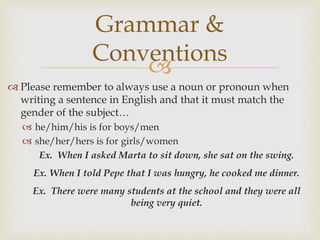
 Please remember to always use a noun or pronoun when
writing a sentence in English and that it must match the
gender of the subject…
 he/him/his is for boys/men
 she/her/hers is for girls/women
Ex. When I asked Marta to sit down, she sat on the swing.
Ex. When I told Pepe that I was hungry, he cooked me dinner.
Ex. There were many students at the school and they were all
being very quiet.
Grammar &
Conventions

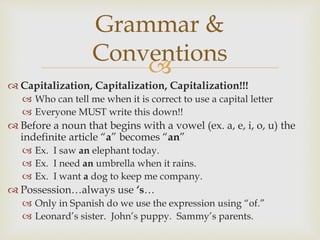
 Capitalization, Capitalization, Capitalization!!!
 Who can tell me when it is correct to use a capital letter
 Everyone MUST write this down!!
 Before a noun that begins with a vowel (ex. a, e, i, o, u) the
indefinite article “a” becomes “an”
 Ex. I saw an elephant today.
 Ex. I need an umbrella when it rains.
 Ex. I want a dog to keep me company.
 Possession…always use ‘s…
 Only in Spanish do we use the expression using “of.”
 Leonard’s sister. John’s puppy. Sammy’s parents.
Grammar &
Conventions
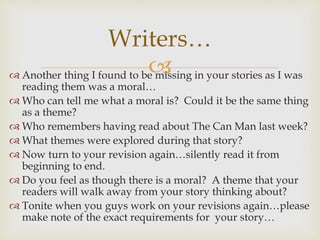
 Another thing I found to be missing in your stories as I was
reading them was a moral…
 Who can tell me what a moral is? Could it be the same thing
as a theme?
 Who remembers having read about The Can Man last week?
 What themes were explored during that story?
 Now turn to your revision again…silently read it from
beginning to end.
 Do you feel as though there is a moral? A theme that your
readers will walk away from your story thinking about?
 Tonite when you guys work on your revisions again…please
make note of the exact requirements for your story…
Writers…

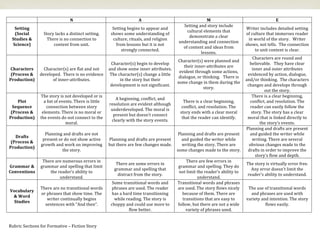
N A M E
Setting
(Social
Studies &
Science)
Story lacks a distinct setting.
There is no connection to
content from unit.
Setting begins to appear and
shows some understanding of
culture, rituals, and religion
from lessons but it is not
strongly connected.
Setting and story include
cultural elements that
demonstrate a clear
understanding and connection
of content and ideas from
lessons.
Writer includes detailed setting
of culture that immerses reader
in world of the story. Writer
shows, not tells. The connection
to unit content is clear.
Characters
(Process &
Production)
Character(s) are flat and not
developed. There is no evidence
of inner-attributes.
Character(s) begin to develop
and show some inner attributes.
The character(s) change a little
in the story but their
development is not significant.
Character(s) were planned and
their inner-attributes are
evident through some actions,
dialogue, or thinking. There is
some change in them during the
story.
Characters are round and
believable. They have clear
inner and outer attributes
evidenced by action, dialogue,
and/or thinking. The characters
changes and develops through
out the story.
Plot
Sequence
(Process &
Production)
The story is not developed or is
a list of events. There is little
connection between story
elements. There is no moral or
the events do not connect to the
moral.
A beginning, conflict, and
resolution are evident although
underdeveloped. The moral is
present but doesn’t connect
clearly with the story events.
There is a clear beginning,
conflict, and resolution. The
story ends with a clear moral
that the reader can identify.
There is a clear beginning,
conflict, and resolution. The
reader can easily follow the
story. The story has a clear
moral that is linked directly to
the story’s events.
Drafts
(Process &
Production)
Planning and drafts are not
present or do not show active
growth and work on improving
the story.
Planning and drafts are present
but there are few changes made.
Planning and drafts are present
and guided the writer while
writing the story. There are
some changes made to the story.
Planning and drafts are present
and guided the writer while
writing. There are several
obvious changes made to the
drafts in order to improve the
story’s flow and depth.
Grammar &
Conventions
There are numerous errors in
grammar and spelling that limit
the reader’s ability to
understand.
There are some errors in
grammar and spelling that
distract from the story.
There are few errors in
grammar and spelling. They do
not limit the reader’s ability to
understand.
The story is virtually error free.
Any error doesn’t limit the
reader’s ability to understand.
Vocabulary
& Word
Studies
There are no transitional words
or phrases that show time. The
writer continually begins
sentences with “And then”.
Some transitional words and
phrases are used. The reader
has a hard time transitioning
while reading. The story is
choppy and could use more to
flow better.
Transitional words and phrases
are used. The story flows nicely
because of them. There are
transitions that are easy to
follow, but there are not a wide
variety of phrases used.
The use of transitional words
and phrases are used with
variety and intention. The story
flows easily.
Rubric Sections for Formative – Fiction Story

5 Minute Break

 Before we begin…
…please confirm that you have your red reading notebook on
your desk.
Reading Workshop

 …of fiction notice how the author shows the passage of time.
 We have already discussed how authors signal the passage
of time. (Remember, when we discussed the clothesline
method?)
 Today we are going to look more closely at how writers use
words known as temporal words to signal movement
through time in their stories.
 Temporal words are words that show a sequence in time in a
variety of ways.
 Let’s take a look at some of these words…
Great Readers…

Great
Readers…
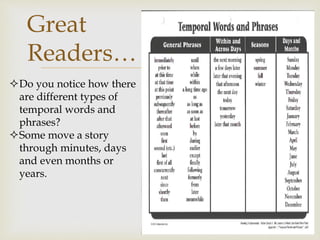
Do you notice how there
are different types of
temporal words and
phrases?
Some move a story
through minutes, days
and even months or
years.
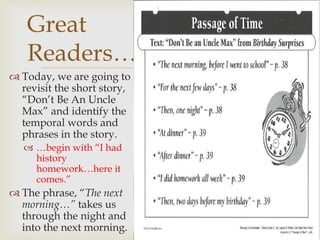
 Today, we are going to
revisit the short story,
“Don’t Be An Uncle
Max” and identify the
temporal words and
phrases in the story.
 …begin with “I had
history
homework…here it
comes.”
 The phrase, “The next
morning…” takes us
through the night and
into the next morning.
Great
Readers…
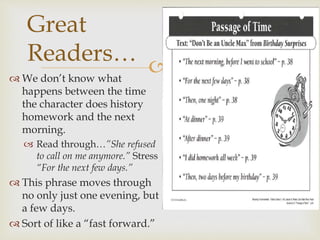
 We don’t know what
happens between the time
the character does history
homework and the next
morning.
 Read through…”She refused
to call on me anymore.” Stress
“For the next few days.”
 This phrase moves through
no only just one evening, but
a few days.
 Sort of like a “fast forward.”
Great
Readers…
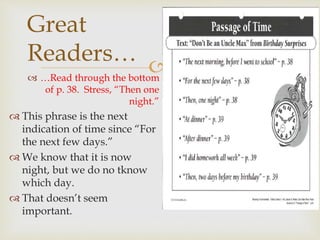
 …Read through the bottom
of p. 38. Stress, “Then one
night.”
 This phrase is the next
indication of time since “For
the next few days.”
 We know that it is now
night, but we do no tknow
which day.
 That doesn’t seem
important.
Great
Readers…
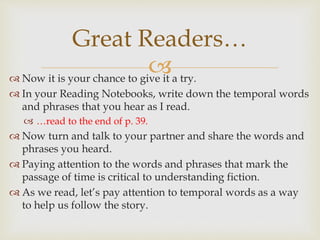
 Now it is your chance to give it a try.
 In your Reading Notebooks, write down the temporal words
and phrases that you hear as I read.
 …read to the end of p. 39.
 Now turn and talk to your partner and share the words and
phrases you heard.
 Paying attention to the words and phrases that mark the
passage of time is critical to understanding fiction.
 As we read, let’s pay attention to temporal words as a way
to help us follow the story.
Great Readers…

5 Minute Break

 Before we begin…
…please confirm that you have your white binders on
your desks.
Writing Workshop

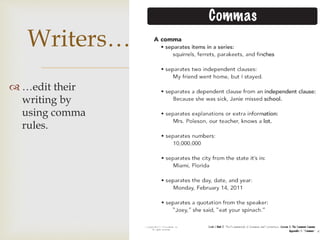
 …edit their
writing by
using comma
rules.
Writers…

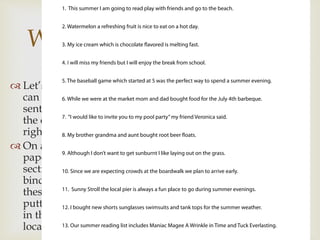
 Let’s see if you guys
can correct these
sentences by putting
the commas in the
right places…
 On a blank sheet of
paper in the editing
section of your white
binder, start copying
these sentences while
putting the commas
in the correct
locations.
Writers…

5 Minute Break

 Before we begin…
…please confirm that you have your red reading notebook on
your desk.
Reading Workshop

 …of fiction recognize the different kinds of conflict in fiction.
 All stories have a conflict.
 The conflict is what makes the story interesting and exciting.
 It keeps readers engaged and curious about what will
happen next.
 Readers of fiction first identify the type of conflict in a story
and then examine the conflict in order to understand how it
effects the plot and characters.
 Conflict is the struggle between two forces in a story.
 The conflict is what keeps the plot moving.
Great Readers…
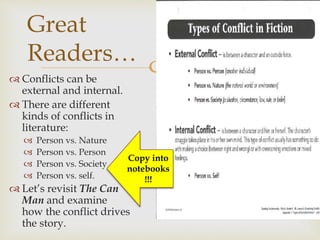
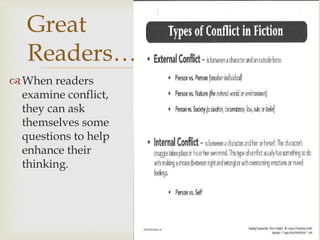
 Conflicts can be
external and internal.
 There are different
kinds of conflicts in
literature:
 Person vs. Nature
 Person vs. Person
 Person vs. Society
 Person vs. self.
 Let’s revisit The Can
Man and examine
how the conflict drives
the story.
Great
Readers…
Copy into
notebooks
!!!
When readers
examine conflict,
they can ask
themselves some
questions to help
enhance their
thinking.
Great
Readers…
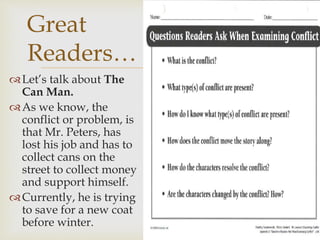
Let’s talk about The
Can Man.
As we know, the
conflict or problem, is
that Mr. Peters, has
lost his job and has to
collect cans on the
street to collect money
and support himself.
Currently, he is trying
to save for a new coat
before winter.
Great
Readers…
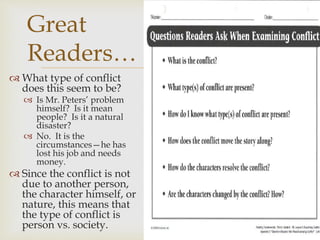
 What type of conflict
does this seem to be?
 Is Mr. Peters’ problem
himself? Is it mean
people? Is it a natural
disaster?
 No. It is the
circumstances—he has
lost his job and needs
money.
 Since the conflict is not
due to another person,
the character himself, or
nature, this means that
the type of conflict is
person vs. society.
Great
Readers…
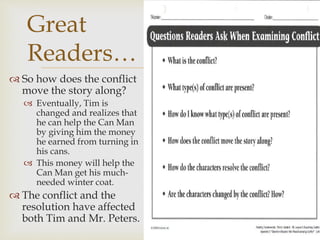
 So how does the conflict
move the story along?
 Eventually, Tim is
changed and realizes that
he can help the Can Man
by giving him the money
he earned from turning in
his cans.
 This money will help the
Can Man get his much-
needed winter coat.
 The conflict and the
resolution have affected
both Tim and Mr. Peters.
Great
Readers…
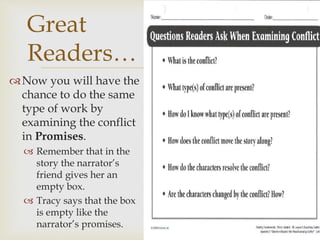
Now you will have the
chance to do the same
type of work by
examining the conflict
in Promises.
 Remember that in the
story the narrator’s
friend gives her an
empty box.
 Tracy says that the box
is empty like the
narrator’s promises.
Great
Readers…
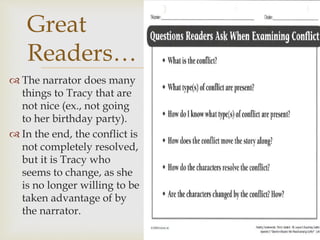
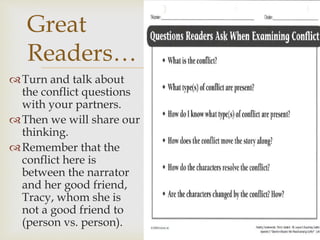
Turn and talk about
the conflict questions
with your partners.
Then we will share our
thinking.
Remember that the
conflict here is
between the narrator
and her good friend,
Tracy, whom she is
not a good friend to
(person vs. person).
Great
Readers…
 The narrator does many
things to Tracy that are
not nice (ex., not going
to her birthday party).
 In the end, the conflict is
not completely resolved,
but it is Tracy who
seems to change, as she
is no longer willing to be
taken advantage of by
the narrator.
Great
Readers…
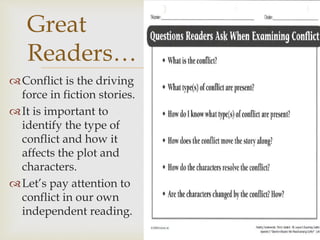
Conflict is the driving
force in fiction stories.
It is important to
identify the type of
conflict and how it
affects the plot and
characters.
Let’s pay attention to
conflict in our own
independent reading.
Great
Readers…

February 3 6

  • 1.
  • 2.
  • 3.
      Before webegin… …please confirm that you have your white binders on your desks. Writing Workshop
  • 4.
      …use punctuationto give their writing effect.  file://localhost/<iframe width="560" height="315" src="https/::www.youtube.com:embed:KS6f1MKpLGM" frameborder="0" allowfullscreen><:iframe>  How could this scene have been changed to produce a more interested effect by the readers?  Turn and talk to your partner and see if you can come up with a suggestion about how the dialogue in that scene could have been made more exciting.  Let’s share our ideas… Writers…
  • 5.
      Let’s considerhow we might be able to increase the attention and interest of our readers by considering adding some more punctuation to our stories.  Have we provided our readers with enough excitement, interest and thought provoking dialogue to keep their interest?  Can we add some punctuation to our stories to make them more interesting or exciting?  Let’s brainstorm on paper… Writers…
  • 6.
      Start byopening up to a blank sheet of paper in your white binder…behind the 3rd tab, Revising.  As you read your draft, consider what may be missing…as you read each paragraph…ask yourself, “Could this be rewritten in a more exciting way?”  Then just write down words and expressions on your blank sheet that could be referred to later when you once again rewrite your revisions.  You have 15 minutes… Writers…
  • 7.
     When writing,remember to put all of your verbs in the past tense…  With most verbs, you should be adding “ed” at the end.  There are exceptions, such as took, spoke, said, made, ate, was, knew, thought, went, etc. If you do not know…look it up!!  When using dialogue…which you should all be using, please follow the below format… “Pleased to meet you,” said the boy. “How many are there?” asked the woman. Remember the ? Mark goes inside the quotes. He screamed, “Stop or I’ll shoot!” Again, the exclamatio point goes inside the quotes. Grammar & Conventions
  • 8.
      Please rememberto always use a noun or pronoun when writing a sentence in English and that it must match the gender of the subject…  he/him/his is for boys/men  she/her/hers is for girls/women Ex. When I asked Marta to sit down, she sat on the swing. Ex. When I told Pepe that I was hungry, he cooked me dinner. Ex. There were many students at the school and they were all being very quiet. Grammar & Conventions
  • 9.
      Capitalization, Capitalization,Capitalization!!!  Who can tell me when it is correct to use a capital letter  Everyone MUST write this down!!  Before a noun that begins with a vowel (ex. a, e, i, o, u) the indefinite article “a” becomes “an”  Ex. I saw an elephant today.  Ex. I need an umbrella when it rains.  Ex. I want a dog to keep me company.  Possession…always use ‘s…  Only in Spanish do we use the expression using “of.”  Leonard’s sister. John’s puppy. Sammy’s parents. Grammar & Conventions
  • 10.
     Another thingI found to be missing in your stories as I was reading them was a moral…  Who can tell me what a moral is? Could it be the same thing as a theme?  Who remembers having read about The Can Man last week?  What themes were explored during that story?  Now turn to your revision again…silently read it from beginning to end.  Do you feel as though there is a moral? A theme that your readers will walk away from your story thinking about?  Tonite when you guys work on your revisions again…please make note of the exact requirements for your story… Writers…
  • 11.
     N A ME Setting (Social Studies & Science) Story lacks a distinct setting. There is no connection to content from unit. Setting begins to appear and shows some understanding of culture, rituals, and religion from lessons but it is not strongly connected. Setting and story include cultural elements that demonstrate a clear understanding and connection of content and ideas from lessons. Writer includes detailed setting of culture that immerses reader in world of the story. Writer shows, not tells. The connection to unit content is clear. Characters (Process & Production) Character(s) are flat and not developed. There is no evidence of inner-attributes. Character(s) begin to develop and show some inner attributes. The character(s) change a little in the story but their development is not significant. Character(s) were planned and their inner-attributes are evident through some actions, dialogue, or thinking. There is some change in them during the story. Characters are round and believable. They have clear inner and outer attributes evidenced by action, dialogue, and/or thinking. The characters changes and develops through out the story. Plot Sequence (Process & Production) The story is not developed or is a list of events. There is little connection between story elements. There is no moral or the events do not connect to the moral. A beginning, conflict, and resolution are evident although underdeveloped. The moral is present but doesn’t connect clearly with the story events. There is a clear beginning, conflict, and resolution. The story ends with a clear moral that the reader can identify. There is a clear beginning, conflict, and resolution. The reader can easily follow the story. The story has a clear moral that is linked directly to the story’s events. Drafts (Process & Production) Planning and drafts are not present or do not show active growth and work on improving the story. Planning and drafts are present but there are few changes made. Planning and drafts are present and guided the writer while writing the story. There are some changes made to the story. Planning and drafts are present and guided the writer while writing. There are several obvious changes made to the drafts in order to improve the story’s flow and depth. Grammar & Conventions There are numerous errors in grammar and spelling that limit the reader’s ability to understand. There are some errors in grammar and spelling that distract from the story. There are few errors in grammar and spelling. They do not limit the reader’s ability to understand. The story is virtually error free. Any error doesn’t limit the reader’s ability to understand. Vocabulary & Word Studies There are no transitional words or phrases that show time. The writer continually begins sentences with “And then”. Some transitional words and phrases are used. The reader has a hard time transitioning while reading. The story is choppy and could use more to flow better. Transitional words and phrases are used. The story flows nicely because of them. There are transitions that are easy to follow, but there are not a wide variety of phrases used. The use of transitional words and phrases are used with variety and intention. The story flows easily. Rubric Sections for Formative – Fiction Story
  • 12.
  • 13.
      Before webegin… …please confirm that you have your red reading notebook on your desk. Reading Workshop
  • 14.
      …of fictionnotice how the author shows the passage of time.  We have already discussed how authors signal the passage of time. (Remember, when we discussed the clothesline method?)  Today we are going to look more closely at how writers use words known as temporal words to signal movement through time in their stories.  Temporal words are words that show a sequence in time in a variety of ways.  Let’s take a look at some of these words… Great Readers…
  • 15.
     Great Readers… Do you noticehow there are different types of temporal words and phrases? Some move a story through minutes, days and even months or years.
  • 16.
     Today, weare going to revisit the short story, “Don’t Be An Uncle Max” and identify the temporal words and phrases in the story.  …begin with “I had history homework…here it comes.”  The phrase, “The next morning…” takes us through the night and into the next morning. Great Readers…
  • 17.
     We don’tknow what happens between the time the character does history homework and the next morning.  Read through…”She refused to call on me anymore.” Stress “For the next few days.”  This phrase moves through no only just one evening, but a few days.  Sort of like a “fast forward.” Great Readers…
  • 18.
     …Read throughthe bottom of p. 38. Stress, “Then one night.”  This phrase is the next indication of time since “For the next few days.”  We know that it is now night, but we do no tknow which day.  That doesn’t seem important. Great Readers…
  • 19.
     Now itis your chance to give it a try.  In your Reading Notebooks, write down the temporal words and phrases that you hear as I read.  …read to the end of p. 39.  Now turn and talk to your partner and share the words and phrases you heard.  Paying attention to the words and phrases that mark the passage of time is critical to understanding fiction.  As we read, let’s pay attention to temporal words as a way to help us follow the story. Great Readers…
  • 20.
  • 21.
      Before webegin… …please confirm that you have your white binders on your desks. Writing Workshop
  • 22.
      …edit their writingby using comma rules. Writers…
  • 23.
      Let’s seeif you guys can correct these sentences by putting the commas in the right places…  On a blank sheet of paper in the editing section of your white binder, start copying these sentences while putting the commas in the correct locations. Writers…
  • 24.
  • 25.
      Before webegin… …please confirm that you have your red reading notebook on your desk. Reading Workshop
  • 26.
      …of fictionrecognize the different kinds of conflict in fiction.  All stories have a conflict.  The conflict is what makes the story interesting and exciting.  It keeps readers engaged and curious about what will happen next.  Readers of fiction first identify the type of conflict in a story and then examine the conflict in order to understand how it effects the plot and characters.  Conflict is the struggle between two forces in a story.  The conflict is what keeps the plot moving. Great Readers…
  • 27.
     Conflicts canbe external and internal.  There are different kinds of conflicts in literature:  Person vs. Nature  Person vs. Person  Person vs. Society  Person vs. self.  Let’s revisit The Can Man and examine how the conflict drives the story. Great Readers… Copy into notebooks !!!
  • 28.
    When readers examine conflict, theycan ask themselves some questions to help enhance their thinking. Great Readers…
  • 29.
    Let’s talk aboutThe Can Man. As we know, the conflict or problem, is that Mr. Peters, has lost his job and has to collect cans on the street to collect money and support himself. Currently, he is trying to save for a new coat before winter. Great Readers…
  • 30.
     What typeof conflict does this seem to be?  Is Mr. Peters’ problem himself? Is it mean people? Is it a natural disaster?  No. It is the circumstances—he has lost his job and needs money.  Since the conflict is not due to another person, the character himself, or nature, this means that the type of conflict is person vs. society. Great Readers…
  • 31.
     So howdoes the conflict move the story along?  Eventually, Tim is changed and realizes that he can help the Can Man by giving him the money he earned from turning in his cans.  This money will help the Can Man get his much- needed winter coat.  The conflict and the resolution have affected both Tim and Mr. Peters. Great Readers…
  • 32.
    Now you willhave the chance to do the same type of work by examining the conflict in Promises.  Remember that in the story the narrator’s friend gives her an empty box.  Tracy says that the box is empty like the narrator’s promises. Great Readers…
  • 33.
    Turn and talkabout the conflict questions with your partners. Then we will share our thinking. Remember that the conflict here is between the narrator and her good friend, Tracy, whom she is not a good friend to (person vs. person). Great Readers…
  • 34.
     The narratordoes many things to Tracy that are not nice (ex., not going to her birthday party).  In the end, the conflict is not completely resolved, but it is Tracy who seems to change, as she is no longer willing to be taken advantage of by the narrator. Great Readers…
  • 35.
    Conflict is thedriving force in fiction stories. It is important to identify the type of conflict and how it affects the plot and characters. Let’s pay attention to conflict in our own independent reading. Great Readers…