“WE ARE CYBORGS”
ARE WE? THOUGHTS ON MARGE PIERCY’S HE, SHE AND IT, AS WELL AS THE POSTHUMANIST VIEW OF
GENDER AND SEXUALITY
PLUS SOME OTHER STUFF:
“WE ARE ONLY BEGINNING TO REALIZE THE POSSIBILITIES AND LIMITATIONS OF VIRTUAL REALITY
AND OF CYBORG TECHNOLOGY, BOTH OF WHICH ARE KEY TO OUR UNDERSTANDING OF OUR
POSTMODERN SELVES.” —JUNE DEERY
HE, SHE AND IT
• Winner of the Arthur C. Clarke Award for Best Science Fiction in
the United Kingdom (1991)
• Author Marge Piercy considers herself a political writer. She is a
poet, novelist and memoirist; she’s written 43 books (by my
counting)
• Her novel, Woman on the Edge of Time (1976) explores
comparable science-fiction and feminist motifs
CYBORGS AS A CONSTRUCT FOR
EXPLORING IDENTITY
• In Donna Harraway’s essay, The Cyborg Manifesto, she defines
the cyborg thusly:
• “A cyborg is a cybernetic organism, a hybrid of machine and
organism, a creature of social reality as well as a creature of
fiction. Social reality is lived social relations, our most
important political construction, a world-changing fiction. The
international women’s movements have constructed ‘women’s
experience,’ as well as uncovered or discovered this crucial
collective object. This experience is a fiction and fact of the
most crucial, political kind.”
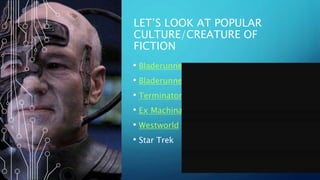
LET’S LOOK AT POPULAR
CULTURE/CREATURE OF
FICTION
• Bladerunner
• Bladerunner
• Terminator
• Ex Machina
• Westworld
• Star Trek
LET’S LOOK AT REAL LIFE
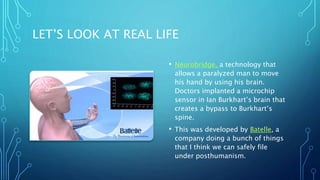
• Neurobridge, a technology that
allows a paralyzed man to move
his hand by using his brain.
Doctors implanted a microchip
sensor in Ian Burkhart’s brain that
creates a bypass to Burkhart’s
spine.
• This was developed by Batelle, a
company doing a bunch of things
that I think we can safely file
under posthumanism.
MEET A REAL EYEBORG
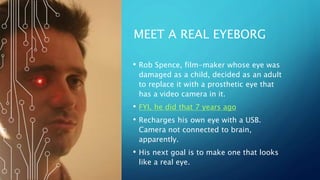
• Rob Spence, film-maker whose eye was
damaged as a child, decided as an adult
to replace it with a prosthetic eye that
has a video camera in it.
• FYI, he did that 7 years ago
• Recharges his own eye with a USB.
Camera not connected to brain,
apparently.
• His next goal is to make one that looks
like a real eye.
BIONICMAN/WOMAN
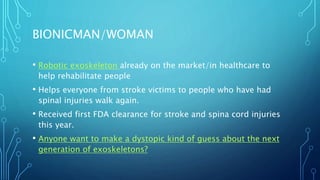
• Robotic exoskeleton already on the market/in healthcare to
help rehabilitate people
• Helps everyone from stroke victims to people who have had
spinal injuries walk again.
• Received first FDA clearance for stroke and spina cord injuries
this year.
• Anyone want to make a dystopic kind of guess about the next
generation of exoskeletons?
BIOHACKING, CONTINUED
• Amal Graafstra is an example of the current “biohacking”
movement. He has been inserting RFID chips (radio frequency
identification) into his hands for more than a decade. His
definition of biohackers” “DIY cyborgs who are upgrading their
bodies with hardware without waiting for corporate
development cycles or authorities to say it’s OK.” (“UK
Guardian, “The Real Cyborgs” by Arthur House
• Let’s hear a little bit what he had to say a few years ago
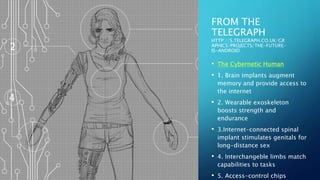
FROM THE
TELEGRAPH
HTTP://S.TELEGRAPH.CO.UK/GR
APHICS/PROJECTS/THE-FUTURE-
IS-ANDROID
• The Cybernetic Human
• 1. Brain implants augment
memory and provide access to
the internet
• 2. Wearable exoskeleton
boosts strength and
endurance
• 3.Internet-connected spinal
implant stimulates genitals for
long-distance sex
• 4. Interchangeble limbs match
capabilities to tasks
• 5. Access-control chips
CYBORG MANIFESTO
• Haraway discusses the value of considering the cyborg as a way
of reading unity into the various fractures in—for lack of a
more complicated term—identity politics.
• She creates an infomatic scheme in which she compares
“traditional” modes of being with (again for a lack of a better
word) more transhumanist conditions. Let’s compare a few of
them.
“COMFORTABLE OLD HIERARCHICAL DOMINATIONS”
VERSUS “SCARY NEW NETWORKS/INFORMATICS OF
DOMINATION”
• Representation
• Bourgeois novel, realism
• Heat
• Biology as clinical practice
• Eugenics
• Nature/culture
• sex
• Simulation
• Science fiction, postmodernism
• Noise
• Biology as inscription
• Population control
• Fields of difference
• Genetic engineering
ANALYZING HARAWAY IN RELATION TO HE,
SHE AND IT
• In groups, please read together and discuss quotations from
The Cyborg Manifesto
• First, make sure you have an understanding of the idea and
then discuss it. You don’t have to discuss it in a binary way, but
see what you think and discuss its application to our current
society/lives/world
• Then see if you can find an application for the idea in He, She
and It. We’ll then present each group’s discussion to the class.
CYBORGS AND WOMEN
• June Deery argues in part that “cyborgs might resemble or
identify with” women and visa versa in the novel.
• Yod’s position in society is comparable to women in patriarchal
society: he has to close read other’s reactions, he isn’t paid for
his work, he’s compared to a sex toy by a character
• He ultimately rejects his own technological/weaponized role/
aka masculine role

He, She and It

  • 1.
    “WE ARE CYBORGS” AREWE? THOUGHTS ON MARGE PIERCY’S HE, SHE AND IT, AS WELL AS THE POSTHUMANIST VIEW OF GENDER AND SEXUALITY PLUS SOME OTHER STUFF: “WE ARE ONLY BEGINNING TO REALIZE THE POSSIBILITIES AND LIMITATIONS OF VIRTUAL REALITY AND OF CYBORG TECHNOLOGY, BOTH OF WHICH ARE KEY TO OUR UNDERSTANDING OF OUR POSTMODERN SELVES.” —JUNE DEERY
  • 2.
    HE, SHE ANDIT • Winner of the Arthur C. Clarke Award for Best Science Fiction in the United Kingdom (1991) • Author Marge Piercy considers herself a political writer. She is a poet, novelist and memoirist; she’s written 43 books (by my counting) • Her novel, Woman on the Edge of Time (1976) explores comparable science-fiction and feminist motifs
  • 3.
    CYBORGS AS ACONSTRUCT FOR EXPLORING IDENTITY • In Donna Harraway’s essay, The Cyborg Manifesto, she defines the cyborg thusly: • “A cyborg is a cybernetic organism, a hybrid of machine and organism, a creature of social reality as well as a creature of fiction. Social reality is lived social relations, our most important political construction, a world-changing fiction. The international women’s movements have constructed ‘women’s experience,’ as well as uncovered or discovered this crucial collective object. This experience is a fiction and fact of the most crucial, political kind.”
  • 4.
    LET’S LOOK ATPOPULAR CULTURE/CREATURE OF FICTION • Bladerunner • Bladerunner • Terminator • Ex Machina • Westworld • Star Trek
  • 5.
    LET’S LOOK ATREAL LIFE • Neurobridge, a technology that allows a paralyzed man to move his hand by using his brain. Doctors implanted a microchip sensor in Ian Burkhart’s brain that creates a bypass to Burkhart’s spine. • This was developed by Batelle, a company doing a bunch of things that I think we can safely file under posthumanism.
  • 6.
    MEET A REALEYEBORG • Rob Spence, film-maker whose eye was damaged as a child, decided as an adult to replace it with a prosthetic eye that has a video camera in it. • FYI, he did that 7 years ago • Recharges his own eye with a USB. Camera not connected to brain, apparently. • His next goal is to make one that looks like a real eye.
  • 7.
    BIONICMAN/WOMAN • Robotic exoskeletonalready on the market/in healthcare to help rehabilitate people • Helps everyone from stroke victims to people who have had spinal injuries walk again. • Received first FDA clearance for stroke and spina cord injuries this year. • Anyone want to make a dystopic kind of guess about the next generation of exoskeletons?
  • 8.
    BIOHACKING, CONTINUED • AmalGraafstra is an example of the current “biohacking” movement. He has been inserting RFID chips (radio frequency identification) into his hands for more than a decade. His definition of biohackers” “DIY cyborgs who are upgrading their bodies with hardware without waiting for corporate development cycles or authorities to say it’s OK.” (“UK Guardian, “The Real Cyborgs” by Arthur House • Let’s hear a little bit what he had to say a few years ago
  • 9.
    FROM THE TELEGRAPH HTTP://S.TELEGRAPH.CO.UK/GR APHICS/PROJECTS/THE-FUTURE- IS-ANDROID • TheCybernetic Human • 1. Brain implants augment memory and provide access to the internet • 2. Wearable exoskeleton boosts strength and endurance • 3.Internet-connected spinal implant stimulates genitals for long-distance sex • 4. Interchangeble limbs match capabilities to tasks • 5. Access-control chips
  • 10.
    CYBORG MANIFESTO • Harawaydiscusses the value of considering the cyborg as a way of reading unity into the various fractures in—for lack of a more complicated term—identity politics. • She creates an infomatic scheme in which she compares “traditional” modes of being with (again for a lack of a better word) more transhumanist conditions. Let’s compare a few of them.
  • 11.
    “COMFORTABLE OLD HIERARCHICALDOMINATIONS” VERSUS “SCARY NEW NETWORKS/INFORMATICS OF DOMINATION” • Representation • Bourgeois novel, realism • Heat • Biology as clinical practice • Eugenics • Nature/culture • sex • Simulation • Science fiction, postmodernism • Noise • Biology as inscription • Population control • Fields of difference • Genetic engineering
  • 12.
    ANALYZING HARAWAY INRELATION TO HE, SHE AND IT • In groups, please read together and discuss quotations from The Cyborg Manifesto • First, make sure you have an understanding of the idea and then discuss it. You don’t have to discuss it in a binary way, but see what you think and discuss its application to our current society/lives/world • Then see if you can find an application for the idea in He, She and It. We’ll then present each group’s discussion to the class.
  • 13.
    CYBORGS AND WOMEN •June Deery argues in part that “cyborgs might resemble or identify with” women and visa versa in the novel. • Yod’s position in society is comparable to women in patriarchal society: he has to close read other’s reactions, he isn’t paid for his work, he’s compared to a sex toy by a character • He ultimately rejects his own technological/weaponized role/ aka masculine role

Editor's Notes

  • #5 The Voight-Kampff is a polygraph-like machine
  • #10 Kevin Warwick, one of the more famous transhumanists,  In the 1990s, Reading University’s visiting professor of cybernetics started implanting RFID chips into himself. In 2002, he underwent pioneering surgery to have an array of electrodes attached to the nerve fibres in his arm. This was the first time a human nervous system had been connected to a computer. Warwick’s “neural interface” allowed him to move a robotic hand by moving his own and to control a customised wheelchair with his thoughts. It also enabled him to experience electronic stimuli coming the other way. In one experiment he was able to sense ultrasound, which is beyond normal “I was born human,”, Warwick has said, “ but I believe it’s something we have the power to change.”
  • #12 Premodernism respected outside authority, the gods, the church. Modernism puts the emphasis on the individual creator, I think therefore I am, postmodernsim rejects that autonomy, looks at the self as a more fractured, diverse, being. Postmodernism can also be a critical project, revealing the cultural constructions we designate as truth and opening up a variety of repressed other histories of modernity. Such as those of women, homosexuals and the colonised. The modernist canon itself is revealed as patriarchal and racist, dominated by white heterosexual men. As a result, one of the most common themes addressed within postmodernism relates to cultural identity.