Propositional logic class 2 of AI/ Ml for Diploma students
2.
Introduction
A propositionis a declarative statement which is either true or
false.
Propositions can be either true or false, but it cannot be both.
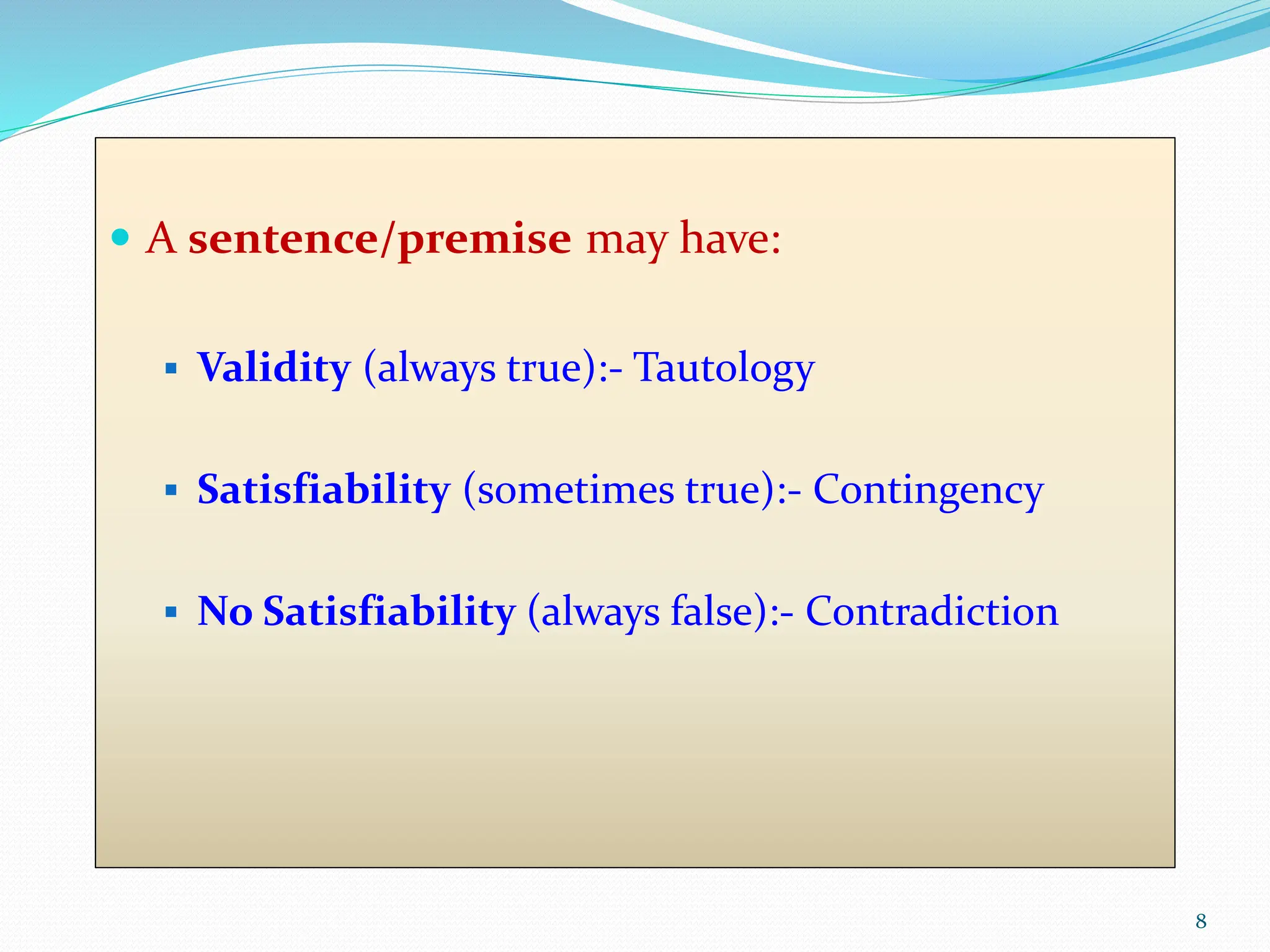
A proposition formula which is always true is called tautology.
A proposition formula which is always false is
called Contradiction.
A proposition formula which has both true and false values is
called Contingency.
3.
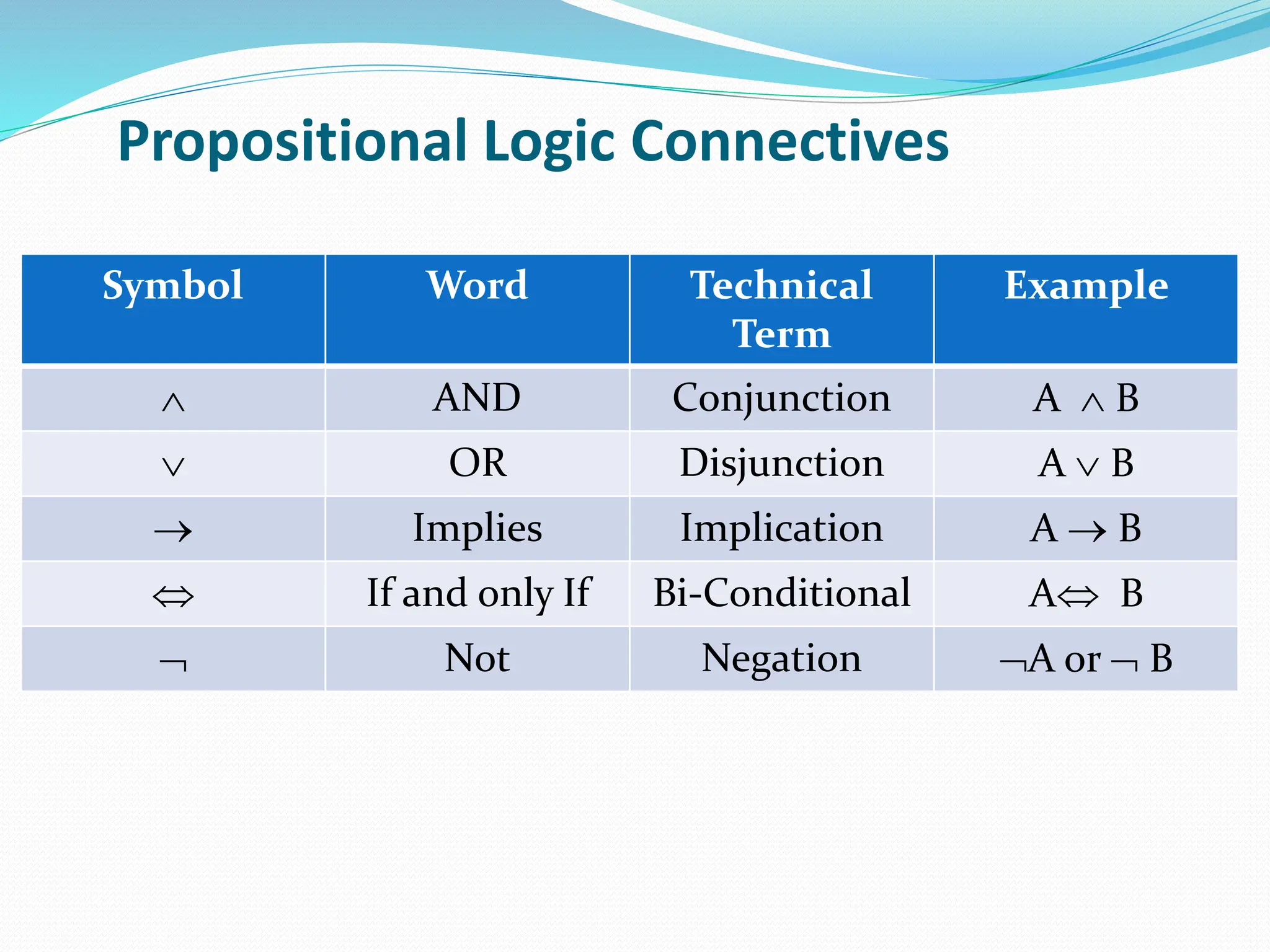
Propositional Logic Connectives
SymbolWord Technical
Term
Example
AND Conjunction A B
OR Disjunction A B
Implies Implication A B
If and only If Bi-Conditional A B
Not Negation A or B
4.
Inference rules
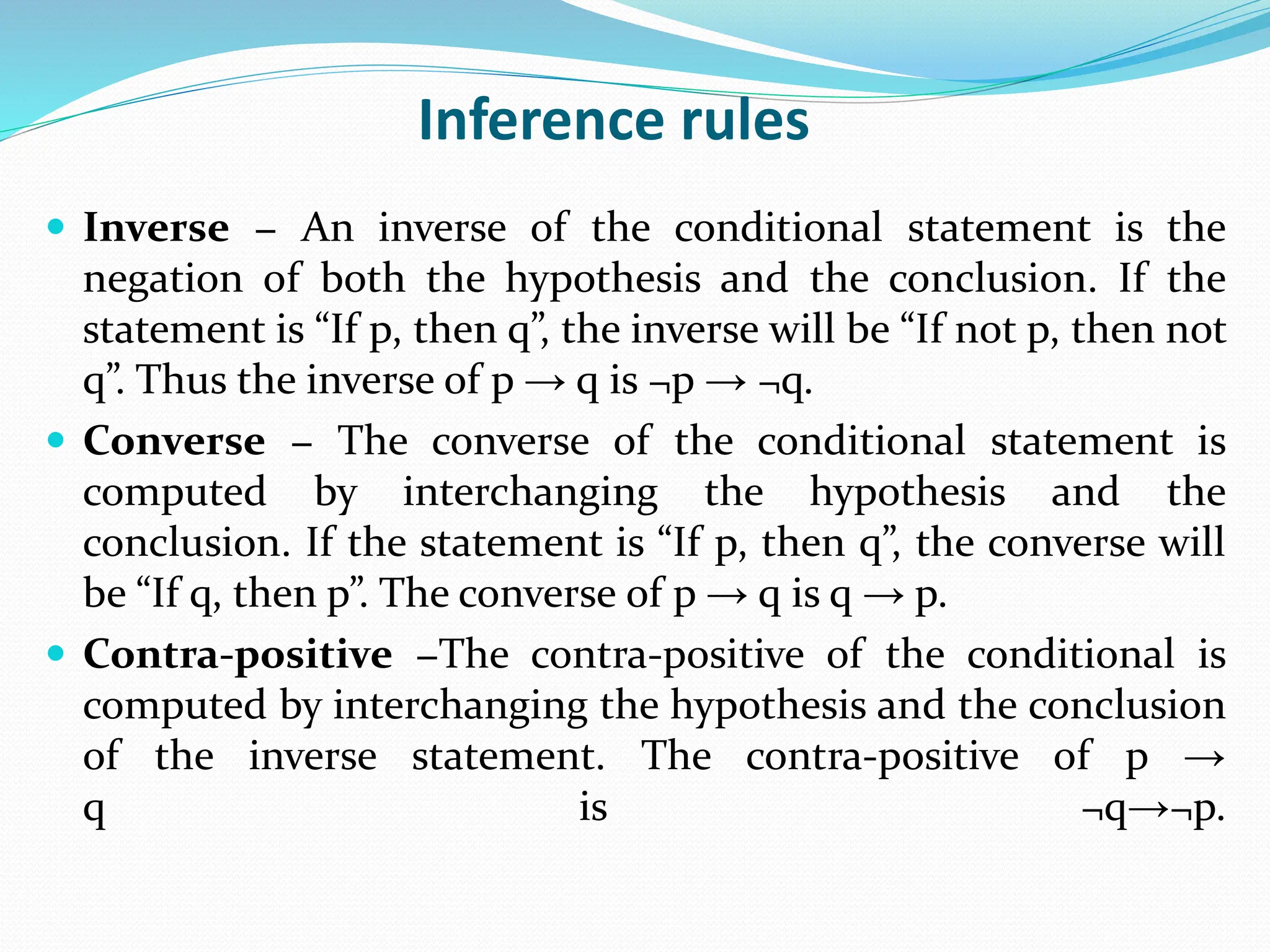
Inverse− An inverse of the conditional statement is the
negation of both the hypothesis and the conclusion. If the
statement is “If p, then q”, the inverse will be “If not p, then not
q”. Thus the inverse of p → q is ¬p → ¬q.
Converse − The converse of the conditional statement is
computed by interchanging the hypothesis and the
conclusion. If the statement is “If p, then q”, the converse will
be “If q, then p”. The converse of p → q is q → p.
Contra-positive −The contra-positive of the conditional is
computed by interchanging the hypothesis and the conclusion
of the inverse statement. The contra-positive of p →
q is ¬q→¬p.
5.
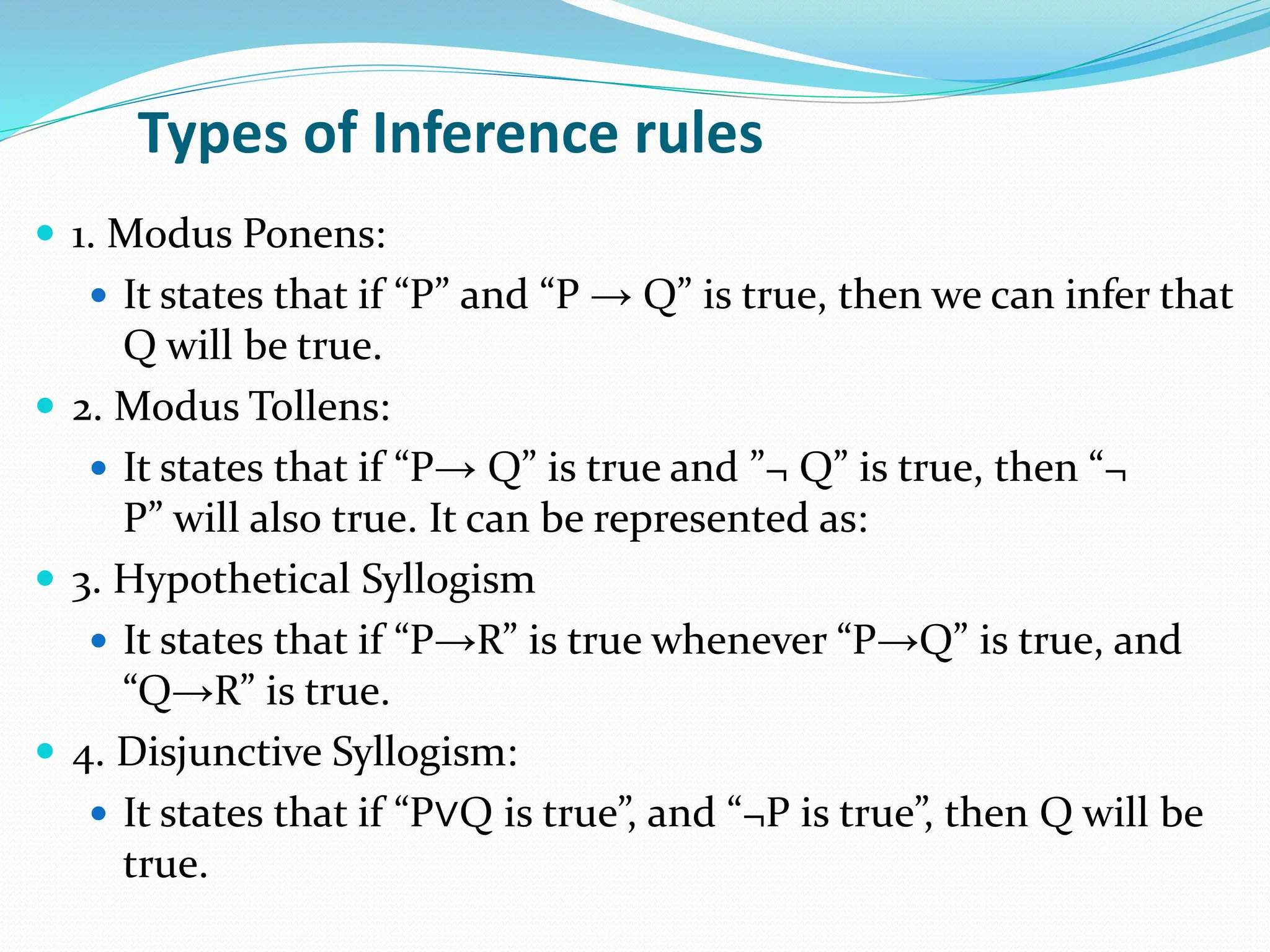
Types of Inferencerules
1. Modus Ponens:
It states that if “P” and “P → Q” is true, then we can infer that
Q will be true.
2. Modus Tollens:
It states that if “P→ Q” is true and ”¬ Q” is true, then “¬
P” will also true. It can be represented as:
3. Hypothetical Syllogism
It states that if “P→R” is true whenever “P→Q” is true, and
“Q→R” is true.
4. Disjunctive Syllogism:
It states that if “P∨Q is true”, and “¬P is true”, then Q will be
true.
6.
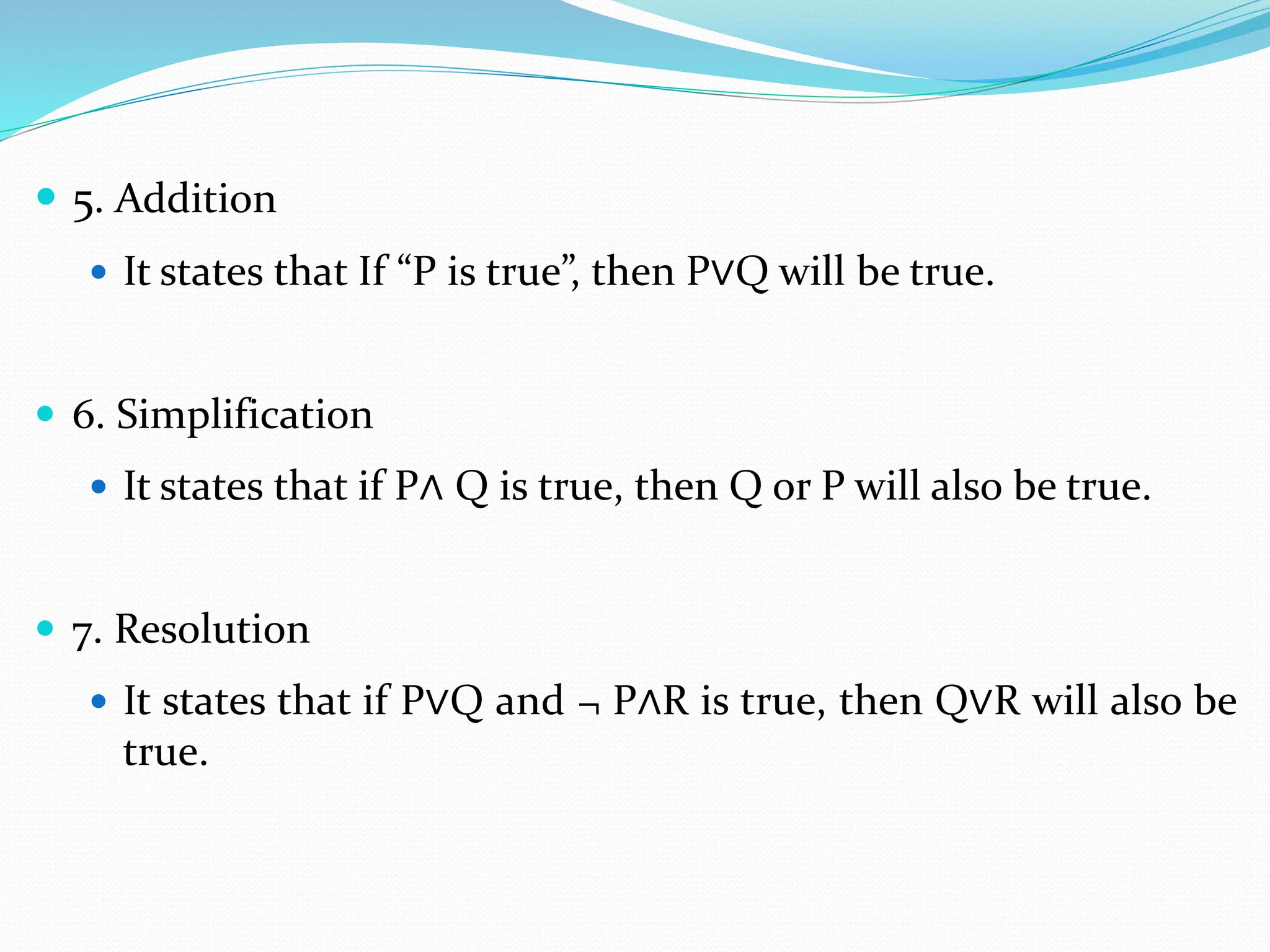
5. Addition
It states that If “P is true”, then P∨Q will be true.
6. Simplification
It states that if P∧ Q is true, then Q or P will also be true.
7. Resolution
It states that if P∨Q and ¬ P∧R is true, then Q∨R will also be
true.
7.
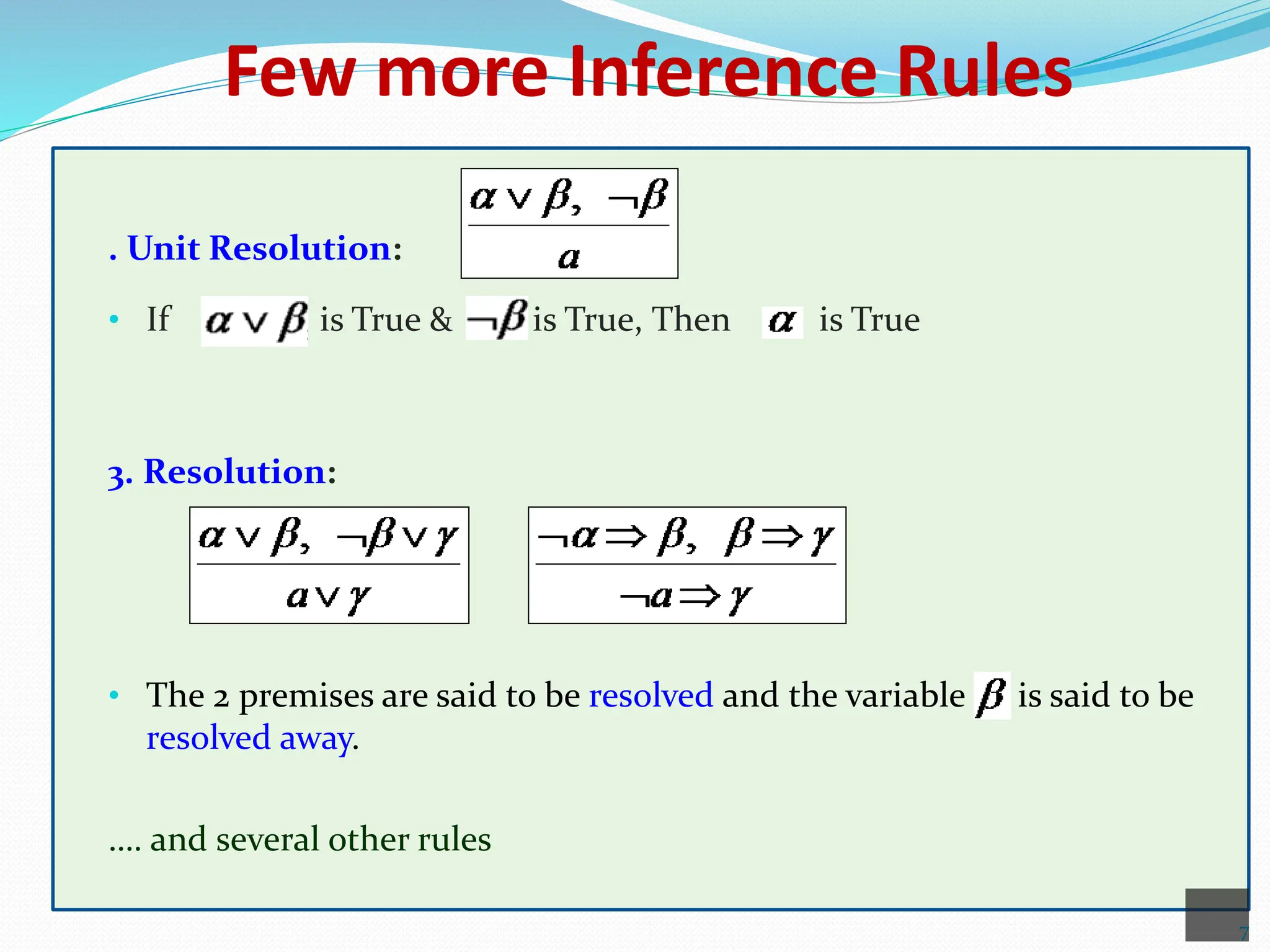
Few more InferenceRules
. Unit Resolution:
• If is True & is True, Then is True
3. Resolution:
or
• The 2 premises are said to be resolved and the variable is said to be
resolved away.
…. and several other rules
7
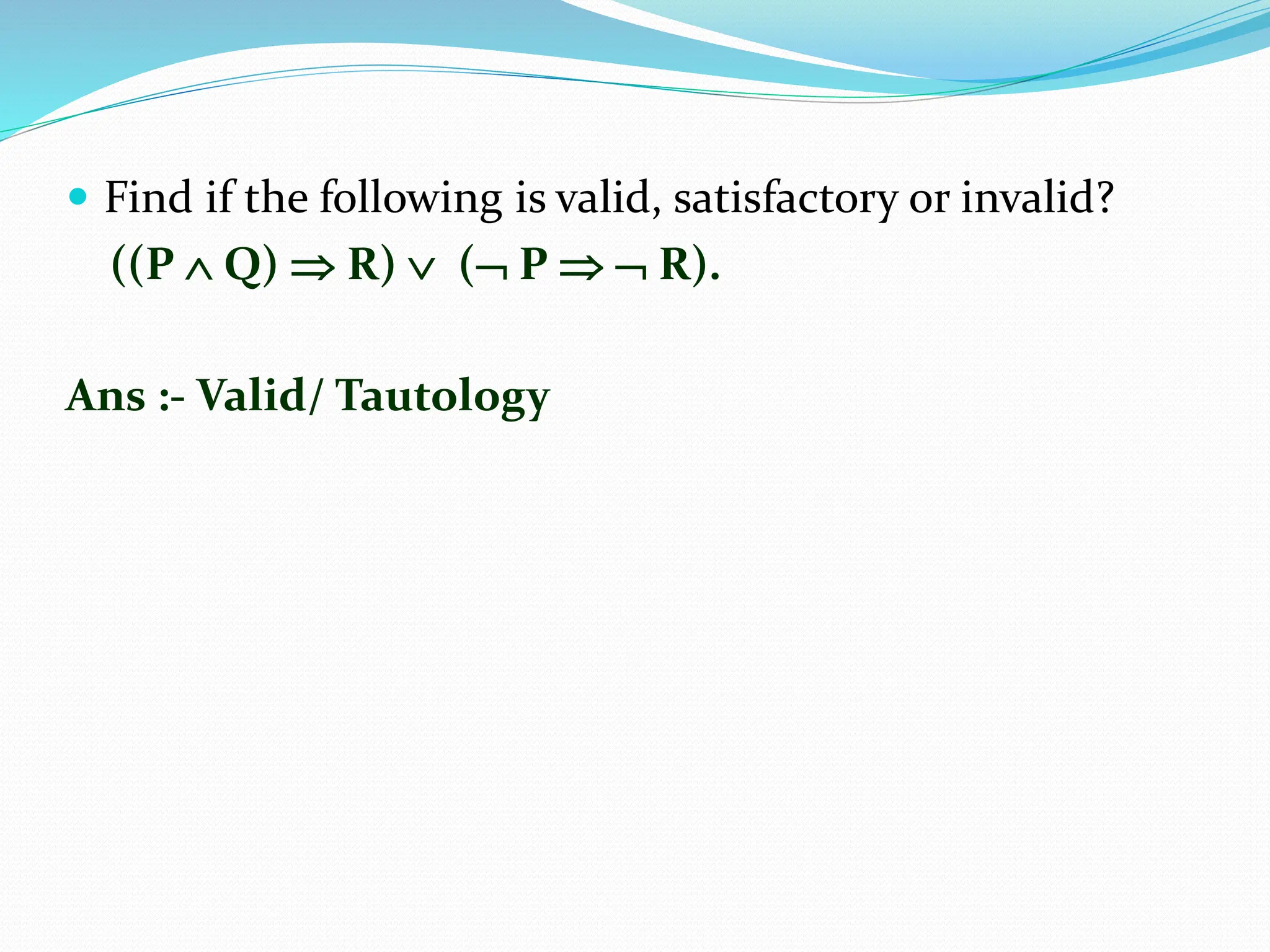
Find ifthe following is valid, satisfactory or invalid?
((P Q) R) ( P R).
Ans :- Valid/ Tautology
10.
10
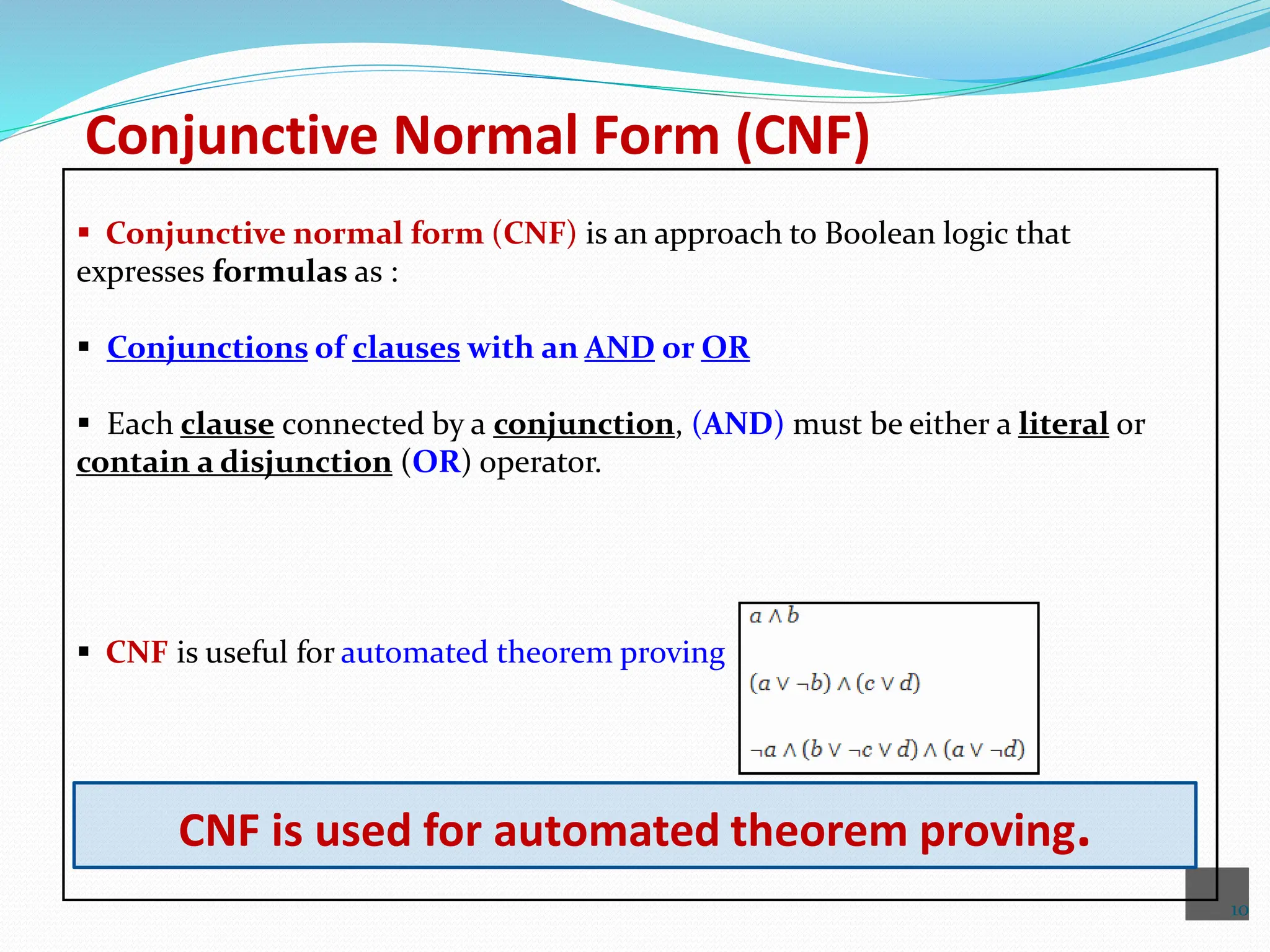
Conjunctive Normal Form(CNF)
Conjunctive normal form (CNF) is an approach to Boolean logic that
expresses formulas as :
Conjunctions of clauses with an AND or OR
Each clause connected by a conjunction, (AND) must be either a literal or
contain a disjunction (OR) operator.
CNF is useful for automated theorem proving
CNF is used for automated theorem proving.
12
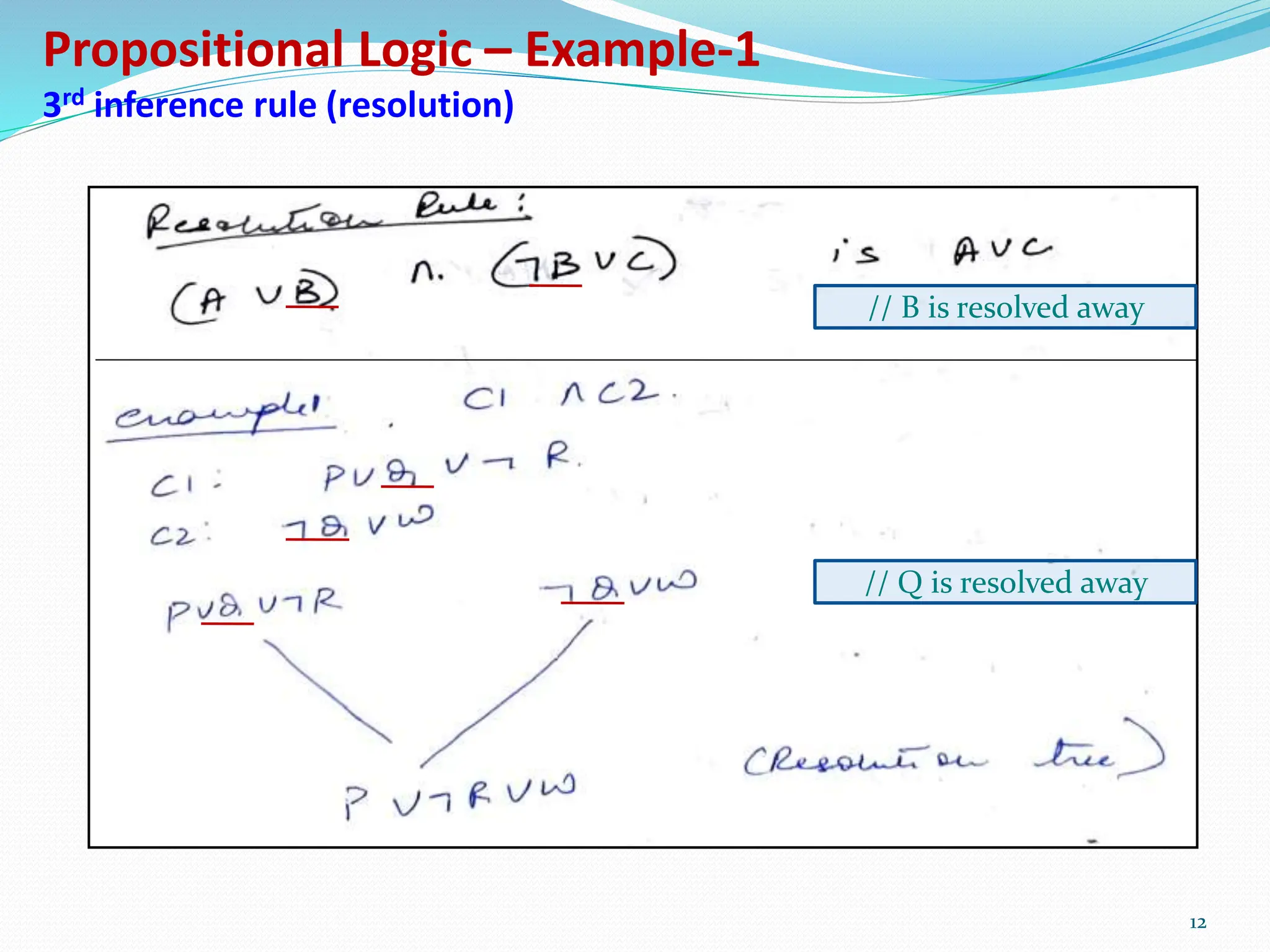
Propositional Logic –Example-1
3rd inference rule (resolution)
// B is resolved away
// Q is resolved away
13.
13
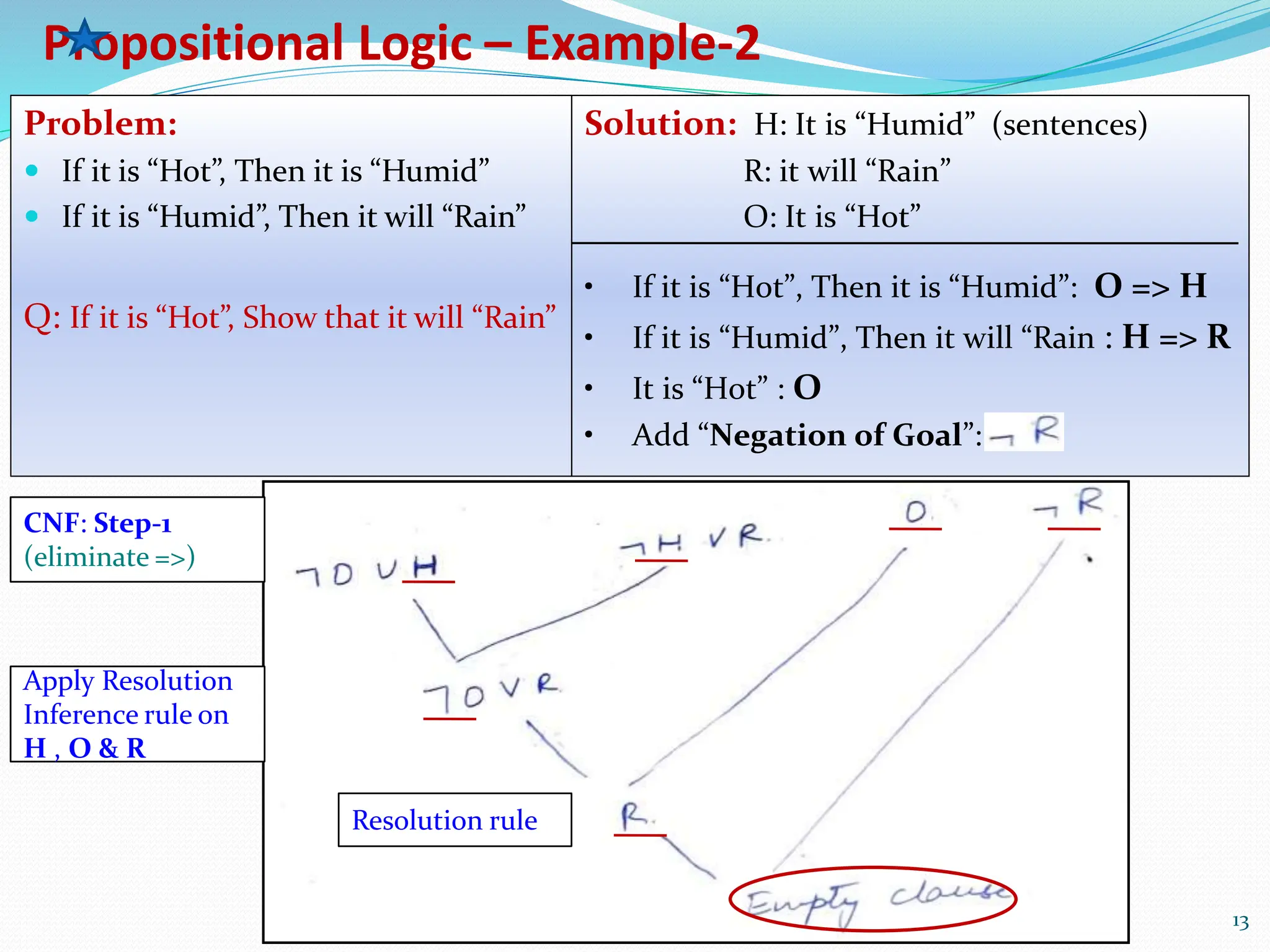
Propositional Logic –Example-2
Problem:
If it is “Hot”, Then it is “Humid”
If it is “Humid”, Then it will “Rain”
Q: If it is “Hot”, Show that it will “Rain”
Solution: H: It is “Humid” (sentences)
R: it will “Rain”
O: It is “Hot”
• If it is “Hot”, Then it is “Humid”: O => H
• If it is “Humid”, Then it will “Rain : H => R
• It is “Hot” : O
• Add “Negation of Goal”:
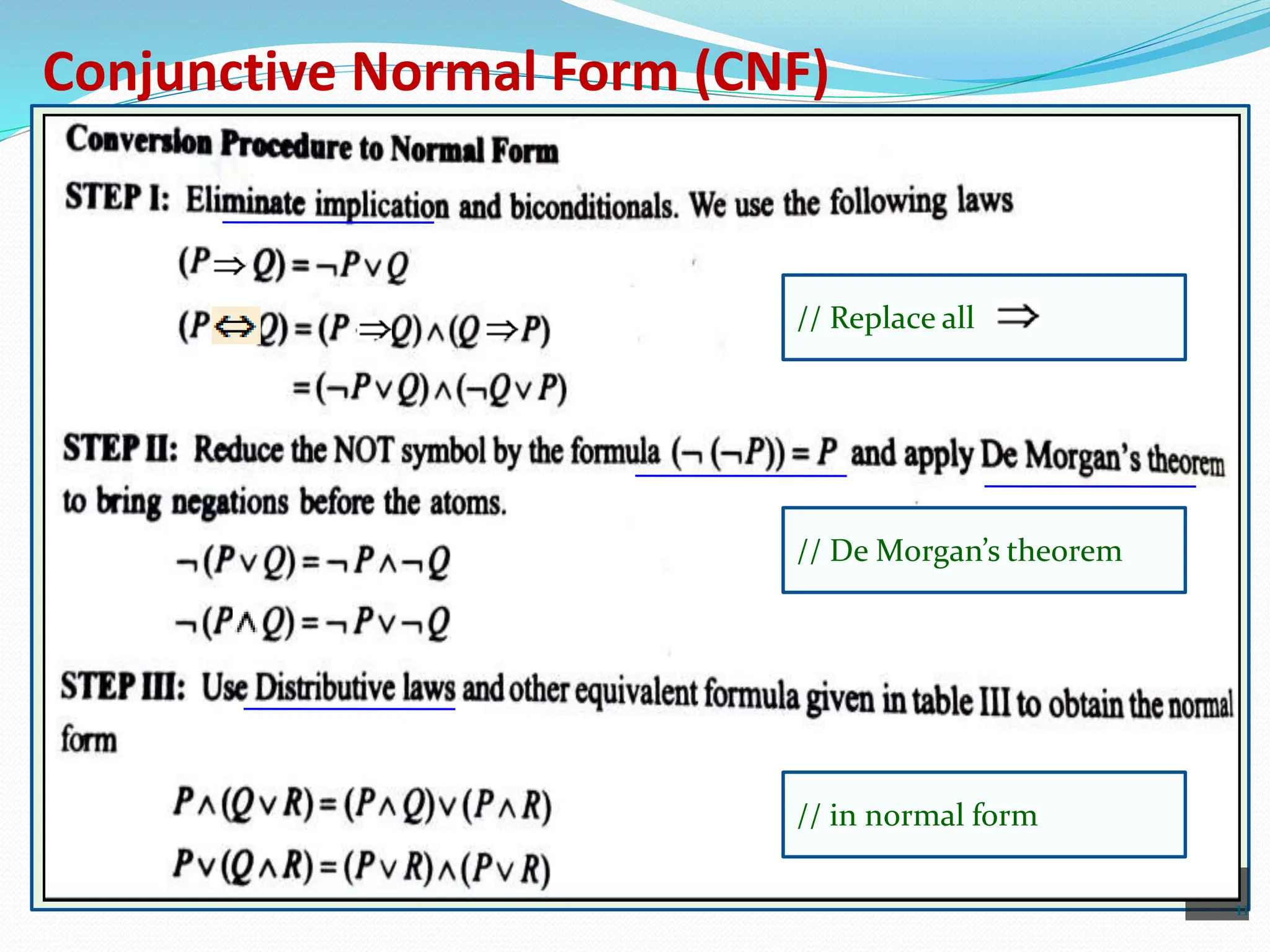
CNF: Step-1
(eliminate =>)
Apply Resolution
Inference rule on
H , O & R
Resolution rule
Limitations of PropositionalLogic
In propositional logic, we can only represent the facts, which
are either true or false.
PL is not sufficient to represent the complex sentences or
natural language statements.
The propositional logic has very limited expressive power.