© 2003 McGraw-Hill Australia Pty Ltd. PowerPoint 1
CHAPTER 7
STRATEGIC MANAGEMENT
© 2003 McGraw-Hill Australia Pty Ltd. PowerPoint 2
Lecture summary
• The concept of strategic management
• Role of competitive analysis in strategy
formulation
• Formulating corporate level strategy
• Formulating business level strategy
• Formulating functional level strategy
• Strategy implementation
© 2003 McGraw-Hill Australia Pty Ltd. PowerPoint 3
Concept of strategic
management
‘Large-scale action plan for interacting with
the environment to achieve long-term goals.’
© 2003 McGraw-Hill Australia Pty Ltd. PowerPoint 4
Concept of strategic
management
• Strategic management process
• Importance of strategic management
• Levels of strategy
© 2003 McGraw-Hill Australia Pty Ltd. PowerPoint 5
Concept of strategic
management
Strategic management process:
‘Process through which managers formulate
and implement strategies geared to
optimising strategic goal achievement, given
available environmental and internal
conditions.’
© 2003 McGraw-Hill Australia Pty Ltd. PowerPoint 6
Concept of strategic
management
Strategic management process:
• Strategy formulation
– Identify mission & goals
– Competitive situation analysis (external & internal)
– Develop/formulate strategies to achieve identified goals
• Strategy implementation
– Implement plans
– Control/monitor execution of plans
© 2003 McGraw-Hill Australia Pty Ltd. PowerPoint 7
Strategic management process
Environmental
analysis
Strategic
control
Strategy
formulation
Strategy
implementation
Conduct SWOT
analysis
Formulate
mission &
strategic goals
Internal
(organisational)
assessment
© 2003 McGraw-Hill Australia Pty Ltd. PowerPoint 8
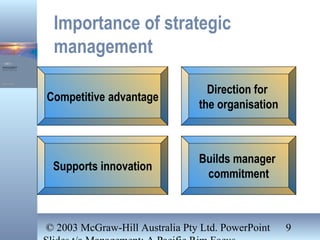
Importance of strategic
management
Important because:
• Helps organisations develop a competitive
advantage (significant edge over competition in
dealing with competitive forces).
• Provides a sense of long-term direction for
organisation members.
• Highlights need for innovation.
• Process involves members and fosters
understanding of goals/strategy.
© 2003 McGraw-Hill Australia Pty Ltd. PowerPoint 9
Importance of strategic
management
Competitive advantage
Direction for
the organisation
Supports innovation
Builds manager
commitment
© 2003 McGraw-Hill Australia Pty Ltd. PowerPoint 10
Levels of strategy
Corporate level
Business level
Functional level
© 2003 McGraw-Hill Australia Pty Ltd. PowerPoint 11
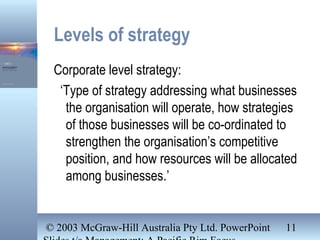
Levels of strategy
Corporate level strategy:
‘Type of strategy addressing what businesses
the organisation will operate, how strategies
of those businesses will be co-ordinated to
strengthen the organisation’s competitive
position, and how resources will be allocated
among businesses.’
© 2003 McGraw-Hill Australia Pty Ltd. PowerPoint 12
Levels of strategy
Business level strategy:
‘Type of strategy concentrating on the best
means of competing within a particular
business while also supporting corporate
level strategy.’
© 2003 McGraw-Hill Australia Pty Ltd. PowerPoint 13
Levels of strategy
Functional level strategy:
‘Type of strategy focussing on action plans for
managing a particular functional area within a
business in a way that supports business
level strategy.’
© 2003 McGraw-Hill Australia Pty Ltd. PowerPoint 14
Competitive analysis in strategy
formulation
Before managers devise an effective strategy
for getting a competitive edge, they must
analyse the organisation’s competitive
situation.
This is done through:
• Environmental analysis (external)
• Organisational assessment (internal)
© 2003 McGraw-Hill Australia Pty Ltd. PowerPoint 15
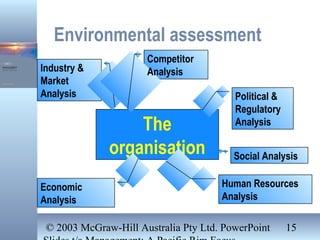
Environmental assessment
The
organisation Social Analysis
Political &
Regulatory
Analysis
Human Resources
Analysis
Industry &
Market
Analysis
Competitor
Analysis
Economic
Analysis
© 2003 McGraw-Hill Australia Pty Ltd. PowerPoint 16
Competitive analysis in strategy
formulation
SWOT analysis:
Method of analysing an organisation’s
competitive situation involving assessing
organisational strengths (S), weaknesses
(W), environmental opportunities (O) and
threats (T).
© 2003 McGraw-Hill Australia Pty Ltd. PowerPoint 17
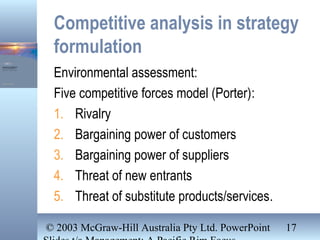
Competitive analysis in strategy
formulation
Environmental assessment:
Five competitive forces model (Porter):
1. Rivalry
2. Bargaining power of customers
3. Bargaining power of suppliers
4. Threat of new entrants
5. Threat of substitute products/services.
© 2003 McGraw-Hill Australia Pty Ltd. PowerPoint 18
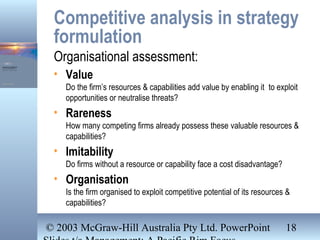
Competitive analysis in strategy
formulation
Organisational assessment:
• Value
Do the firm’s resources & capabilities add value by enabling it to exploit
opportunities or neutralise threats?
• Rareness
How many competing firms already possess these valuable resources &
capabilities?
• Imitability
Do firms without a resource or capability face a cost disadvantage?
• Organisation
Is the firm organised to exploit competitive potential of its resources &
capabilities?
© 2003 McGraw-Hill Australia Pty Ltd. PowerPoint 19
Formulating corporate level
strategy
Corporate level strategy is the overall strategy
an organisation follows. Its development
involves selecting a grand strategy and using
portfolio-strategy approaches to determine the
various businesses making up the
organisation:
• Grand strategy
• Portfolio-strategy approaches.
© 2003 McGraw-Hill Australia Pty Ltd. PowerPoint 20
Formulating corporate level
strategy
Grand strategies:
• Growth
Concentration
Vertical integration
Diversification
• Stability
Harvest
Turnaround
• Defensive
Divestiture
Bankruptcy
Liquidation
© 2003 McGraw-Hill Australia Pty Ltd. PowerPoint 21
Formulating corporate level
strategy
Portfolio strategies:
Method of analysing an organisation’s mix of businesses in
terms of both individual and collective contributions to
strategic goals.
• BCG growth–share matrix
Compares businesses in an organisation’s portfolio on the
basis of relative market market share and market growth
rate.
• Product–market evaluation matrix
Compares businesses’ strength against product/market life-
cycle.
© 2003 McGraw-Hill Australia Pty Ltd. PowerPoint 22
BCG growth-share matrix
Relative competitive position (market share)Marketgrowthrate
High Low
Cash cows
Stars
Dogs
Question
marks
© 2003 McGraw-Hill Australia Pty Ltd. PowerPoint 23
Product-market evaluation
matrix
Business unit’s competitive position
Strong Average Weak
Product/ Development
Market Growth
Life cycle Shakeout
Growth Maturity
Saturation
Decline
© 2003 McGraw-Hill Australia Pty Ltd. PowerPoint 24
Formulating business level
strategy
• Business level strategy is concerned with
how a particular business competes.
• The best known approach for strategy
development is based on Porter’s research.
© 2003 McGraw-Hill Australia Pty Ltd. PowerPoint 25
Formulating business level
strategy
Generic business strategies:
Porter outlined three generic business level
strategies to gain competitive advantage over
other firms operating in the same industry.
© 2003 McGraw-Hill Australia Pty Ltd. PowerPoint 26
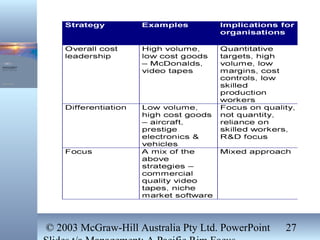
Formulating business level
strategy
Generic business strategies (Porter):
• Cost leadership strategy
Emphasises operational efficiency i.e. overall costs are lower
than competitors.
• Differentiation strategy
Attempts to develop products/services viewed as unique in
the industry.
• Focus strategy
Concentration on a segment, portion of a market.
© 2003 McGraw-Hill Australia Pty Ltd. PowerPoint 27
© 2003 McGraw-Hill Australia Pty Ltd. PowerPoint 28
Formulating functional level
strategy
Functional level strategies spell out specific
ways that functional areas can bolster business
level strategy.
For example:
• Under a product differentiation strategy, the R & D
dept. may accelerate the innovation process to
provide new products in advance of competitors.
© 2003 McGraw-Hill Australia Pty Ltd. PowerPoint 29
Strategy implementation
Strategy implementation involves
management activities needed to put the
strategy in motion, institute strategic controls
for monitoring progress, and ultimately
achieve organisation goals.
© 2003 McGraw-Hill Australia Pty Ltd. PowerPoint 30
Strategy implementation
Strategy
formulation
Carry out plans:
•Technology
•Human resources
•Reward systems
•Decision processes
•structure
Maintain control:
•Control systems
•Adjustments
© 2003 McGraw-Hill Australia Pty Ltd. PowerPoint 31
Lecture summary
• Concept of strategic management
– Process
– Importance
– Levels
• Competitive analysis in strategy formulation
– SWOT analysis
– Environmental assessment
– Organisational assessment
© 2003 McGraw-Hill Australia Pty Ltd. PowerPoint 32
Lecture summary
• Formulating corporate level strategy
– Grand strategy
– Portfolio strategies
• Formulating business level strategy
– Porter generic strategies: cost, differentiation & focus
• Formulating corporate level strategy
• Strategy implementation
– Control systems & adjustments

Chapter 7-2070k1970

  • 1.
    © 2003 McGraw-HillAustralia Pty Ltd. PowerPoint 1 CHAPTER 7 STRATEGIC MANAGEMENT
  • 2.
    © 2003 McGraw-HillAustralia Pty Ltd. PowerPoint 2 Lecture summary • The concept of strategic management • Role of competitive analysis in strategy formulation • Formulating corporate level strategy • Formulating business level strategy • Formulating functional level strategy • Strategy implementation
  • 3.
    © 2003 McGraw-HillAustralia Pty Ltd. PowerPoint 3 Concept of strategic management ‘Large-scale action plan for interacting with the environment to achieve long-term goals.’
  • 4.
    © 2003 McGraw-HillAustralia Pty Ltd. PowerPoint 4 Concept of strategic management • Strategic management process • Importance of strategic management • Levels of strategy
  • 5.
    © 2003 McGraw-HillAustralia Pty Ltd. PowerPoint 5 Concept of strategic management Strategic management process: ‘Process through which managers formulate and implement strategies geared to optimising strategic goal achievement, given available environmental and internal conditions.’
  • 6.
    © 2003 McGraw-HillAustralia Pty Ltd. PowerPoint 6 Concept of strategic management Strategic management process: • Strategy formulation – Identify mission & goals – Competitive situation analysis (external & internal) – Develop/formulate strategies to achieve identified goals • Strategy implementation – Implement plans – Control/monitor execution of plans
  • 7.
    © 2003 McGraw-HillAustralia Pty Ltd. PowerPoint 7 Strategic management process Environmental analysis Strategic control Strategy formulation Strategy implementation Conduct SWOT analysis Formulate mission & strategic goals Internal (organisational) assessment
  • 8.
    © 2003 McGraw-HillAustralia Pty Ltd. PowerPoint 8 Importance of strategic management Important because: • Helps organisations develop a competitive advantage (significant edge over competition in dealing with competitive forces). • Provides a sense of long-term direction for organisation members. • Highlights need for innovation. • Process involves members and fosters understanding of goals/strategy.
  • 9.
    © 2003 McGraw-HillAustralia Pty Ltd. PowerPoint 9 Importance of strategic management Competitive advantage Direction for the organisation Supports innovation Builds manager commitment
  • 10.
    © 2003 McGraw-HillAustralia Pty Ltd. PowerPoint 10 Levels of strategy Corporate level Business level Functional level
  • 11.
    © 2003 McGraw-HillAustralia Pty Ltd. PowerPoint 11 Levels of strategy Corporate level strategy: ‘Type of strategy addressing what businesses the organisation will operate, how strategies of those businesses will be co-ordinated to strengthen the organisation’s competitive position, and how resources will be allocated among businesses.’
  • 12.
    © 2003 McGraw-HillAustralia Pty Ltd. PowerPoint 12 Levels of strategy Business level strategy: ‘Type of strategy concentrating on the best means of competing within a particular business while also supporting corporate level strategy.’
  • 13.
    © 2003 McGraw-HillAustralia Pty Ltd. PowerPoint 13 Levels of strategy Functional level strategy: ‘Type of strategy focussing on action plans for managing a particular functional area within a business in a way that supports business level strategy.’
  • 14.
    © 2003 McGraw-HillAustralia Pty Ltd. PowerPoint 14 Competitive analysis in strategy formulation Before managers devise an effective strategy for getting a competitive edge, they must analyse the organisation’s competitive situation. This is done through: • Environmental analysis (external) • Organisational assessment (internal)
  • 15.
    © 2003 McGraw-HillAustralia Pty Ltd. PowerPoint 15 Environmental assessment The organisation Social Analysis Political & Regulatory Analysis Human Resources Analysis Industry & Market Analysis Competitor Analysis Economic Analysis
  • 16.
    © 2003 McGraw-HillAustralia Pty Ltd. PowerPoint 16 Competitive analysis in strategy formulation SWOT analysis: Method of analysing an organisation’s competitive situation involving assessing organisational strengths (S), weaknesses (W), environmental opportunities (O) and threats (T).
  • 17.
    © 2003 McGraw-HillAustralia Pty Ltd. PowerPoint 17 Competitive analysis in strategy formulation Environmental assessment: Five competitive forces model (Porter): 1. Rivalry 2. Bargaining power of customers 3. Bargaining power of suppliers 4. Threat of new entrants 5. Threat of substitute products/services.
  • 18.
    © 2003 McGraw-HillAustralia Pty Ltd. PowerPoint 18 Competitive analysis in strategy formulation Organisational assessment: • Value Do the firm’s resources & capabilities add value by enabling it to exploit opportunities or neutralise threats? • Rareness How many competing firms already possess these valuable resources & capabilities? • Imitability Do firms without a resource or capability face a cost disadvantage? • Organisation Is the firm organised to exploit competitive potential of its resources & capabilities?
  • 19.
    © 2003 McGraw-HillAustralia Pty Ltd. PowerPoint 19 Formulating corporate level strategy Corporate level strategy is the overall strategy an organisation follows. Its development involves selecting a grand strategy and using portfolio-strategy approaches to determine the various businesses making up the organisation: • Grand strategy • Portfolio-strategy approaches.
  • 20.
    © 2003 McGraw-HillAustralia Pty Ltd. PowerPoint 20 Formulating corporate level strategy Grand strategies: • Growth Concentration Vertical integration Diversification • Stability Harvest Turnaround • Defensive Divestiture Bankruptcy Liquidation
  • 21.
    © 2003 McGraw-HillAustralia Pty Ltd. PowerPoint 21 Formulating corporate level strategy Portfolio strategies: Method of analysing an organisation’s mix of businesses in terms of both individual and collective contributions to strategic goals. • BCG growth–share matrix Compares businesses in an organisation’s portfolio on the basis of relative market market share and market growth rate. • Product–market evaluation matrix Compares businesses’ strength against product/market life- cycle.
  • 22.
    © 2003 McGraw-HillAustralia Pty Ltd. PowerPoint 22 BCG growth-share matrix Relative competitive position (market share)Marketgrowthrate High Low Cash cows Stars Dogs Question marks
  • 23.
    © 2003 McGraw-HillAustralia Pty Ltd. PowerPoint 23 Product-market evaluation matrix Business unit’s competitive position Strong Average Weak Product/ Development Market Growth Life cycle Shakeout Growth Maturity Saturation Decline
  • 24.
    © 2003 McGraw-HillAustralia Pty Ltd. PowerPoint 24 Formulating business level strategy • Business level strategy is concerned with how a particular business competes. • The best known approach for strategy development is based on Porter’s research.
  • 25.
    © 2003 McGraw-HillAustralia Pty Ltd. PowerPoint 25 Formulating business level strategy Generic business strategies: Porter outlined three generic business level strategies to gain competitive advantage over other firms operating in the same industry.
  • 26.
    © 2003 McGraw-HillAustralia Pty Ltd. PowerPoint 26 Formulating business level strategy Generic business strategies (Porter): • Cost leadership strategy Emphasises operational efficiency i.e. overall costs are lower than competitors. • Differentiation strategy Attempts to develop products/services viewed as unique in the industry. • Focus strategy Concentration on a segment, portion of a market.
  • 27.
    © 2003 McGraw-HillAustralia Pty Ltd. PowerPoint 27
  • 28.
    © 2003 McGraw-HillAustralia Pty Ltd. PowerPoint 28 Formulating functional level strategy Functional level strategies spell out specific ways that functional areas can bolster business level strategy. For example: • Under a product differentiation strategy, the R & D dept. may accelerate the innovation process to provide new products in advance of competitors.
  • 29.
    © 2003 McGraw-HillAustralia Pty Ltd. PowerPoint 29 Strategy implementation Strategy implementation involves management activities needed to put the strategy in motion, institute strategic controls for monitoring progress, and ultimately achieve organisation goals.
  • 30.
    © 2003 McGraw-HillAustralia Pty Ltd. PowerPoint 30 Strategy implementation Strategy formulation Carry out plans: •Technology •Human resources •Reward systems •Decision processes •structure Maintain control: •Control systems •Adjustments
  • 31.
    © 2003 McGraw-HillAustralia Pty Ltd. PowerPoint 31 Lecture summary • Concept of strategic management – Process – Importance – Levels • Competitive analysis in strategy formulation – SWOT analysis – Environmental assessment – Organisational assessment
  • 32.
    © 2003 McGraw-HillAustralia Pty Ltd. PowerPoint 32 Lecture summary • Formulating corporate level strategy – Grand strategy – Portfolio strategies • Formulating business level strategy – Porter generic strategies: cost, differentiation & focus • Formulating corporate level strategy • Strategy implementation – Control systems & adjustments