CAPABİLİTY MATURİTY MODEL İNTEGRATİON  (CMMI) Kıvanç Kantürk SWE 550 Fall 2010
Outline Introduction CMMI Two Types of Leveling Maturity Levels Capability Levels Representations Staged Representation  Continuous Representation Benefits & Improvements Conclusion
Introduction Thanks to globalization, projects are more distributed today. Products getting more complex because of the developing technology. Today’s competitive market forces companies to produce Faster Better Cheaper Companies have to manage complex product development and maintenence.
Intoduction Contd’ Some products developed requires both inhouse development and outsorcing. (Integration problem) Far out companies recognized that, they have to develop softwares in order to compete in the market. For example; Aerospace companies Car manifacturers Banks Those companies have to find a solution in order to manage that complex, generally integrated approach while developing products.
CMMI Organized collections of best practices  Based on work (TQM) by Crosby, Juran, Deming, Humphrey… Systematic ordered approach to process improvement.  Means of measuring organizational maturity.  This model shows what to do, NOT how to do it or  who does it Have proven to bring significant return on investment in productivity and quality .
CMMI Contd’ NDIA (National Defence Industrial Association), DoD (Department of Defence) are sponsored and collaborative work of SEI (Software Engineering Institute ), NDIA Systems Engineering Community and Government. I mprovement in any discipline ,  is a function of   performing: Implementing practices   that reflect the   fundamentals of a particular topic ( For example:  configuration management   ) Institutionalizing practices   that lead to   sustainment and improvement of an   implementation
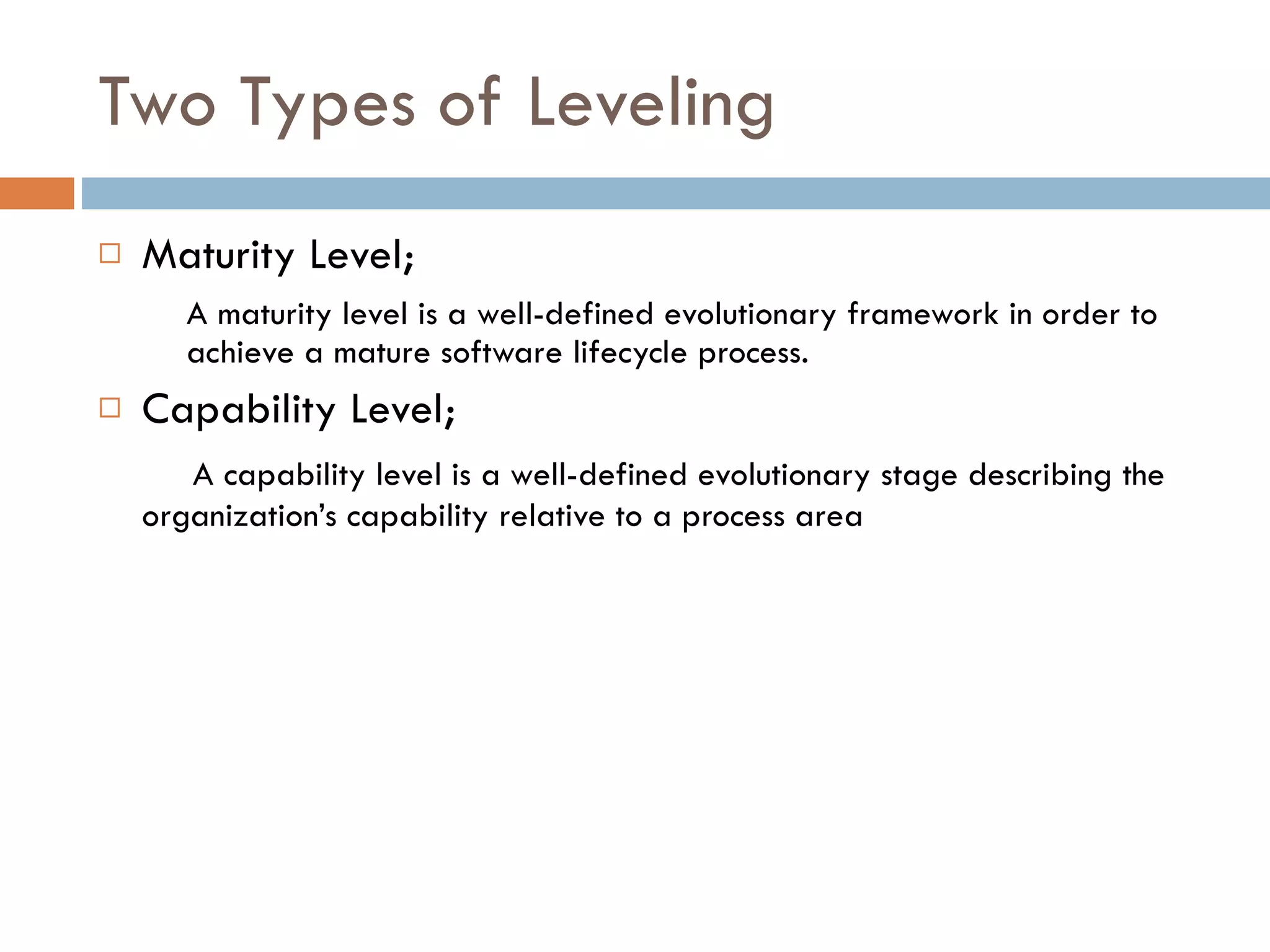
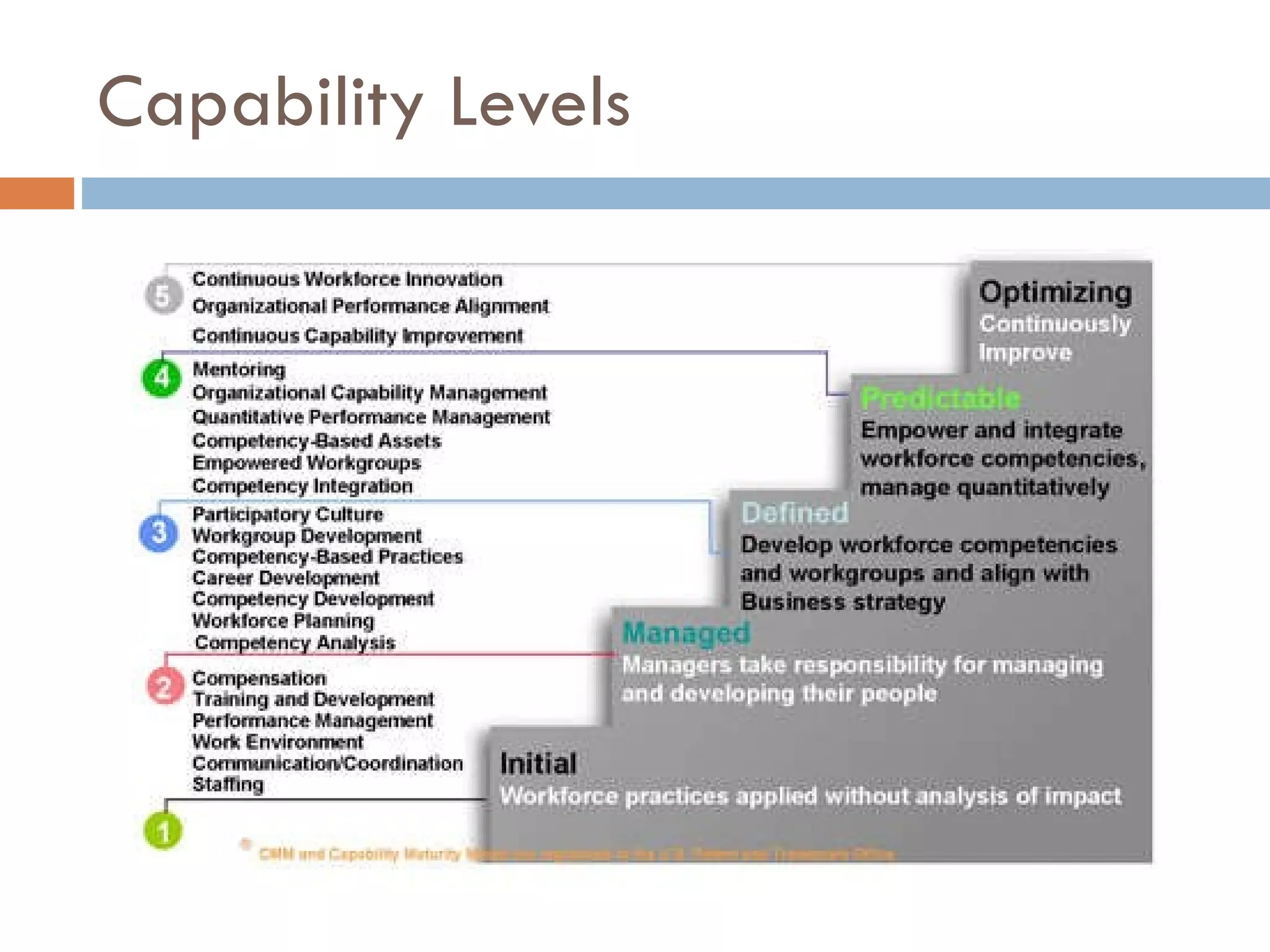
Two Types of Leveling Maturity Level; A maturity level is a well-defined evolutionary  framework   in order to achieve  a mature software  lifecycle  process . Capability Level;   A capability level is a well-defined evolutionary   stage describing the organization’s capability   relative to a process area
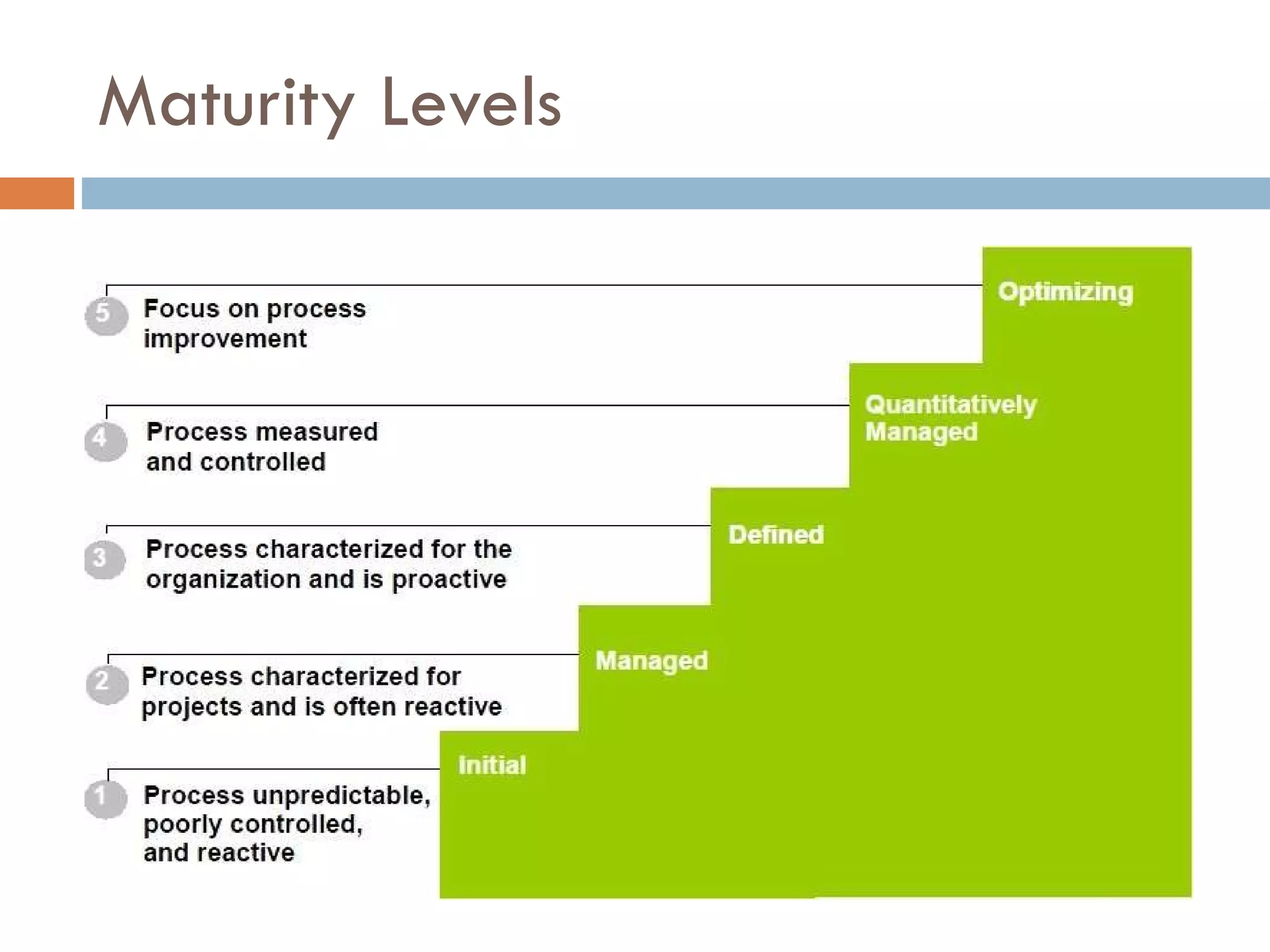
Maturity Levels
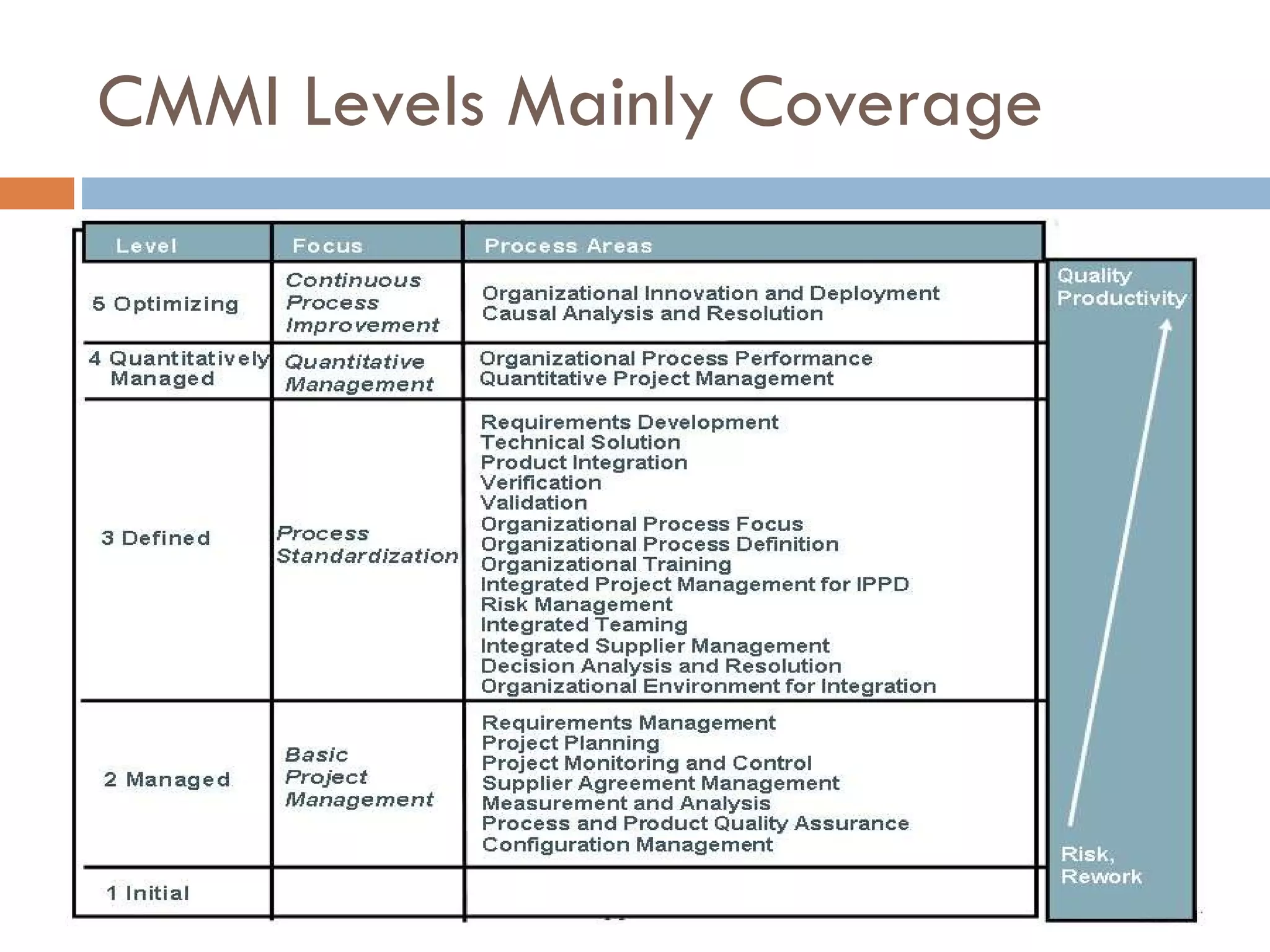
Maturity Levels Contd’ Organizations or compaines which are maturity level 1(CMMI Level 1) have poor managed processes and generally exceed the schedule and budget constraints. Highest level (CMMI Level 5) compaines have achieved the defined goals of the process aresas covered by lower levels.
Capability Levels
CMMI Levels Mainly Coverage
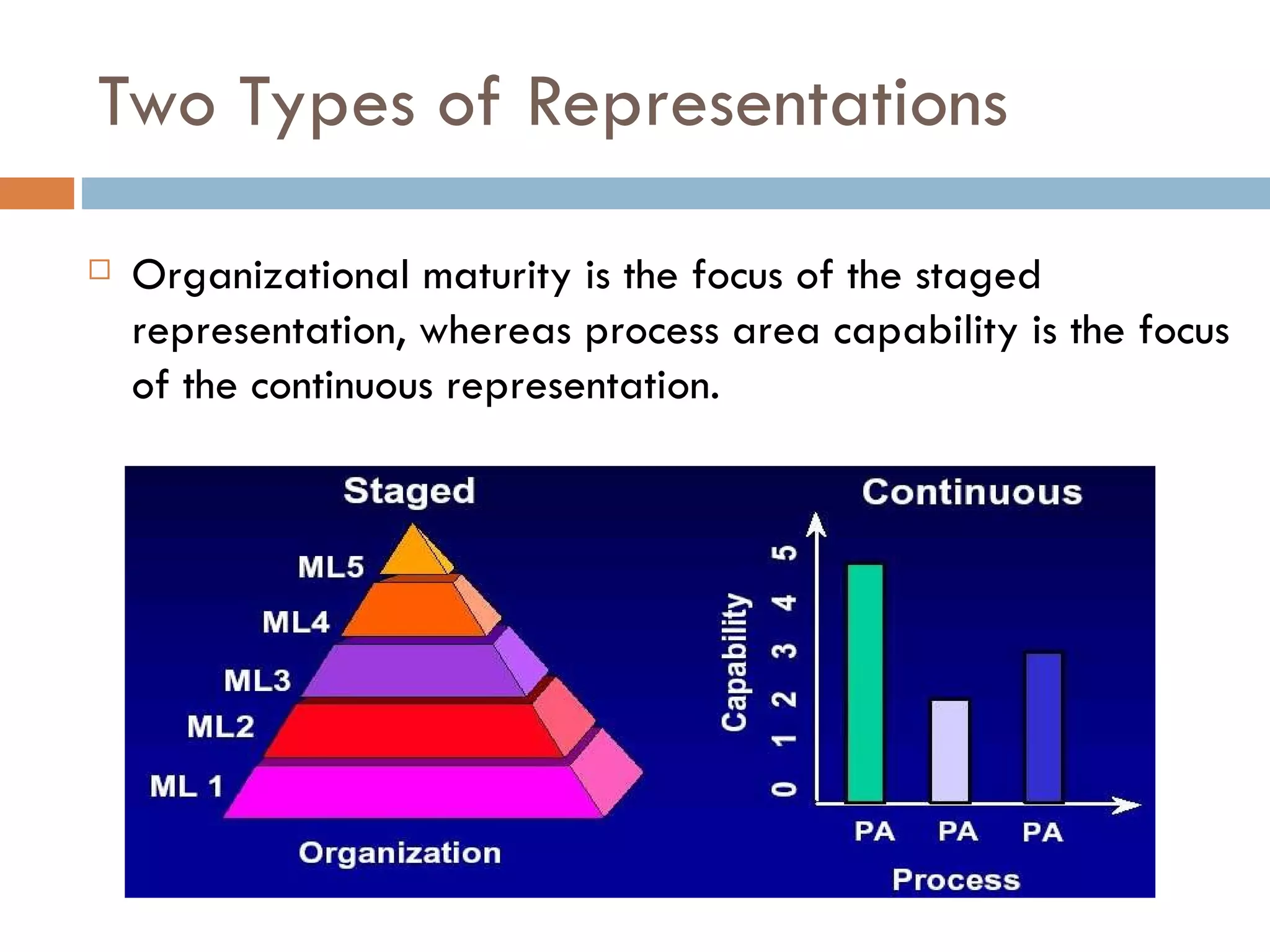
Two Types of Representations Organizational maturity is the focus of the staged representation, whereas process area capability is the focus of the continuous representation.
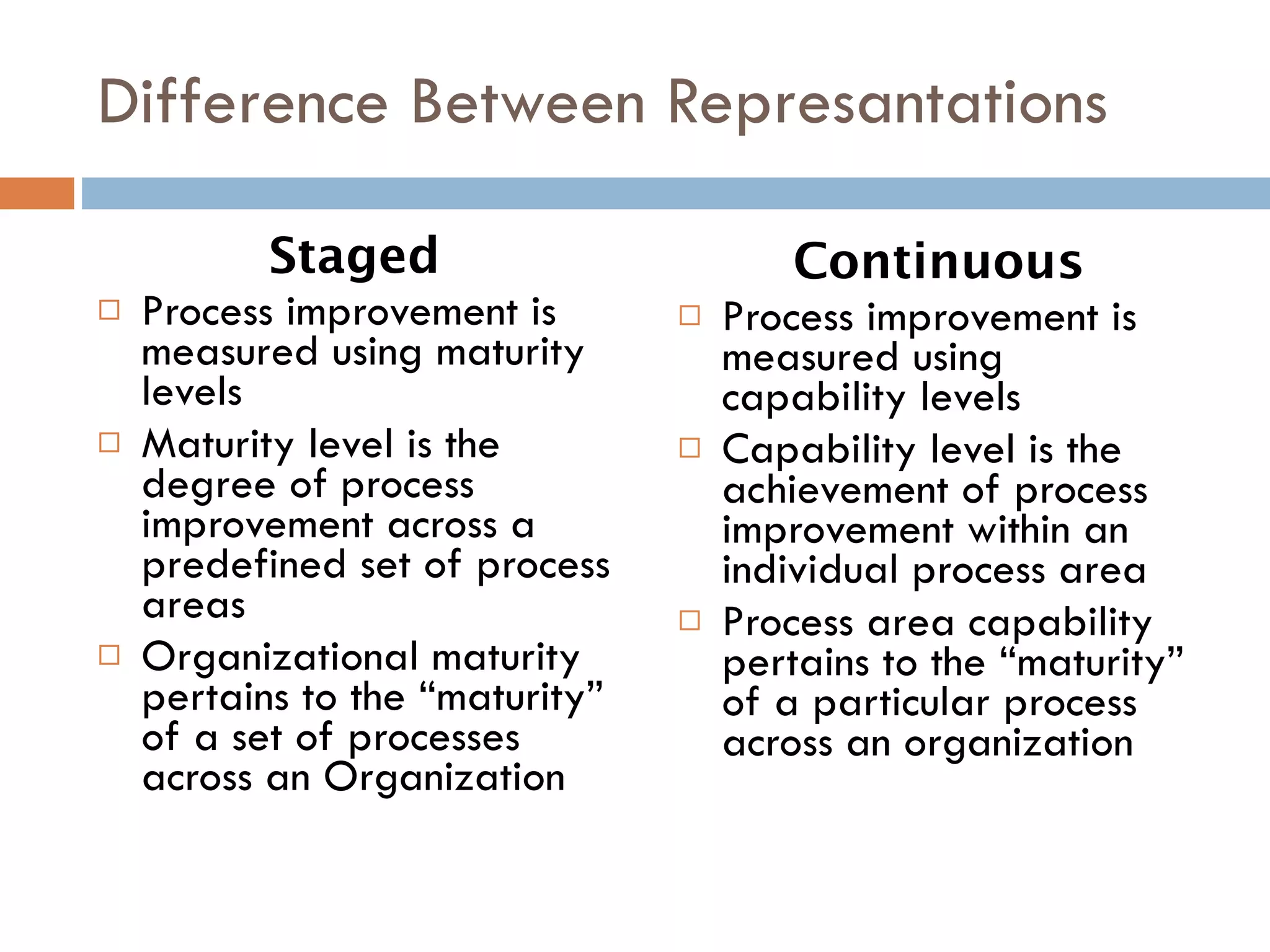
Difference Between Represantations Staged Process improvement is measured using maturity levels Maturity level is the degree of  process improvement across a  predefined set of process area s Organizational maturity  pertains to the “maturity” of a set  of processes across an Organization Continuous Process improvement is measured using capability levels Capability level is the achievement of process improvement within an individual process area Process area capability pertains  to the “maturity” of a particular  process across an organization
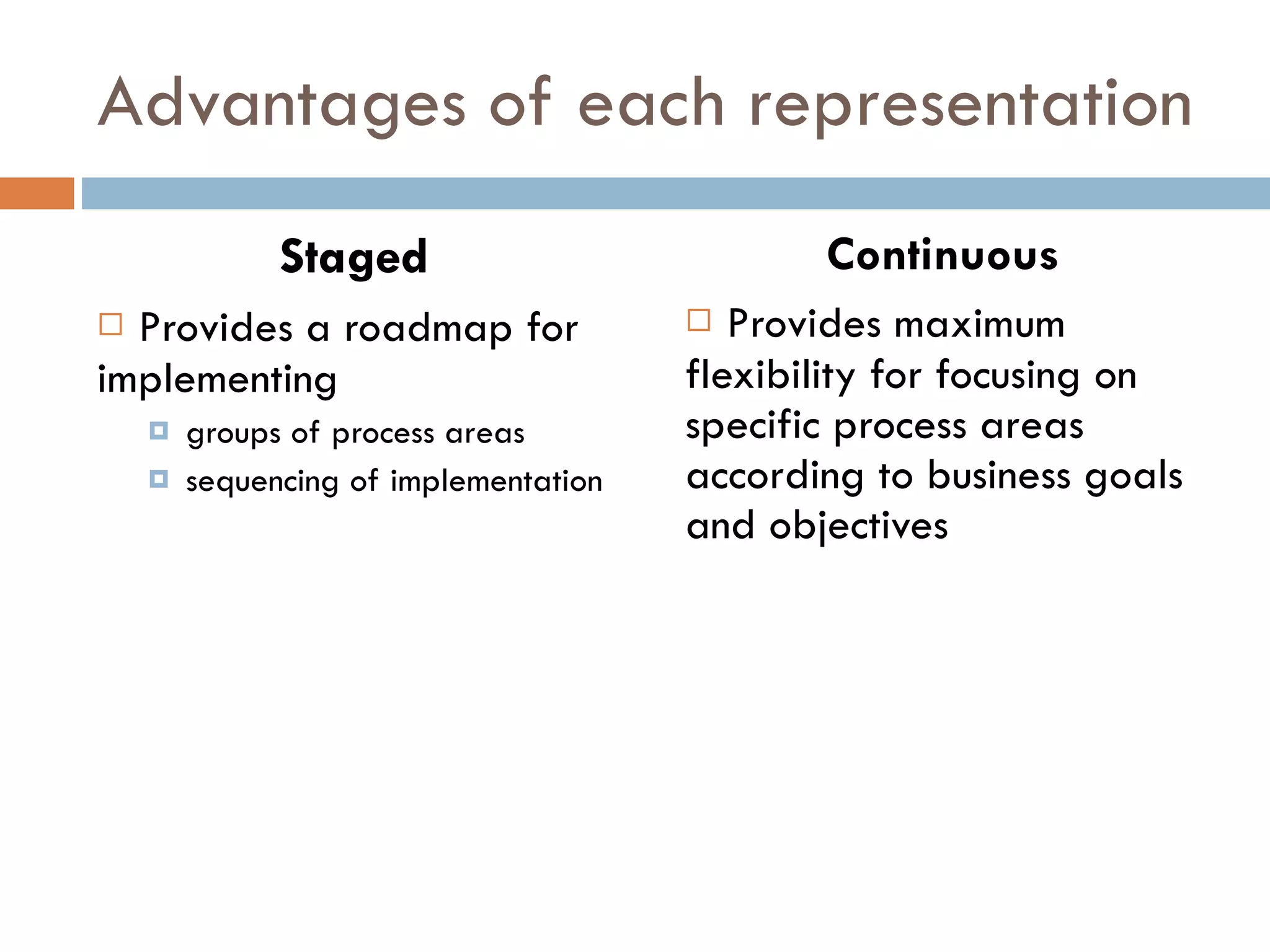
Advantages of each representation Staged Provides a roadmap for implementing groups of process areas sequencing of implementation Continuous Provides maximum flexibility for focusing on specific process areas according to business goals and objectives
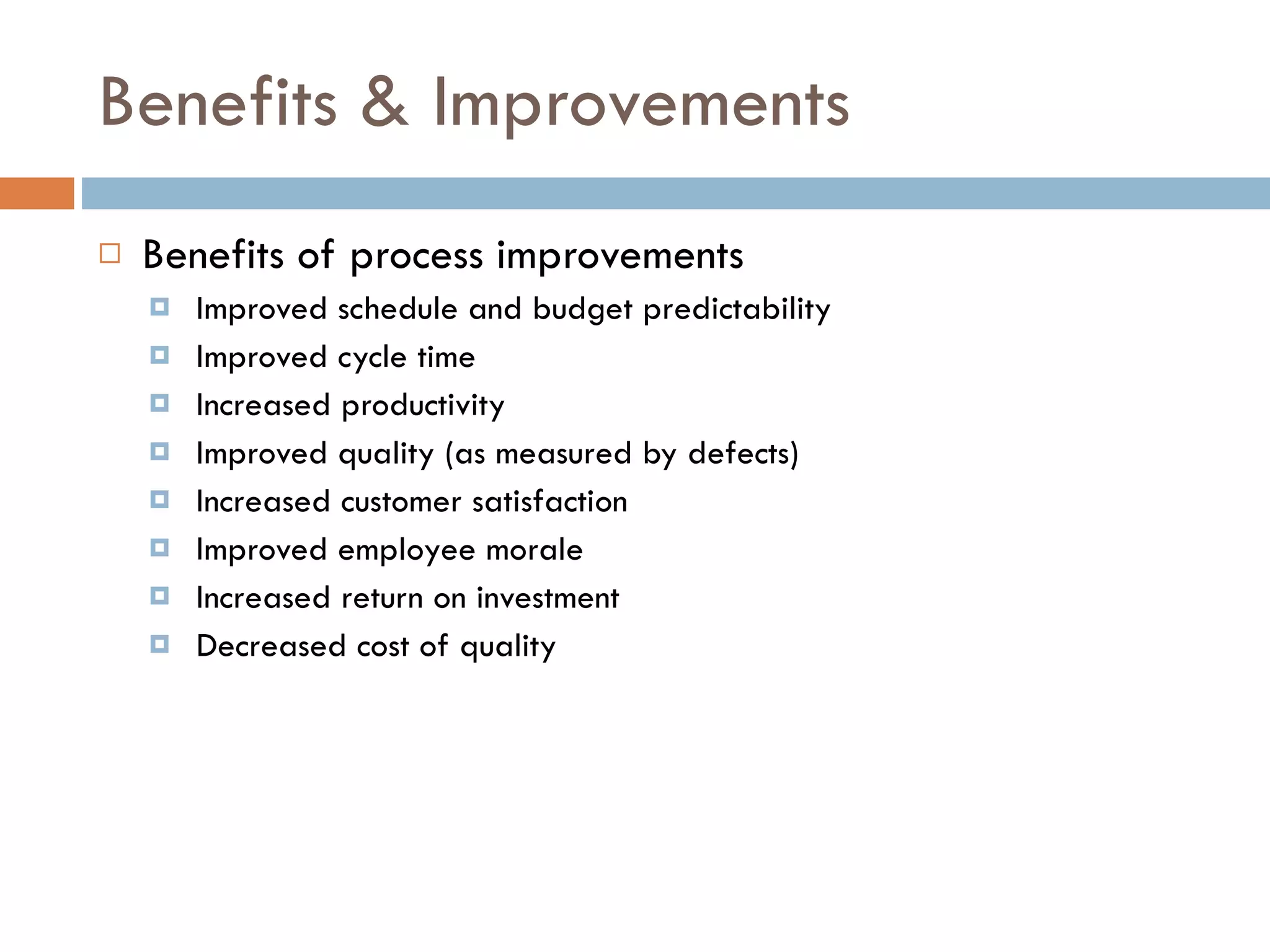
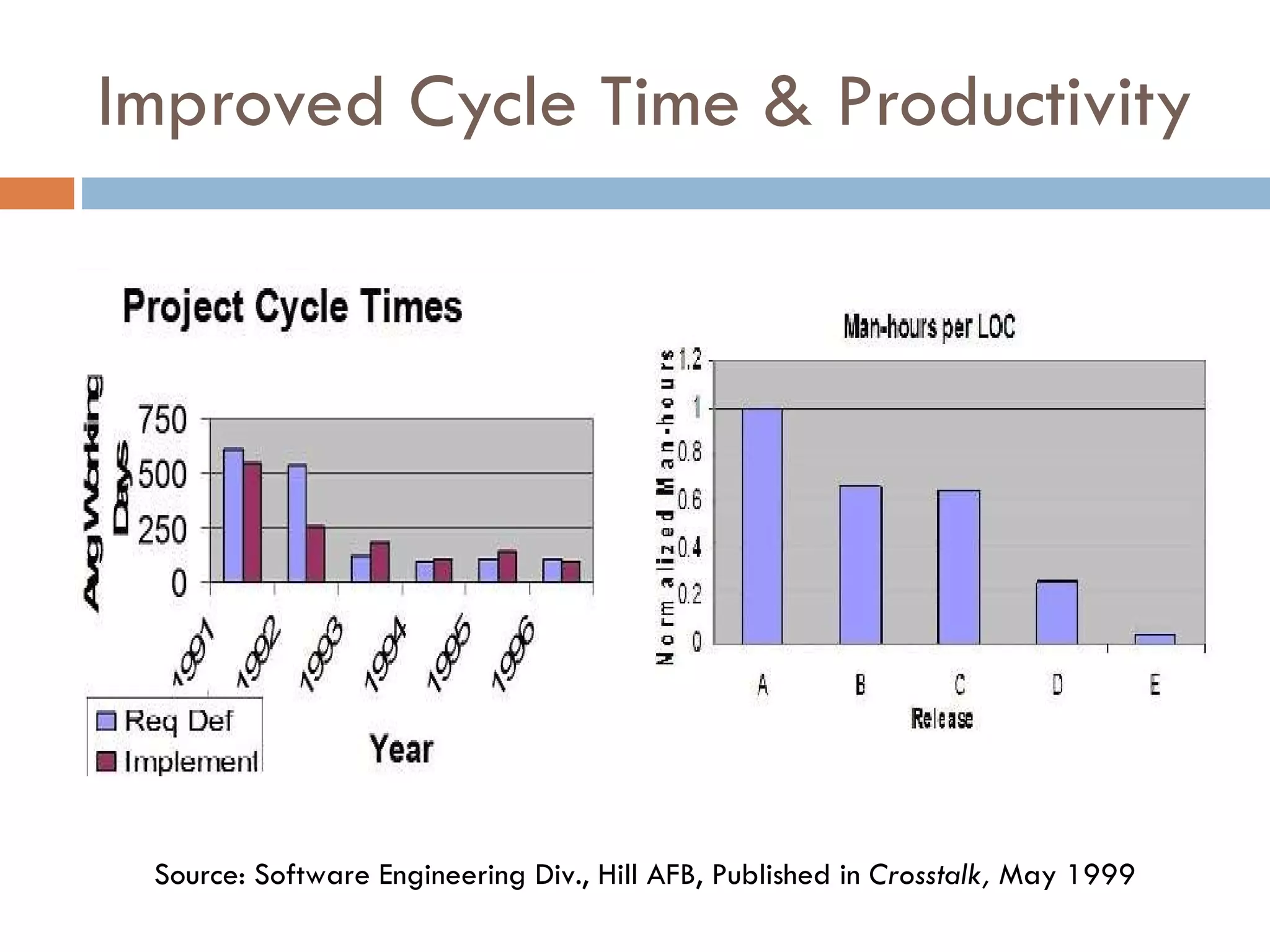
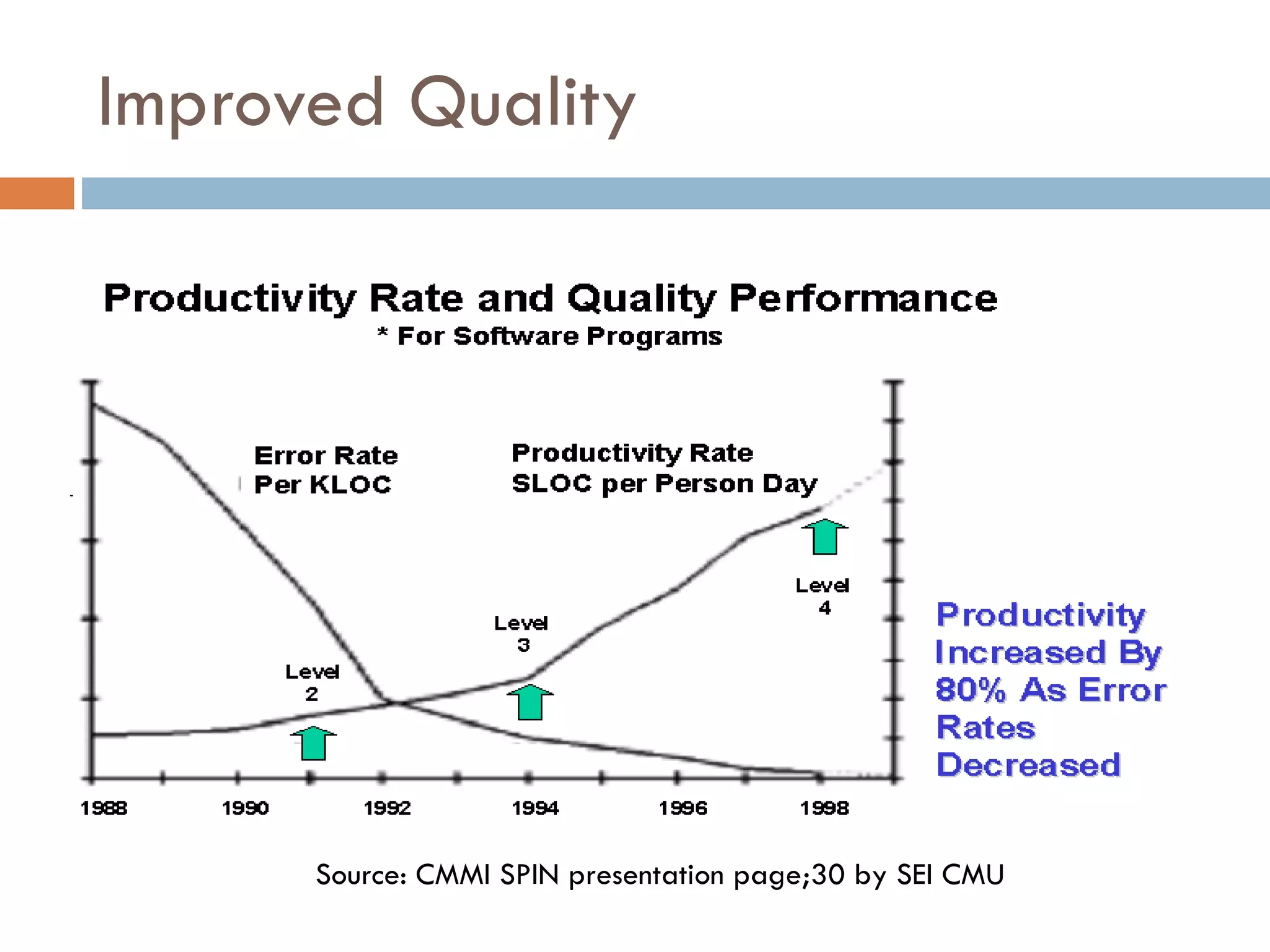
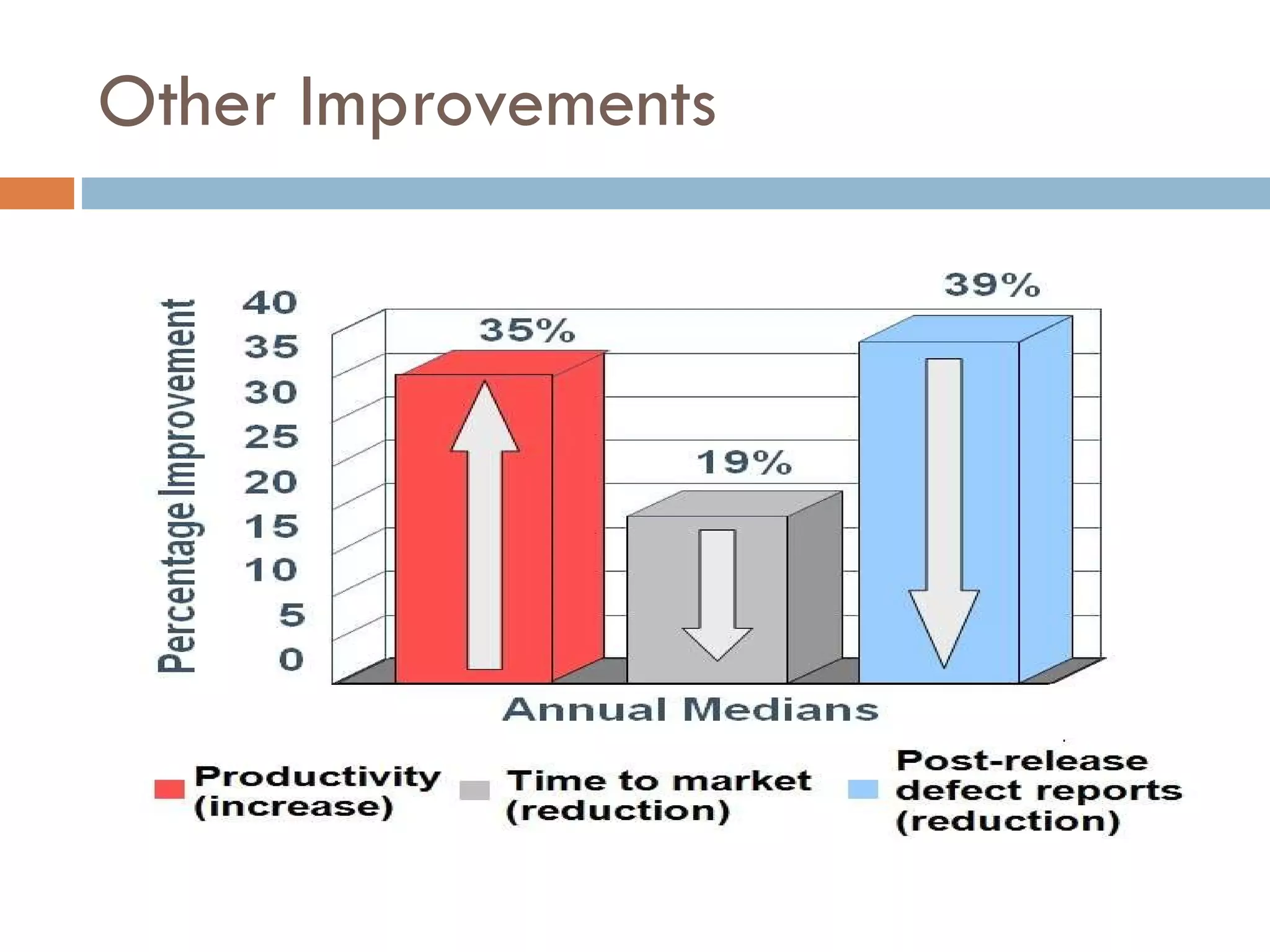
Benefits & Improvements Benefits of process improvements Improved schedule and budget predictability Improved cycle time Increased productivity Improved quality (as measured by defects) Increased customer satisfaction Improved employee morale Increased return on investment Decreased cost of quality
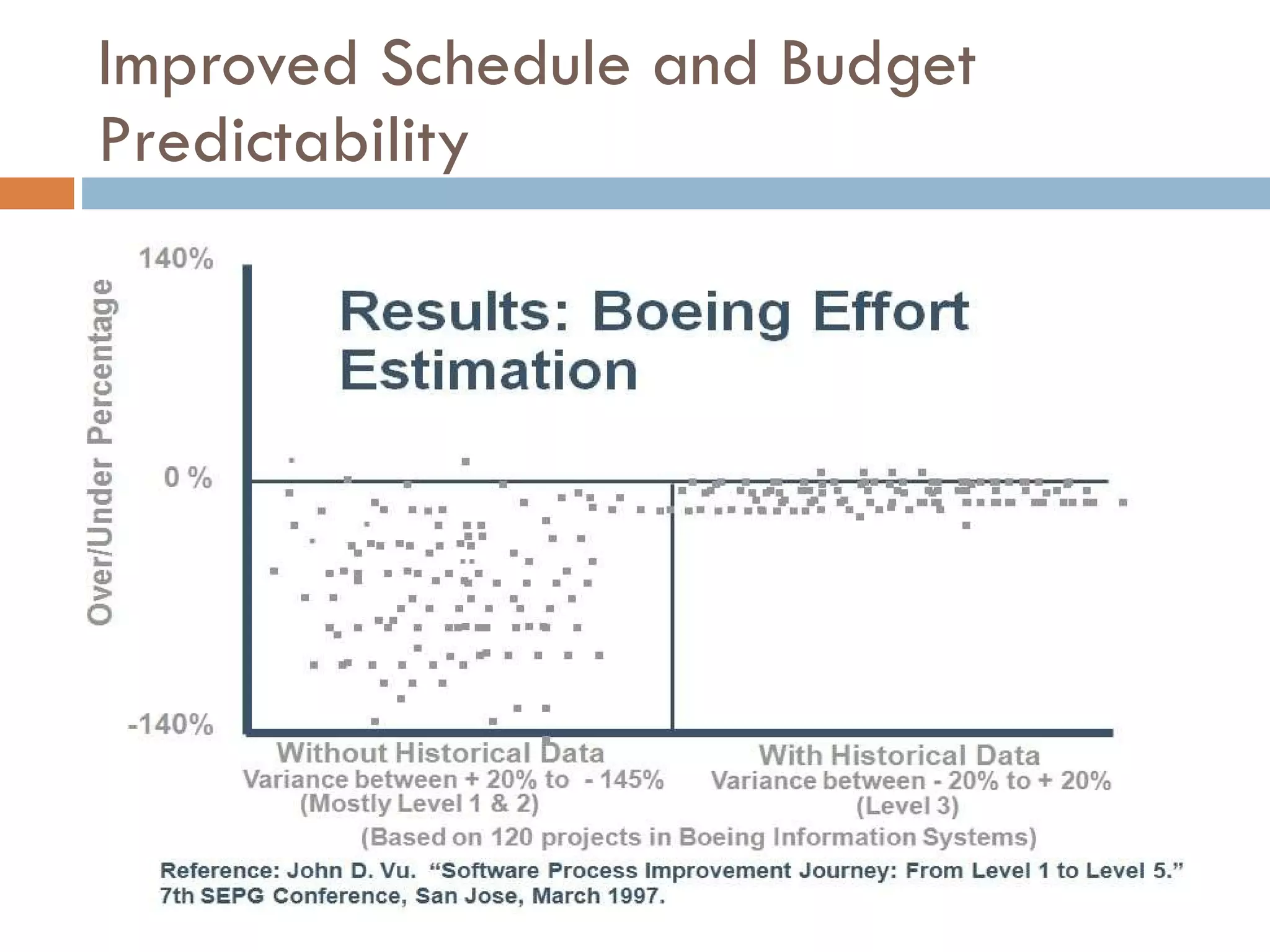
Improved  S chedule and  B udget  P redictability
Improved Cycle Time & Productivity Source: Software Engineering Div., Hill AFB, Published in  Crosstalk,  May 1999
Improved Quality Source:  CMMI SPIN presentation page;30 by SEI CMU
Other Improvements
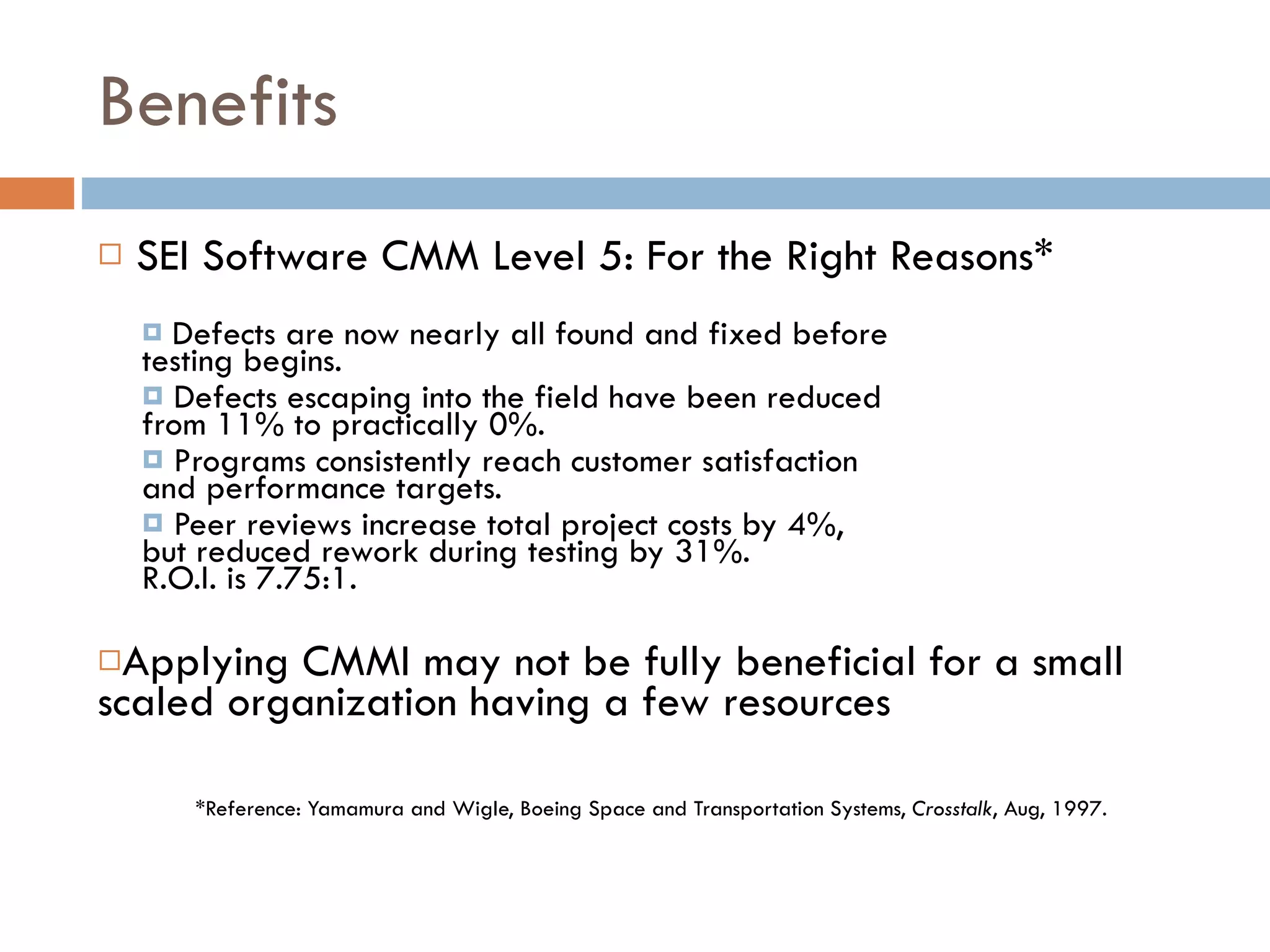
Benefits SEI Software CMM Level 5: For the Right Reasons* Defects are now nearly all found and fixed before testing begins. Defects escaping into the field have been reduced  from 11% to practically 0%. Programs consistently reach customer satisfaction  and performance targets. Peer reviews increase total project costs by 4%,  but reduced rework during testing by 31%.  R.O.I. is 7.75:1. Applying CMMI may not be fully beneficial for a small scaled organization having a few resources *Reference: Yamamura and Wigle, Boeing Space and Transportation Systems,  Crosstalk , Aug, 1997.
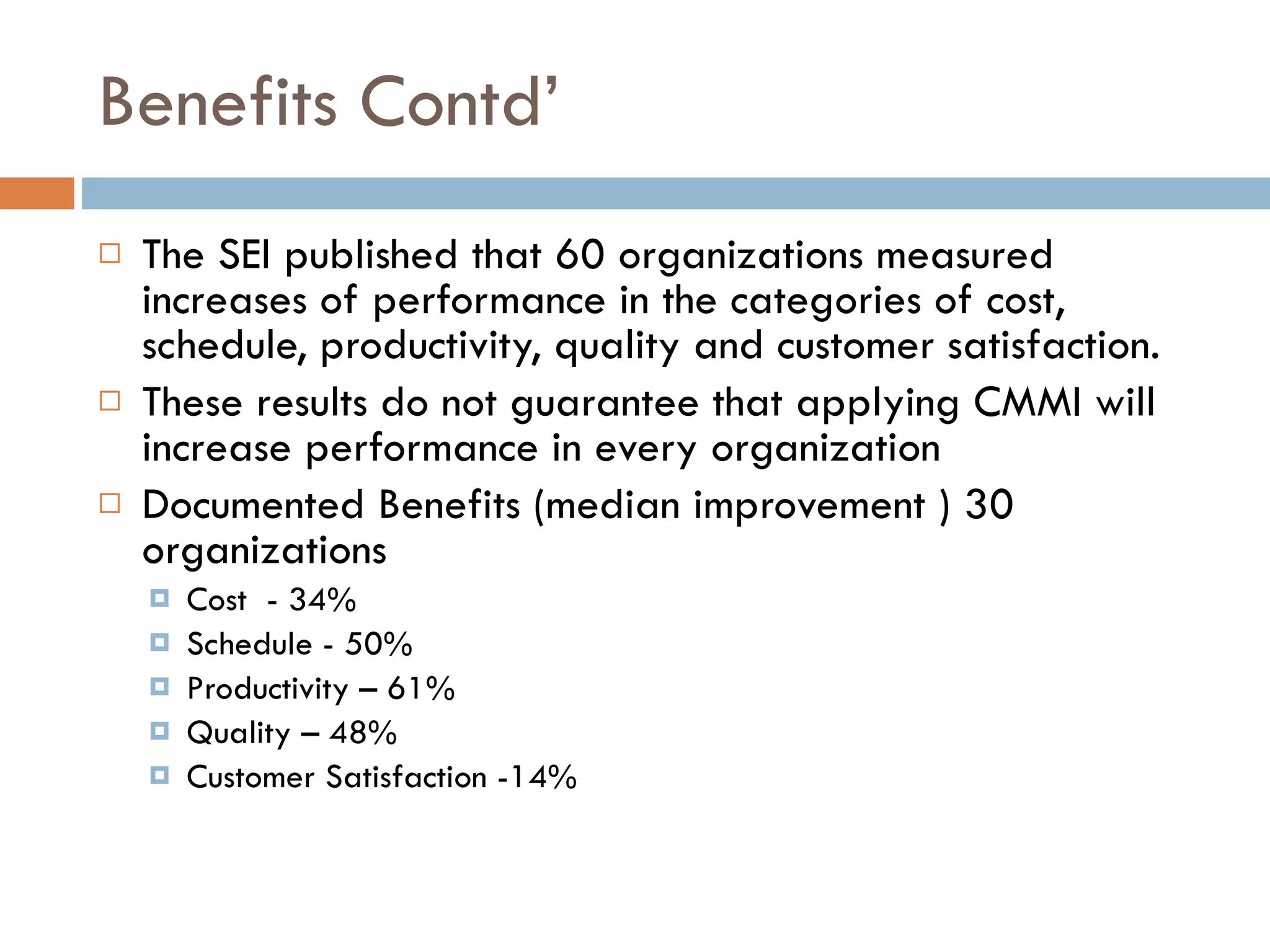
Benefits Contd’ The SEI published that 60 organizations   measured increases of performance in the   categories of cost, schedule, productivity,  quality and customer satisfaction. These results do not guarantee that   applying CMMI will increase performance  in every organization Documented Benefits (median improvement ) 30  o rganizations Cost  - 34% Schedule - 50% Productivity – 61% Quality – 48% Customer Satisfaction -14%
Conclusion CMMI provides Efficient, effective assessment and improvement across multiple process disciplines in an organization Improvements to best practices incorporated from the Software CMM A common, integrated vision of improvement for all elements of an organization A means of representing new discipline-specific information in a standard, proven process-improvement context
Referances CMMI FOR SMALL BUSINESS PILOT Project ,  SuZ Garcia, SEI Gene Miluk, SEI   Sandra L. Cepeda, SEI Visiting Scientist/CSSA   Mary Jo Staley, CSC ,  CMMI Technology Conference 2003 Capability Maturity Model® Integration (CMMI®) Overview , CMMI SPIN Presentation 2003 Capability Maturity Model Integration, Damla Demirtaş, March 2010 http://en.wikipedia.org/wiki/Capability_Maturity_Model_Integration http://www.sei.cmu.edu/reports/10tr033.pdf

Kivanc Kanturk Swe550 Fall2010 Capability Maturity Model Integration (Cmmi)

  • 1.
    CAPABİLİTY MATURİTY MODELİNTEGRATİON (CMMI) Kıvanç Kantürk SWE 550 Fall 2010
  • 2.
    Outline Introduction CMMITwo Types of Leveling Maturity Levels Capability Levels Representations Staged Representation Continuous Representation Benefits & Improvements Conclusion
  • 3.
    Introduction Thanks toglobalization, projects are more distributed today. Products getting more complex because of the developing technology. Today’s competitive market forces companies to produce Faster Better Cheaper Companies have to manage complex product development and maintenence.
  • 4.
    Intoduction Contd’ Someproducts developed requires both inhouse development and outsorcing. (Integration problem) Far out companies recognized that, they have to develop softwares in order to compete in the market. For example; Aerospace companies Car manifacturers Banks Those companies have to find a solution in order to manage that complex, generally integrated approach while developing products.
  • 5.
    CMMI Organized collectionsof best practices Based on work (TQM) by Crosby, Juran, Deming, Humphrey… Systematic ordered approach to process improvement. Means of measuring organizational maturity. This model shows what to do, NOT how to do it or who does it Have proven to bring significant return on investment in productivity and quality .
  • 6.
    CMMI Contd’ NDIA(National Defence Industrial Association), DoD (Department of Defence) are sponsored and collaborative work of SEI (Software Engineering Institute ), NDIA Systems Engineering Community and Government. I mprovement in any discipline , is a function of performing: Implementing practices that reflect the fundamentals of a particular topic ( For example: configuration management ) Institutionalizing practices that lead to sustainment and improvement of an implementation
  • 7.
    Two Types ofLeveling Maturity Level; A maturity level is a well-defined evolutionary framework in order to achieve a mature software lifecycle process . Capability Level; A capability level is a well-defined evolutionary stage describing the organization’s capability relative to a process area
  • 8.
  • 9.
    Maturity Levels Contd’Organizations or compaines which are maturity level 1(CMMI Level 1) have poor managed processes and generally exceed the schedule and budget constraints. Highest level (CMMI Level 5) compaines have achieved the defined goals of the process aresas covered by lower levels.
  • 10.
  • 11.
  • 12.
    Two Types ofRepresentations Organizational maturity is the focus of the staged representation, whereas process area capability is the focus of the continuous representation.
  • 13.
    Difference Between RepresantationsStaged Process improvement is measured using maturity levels Maturity level is the degree of process improvement across a predefined set of process area s Organizational maturity pertains to the “maturity” of a set of processes across an Organization Continuous Process improvement is measured using capability levels Capability level is the achievement of process improvement within an individual process area Process area capability pertains to the “maturity” of a particular process across an organization
  • 14.
    Advantages of eachrepresentation Staged Provides a roadmap for implementing groups of process areas sequencing of implementation Continuous Provides maximum flexibility for focusing on specific process areas according to business goals and objectives
  • 15.
    Benefits & ImprovementsBenefits of process improvements Improved schedule and budget predictability Improved cycle time Increased productivity Improved quality (as measured by defects) Increased customer satisfaction Improved employee morale Increased return on investment Decreased cost of quality
  • 16.
    Improved Schedule and B udget P redictability
  • 17.
    Improved Cycle Time& Productivity Source: Software Engineering Div., Hill AFB, Published in Crosstalk, May 1999
  • 18.
    Improved Quality Source: CMMI SPIN presentation page;30 by SEI CMU
  • 19.
  • 20.
    Benefits SEI SoftwareCMM Level 5: For the Right Reasons* Defects are now nearly all found and fixed before testing begins. Defects escaping into the field have been reduced from 11% to practically 0%. Programs consistently reach customer satisfaction and performance targets. Peer reviews increase total project costs by 4%, but reduced rework during testing by 31%. R.O.I. is 7.75:1. Applying CMMI may not be fully beneficial for a small scaled organization having a few resources *Reference: Yamamura and Wigle, Boeing Space and Transportation Systems, Crosstalk , Aug, 1997.
  • 21.
    Benefits Contd’ TheSEI published that 60 organizations measured increases of performance in the categories of cost, schedule, productivity, quality and customer satisfaction. These results do not guarantee that applying CMMI will increase performance in every organization Documented Benefits (median improvement ) 30 o rganizations Cost - 34% Schedule - 50% Productivity – 61% Quality – 48% Customer Satisfaction -14%
  • 22.
    Conclusion CMMI providesEfficient, effective assessment and improvement across multiple process disciplines in an organization Improvements to best practices incorporated from the Software CMM A common, integrated vision of improvement for all elements of an organization A means of representing new discipline-specific information in a standard, proven process-improvement context
  • 23.
    Referances CMMI FORSMALL BUSINESS PILOT Project , SuZ Garcia, SEI Gene Miluk, SEI Sandra L. Cepeda, SEI Visiting Scientist/CSSA Mary Jo Staley, CSC , CMMI Technology Conference 2003 Capability Maturity Model® Integration (CMMI®) Overview , CMMI SPIN Presentation 2003 Capability Maturity Model Integration, Damla Demirtaş, March 2010 http://en.wikipedia.org/wiki/Capability_Maturity_Model_Integration http://www.sei.cmu.edu/reports/10tr033.pdf